
FIFO Queues CSE 2320 Algorithms and Data Structures
- Slides: 6
FIFO Queues CSE 2320 – Algorithms and Data Structures Alexandra Stefan University of Texas at Arlington 9/5/2021 1
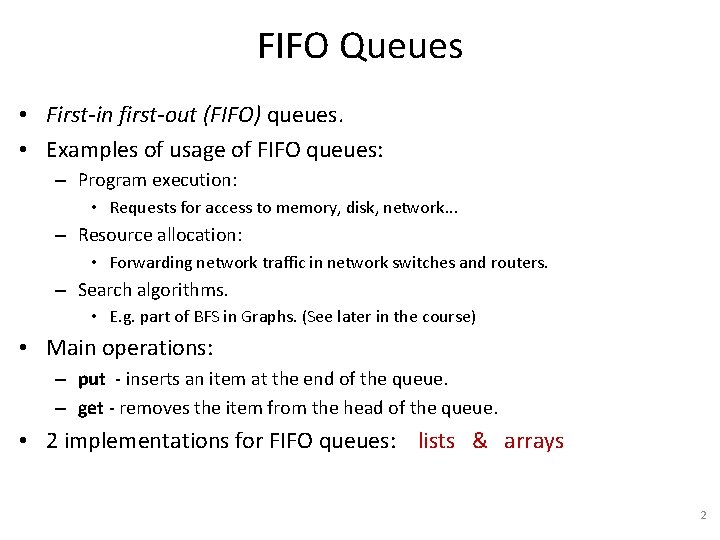
FIFO Queues • First-in first-out (FIFO) queues. • Examples of usage of FIFO queues: – Program execution: • Requests for access to memory, disk, network. . . – Resource allocation: • Forwarding network traffic in network switches and routers. – Search algorithms. • E. g. part of BFS in Graphs. (See later in the course) • Main operations: – put - inserts an item at the end of the queue. – get - removes the item from the head of the queue. • 2 implementations for FIFO queues: lists & arrays 2
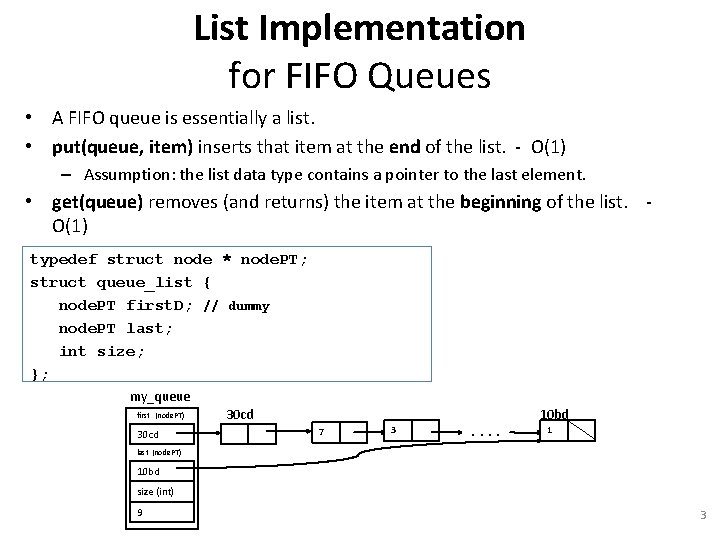
List Implementation for FIFO Queues • A FIFO queue is essentially a list. • put(queue, item) inserts that item at the end of the list. - O(1) – Assumption: the list data type contains a pointer to the last element. • get(queue) removes (and returns) the item at the beginning of the list. O(1) typedef struct node * node. PT; struct queue_list { node. PT first. D; // dummy node. PT last; int size; }; my_queue first (node. PT) 30 cd 10 bd 7 3 . . 1 last (node. PT) 10 bd size (int) 9 3
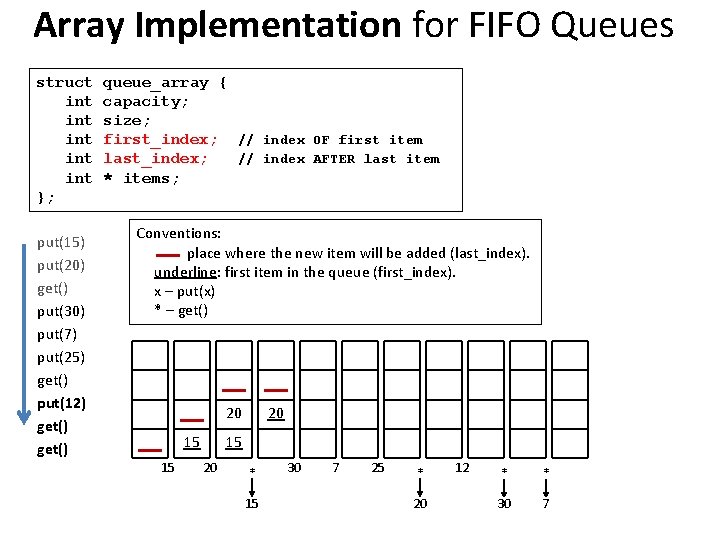
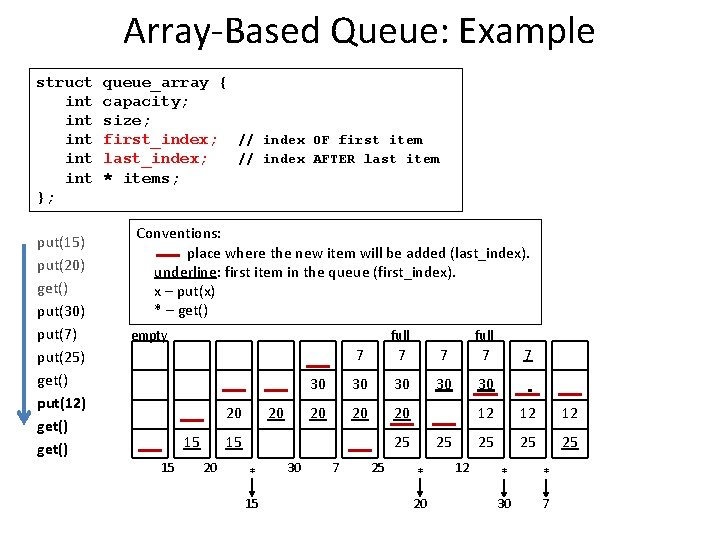
Array Implementation for FIFO Queues struct int int int }; put(15) put(20) get() put(30) put(7) put(25) get() put(12) get() queue_array { capacity; size; first_index; // index OF first item last_index; // index AFTER last item * items; Conventions: place where the new item will be added (last_index). underline: first item in the queue (first_index). x – put(x) * – get() 20 15 15 20 * 15 30 7 25 * 20 12 * * 30 7
Array-Based Queue: Example struct int int int }; put(15) put(20) get() put(30) put(7) put(25) get() put(12) get() queue_array { capacity; size; first_index; // index OF first item last_index; // index AFTER last item * items; Conventions: place where the new item will be added (last_index). underline: first item in the queue (first_index). x – put(x) * – get() empty full 20 15 15 20 7 7 30 30 30 20 20 20 15 20 full 25 * 15 30 7 25 25 * 20 12 7 12 12 12 25 25 25 * * 30 7
Issues with reallocation Assume that if the queue is full and a put operation is called you will NOT refuse the insertion, instead you will reallocate the array to make a bigger queue. (Assume the initial max_size is 10) Q 1. How do reallocate? a) +10 (an extra 10 spaces) b) *2 (double the space) Q 2. How do you reallocate memory and how do you “copy”? Consider these options: - (Realloc) or (malloc with memcopy) - Malloc with copy one by one (e. g. new. Arr[i] = old. Arr[i]) - Reinsert one by one Assume you allocate a queue of max size 10 at first. The user keeps inserting items until they put M items in the queue. (M can be a 1000000) For Q 1 a) and b) above answer: - how many reallocations are needed - Time complexity of all the reallocations and data copying to put all M items in 6