
Field Theory and Electroweak Standard Model Three Lectures
- Slides: 34
Field Theory and Electroweak Standard Model (Three Lectures) Faisal Akram 7 th School on LHC Physics, August 6 -17, 2018 NCP, Islamabad
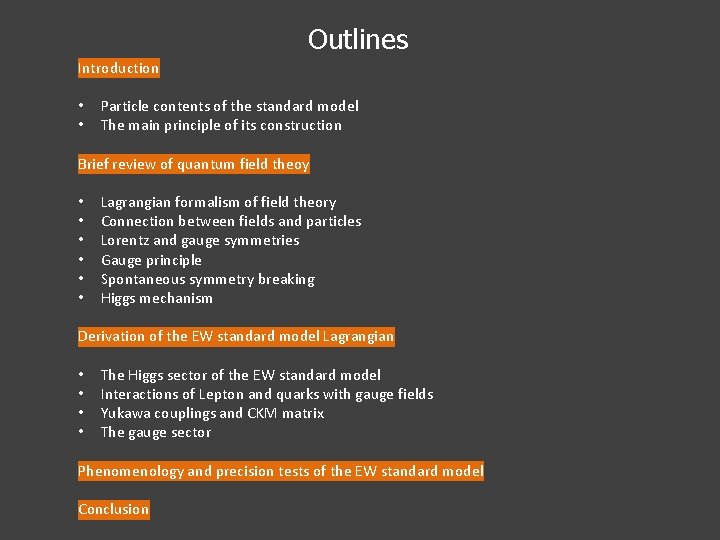
Outlines Introduction • • Particle contents of the standard model The main principle of its construction Brief review of quantum field theoy • • • Lagrangian formalism of field theory Connection between fields and particles Lorentz and gauge symmetries Gauge principle Spontaneous symmetry breaking Higgs mechanism Derivation of the EW standard model Lagrangian • • The Higgs sector of the EW standard model Interactions of Lepton and quarks with gauge fields Yukawa couplings and CKM matrix The gauge sector Phenomenology and precision tests of the EW standard model Conclusion
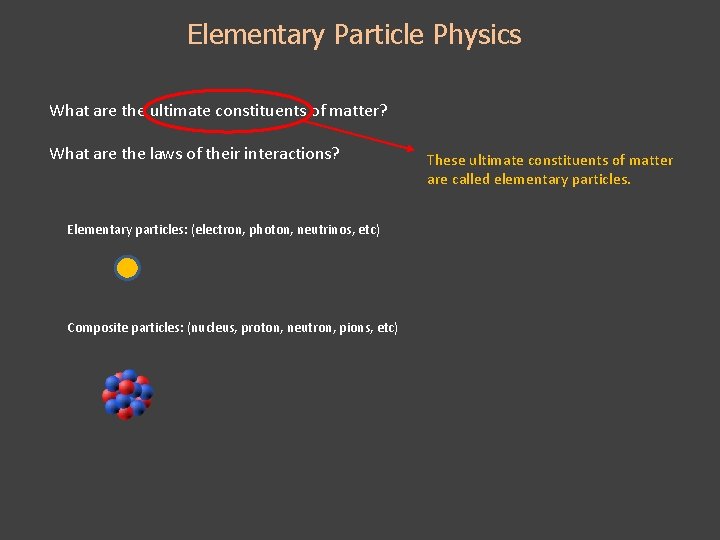
Elementary Particle Physics What are the ultimate constituents of matter? What are the laws of their interactions? Elementary particles: (electron, photon, neutrinos, etc) Composite particles: (nucleus, proton, neutron, pions, etc) These ultimate constituents of matter are called elementary particles.
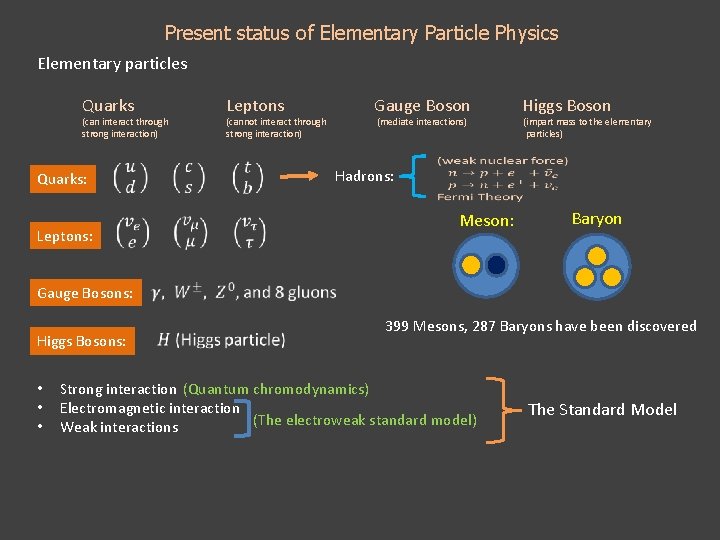
Present status of Elementary Particle Physics Elementary particles Quarks (can interact through strong interaction) Quarks: Leptons: Higgs Bosons: • • • (cannot interact through strong interaction) Gauge Boson (mediate interactions) Hadrons: Higgs Boson (impart mass to the elementary particles) Meson: Gauge Bosons: Leptons Baryon 399 Mesons, 287 Baryons have been discovered Strong interaction (Quantum chromodynamics) Electromagnetic interaction (The electroweak standard model) Weak interactions The Standard Model
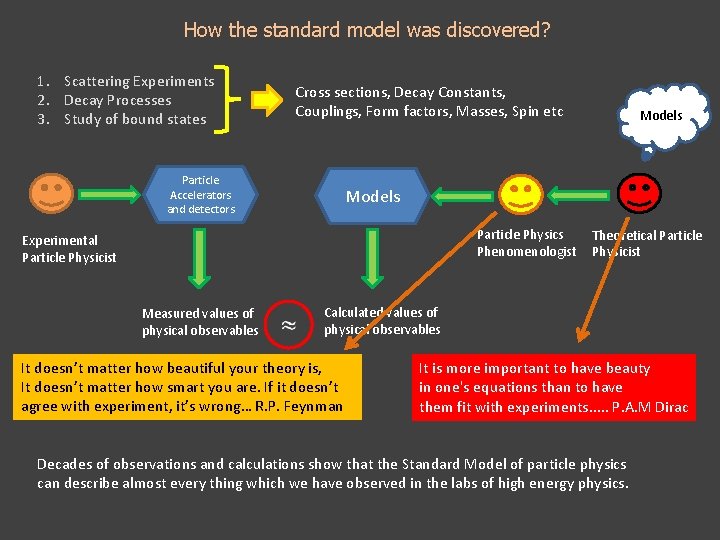
How the standard model was discovered? 1. Scattering Experiments 2. Decay Processes 3. Study of bound states Cross sections, Decay Constants, Couplings, Form factors, Masses, Spin etc Particle Accelerators and detectors Models Particle Physics Phenomenologist Experimental Particle Physicist Measured values of physical observables Models Theoretical Particle Physicist Calculated values of physical observables It doesn’t matter how beautiful your theory is, It doesn’t matter how smart you are. If it doesn’t agree with experiment, it’s wrong… R. P. Feynman It is more important to have beauty in one's equations than to have them fit with experiments. . . P. A. M Dirac Decades of observations and calculations show that the Standard Model of particle physics can describe almost every thing which we have observed in the labs of high energy physics.
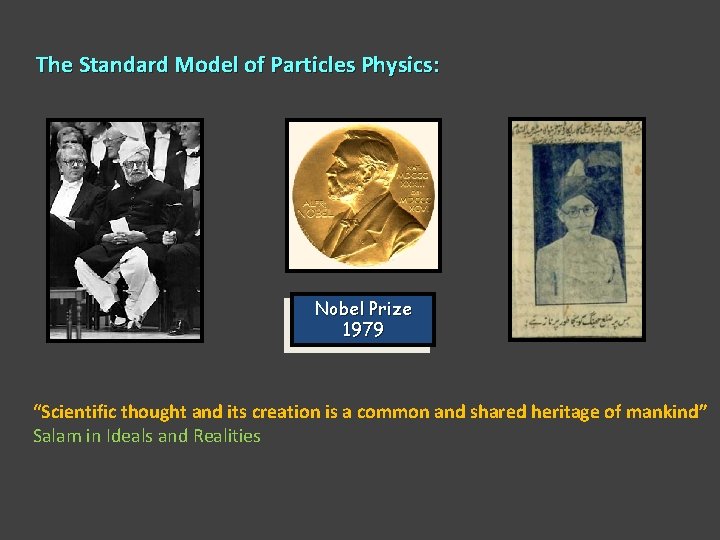
The Standard Model of Particles Physics: Nobel Prize 1979 “Scientific thought and its creation is a common and shared heritage of mankind” Salam in Ideals and Realities
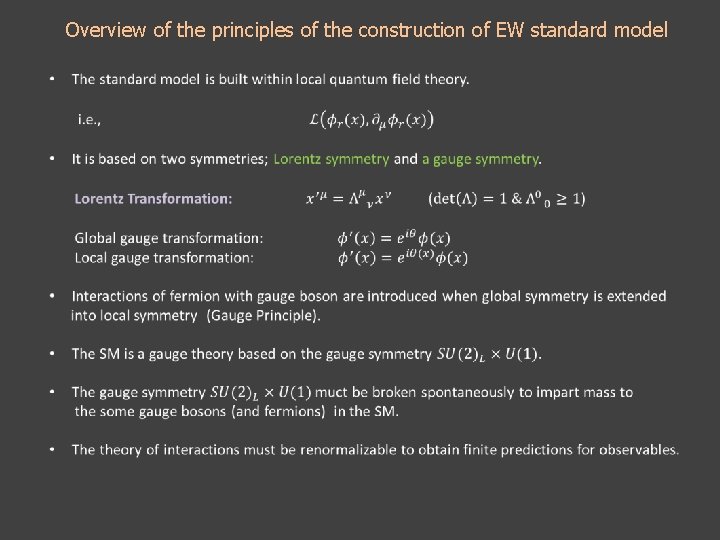
Overview of the principles of the construction of EW standard model
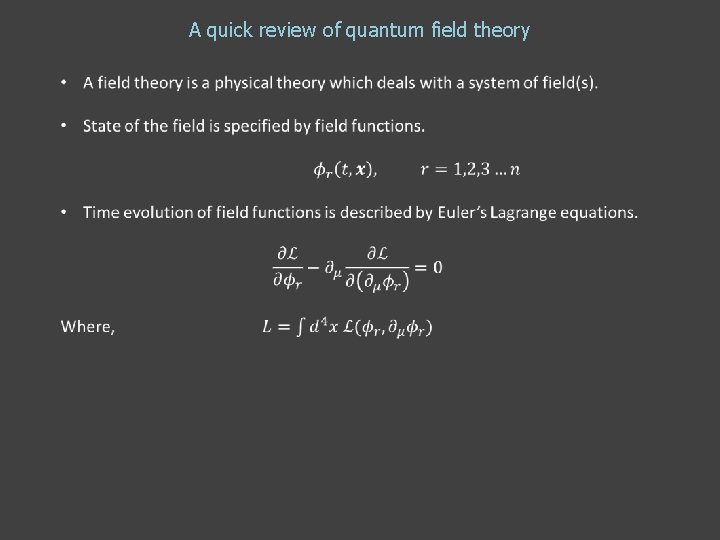
A quick review of quantum field theory
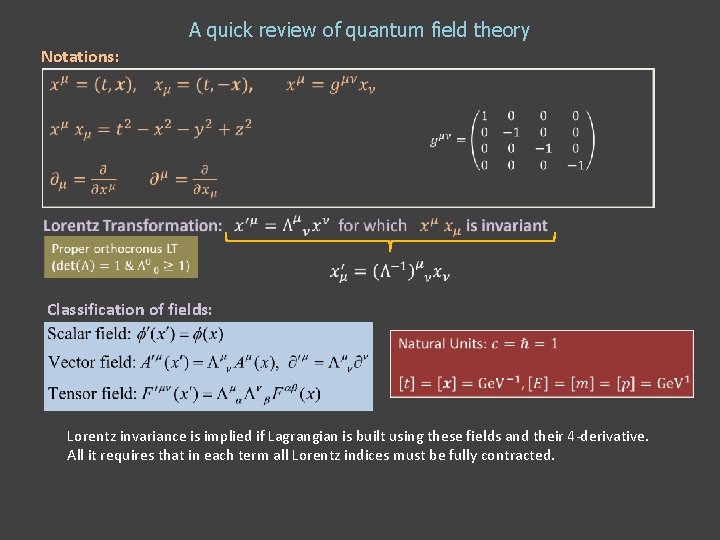
A quick review of quantum field theory Notations: Classification of fields: Lorentz invariance is implied if Lagrangian is built using these fields and their 4 -derivative. All it requires that in each term all Lorentz indices must be fully contracted.
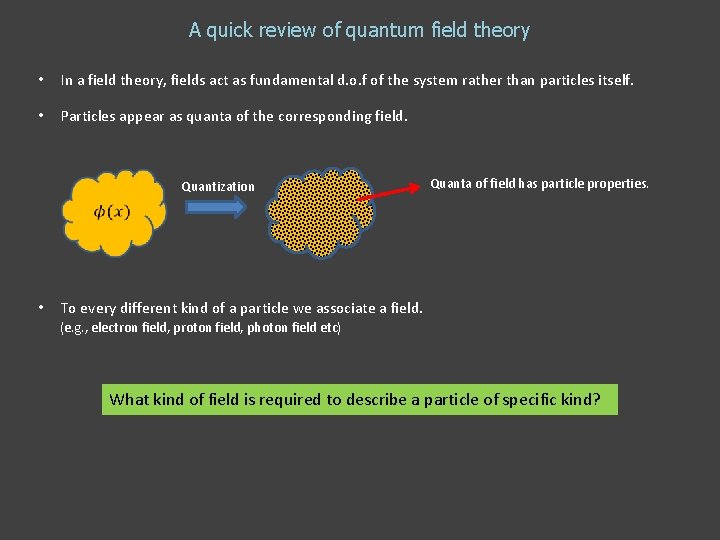
A quick review of quantum field theory • In a field theory, fields act as fundamental d. o. f of the system rather than particles itself. • Particles appear as quanta of the corresponding field. Quantization Quanta of field has particle properties. • To every different kind of a particle we associate a field. (e. g. , electron field, proton field, photon field etc) What kind of field is required to describe a particle of specific kind?
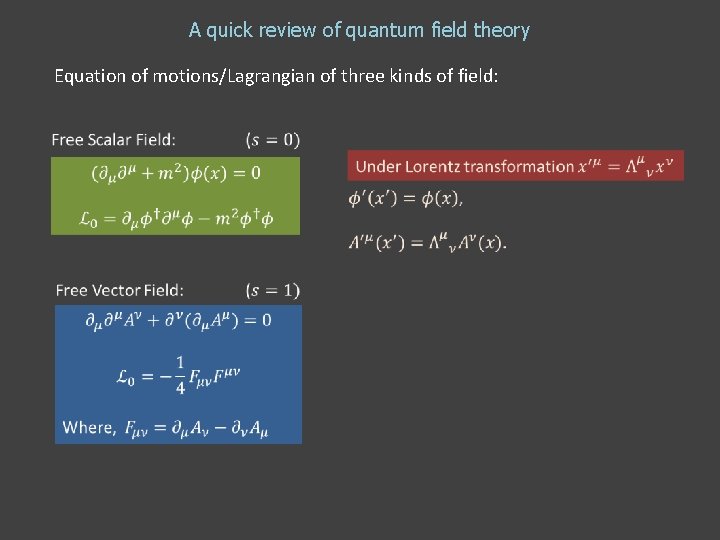
A quick review of quantum field theory Equation of motions/Lagrangian of three kinds of field:
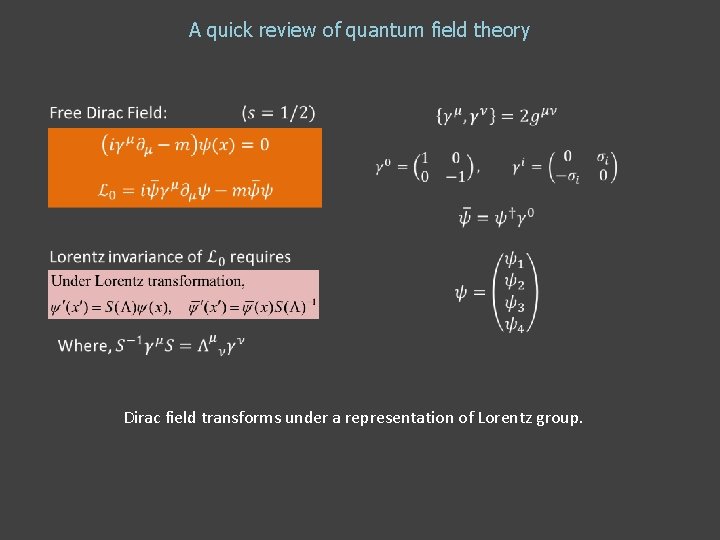
A quick review of quantum field theory Dirac field transforms under a representation of Lorentz group.
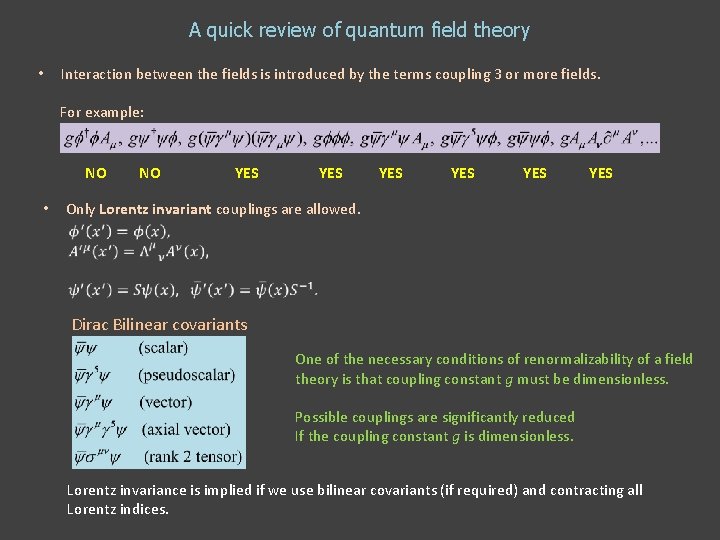
A quick review of quantum field theory • Interaction between the fields is introduced by the terms coupling 3 or more fields. For example: NO • NO YES YES YES Only Lorentz invariant couplings are allowed. Dirac Bilinear covariants One of the necessary conditions of renormalizability of a field theory is that coupling constant g must be dimensionless. Possible couplings are significantly reduced If the coupling constant g is dimensionless. Lorentz invariance is implied if we use bilinear covariants (if required) and contracting all Lorentz indices.
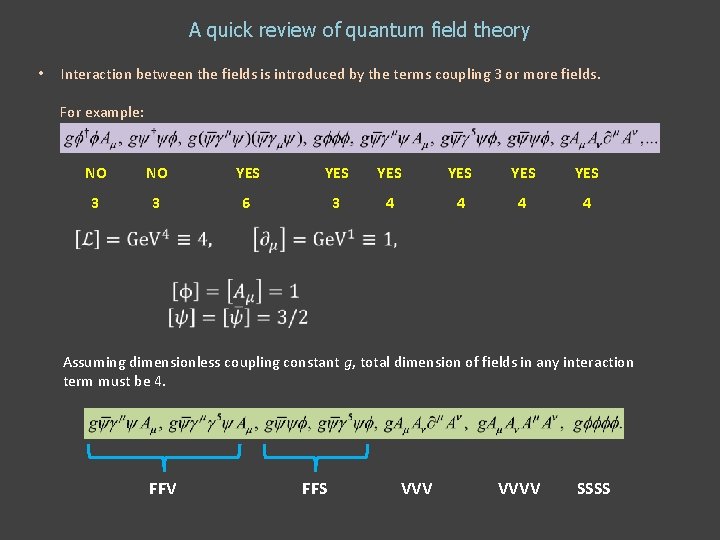
A quick review of quantum field theory • Interaction between the fields is introduced by the terms coupling 3 or more fields. For example: NO NO YES YES YES 3 3 6 3 4 4 Assuming dimensionless coupling constant g, total dimension of fields in any interaction term must be 4. FFV FFS VVVV SSSS
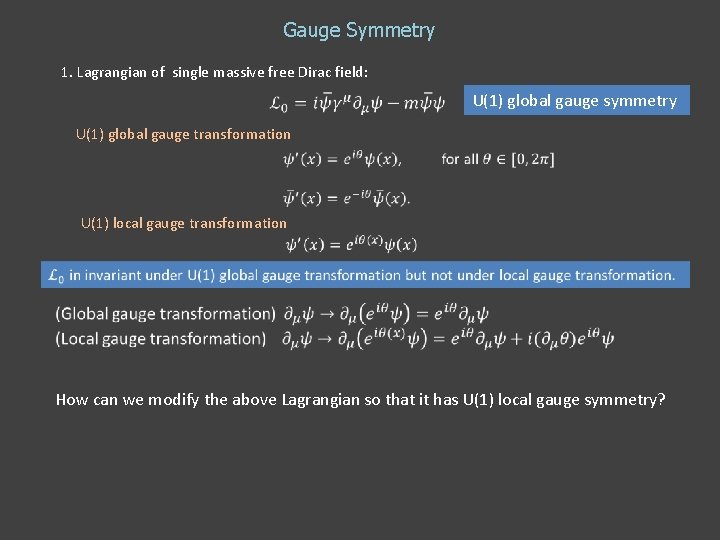
Gauge Symmetry 1. Lagrangian of single massive free Dirac field: U(1) global gauge symmetry U(1) global gauge transformation U(1) local gauge transformation How can we modify the above Lagrangian so that it has U(1) local gauge symmetry?
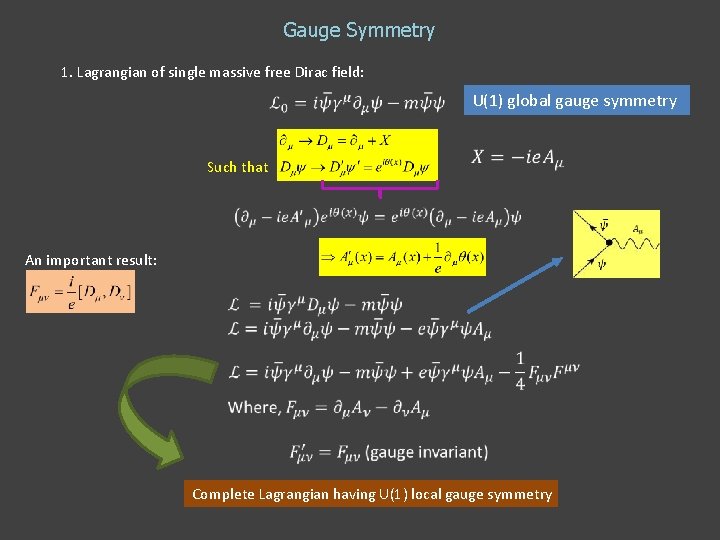
Gauge Symmetry 1. Lagrangian of single massive free Dirac field: Such that U(1) global gauge symmetry An important result: Complete Lagrangian having U(1) local gauge symmetry
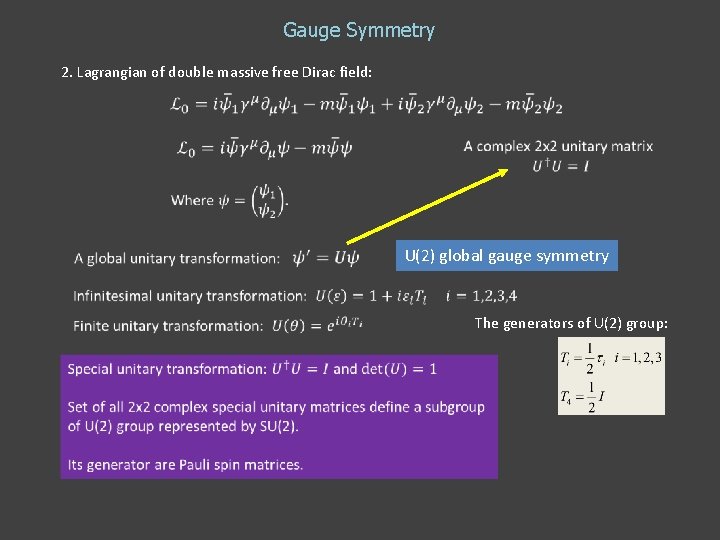
Gauge Symmetry 2. Lagrangian of double massive free Dirac field: U(2) global gauge symmetry The generators of U(2) group:
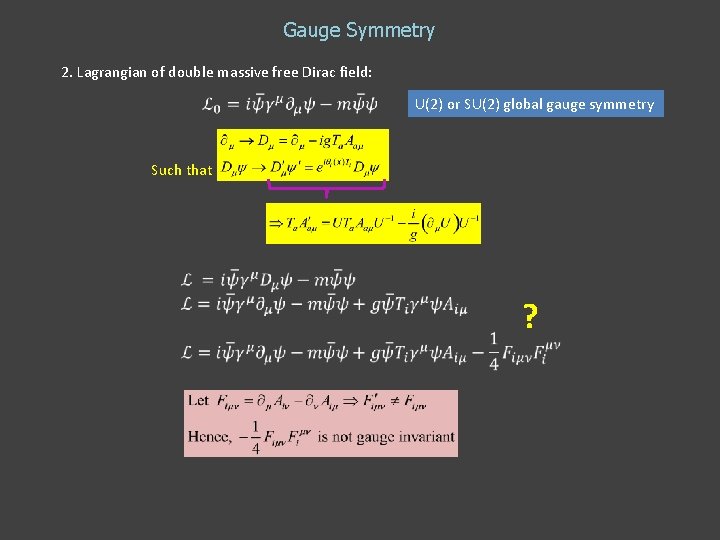
Gauge Symmetry 2. Lagrangian of double massive free Dirac field: U(2) or SU(2) global gauge symmetry Such that ?
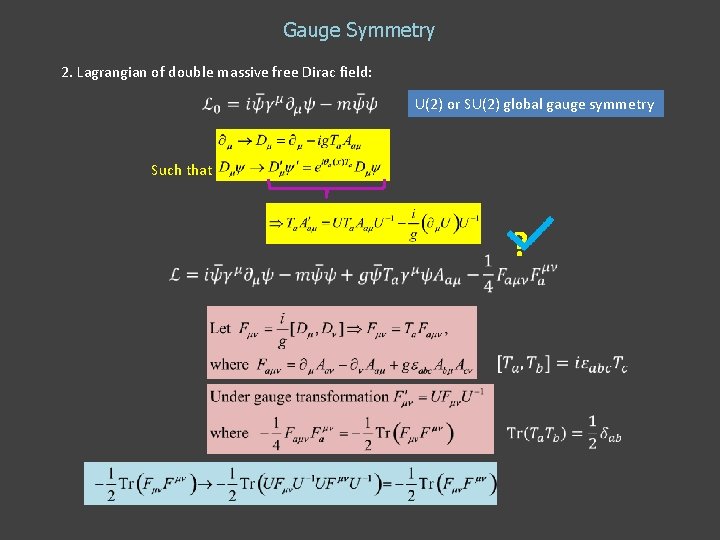
Gauge Symmetry 2. Lagrangian of double massive free Dirac field: U(2) or SU(2) global gauge symmetry Such that ?
Field Theory and the Electroweak Standard Model (Lecture 2) Faisal Akram 7 th School on LHC Physics, 6 -18 August 2018 NCP, Islamabad.
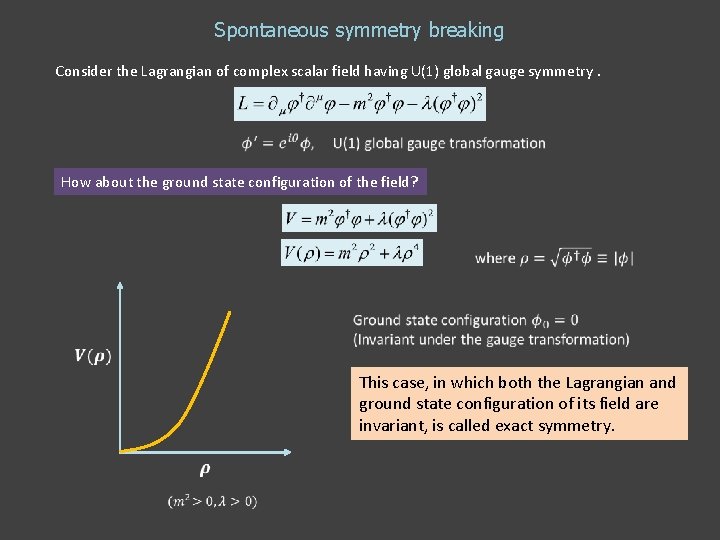
Spontaneous symmetry breaking Consider the Lagrangian of complex scalar field having U(1) global gauge symmetry. How about the ground state configuration of the field? This case, in which both the Lagrangian and ground state configuration of its field are invariant, is called exact symmetry.
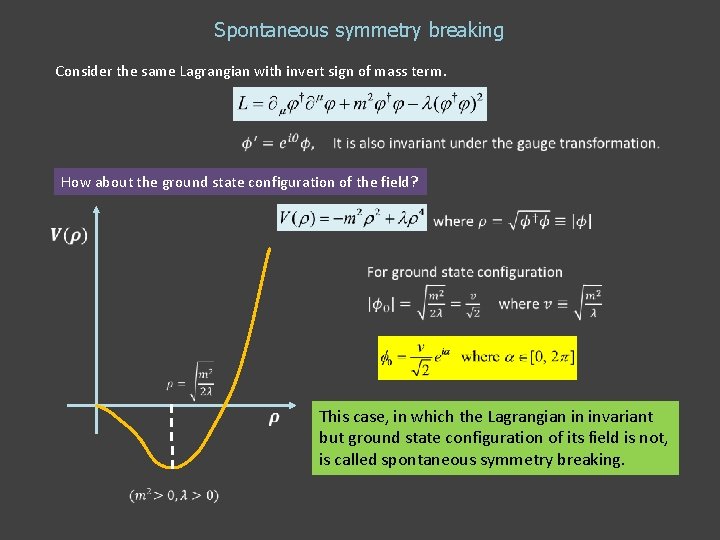
Spontaneous symmetry breaking Consider the same Lagrangian with invert sign of mass term. How about the ground state configuration of the field? This case, in which the Lagrangian in invariant but ground state configuration of its field is not, is called spontaneous symmetry breaking.
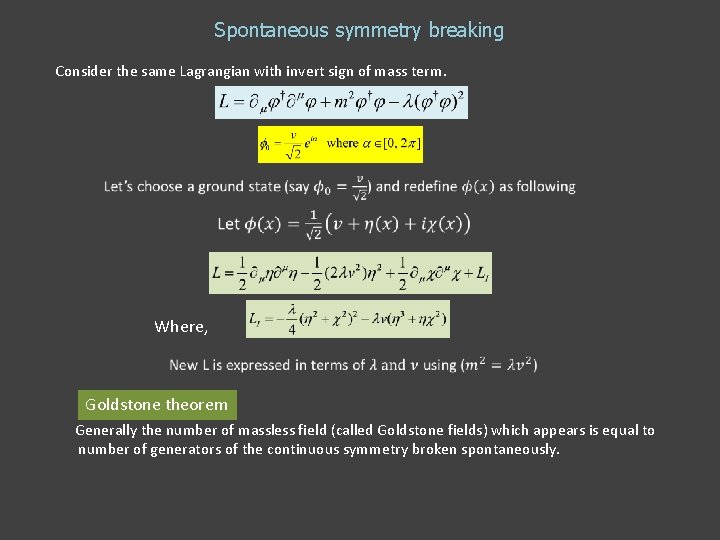
Spontaneous symmetry breaking Consider the same Lagrangian with invert sign of mass term. Where, Goldstone theorem Generally the number of massless field (called Goldstone fields) which appears is equal to number of generators of the continuous symmetry broken spontaneously.
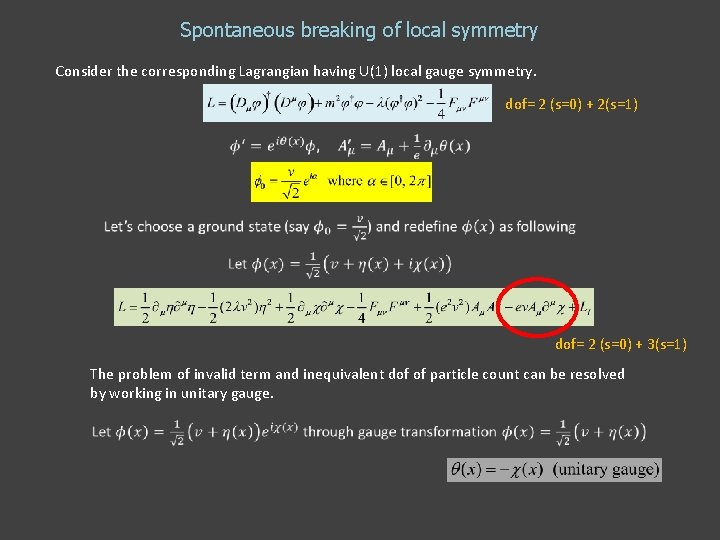
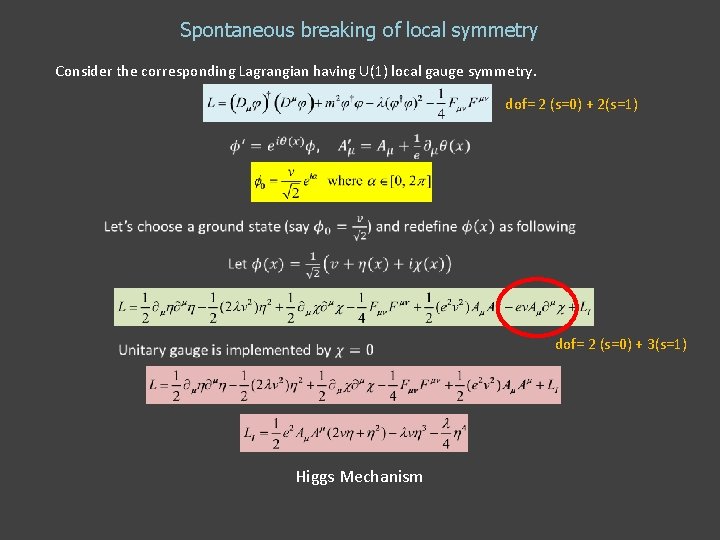
Spontaneous breaking of local symmetry Consider the corresponding Lagrangian having U(1) local gauge symmetry. dof= 2 (s=0) + 2(s=1) dof= 2 (s=0) + 3(s=1) The problem of invalid term and inequivalent dof of particle count can be resolved by working in unitary gauge.
Spontaneous breaking of local symmetry Consider the corresponding Lagrangian having U(1) local gauge symmetry. dof= 2 (s=0) + 2(s=1) dof= 2 (s=0) + 3(s=1) Higgs Mechanism
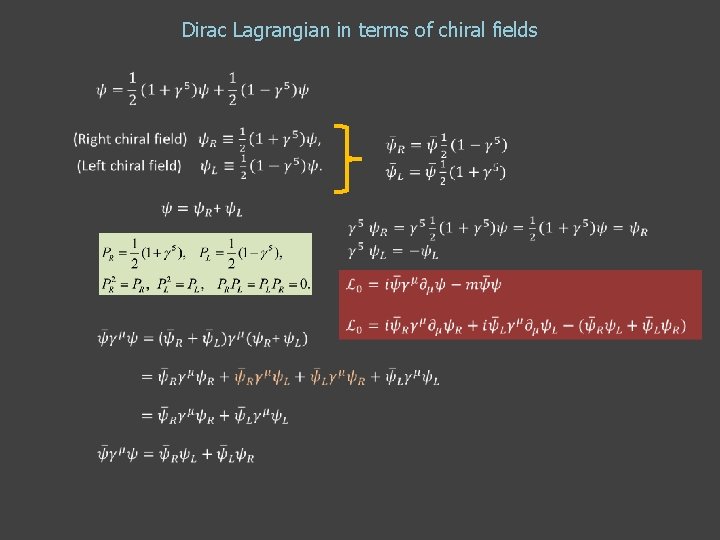
Dirac Lagrangian in terms of chiral fields
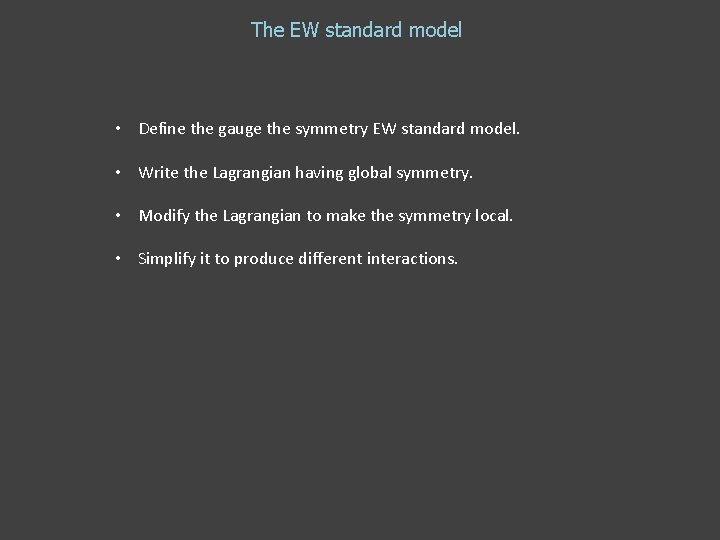
The EW standard model • Define the gauge the symmetry EW standard model. • Write the Lagrangian having global symmetry. • Modify the Lagrangian to make the symmetry local. • Simplify it to produce different interactions.
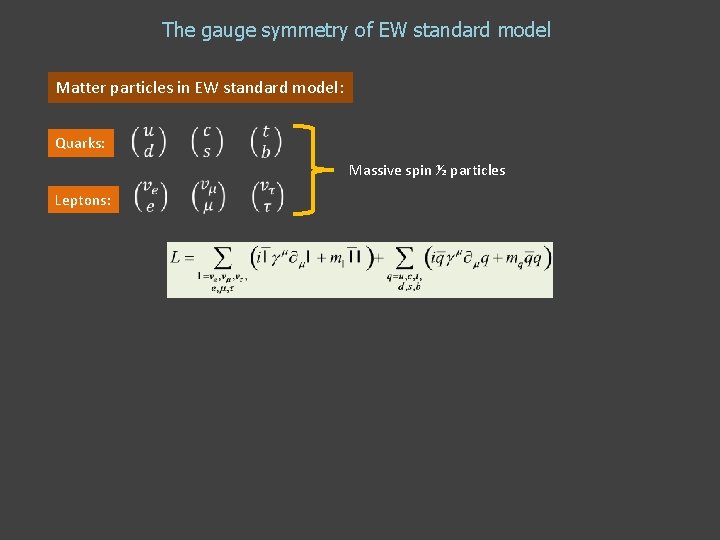
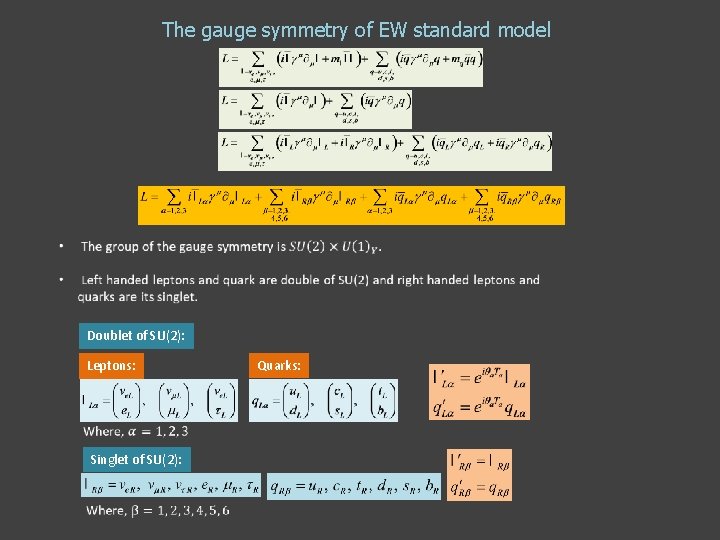
The gauge symmetry of EW standard model Matter particles in EW standard model: Quarks: Leptons: Massive spin ½ particles
The gauge symmetry of EW standard model Doublet of SU(2): Leptons: Singlet of SU(2): Quarks:
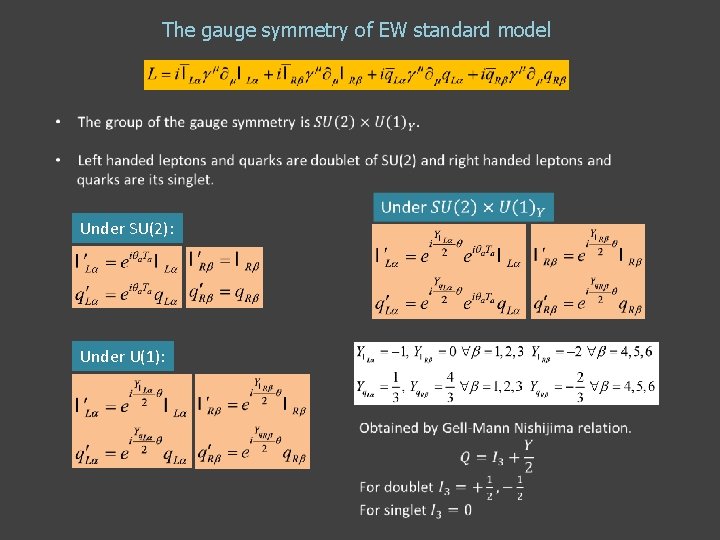
The gauge symmetry of EW standard model Under SU(2): Under U(1):
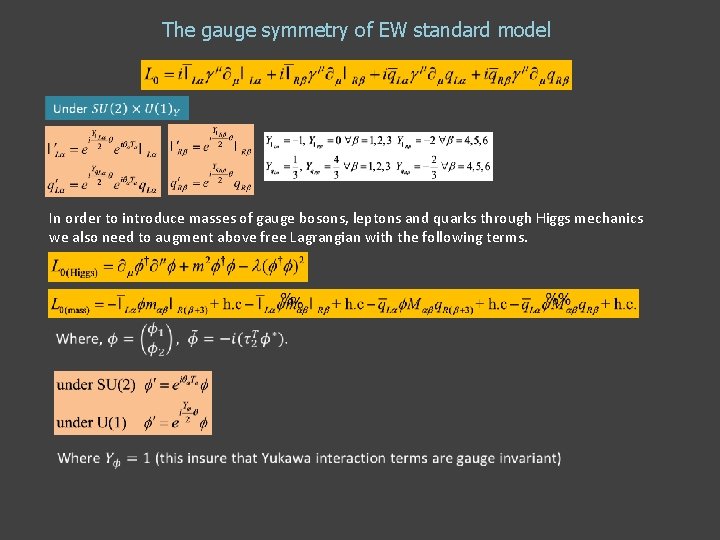
The gauge symmetry of EW standard model In order to introduce masses of gauge bosons, leptons and quarks through Higgs mechanics we also need to augment above free Lagrangian with the following terms.
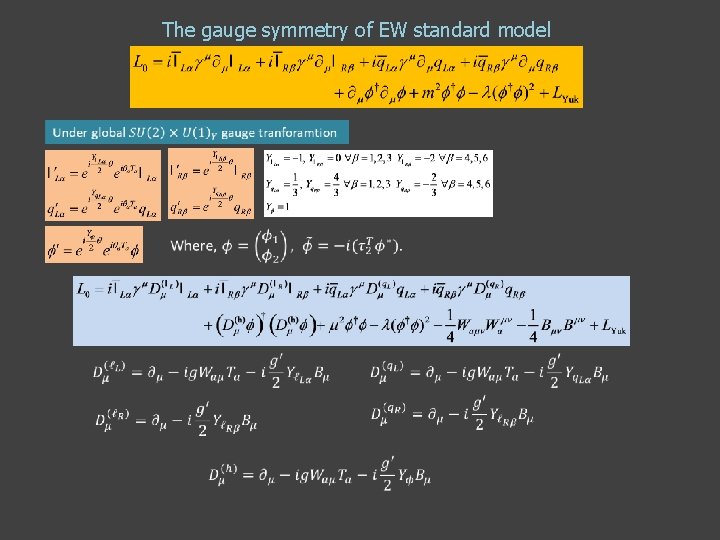
The gauge symmetry of EW standard model
Field Theory and the Electroweak Standard Model (Lecture 3) Faisal Akram 7 th School on LHC Physics, 6 -18 August 2018 NCP, Islamabad.
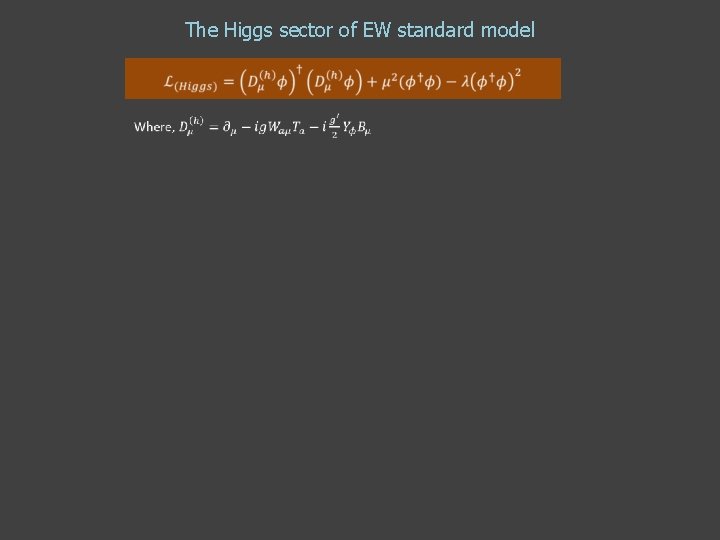
The Higgs sector of EW standard model