
Field techniques for Biologists Health and Safety Sampling
Field techniques for Biologists Health and Safety Sampling of wild organisms Identification and taxonomy Monitoring populations Measuring and recording animal behaviour 1
Health and Safety What are the hazards associated with terrain, weather conditions and isolation? Robins in your garden The Red Deer rut in Glen Affric Beach transect at Rosemarkie Ptarmigan behaviour in the Cairngorms Phytoplankton studies in Antarctic waters Lemurs in Madagascar Mongoose in Botswana 2

Sampling of wild organisms Minimise impact on wild species and habitats Rare and vulnerable species Rare and vulnerable habitats Legislation 3

Sampling of wild organisms Appropriate techniques Point count Transect Remote detection Quadrats (size, shape, sessile, slow moving) Capture (mobile) Elusive species (camera traps, scat sampling) 4
Monitoring of populations Important for: Indicator species – species whose presence, absence or abundance provides information about environmental qualities, e. g. pollution Impact of other human activity e. g. land use, harvesting of species, introduction of alien species 5
Monitoring of populations Mark and recapture studies Marking methods include banding, tagging, surgical implants, painting and hair clipping. Marking methods, capture and observation should have minimal impact on species studied. Sample of a population is captured, marked (M) and then released. After a period of time a second sample is captured (C). Some of the second sample may be recaptures (R). The total population for the area N=(MC)/R. 6 This assumes all individuals have an equal chance of capture and that no immigration or emigration has occurred.

Measuring and recording animal behaviour Ethological studies Ethograms of behaviour shown by species in a wild context These allow time budgets to be constructed (how long organism spends on an activity and energy consumed) 7

Measuring and recording animal behaviour Latency – time taken for a behaviour to occur after a stimulus Frequency – how many times a behaviour occurs within a set time period Duration – the % time the behaviour occurs during the set time period of observation Avoid anthropomorphism 8
Identification and taxonomy Classification guides Biological keys Analysis of DNA or protein 9
Identification and taxonomy Existing taxonomic groupings mean new organisms can be grouped predictably and by inference to known features within other better known or ‘model’ organisms. Genetic material can give more accurate taxonomic placement where evolutionary pathways have diverged or converged and obscured relatedness to other organisms. 10
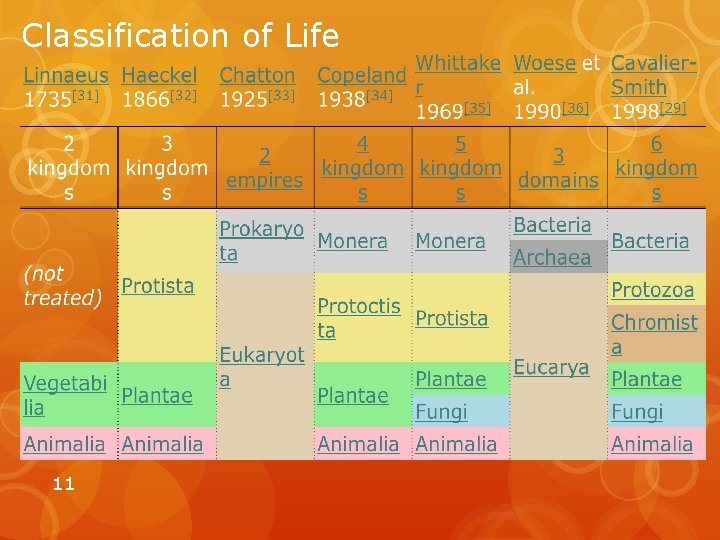
Classification of Life 11
How many organisms on earth now? About 1. 8 million have been given scientific names. The most recent methodical survey indicates that it is likely to be close to 9 million, with 6. 5 million of them living on the land 2. 2 million in the oceans. Estimates suggest 99% of all plant and animal species that have existed have already become extinct with most leaving no fossils. Humans and other large animals are freakishly rare life forms, given that 99% of all known animal species are smaller than bumble bees. 12
Classifying with the 3 domain system Archaea are single-celled microorganisms. Often regarded as extremophiles, with tendencies to methanogens, halophiles, and thermophiles Bacteria are a very large group of single-celled microorganisms that display a wide range of metabolic types, geometric shapes and utilise many environmental habitats and niches. Eukaryotes are the animals, plants, fungi, protozoa and chromista. They display a much greater degree of structural organisation and complexity. The word ‘eu-karyote’ literally means ‘true kernel’, in reference to the genome being organised into the membranebound compartment called the nucleus. 13
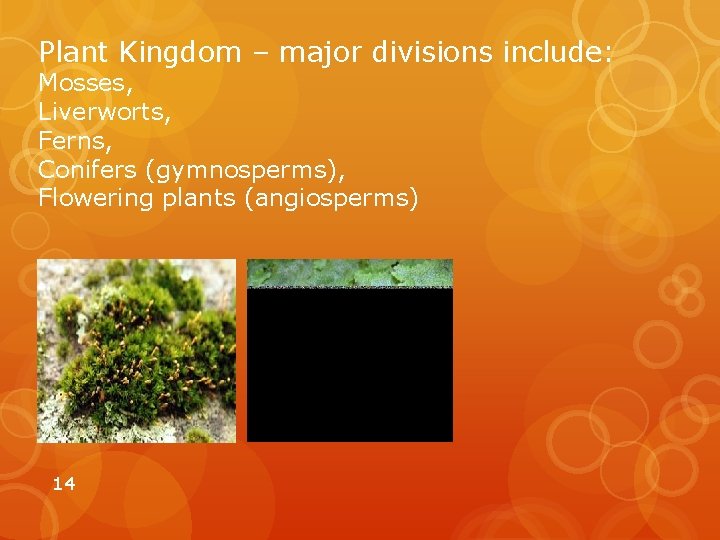
Plant Kingdom – major divisions include: Mosses, Liverworts, Ferns, Conifers (gymnosperms), Flowering plants (angiosperms) 14
Animal kingdom – divided into phyla including Chordata (sea squirts and vertebrates), 15
Arthropoda (joint legged invertebrates, usually paired appendages) 16
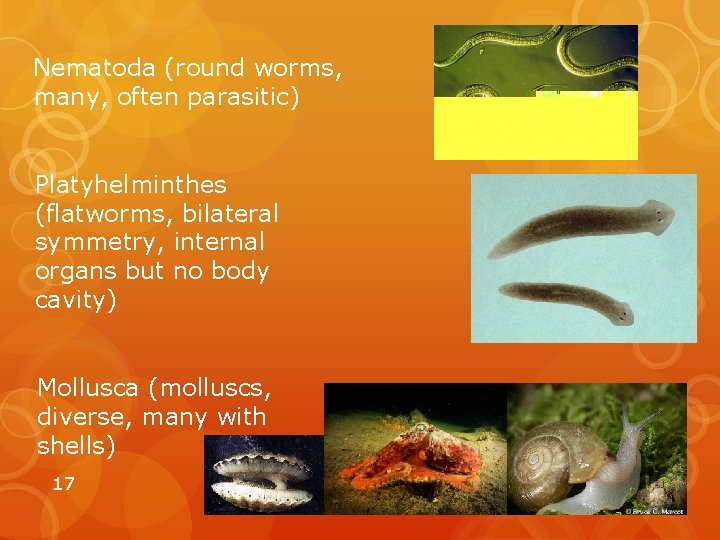
Nematoda (round worms, many, often parasitic) Platyhelminthes (flatworms, bilateral symmetry, internal organs but no body cavity) Mollusca (molluscs, diverse, many with shells) 17
Model Organisms These can be used from all taxonomic groups to apply to species that are difficult to study directly. Model organisms include: E. coli (bacteria) Arabidopsis thaliana ((thale cress) flowering plant), C. elegans (nematode), Drosophila melanogaster (fruit fly), Mice, rats and zebrafish (chordates). 18
- Slides: 18