
Fibroepithelial Lesions in the Breast of Adolescent Females
Fibroepithelial Lesions in the Breast of Adolescent Females: A Clinicopathological Profile of 53 Cases DS Ross, 1 DD Giri, 1 MM Akram, 1 JP Catalano, 1 KJ Van Zee, 2 E Brogi 1 1 Department of Pathology, Memorial Sloan-Kettering Cancer Center, NYC, NY 2 Department of Surgery, Memorial Sloan-Kettering Cancer Center, NYC, NY

Background Fibroepithelial lesions (FELs): • Most common breast abnormality in adolescent females (< 18 years-old) • Referred to as: - Fetal fibroadenoma Cellular fibroadenoma Juvenile fibroadenoma Giant fibroadenoma Fibroadenoma variant - Tubular adenoma Hamartoma Cystosarcoma phyllodes Phyllodes tumor
Study Aims • Investigate the morphology and clinical behavior of FELs in adolescents • Standardize the diagnostic terms used for FELs in adolescents based upon histologic criteria
Study Design (1) • Search of MSKCC pathology database – Age < 18 years-old – Excision or mastectomy between 19922011 – Diagnosis of any fibroepithelial lesion • 7 FELs from a prior series were also included (1975 -1983) Barrio AV et al. Ann Surg Oncol 2007
Study Design (2) • 3 pathologists reviewed all available slides • Features noted: • Gross & microscopic size • Borders / margin status • Growth pattern • Stromal overgrowth • Stromal cellularity • Nuclear pleomorphism • Epithelial hyperplasia • Stromal cell mitoses • Smooth muscle actin-α (1 A 4, DAKO) staining performed on available tissue
Study Design (3) • Patient information and clinical follow-up obtained from e-medical records – Age at presentation – Age at menarche – Race – Laterality – Family history
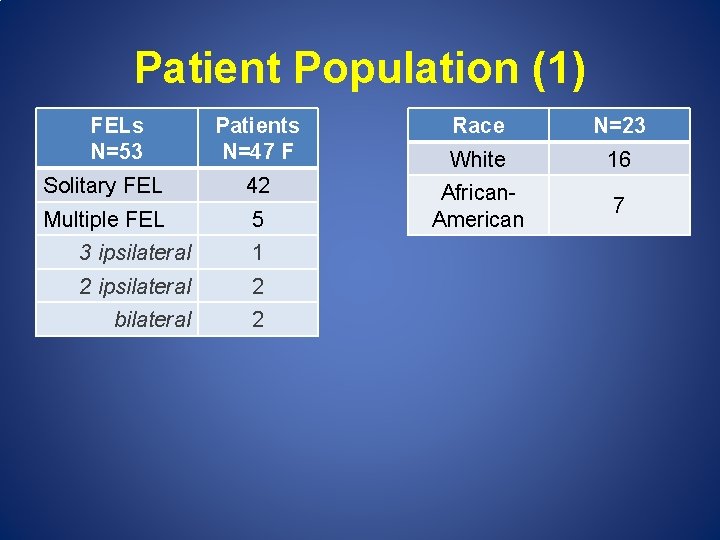
Patient Population (1) FELs N=53 Patients N=47 F Solitary FEL 42 Multiple FEL 5 3 ipsilateral 1 2 ipsilateral 2 bilateral 2 Race N=23 White 16 African. American 7
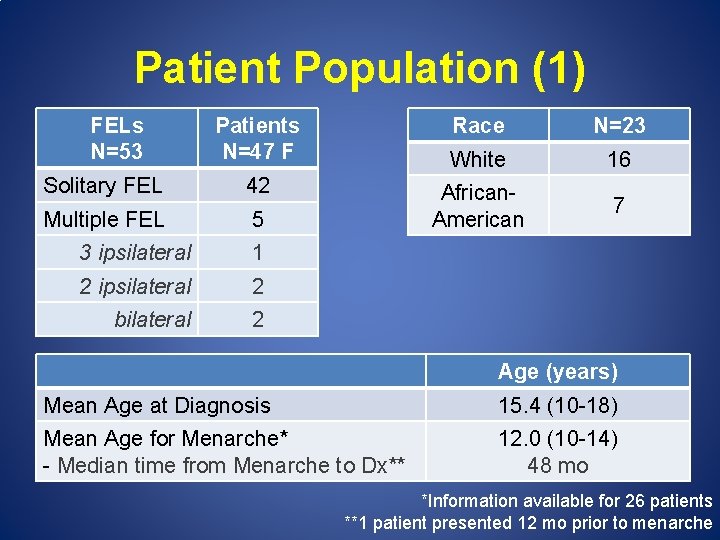
Patient Population (1) FELs N=53 Patients N=47 F Solitary FEL 42 Multiple FEL 5 3 ipsilateral 1 2 ipsilateral 2 bilateral 2 Race N=23 White 16 African. American 7 Age (years) Mean Age at Diagnosis 15. 4 (10 -18) Mean Age for Menarche* - Median time from Menarche to Dx** 12. 0 (10 -14) 48 mo *Information available for 26 patients **1 patient presented 12 mo prior to menarche
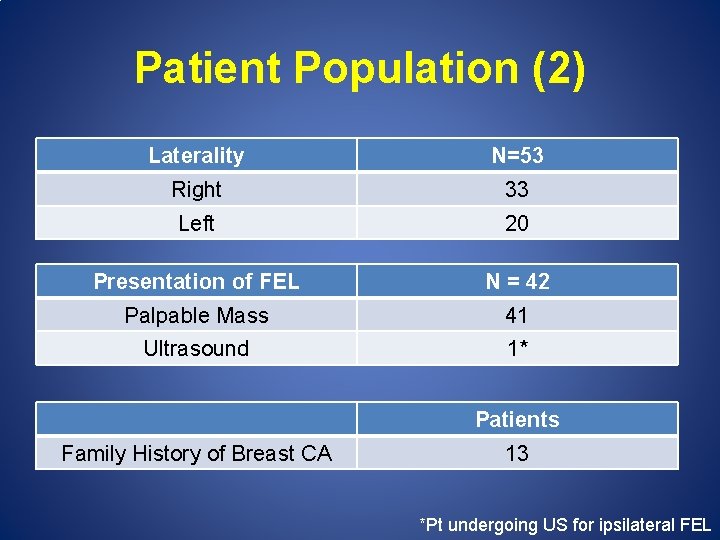
Patient Population (2) Laterality N=53 Right 33 Left 20 Presentation of FEL N = 42 Palpable Mass 41 Ultrasound 1* Patients Family History of Breast CA 13 *Pt undergoing US for ipsilateral FEL
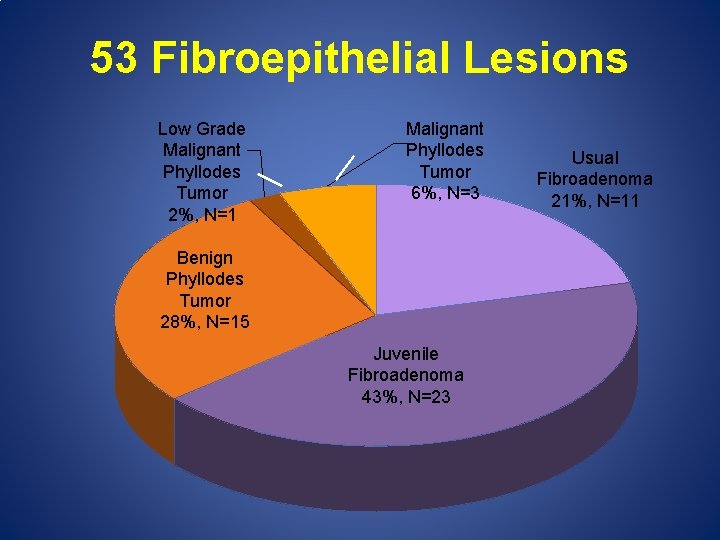
53 Fibroepithelial Lesions Low Grade Malignant Phyllodes Tumor 2%, N=1 Malignant Phyllodes Tumor 6%, N=3 Benign Phyllodes Tumor 28%, N=15 Juvenile Fibroadenoma 43%, N=23 Usual Fibroadenoma 21%, N=11
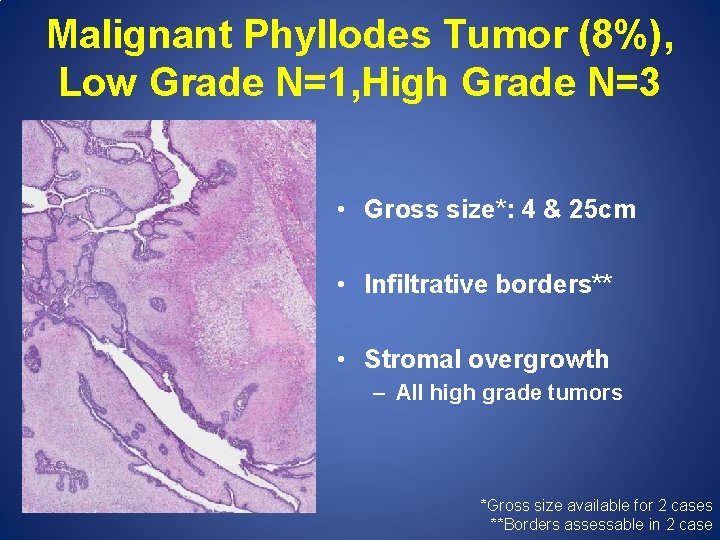
Malignant Phyllodes Tumor (8%), Low Grade N=1, High Grade N=3 • Gross size*: 4 & 25 cm • Infiltrative borders** • Stromal overgrowth – All high grade tumors *Gross size available for 2 cases **Borders assessable in 2 case
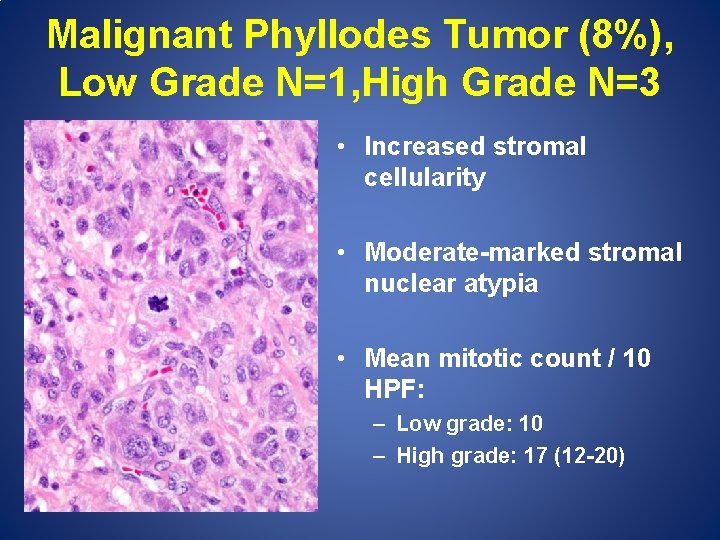
Malignant Phyllodes Tumor (8%), Low Grade N=1, High Grade N=3 • Increased stromal cellularity • Moderate-marked stromal nuclear atypia • Mean mitotic count / 10 HPF: – Low grade: 10 – High grade: 17 (12 -20)
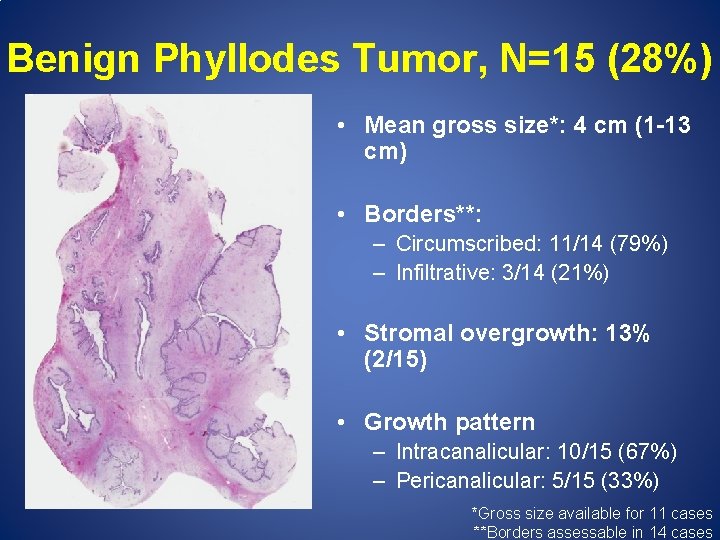
Benign Phyllodes Tumor, N=15 (28%) • Mean gross size*: 4 cm (1 -13 cm) • Borders**: – Circumscribed: 11/14 (79%) – Infiltrative: 3/14 (21%) • Stromal overgrowth: 13% (2/15) • Growth pattern – Intracanalicular: 10/15 (67%) – Pericanalicular: 5/15 (33%) *Gross size available for 11 cases **Borders assessable in 14 cases
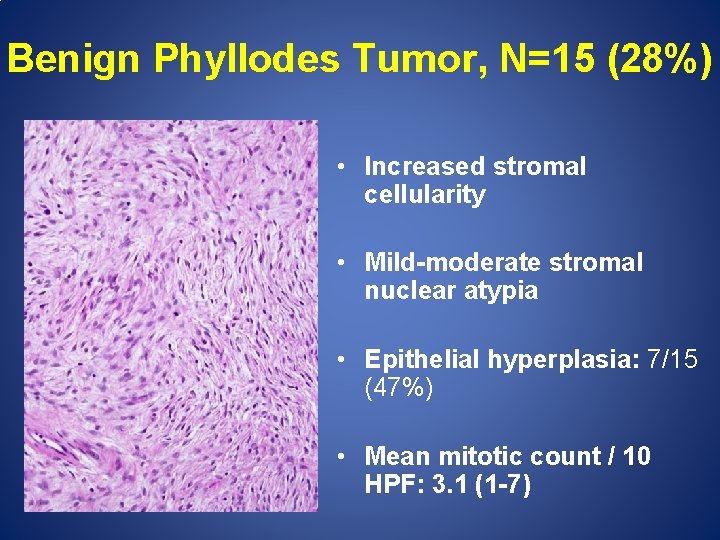
Benign Phyllodes Tumor, N=15 (28%) • Increased stromal cellularity • Mild-moderate stromal nuclear atypia • Epithelial hyperplasia: 7/15 (47%) • Mean mitotic count / 10 HPF: 3. 1 (1 -7)
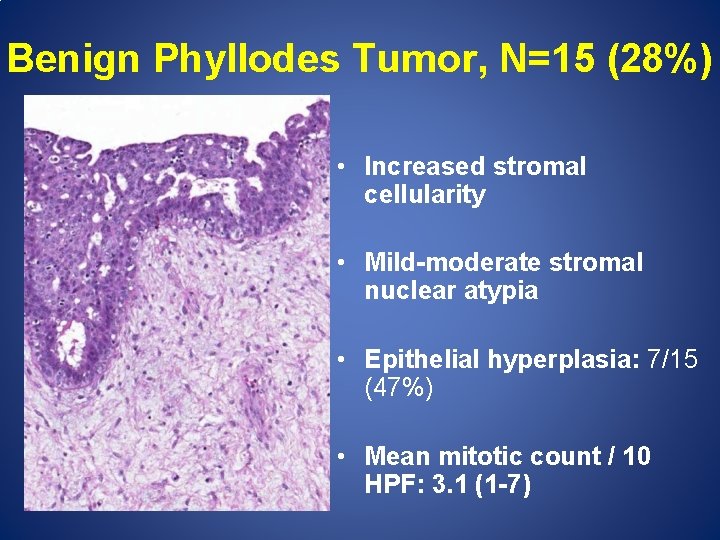
Benign Phyllodes Tumor, N=15 (28%) • Increased stromal cellularity • Mild-moderate stromal nuclear atypia • Epithelial hyperplasia: 7/15 (47%) • Mean mitotic count / 10 HPF: 3. 1 (1 -7)
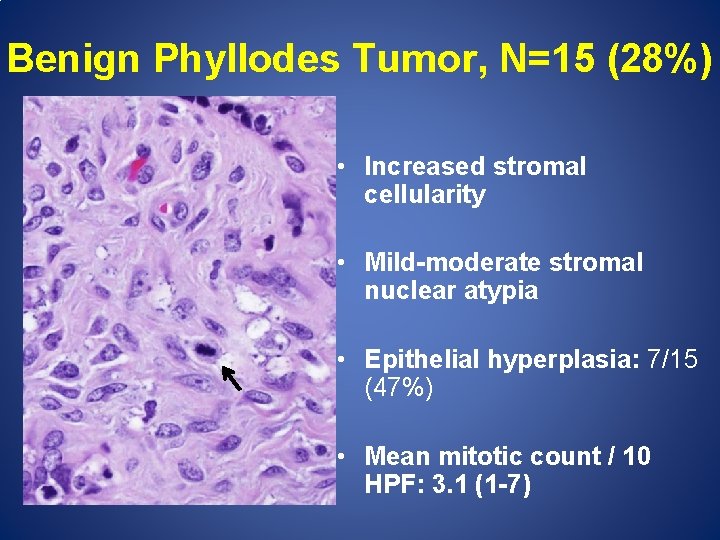
Benign Phyllodes Tumor, N=15 (28%) • Increased stromal cellularity • Mild-moderate stromal nuclear atypia • Epithelial hyperplasia: 7/15 (47%) • Mean mitotic count / 10 HPF: 3. 1 (1 -7)
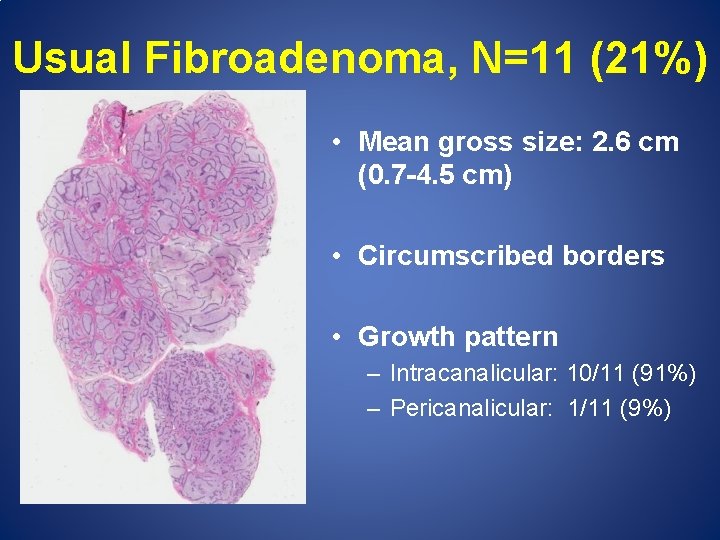
Usual Fibroadenoma, N=11 (21%) • Mean gross size: 2. 6 cm (0. 7 -4. 5 cm) • Circumscribed borders • Growth pattern – Intracanalicular: 10/11 (91%) – Pericanalicular: 1/11 (9%)
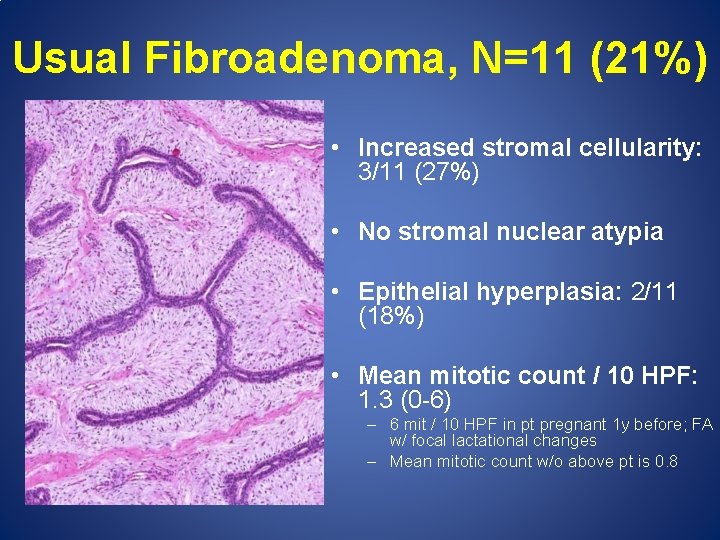
Usual Fibroadenoma, N=11 (21%) • Increased stromal cellularity: 3/11 (27%) • No stromal nuclear atypia • Epithelial hyperplasia: 2/11 (18%) • Mean mitotic count / 10 HPF: 1. 3 (0 -6) – 6 mit / 10 HPF in pt pregnant 1 y before; FA w/ focal lactational changes – Mean mitotic count w/o above pt is 0. 8
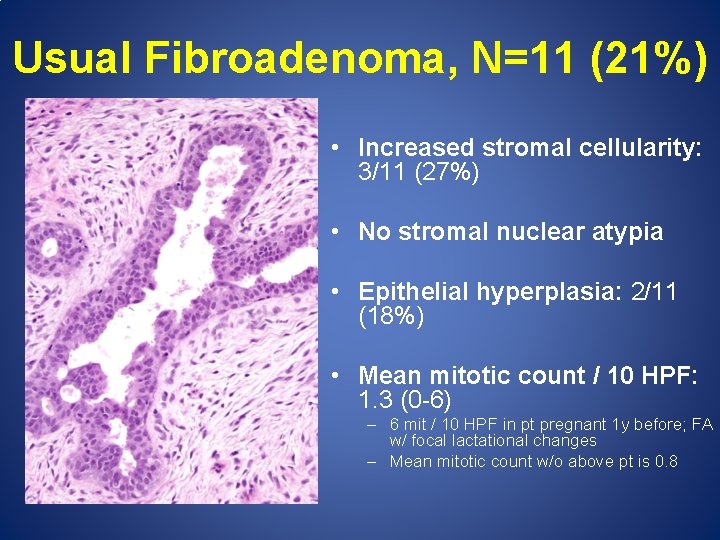
Usual Fibroadenoma, N=11 (21%) • Increased stromal cellularity: 3/11 (27%) • No stromal nuclear atypia • Epithelial hyperplasia: 2/11 (18%) • Mean mitotic count / 10 HPF: 1. 3 (0 -6) – 6 mit / 10 HPF in pt pregnant 1 y before; FA w/ focal lactational changes – Mean mitotic count w/o above pt is 0. 8
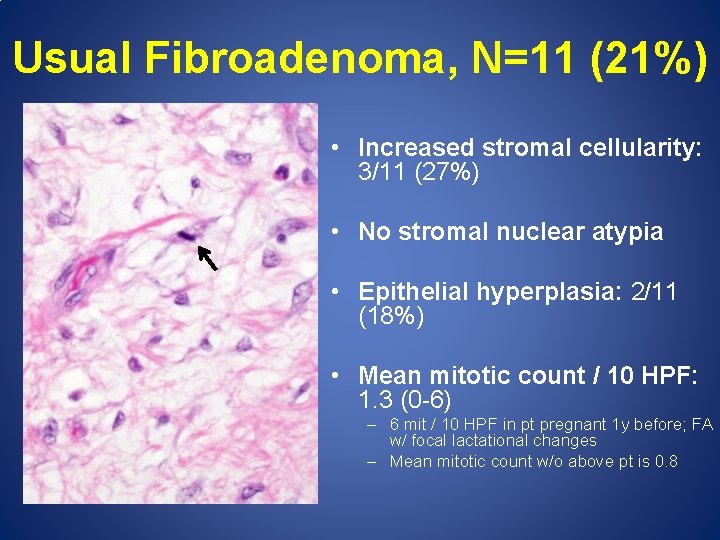
Usual Fibroadenoma, N=11 (21%) • Increased stromal cellularity: 3/11 (27%) • No stromal nuclear atypia • Epithelial hyperplasia: 2/11 (18%) • Mean mitotic count / 10 HPF: 1. 3 (0 -6) – 6 mit / 10 HPF in pt pregnant 1 y before; FA w/ focal lactational changes – Mean mitotic count w/o above pt is 0. 8
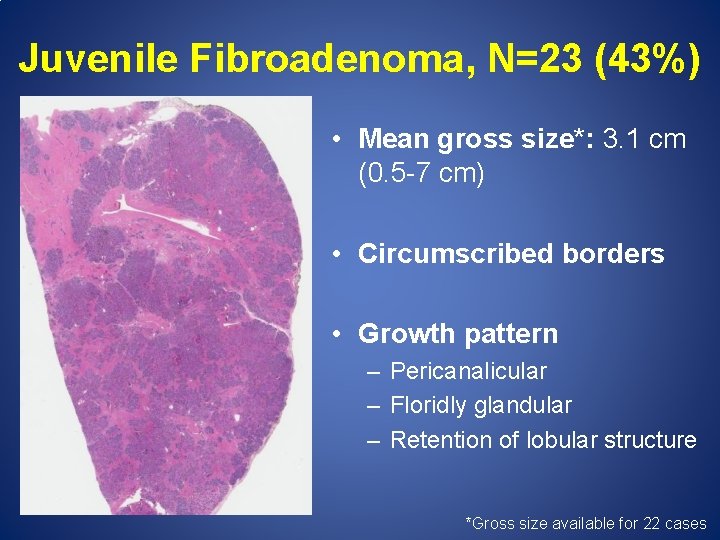
Juvenile Fibroadenoma, N=23 (43%) • Mean gross size*: 3. 1 cm (0. 5 -7 cm) • Circumscribed borders • Growth pattern – Pericanalicular – Floridly glandular – Retention of lobular structure *Gross size available for 22 cases
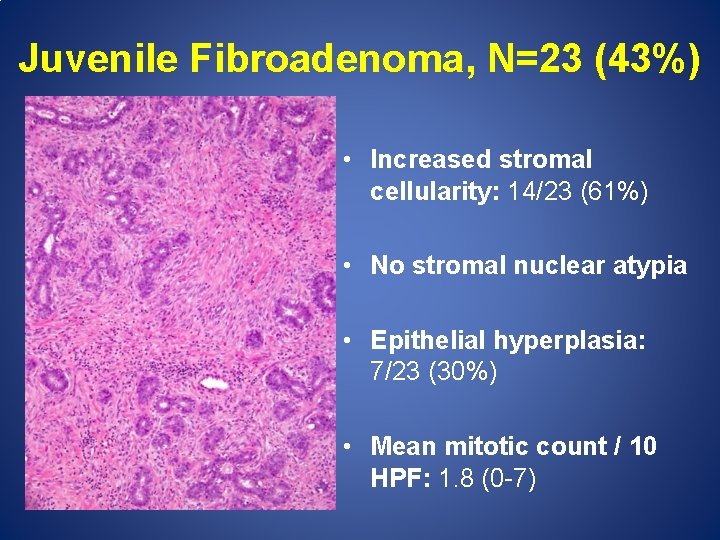
Juvenile Fibroadenoma, N=23 (43%) • Increased stromal cellularity: 14/23 (61%) • No stromal nuclear atypia • Epithelial hyperplasia: 7/23 (30%) • Mean mitotic count / 10 HPF: 1. 8 (0 -7)
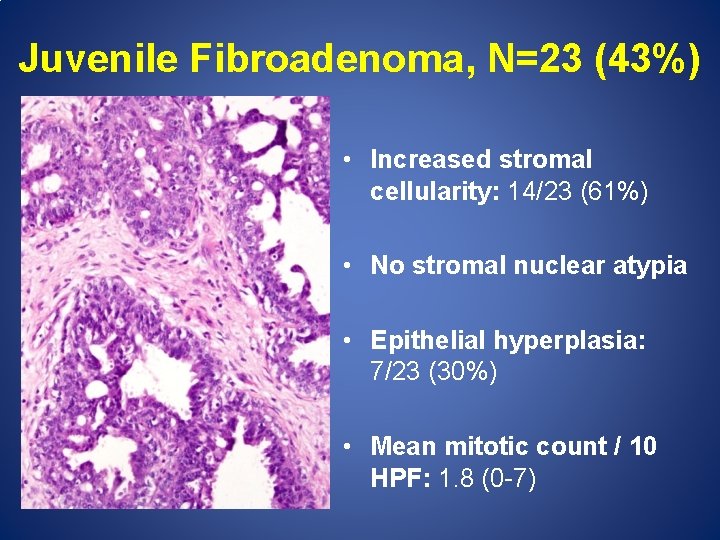
Juvenile Fibroadenoma, N=23 (43%) • Increased stromal cellularity: 14/23 (61%) • No stromal nuclear atypia • Epithelial hyperplasia: 7/23 (30%) • Mean mitotic count / 10 HPF: 1. 8 (0 -7)
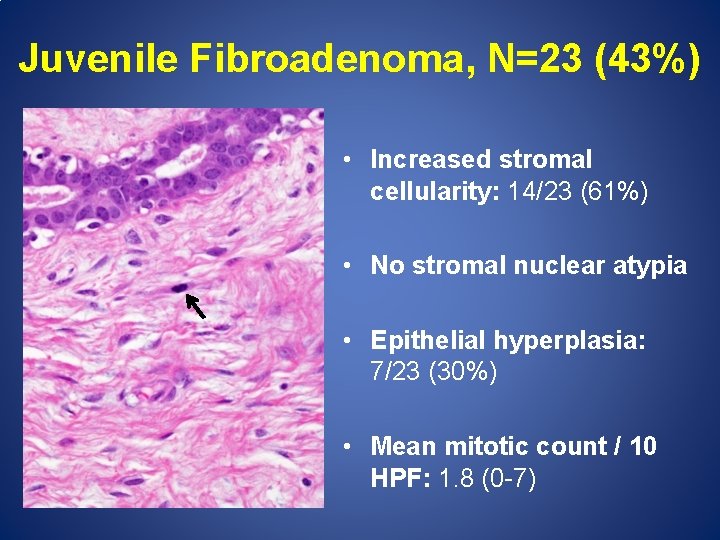
Juvenile Fibroadenoma, N=23 (43%) • Increased stromal cellularity: 14/23 (61%) • No stromal nuclear atypia • Epithelial hyperplasia: 7/23 (30%) • Mean mitotic count / 10 HPF: 1. 8 (0 -7)
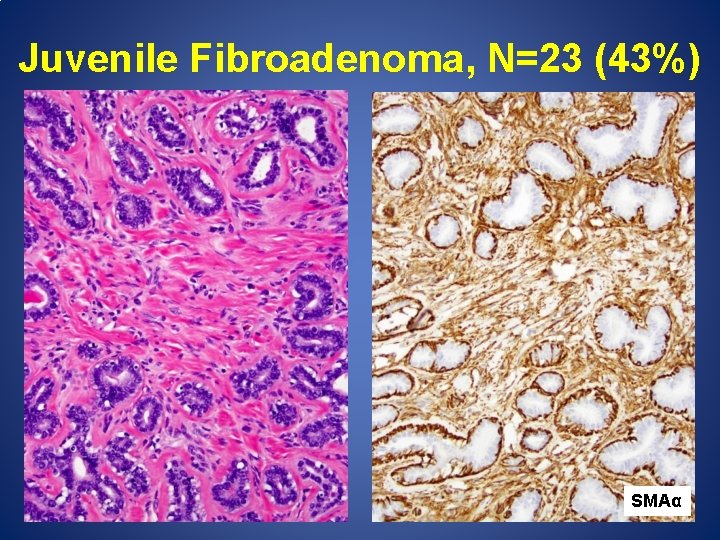
Juvenile Fibroadenoma, N=23 (43%) SMAα
Juvenile Fibroadenoma • A distinctive type of FA – Collagenized and cellular stroma – Pericanalicular growth pattern – Lobular arrangement – +/- Florid ductal hyperplasia
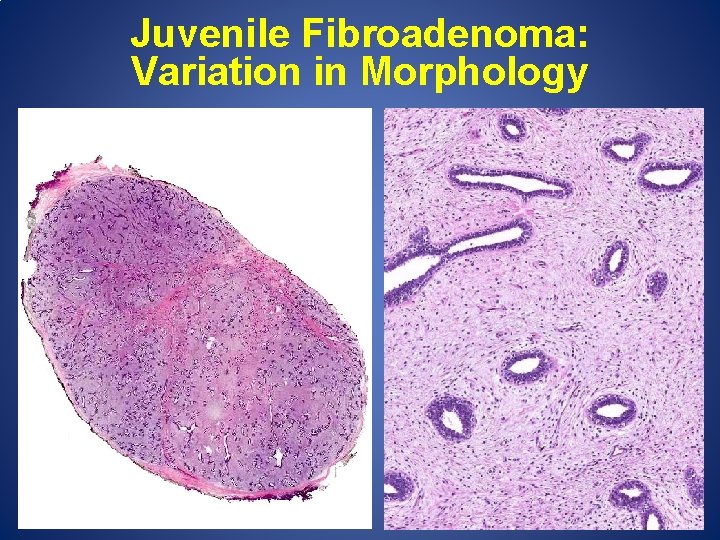
Juvenile Fibroadenoma: Variation in Morphology
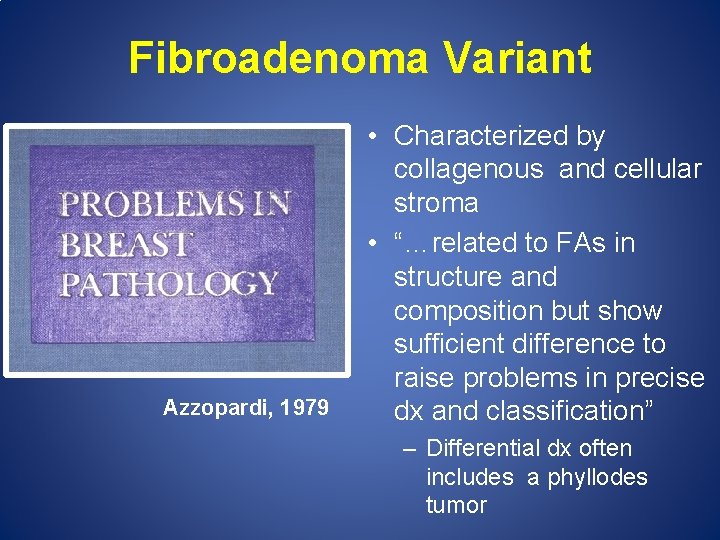
Fibroadenoma Variant Azzopardi, 1979 • Characterized by collagenous and cellular stroma • “…related to FAs in structure and composition but show sufficient difference to raise problems in precise dx and classification” – Differential dx often includes a phyllodes tumor
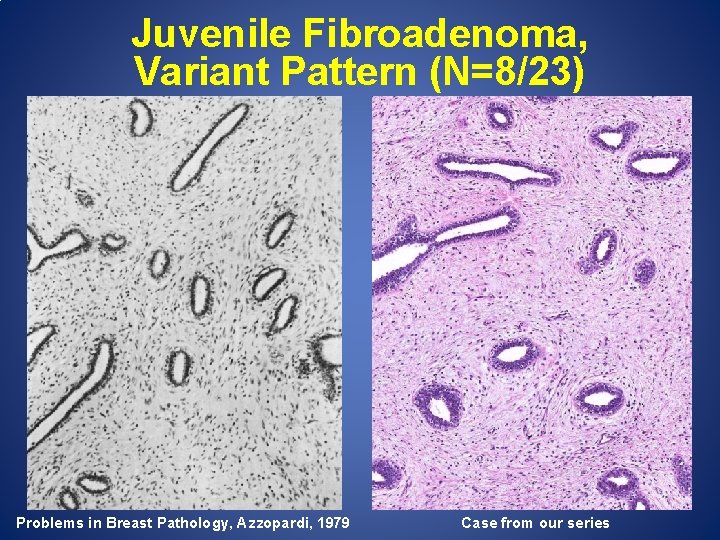
Juvenile Fibroadenoma, Variant Pattern (N=8/23) Problems in Breast Pathology, Azzopardi, 1979 Case from our series
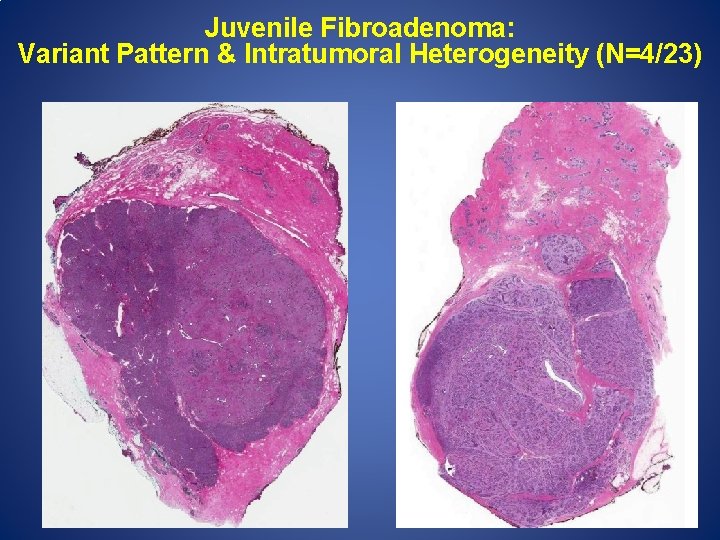
Juvenile Fibroadenoma: Variant Pattern & Intratumoral Heterogeneity (N=4/23)
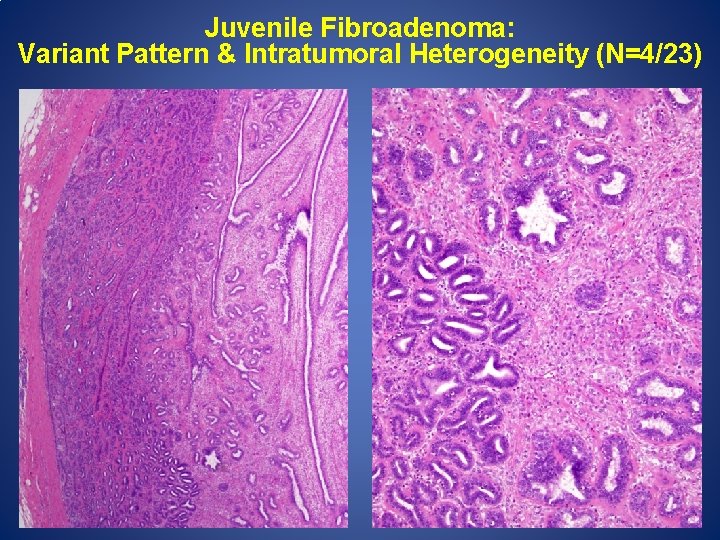
Juvenile Fibroadenoma: Variant Pattern & Intratumoral Heterogeneity (N=4/23)
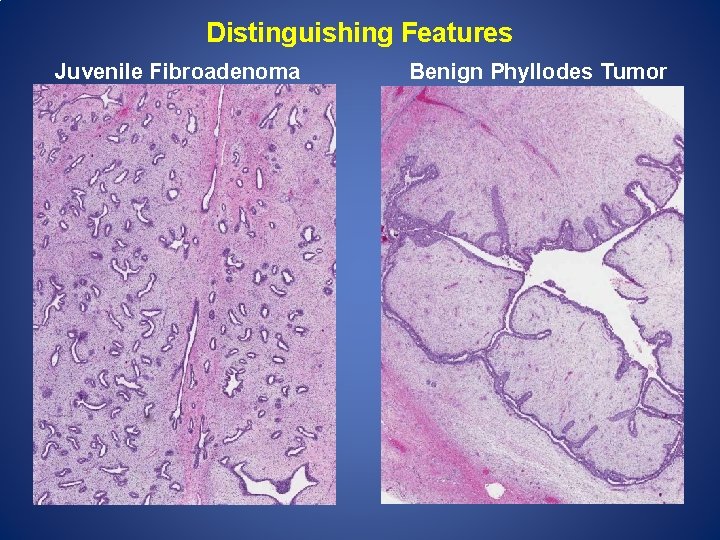
Distinguishing Features Juvenile Fibroadenoma Benign Phyllodes Tumor
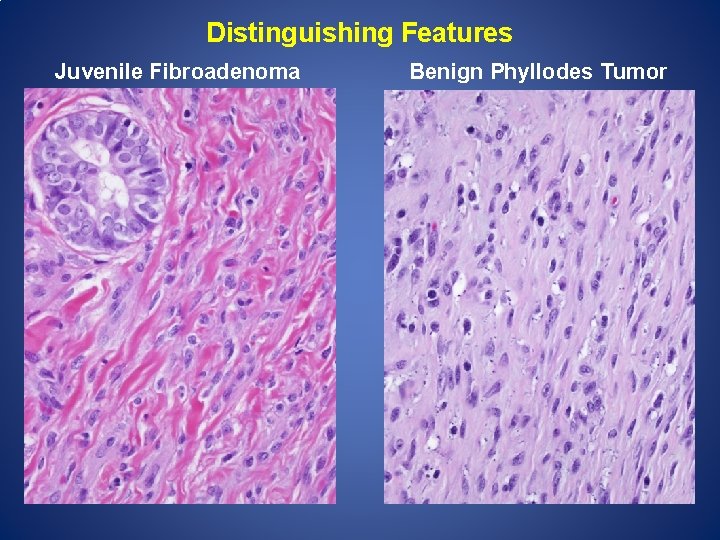
Distinguishing Features Juvenile Fibroadenoma Benign Phyllodes Tumor
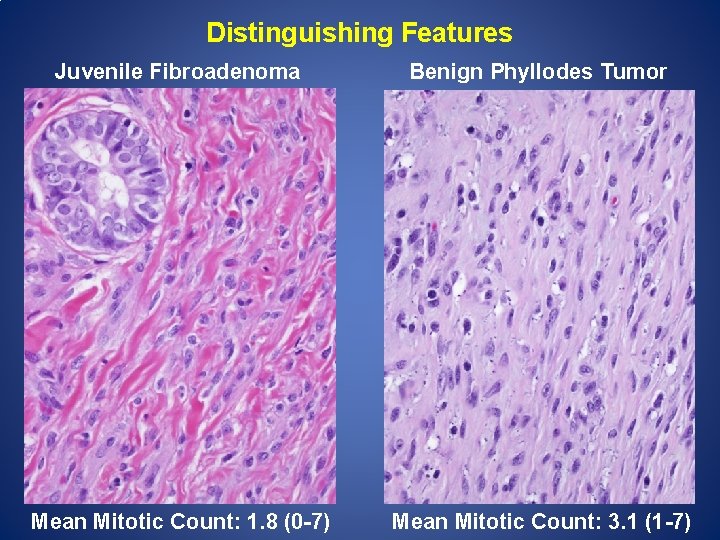
Distinguishing Features Juvenile Fibroadenoma Benign Phyllodes Tumor Mean Mitotic Count: 1. 8 (0 -7) Mean Mitotic Count: 3. 1 (1 -7)
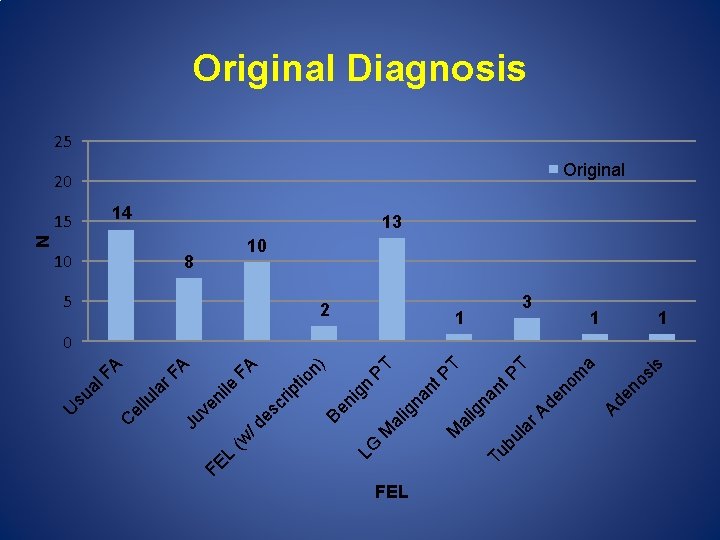
FEL 3 si s 20 Ad en o a de no m PT 1 ar A bu l T 2 ig na nt al PT t. P na n al ig M M n 14 Tu LG ni g 5 Be n) ip tio FA 8 /d es cr (w ve ni le A 10 FE L Ju r. F lu la A 15 C el su al F U N Original Diagnosis 25 Original 13 10 1 1 0
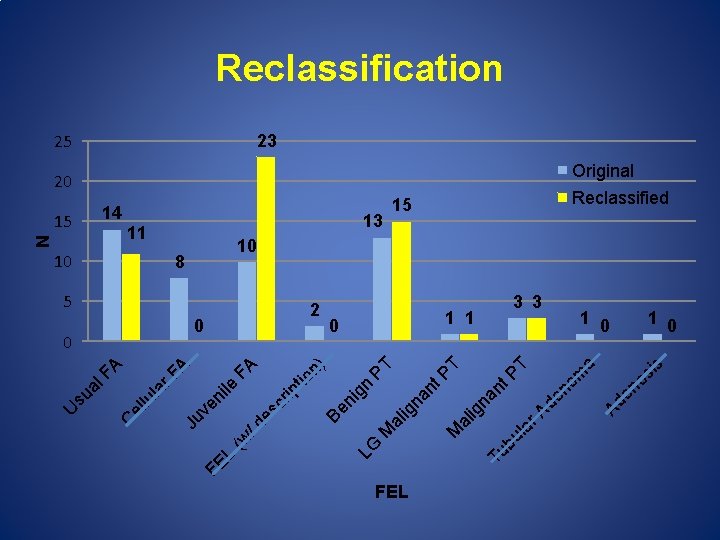
FEL 15 3 3 si s 20 Ad en o a de no m PT 1 1 ar A bu l Tu ig na nt T 0 al t. P na n al ig PT 13 M M n 2 LG 0 ni g 5 Be 8 n) 25 ip tio FA 11 /d es cr (w 0 ve ni le 10 FE L A 14 Ju r. F lu la A 15 C el su al F U N Reclassification 23 Original Reclassified 10 1 0
Follow-Up • 37 patients (41 FELs) – Mean follow-up: 40 months • From less than a month to 278 months
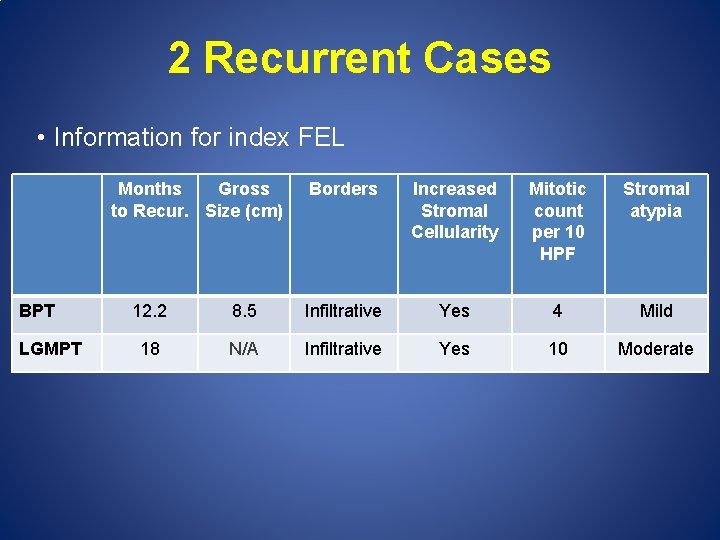
2 Recurrent Cases • Information for index FEL Months Gross to Recur. Size (cm) BPT LGMPT Borders Increased Stromal Cellularity Mitotic count per 10 HPF Stromal atypia 12. 2 8. 5 Infiltrative Yes 4 Mild 18 N/A Infiltrative Yes 10 Moderate
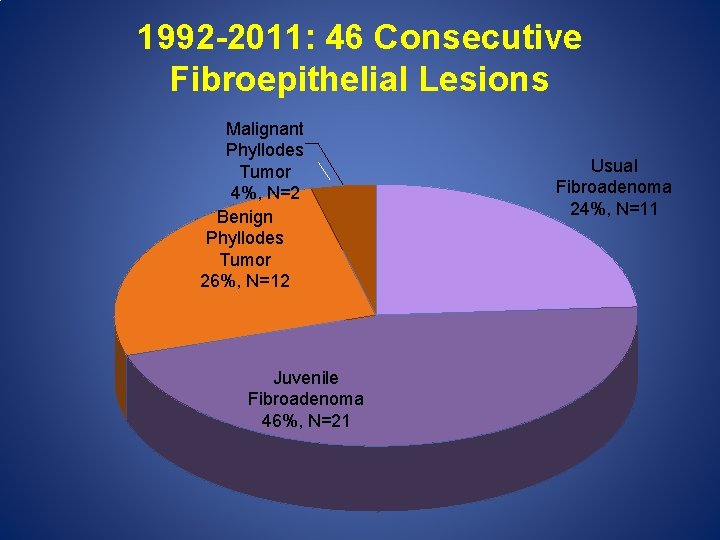
1992 -2011: 46 Consecutive Fibroepithelial Lesions Malignant Phyllodes Tumor 4%, N=2 Benign Phyllodes Tumor 26%, N=12 Juvenile Fibroadenoma 46%, N=21 Usual Fibroadenoma 24%, N=11
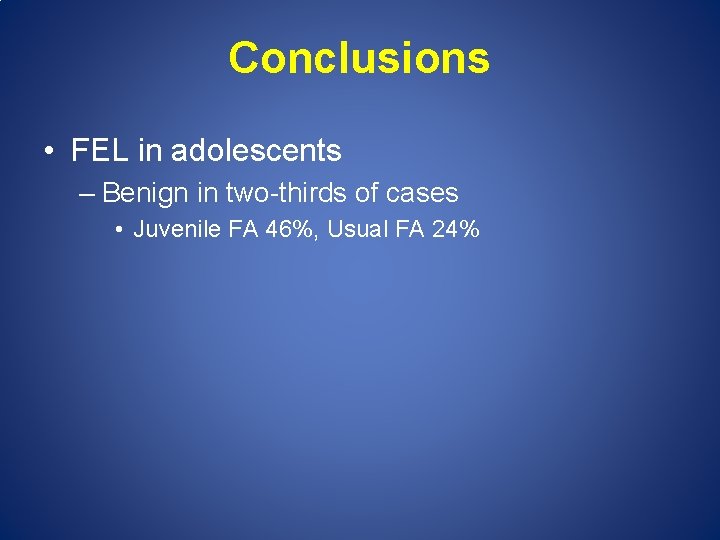
Conclusions • FEL in adolescents – Benign in two-thirds of cases • Juvenile FA 46%, Usual FA 24%
Conclusions • FEL in adolescents – Benign in two-thirds of cases • Juvenile FA 46%, Usual FA 24% – Frequent stromal mitoses
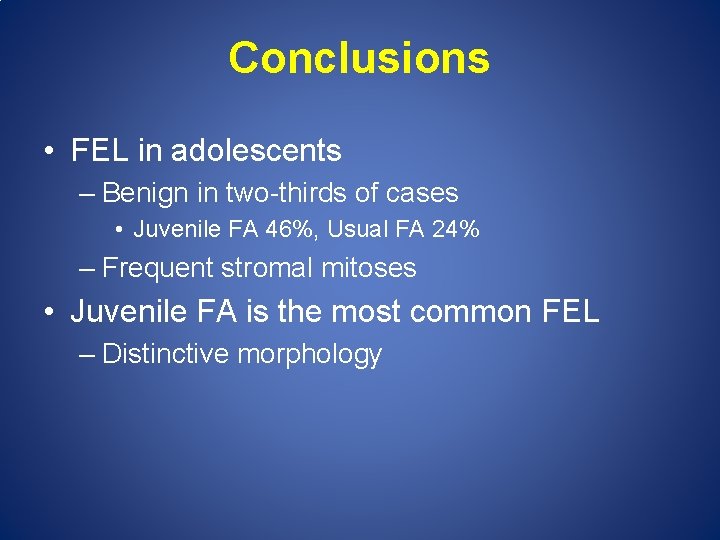
Conclusions • FEL in adolescents – Benign in two-thirds of cases • Juvenile FA 46%, Usual FA 24% – Frequent stromal mitoses • Juvenile FA is the most common FEL – Distinctive morphology
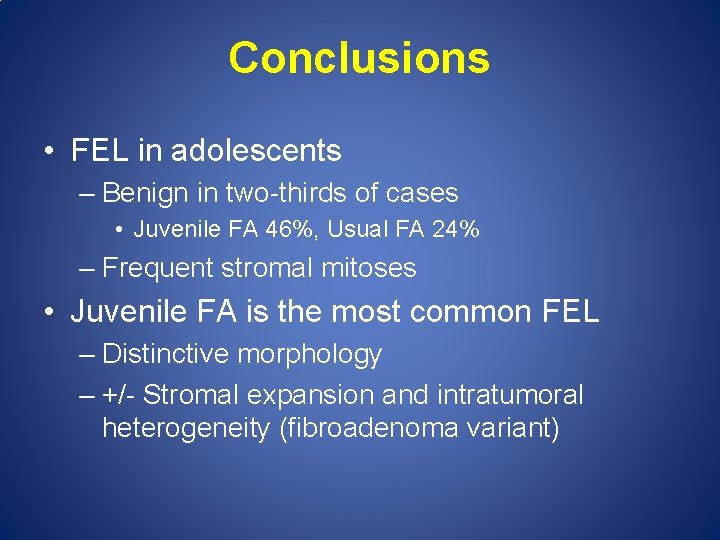
Conclusions • FEL in adolescents – Benign in two-thirds of cases • Juvenile FA 46%, Usual FA 24% – Frequent stromal mitoses • Juvenile FA is the most common FEL – Distinctive morphology – +/- Stromal expansion and intratumoral heterogeneity (fibroadenoma variant)
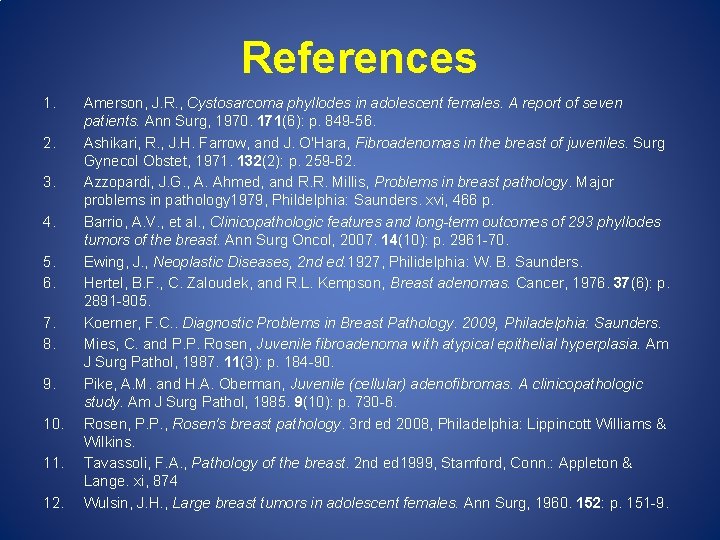
References 1. 2. 3. 4. 5. 6. 7. 8. 9. 10. 11. 12. Amerson, J. R. , Cystosarcoma phyllodes in adolescent females. A report of seven patients. Ann Surg, 1970. 171(6): p. 849 -56. Ashikari, R. , J. H. Farrow, and J. O'Hara, Fibroadenomas in the breast of juveniles. Surg Gynecol Obstet, 1971. 132(2): p. 259 -62. Azzopardi, J. G. , A. Ahmed, and R. R. Millis, Problems in breast pathology. Major problems in pathology 1979, Phildelphia: Saunders. xvi, 466 p. Barrio, A. V. , et al. , Clinicopathologic features and long-term outcomes of 293 phyllodes tumors of the breast. Ann Surg Oncol, 2007. 14(10): p. 2961 -70. Ewing, J. , Neoplastic Diseases, 2 nd ed. 1927, Philidelphia: W. B. Saunders. Hertel, B. F. , C. Zaloudek, and R. L. Kempson, Breast adenomas. Cancer, 1976. 37(6): p. 2891 -905. Koerner, F. C. . Diagnostic Problems in Breast Pathology. 2009, Philadelphia: Saunders. Mies, C. and P. P. Rosen, Juvenile fibroadenoma with atypical epithelial hyperplasia. Am J Surg Pathol, 1987. 11(3): p. 184 -90. Pike, A. M. and H. A. Oberman, Juvenile (cellular) adenofibromas. A clinicopathologic study. Am J Surg Pathol, 1985. 9(10): p. 730 -6. Rosen, P. P. , Rosen's breast pathology. 3 rd ed 2008, Philadelphia: Lippincott Williams & Wilkins. Tavassoli, F. A. , Pathology of the breast. 2 nd ed 1999, Stamford, Conn. : Appleton & Lange. xi, 874 Wulsin, J. H. , Large breast tumors in adolescent females. Ann Surg, 1960. 152: p. 151 -9.

- Slides: 45