
Fibrinolytic Drugs Thrombolytic Drugs By Prof Hanan Hagar
Fibrinolytic Drugs (Thrombolytic Drugs ) By Prof. Hanan Hagar
Definition: Drugs that cause lysis of already formed thrombus in clinical settings where ischemia may be fatal so blood flow can be restored to prevent further damage and assist healing.

Fibrinolyic drugs 1. Streptokinase. 2. Anistreplase. 3. Urokinase 4. Tissue plasminogen activators ( t -PA).
Uses of fibrinolyic drugs Acute myocardial infarction. q Acute thrombotic stroke. q Peripheral artery occlusion. q Pulmonary embolism. q Deep venous thrombosis. q
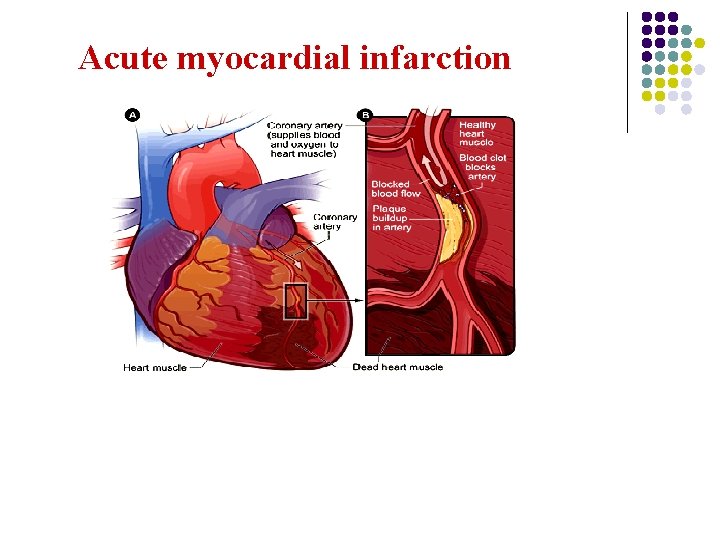
Acute myocardial infarction
Mechanism of Action q acts directly or indirectly to convert plasminogen to plasmin within the thrombus that degrades fibrin clots.

Mechanism of action Plasminogen Fibrinolytic drugs Plasmin fibrin degradation products

Precautions l Should be given as soon as possible after onset of symptoms. l Fibrinolytics are given intravenously. l Bleeding can occur (Systemic fibrinolysis).
Contraindications to thrombolytic therapy q Absolute contraindications include: Ø Recent head trauma or cranial tumor Ø Previous hemorrhagic shock Ø Stroke Ø Active internal bleeding Ø Major recent surgery within two weeks q Relative contraindications include: ü Active peptic ulcer, diabetic retinopathy, pregnancy, uncontrolled hypertension
Streptokinase is a protein synthesized by B-hemolytic streptococci. q acts indirectly by forming plasminogen streptokinase complex which converts inactive plasminogen into active plasmin. q It is the least expensive. q T 1/2 = half an hour. q I. V. Infusion (250, 000 U then 100, 000 U/h for 24 q 72 h).
Side effects q q Bleeding (due to activation of circulating plasminogen). Hypersensitivity reactions (rash, fever, allergic reaction due to antigenicity). q q Hypotension. not used in patients with recent streptococcal infections (because they have antistreptococcal antibodies and may develop fever, allergic reactions and resistance upon treatment with streptokinase).
Anistreplase ( APSAC ) l l Anisoylated Plasminogen-Streptokinase Activator Complex is a complex of l l human plasminogen + bacterial streptokinase that rendered inactive by introducing anisoyl group at its active site. is a prodrug, de-acylated in circulation into the active plasminogen-streptokinase complex (acts directly to convert plasminogen into plasmin).
Advantages q Longer duration of action (T 1/2 is 70 -120 min). q Given as a bolus I. V. (30 units over 3 - 5 min. ).
Disadvantages (less than streptokinase alone). q Expensive. q Antigenic. q Allergic reactions. q Bleeding due to minimal fibrin specificity
Urokinase Human enzyme synthesized by the kidney, obtained from either urine or cultures of human embryonic kidney cells. q acts by converting plasminogen to active plasmin (directly). q given by intravenous infusion(300, 000 U over 10 q min then 300, 000 U/h for 12 h).
Disadvantages Expensive. Systemic lysis. Advantages Not antigenic. No Hypotension.
Tissue Plasminogen Activators ( t - PA ) Alteplase • • Alteplase ( Single Chain ). Is a recombinant human t - PA. Synthesis by recombinant DNA technology.
Advantages q Clot specific (fibrin specific). q Activate fibrin-bound plasminogen rather than free plasminogen in blood. q Limited systemic fibrinolysis. q Non–antigenic (can be used in patients with antistreptococcal antibodies).
Alteplase q very q Is short half life delivered by an initial IV bolus injection, followed by two IV infusions (60 mg i. v. bolus + 40 mg infusion over 2 h).
Antiplasmin (Antifibrinolytics) inhibit plasminogen activation and thus inhibit fibrinolysis and promote clot stabilization. Uses o o Antidote for fibrinolytics. Adjunctive therapy in hemophilia. Drugs as Aprotinin, aminocaproic acid, tranexamic acid
Aminocaproic Acid & tranexamic acid o o Synthetic It competitively inhibits conversion of plasminogen into plasmin Given orally May cause intravascular thrombosis Aprotinin o o It acts by inhibiting plasmin. Can be taken orally or I. V.
- Slides: 22