
Fibres Content Introduction Classification Cotton Hemp Jute FIBRES
Fibres
Content • Introduction • Classification • Cotton • Hemp • Jute
FIBRES Tissue composed of Spindle shaped or elongated thick walled cells with pointed ends, cell walls of which consist of cellulose and may or may not contain lignin. Fibres are developed from single cell, the fibre initial, which during its development grows rapidly in the axial direction. They are unicellular in structure. During its growth period, the tips of the elongating cells may push one another. This process is known as “Gliding growth. ”
Differentiation of fibres: On the basis of tissue in which they occur they are diffrentiated as: Pericyclic fibres Phloem fibres Xylem fibres Pericyclic fibres: They are found in the pericyclic region i. e. near xylem and phloem. May or may not be lignified. Pholem fibres: They are found in the phloem region May or may not be lignified. Xylem fibres: They are found in the xylem region. They are dead and always lignified elements.
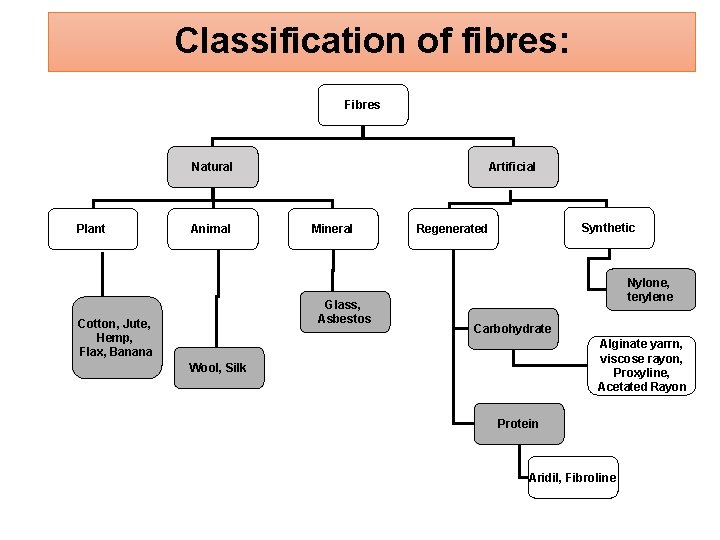
Classification of fibres: Fibres Natural Plant Animal Artificial Mineral Glass, Asbestos Cotton, Jute, Hemp, Flax, Banana Synthetic Regenerated Nylone, terylene Carbohydrate Alginate yarrn, viscose rayon, Proxyline, Acetated Rayon Wool, Silk Protein Aridil, Fibroline
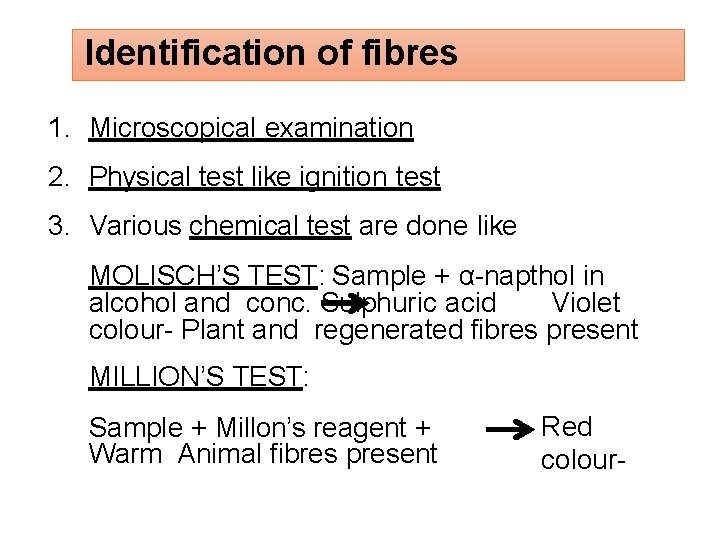
Identification of fibres 1. Microscopical examination 2. Physical test like ignition test 3. Various chemical test are done like MOLISCH’S TEST: Sample + α-napthol in alcohol and conc. Sulphuric acid Violet colour- Plant and regenerated fibres present MILLION’S TEST: Sample + Millon’s reagent + Warm Animal fibres present Red colour-
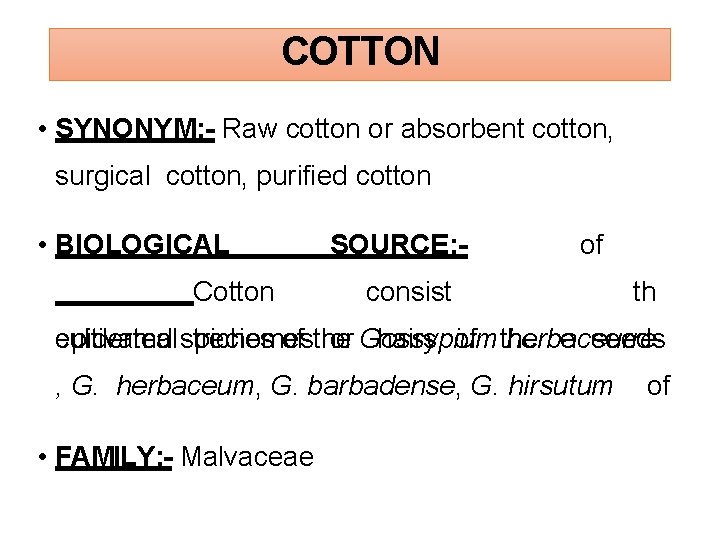
COTTON • SYNONYM: - Raw cotton or absorbent cotton, surgical cotton, purified cotton • BIOLOGICAL Cotton SOURCE: - of consist th cultivated of the herbaceurre epidermal species trichomes or Gossypium hairs of the e seeds , G. herbaceum, G. barbadense, G. hirsutum • FAMILY: - Malvaceae of
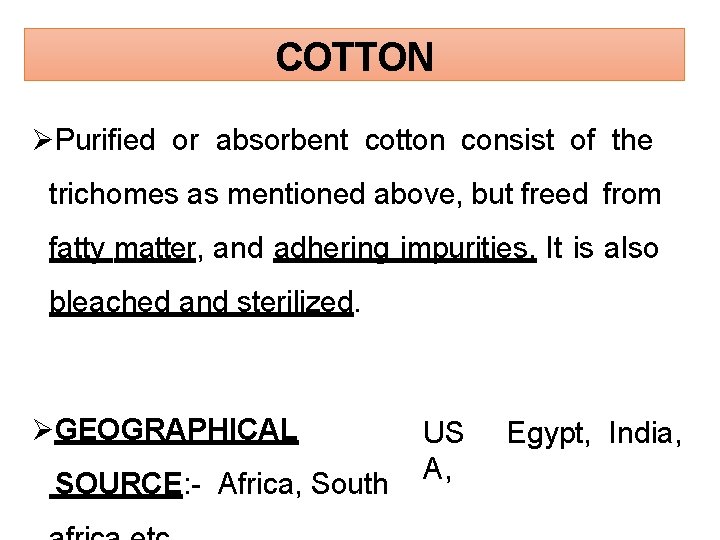
COTTON Purified or absorbent cotton consist of the trichomes as mentioned above, but freed from fatty matter, and adhering impurities. It is also bleached and sterilized. GEOGRAPHICAL SOURCE: - Africa, South US A, Egypt, India,
Cotton Preparation Seeds are covered with the hairs are known as Bolls. They are collected, dried and taken to ginning press where trichomes are separated from the seeds. Various devices are used to separate the hairs. The short and long hairs are separated from each other. The hairs with short length are know as Linters and used for the manufacture of absorbent cotton while long hairs are used for the preparation of cloth. The raw cotton obtained by this way is full of impurities, like wax, fat, coloring matter, vegetable
Cotton Preparation It is processed to get rid of most of the impurities. It is taken to the machine known as cotton opener and followed by treatment with dilute soda solution or soda ash solution under pressure for about 10 -15 hours. The wax, fatty material and coloring matter are removed by this treatment. It is then washed with water and treated with suitable bleaching agent. It is again washed with water, dried and carded into flat sheets. It is finally packed in wrappers and sterilised by means of
Morphological Description Size- 2. 5 to 4. 5 cm in length and 25 to 35µ in diameter. Shape- Cylindrical when young, but becomes flattened and twisted as it matures Colour- white (Due to bleaching), Slightly off white if sterilized Odour- Odourless Taste- Tasteless Extra features: Appearance is soft, fine, filament like hairs which are unicellular
Microscopical Characters The trichomes are unicellular, flattened and ribbon like with slightly thickened and rounded apex. They are tubular and hollow.
Chemical Constituents 90% of cellulose, 7 -8% of moisture, 0. 4% wax, fat, oil, 0. 6% protoplasm and other cell content and 0. 2% ash. entirel cellulose Purified with cotton or ofabsorbent cotton is y 6 -7% moisture and 0. 2 -0. 3% ash.
1. Specific test for cotton: - Cotton fibres + N/50 iodine Solution+ dry it + add few ml. of 80% sulfuric acid Trichomes assume purplish-blue or bluish-green colour (Distinction from jute, hemp, wool, silk, nylon, yarn alginate
CHEMICAL TESTS 3. Cotton + dilute sodium hydroxide solution and HCl Insoluble (Distinction from silk). 4. Cotton + Cold 80% of sulfuric acid Soluble. And insoluble in cold 60% sulfuric acid, Conc. HCl, 5% KOH, 90% phenol, cresol, acetone
USES Filtering medium and surgical dressings. Insulating material Absorbent cotton absorbs blood, mucus, pus and prevents the wounds from infections.
STORAGE store in cool place. The absorbent cotton should be wrapped in wrappers so as to prevent the dust and microbial contamination.
Hemp Synonyms: Cannabis Indica, Indian hemp, Ganja, Marihuana, Charas. Biological source: Hemp fibre is obtained from the bast of the plant Cannabis sativa Family: Cannabinaceae.
Cultivation There are broadly three groups of Cannabisbeing cultivated today: varieties Varieties primarily cultivated for their fibre, and little characterized by long branching, called industrial hemp. stems Varieties grown for seed from which hemp oil is extracted. Varieties grown for medicinal or recreational purposes.
Preparation & Morphology Fibres are obtained by subjecting the stalks to a series of operations—including retting, drying, and crushing—and a shaking process that completes separation from the woody portion, releasing the long, fairly straight fibre, or line. The fibre strands, usually over 1. 8 metres (5. 8 feet) long, are made of individual cylindrical cells with an irregular surface. The fibre diameter ranges from 16 to 50 microns. The fibre, longer and less flexible, is usually yellowish, greenish, or a dark brown or gray and, because it is not easily bleached to sufficiently light shades, is rarely dyed.
Chemical Constituents • Long, strong and durable, hemp fibres are about 70% cellulose and contain low levels of lignin (around 8 -10%). • Pectin-2. 9% • Fat-Wax-0. 9% • Mineral-1. 8%
Uses • Hemp has been used for centuries to make rope, canvas and paper • Cloth • Filter
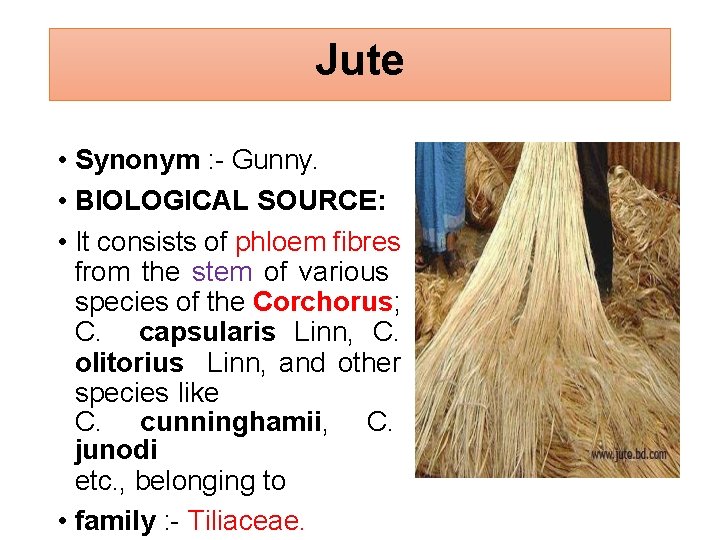
Jute • Synonym : - Gunny. • BIOLOGICAL SOURCE: • It consists of phloem fibres from the stem of various species of the Corchorus; C. capsularis Linn, C. olitorius Linn, and other species like C. cunninghamii, C. junodi etc. , belonging to • family : - Tiliaceae.
Jute Geographical Source : West Bengal and Assam. Description : They are tall, usually annual herbs. Reaching to a height of 2– 4 m, unbranched and if branched it has only a few side branches. The leaves are alternate, simple, lanceolate, 5– 15 cm long and a finely serrated or lobed margin. The flowers are small (1. 5– 3 cm in diameter) and yellow, with five petals; The fruit encloses many seeds in the capsule
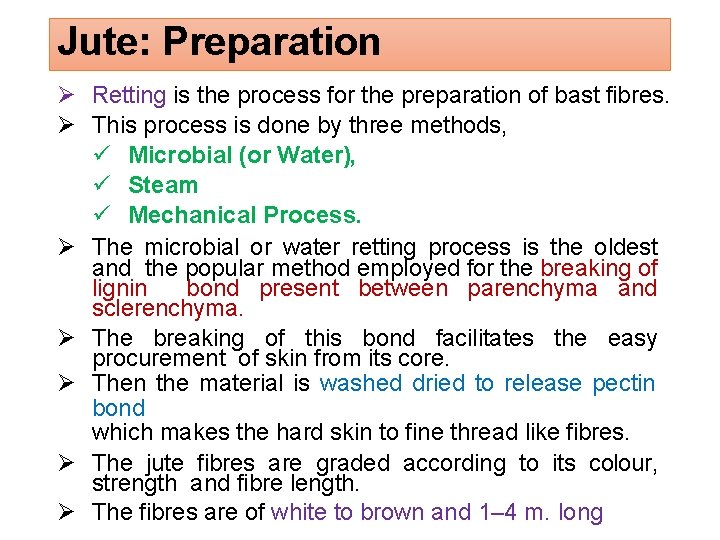
Jute: Preparation Retting is the process for the preparation of bast fibres. This process is done by three methods, Microbial (or Water), Steam Mechanical Process. The microbial or water retting process is the oldest and the popular method employed for the breaking of lignin bond present between parenchyma and sclerenchyma. The breaking of this bond facilitates the easy procurement of skin from its core. Then the material is washed dried to release pectin bond which makes the hard skin to fine thread like fibres. The jute fibres are graded according to its colour, strength and fibre length. The fibres are of white to brown and 1– 4 m. long
Jute • Microscopy : A thin transverse section of the strand when treated with phuloroglucinol and HCl, stains the strands deep red, indicating the presence of lignin.
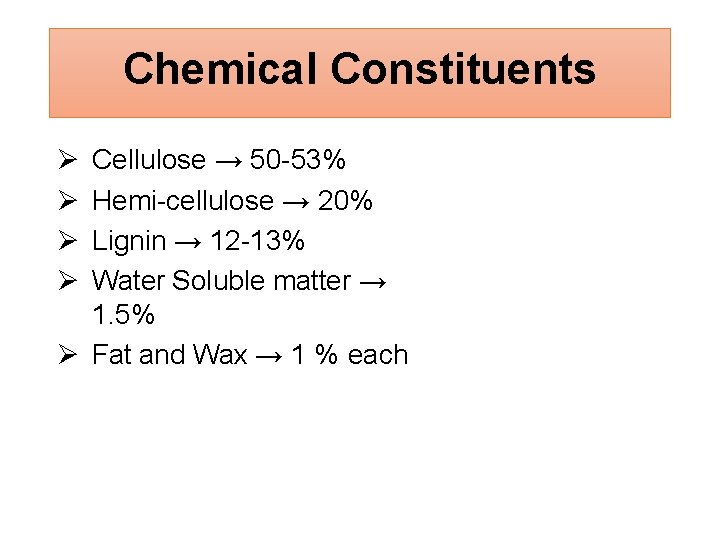
Chemical Constituents Cellulose → 50 -53% Hemi-cellulose → 20% Lignin → 12 -13% Water Soluble matter → 1. 5% Fat and Wax → 1 % each
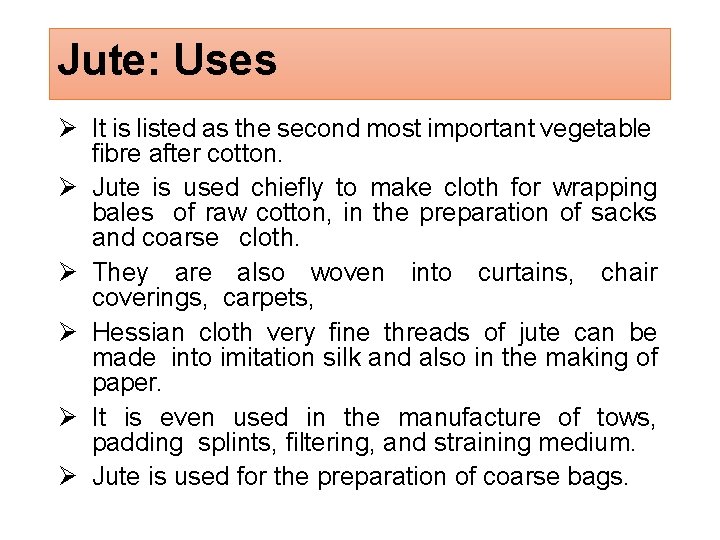
Jute: Uses It is listed as the second most important vegetable fibre after cotton. Jute is used chiefly to make cloth for wrapping bales of raw cotton, in the preparation of sacks and coarse cloth. They are also woven into curtains, chair coverings, carpets, Hessian cloth very fine threads of jute can be made into imitation silk and also in the making of paper. It is even used in the manufacture of tows, padding splints, filtering, and straining medium. Jute is used for the preparation of coarse bags.
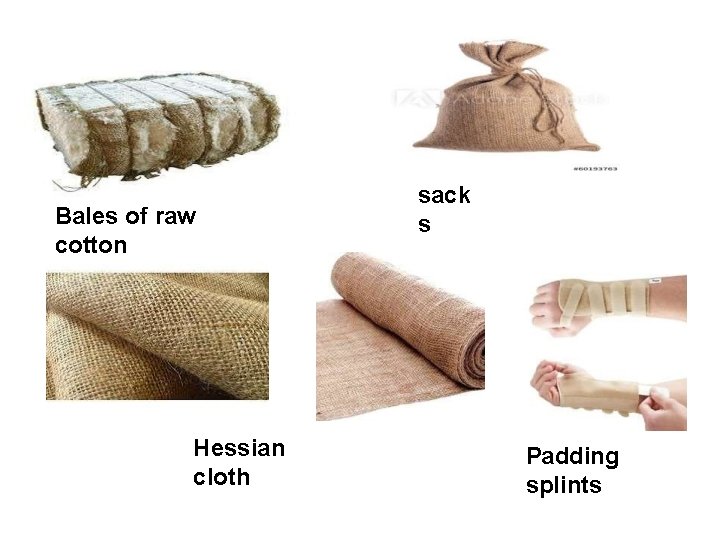
Bales of raw cotton Hessian cloth sack s Padding splints

- Slides: 30