
Fibonacci Numbers 1 1 2 3 5 8
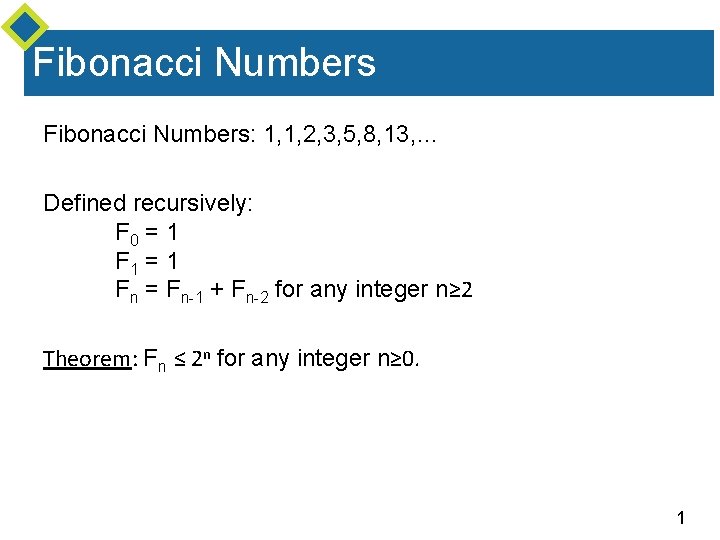
Fibonacci Numbers: 1, 1, 2, 3, 5, 8, 13, … Defined recursively: F 0 = 1 F 1 = 1 Fn = Fn-1 + Fn-2 for any integer n≥ 2 Theorem: Fn ≤ 2 n for any integer n≥ 0. 1
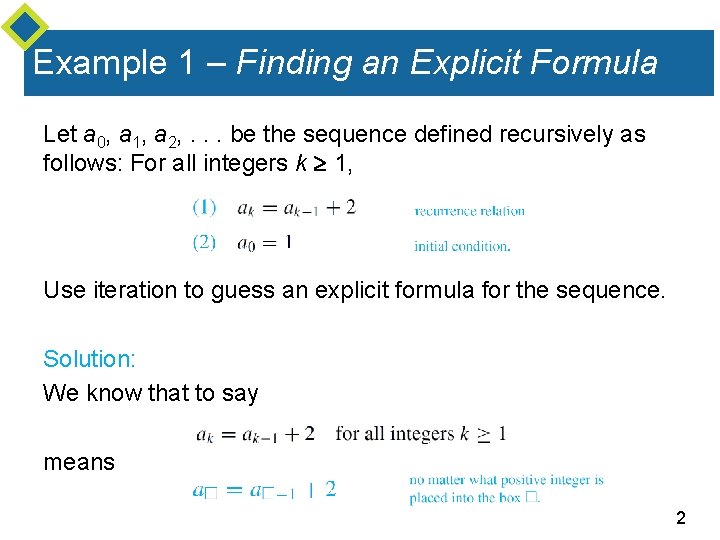
Example 1 – Finding an Explicit Formula Let a 0, a 1, a 2, . . . be the sequence defined recursively as follows: For all integers k 1, Use iteration to guess an explicit formula for the sequence. Solution: We know that to say means 2
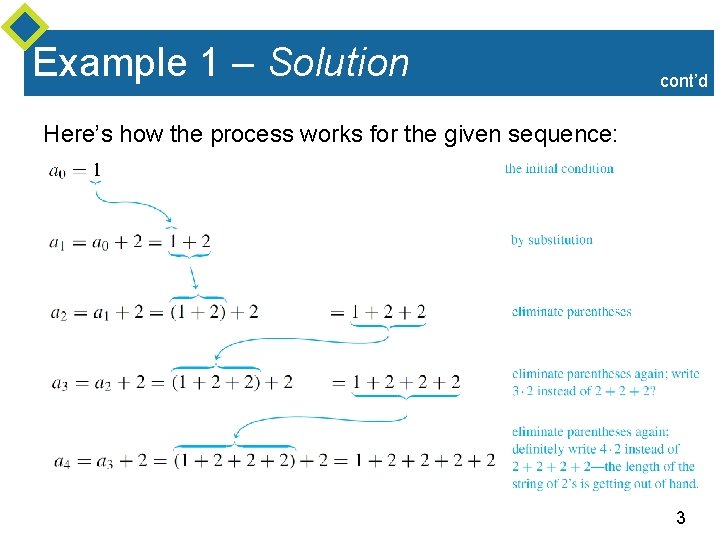
Example 1 – Solution cont’d Here’s how the process works for the given sequence: 3

Fibonacci Numbers 4

Fibonacci Numbers 5
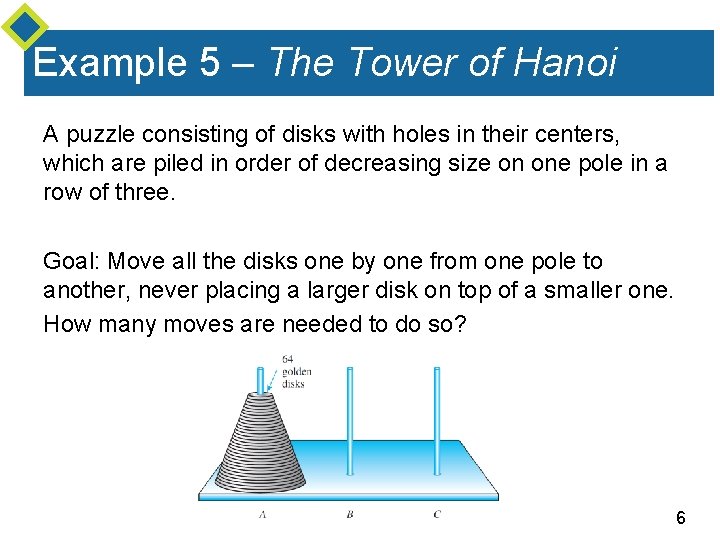
Example 5 – The Tower of Hanoi A puzzle consisting of disks with holes in their centers, which are piled in order of decreasing size on one pole in a row of three. Goal: Move all the disks one by one from one pole to another, never placing a larger disk on top of a smaller one. How many moves are needed to do so? 6
Example 5 – Solution An elegant and efficient way to solve this problem is to think recursively. Suppose that you, somehow or other, have found the most efficient way possible to transfer a tower of k – 1 disks one by one from one pole to another, obeying the restriction that you never place a larger disk on top of a smaller one. What is the most efficient way to transfer a tower of k disks from one pole to another? 7
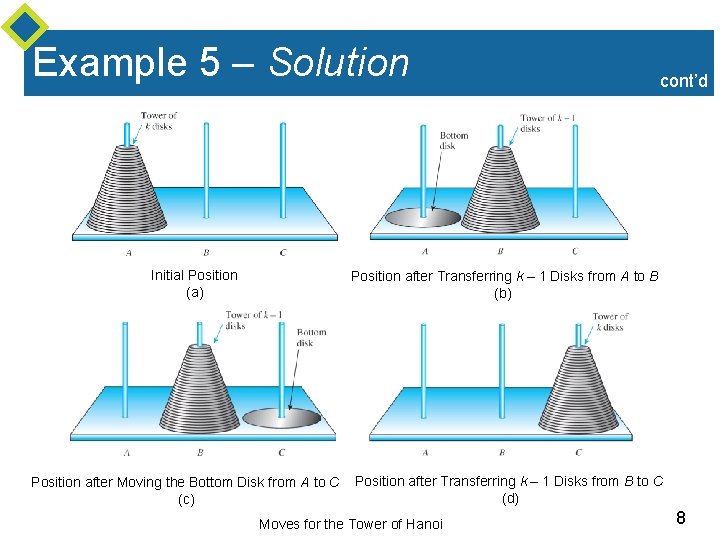
Example 5 – Solution Initial Position (a) cont’d Position after Transferring k – 1 Disks from A to B (b) Position after Moving the Bottom Disk from A to C (c) Position after Transferring k – 1 Disks from B to C (d) Moves for the Tower of Hanoi 8
- Slides: 8