
Fibonacci Heaps Lecture slides adapted from Chapter 20
Fibonacci Heaps Lecture slides adapted from: · Chapter 20 of Introduction to Algorithms by Cormen, Leiserson, Rivest, and Stein. · Chapter 9 of The Design and Analysis of Algorithms by Dexter Kozen. COS 423 Theory of Algorithms • Kevin Wayne • Spring 2007

Priority Queues Performance Cost Summary Operation Linked List Binary Heap Binomial Heap Fibonacci Heap † Relaxed Heap make-heap 1 1 1 is-empty 1 1 1 insert 1 log n 1 1 delete-min n log n decrease-key n log n 1 1 delete n log n union 1 n log n 1 1 find-min n 1 log n 1 1 n = number of elements in priority queue † amortized Theorem. Starting from empty Fibonacci heap, any sequence of a 1 insert, a 2 delete-min, and a 3 decrease-key operations takes O(a 1 + a 2 log n + a 3) time. 2

Priority Queues Performance Cost Summary Operation Linked List Binary Heap Binomial Heap Fibonacci Heap † Relaxed Heap make-heap 1 1 1 is-empty 1 1 1 insert 1 log n 1 1 delete-min n log n decrease-key n log n 1 1 delete n log n union 1 n log n 1 1 find-min n 1 log n 1 1 n = number of elements in priority queue † amortized Hopeless challenge. O(1) insert, delete-min and decrease-key. Why? 3
![Fibonacci Heaps History. [Fredman and Tarjan, 1986] Ingenious data structure and analysis. Original motivation:](http://slidetodoc.com/presentation_image/4d6cc08239941e2fbf8e5195968ed750/image-4.jpg "Fibonacci Heaps History. [Fredman and Tarjan, 1986] Ingenious data structure and analysis. Original motivation:")
Fibonacci Heaps History. [Fredman and Tarjan, 1986] Ingenious data structure and analysis. Original motivation: improve Dijkstra's shortest path algorithm from O(E log V ) to O(E + V log V ). n n V insert, V delete-min, E decrease-key Basic idea. Similar to binomial heaps, but less rigid structure. Binomial heap: eagerly consolidate trees after each insert. n n n Fibonacci heap: lazily defer consolidation until next delete-min. 4

Fibonacci Heaps: Structure each parent larger than its children Fibonacci heap. Set of heap-ordered trees. Maintain pointer to minimum element. Set of marked nodes. n n n roots 17 30 Heap H 24 26 35 46 heap-ordered tree 23 7 3 18 39 52 41 44 5
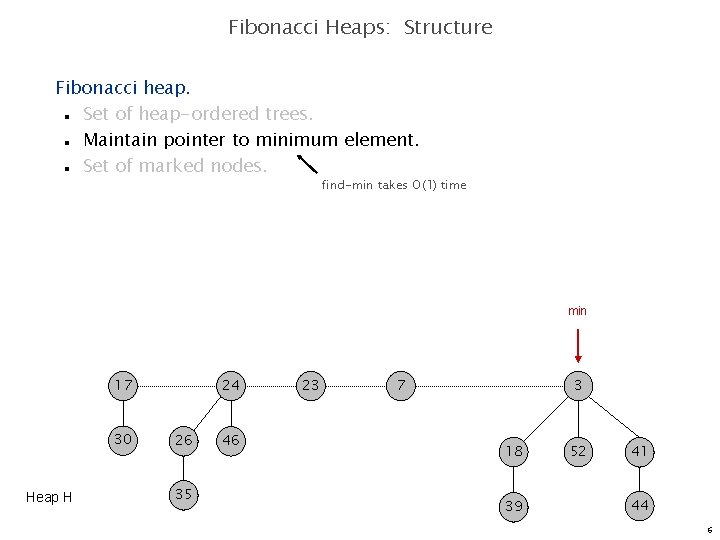
Fibonacci Heaps: Structure Fibonacci heap. Set of heap-ordered trees. Maintain pointer to minimum element. Set of marked nodes. n n n find-min takes O(1) time min 17 30 Heap H 24 26 35 46 23 7 3 18 39 52 41 44 6
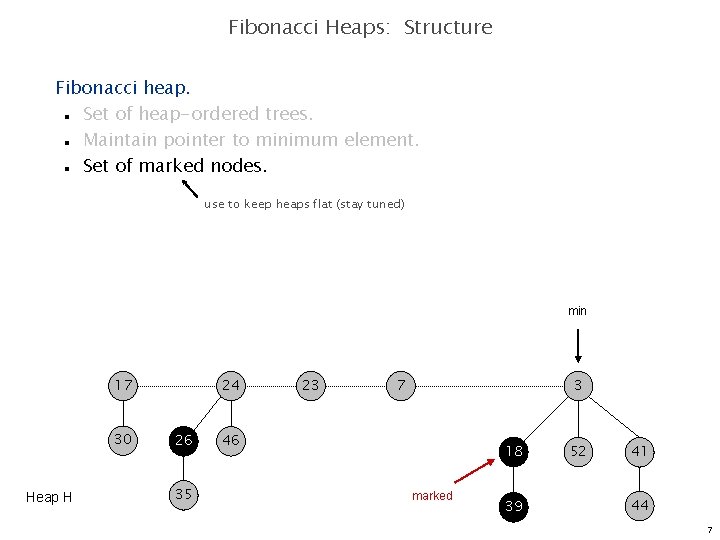
Fibonacci Heaps: Structure Fibonacci heap. Set of heap-ordered trees. Maintain pointer to minimum element. Set of marked nodes. n n n use to keep heaps flat (stay tuned) min 17 30 Heap H 24 26 35 23 7 3 46 18 marked 39 52 41 44 7
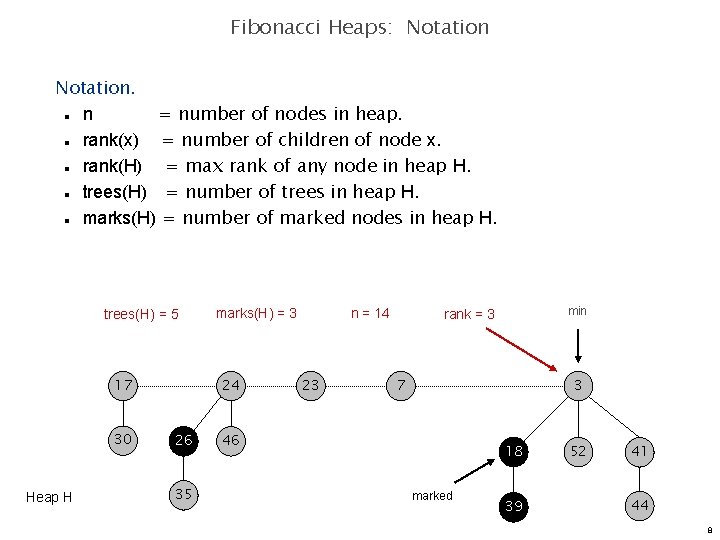
Fibonacci Heaps: Notation. n = number of nodes in heap. rank(x) = number of children of node x. rank(H) = max rank of any node in heap H. trees(H) = number of trees in heap H. marks(H) = number of marked nodes in heap H. n n n trees(H) = 5 17 30 Heap H marks(H) = 3 24 26 35 n = 14 23 rank = 3 7 min 3 46 18 marked 39 52 41 44 8
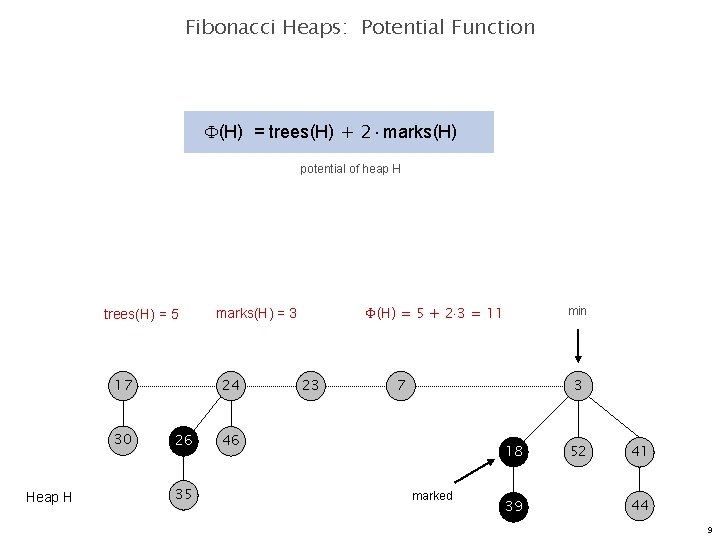
Fibonacci Heaps: Potential Function (H) = trees(H) + 2 marks(H) potential of heap H trees(H) = 5 17 30 Heap H 24 26 35 (H) = 5 + 2 3 = 11 marks(H) = 3 23 min 7 3 46 18 marked 39 52 41 44 9
Insert 10
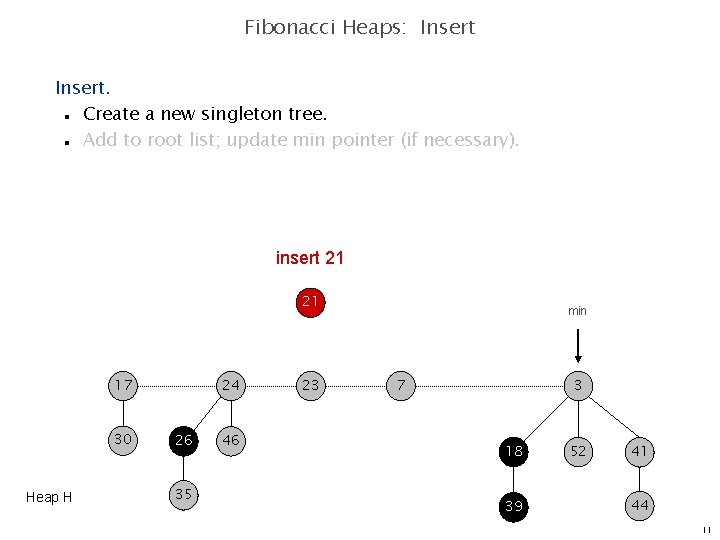
Fibonacci Heaps: Insert. Create a new singleton tree. Add to root list; update min pointer (if necessary). n n insert 21 21 17 30 Heap H 24 26 35 46 23 min 7 3 18 39 52 41 44 11
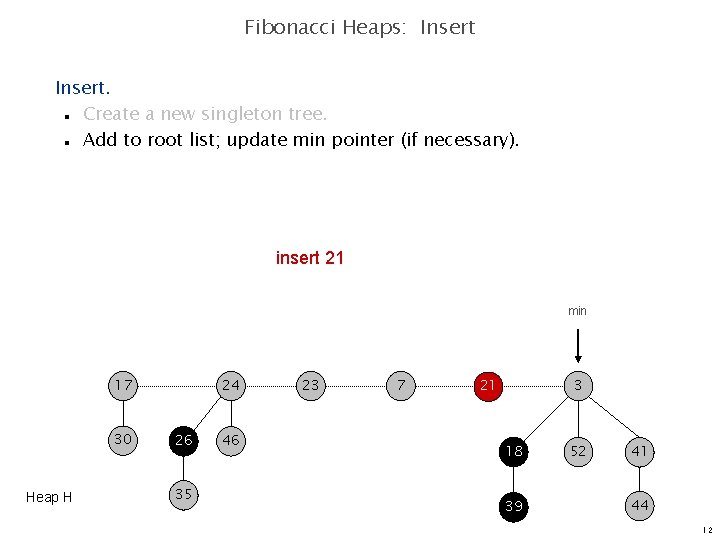
Fibonacci Heaps: Insert. Create a new singleton tree. Add to root list; update min pointer (if necessary). n n insert 21 min 17 30 Heap H 24 26 35 46 23 7 3 21 18 39 52 41 44 12

Fibonacci Heaps: Insert Analysis Actual cost. O(1) (H) = trees(H) + 2 marks(H) Change in potential. +1 potential of heap H Amortized cost. O(1) min 17 30 Heap H 24 26 35 46 23 7 3 21 18 39 52 41 44 13
Delete Min 14
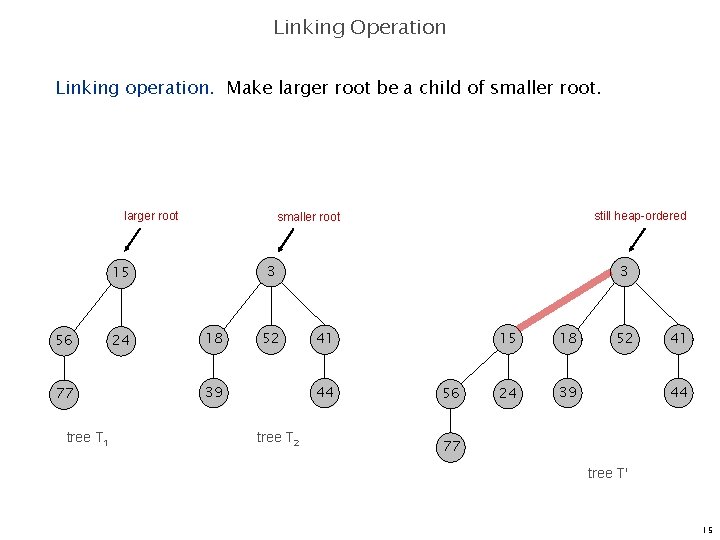
Linking Operation Linking operation. Make larger root be a child of smaller root. larger root 77 tree T 1 24 3 3 15 56 still heap-ordered smaller root 18 52 39 41 44 tree T 2 56 15 18 24 39 52 41 44 77 tree T' 15
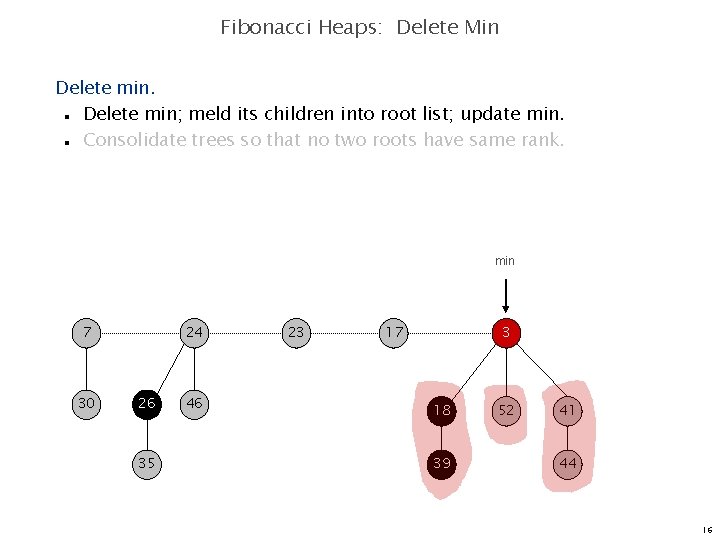
Fibonacci Heaps: Delete Min Delete min; meld its children into root list; update min. Consolidate trees so that no two roots have same rank. n n min 7 30 24 26 35 46 23 17 3 18 39 52 41 44 16
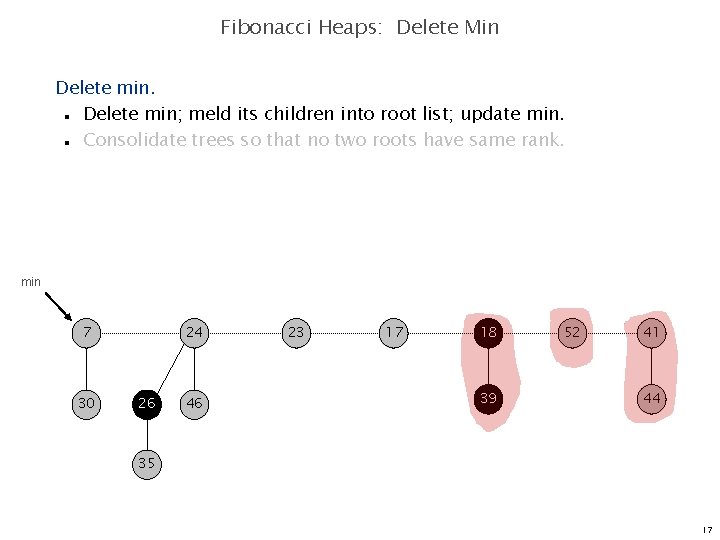
Fibonacci Heaps: Delete Min Delete min; meld its children into root list; update min. Consolidate trees so that no two roots have same rank. n n min 7 30 24 26 46 23 17 18 39 52 41 44 35 17
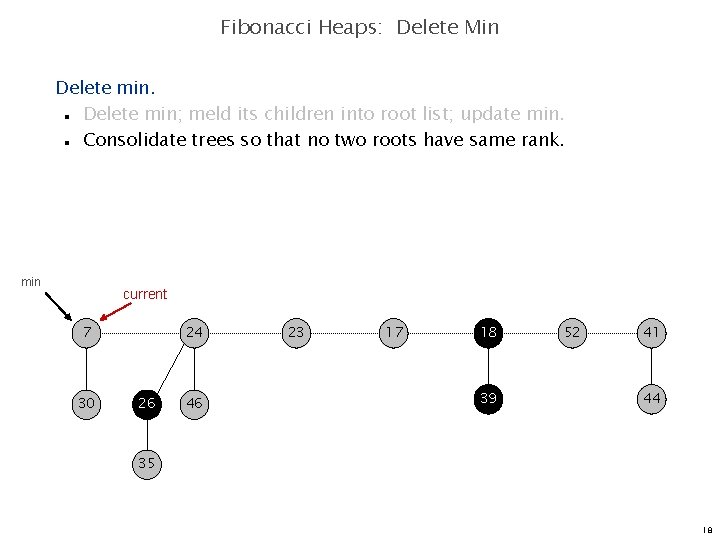
Fibonacci Heaps: Delete Min Delete min; meld its children into root list; update min. Consolidate trees so that no two roots have same rank. n n min current 7 30 24 26 46 23 17 18 39 52 41 44 35 18
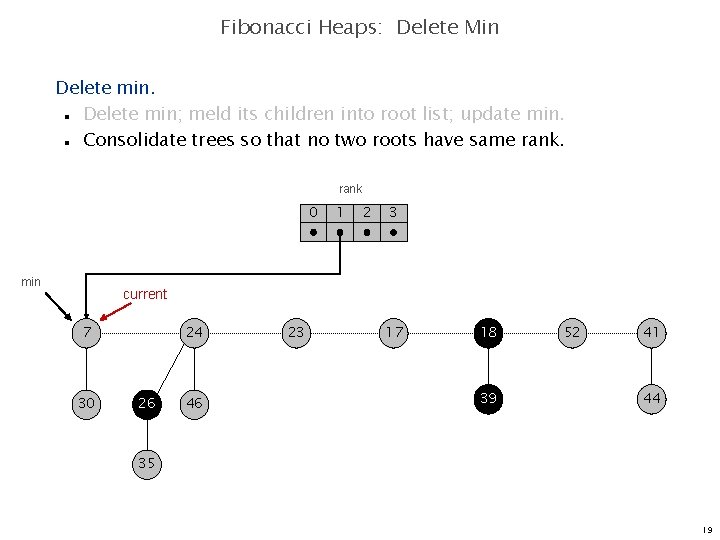
Fibonacci Heaps: Delete Min Delete min; meld its children into root list; update min. Consolidate trees so that no two roots have same rank. n n rank 0 min 1 2 3 current 7 30 24 26 46 23 17 18 39 52 41 44 35 19
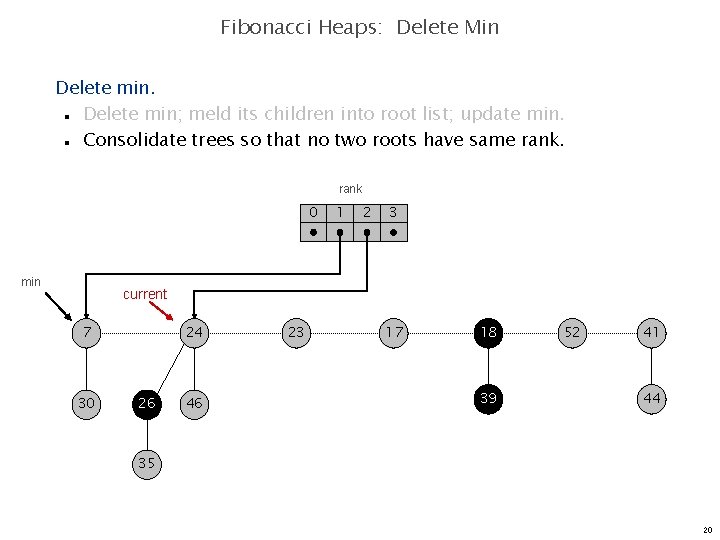
Fibonacci Heaps: Delete Min Delete min; meld its children into root list; update min. Consolidate trees so that no two roots have same rank. n n rank 0 min 1 2 3 current 7 30 24 26 46 23 17 18 39 52 41 44 35 20
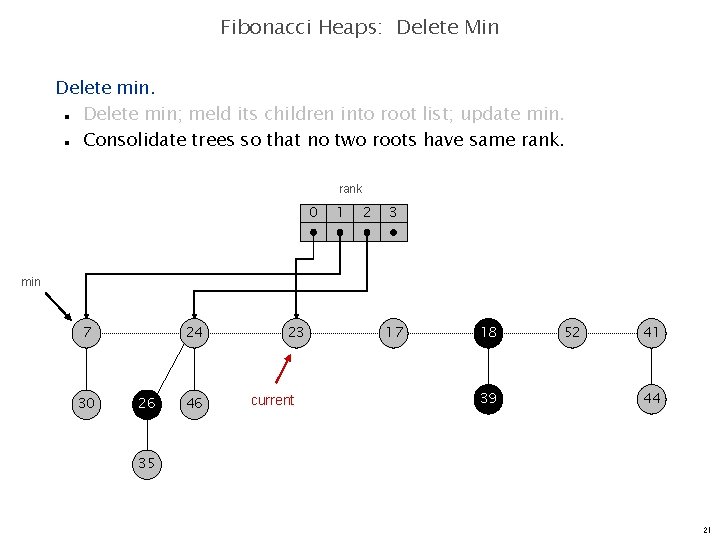
Fibonacci Heaps: Delete Min Delete min; meld its children into root list; update min. Consolidate trees so that no two roots have same rank. n n rank 0 1 2 3 min 7 30 24 26 46 23 current 17 18 39 52 41 44 35 21
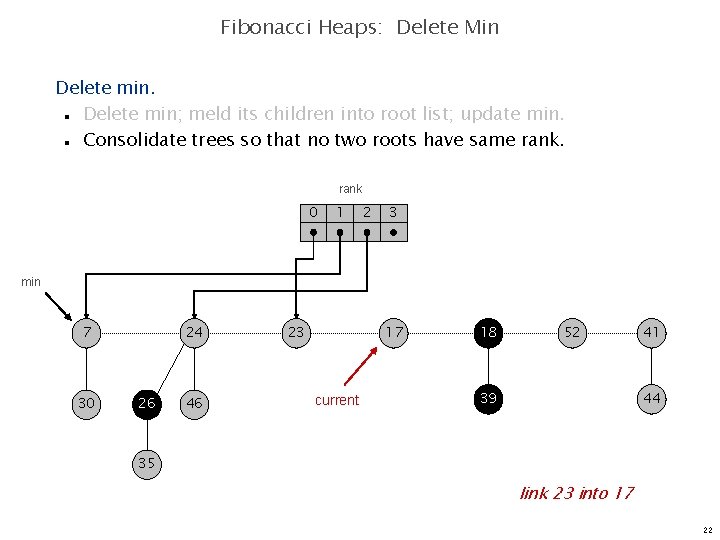
Fibonacci Heaps: Delete Min Delete min; meld its children into root list; update min. Consolidate trees so that no two roots have same rank. n n rank 0 1 2 3 min 7 30 24 26 46 23 17 current 18 52 39 41 44 35 link 23 into 17 22
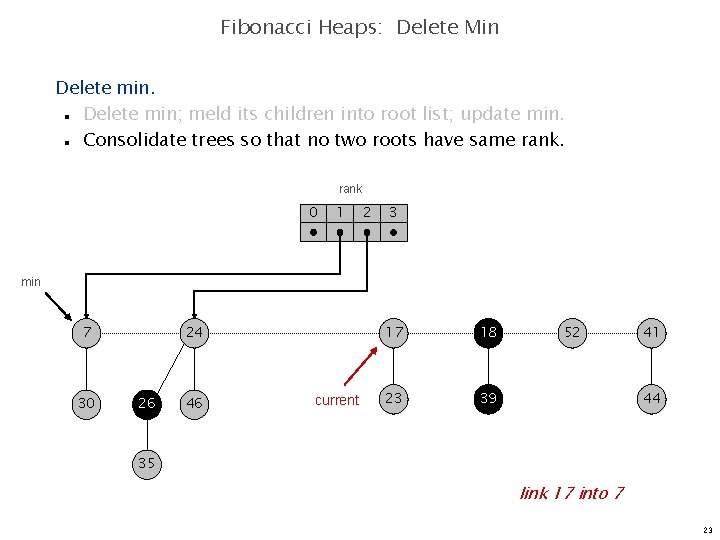
Fibonacci Heaps: Delete Min Delete min; meld its children into root list; update min. Consolidate trees so that no two roots have same rank. n n rank 0 1 2 3 min 7 30 24 26 46 current 17 18 23 39 52 41 44 35 link 17 into 7 23
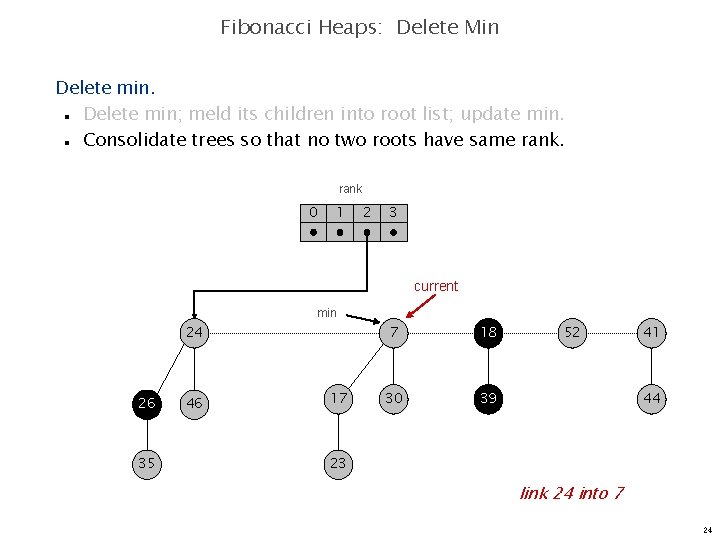
Fibonacci Heaps: Delete Min Delete min; meld its children into root list; update min. Consolidate trees so that no two roots have same rank. n n rank 0 1 2 3 current min 24 26 35 46 17 7 18 30 39 52 41 44 23 link 24 into 7 24
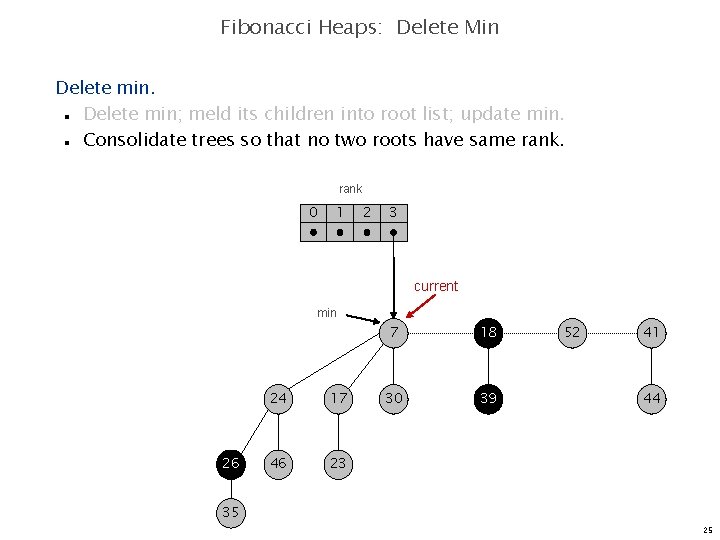
Fibonacci Heaps: Delete Min Delete min; meld its children into root list; update min. Consolidate trees so that no two roots have same rank. n n rank 0 1 2 3 current min 26 24 17 46 23 7 18 30 39 52 41 44 35 25
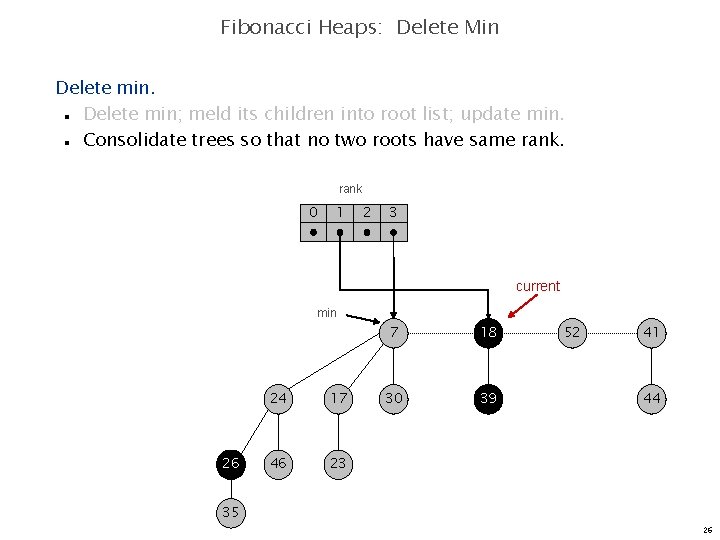
Fibonacci Heaps: Delete Min Delete min; meld its children into root list; update min. Consolidate trees so that no two roots have same rank. n n rank 0 1 2 3 current min 26 24 17 46 23 7 18 30 39 52 41 44 35 26
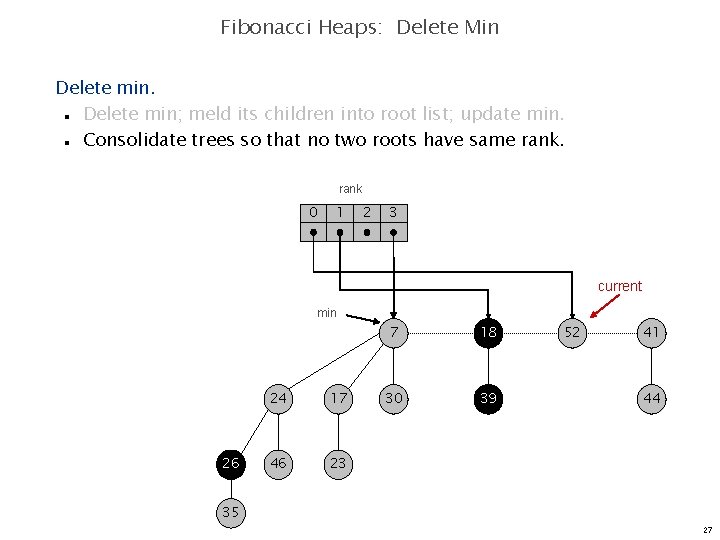
Fibonacci Heaps: Delete Min Delete min; meld its children into root list; update min. Consolidate trees so that no two roots have same rank. n n rank 0 1 2 3 current min 26 24 17 46 23 7 18 30 39 52 41 44 35 27
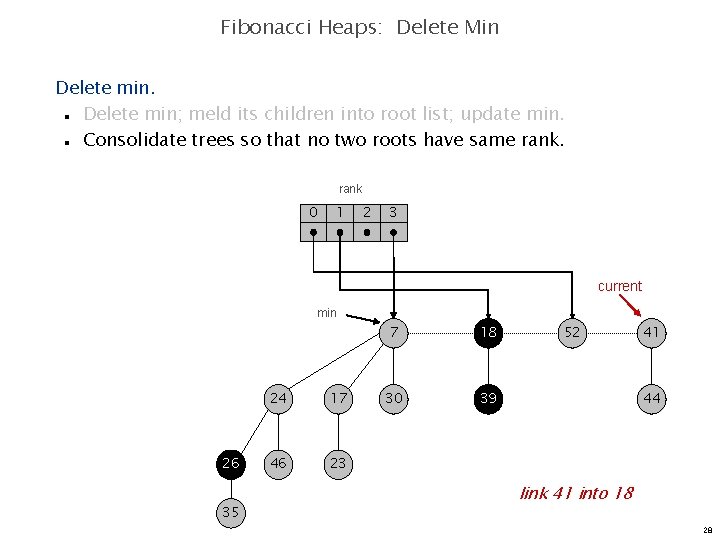
Fibonacci Heaps: Delete Min Delete min; meld its children into root list; update min. Consolidate trees so that no two roots have same rank. n n rank 0 1 2 3 current min 26 35 24 17 46 23 7 18 30 39 52 41 44 link 41 into 18 28
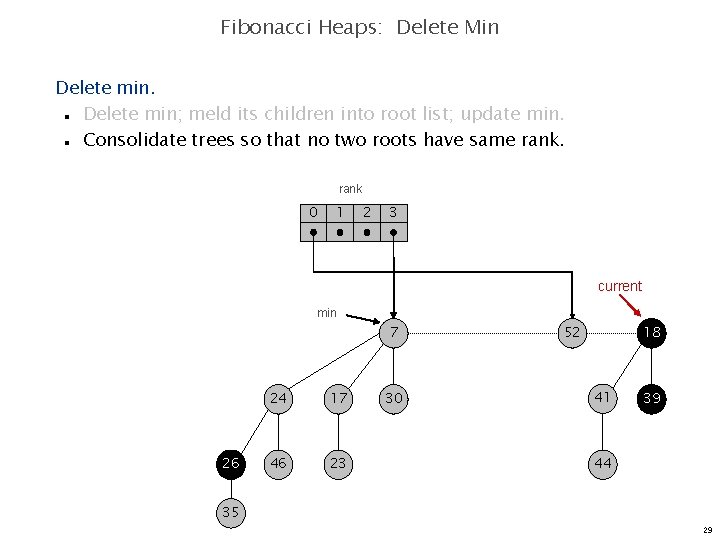
Fibonacci Heaps: Delete Min Delete min; meld its children into root list; update min. Consolidate trees so that no two roots have same rank. n n rank 0 1 2 3 current min 7 26 24 17 46 23 30 52 18 41 39 44 35 29
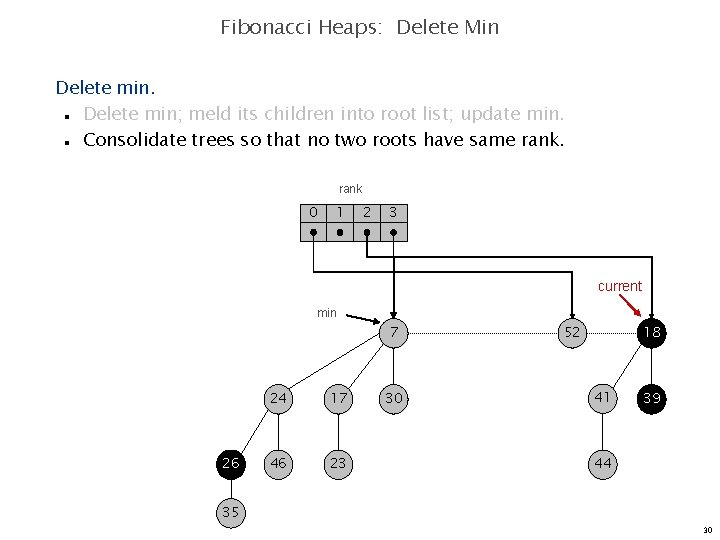
Fibonacci Heaps: Delete Min Delete min; meld its children into root list; update min. Consolidate trees so that no two roots have same rank. n n rank 0 1 2 3 current min 7 26 24 17 46 23 30 52 18 41 39 44 35 30
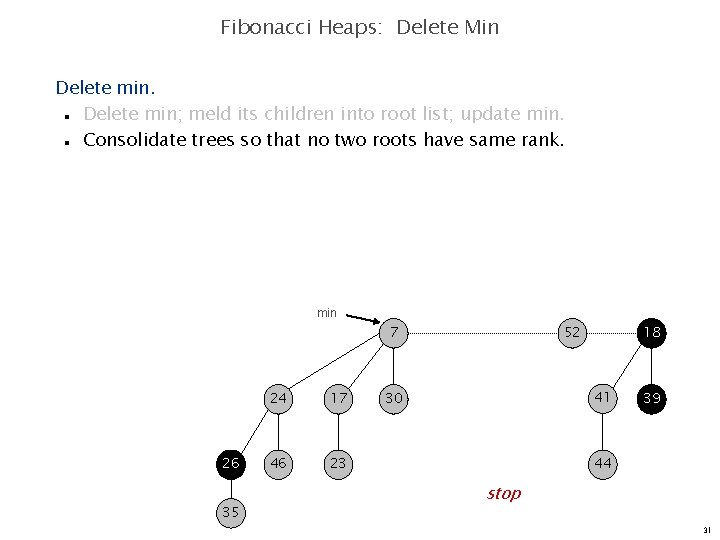
Fibonacci Heaps: Delete Min Delete min; meld its children into root list; update min. Consolidate trees so that no two roots have same rank. n n min 7 26 35 24 17 46 23 52 18 41 30 39 44 stop 31
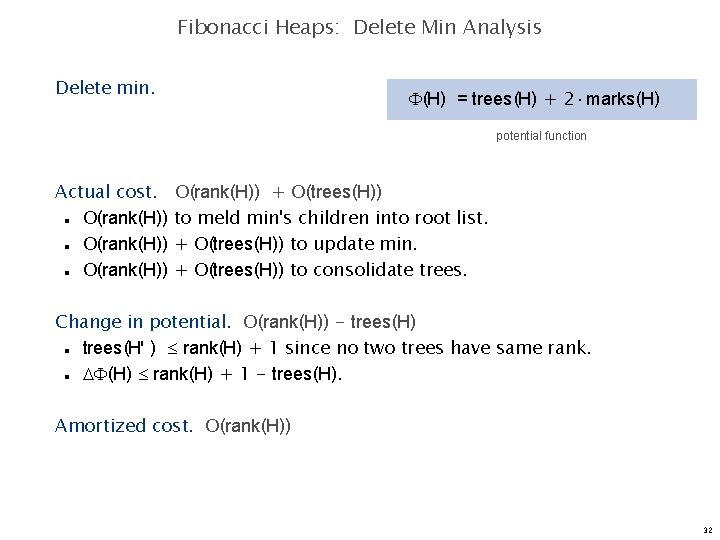
Fibonacci Heaps: Delete Min Analysis Delete min. (H) = trees(H) + 2 marks(H) potential function Actual cost. O(rank(H)) n n n O(rank(H)) + O(trees(H)) to meld min's children into root list. + O(trees(H)) to update min. + O(trees(H)) to consolidate trees. Change in potential. O(rank(H)) - trees(H) trees(H' ) rank(H) + 1 since no two trees have same rank. (H) rank(H) + 1 - trees(H). n n Amortized cost. O(rank(H)) 32
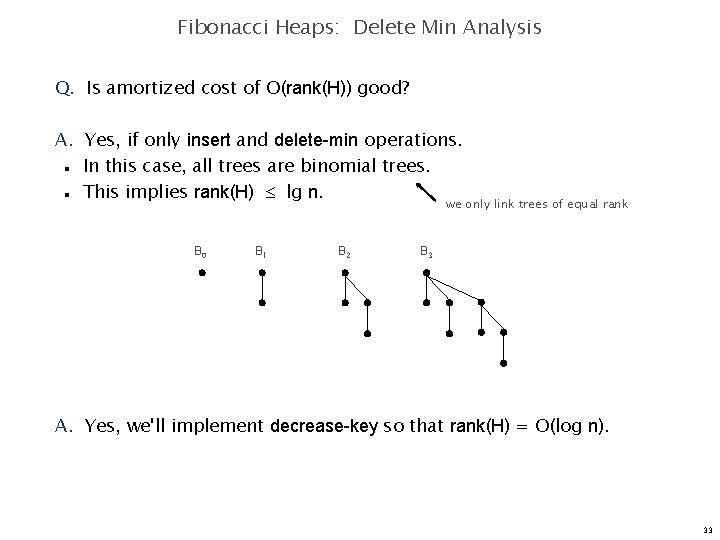
Fibonacci Heaps: Delete Min Analysis Q. Is amortized cost of O(rank(H)) good? A. Yes, if only insert and delete-min operations. In this case, all trees are binomial trees. This implies rank(H) lg n. n n we only link trees of equal rank B 0 B 1 B 2 B 3 A. Yes, we'll implement decrease-key so that rank(H) = O(log n). 33
Decrease Key 34
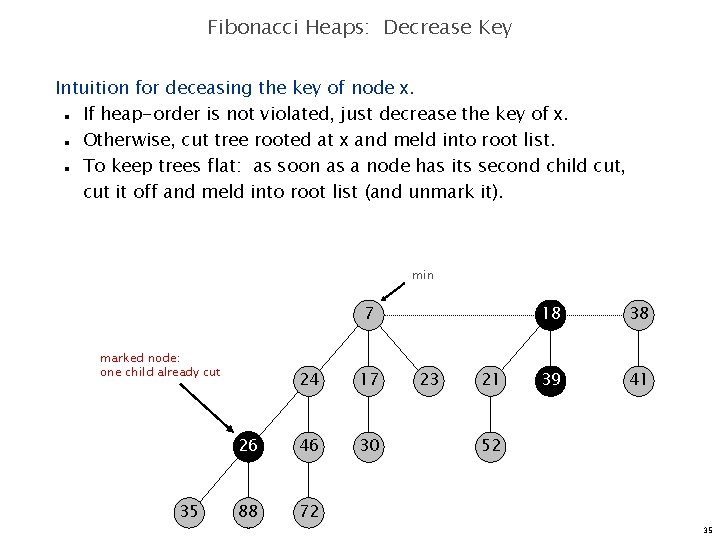
Fibonacci Heaps: Decrease Key Intuition for deceasing the key of node x. If heap-order is not violated, just decrease the key of x. Otherwise, cut tree rooted at x and meld into root list. To keep trees flat: as soon as a node has its second child cut, cut it off and meld into root list (and unmark it). n n n min 7 marked node: one child already cut 35 24 17 26 46 30 88 72 23 21 18 38 39 41 52 35
![Fibonacci Heaps: Decrease Key Case 1. [heap order not violated] Decrease key of x.](http://slidetodoc.com/presentation_image/4d6cc08239941e2fbf8e5195968ed750/image-36.jpg "Fibonacci Heaps: Decrease Key Case 1. [heap order not violated] Decrease key of x.")
Fibonacci Heaps: Decrease Key Case 1. [heap order not violated] Decrease key of x. Change heap min pointer (if necessary). n n min 7 26 24 17 46 29 30 23 21 18 38 39 41 52 x 35 88 72 decrease-key of x from 46 to 29 36
![Fibonacci Heaps: Decrease Key Case 1. [heap order not violated] Decrease key of x.](http://slidetodoc.com/presentation_image/4d6cc08239941e2fbf8e5195968ed750/image-37.jpg "Fibonacci Heaps: Decrease Key Case 1. [heap order not violated] Decrease key of x.")
Fibonacci Heaps: Decrease Key Case 1. [heap order not violated] Decrease key of x. Change heap min pointer (if necessary). n n min 7 26 24 17 29 30 23 21 18 38 39 41 52 x 35 88 72 decrease-key of x from 46 to 29 37
![Fibonacci Heaps: Decrease Key Case 2 a. [heap order violated] Decrease key of x.](http://slidetodoc.com/presentation_image/4d6cc08239941e2fbf8e5195968ed750/image-38.jpg "Fibonacci Heaps: Decrease Key Case 2 a. [heap order violated] Decrease key of x.")
Fibonacci Heaps: Decrease Key Case 2 a. [heap order violated] Decrease key of x. Cut tree rooted at x, meld into root list, and unmark. If parent p of x is unmarked (hasn't yet lost a child), mark it; Otherwise, cut p, meld into root list, and unmark (and do so recursively for all ancestors that lose a second child). n n n min 7 24 17 23 21 18 38 39 41 p 26 29 15 30 52 x 35 88 72 decrease-key of x from 29 to 15 38
![Fibonacci Heaps: Decrease Key Case 2 a. [heap order violated] Decrease key of x.](http://slidetodoc.com/presentation_image/4d6cc08239941e2fbf8e5195968ed750/image-39.jpg "Fibonacci Heaps: Decrease Key Case 2 a. [heap order violated] Decrease key of x.")
Fibonacci Heaps: Decrease Key Case 2 a. [heap order violated] Decrease key of x. Cut tree rooted at x, meld into root list, and unmark. If parent p of x is unmarked (hasn't yet lost a child), mark it; Otherwise, cut p, meld into root list, and unmark (and do so recursively for all ancestors that lose a second child). n n n min 7 24 17 23 21 18 38 39 41 p 26 15 30 52 x 35 88 72 decrease-key of x from 29 to 15 39
![Fibonacci Heaps: Decrease Key Case 2 a. [heap order violated] Decrease key of x.](http://slidetodoc.com/presentation_image/4d6cc08239941e2fbf8e5195968ed750/image-40.jpg "Fibonacci Heaps: Decrease Key Case 2 a. [heap order violated] Decrease key of x.")
Fibonacci Heaps: Decrease Key Case 2 a. [heap order violated] Decrease key of x. Cut tree rooted at x, meld into root list, and unmark. If parent p of x is unmarked (hasn't yet lost a child), mark it; Otherwise, cut p, meld into root list, and unmark (and do so recursively for all ancestors that lose a second child). n n n x min 15 7 72 24 17 23 21 18 38 39 41 p 26 35 88 30 52 decrease-key of x from 29 to 15 40
![Fibonacci Heaps: Decrease Key Case 2 a. [heap order violated] Decrease key of x.](http://slidetodoc.com/presentation_image/4d6cc08239941e2fbf8e5195968ed750/image-41.jpg "Fibonacci Heaps: Decrease Key Case 2 a. [heap order violated] Decrease key of x.")
Fibonacci Heaps: Decrease Key Case 2 a. [heap order violated] Decrease key of x. Cut tree rooted at x, meld into root list, and unmark. If parent p of x is unmarked (hasn't yet lost a child), mark it; Otherwise, cut p, meld into root list, and unmark (and do so recursively for all ancestors that lose a second child). n n n x min 15 7 72 24 23 21 38 39 41 p mark parent 26 35 17 18 88 30 52 decrease-key of x from 29 to 15 41
![Fibonacci Heaps: Decrease Key Case 2 b. [heap order violated] Decrease key of x.](http://slidetodoc.com/presentation_image/4d6cc08239941e2fbf8e5195968ed750/image-42.jpg "Fibonacci Heaps: Decrease Key Case 2 b. [heap order violated] Decrease key of x.")
Fibonacci Heaps: Decrease Key Case 2 b. [heap order violated] Decrease key of x. Cut tree rooted at x, meld into root list, and unmark. If parent p of x is unmarked (hasn't yet lost a child), mark it; Otherwise, cut p, meld into root list, and unmark (and do so recursively for all ancestors that lose a second child). n n n min 15 7 72 24 p x 35 5 26 88 17 30 23 21 18 38 39 41 52 decrease-key of x from 35 to 5 42
![Fibonacci Heaps: Decrease Key Case 2 b. [heap order violated] Decrease key of x.](http://slidetodoc.com/presentation_image/4d6cc08239941e2fbf8e5195968ed750/image-43.jpg "Fibonacci Heaps: Decrease Key Case 2 b. [heap order violated] Decrease key of x.")
Fibonacci Heaps: Decrease Key Case 2 b. [heap order violated] Decrease key of x. Cut tree rooted at x, meld into root list, and unmark. If parent p of x is unmarked (hasn't yet lost a child), mark it; Otherwise, cut p, meld into root list, and unmark (and do so recursively for all ancestors that lose a second child). n n n min 15 7 72 24 p x 5 26 88 17 30 23 21 18 38 39 41 52 decrease-key of x from 35 to 5 43
![Fibonacci Heaps: Decrease Key Case 2 b. [heap order violated] Decrease key of x.](http://slidetodoc.com/presentation_image/4d6cc08239941e2fbf8e5195968ed750/image-44.jpg "Fibonacci Heaps: Decrease Key Case 2 b. [heap order violated] Decrease key of x.")
Fibonacci Heaps: Decrease Key Case 2 b. [heap order violated] Decrease key of x. Cut tree rooted at x, meld into root list, and unmark. If parent p of x is unmarked (hasn't yet lost a child), mark it; Otherwise, cut p, meld into root list, and unmark (and do so recursively for all ancestors that lose a second child). n n n min 15 x 5 7 72 24 p 26 88 17 30 23 21 18 38 39 41 52 decrease-key of x from 35 to 5 44
![Fibonacci Heaps: Decrease Key Case 2 b. [heap order violated] Decrease key of x.](http://slidetodoc.com/presentation_image/4d6cc08239941e2fbf8e5195968ed750/image-45.jpg "Fibonacci Heaps: Decrease Key Case 2 b. [heap order violated] Decrease key of x.")
Fibonacci Heaps: Decrease Key Case 2 b. [heap order violated] Decrease key of x. Cut tree rooted at x, meld into root list, and unmark. If parent p of x is unmarked (hasn't yet lost a child), mark it; Otherwise, cut p, meld into root list, and unmark (and do so recursively for all ancestors that lose a second child). n n n min 15 72 x 5 7 24 second child cut p 26 88 17 30 23 21 18 38 39 41 52 decrease-key of x from 35 to 5 45
![Fibonacci Heaps: Decrease Key Case 2 b. [heap order violated] Decrease key of x.](http://slidetodoc.com/presentation_image/4d6cc08239941e2fbf8e5195968ed750/image-46.jpg "Fibonacci Heaps: Decrease Key Case 2 b. [heap order violated] Decrease key of x.")
Fibonacci Heaps: Decrease Key Case 2 b. [heap order violated] Decrease key of x. Cut tree rooted at x, meld into root list, and unmark. If parent p of x is unmarked (hasn't yet lost a child), mark it; Otherwise, cut p, meld into root list, and unmark (and do so recursively for all ancestors that lose a second child). n n n min 15 72 x p 5 26 88 7 24 17 30 23 21 18 38 39 41 52 decrease-key of x from 35 to 5 46
![Fibonacci Heaps: Decrease Key Case 2 b. [heap order violated] Decrease key of x.](http://slidetodoc.com/presentation_image/4d6cc08239941e2fbf8e5195968ed750/image-47.jpg "Fibonacci Heaps: Decrease Key Case 2 b. [heap order violated] Decrease key of x.")
Fibonacci Heaps: Decrease Key Case 2 b. [heap order violated] Decrease key of x. Cut tree rooted at x, meld into root list, and unmark. If parent p of x is unmarked (hasn't yet lost a child), mark it; Otherwise, cut p, meld into root list, and unmark (and do so recursively for all ancestors that lose a second child). n n n min 15 72 x p 5 26 88 7 p' second child cut 24 17 30 23 21 18 38 39 41 52 decrease-key of x from 35 to 5 47
![Fibonacci Heaps: Decrease Key Case 2 b. [heap order violated] Decrease key of x.](http://slidetodoc.com/presentation_image/4d6cc08239941e2fbf8e5195968ed750/image-48.jpg "Fibonacci Heaps: Decrease Key Case 2 b. [heap order violated] Decrease key of x.")
Fibonacci Heaps: Decrease Key Case 2 b. [heap order violated] Decrease key of x. Cut tree rooted at x, meld into root list, and unmark. If parent p of x is unmarked (hasn't yet lost a child), mark it; Otherwise, cut p, meld into root list, and unmark (and do so recursively for all ancestors that lose a second child). n n n min 15 72 x p p' p'' 5 26 24 7 88 don't mark parent if it's a root 17 30 23 21 18 38 39 41 52 decrease-key of x from 35 to 5 48
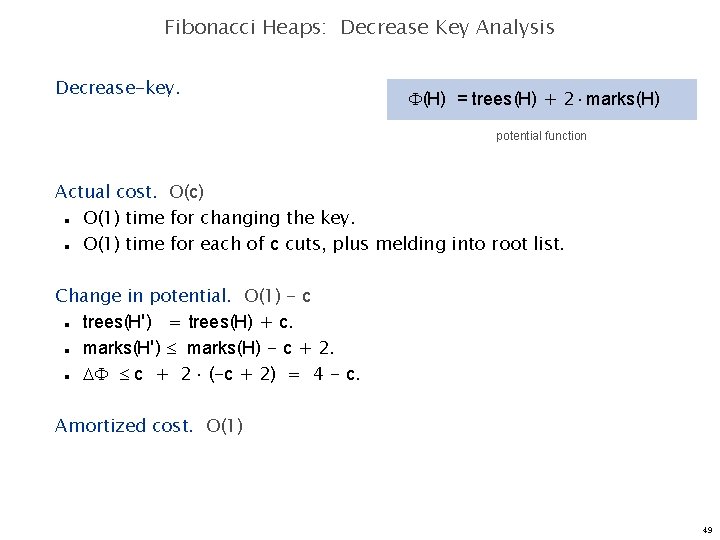
Fibonacci Heaps: Decrease Key Analysis Decrease-key. (H) = trees(H) + 2 marks(H) potential function Actual cost. O(c) O(1) time for changing the key. O(1) time for each of c cuts, plus melding into root list. n n Change in potential. O(1) - c trees(H') = trees(H) + c. marks(H') marks(H) - c + 2 (-c + 2) = 4 - c. n n n Amortized cost. O(1) 49
Analysis 50
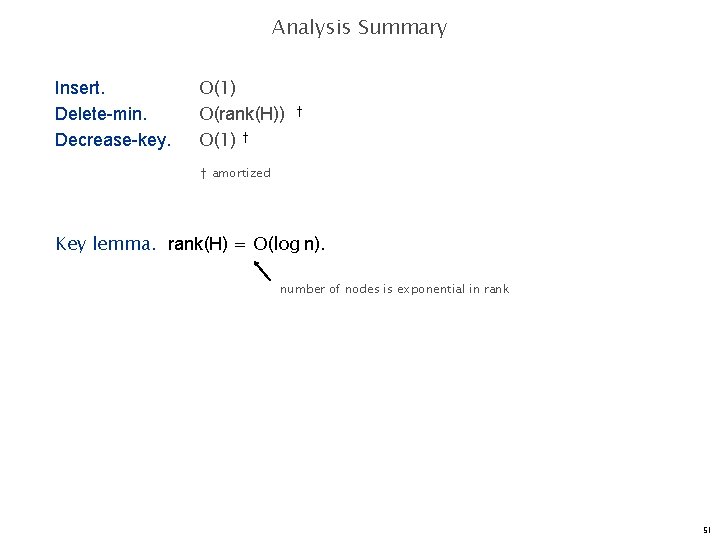
Analysis Summary Insert. Delete-min. Decrease-key. O(1) O(rank(H)) O(1) † † † amortized Key lemma. rank(H) = O(log n). number of nodes is exponential in rank 51
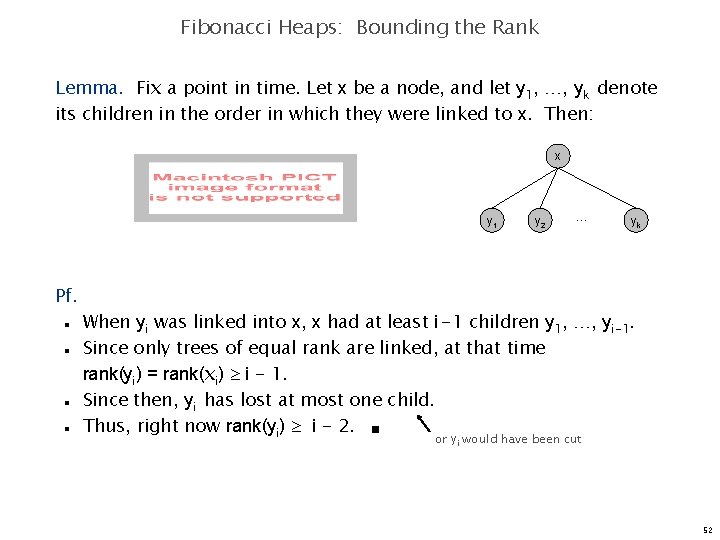
Fibonacci Heaps: Bounding the Rank Lemma. Fix a point in time. Let x be a node, and let y 1, …, yk denote its children in the order in which they were linked to x. Then: x y 1 Pf. n n y 2 … yk When yi was linked into x, x had at least i -1 children y 1, …, yi-1. Since only trees of equal rank are linked, at that time rank(yi) = rank(xi) i - 1. Since then, yi has lost at most one child. Thus, right now rank(yi) i - 2. or yi would have been cut 52
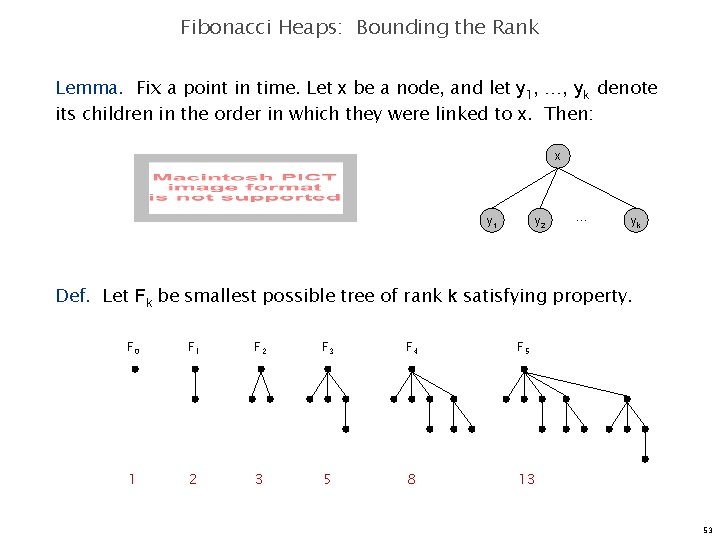
Fibonacci Heaps: Bounding the Rank Lemma. Fix a point in time. Let x be a node, and let y 1, …, yk denote its children in the order in which they were linked to x. Then: x y 1 y 2 … yk Def. Let Fk be smallest possible tree of rank k satisfying property. F 0 F 1 F 2 F 3 F 4 F 5 1 2 3 5 8 13 53
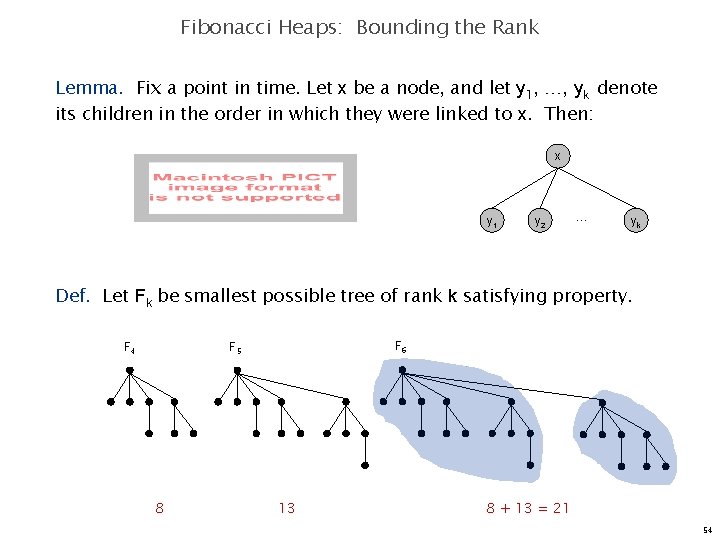
Fibonacci Heaps: Bounding the Rank Lemma. Fix a point in time. Let x be a node, and let y 1, …, yk denote its children in the order in which they were linked to x. Then: x y 1 y 2 … yk Def. Let Fk be smallest possible tree of rank k satisfying property. F 4 F 6 F 5 8 13 8 + 13 = 21 54
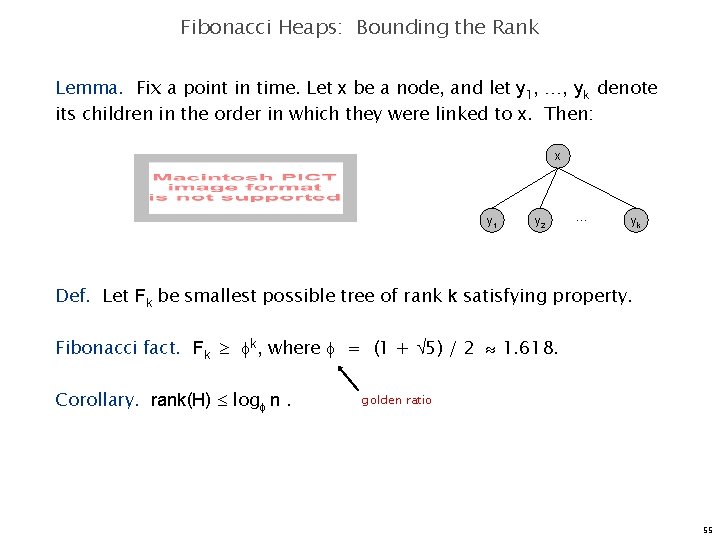
Fibonacci Heaps: Bounding the Rank Lemma. Fix a point in time. Let x be a node, and let y 1, …, yk denote its children in the order in which they were linked to x. Then: x y 1 y 2 … yk Def. Let Fk be smallest possible tree of rank k satisfying property. Fibonacci fact. Fk k, where = (1 + 5) / 2 1. 618. Corollary. rank(H) log n. golden ratio 55
Fibonacci Numbers 56
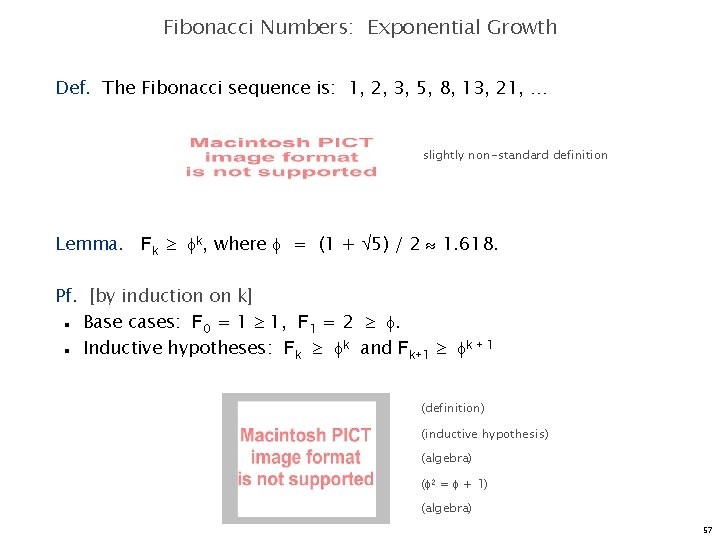
Fibonacci Numbers: Exponential Growth Def. The Fibonacci sequence is: 1, 2, 3, 5, 8, 13, 21, … slightly non-standard definition Lemma. Fk k, where = (1 + 5) / 2 1. 618. Pf. [by induction on k] Base cases: F 0 = 1 1, F 1 = 2 . Inductive hypotheses: Fk k and Fk+1 k + 1 n n (definition) (inductive hypothesis) (algebra) ( 2 = + 1) (algebra) 57
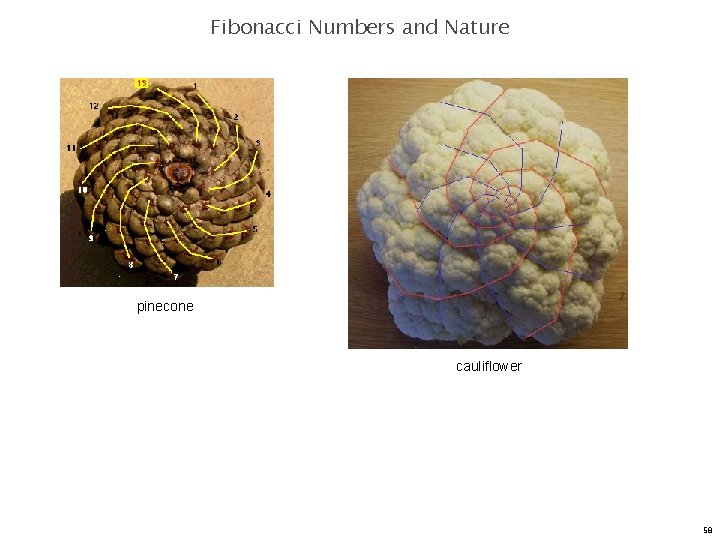
Fibonacci Numbers and Nature pinecone cauliflower 58
Union 59
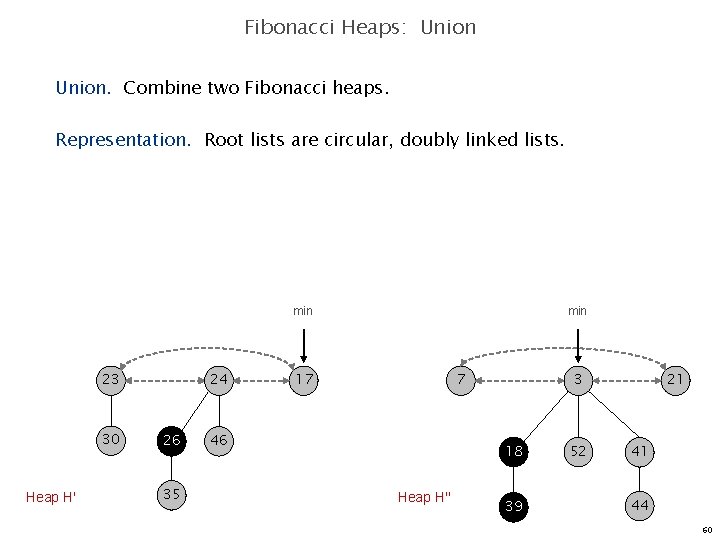
Fibonacci Heaps: Union. Combine two Fibonacci heaps. Representation. Root lists are circular, doubly linked lists. min 23 30 Heap H' 24 26 35 min 17 7 46 3 18 Heap H'' 39 52 21 41 44 60
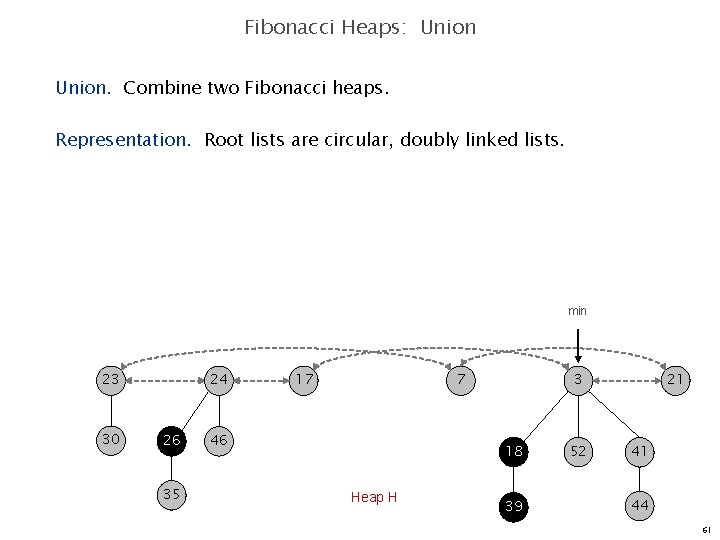
Fibonacci Heaps: Union. Combine two Fibonacci heaps. Representation. Root lists are circular, doubly linked lists. min 23 30 24 26 35 17 7 46 3 18 Heap H 39 52 21 41 44 61
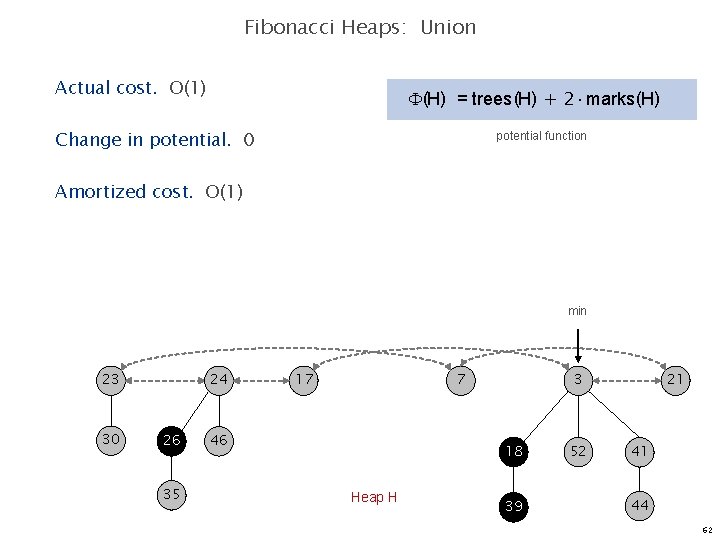
Fibonacci Heaps: Union Actual cost. O(1) (H) = trees(H) + 2 marks(H) Change in potential. 0 potential function Amortized cost. O(1) min 23 30 24 26 35 17 7 46 3 18 Heap H 39 52 21 41 44 62
Delete 63
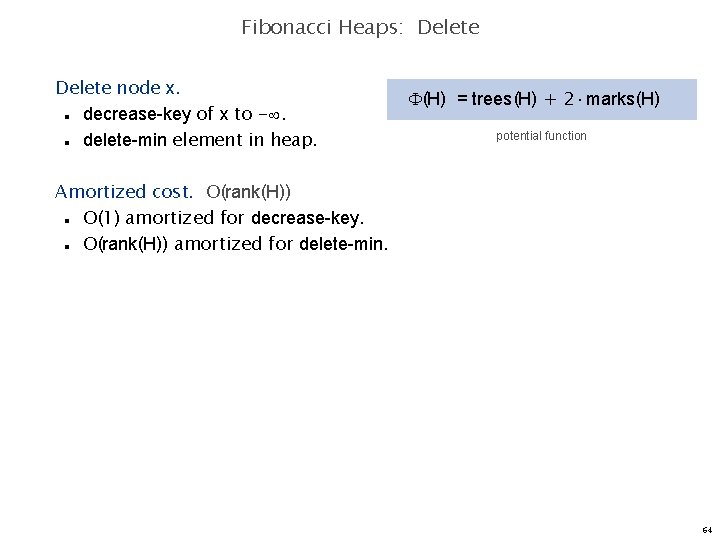
Fibonacci Heaps: Delete node x. decrease-key of x to -. delete-min element in heap. (H) = trees(H) + 2 marks(H) n n potential function Amortized cost. O(rank(H)) O(1) amortized for decrease-key. O(rank(H)) amortized for delete-min. n n 64
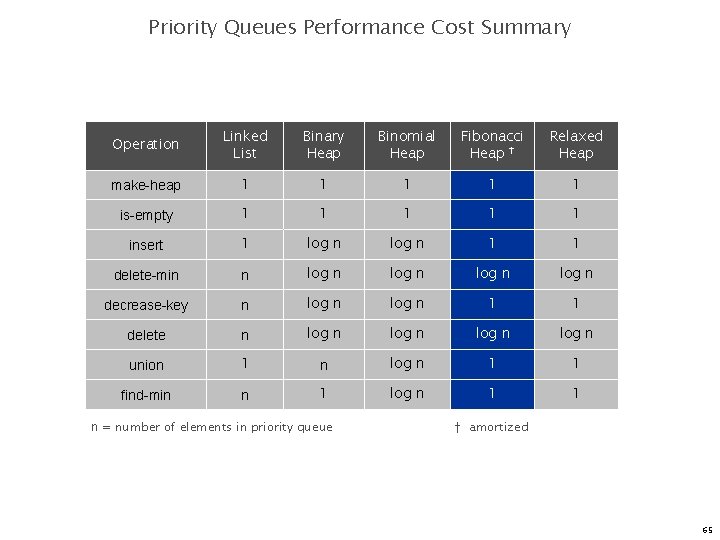
Priority Queues Performance Cost Summary Operation Linked List Binary Heap Binomial Heap Fibonacci Heap † Relaxed Heap make-heap 1 1 1 is-empty 1 1 1 insert 1 log n 1 1 delete-min n log n decrease-key n log n 1 1 delete n log n union 1 n log n 1 1 find-min n 1 log n 1 1 n = number of elements in priority queue † amortized 65
- Slides: 65