
Fibonacci Heap BHFH Why BHFH Max PQ Min

Fibonacci Heap BH&FH
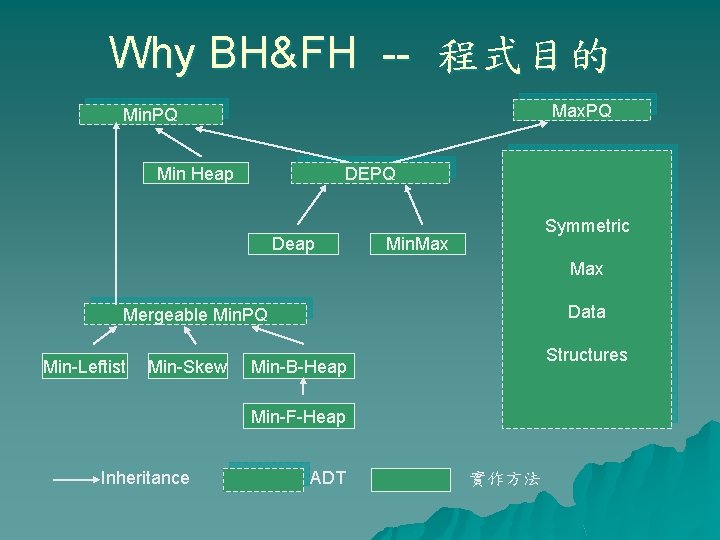
Why BH&FH -- 程式目的 Max. PQ Min Heap DEPQ Deap Symmetric Min. Max Data Mergeable Min. PQ Min-Leftist Min-Skew Structures Min-B-Heap Min-F-Heap Inheritance ADT 實作方法
Why BH&FH -- 舉例 u Server for one priority shuts down。 u Efficient algorithms for Shortest-path problem and finding minimum spanning trees。(Improved network optimization)
What’s BH&FH -- Definition A binomial heap is a collection of binomial trees. u The binomial tree Bk is an ordered tree defined recursively. the binomial tree B 0 consists of a single node. The binomial tree Bk consists of two binomial trees Bk-1 that are linked together: the root of one is the leftmost child of the root of the other. u Like a binomial heap, a Fibonacci heap is a collection of min-heap-ordered trees. The trees in a Fibonacci heap are not constrained to be binomial trees. u
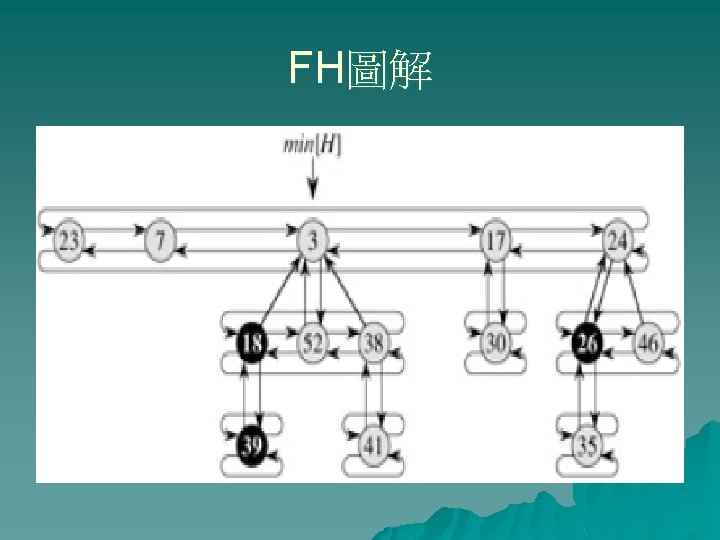
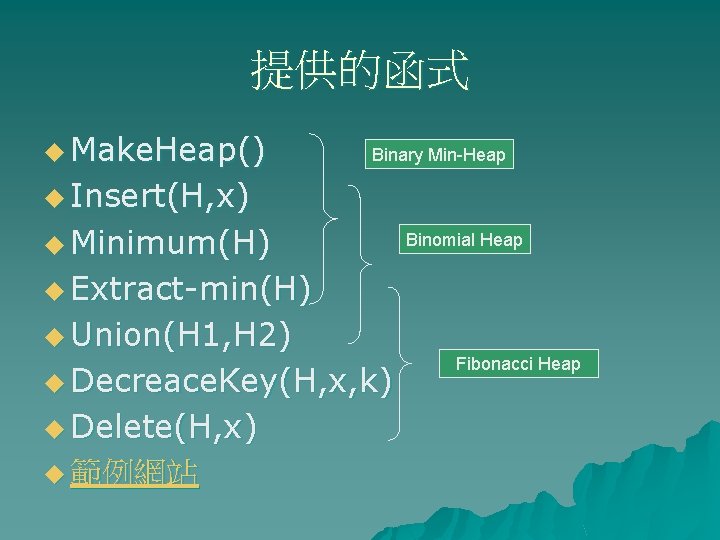
提供的函式 u Make. Heap() Binary Min-Heap u Insert(H, x) u Minimum(H) Binomial Heap u Extract-min(H) u Union(H 1, H 2) u Decreace. Key(H, x, k) u Delete(H, x) u 範例網站 Fibonacci Heap
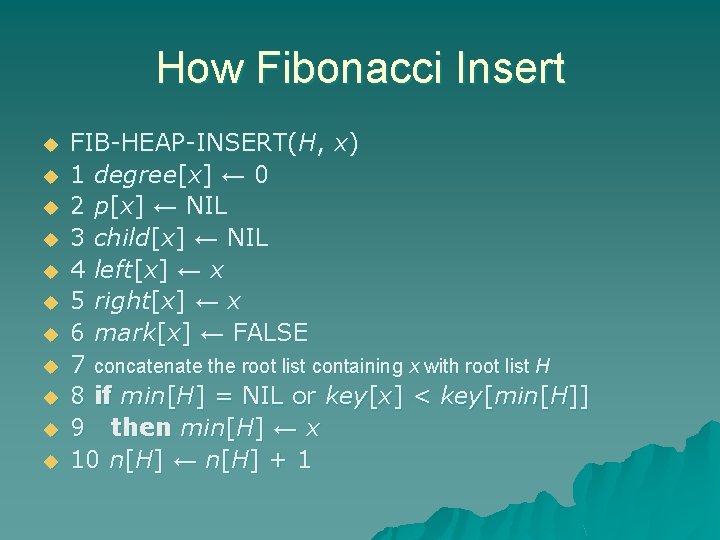
How Fibonacci Insert u u u FIB-HEAP-INSERT(H, x) 1 degree[x] ← 0 2 p[x] ← NIL 3 child[x] ← NIL 4 left[x] ← x 5 right[x] ← x 6 mark[x] ← FALSE 7 concatenate the root list containing x with root list H 8 if min[H] = NIL or key[x] < key[min[H]] 9 then min[H] ← x 10 n[H] ← n[H] + 1
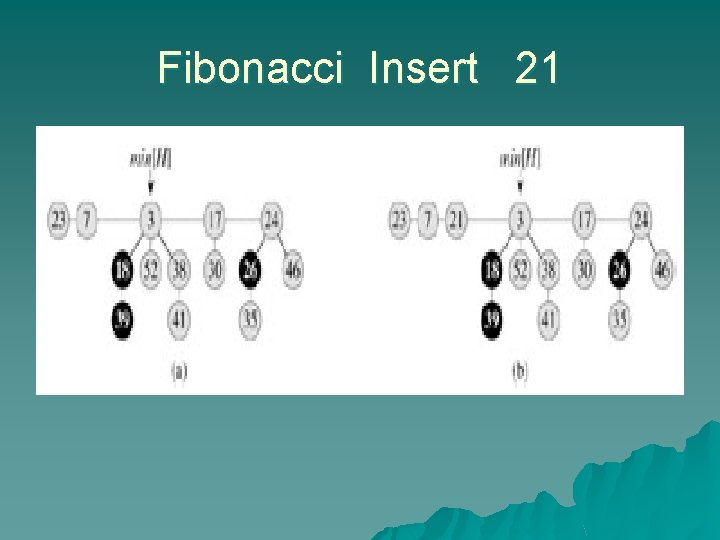
Fibonacci Insert 21
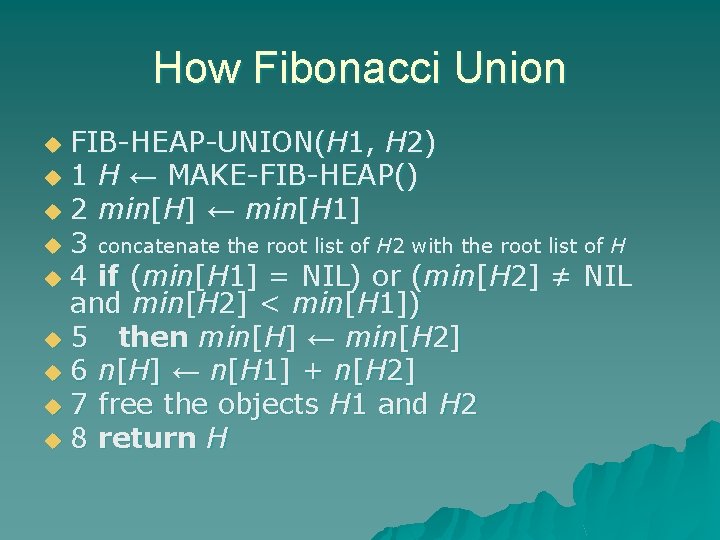
How Fibonacci Union FIB-HEAP-UNION(H 1, H 2) u 1 H ← MAKE-FIB-HEAP() u 2 min[H] ← min[H 1] u 3 concatenate the root list of H 2 with the root list of H u 4 if (min[H 1] = NIL) or (min[H 2] ≠ NIL and min[H 2] < min[H 1]) u 5 then min[H] ← min[H 2] u 6 n[H] ← n[H 1] + n[H 2] u 7 free the objects H 1 and H 2 u 8 return H u
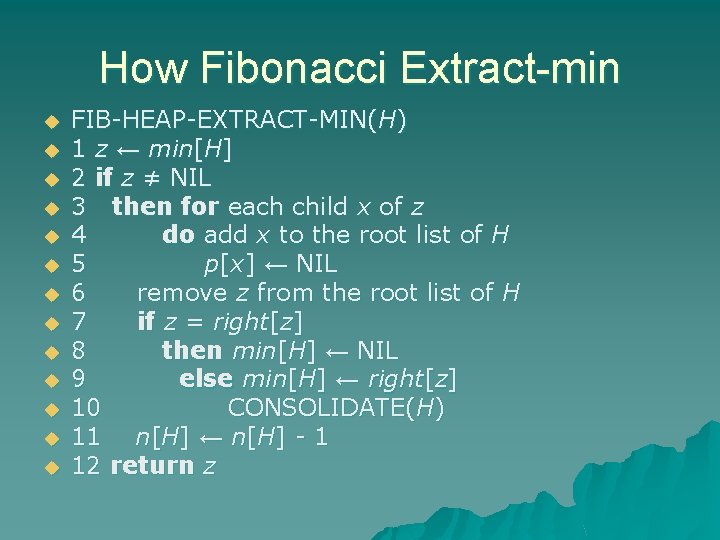
How Fibonacci Extract-min u u u u FIB-HEAP-EXTRACT-MIN(H) 1 z ← min[H] 2 if z ≠ NIL 3 then for each child x of z 4 do add x to the root list of H 5 p[x] ← NIL 6 remove z from the root list of H 7 if z = right[z] 8 then min[H] ← NIL 9 else min[H] ← right[z] 10 CONSOLIDATE(H) 11 n[H] ← n[H] - 1 12 return z
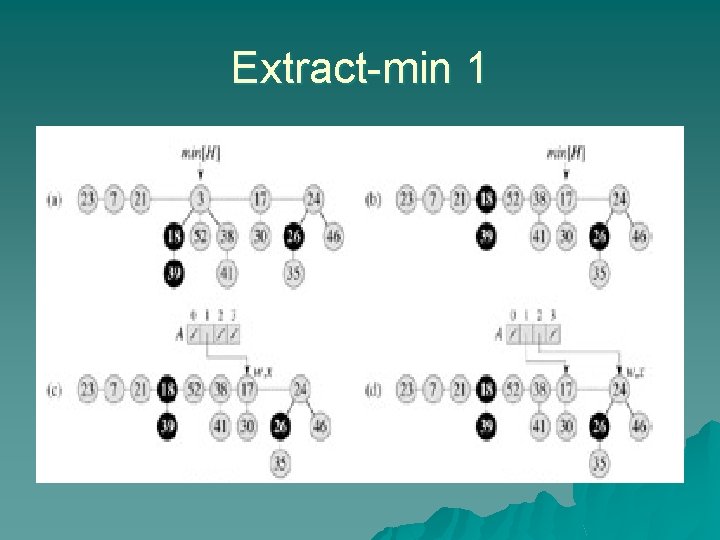
Extract-min 1
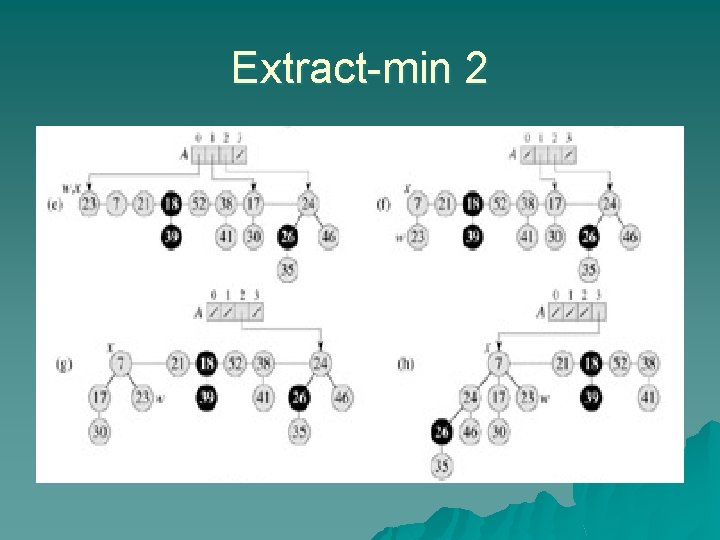
Extract-min 2
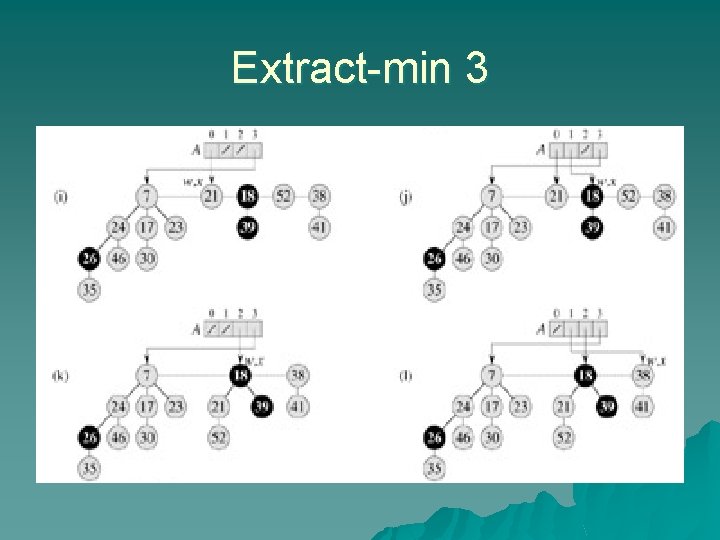
Extract-min 3
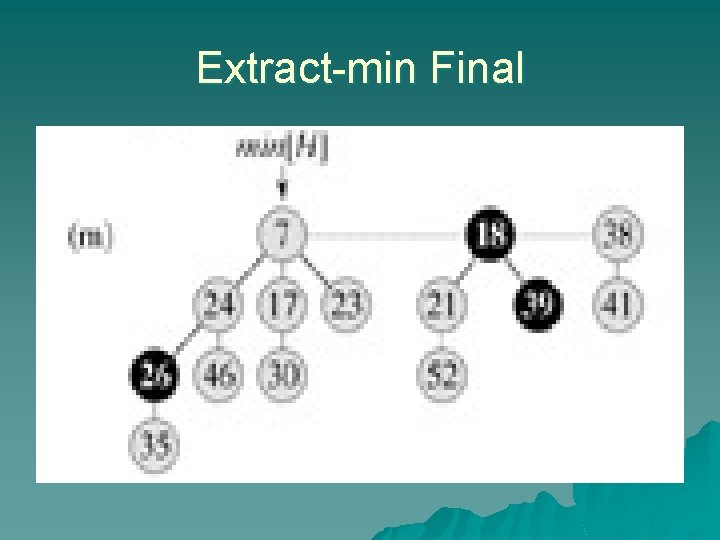
Extract-min Final
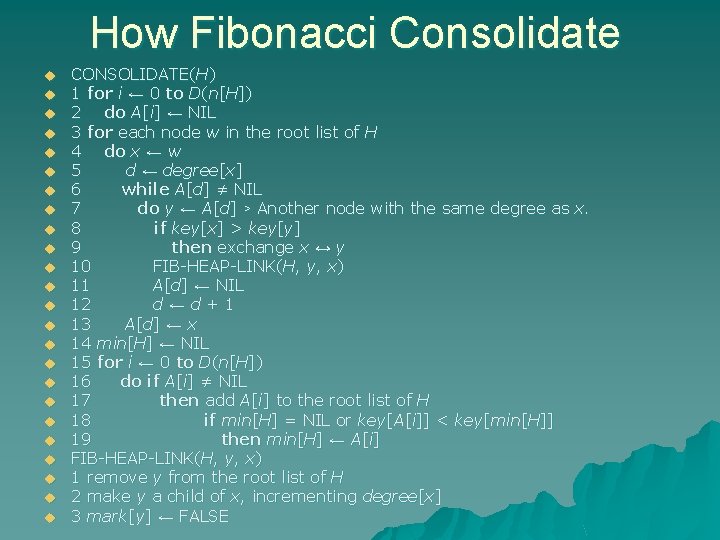
How Fibonacci Consolidate u u u u u u CONSOLIDATE(H) 1 for i ← 0 to D(n[H]) 2 do A[i] ← NIL 3 for each node w in the root list of H 4 do x ← w 5 d ← degree[x] 6 while A[d] ≠ NIL 7 do y ← A[d] ▹ Another node with the same degree as x. 8 if key[x] > key[y] 9 then exchange x ↔ y 10 FIB-HEAP-LINK(H, y, x) 11 A[d] ← NIL 12 d←d+1 13 A [ d] ← x 14 min[H] ← NIL 15 for i ← 0 to D(n[H]) 16 do if A[i] ≠ NIL 17 then add A[i] to the root list of H 18 if min[H] = NIL or key[A[i]] < key[min[H]] 19 then min[H] ← A[i] FIB-HEAP-LINK(H, y, x) 1 remove y from the root list of H 2 make y a child of x, incrementing degree[x] 3 mark[y] ← FALSE
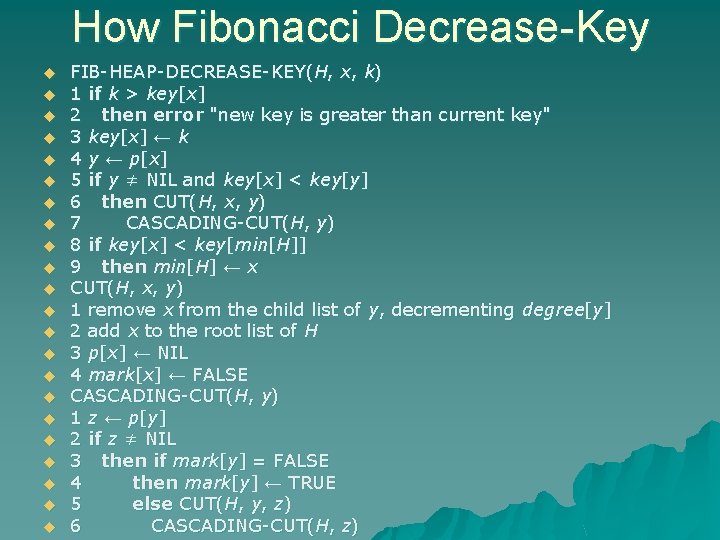
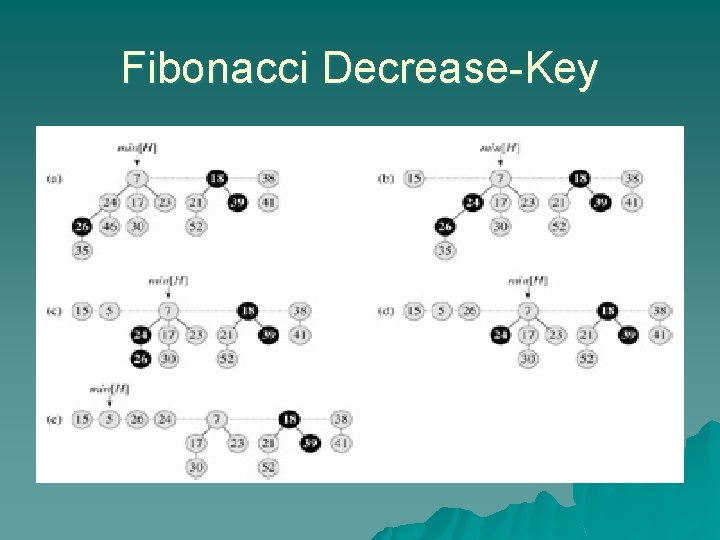
How Fibonacci Decrease-Key u u u u u u FIB-HEAP-DECREASE-KEY(H, x, k) 1 if k > key[x] 2 then error "new key is greater than current key" 3 key[x] ← k 4 y ← p[ x ] 5 if y ≠ NIL and key[x] < key[y] 6 then CUT(H, x, y) 7 CASCADING-CUT(H, y) 8 if key[x] < key[min[H]] 9 then min[H] ← x CUT(H, x, y) 1 remove x from the child list of y, decrementing degree[y] 2 add x to the root list of H 3 p[x] ← NIL 4 mark[x] ← FALSE CASCADING-CUT(H, y) 1 z ← p[ y ] 2 if z ≠ NIL 3 then if mark[y] = FALSE 4 then mark[y] ← TRUE 5 else CUT(H, y, z) 6 CASCADING-CUT(H, z)
Fibonacci Decrease-Key
How Fibonacci Delete u FIB-HEAP-DELETE(H, x) u 1 FIB-HEAP-DECREASE-KEY(H, x, ∞) u 2 FIB-HEAP-EXTRACT-MIN(H)
How Binomial Delete u BINOMIAL-HEAP-DELETE(H, x) u 1 BINOMIAL-HEAP-DECREASE-KEY(H, x, ∞) u 2 BINOMIAL-HEAP-EXTRACT-MIN(H)
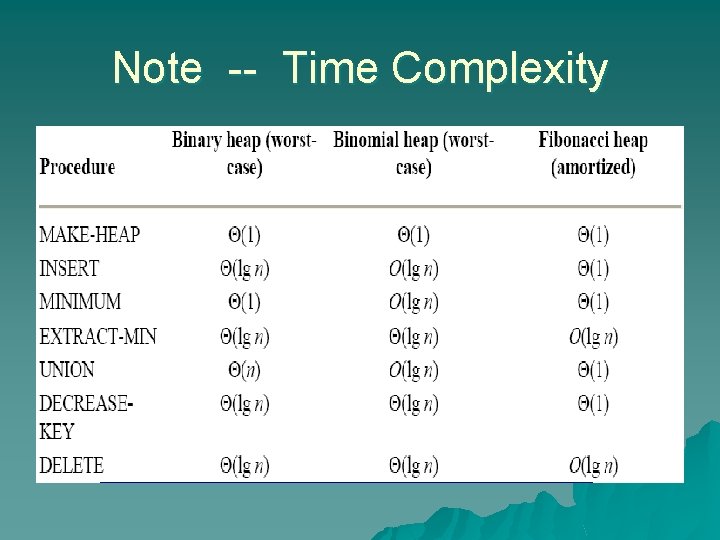
Note -- Time Complexity
Note -- Difference u 1 u 2 Delete Decrease. Key Binomial:Ordered Fibonacci:Unordered
Note -- Application u Shortest-path u Combine PQ

Fibonacci Heap 習題
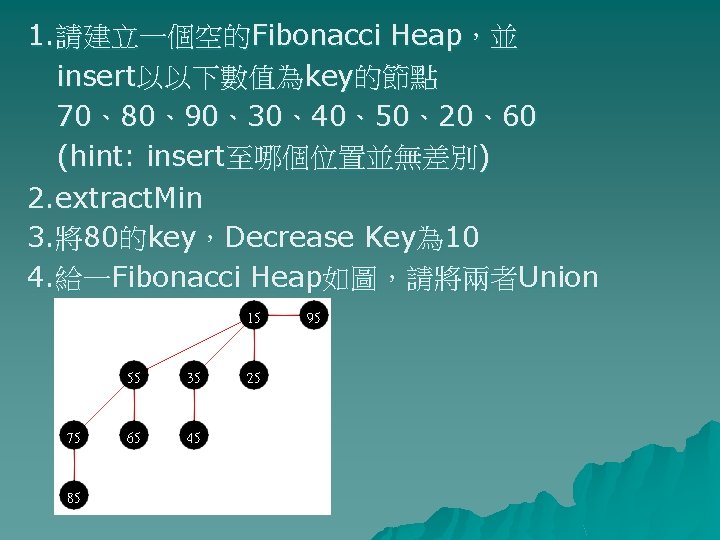
1. 請建立一個空的Fibonacci Heap,並 insert以以下數值為key的節點 70、80、90、30、40、50、20、60 (hint: insert至哪個位置並無差別) 2. extract. Min 3. 將80的key,Decrease Key為 10 4. 給一Fibonacci Heap如圖,請將兩者Union
- Slides: 25