
FiberOptic Communication Systems An Introduction Xavier Fernando Ryerson
Fiber-Optic Communication Systems An Introduction Xavier Fernando Ryerson Communications Lab http: //www. ee. ryerson. ca/~fernando
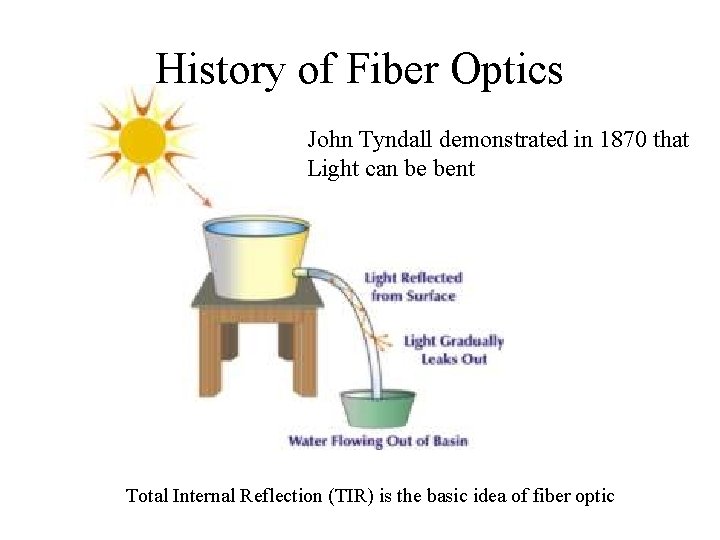
History of Fiber Optics John Tyndall demonstrated in 1870 that Light can be bent Total Internal Reflection (TIR) is the basic idea of fiber optic

Why Optical Communications? – Almost all long distance phone calls – Most Internet traffic (Dial-up, DSL or Cable) – Most Television channels (Cable or DSL) ‘Triple Play’ • Optical Fiber is the backbone of the modern communication networks • The Optical Fiber Carries: • One fiber can carry up to 6. 4 Tb/s (1012 b/s) or 100 million conversations simultaneously • Information revolution wouldn’t have happened without the Optical Fiber
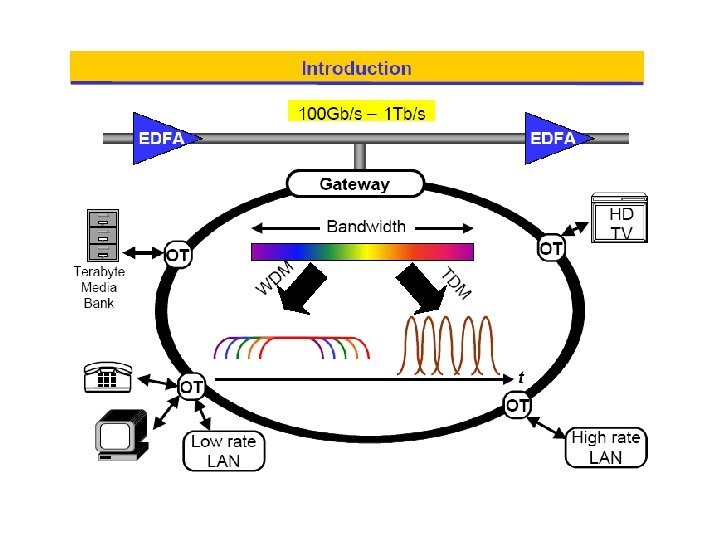
Why Optical Communications? Lowest Attenuation: 0. 2 d. B/km at 1. 55 µm band resulting in 100 s of km fiber links without repeaters Highest Bandwidth of any communication channel: Single Mode Fiber (SMF) offers the lowest dispersion highest bit rate rich content (broadband) up to 100 Gb/s or more Enormous Capacity: Via WDM that also offer easy upgradability, The ‘Optical Layer’: Wavelength routing, switching and processing all optically, which adds another layer of flexibility
Why OPTICOM for you? • Optical communications is a huge area • Basic knowledge in optics is required in many other fields • Power Engineering – Fiber optics in smart grids, optical ground wire • Biomedical – Optical Coherent Tomography, video sensors • Optical sensing – Structural monitoring • VLSI – Intra chip communications

Fiber in Smart Grid
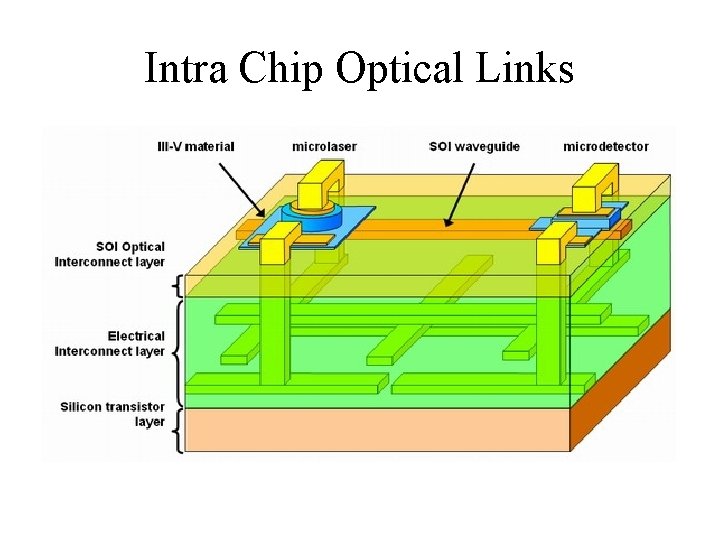
Intra Chip Optical Links
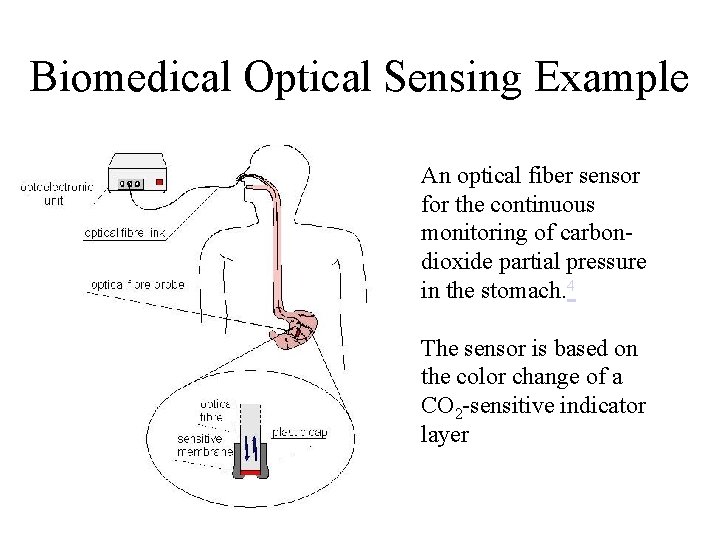
Biomedical Optical Sensing Example An optical fiber sensor for the continuous monitoring of carbondioxide partial pressure in the stomach. 4 The sensor is based on the color change of a CO 2 -sensitive indicator layer
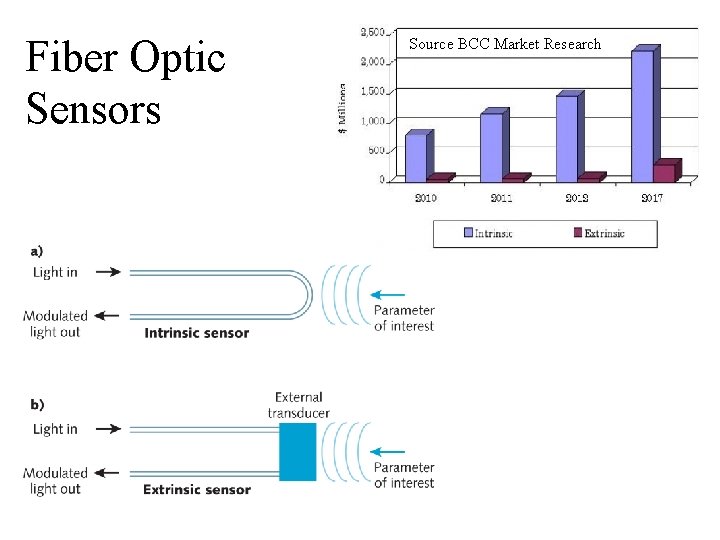
Fiber Optic Sensors Source BCC Market Research
Elements of a Fiber Optic Link
Elements of OPTICOM System • The Fiber – that carries the light – Single Mode Fiber (only one EM mode exists), offers the highest bit rate, most widely used – Multi Mode Fiber (multiple EM modes exist), hence higher dispersion (due to multiple modes) cheaper than SMF, used in local area networks – Step Index Fiber – two distinct refractive indices – Graded Index Fiber – gradual change in refractive index
Elements of OPTICOM System • Optical Transmitter converts the electrical information to optical format (E/O) – Light Emitting Diode (LED): cheap, robust and used with MMF in short range applications • Surface emitting and edge emitting LED – LASER Diode: high performance and more power, used with SMF in high speed links • Distributed Feedback (DFB) Laser – high performance single mode laser • Fabry-Perrot (FP) lasers – low performance multimode laser
Elements of OPTICOM System • Optical Receiver converts the optical signal into appropriate electrical format (E/O) – PIN Photo Diode: Low performance, no internal gain, low cost, widely used – Avalanche Photo Diode (APD): High performance with internal (avalanche) gain • Repeater: receives weak light signal, cleansup, amplifies and retransmits (O/E/O) • Optical Amplifier: Amplifies light in fiber without O/E/O
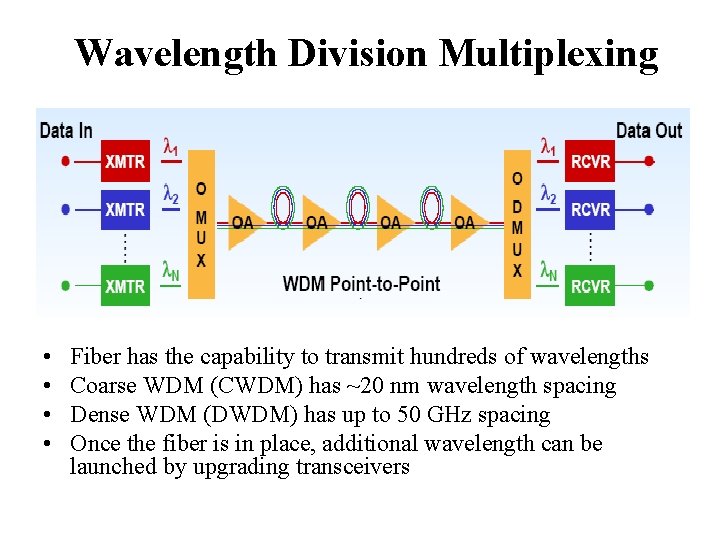
Wavelength Division Multiplexing • • Fiber has the capability to transmit hundreds of wavelengths Coarse WDM (CWDM) has ~20 nm wavelength spacing Dense WDM (DWDM) has up to 50 GHz spacing Once the fiber is in place, additional wavelength can be launched by upgrading transceivers
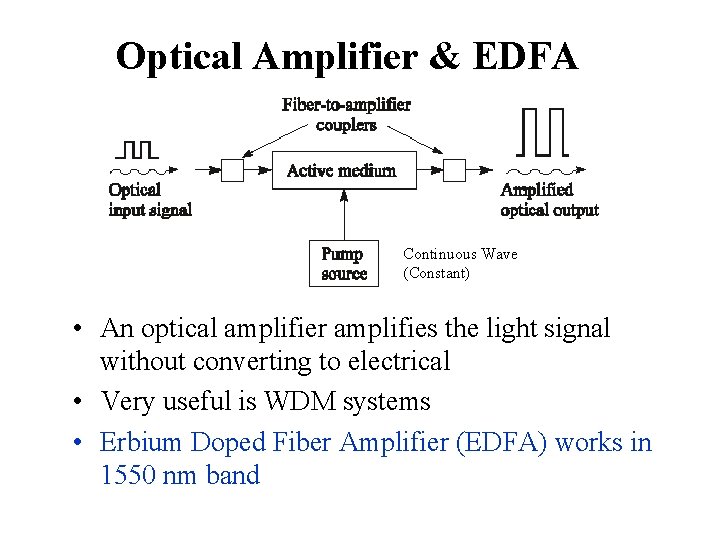
Optical Amplifier & EDFA Continuous Wave (Constant) • An optical amplifier amplifies the light signal without converting to electrical • Very useful is WDM systems • Erbium Doped Fiber Amplifier (EDFA) works in 1550 nm band
Brief Intro on Telecom Networks
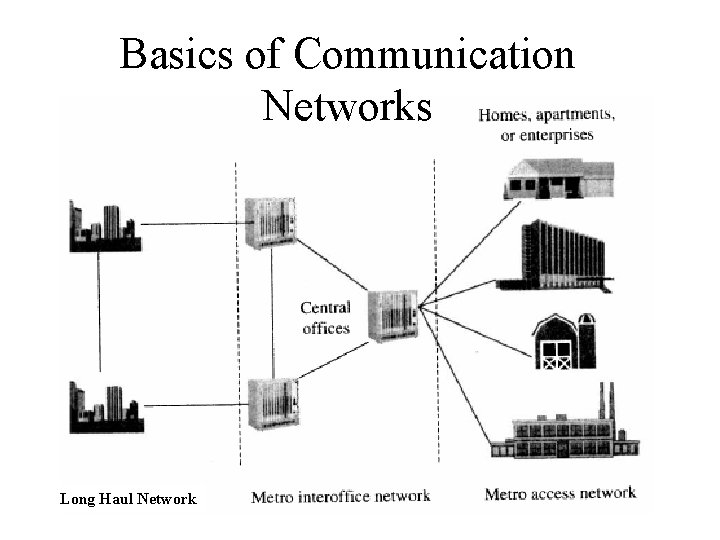
Basics of Communication Networks Long Haul Network
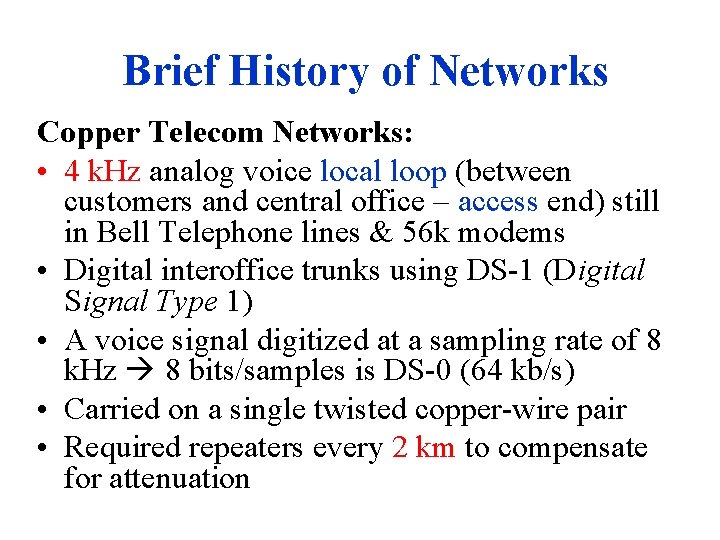
Brief History of Networks Copper Telecom Networks: • 4 k. Hz analog voice local loop (between customers and central office – access end) still in Bell Telephone lines & 56 k modems • Digital interoffice trunks using DS-1 (Digital Signal Type 1) • A voice signal digitized at a sampling rate of 8 k. Hz 8 bits/samples is DS-0 (64 kb/s) • Carried on a single twisted copper-wire pair • Required repeaters every 2 km to compensate for attenuation
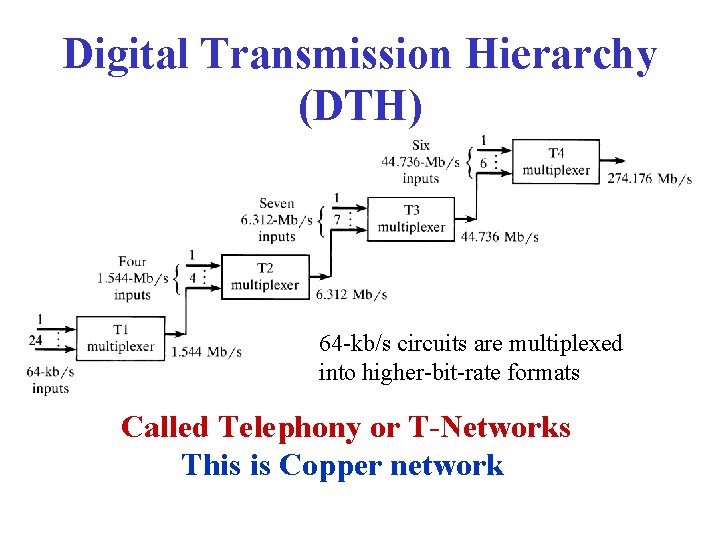
Digital Transmission Hierarchy (DTH) 64 -kb/s circuits are multiplexed into higher-bit-rate formats Called Telephony or T-Networks This is Copper network

First Generation Fiber Optic Systems Purpose: • Eliminate repeaters in T-1 systems used in inter-office trunk lines Technology: • 0. 8 µm Ga. As semiconductor lasers • Multimode silica fibers Limitations: • Fiber attenuation • Intermodal dispersion Deployed since 1974
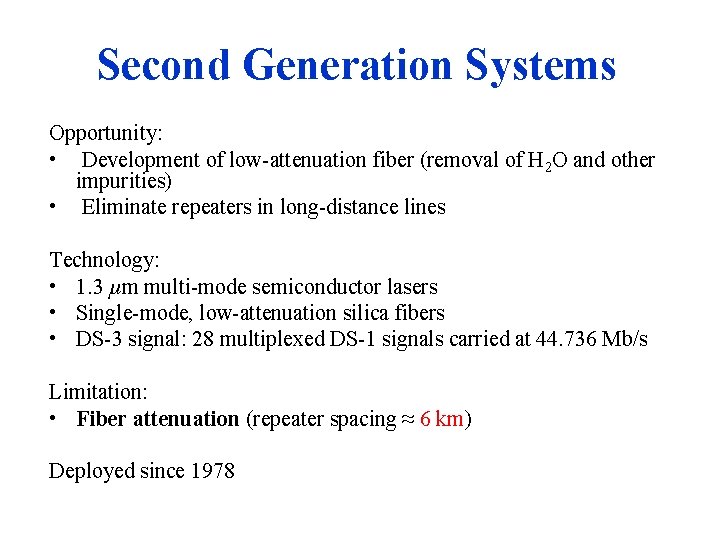
Second Generation Systems Opportunity: • Development of low-attenuation fiber (removal of H 2 O and other impurities) • Eliminate repeaters in long-distance lines Technology: • 1. 3 µm multi-mode semiconductor lasers • Single-mode, low-attenuation silica fibers • DS-3 signal: 28 multiplexed DS-1 signals carried at 44. 736 Mb/s Limitation: • Fiber attenuation (repeater spacing ≈ 6 km) Deployed since 1978
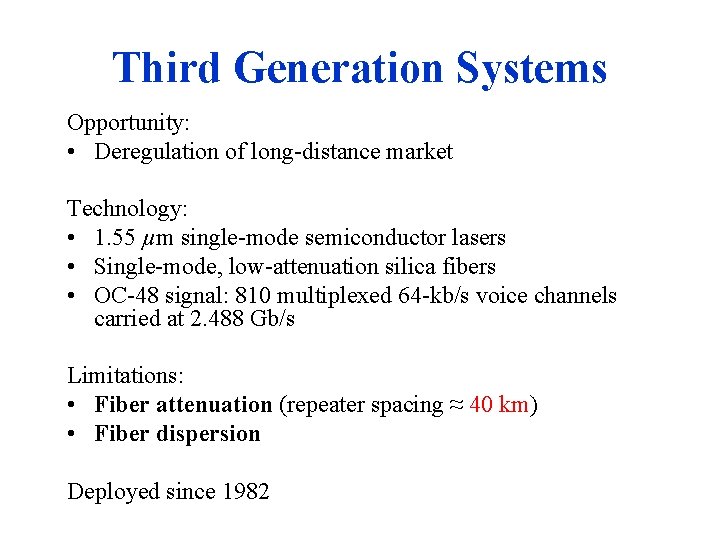
Third Generation Systems Opportunity: • Deregulation of long-distance market Technology: • 1. 55 µm single-mode semiconductor lasers • Single-mode, low-attenuation silica fibers • OC-48 signal: 810 multiplexed 64 -kb/s voice channels carried at 2. 488 Gb/s Limitations: • Fiber attenuation (repeater spacing ≈ 40 km) • Fiber dispersion Deployed since 1982
Fourth Generation Systems Opportunity: • Development of erbium-doped fiber amplifiers (EDFA) Technology (deployment began in 1994): • 1. 55 µm single-mode, narrow-band semiconductor lasers • Single-mode, low-attenuation, dispersion-shifted silica fibers • Wavelength-division multiplexing of 2. 5 Gb/s or 10 Gb/s signals Nonlinear effects limit the following system parameters: • Signal launch power • Propagation distance without regeneration/re-clocking • WDM channel separation • Maximum number of WDM channels per fiber Polarization-mode dispersion limits the following parameters: • Propagation distance without regeneration/re-clocking
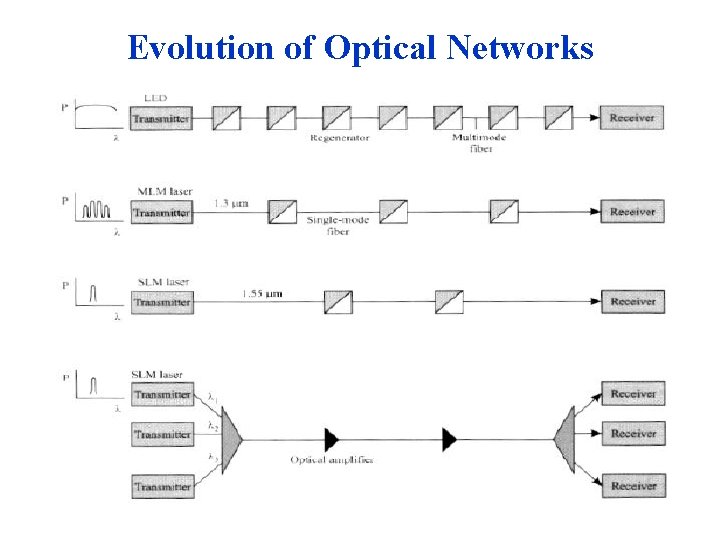
Evolution of Optical Networks
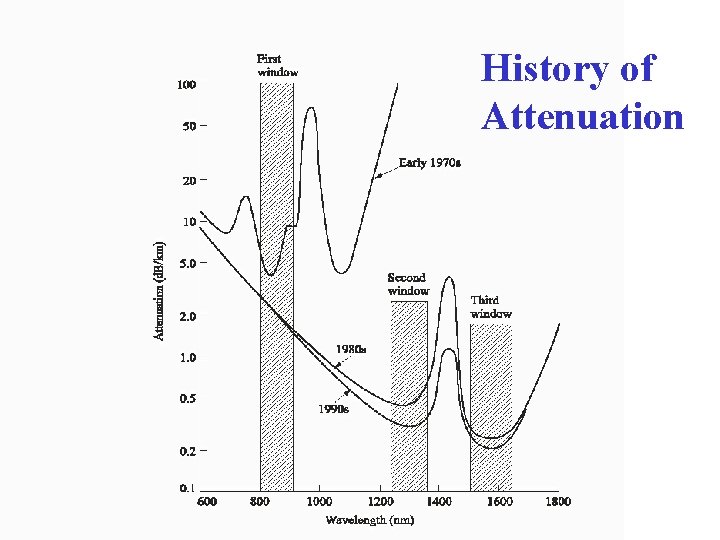
History of Attenuation
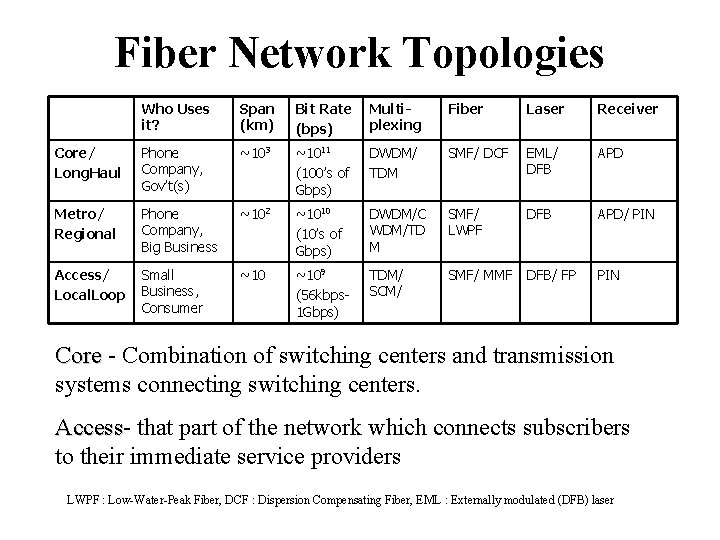
Fiber Network Topologies Who Uses it? Span (km) Bit Rate (bps) Multiplexing Fiber Laser Receiver Core/ Long. Haul Phone Company, Gov’t(s) ~103 ~1011 (100’s of Gbps) DWDM/ TDM SMF/ DCF EML/ DFB APD Metro/ Regional Phone Company, Big Business ~102 ~1010 (10’s of Gbps) DWDM/C WDM/TD M SMF/ LWPF DFB APD/ PIN Access/ Local. Loop Small Business, Consumer ~109 (56 kbps 1 Gbps) TDM/ SCM/ SMF/ MMF DFB/ FP PIN Core - Combination of switching centers and transmission Core systems connecting switching centers. Access- that part of the network which connects subscribers Access to their immediate service providers LWPF : Low-Water-Peak Fiber, DCF : Dispersion Compensating Fiber, EML : Externally modulated (DFB) laser
Synchronous Optical Networks • SONET is the TDM optical network standard for North America (called SDH in the rest of the world) • De-facto standard for fiber backhaul networks • OC-1 consists of 810 bytes over 125 us; OC -n consists of 810 n bytes over 125 us • Linear multiplexing and de-multiplexing is possible with Add-Drop-Multiplexers
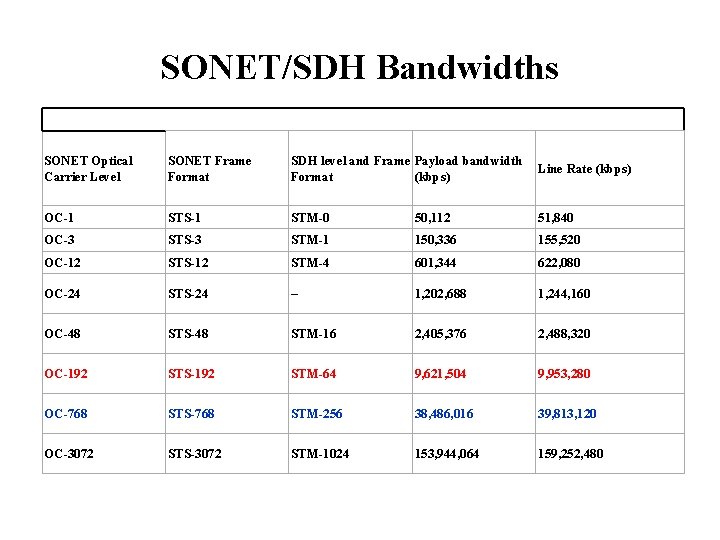
SONET/SDH Bandwidths SONET Optical Carrier Level SONET Frame Format SDH level and Frame Payload bandwidth Format (kbps) Line Rate (kbps) OC-1 STS-1 STM-0 50, 112 51, 840 OC-3 STS-3 STM-1 150, 336 155, 520 OC-12 STS-12 STM-4 601, 344 622, 080 OC-24 STS-24 – 1, 202, 688 1, 244, 160 OC-48 STS-48 STM-16 2, 405, 376 2, 488, 320 OC-192 STS-192 STM-64 9, 621, 504 9, 953, 280 OC-768 STS-768 STM-256 38, 486, 016 39, 813, 120 OC-3072 STS-3072 STM-1024 153, 944, 064 159, 252, 480
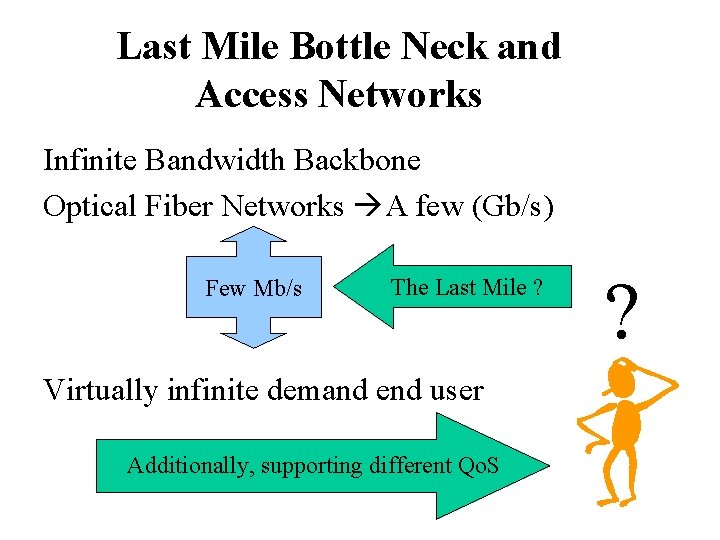
Last Mile Bottle Neck and Access Networks Infinite Bandwidth Backbone Optical Fiber Networks A few (Gb/s) Few Mb/s The Last Mile ? Virtually infinite demand end user Additionally, supporting different Qo. S ?
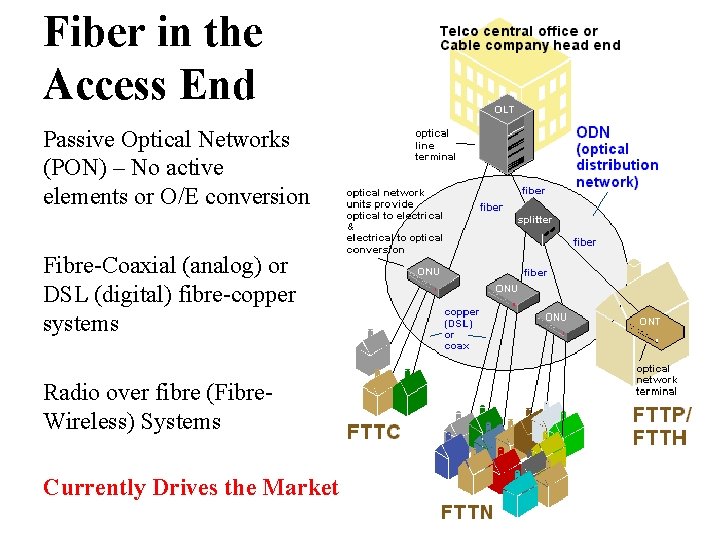
Fiber in the Access End Passive Optical Networks (PON) – No active elements or O/E conversion Fibre-Coaxial (analog) or DSL (digital) fibre-copper systems Radio over fibre (Fibre. Wireless) Systems Currently Drives the Market
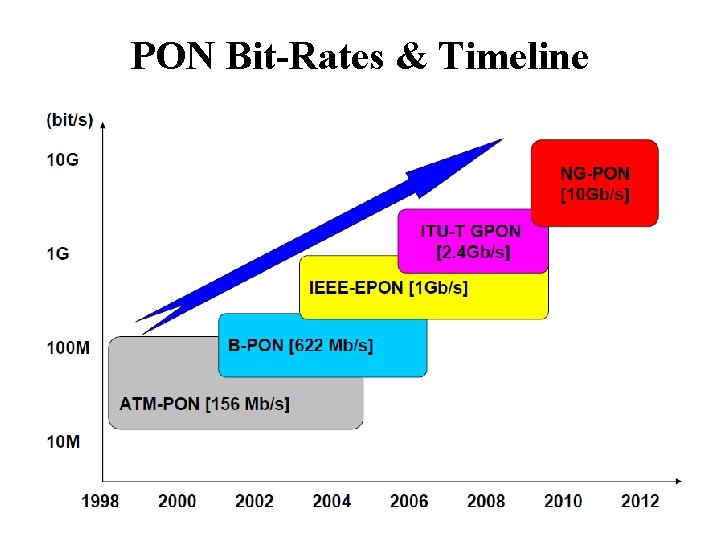
PON Bit-Rates & Timeline
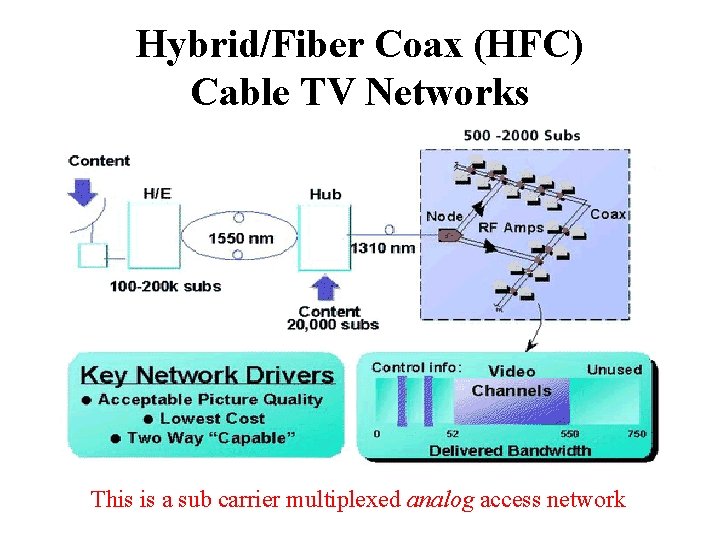
Hybrid/Fiber Coax (HFC) Cable TV Networks This is a sub carrier multiplexed analog access network
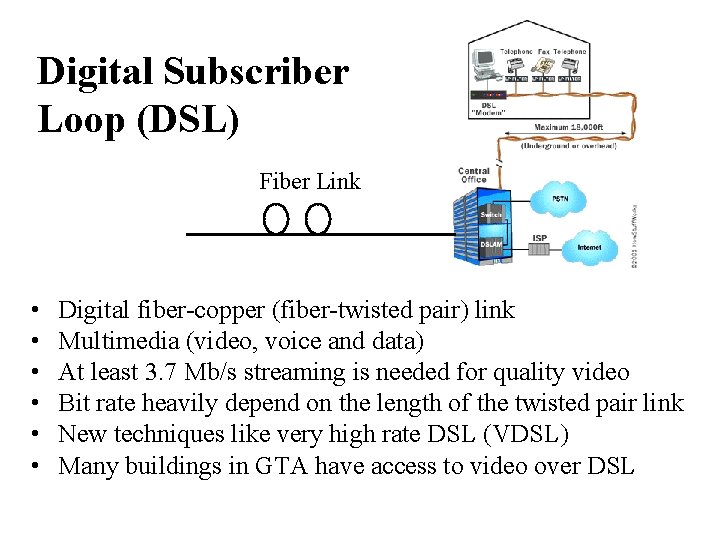
Digital Subscriber Loop (DSL) Fiber Link • • • Digital fiber-copper (fiber-twisted pair) link Multimedia (video, voice and data) At least 3. 7 Mb/s streaming is needed for quality video Bit rate heavily depend on the length of the twisted pair link New techniques like very high rate DSL (VDSL) Many buildings in GTA have access to video over DSL
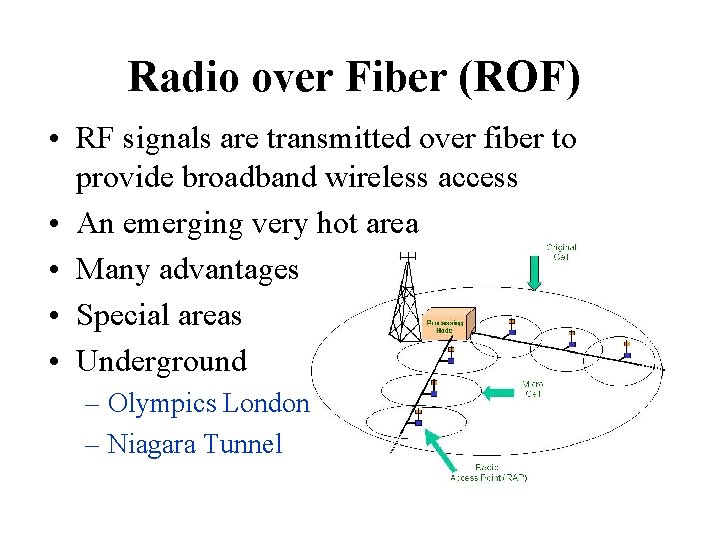
Radio over Fiber (ROF) • RF signals are transmitted over fiber to provide broadband wireless access • An emerging very hot area • Many advantages • Special areas • Underground – Olympics London – Niagara Tunnel
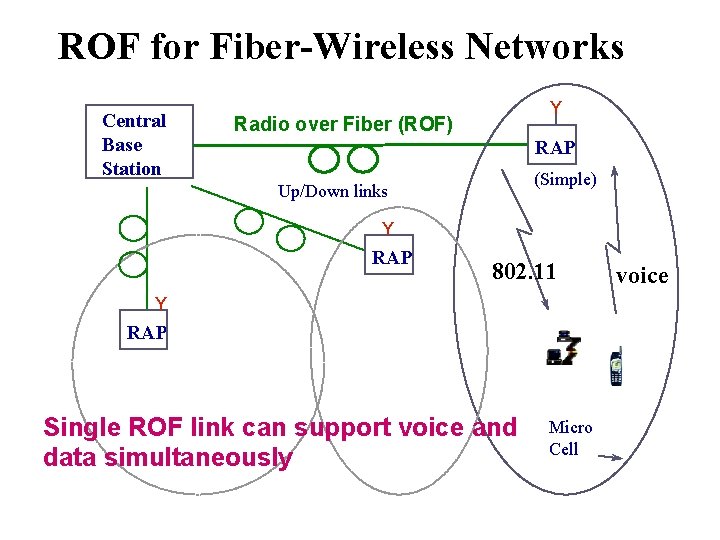
ROF for Fiber-Wireless Networks Central Base Station Y Radio over Fiber (ROF) RAP (Simple) Up/Down links Y RAP 802. 11 Y RAP Single ROF link can support voice and data simultaneously Micro Cell voice
- Slides: 36