
FIBERGLASS STORAGE TANK INSTALLATION INSTRUCTIONS OPERATING GUIDELINES INST
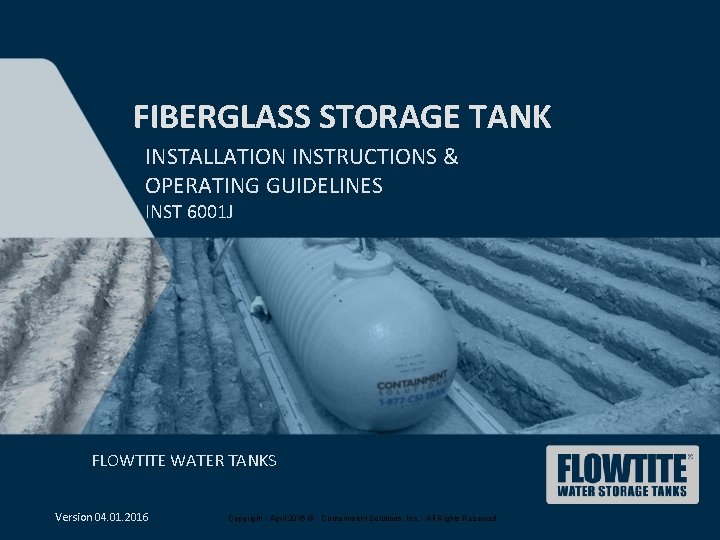
FIBERGLASS STORAGE TANK INSTALLATION INSTRUCTIONS & OPERATING GUIDELINES INST 6001 J FLOWTITE WATER TANKS Version 04. 01. 2016 Copyright • April 2016 © • Containment Solutions, Inc. • All Rights Reserved
Agenda • Introductions • Review Key Installation Procedures (PPT) • Written Exam • Contractor Documentation • Submit Signed Attachment E as a Record of Training • Review Missed Questions • 2 -Year Renewal Copyright • April 2016 © • Containment Solutions, Inc. • All Rights Reserved
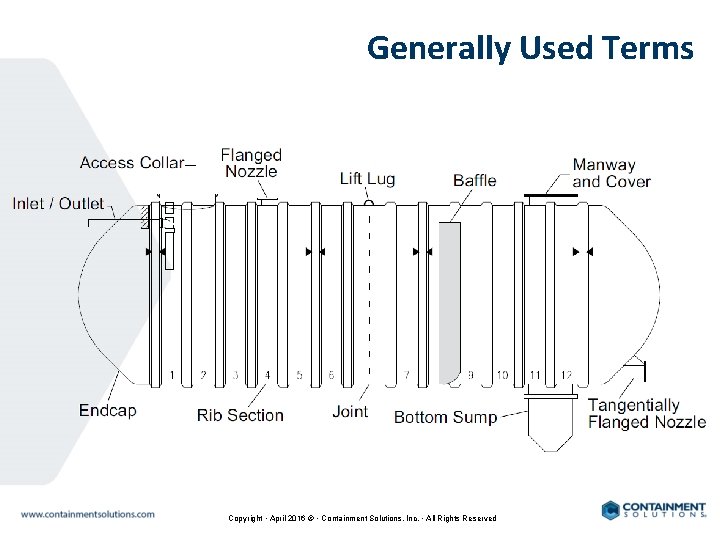
Generally Used Terms Copyright • April 2016 © • Containment Solutions, Inc. • All Rights Reserved
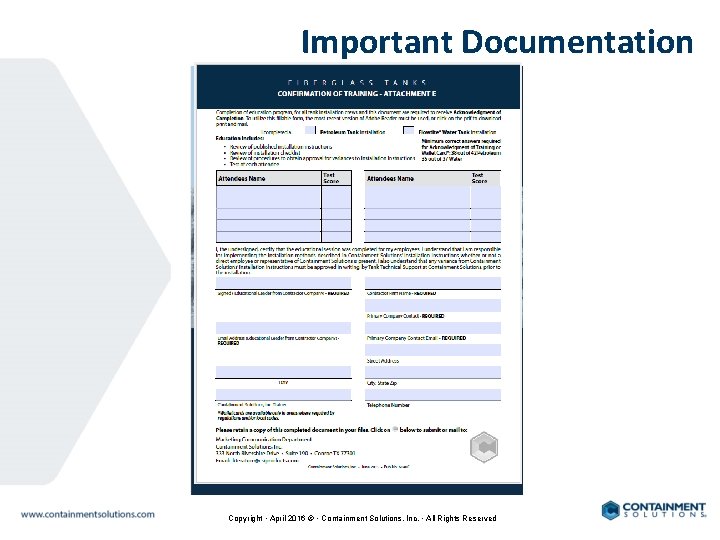
Important Documentation Copyright • April 2016 © • Containment Solutions, Inc. • All Rights Reserved
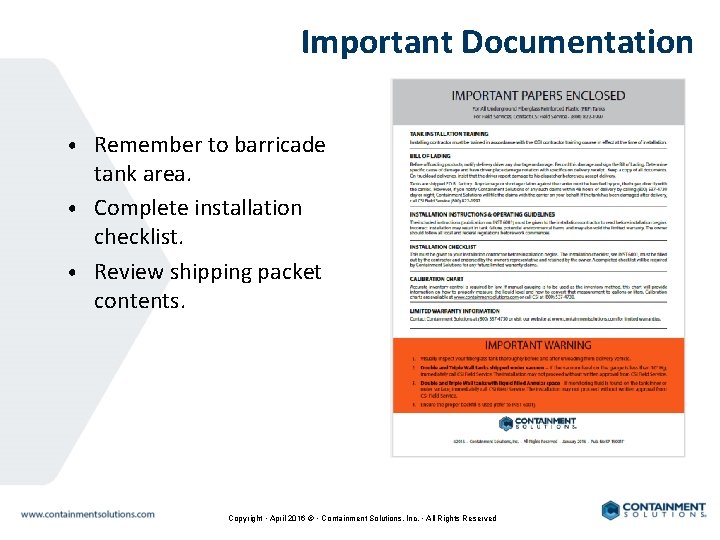
Important Documentation • Remember to barricade tank area. • Complete installation checklist. • Review shipping packet contents. Copyright • April 2016 © • Containment Solutions, Inc. • All Rights Reserved
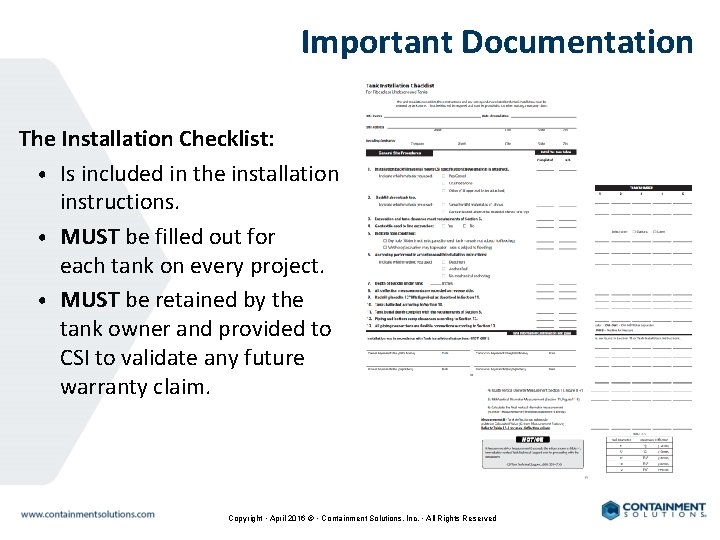
Important Documentation The Installation Checklist: • Is included in the installation instructions. • MUST be filled out for each tank on every project. • MUST be retained by the tank owner and provided to CSI to validate any future warranty claim. Copyright • April 2016 © • Containment Solutions, Inc. • All Rights Reserved
PRE INSTALLATION PREPARATION Sections 1 & 2 Copyright • April 2016 © • Containment Solutions, Inc. • All Rights Reserved
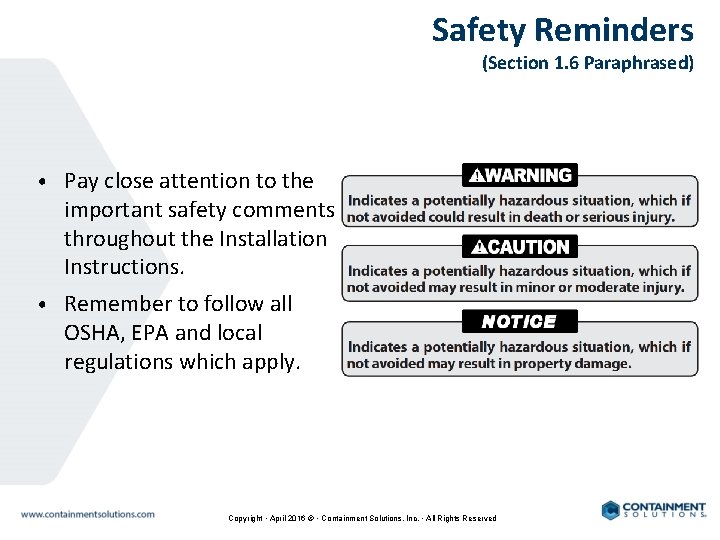
Safety Reminders (Section 1. 6 Paraphrased) • Pay close attention to the important safety comments throughout the Installation Instructions. • Remember to follow all OSHA, EPA and local regulations which apply. Copyright • April 2016 © • Containment Solutions, Inc. • All Rights Reserved
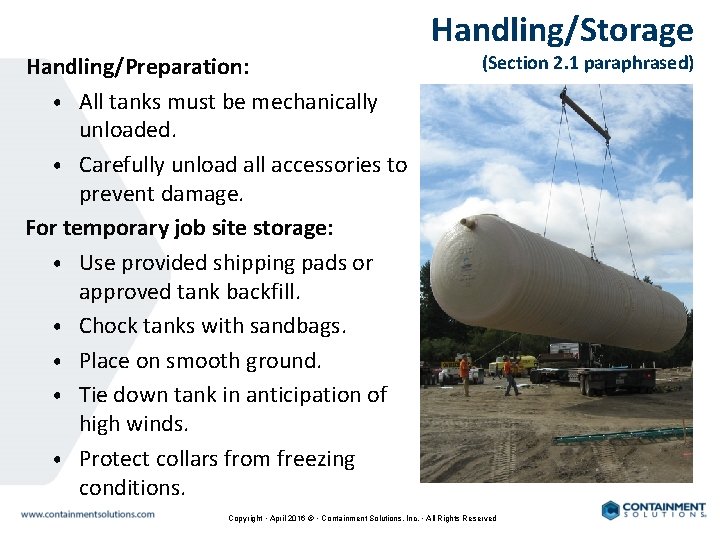
Handling/Preparation: • All tanks must be mechanically unloaded. • Carefully unload all accessories to prevent damage. For temporary job site storage: • Use provided shipping pads or approved tank backfill. • Chock tanks with sandbags. • Place on smooth ground. • Tie down tank in anticipation of high winds. • Protect collars from freezing conditions. Handling/Storage (Section 2. 1 paraphrased) Copyright • April 2016 © • Containment Solutions, Inc. • All Rights Reserved
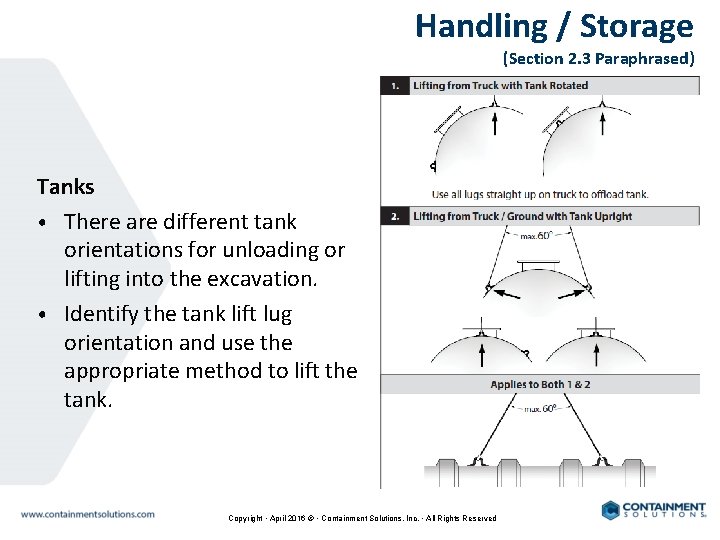
Handling / Storage (Section 2. 3 Paraphrased) Tanks • There are different tank orientations for unloading or lifting into the excavation. • Identify the tank lift lug orientation and use the appropriate method to lift the tank. Copyright • April 2016 © • Containment Solutions, Inc. • All Rights Reserved
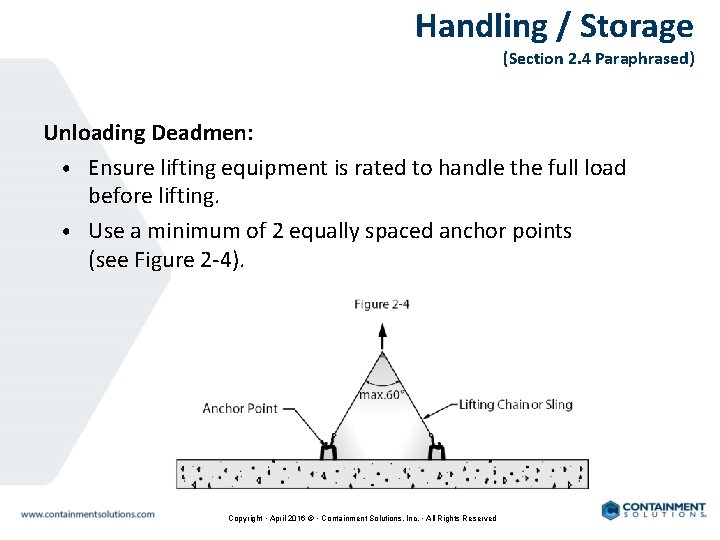
Handling / Storage (Section 2. 4 Paraphrased) Unloading Deadmen: • Ensure lifting equipment is rated to handle the full load before lifting. • Use a minimum of 2 equally spaced anchor points (see Figure 2 -4). Copyright • April 2016 © • Containment Solutions, Inc. • All Rights Reserved
BED & BACKFILL Section 3 Copyright • April 2016 © • Containment Solutions, Inc. • All Rights Reserved
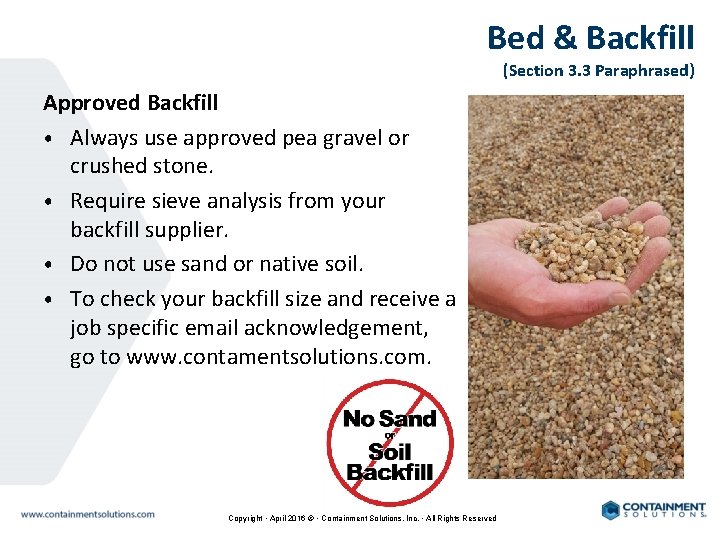
Bed & Backfill (Section 3. 3 Paraphrased) Approved Backfill • Always use approved pea gravel or crushed stone. • Require sieve analysis from your backfill supplier. • Do not use sand or native soil. • To check your backfill size and receive a job specific email acknowledgement, go to www. contamentsolutions. com. Copyright • April 2016 © • Containment Solutions, Inc. • All Rights Reserved
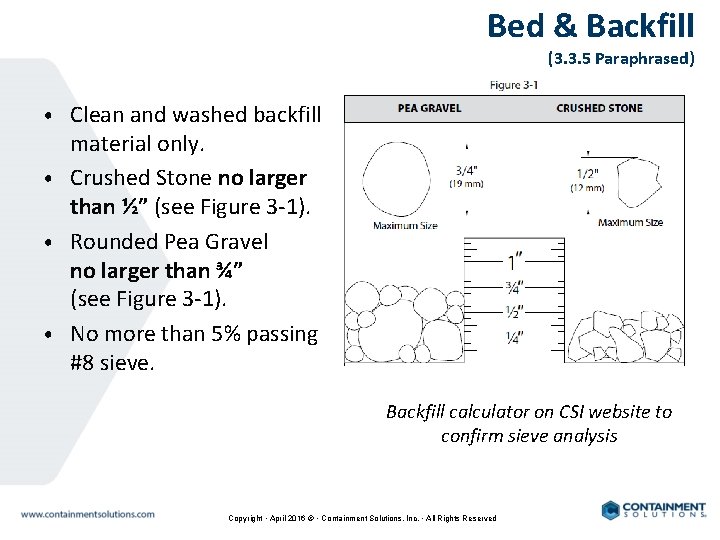
Bed & Backfill (3. 3. 5 Paraphrased) • Clean and washed backfill material only. • Crushed Stone no larger than ½” (see Figure 3 -1). • Rounded Pea Gravel no larger than ¾” (see Figure 3 -1). • No more than 5% passing #8 sieve. Backfill calculator on CSI website to confirm sieve analysis Copyright • April 2016 © • Containment Solutions, Inc. • All Rights Reserved

PRE-INSTALLATION TESTING Section 4 Copyright • April 2016 © • Containment Solutions, Inc. • All Rights Reserved
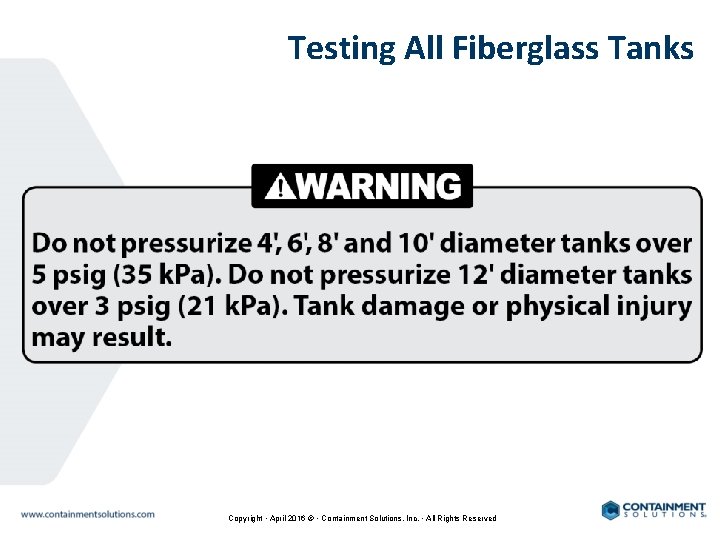
Testing All Fiberglass Tanks Copyright • April 2016 © • Containment Solutions, Inc. • All Rights Reserved
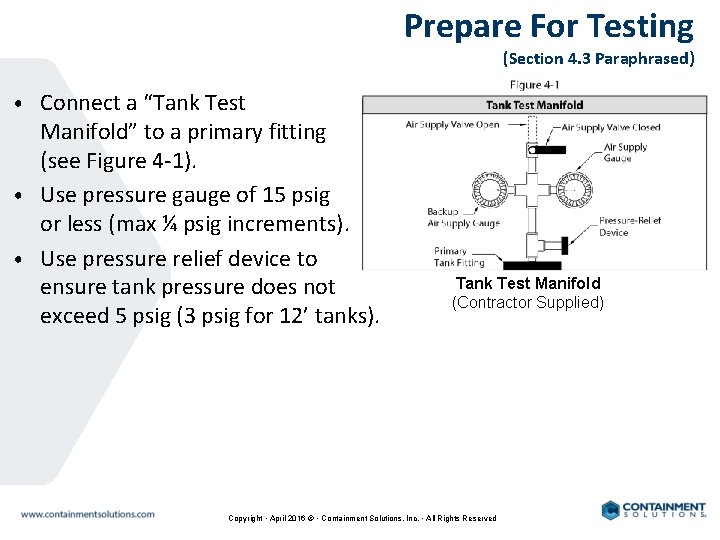
Prepare For Testing (Section 4. 3 Paraphrased) • Connect a “Tank Test Manifold” to a primary fitting (see Figure 4 -1). • Use pressure gauge of 15 psig or less (max ¼ psig increments). • Use pressure relief device to ensure tank pressure does not exceed 5 psig (3 psig for 12’ tanks). Tank Test Manifold (Contractor Supplied) Copyright • April 2016 © • Containment Solutions, Inc. • All Rights Reserved
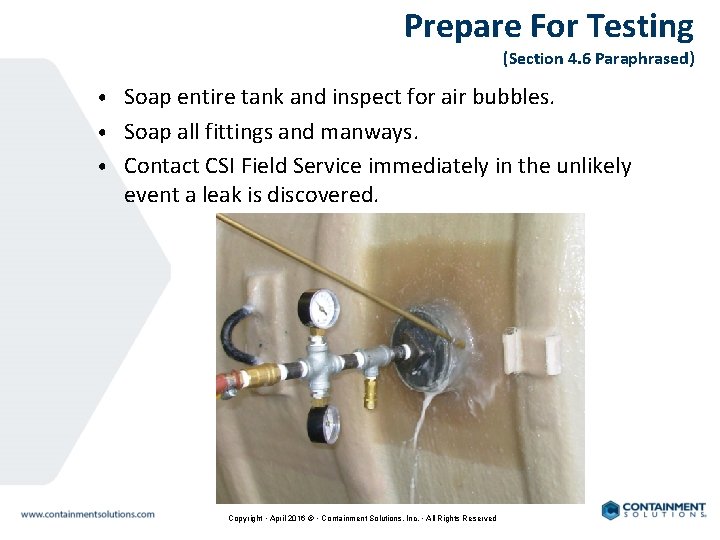
Prepare For Testing (Section 4. 6 Paraphrased) • Soap entire tank and inspect for air bubbles. • Soap all fittings and manways. • Contact CSI Field Service immediately in the unlikely event a leak is discovered. Copyright • April 2016 © • Containment Solutions, Inc. • All Rights Reserved

SINGLE-WALL FLOWTITE® WATER TANK TESTING PROCEDURES Section 5. 1 Copyright • April 2016 © • Containment Solutions, Inc. • All Rights Reserved
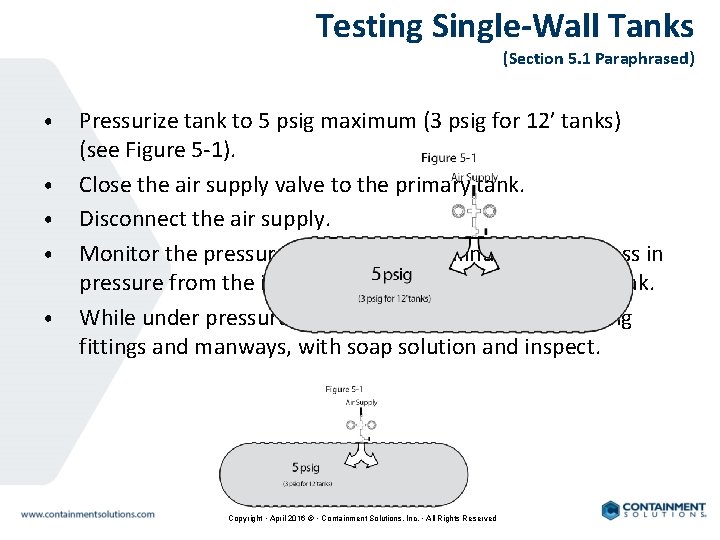
Testing Single-Wall Tanks (Section 5. 1 Paraphrased) • • • Pressurize tank to 5 psig maximum (3 psig for 12’ tanks) (see Figure 5 -1). Close the air supply valve to the primary tank. Disconnect the air supply. Monitor the pressure readings for 30 minutes for any loss in pressure from the initial reading which may indicate a leak. While under pressure, cover tank outer surface including fittings and manways, with soap solution and inspect. Copyright • April 2016 © • Containment Solutions, Inc. • All Rights Reserved
FOR TANKS THAT CANNOT BE AIR TESTED (MAY APPLY FOR CERTAIN NON-UL TANKS) Section 5. 7 Copyright • April 2016 © • Containment Solutions, Inc. • All Rights Reserved
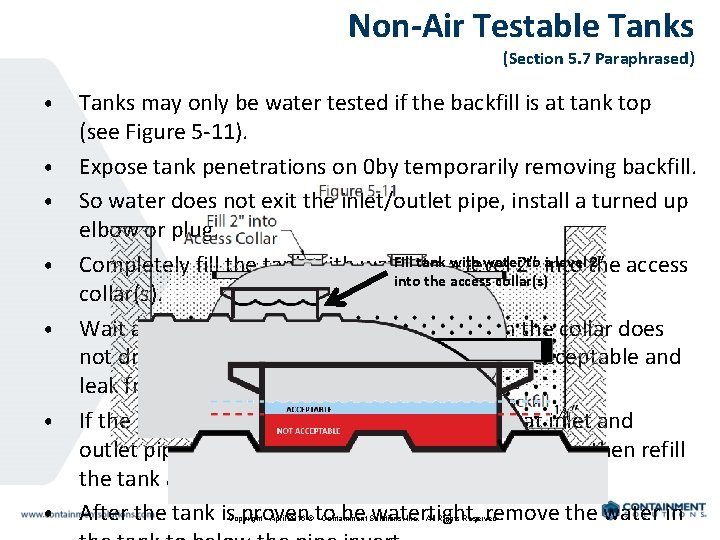
Non-Air Testable Tanks (Section 5. 7 Paraphrased) • • Tanks may only be water tested if the backfill is at tank top (see Figure 5 -11). Expose tank penetrations on 0 by temporarily removing backfill. So water does not exit the inlet/outlet pipe, install a turned up elbow or plug. Fill tank water 2” to ainto level the 2” access Completely fill the tank with water to awith level into the access collar(s). Wait at least 30 minutes, if the water level in the collar does not drop more than ¼”, the tank is considered acceptable and leak free. If the level drops more than the ¼”, ensure that inlet and outlet pipe caps or plugs and collars are not leaking, then refill the tank and retest. After the tank is proven to be watertight, remove the water in Copyright • April 2016 © • Containment Solutions, Inc. • All Rights Reserved

EXCAVATION Section 6 Copyright • April 2016 © • Containment Solutions, Inc. • All Rights Reserved
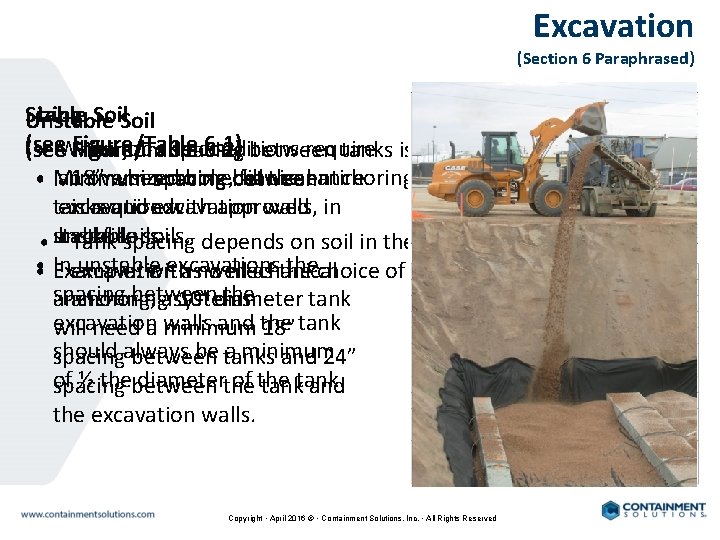
Excavation (Section 6 Paraphrased) Stable Sizing Soil Unstable (see Figure/Table 6 -1) job site conditions require • When Minimum spacing tanks is (see Figure/Table 6 -2) between an 18” oversized fill the entire whenspacing nohole, mechanical anchoring • Minimum between excavation with approved is required. tanks and excavation walls, in backfill. stable soils. depends on soil in the • unstable Tanksoils. spacing • • In unstable excavations thechoice of Example: with mechanical excavation asno well as the spacing between the anchoring, asystems. 10’ diameter tank anchoring excavation and the will need a walls minimum 18” tank should be tanks a minimum spacingalways between and 24” of ½ thebetween diameterthe of the spacing tank. and the excavation walls. Copyright • April 2016 © • Containment Solutions, Inc. • All Rights Reserved

GEOTEXTILE FABRIC (FILTER FABRIC) Section 7 Copyright • April 2016 © • Containment Solutions, Inc. • All Rights Reserved
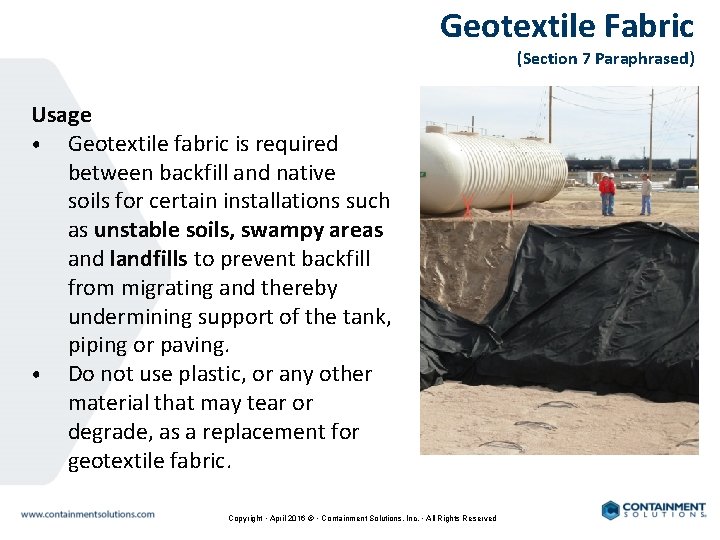
Geotextile Fabric (Section 7 Paraphrased) Usage • Geotextile fabric is required between backfill and native soils for certain installations such as unstable soils, swampy areas and landfills to prevent backfill from migrating and thereby undermining support of the tank, piping or paving. • Do not use plastic, or any other material that may tear or degrade, as a replacement for geotextile fabric. Copyright • April 2016 © • Containment Solutions, Inc. • All Rights Reserved

BURIAL DEPTH & COVER Section 8 Copyright • April 2016 © • Containment Solutions, Inc. • All Rights Reserved
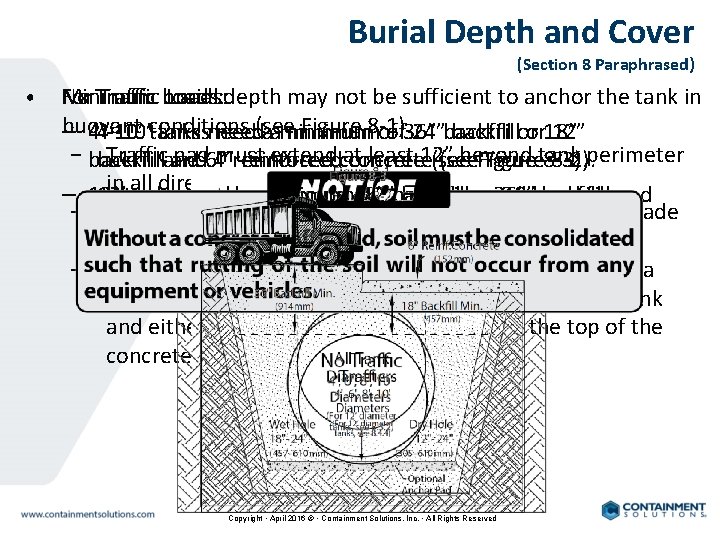
Burial Depth and Cover (Section 8 Paraphrased) • For Traffic Loads: depth may not be sufficient to anchor the tank in No Minimum Traffic burial Figure 8 -1). −buoyant tanks aaminimum ofof 36” − 4’-10’conditions tanksneed(see minimum 24”backfillor or 18” 12” − backfill Trafficand pad 6” must extend concrete at least 12” beyond reinforced (see Figure 8 -3). backfill and 4” reinforced concrete (see Figuretank 8 -2). perimeter intanks all directions. −− 12’ need 12’ tanks needaaminimum 48” 42”backfillor or 36” 38”backfill and − and The burial depth is 7’ from the tank top to grade 6”maximum reinforced concrete. 4” reinforced concrete. elevation. − Dry hole excavations must have a minimum of 12” and a maximum of 24” backfill between the bottom of the tank and either the bottom of the excavation or the top of the concrete anchor pad. Copyright • April 2016 © • Containment Solutions, Inc. • All Rights Reserved
TANK ANCHORING Section 9 Copyright • April 2016 © • Containment Solutions, Inc. • All Rights Reserved
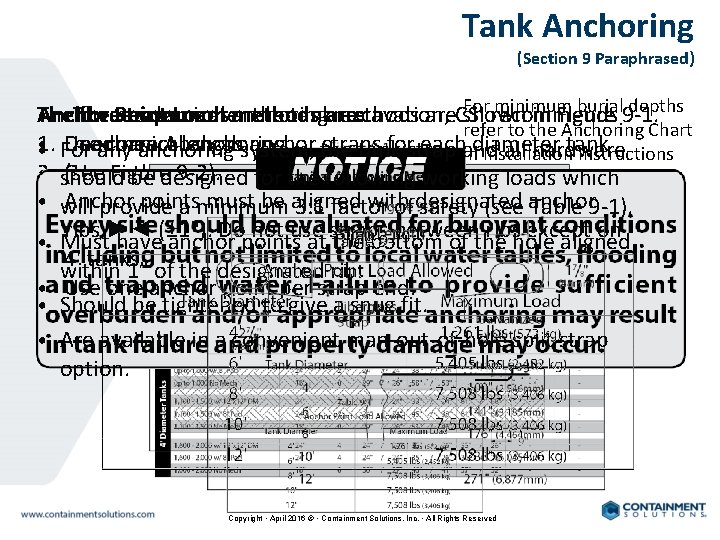
Tank Anchoring (Section 9 Paraphrased) Forrecommends minimum burial 9 -1. depths • Anchor Point mechanical Loads: anchoring methods are. CSI shown in Figure The Ifthree water Straps common can enter methods the tankare: excavation, refer to the Anchoring Chart • 1. Deadmen Use mechanical correct Anchors. length anchoring. anchor straps for each tank • For any anchoring system, the tank strap and all hardware indiameter Installation Instructions • 2. should Concrete (see Use. Figure only CSI 9 -2). fiberglass Pad. anchor straps. INST 6001 be Anchor designed for the following working loads(Appendix which A) • 3. will Overburden Anchor Deadmen points or concrete must mechanical be aligned anchoring). pads with designated be(see used. anchor provide a(no minimum 3: 1 factor of may safety Table 9 -1). • ribs After ►◄ installation, (± 1"). Do all notexposed use straps metal between shouldribs beexcept coatedon or • Must have anchor points at the bottom of the hole aligned 4'galvanized tanks. to protect against within 1” of the designated rib. corrosion. • Use one anchor point per strap end. • Should be tightened to give a snug fit. • Are available in a convenient man-out-of-hole split strap option. Copyright • April 2016 © • Containment Solutions, Inc. • All Rights Reserved
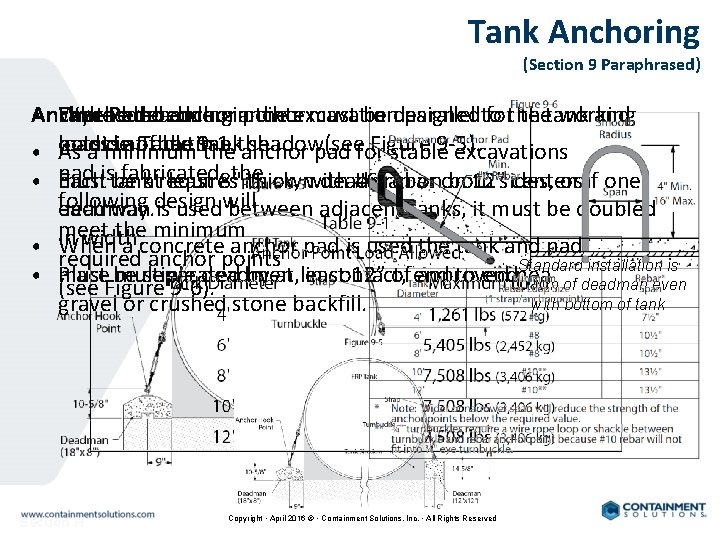
Tank Anchoring (Section 9 Paraphrased) • Anchor Embedded When Pad: embedding anchorin anchor points must be designed forthe thetank working Lay the deadmen the excavation parallel to and points loads inatof Table the 9 -1. outside thetime tank shadow(see Figure 9 -5). As a minimum the anchor pad for stable excavations pad fabricated, must be atrequires least 8"the thick, #6 rebar 12"sides, centers Eachistank its ownwith deadman onon both or if one following each way. design deadman is usedwill between adjacent tanks, it must be doubled meet the minimum in width. • When a concrete anchor pad is used the tank and pad required anchor points Standard installation is separated by at least 12” of end approved pea • must Place be multiple deadmen, in contact, to end. bottom of deadman even (see Figure 9 -6). with bottom of tank gravel or crushed stone backfill. • • Section H Copyright • April 2016 © • Containment Solutions, Inc. • All Rights Reserved
BALLASTING TANKS (ADDING LIQUID) Section 10 Copyright • April 2016 © • Containment Solutions, Inc. • All Rights Reserved
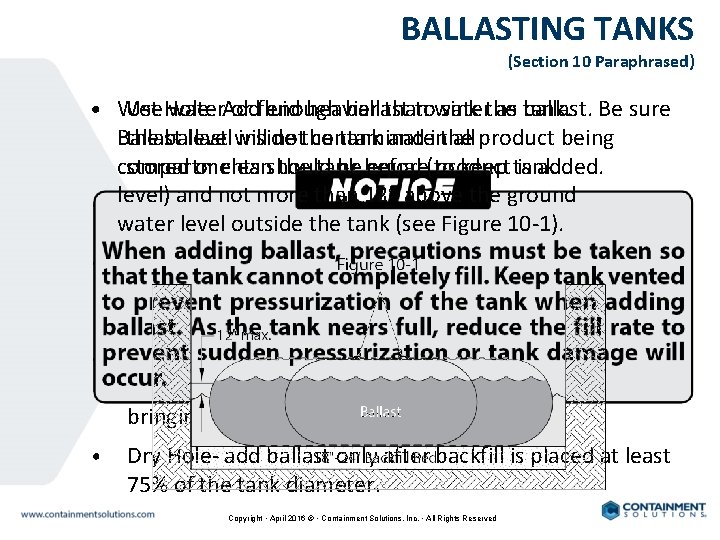
BALLASTING TANKS (Section 10 Paraphrased) • Wet Use Holewater. Add or fluid enough heavier ballast than towater sink the as tank. ballast. Be sure Ballast the ballast level will inside notthe contaminate tank and inthe all product being compartments stored or cleanshould the tank be before equal (to product keep tank is added. and not more than 12” connection above the ground • level) Do not make a direct (hard) of the ballast fill water the tank (see Figure 10 -1). line tolevel any outside tank fitting. • At the moment the tank is full, the pressure in the fill line will result in an instant pressurization of the tank which will damage the tank. • This problem can be avoided by providing adequate tank venting or removing the fill line and manually bringing the tank to full capacity. • Dry Hole- add ballast only after backfill is placed at least 75% of the tank diameter. Copyright • April 2016 © • Containment Solutions, Inc. • All Rights Reserved

VERTICAL DIAMETER MEASUREMENTS Section 11. 2 Copyright • April 2016 © • Containment Solutions, Inc. • All Rights Reserved
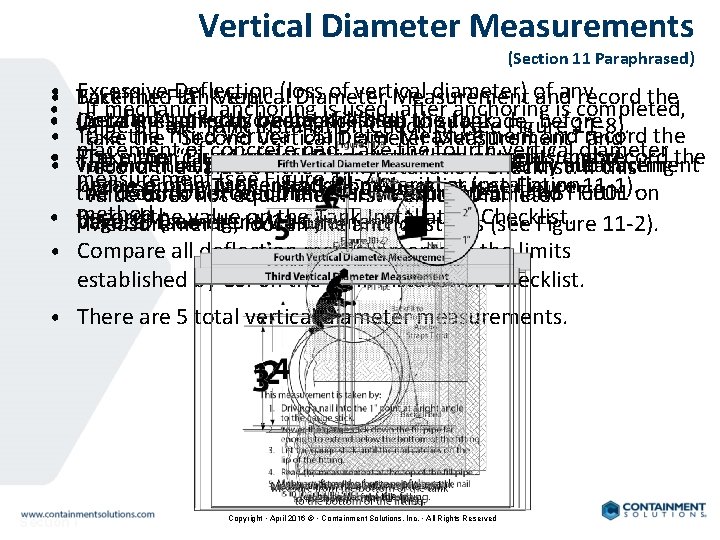
Vertical Diameter Measurements (Section 11 Paraphrased) Excessive Deflection (loss of vertical diameter) of any Take Backfill the to Fifth tank Vertical top. Diameter Measurement and record the If mechanical anchoring is used, after anchoring is completed, installed tank can stress on to thesubgrade, tank. Set tanks directly on backfill bed. Once the tank has create been backfilled before value on the Tank Installation Checklist (see Figure Take the Third Vertical Diameter Measurement and 11 -8). record the take the “Second Vertical Diameter Measurement” and placement of concrete pad, take the fourth vertical diameter The major cause of deflection is the loss of tank support Take the “First Vertical Diameter Measurement” and record the The value inner on the diameter Tank Installation measurement Checklist is calculated and verify by measurement subtracting record the value on the Tank Installation Checklist. If this measurement (see Installation Figure 11 -7). because of improper backfill material installation value on the Tank Checklist (see 11 -1). on the “A” “Fourth does notnot Vertical exceed Diameter the Measurement” in Tableor 11 -1 in. Figure and INST“Fifth 6001 value does equal thevalue “First Vertical Diameter method. • Vertical Record on the Tankanchor Installation page 19 the Diameter (seevalue Figure Measurement”. 11 -6). Measurement”, loosen straps. Checklist. (see Figure 11 -2). • Compare all deflection measurements to the limits established by CSI on the Tank Installation Checklist. • • • There are 5 total vertical diameter measurements. Section I Copyright • April 2016 © • Containment Solutions, Inc. • All Rights Reserved
TANK INSTALLATION PROCEDURES Section 11 Copyright • April 2016 © • Containment Solutions, Inc. • All Rights Reserved
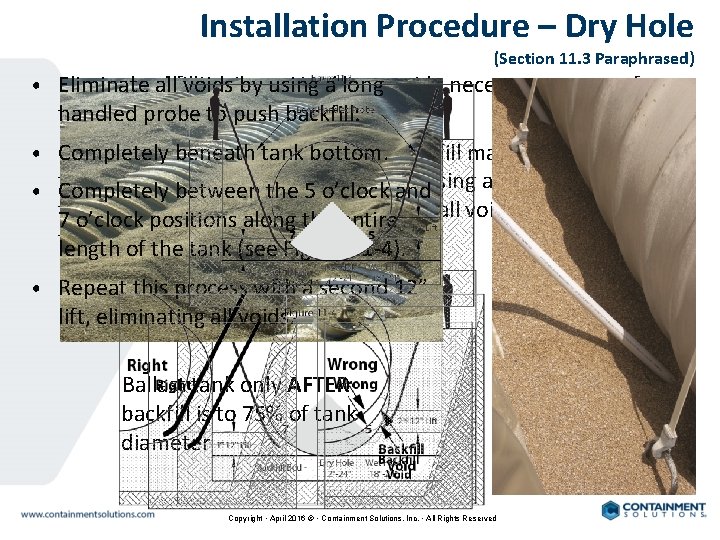
Installation Procedure – Dry Hole (Section 11. 3 Paraphrased) Proper backfilling to provide necessary support for • Eliminate all voidsisbyrequired using a long the tank. probe to push backfill: handled Place the first 12” lifttank of approved • Completely beneath bottom. backfill material evenly around the tank. Push the backfill place and by using a probe long enough • Completely between the 5 ino’clock too’clock reach beneath tank, all voids, so the tank is 7 positionsthe along theeliminating entire fully supported (see Figure 11 -3). length of the tank (see Figure 11 -4). • Repeat this process with a second 12” lift, eliminating all voids. Ballast tank only AFTER backfill is to 75% of tank diameter Copyright • April 2016 © • Containment Solutions, Inc. • All Rights Reserved

INSTALLATION PROCEDURES – WET HOLE • Water level in the excavation should be maintained at lowest practical level by using pumps. • Ballast the tank if ground water cannot be lowered (refer Section 10). Copyright • April 2016 © • Containment Solutions, Inc. • All Rights Reserved 38
PIPING & BOTTOM CLEARANCES Section 13 Copyright • April 2016 © • Containment Solutions, Inc. • All Rights Reserved
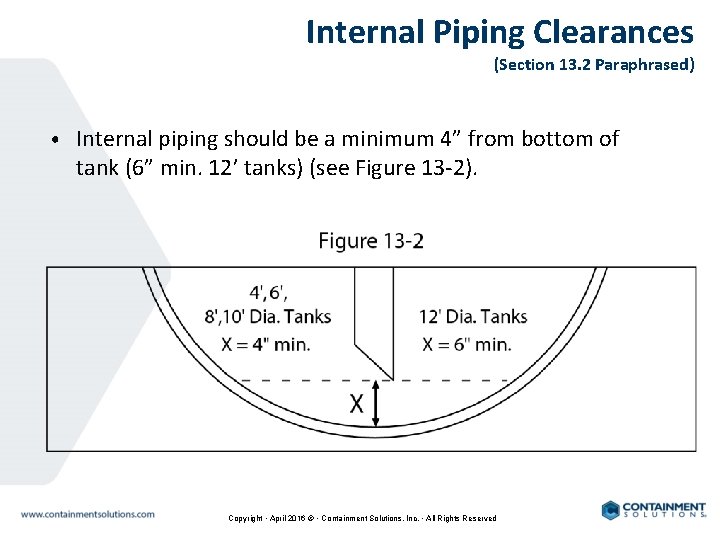
Internal Piping Clearances (Section 13. 2 Paraphrased) • Internal piping should be a minimum 4” from bottom of tank (6” min. 12’ tanks) (see Figure 13 -2). Copyright • April 2016 © • Containment Solutions, Inc. • All Rights Reserved
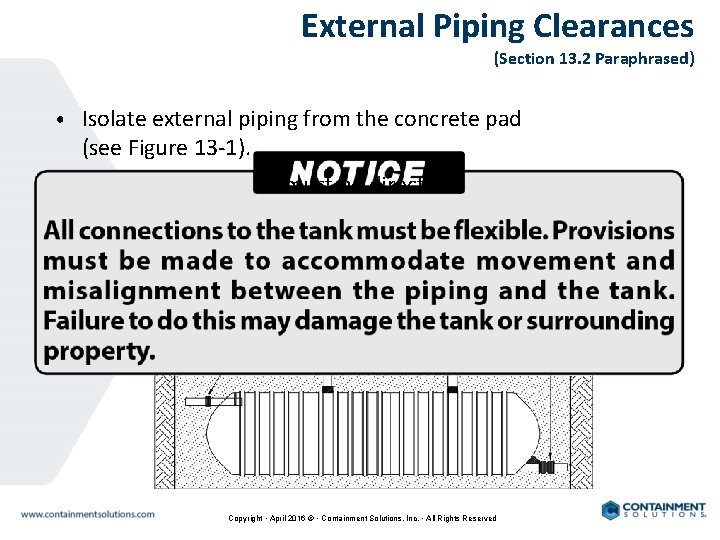
External Piping Clearances (Section 13. 2 Paraphrased) • Isolate external piping from the concrete pad (see Figure 13 -1). • A flexible Connector must be directly installed on all tangentially mounted fittings, nozzle or pipe. Copyright • April 2016 © • Containment Solutions, Inc. • All Rights Reserved
TANK VENTING Section 14 Copyright • April 2016 © • Containment Solutions, Inc. • All Rights Reserved
Tank Venting (Section 14 Paraphrased) • All primary tanks and compartments that contain product must be vented at all times, except as defined during pre-installation testing. • For tanks with inlet or outlet piping that will result in pressure at the tank top, the pressure should be limited to 1 psig. • The tank’s venting system must be adequately sized to ensure that the pressure or vacuum at the tank top will not exceed 1 psig at the tank top at all times, including when filling and emptying the tank. Copyright • April 2016 © • Containment Solutions, Inc. • All Rights Reserved
Filling Tanks Section 15 Copyright • April 2016 © • Containment Solutions, Inc. • All Rights Reserved
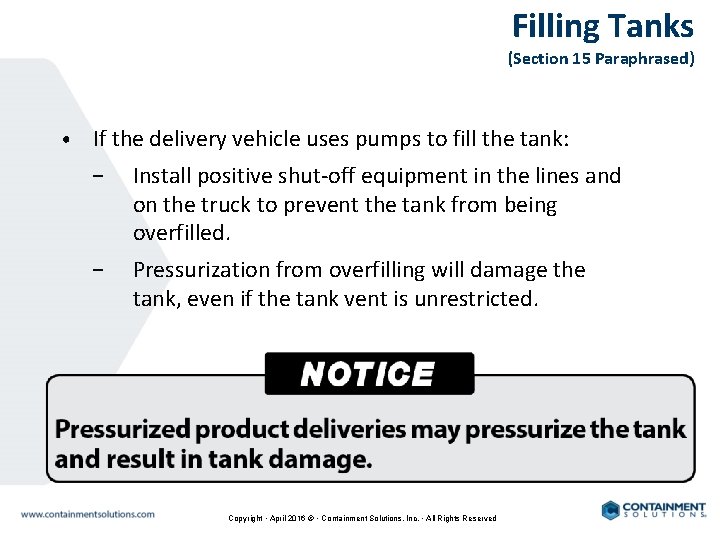
Filling Tanks (Section 15 Paraphrased) • If the delivery vehicle uses pumps to fill the tank: − Install positive shut-off equipment in the lines and on the truck to prevent the tank from being overfilled. − Pressurization from overfilling will damage the tank, even if the tank vent is unrestricted. Copyright • April 2016 © • Containment Solutions, Inc. • All Rights Reserved
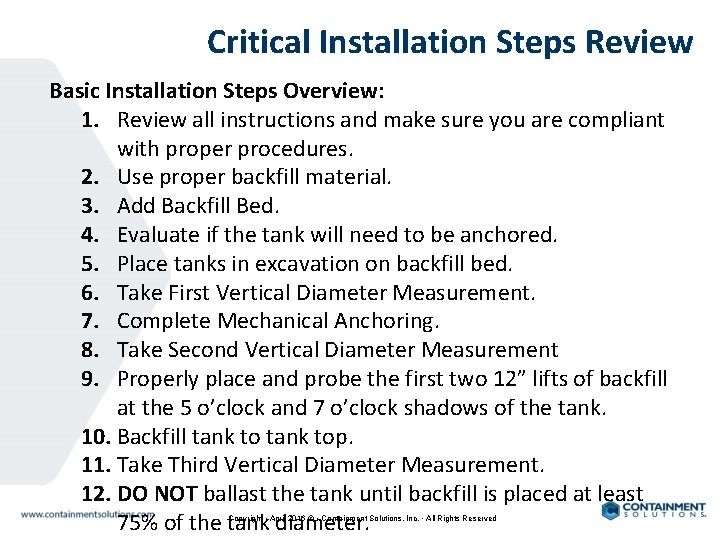
Critical Installation Steps Review Basic Installation Steps Overview: 1. Review all instructions and make sure you are compliant with proper procedures. 2. Use proper backfill material. 3. Add Backfill Bed. 4. Evaluate if the tank will need to be anchored. 5. Place tanks in excavation on backfill bed. 6. Take First Vertical Diameter Measurement. 7. Complete Mechanical Anchoring. 8. Take Second Vertical Diameter Measurement 9. Properly place and probe the first two 12” lifts of backfill at the 5 o’clock and 7 o’clock shadows of the tank. 10. Backfill tank top. 11. Take Third Vertical Diameter Measurement. 12. DO NOT ballast the tank until backfill is placed at least 75% of the tank diameter. Copyright • April 2016 © • Containment Solutions, Inc. • All Rights Reserved
MANWAYS Section 16 Copyright • April 2016 © • Containment Solutions, Inc. • All Rights Reserved
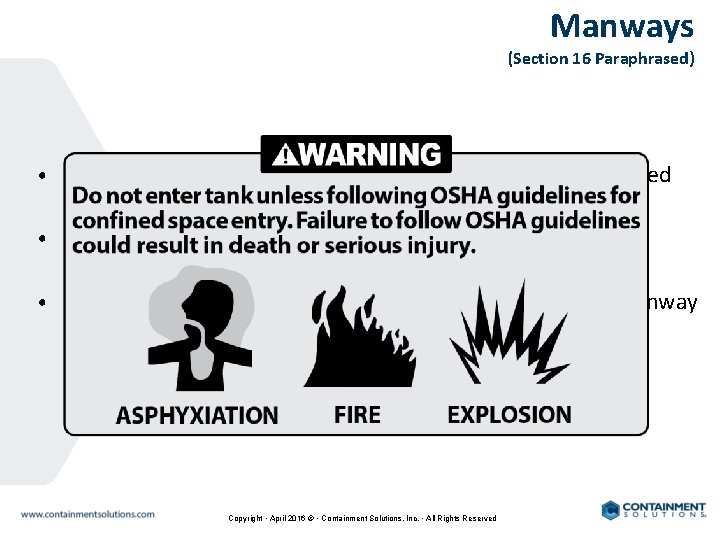
Manways (Section 16 Paraphrased) • The load bearing capacity for a standard 22” manway installed is 1, 200 lbs. for single-wall tanks. • All 30” and 36” manways have a load bearing capacity of 2, 400 lbs. • Do not exceed 50 ft. /lb. torque during bolt tightening or manway flange damage may occur. Copyright • April 2016 © • Containment Solutions, Inc. • All Rights Reserved
ACCESS RISER WITH ADHESIVE CHANNELS INST 6056 Copyright • April 2016 © • Containment Solutions, Inc. • All Rights Reserved
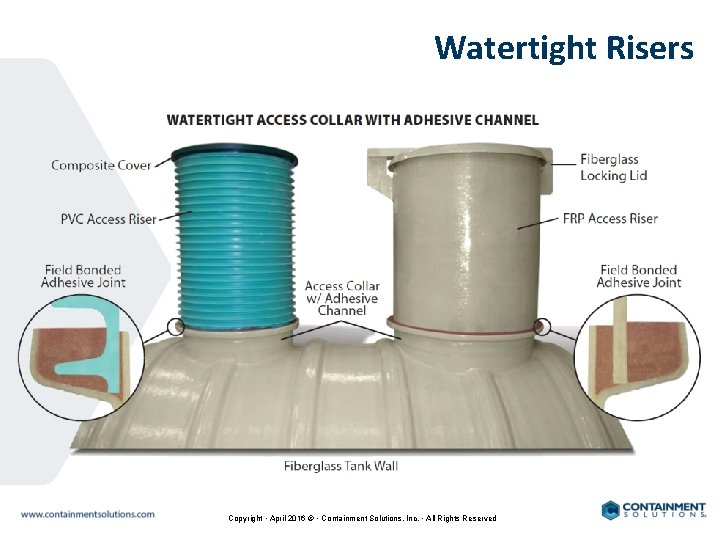
Watertight Risers Copyright • April 2016 © • Containment Solutions, Inc. • All Rights Reserved
Handling and Preparation (Section 2 Paraphrased) • Visually inspect the riser components for shipping damage. If damage is found, contact CSI Field Service. • Wear gloves. • Do not roll, drop, or bounce risers. • Set on smooth surface. • Secure risers to prevent damage from high winds. Proper precautions should be taken to protect adhesive channels. Copyright • April 2016 © • Containment Solutions, Inc. • All Rights Reserved
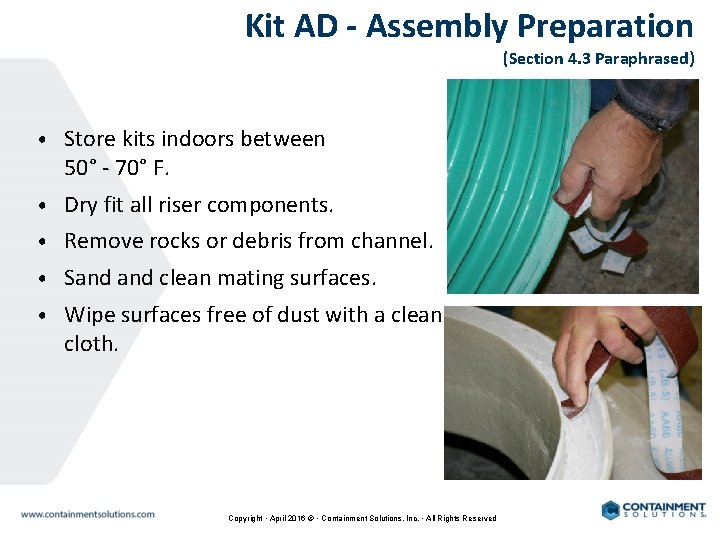
Kit AD - Assembly Preparation (Section 4. 3 Paraphrased) • Store kits indoors between 50° - 70° F. • Dry fit all riser components. • Remove rocks or debris from channel. • Sand clean mating surfaces. • Wipe surfaces free of dust with a clean cloth. Copyright • April 2016 © • Containment Solutions, Inc. • All Rights Reserved
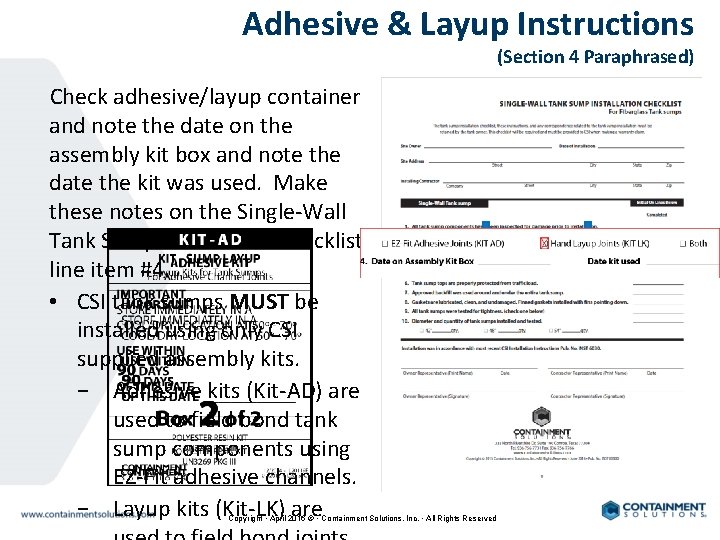
Adhesive & Layup Instructions (Section 4 Paraphrased) Check adhesive/layup container and note the date on the assembly kit box and note the date the kit was used. Make these notes on the Single-Wall Tank Sump Installation Checklist line item #4. • CSI tank sumps MUST be installed using only CSI supplied assembly kits. − Adhesive kits (Kit-AD) are used to field bond tank sump components using EZ-Fit adhesive channels. − Layup kits (Kit-LK) are Copyright • April 2016 © • Containment Solutions, Inc. • All Rights Reserved
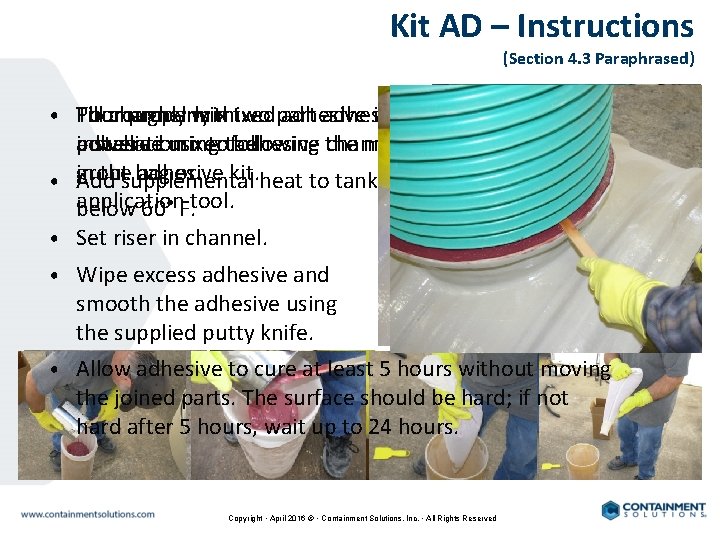
Kit AD – Instructions (Section 4. 3 Paraphrased) Pour properly adhesive into by grout bag easy • Fill Thoroughly channel with mixmixed two part adhesive hand orfor with a installation intothe adhesive the channel. adhesive powered using mixer following mixing instructions contained in thesupplemental bag adhesive or kit. heat to tank riser when temperatures are • grout Add application below 60° F. tool. • Set riser in channel. • Wipe excess adhesive and smooth the adhesive using the supplied putty knife. • Allow adhesive to cure at least 5 hours without moving the joined parts. The surface should be hard; if not hard after 5 hours, wait up to 24 hours. Copyright • April 2016 © • Containment Solutions, Inc. • All Rights Reserved
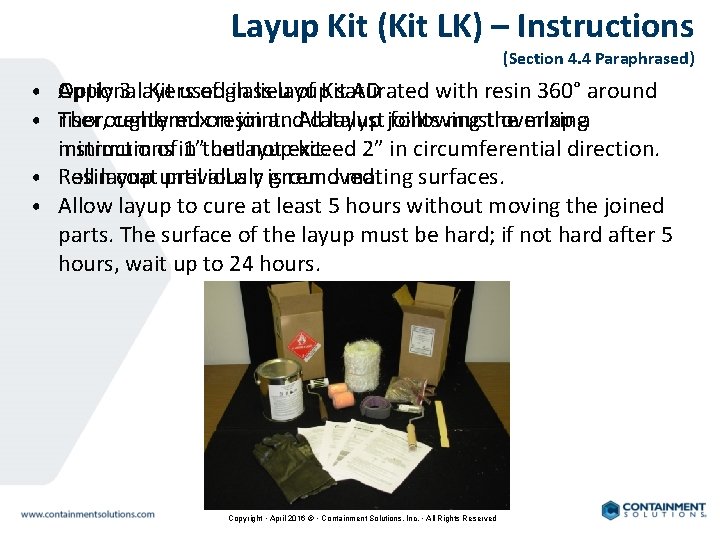
Layup Kit (Kit LK) – Instructions (Section 4. 4 Paraphrased) • Optional Apply 3 layers Kit used of glass in lieu layup of Kitsaturated AD with resin 360° around • Thoroughly riser, centered mixon resin joint. and. All catalyst layup joints following mustthe overlap mixinga instructions minimum of in 1”the butlayup not exceed kit. 2” in circumferential direction. • Resin Roll layup coatuntil previously all air is ground removed. mating surfaces. • Allow layup to cure at least 5 hours without moving the joined parts. The surface of the layup must be hard; if not hard after 5 hours, wait up to 24 hours. Copyright • April 2016 © • Containment Solutions, Inc. • All Rights Reserved
For Additional Questions: Tank Technical Support (800) 537 -4730 (936) 756 -7731 Field Service Department (800) 822 -1997 (814) 542 -8520 Copyright • April 2016 © • Containment Solutions, Inc. • All Rights Reserved
- Slides: 56