
FHWA Freight Intermodal Connectors Study presented to Office


- Slides: 13
FHWA Freight Intermodal Connectors Study presented to Office of Freight Management and Operations 1200 New Jersey Avenue SE Washington, D. C. 20590 www. ops. fhwa. dot. gov/freight 202 -366 -9210 Advisory Committee on Supply Chain Competitiveness presented by Tiffany Julien, FHWA April 16, 2015
Agenda • • Overview of Study Key Findings from Literature Review Discussion of Case Study Results Approach for Analysis of Connector Conditions and Performance Task • Next Steps 2
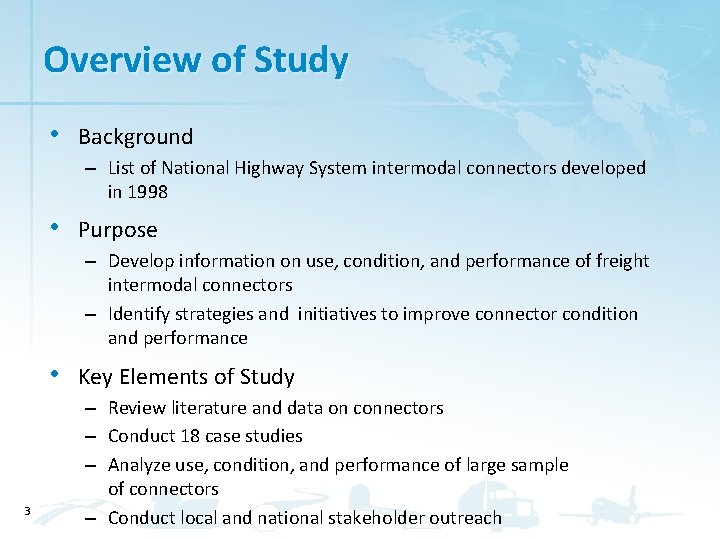
Overview of Study • Background – List of National Highway System intermodal connectors developed in 1998 • Purpose – Develop information on use, condition, and performance of freight intermodal connectors – Identify strategies and initiatives to improve connector condition and performance • Key Elements of Study 3 – Review literature and data on connectors – Conduct 18 case studies – Analyze use, condition, and performance of large sample of connectors – Conduct local and national stakeholder outreach
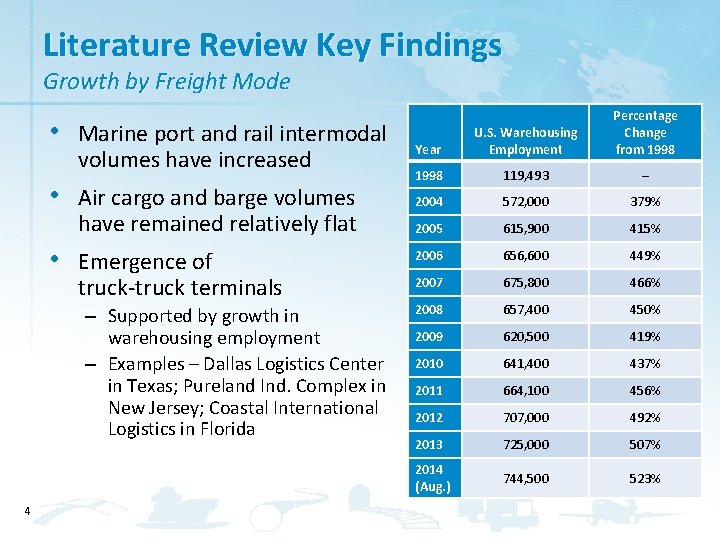
Literature Review Key Findings Growth by Freight Mode • Marine port and rail intermodal volumes have increased • Air cargo and barge volumes have remained relatively flat • Emergence of truck-truck terminals – Supported by growth in warehousing employment – Examples – Dallas Logistics Center in Texas; Pureland Ind. Complex in New Jersey; Coastal International Logistics in Florida 4 Year U. S. Warehousing Employment Percentage Change from 1998 119, 493 – 2004 572, 000 379% 2005 615, 900 415% 2006 656, 600 449% 2007 675, 800 466% 2008 657, 400 450% 2009 620, 500 419% 2010 641, 400 437% 2011 664, 100 456% 2012 707, 000 492% 2013 725, 000 507% 2014 (Aug. ) 744, 500 523%
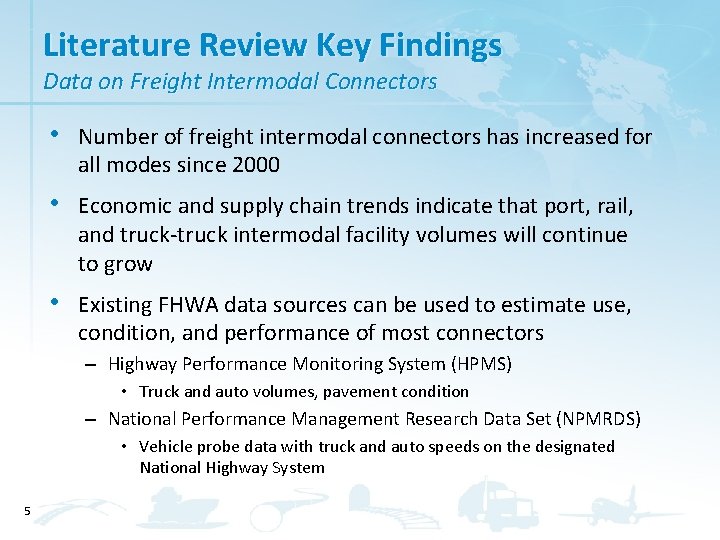
Literature Review Key Findings Data on Freight Intermodal Connectors • Number of freight intermodal connectors has increased for all modes since 2000 • Economic and supply chain trends indicate that port, rail, and truck-truck intermodal facility volumes will continue to grow • Existing FHWA data sources can be used to estimate use, condition, and performance of most connectors – Highway Performance Monitoring System (HPMS) • Truck and auto volumes, pavement condition – National Performance Management Research Data Set (NPMRDS) • Vehicle probe data with truck and auto speeds on the designated National Highway System 5
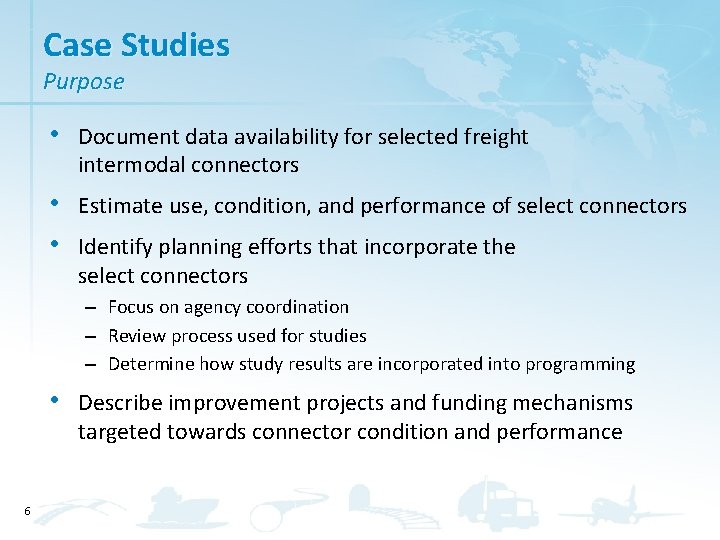
Case Studies Purpose • Document data availability for selected freight intermodal connectors • Estimate use, condition, and performance of select connectors • Identify planning efforts that incorporate the select connectors – Focus on agency coordination – Review process used for studies – Determine how study results are incorporated into programming • Describe improvement projects and funding mechanisms targeted towards connector condition and performance 6
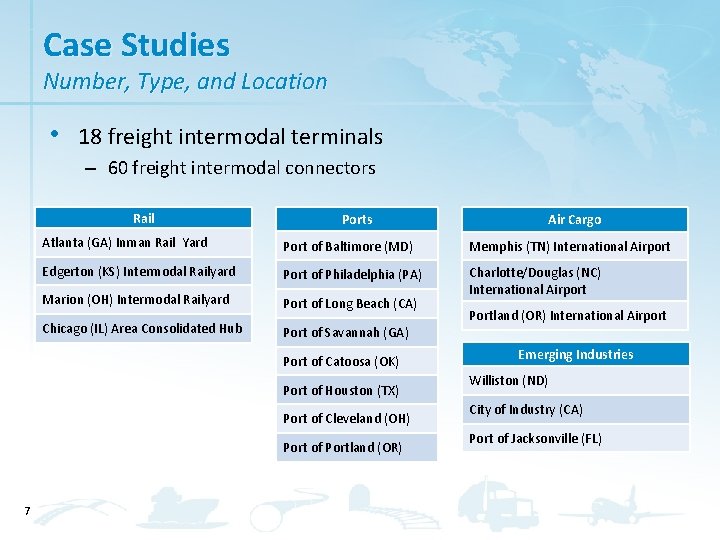
Case Studies Number, Type, and Location • 18 freight intermodal terminals – 60 freight intermodal connectors Rail Ports Atlanta (GA) Inman Rail Yard Port of Baltimore (MD) Memphis (TN) International Airport Edgerton (KS) Intermodal Railyard Port of Philadelphia (PA) Marion (OH) Intermodal Railyard Port of Long Beach (CA) Charlotte/Douglas (NC) International Airport Chicago (IL) Area Consolidated Hub Port of Savannah (GA) Port of Catoosa (OK) Port of Houston (TX) Port of Cleveland (OH) Port of Portland (OR) 7 Air Cargo Portland (OR) International Airport Emerging Industries Williston (ND) City of Industry (CA) Port of Jacksonville (FL)
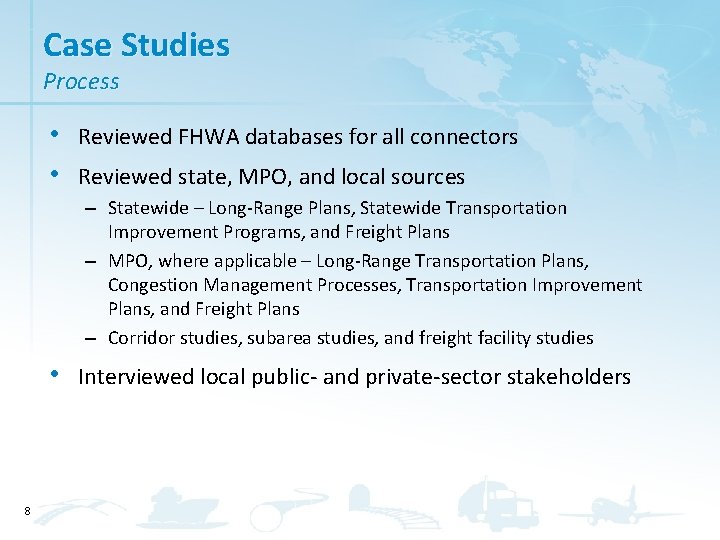
Case Studies Process • Reviewed FHWA databases for all connectors • Reviewed state, MPO, and local sources – Statewide – Long-Range Plans, Statewide Transportation Improvement Programs, and Freight Plans – MPO, where applicable – Long-Range Transportation Plans, Congestion Management Processes, Transportation Improvement Plans, and Freight Plans – Corridor studies, subarea studies, and freight facility studies • Interviewed local public- and private-sector stakeholders 8
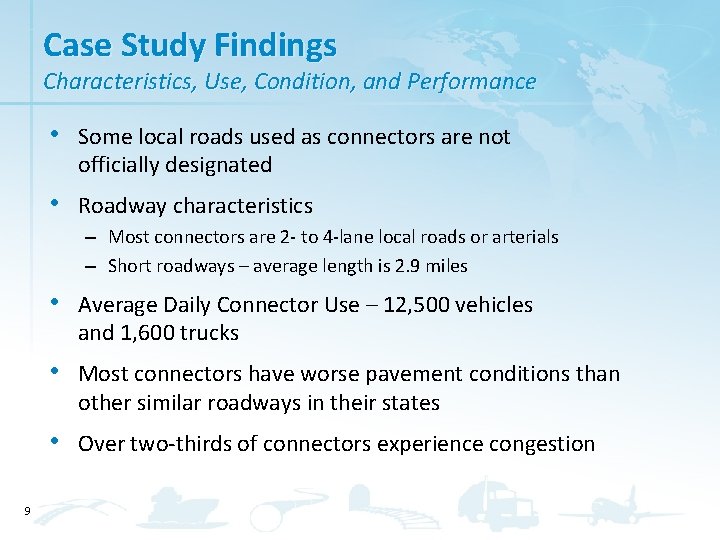
Case Study Findings Characteristics, Use, Condition, and Performance • Some local roads used as connectors are not officially designated • Roadway characteristics – Most connectors are 2 - to 4 -lane local roads or arterials – Short roadways – average length is 2. 9 miles • Average Daily Connector Use – 12, 500 vehicles and 1, 600 trucks • Most connectors have worse pavement conditions than other similar roadways in their states • Over two-thirds of connectors experience congestion 9
Case Study Findings Planning and Stakeholder Coordination • Planning – Tools to estimate future intermodal conditions not widely used – Studies that include connectors emphasized congestion and land use issues with pavement rarely mentioned – No freight intermodal connector programs were identified • Stakeholder Coordination – Connectors may be owned by states, counties, or cities and often span several local jurisdictions – Motivation for freight intermodal connectors planning – states concerned about economic development, locals concerned about neighborhoods – Stakeholder coordination relied heavily on freight champions
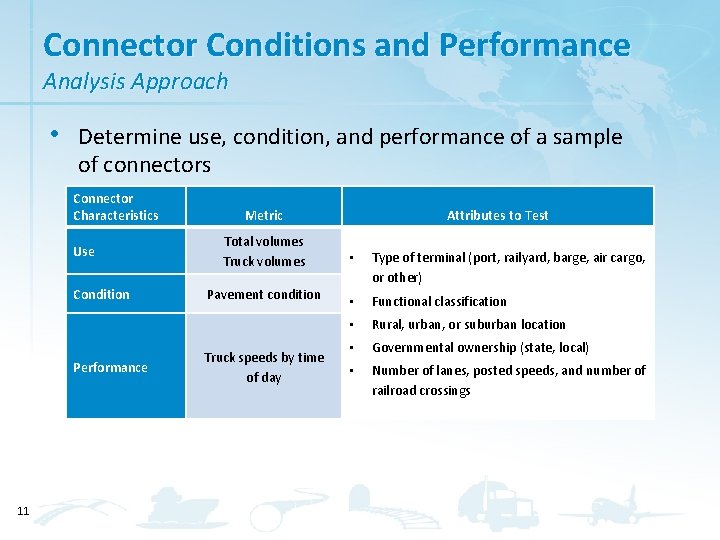
Connector Conditions and Performance Analysis Approach • Determine use, condition, and performance of a sample of connectors Connector Characteristics Use Condition Performance 11 Metric Attributes to Test Total volumes Truck volumes • Pavement condition Type of terminal (port, railyard, barge, air cargo, or other) • Functional classification • Rural, urban, or suburban location • Governmental ownership (state, local) • Number of lanes, posted speeds, and number of railroad crossings Truck speeds by time of day
Next Steps • Complete case study documentation • Analyze connectors condition and performance • Prepare recommendations and draft report – Available summer 2015 • Review draft report with national and local stakeholder groups and other national freight organizations 12
Questions and Comments For additional information, contact: Tiffany Julien FHWA Project Manager tiffany. julien@dot. gov 13