
FGC 3 Integration in PSBPS MSWG meeting November
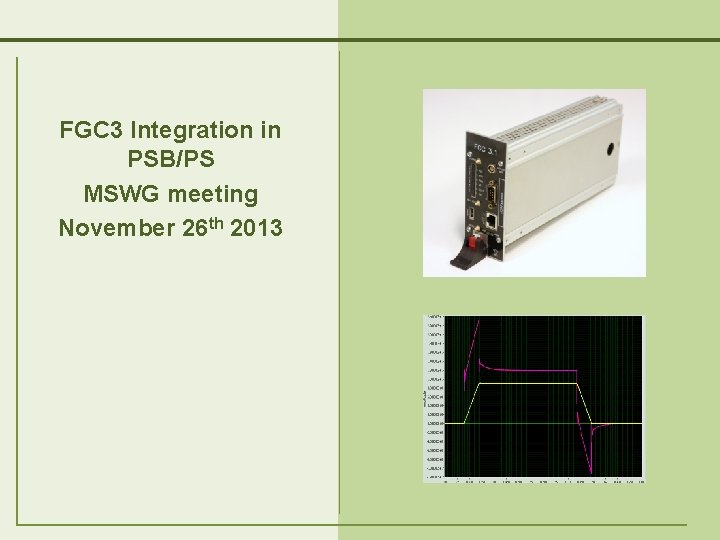
FGC 3 Integration in PSB/PS MSWG meeting November 26 th 2013
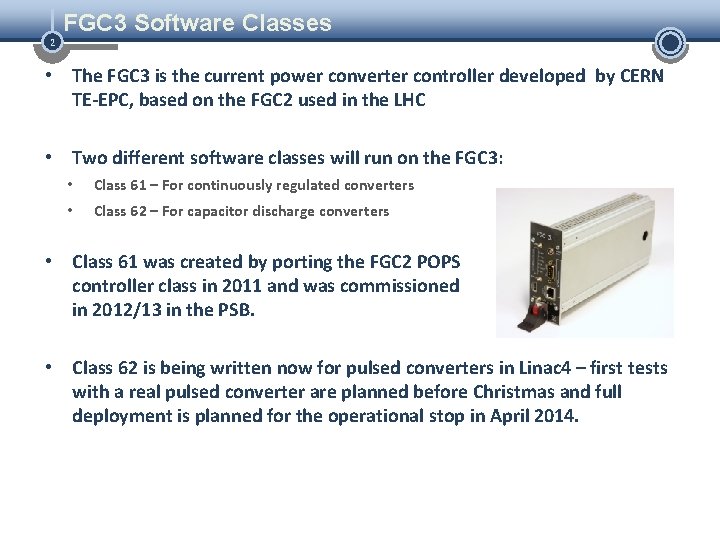
FGC 3 Software Classes 2 • The FGC 3 is the current power converter controller developed by CERN TE-EPC, based on the FGC 2 used in the LHC • Two different software classes will run on the FGC 3: • Class 61 – For continuously regulated converters • Class 62 – For capacitor discharge converters • Class 61 was created by porting the FGC 2 POPS controller class in 2011 and was commissioned in 2012/13 in the PSB. • Class 62 is being written now for pulsed converters in Linac 4 – first tests with a real pulsed converter are planned before Christmas and full deployment is planned for the operational stop in April 2014.
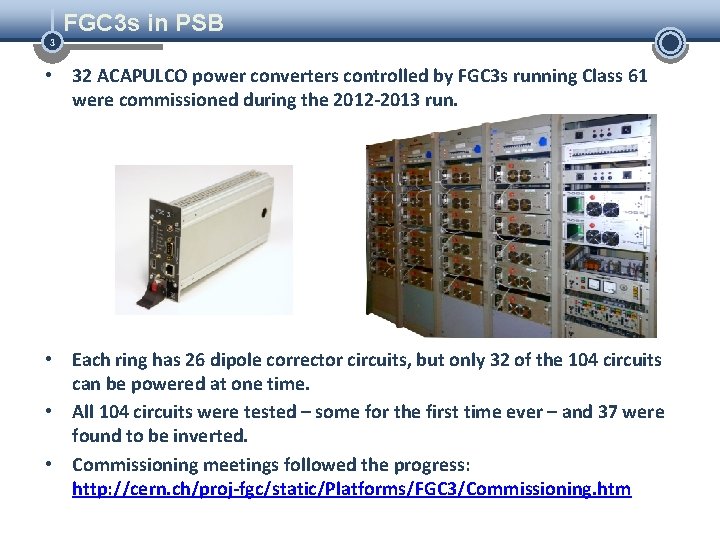
FGC 3 s in PSB 3 • 32 ACAPULCO power converters controlled by FGC 3 s running Class 61 were commissioned during the 2012 -2013 run. • Each ring has 26 dipole corrector circuits, but only 32 of the 104 circuits can be powered at one time. • All 104 circuits were tested – some for the first time ever – and 37 were found to be inverted. • Commissioning meetings followed the progress: http: //cern. ch/proj-fgc/static/Platforms/FGC 3/Commissioning. htm
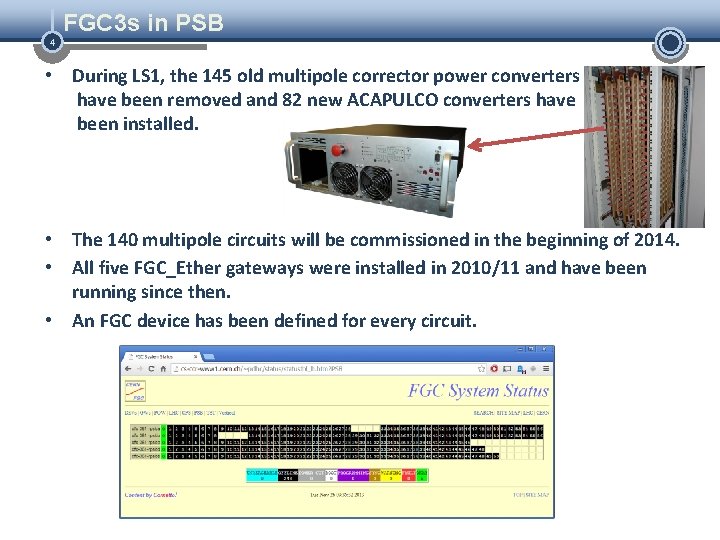
FGC 3 s in PSB 4 • During LS 1, the 145 old multipole corrector power converters have been removed and 82 new ACAPULCO converters have been installed. • The 140 multipole circuits will be commissioned in the beginning of 2014. • All five FGC_Ether gateways were installed in 2010/11 and have been running since then. • An FGC device has been defined for every circuit.
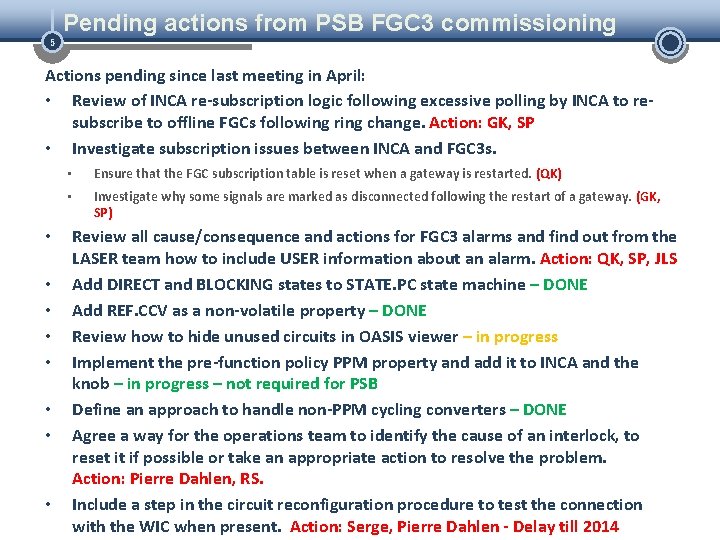
Pending actions from PSB FGC 3 commissioning 5 Actions pending since last meeting in April: • Review of INCA re-subscription logic following excessive polling by INCA to resubscribe to offline FGCs following ring change. Action: GK, SP • Investigate subscription issues between INCA and FGC 3 s. • • • Ensure that the FGC subscription table is reset when a gateway is restarted. (QK) • Investigate why some signals are marked as disconnected following the restart of a gateway. (GK, SP) Review all cause/consequence and actions for FGC 3 alarms and find out from the LASER team how to include USER information about an alarm. Action: QK, SP, JLS Add DIRECT and BLOCKING states to STATE. PC state machine – DONE Add REF. CCV as a non-volatile property – DONE Review how to hide unused circuits in OASIS viewer – in progress Implement the pre-function policy PPM property and add it to INCA and the knob – in progress – not required for PSB Define an approach to handle non-PPM cycling converters – DONE Agree a way for the operations team to identify the cause of an interlock, to reset it if possible or take an appropriate action to resolve the problem. Action: Pierre Dahlen, RS. Include a step in the circuit reconfiguration procedure to test the connection with the WIC when present. Action: Serge, Pierre Dahlen - Delay till 2014
FGC 3 in PS 6 • During LS 1, only 4 new FGC 3 -based systems will be installed in the PS using the new CANCUN converters (these are updated ACAPULCOs with higher voltageloop bandwidth) • These 4 new systems are for resonance compensation • For the moment, the only other FGCs in the PS are the FGC 2 s that run the old MPS (rotating machine) and the new POPS. • The POPS controls will ultimately be migrated to FGC 3 to benefit from the increased network bandwidth (FGC_Ether is much faster than World. FIP) and logging memory. • This upgrade will be in LS 2 or LS 3.
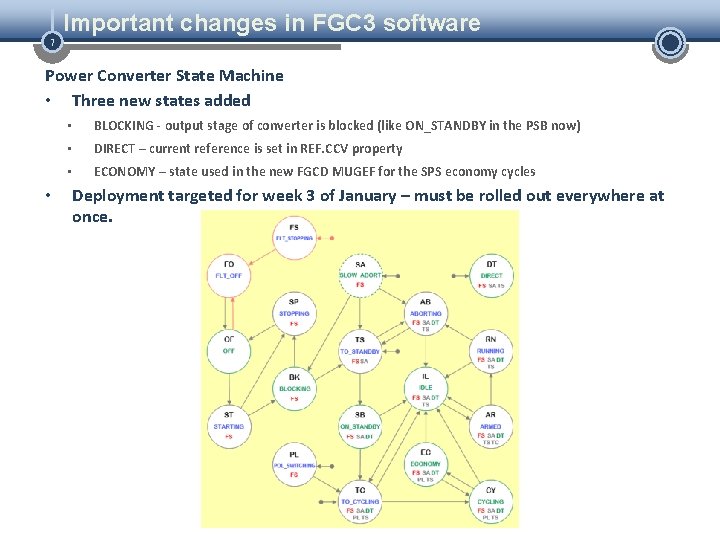
Important changes in FGC 3 software 7 Power Converter State Machine • Three new states added • • BLOCKING - output stage of converter is blocked (like ON_STANDBY in the PSB now) • DIRECT – current reference is set in REF. CCV property • ECONOMY – state used in the new FGCD MUGEF for the SPS economy cycles Deployment targeted for week 3 of January – must be rolled out everywhere at once.
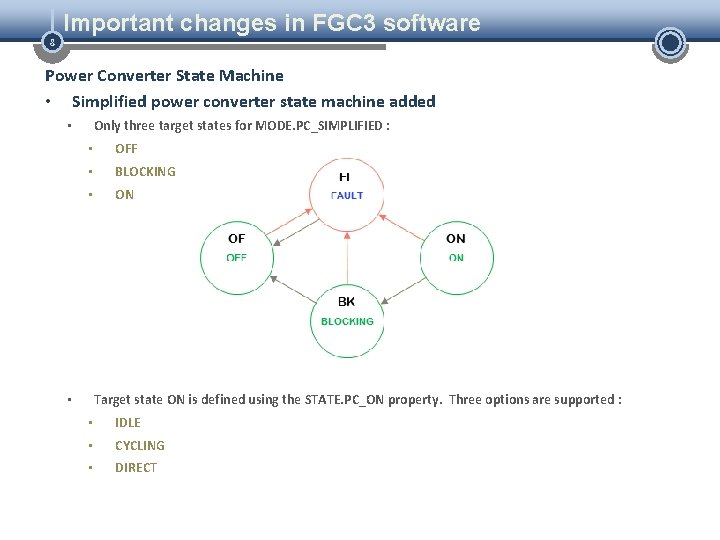
Important changes in FGC 3 software 8 Power Converter State Machine • Simplified power converter state machine added Only three target states for MODE. PC_SIMPLIFIED : • • OFF • BLOCKING • ON Target state ON is defined using the STATE. PC_ON property. Three options are supported : • • IDLE • CYCLING • DIRECT
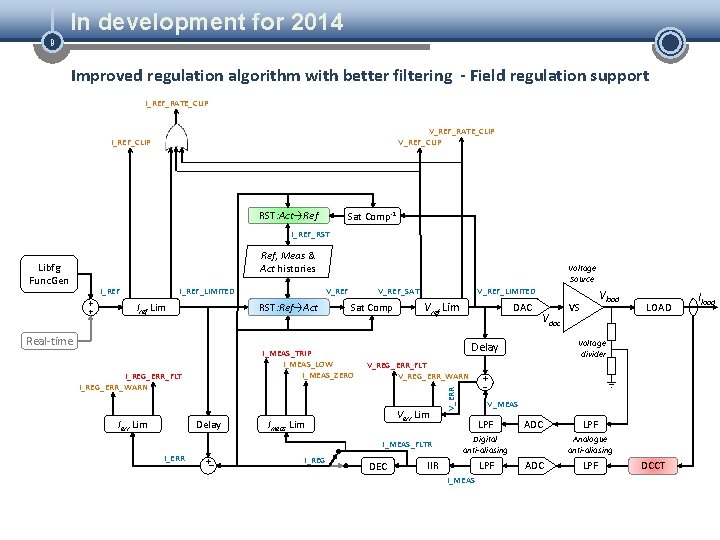
In development for 2014 9 Improved regulation algorithm with better filtering - Field regulation support I_REF_RATE_CLIP V_REF_CLIP I_REF_CLIP RST: Act→Ref Sat Comp-1 I_REF_RST Ref, Meas & Act histories I_REF_LIMITED Iref Lim V_REF RST: Ref→Act Real-time V_REF_SAT Sat Comp I_MEAS_TRIP I_MEAS_LOW I_MEAS_ZERO I_REG_ERR_FLT I_REG_ERR_WARN Ierr Lim Voltage Source Delay V_REF_LIMITED Vref Lim Vload VS LOAD Voltage divider V_REG_ERR_FLT V_REG_ERR_WARN Verr Lim Imeas Lim I_REG Vdac Delay I_MEAS_FLTR I_ERR DAC DEC V_ERR Libfg Func. Gen V_MEAS LPF ADC Analogue anti-aliasing Digital anti-aliasing IIR LPF I_MEAS LPF ADC LPF DCCT Iload
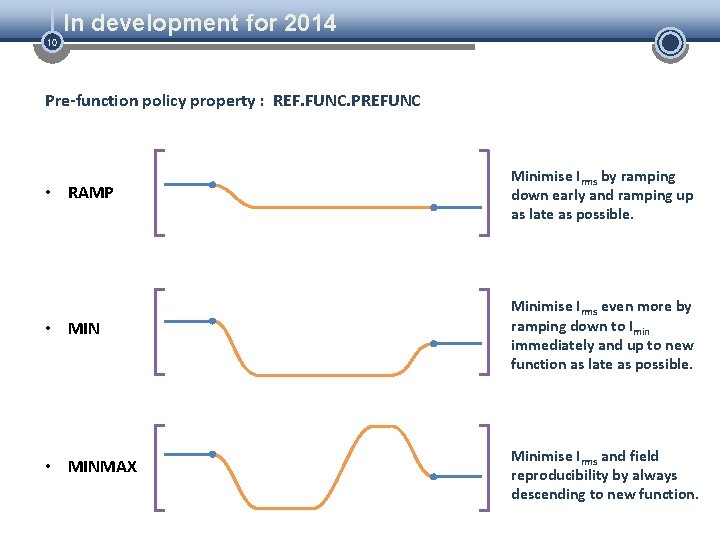
In development for 2014 10 Pre-function policy property : REF. FUNC. PREFUNC • RAMP Minimise Irms by ramping down early and ramping up as late as possible. • MIN Minimise Irms even more by ramping down to Imin immediately and up to new function as late as possible. • MINMAX Minimise Irms and field reproducibility by always descending to new function.
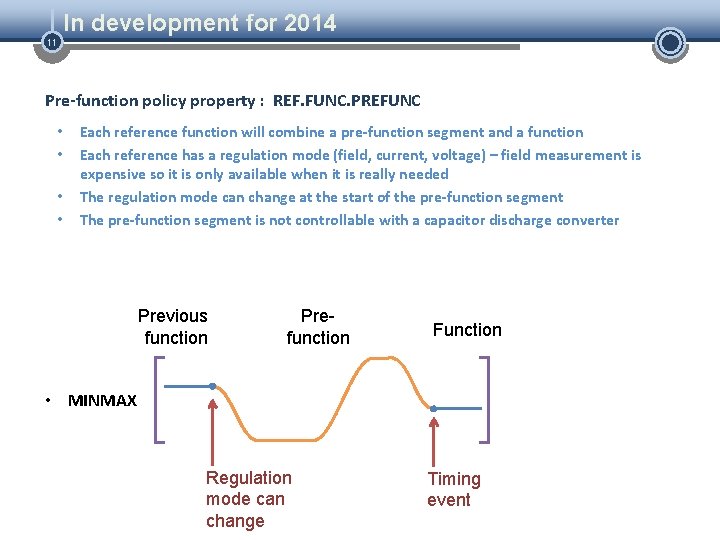
In development for 2014 11 Pre-function policy property : REF. FUNC. PREFUNC • • Each reference function will combine a pre-function segment and a function Each reference has a regulation mode (field, current, voltage) – field measurement is expensive so it is only available when it is really needed The regulation mode can change at the start of the pre-function segment The pre-function segment is not controllable with a capacitor discharge converter Previous function Prefunction Function • MINMAX Regulation mode can change Timing event
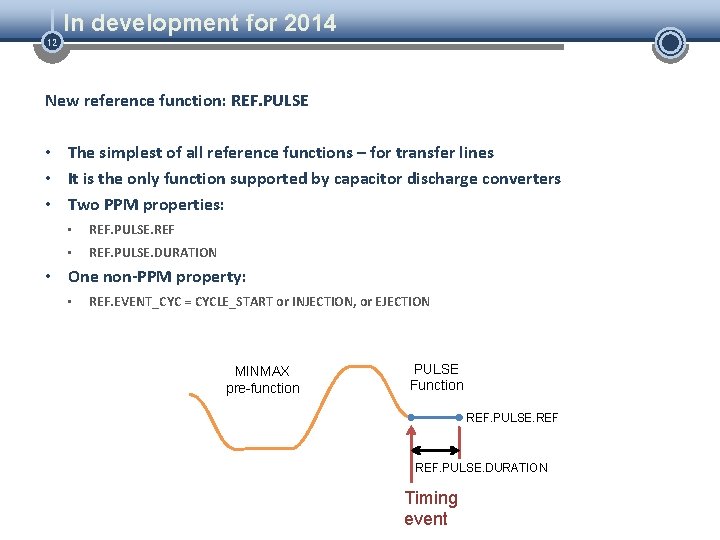
In development for 2014 12 New reference function: REF. PULSE • The simplest of all reference functions – for transfer lines • It is the only function supported by capacitor discharge converters • Two PPM properties: • REF. PULSE. REF • REF. PULSE. DURATION • One non-PPM property: • REF. EVENT_CYC = CYCLE_START or INJECTION, or EJECTION MINMAX pre-function PULSE Function REF. PULSE. DURATION Timing event
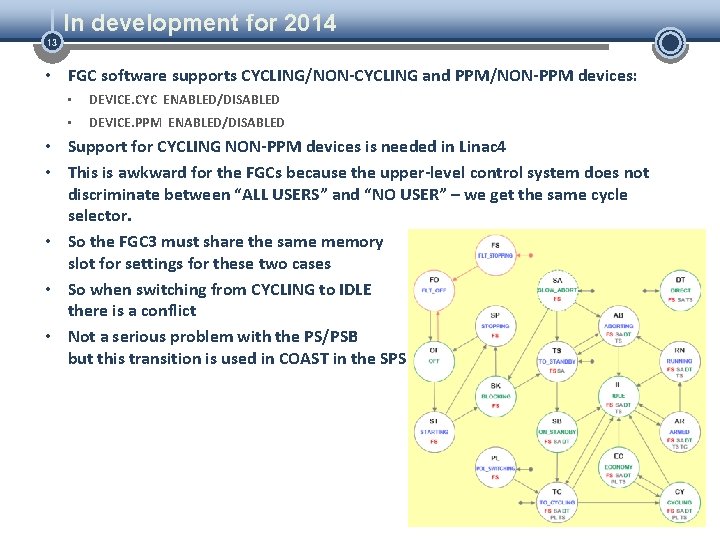
In development for 2014 13 • FGC software supports CYCLING/NON-CYCLING and PPM/NON-PPM devices: • DEVICE. CYC ENABLED/DISABLED • DEVICE. PPM ENABLED/DISABLED • Support for CYCLING NON-PPM devices is needed in Linac 4 • This is awkward for the FGCs because the upper-level control system does not discriminate between “ALL USERS” and “NO USER” – we get the same cycle selector. • So the FGC 3 must share the same memory slot for settings for these two cases • So when switching from CYCLING to IDLE there is a conflict • Not a serious problem with the PS/PSB but this transition is used in COAST in the SPS
Summary 14 • The FGC 3 hardware has enormous potential to support improved features for converter control, especially improved diagnostics. • We are still very early in the software development process, but we have a solid foundation from the 2012/13 commissioning in the PSB • Operation in 2014 will depend on the FGC 3 s for the multipole corrector circuits which are essential (unlike the dipole correctors), but the FGC 3 s will be ready. Thanks to TE-EPC LPC, CCS and CCE sections.
- Slides: 14