
Ffiseg Sylfaenol Basic Physics PH 1 1 Unedau
Ffiseg Sylfaenol (Basic Physics) PH 1. 1
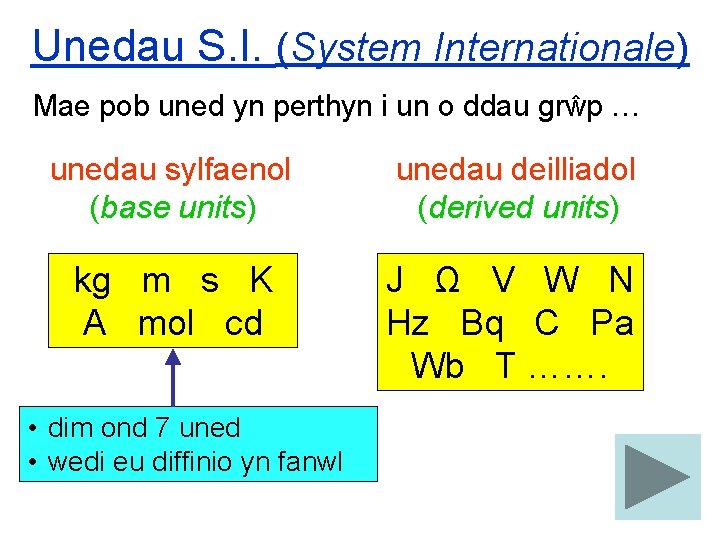
Unedau S. I. (System Internationale) Mae pob uned yn perthyn i un o ddau grŵp … unedau sylfaenol (base units) unedau deilliadol (derived units) kg m s K A mol cd J Ω V W N Hz Bq C Pa Wb T ……. • dim ond 7 uned • wedi eu diffinio yn fanwl
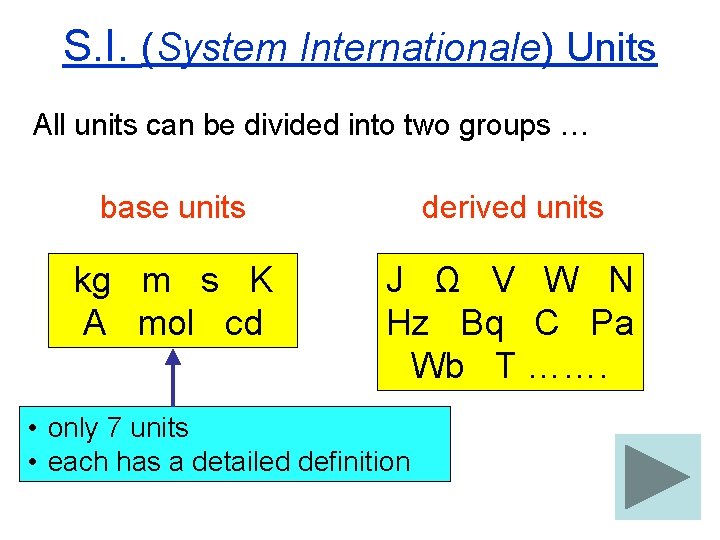
S. I. (System Internationale) Units All units can be divided into two groups … base units derived units kg m s K A mol cd J Ω V W N Hz Bq C Pa Wb T ……. • only 7 units • each has a detailed definition
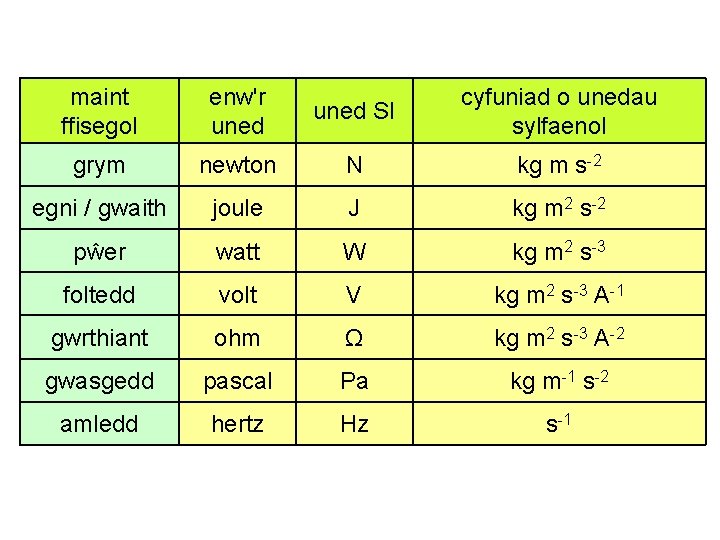
maint ffisegol enw'r uned SI cyfuniad o unedau sylfaenol grym newton N kg m s-2 egni / gwaith joule J kg m 2 s-2 pŵer watt W kg m 2 s-3 foltedd volt V kg m 2 s-3 A-1 gwrthiant ohm Ω kg m 2 s-3 A-2 gwasgedd pascal Pa kg m-1 s-2 amledd hertz Hz s-1

physical quantity unit name SI unit combination of base units force newton N kg m s-2 energy / work joule J kg m 2 s-2 power watt W kg m 2 s-3 voltage volt V kg m 2 s-3 A-1 resistance ohm Ω kg m 2 s-3 A-2 pressure pascal Pa kg m-1 s-2 frequency hertz Hz s-1

Er enghraifft: y cilogram … © BIPM mae gan unrhywbeth sydd â màs o 1 kg union yr un màs â phrototeip rhyngwladol y cilogram gwasgedd atmosfferig y tu fewn i dair haen o wydr aloi platinwm-iridiwm ar dymheredd cyson 19± 1 C Pam dewis platinwm-iridiwm? Mae’n aloi ddwys iawn, felly mae gan y sampl yma gyfaint bychan a felly arwynebedd bychan. O ganlyniad nid oes llawer o halogiad yn digwydd ar yr wyneb. Felly mae màs y sampl yn gyson.
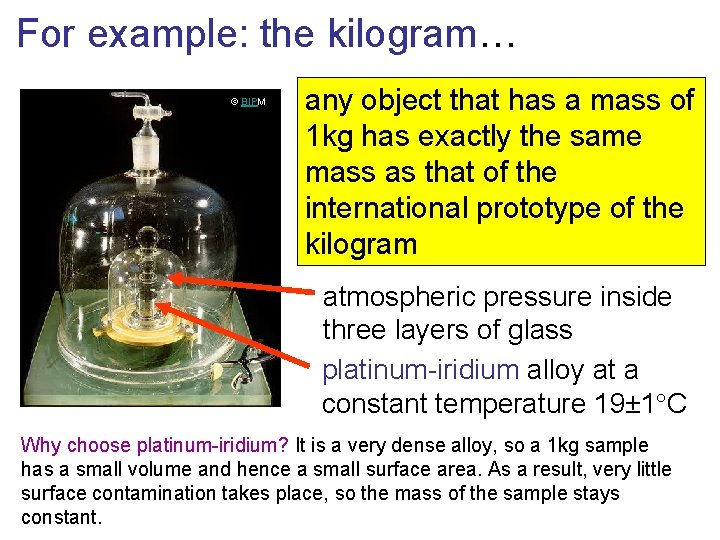
For example: the kilogram… © BIPM any object that has a mass of 1 kg has exactly the same mass as that of the international prototype of the kilogram atmospheric pressure inside three layers of glass platinum-iridium alloy at a constant temperature 19± 1 C Why choose platinum-iridium? It is a very dense alloy, so a 1 kg sample has a small volume and hence a small surface area. As a result, very little surface contamination takes place, so the mass of the sample stays constant.
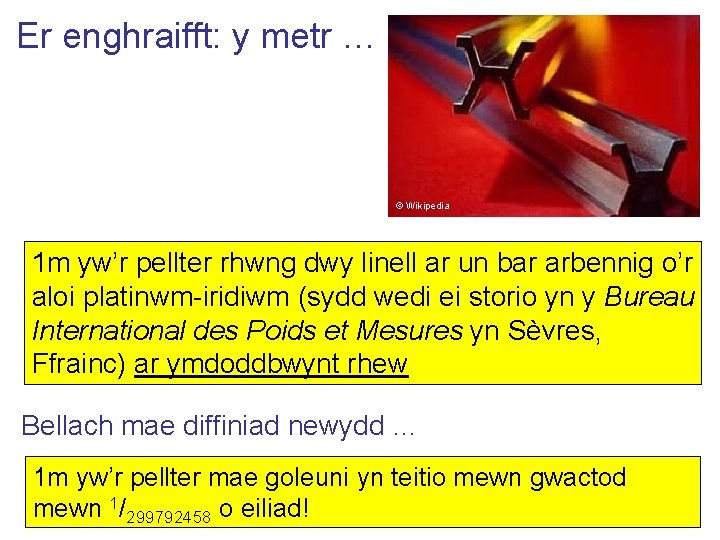
Er enghraifft: y metr … © Wikipedia 1 m yw’r pellter rhwng dwy linell ar un bar arbennig o’r aloi platinwm-iridiwm (sydd wedi ei storio yn y Bureau International des Poids et Mesures yn Sèvres, Ffrainc) ar ymdoddbwynt rhew Bellach mae diffiniad newydd … 1 m yw’r pellter mae goleuni yn teitio mewn gwactod mewn 1/299792458 o eiliad!
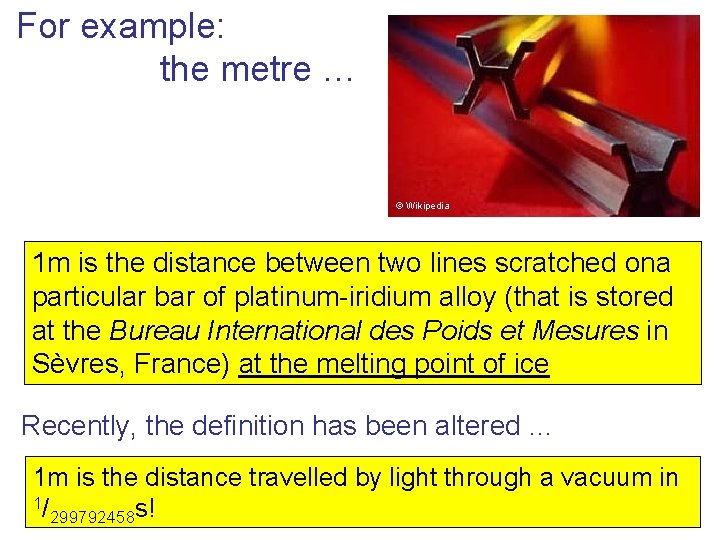
For example: the metre … © Wikipedia 1 m is the distance between two lines scratched ona particular bar of platinum-iridium alloy (that is stored at the Bureau International des Poids et Mesures in Sèvres, France) at the melting point of ice Recently, the definition has been altered … 1 m is the distance travelled by light through a vacuum in 1/ 299792458 s!
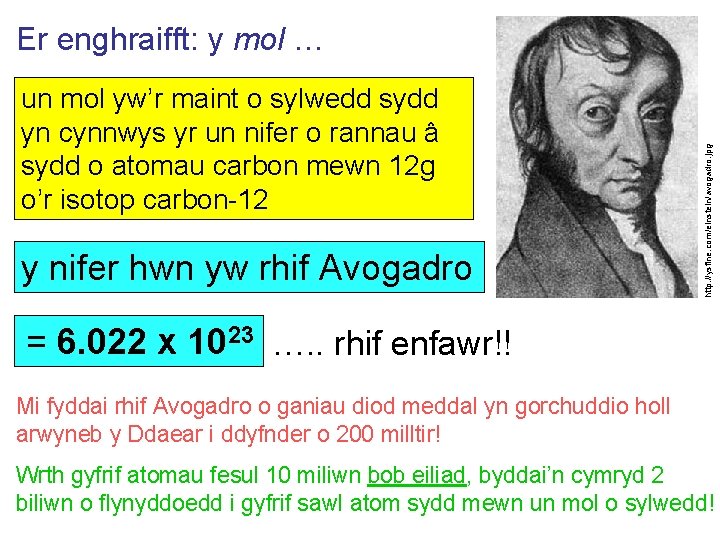
un mol yw’r maint o sylwedd sydd yn cynnwys yr un nifer o rannau â sydd o atomau carbon mewn 12 g o’r isotop carbon-12 y nifer hwn yw rhif Avogadro http: //ysfine. com/einstein/avogadro. jpg Er enghraifft: y mol … = 6. 022 x 1023 …. . rhif enfawr!! Mi fyddai rhif Avogadro o ganiau diod meddal yn gorchuddio holl arwyneb y Ddaear i ddyfnder o 200 milltir! Wrth gyfrif atomau fesul 10 miliwn bob eiliad, byddai’n cymryd 2 biliwn o flynyddoedd i gyfrif sawl atom sydd mewn un mol o sylwedd!
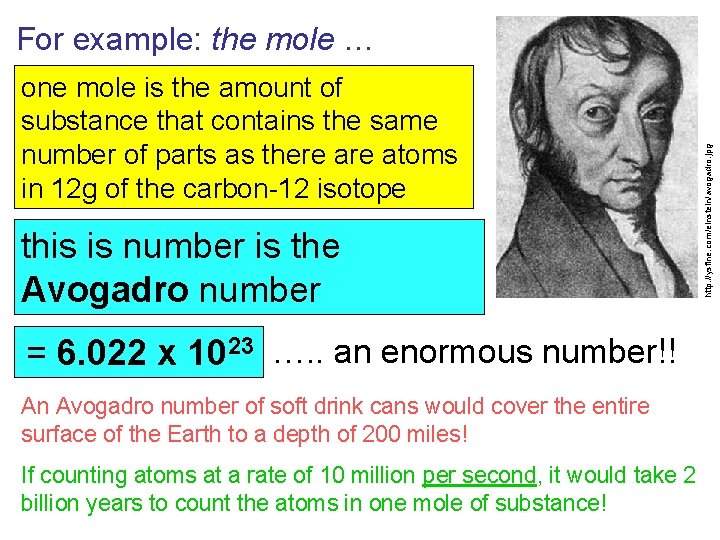
one mole is the amount of substance that contains the same number of parts as there atoms in 12 g of the carbon-12 isotope this is number is the Avogadro number = 6. 022 x 1023 …. . an enormous number!! An Avogadro number of soft drink cans would cover the entire surface of the Earth to a depth of 200 miles! If counting atoms at a rate of 10 million per second, it would take 2 billion years to count the atoms in one mole of substance! http: //ysfine. com/einstein/avogadro. jpg For example: the mole …
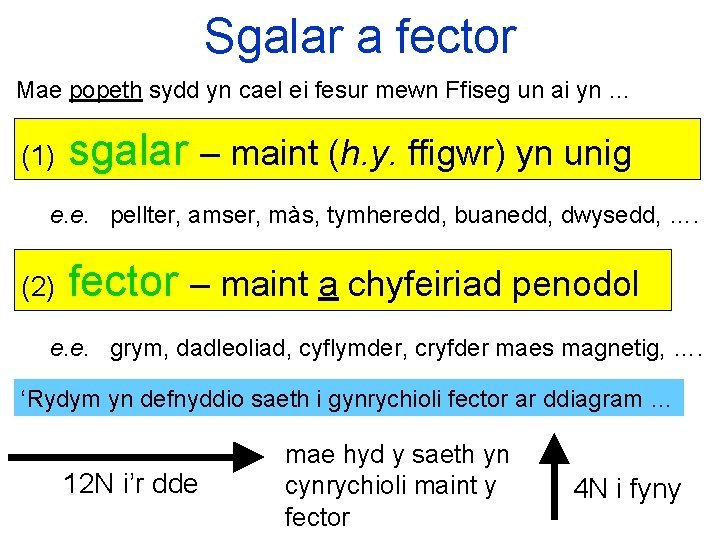
Sgalar a fector Mae popeth sydd yn cael ei fesur mewn Ffiseg un ai yn … (1) sgalar – maint (h. y. ffigwr) yn unig e. e. pellter, amser, màs, tymheredd, buanedd, dwysedd, …. (2) fector – maint a chyfeiriad penodol e. e. grym, dadleoliad, cyflymder, cryfder maes magnetig, …. ‘Rydym yn defnyddio saeth i gynrychioli fector ar ddiagram … 12 N i’r dde mae hyd y saeth yn cynrychioli maint y fector 4 N i fyny
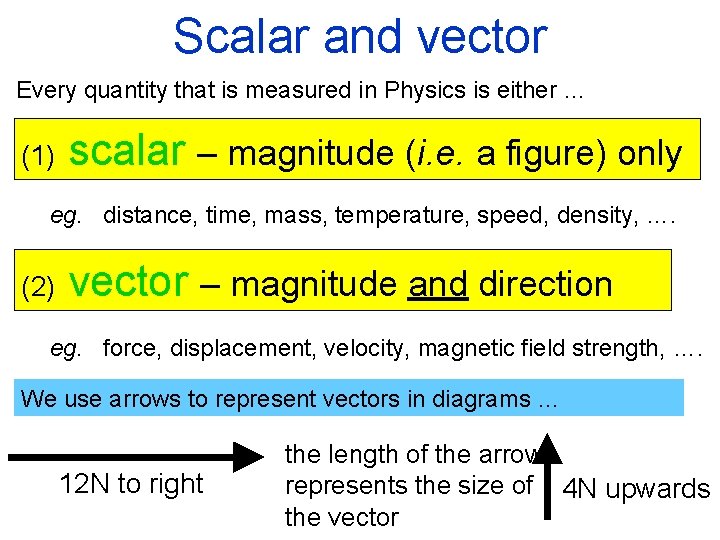
Scalar and vector Every quantity that is measured in Physics is either … (1) scalar – magnitude (i. e. a figure) only eg. distance, time, mass, temperature, speed, density, …. (2) vector – magnitude and direction eg. force, displacement, velocity, magnetic field strength, …. We use arrows to represent vectors in diagrams … 12 N to right the length of the arrow represents the size of 4 N upwards the vector
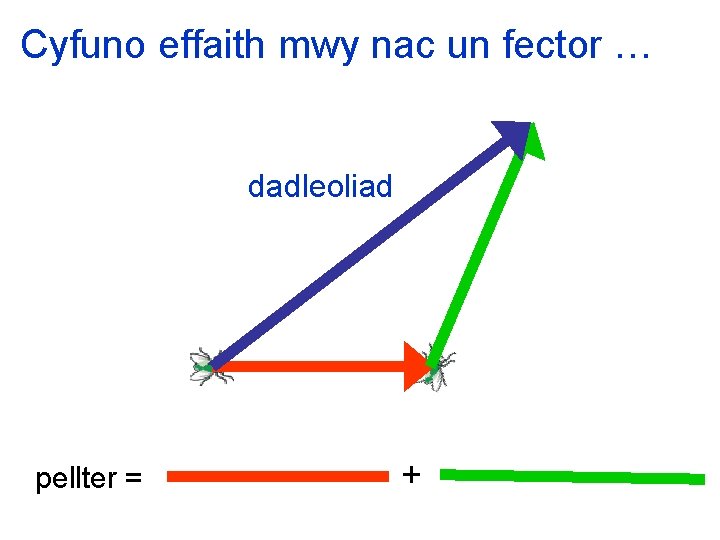
Cyfuno effaith mwy nac un fector … dadleoliad pellter = +
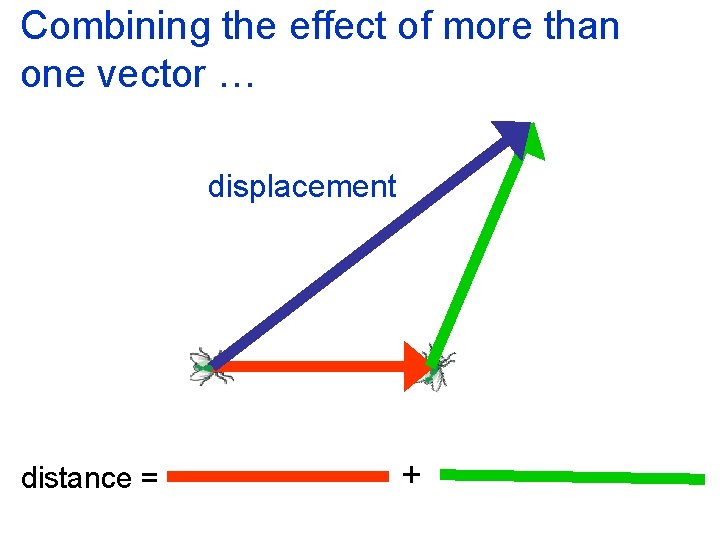
Combining the effect of more than one vector … displacement distance = +
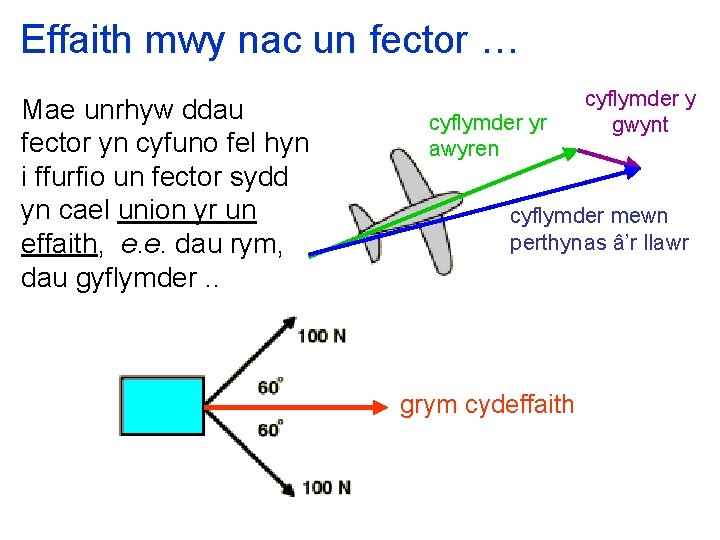
Effaith mwy nac un fector … Mae unrhyw ddau fector yn cyfuno fel hyn i ffurfio un fector sydd yn cael union yr un effaith, e. e. dau rym, dau gyflymder. . cyflymder yr awyren cyflymder y gwynt cyflymder mewn perthynas â’r llawr grym cydeffaith
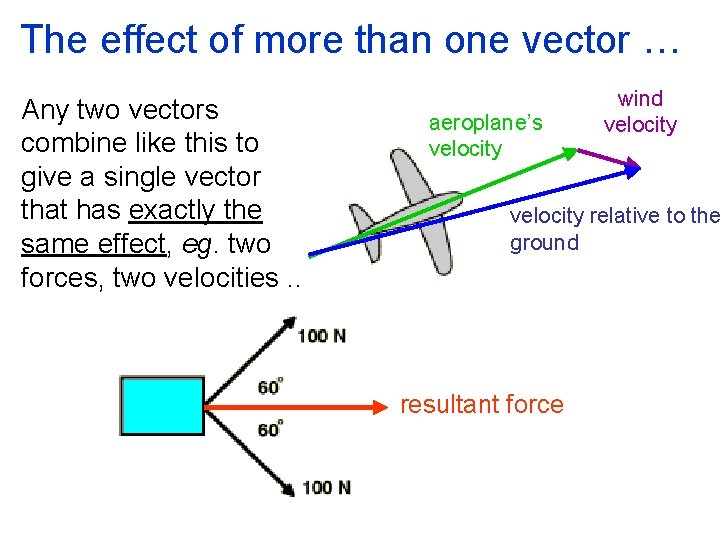
The effect of more than one vector … Any two vectors combine like this to give a single vector that has exactly the same effect, eg. two forces, two velocities. . aeroplane’s velocity wind velocity relative to the ground resultant force
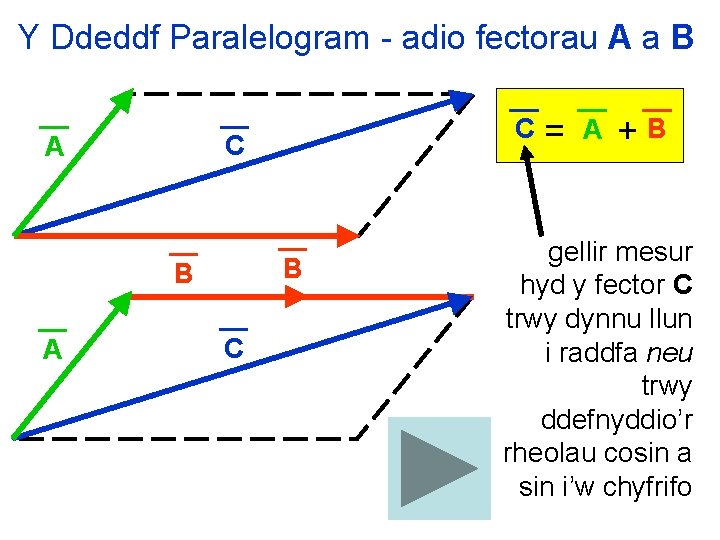
Y Ddeddf Paralelogram - adio fectorau A a B C A B B A C C = A +B gellir mesur hyd y fector C trwy dynnu llun i raddfa neu trwy ddefnyddio’r rheolau cosin a sin i’w chyfrifo
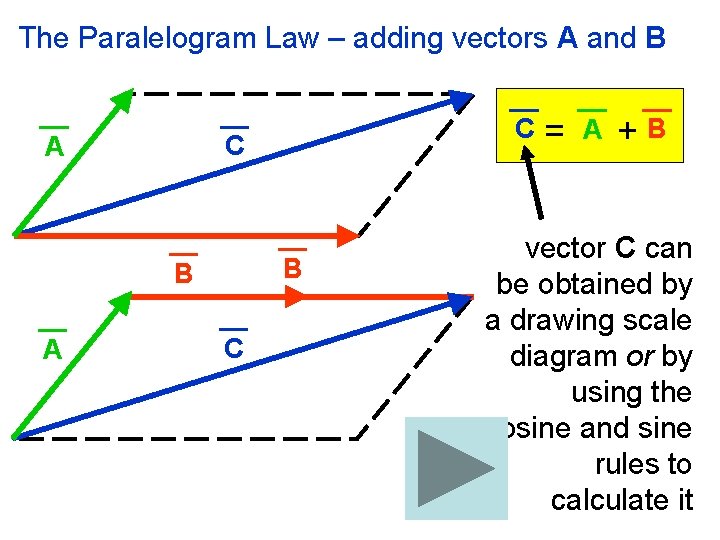
The Paralelogram Law – adding vectors A and B C A B B A C C = A +B vector C can be obtained by a drawing scale diagram or by using the cosine and sine rules to calculate it
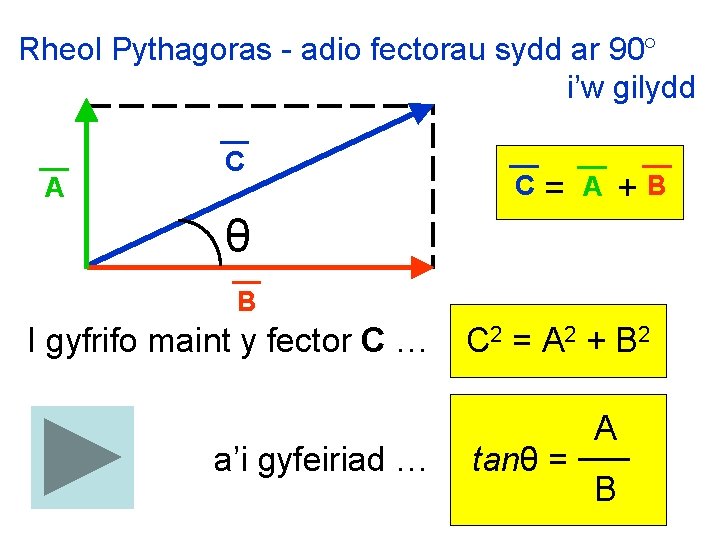
Rheol Pythagoras - adio fectorau sydd ar 90 i’w gilydd A C C = A +B θ B I gyfrifo maint y fector C … a’i gyfeiriad … C 2 = A 2 + B 2 tanθ = A B
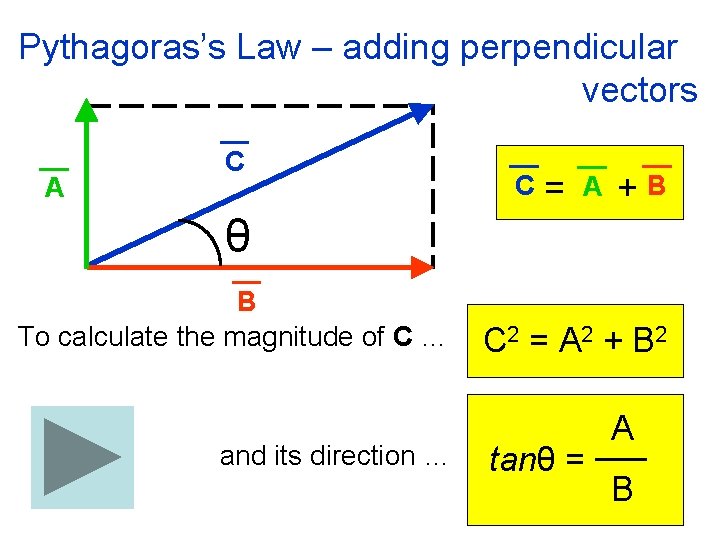
Pythagoras’s Law – adding perpendicular vectors A C C = A +B θ B To calculate the magnitude of C … and its direction … C 2 = A 2 + B 2 tanθ = A B
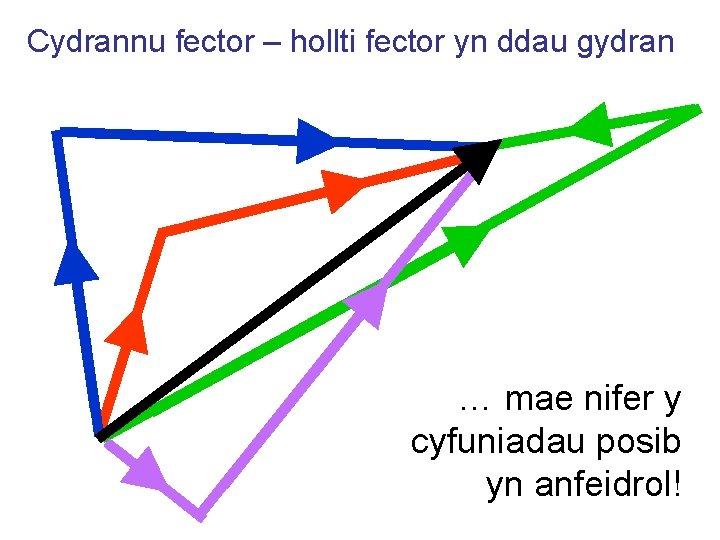
Cydrannu fector – hollti fector yn ddau gydran … mae nifer y cyfuniadau posib yn anfeidrol!
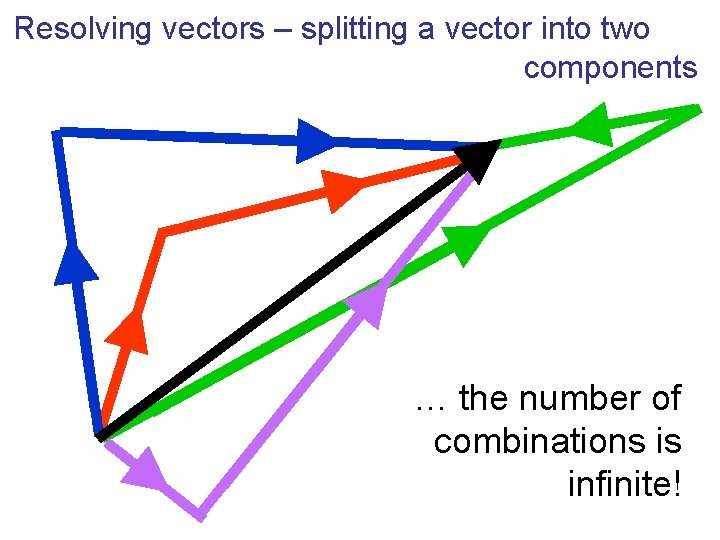
Resolving vectors – splitting a vector into two components … the number of combinations is infinite!
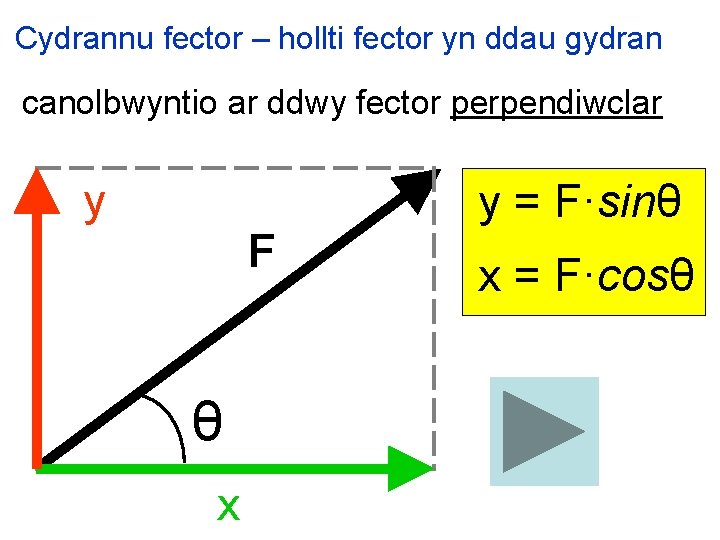
Cydrannu fector – hollti fector yn ddau gydran canolbwyntio ar ddwy fector perpendiwclar y F θ x y = F·sinθ x = F·cosθ
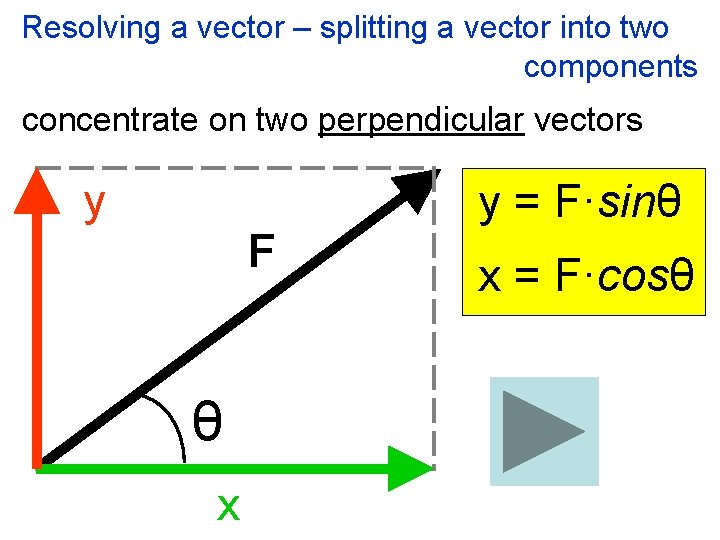
Resolving a vector – splitting a vector into two components concentrate on two perpendicular vectors y F θ x y = F·sinθ x = F·cosθ
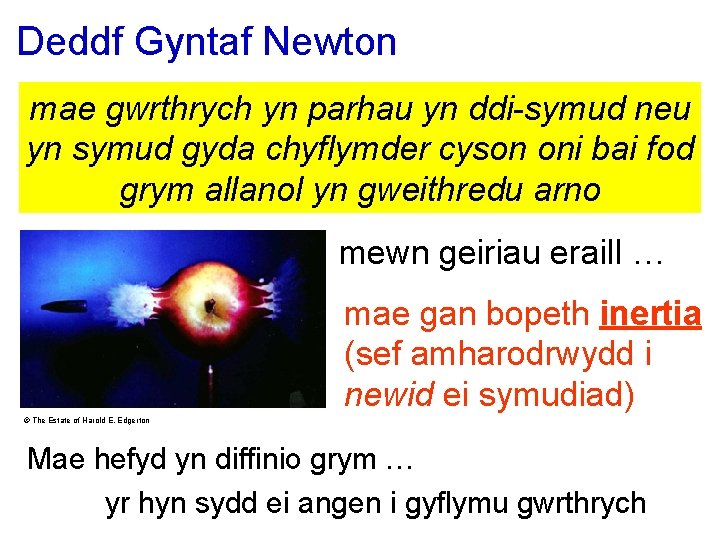
Deddf Gyntaf Newton mae gwrthrych yn parhau yn ddi-symud neu yn symud gyda chyflymder cyson oni bai fod grym allanol yn gweithredu arno mewn geiriau eraill … mae gan bopeth inertia (sef amharodrwydd i newid ei symudiad) © The Estate of Harold E. Edgerton Mae hefyd yn diffinio grym … yr hyn sydd ei angen i gyflymu gwrthrych
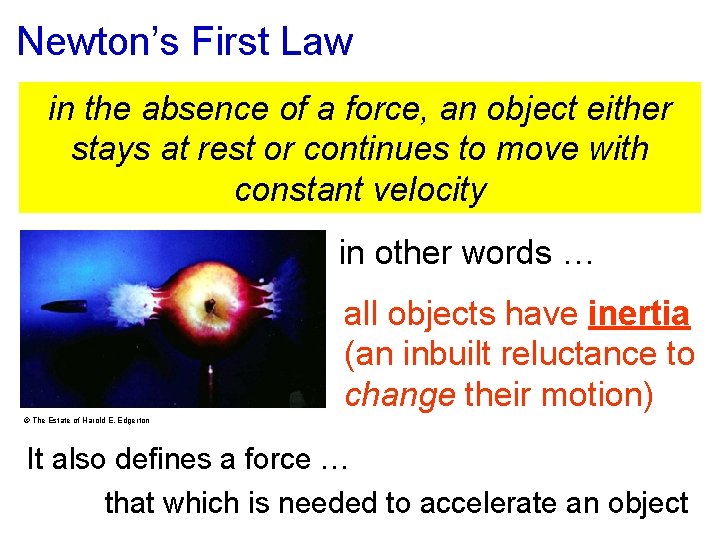
Newton’s First Law in the absence of a force, an object either stays at rest or continues to move with constant velocity in other words … all objects have inertia (an inbuilt reluctance to change their motion) © The Estate of Harold E. Edgerton It also defines a force … that which is needed to accelerate an object
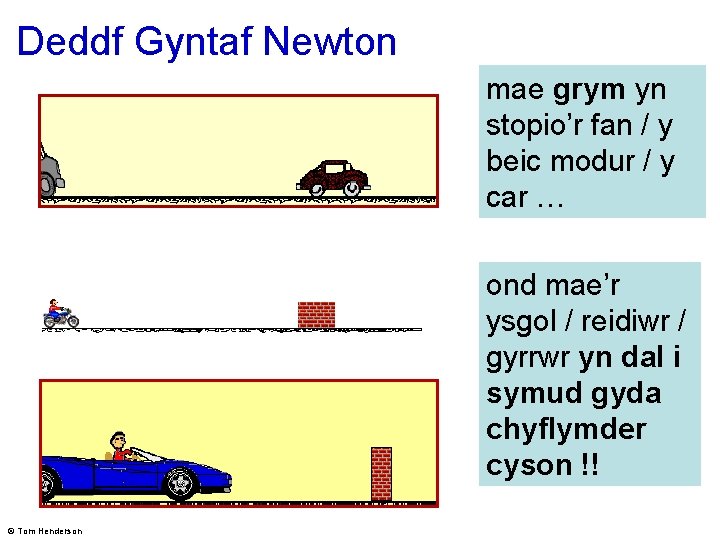
Deddf Gyntaf Newton mae grym yn stopio’r fan / y beic modur / y car … ond mae’r ysgol / reidiwr / gyrrwr yn dal i symud gyda chyflymder cyson !! © Tom Henderson
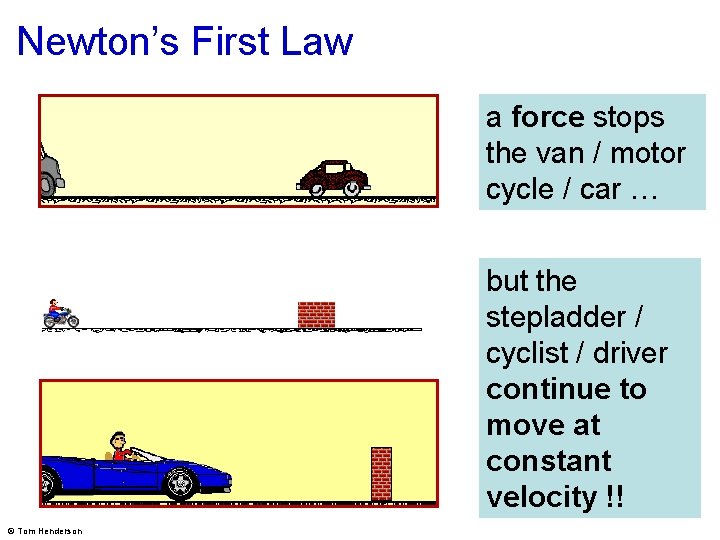
Newton’s First Law a force stops the van / motor cycle / car … but the stepladder / cyclist / driver continue to move at constant velocity !! © Tom Henderson
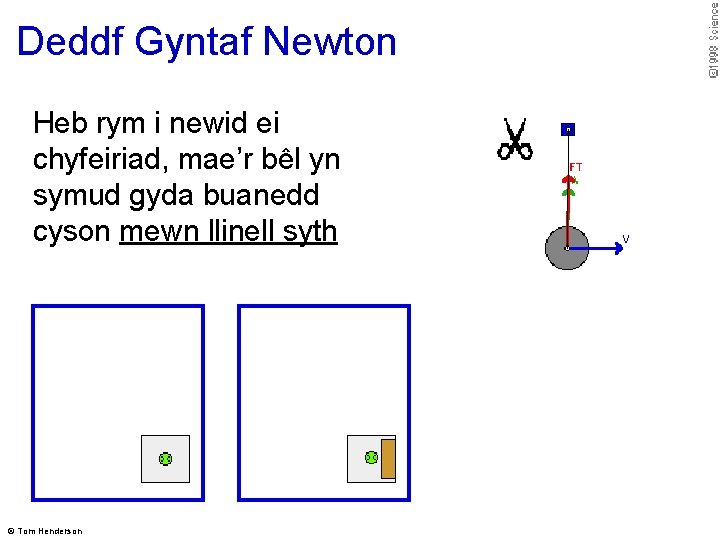
Deddf Gyntaf Newton Heb rym i newid ei chyfeiriad, mae’r bêl yn symud gyda buanedd cyson mewn llinell syth © Tom Henderson
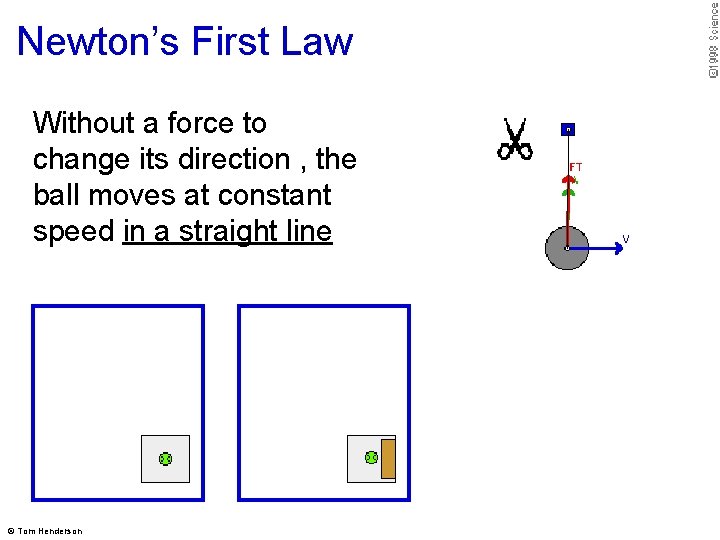
Newton’s First Law Without a force to change its direction , the ball moves at constant speed in a straight line © Tom Henderson
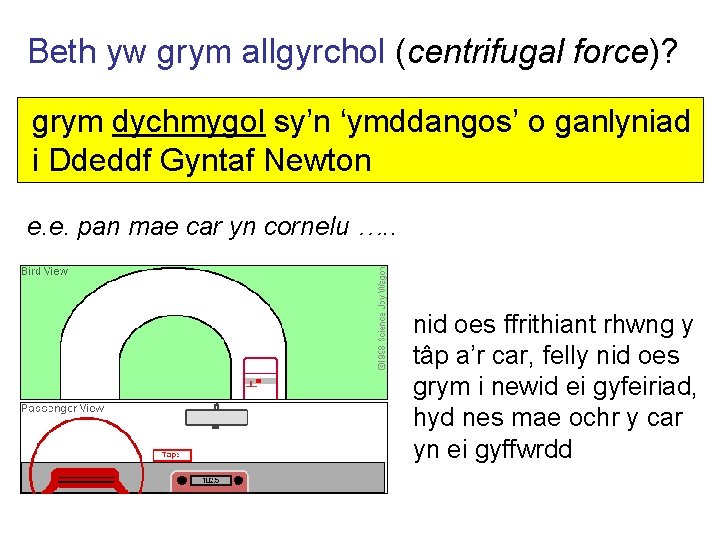
Beth yw grym allgyrchol (centrifugal force)? grym dychmygol sy’n ‘ymddangos’ o ganlyniad i Ddeddf Gyntaf Newton e. e. pan mae car yn cornelu …. . nid oes ffrithiant rhwng y tâp a’r car, felly nid oes grym i newid ei gyfeiriad, hyd nes mae ochr y car yn ei gyffwrdd
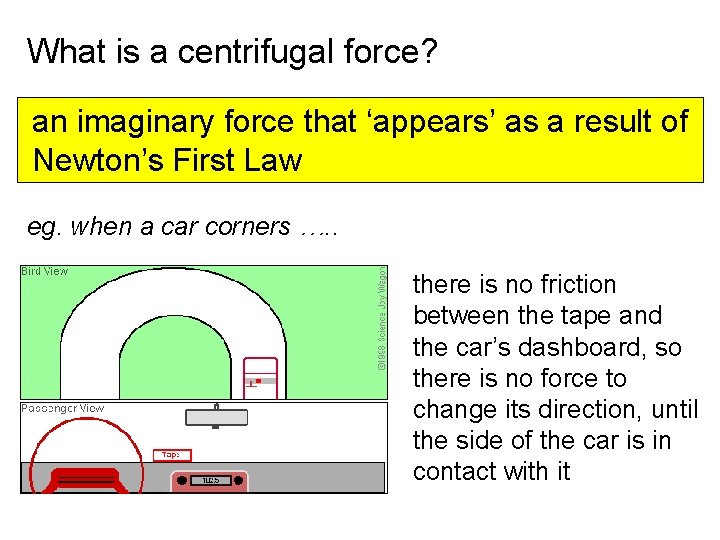
What is a centrifugal force? an imaginary force that ‘appears’ as a result of Newton’s First Law eg. when a car corners …. . there is no friction between the tape and the car’s dashboard, so there is no force to change its direction, until the side of the car is in contact with it
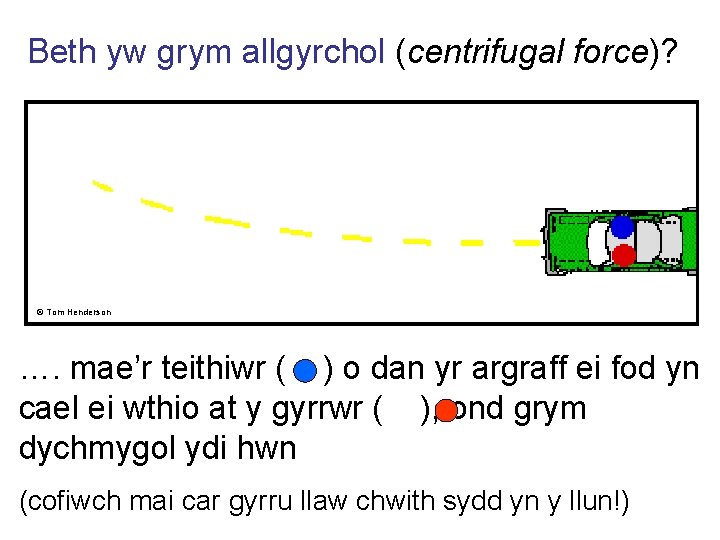
Beth yw grym allgyrchol (centrifugal force)? © Tom Henderson …. mae’r teithiwr ( ) o dan yr argraff ei fod yn cael ei wthio at y gyrrwr ( ), ond grym dychmygol ydi hwn (cofiwch mai car gyrru llaw chwith sydd yn y llun!)
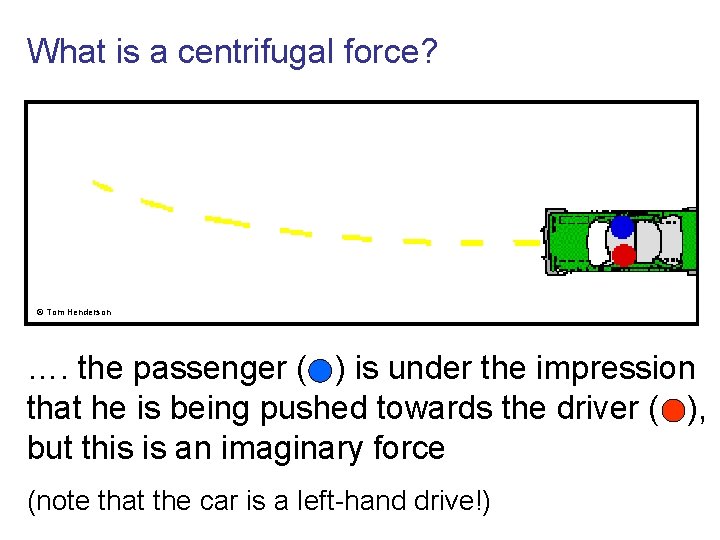
What is a centrifugal force? © Tom Henderson …. the passenger ( ) is under the impression that he is being pushed towards the driver ( ), but this is an imaginary force (note that the car is a left-hand drive!)
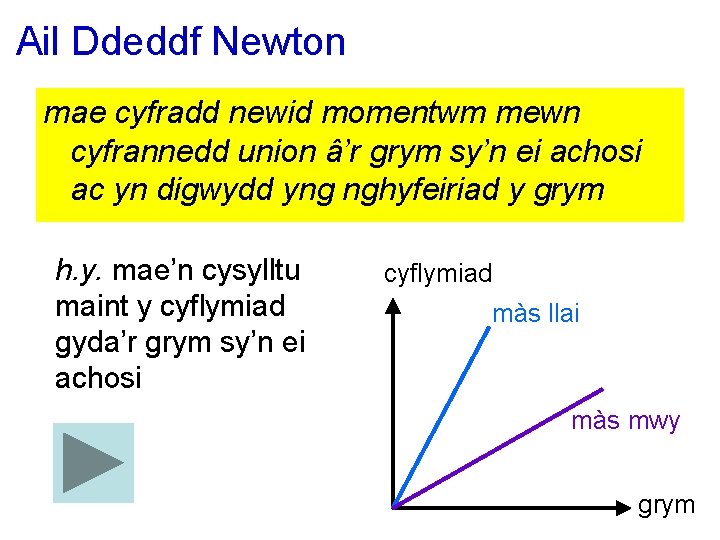
Ail Ddeddf Newton mae cyfradd newid momentwm mewn cyfrannedd union â’r grym sy’n ei achosi ac yn digwydd yng nghyfeiriad y grym h. y. mae’n cysylltu maint y cyflymiad gyda’r grym sy’n ei achosi cyflymiad màs llai màs mwy grym
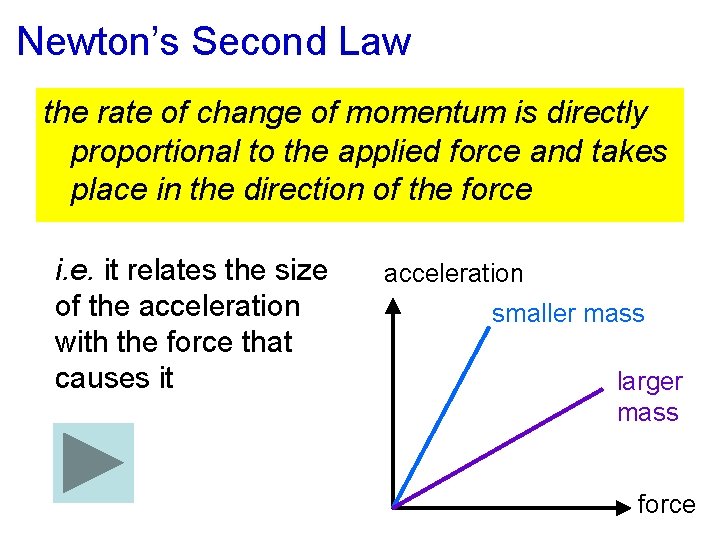
Newton’s Second Law the rate of change of momentum is directly proportional to the applied force and takes place in the direction of the force i. e. it relates the size of the acceleration with the force that causes it acceleration smaller mass larger mass force
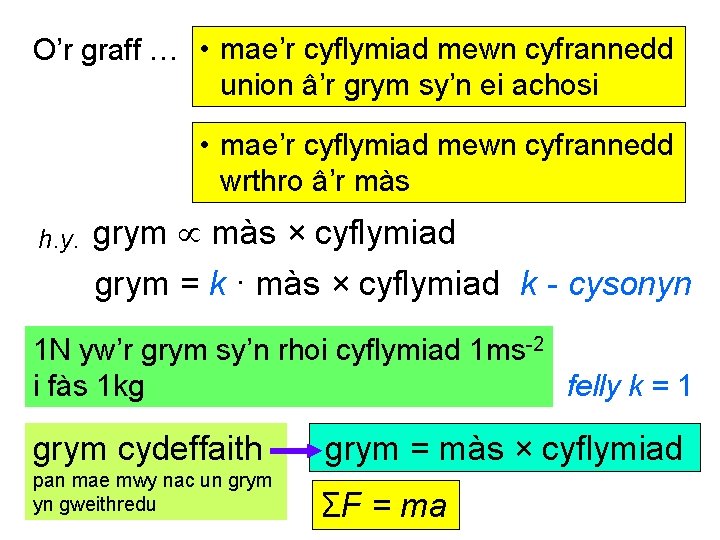
O’r graff … • mae’r cyflymiad mewn cyfrannedd union â’r grym sy’n ei achosi • mae’r cyflymiad mewn cyfrannedd wrthro â’r màs h. y. grym màs × cyflymiad grym = k · màs × cyflymiad k - cysonyn 1 N yw’r grym sy’n rhoi cyflymiad 1 ms-2 i fàs 1 kg felly k = 1 grym cydeffaith grym = màs × cyflymiad pan mae mwy nac un grym yn gweithredu ΣF = ma
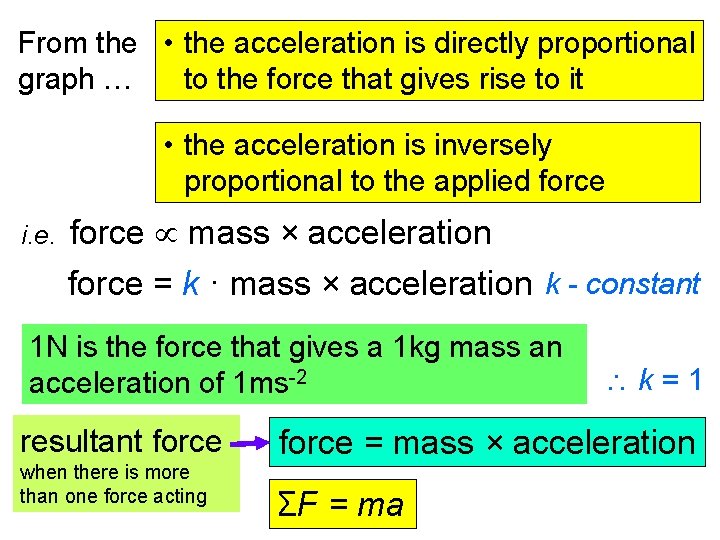
From the • the acceleration is directly proportional graph … to the force that gives rise to it • the acceleration is inversely proportional to the applied force i. e. force mass × acceleration force = k · mass × acceleration k - constant 1 N is the force that gives a 1 kg mass an acceleration of 1 ms-2 resultant force when there is more than one force acting k=1 force = mass × acceleration ΣF = ma
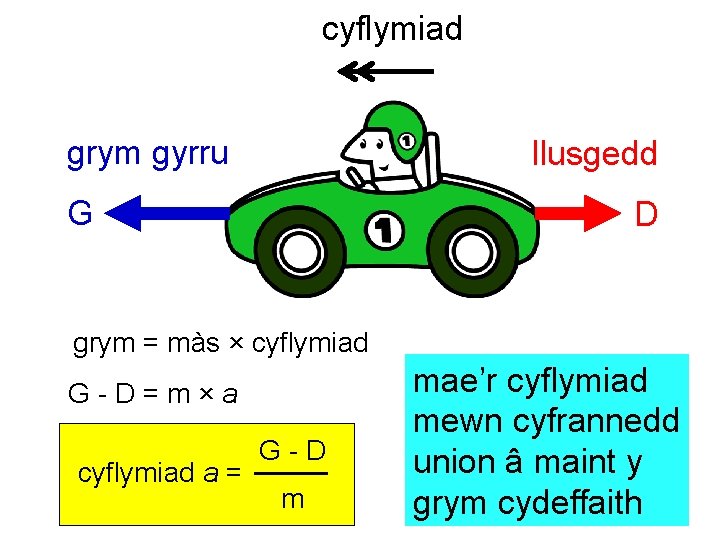
cyflymiad grym gyrru llusgedd G D grym = màs × cyflymiad G-D=m×a cyflymiad a = G-D m mae’r cyflymiad mewn cyfrannedd union â maint y grym cydeffaith
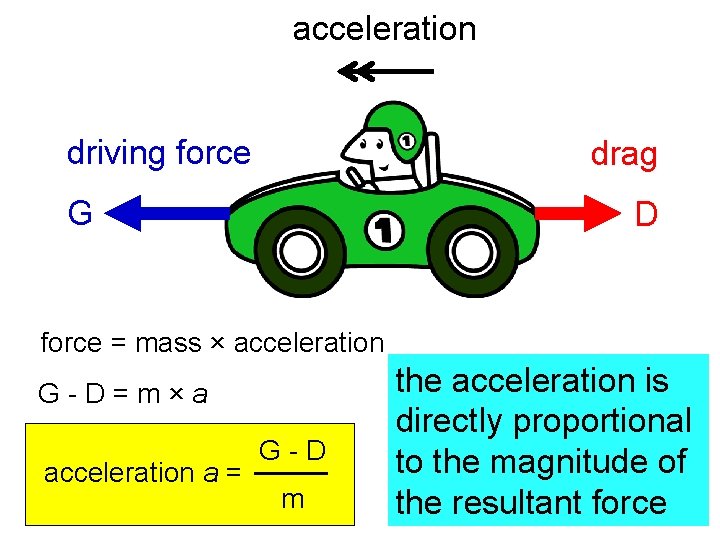
acceleration driving force drag G D force = mass × acceleration G-D=m×a acceleration a = G-D m the acceleration is directly proportional to the magnitude of the resultant force
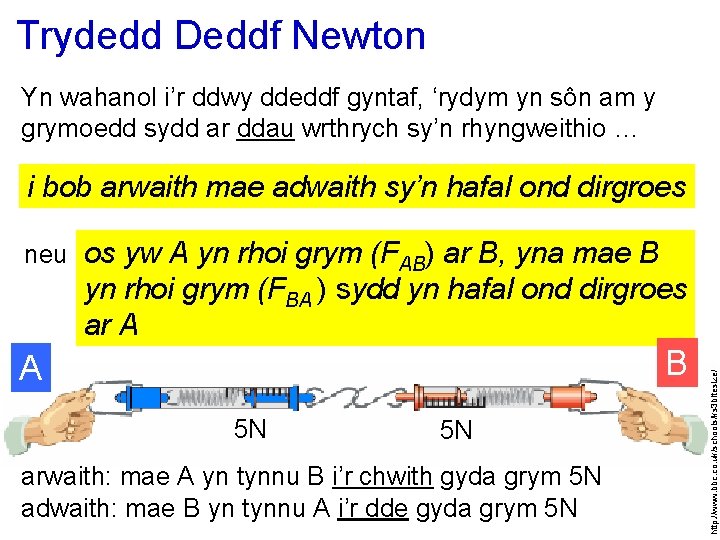
Trydedd Deddf Newton Yn wahanol i’r ddwy ddeddf gyntaf, ‘rydym yn sôn am y grymoedd sydd ar ddau wrthrych sy’n rhyngweithio … i bob arwaith mae adwaith sy’n hafal ond dirgroes neu os yw A yn rhoi grym (FAB) ar B, yna mae B B A 5 N 5 N arwaith: mae A yn tynnu B i’r chwith gyda grym 5 N adwaith: mae B yn tynnu A i’r dde gyda grym 5 N http: //www. bbc. co. uk/schools/ks 3 bitesize/ yn rhoi grym (FBA ) sydd yn hafal ond dirgroes ar A
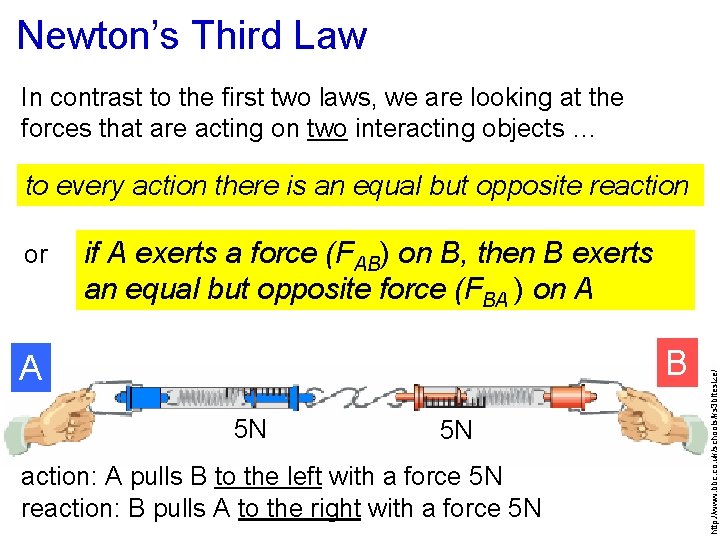
Newton’s Third Law In contrast to the first two laws, we are looking at the forces that are acting on two interacting objects … to every action there is an equal but opposite reaction if A exerts a force (FAB) on B, then B exerts an equal but opposite force (FBA ) on A B A 5 N 5 N action: A pulls B to the left with a force 5 N reaction: B pulls A to the right with a force 5 N http: //www. bbc. co. uk/schools/ks 3 bitesize/ or
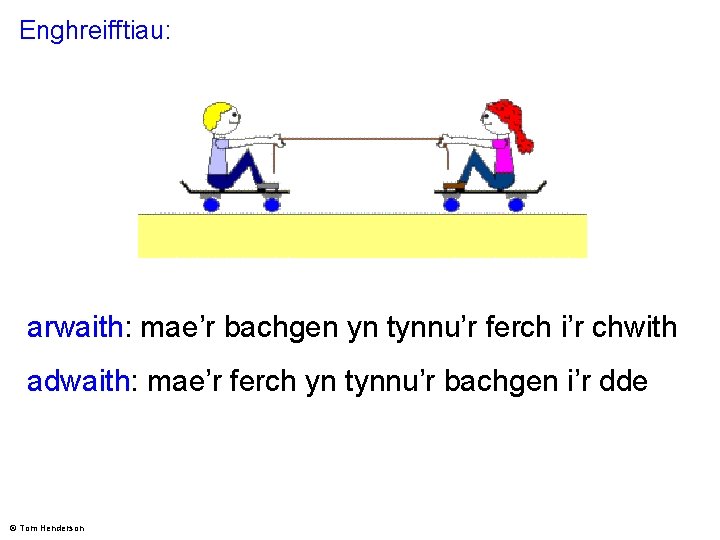
Enghreifftiau: arwaith: mae’r bachgen yn tynnu’r ferch i’r chwith adwaith: mae’r ferch yn tynnu’r bachgen i’r dde © Tom Henderson
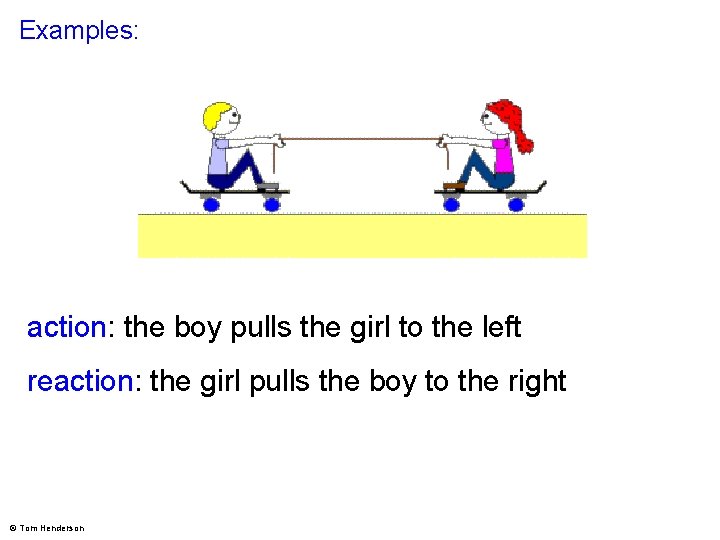
Examples: action: the boy pulls the girl to the left reaction: the girl pulls the boy to the right © Tom Henderson
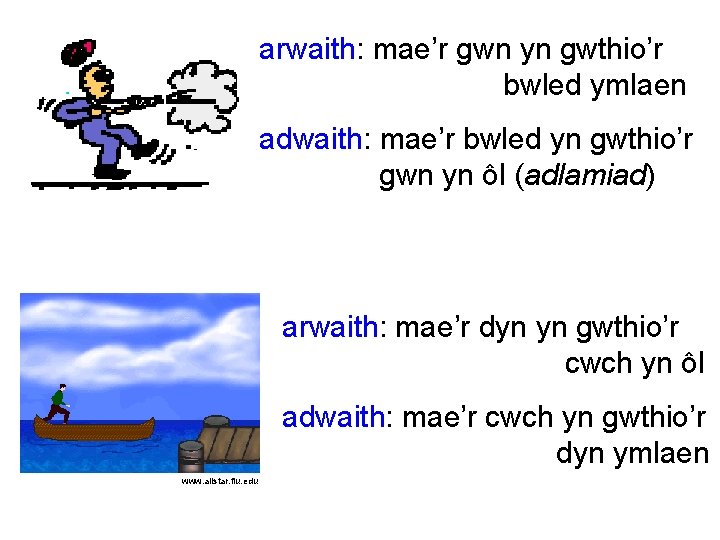
arwaith: mae’r gwn yn gwthio’r bwled ymlaen adwaith: mae’r bwled yn gwthio’r gwn yn ôl (adlamiad) arwaith: mae’r dyn yn gwthio’r cwch yn ôl adwaith: mae’r cwch yn gwthio’r dyn ymlaen www. allstar. fiu. edu
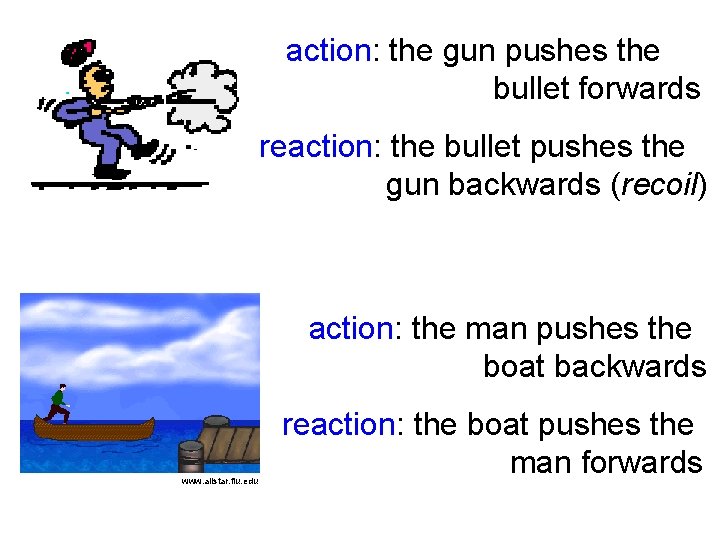
action: the gun pushes the bullet forwards reaction: the bullet pushes the gun backwards (recoil) action: the man pushes the boat backwards www. allstar. fiu. edu reaction: the boat pushes the man forwards
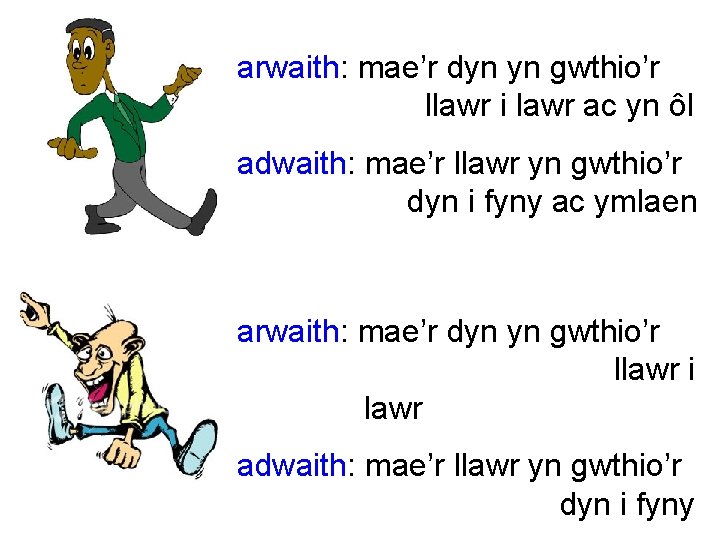
arwaith: mae’r dyn yn gwthio’r llawr i lawr ac yn ôl adwaith: mae’r llawr yn gwthio’r dyn i fyny ac ymlaen arwaith: mae’r dyn yn gwthio’r llawr i lawr adwaith: mae’r llawr yn gwthio’r dyn i fyny
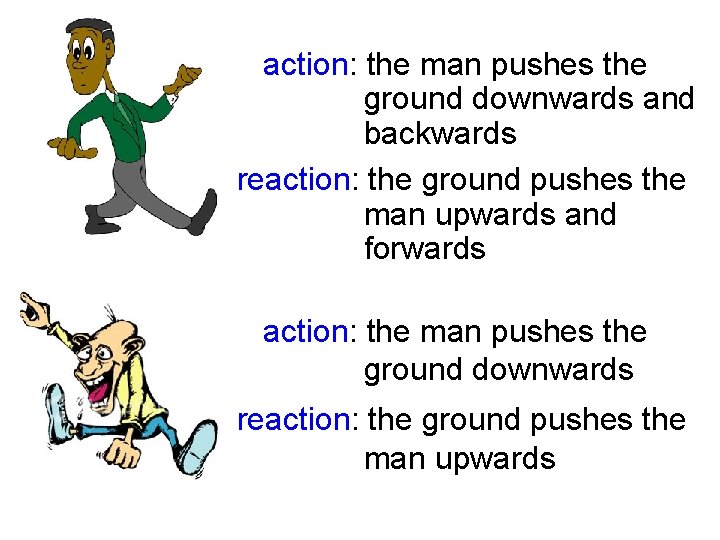
action: the man pushes the ground downwards and backwards reaction: the ground pushes the man upwards and forwards action: the man pushes the ground downwards reaction: the ground pushes the man upwards
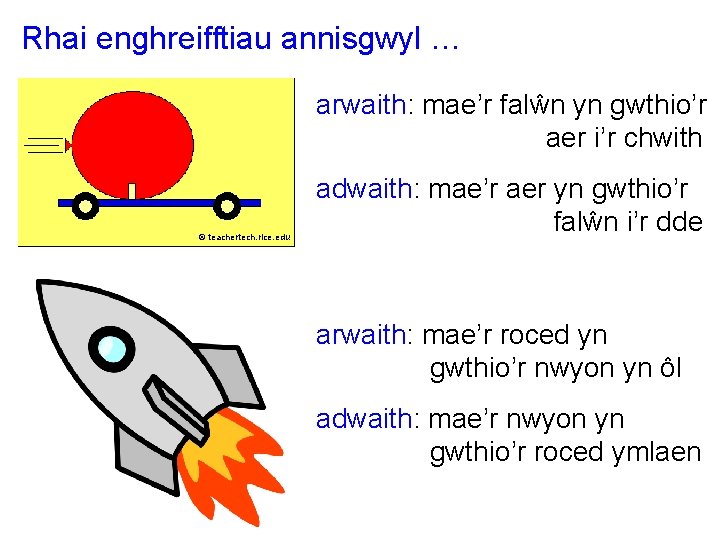
Rhai enghreifftiau annisgwyl … arwaith: mae’r falŵn yn gwthio’r aer i’r chwith © teachertech. rice. edu adwaith: mae’r aer yn gwthio’r falŵn i’r dde arwaith: mae’r roced yn gwthio’r nwyon yn ôl adwaith: mae’r nwyon yn gwthio’r roced ymlaen
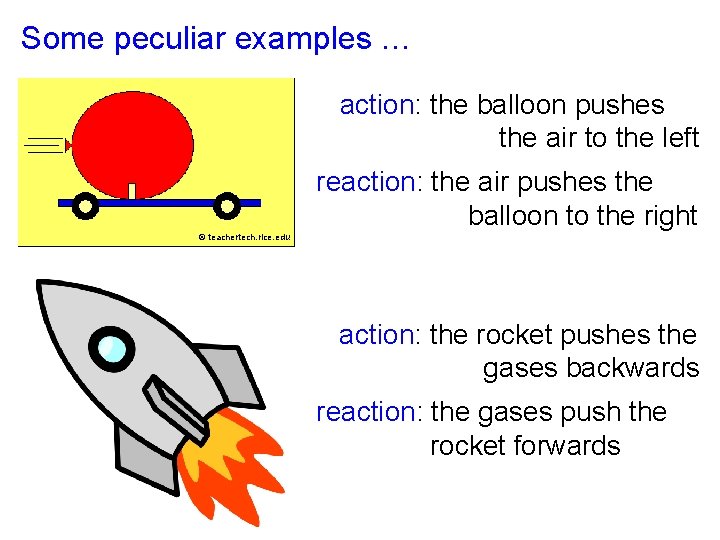
Some peculiar examples … action: the balloon pushes the air to the left reaction: the air pushes the balloon to the right © teachertech. rice. edu action: the rocket pushes the gases backwards reaction: the gases push the rocket forwards
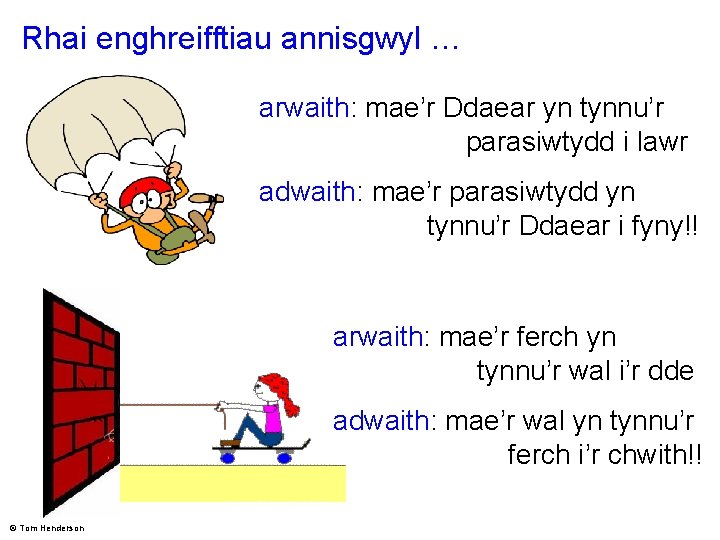
Rhai enghreifftiau annisgwyl … arwaith: mae’r Ddaear yn tynnu’r parasiwtydd i lawr adwaith: mae’r parasiwtydd yn tynnu’r Ddaear i fyny!! arwaith: mae’r ferch yn tynnu’r wal i’r dde adwaith: mae’r wal yn tynnu’r ferch i’r chwith!! © Tom Henderson
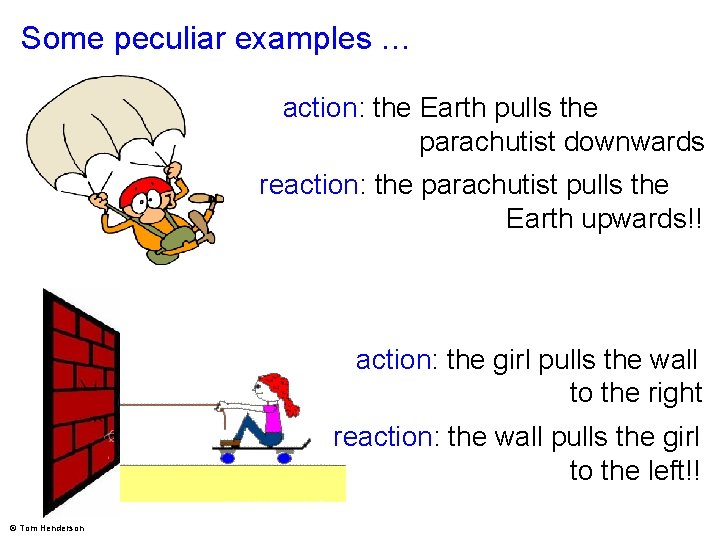
Some peculiar examples … action: the Earth pulls the parachutist downwards reaction: the parachutist pulls the Earth upwards!! action: the girl pulls the wall to the right reaction: the wall pulls the girl to the left!! © Tom Henderson
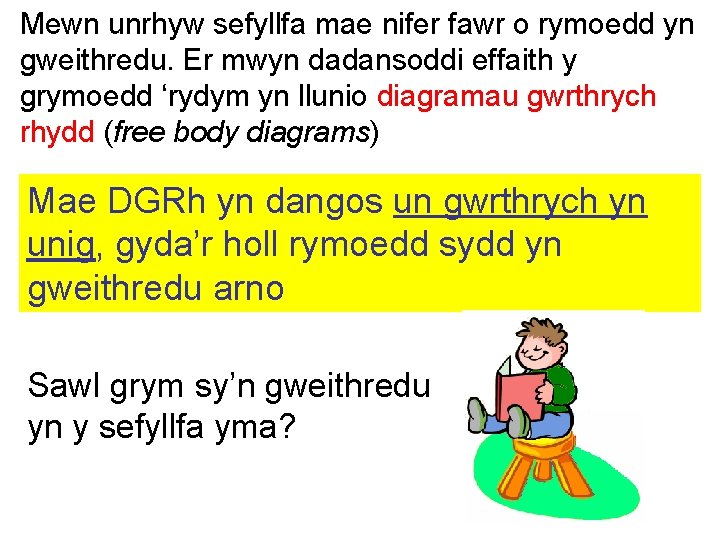
Mewn unrhyw sefyllfa mae nifer fawr o rymoedd yn gweithredu. Er mwyn dadansoddi effaith y grymoedd ‘rydym yn llunio diagramau gwrthrych rhydd (free body diagrams) Mae DGRh yn dangos un gwrthrych yn unig, gyda’r holl rymoedd sydd yn gweithredu arno Sawl grym sy’n gweithredu yn y sefyllfa yma?
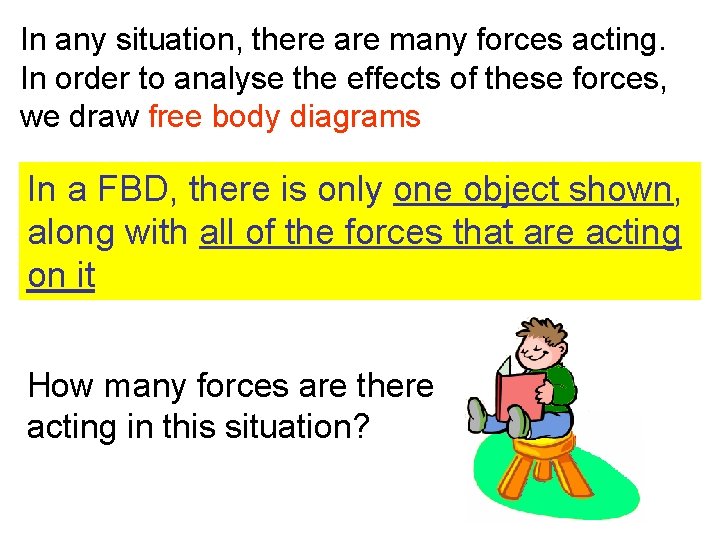
In any situation, there are many forces acting. In order to analyse the effects of these forces, we draw free body diagrams In a FBD, there is only one object shown, along with all of the forces that are acting on it How many forces are there acting in this situation?
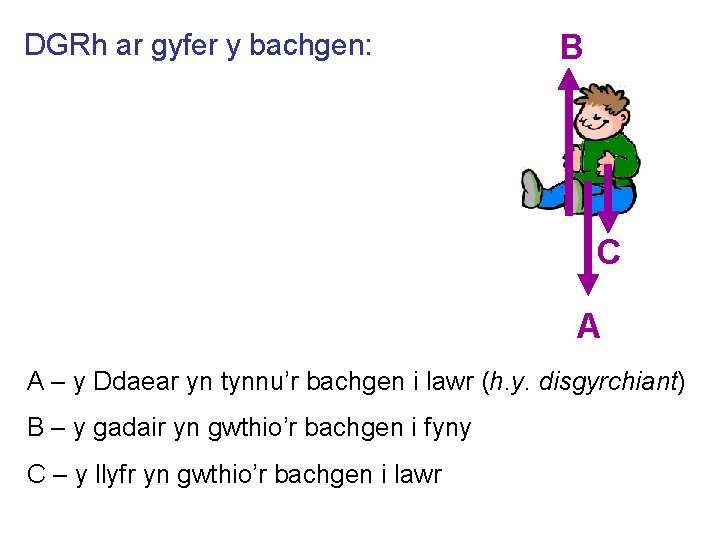
DGRh ar gyfer y bachgen: B C A A – y Ddaear yn tynnu’r bachgen i lawr (h. y. disgyrchiant) B – y gadair yn gwthio’r bachgen i fyny C – y llyfr yn gwthio’r bachgen i lawr
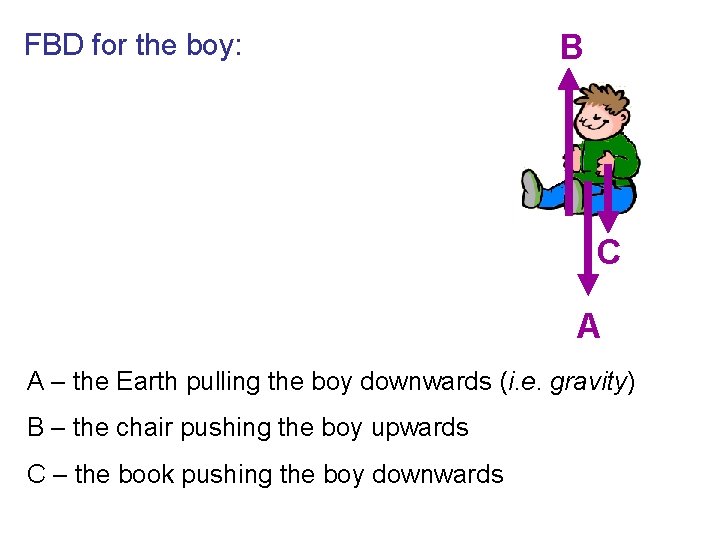
FBD for the boy: B C A A – the Earth pulling the boy downwards (i. e. gravity) B – the chair pushing the boy upwards C – the book pushing the boy downwards
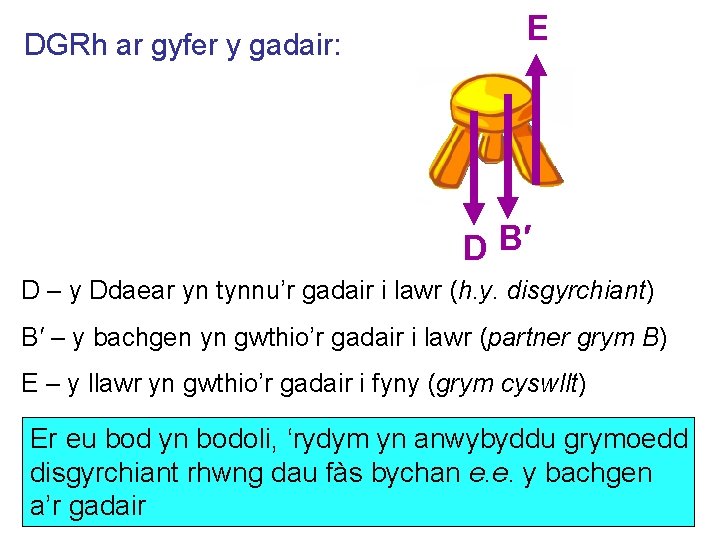
DGRh ar gyfer y gadair: E D B′ D – y Ddaear yn tynnu’r gadair i lawr (h. y. disgyrchiant) B′ – y bachgen yn gwthio’r gadair i lawr (partner grym B) E – y llawr yn gwthio’r gadair i fyny (grym cyswllt) Er eu bod yn bodoli, ‘rydym yn anwybyddu grymoedd disgyrchiant rhwng dau fàs bychan e. e. y bachgen a’r gadair
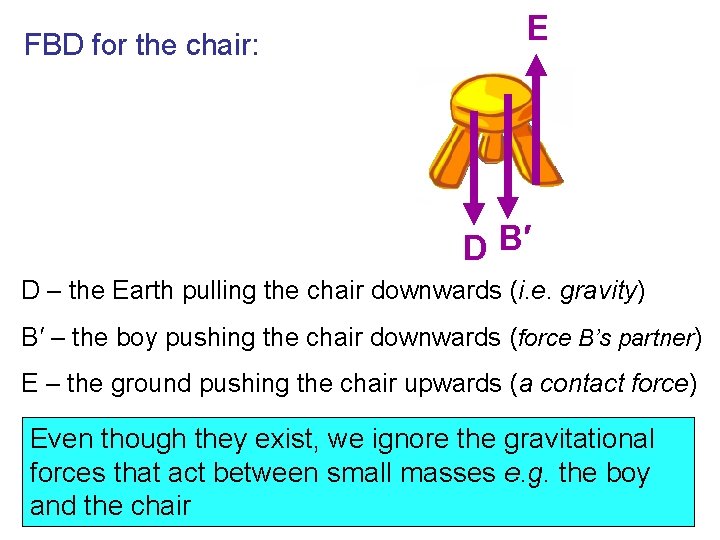
FBD for the chair: E D B′ D – the Earth pulling the chair downwards (i. e. gravity) B′ – the boy pushing the chair downwards (force B’s partner) E – the ground pushing the chair upwards (a contact force) Even though they exist, we ignore the gravitational forces that act between small masses e. g. the boy and the chair
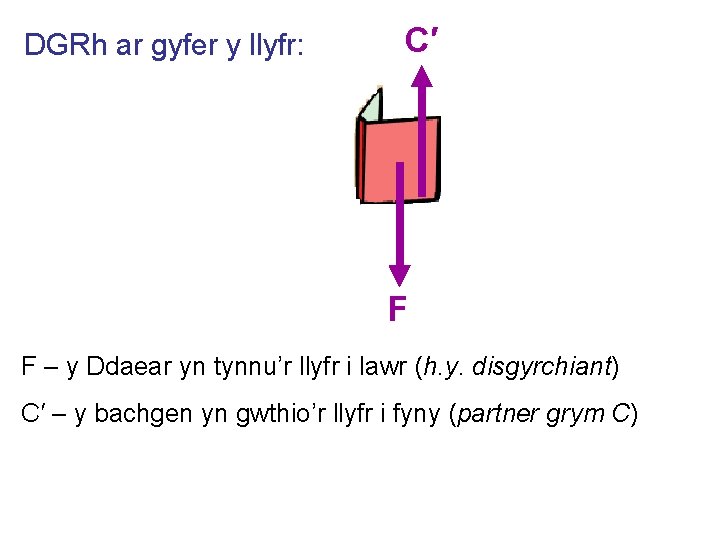
DGRh ar gyfer y llyfr: C′ F F – y Ddaear yn tynnu’r llyfr i lawr (h. y. disgyrchiant) C′ – y bachgen yn gwthio’r llyfr i fyny (partner grym C)
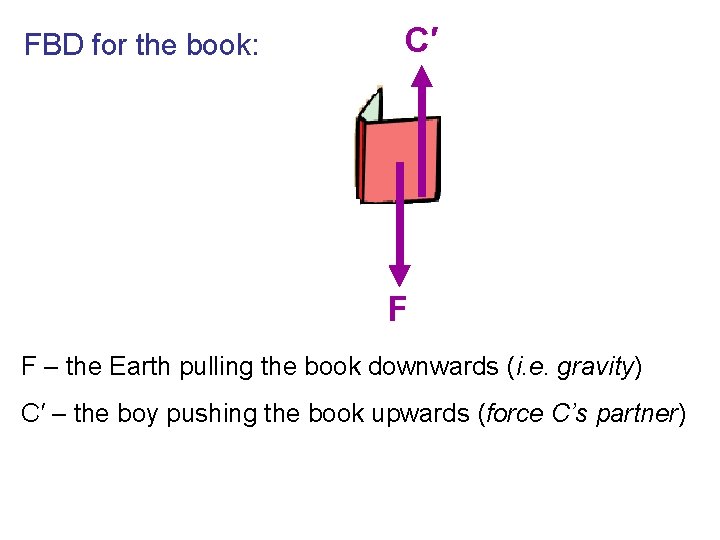
FBD for the book: C′ F F – the Earth pulling the book downwards (i. e. gravity) C′ – the boy pushing the book upwards (force C’s partner)
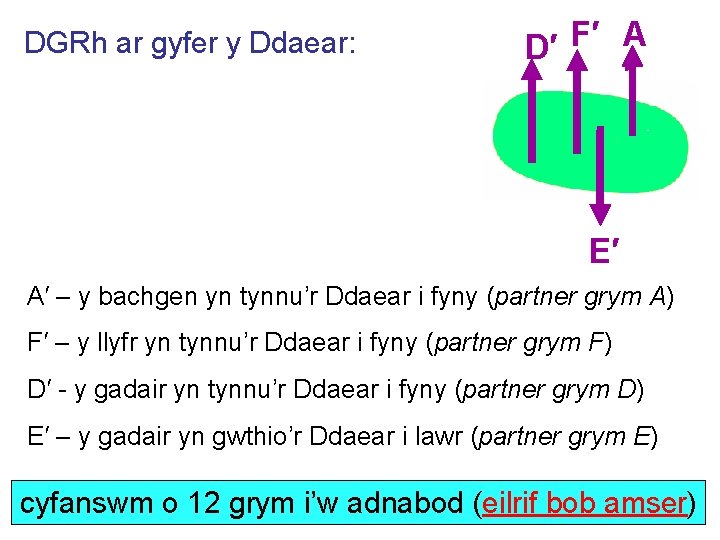
DGRh ar gyfer y Ddaear: D′ F′ A ′ E′ A′ – y bachgen yn tynnu’r Ddaear i fyny (partner grym A) F′ – y llyfr yn tynnu’r Ddaear i fyny (partner grym F) D′ - y gadair yn tynnu’r Ddaear i fyny (partner grym D) E′ – y gadair yn gwthio’r Ddaear i lawr (partner grym E) cyfanswm o 12 grym i’w adnabod (eilrif bob amser)
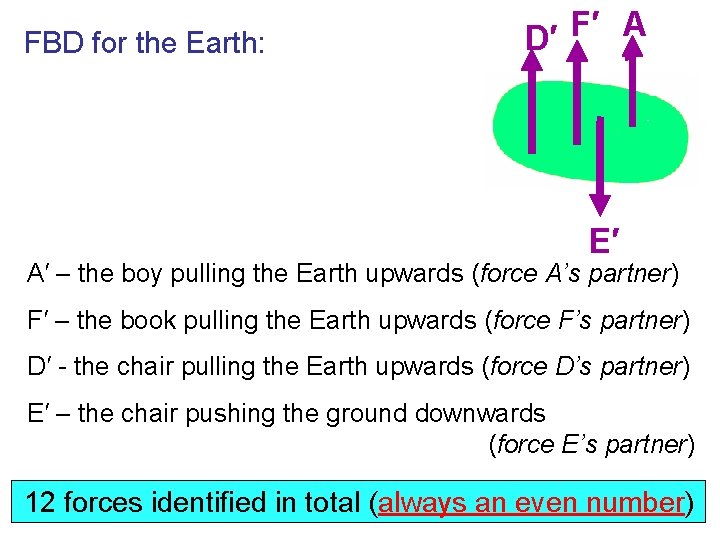
FBD for the Earth: D′ F′ A ′ E′ A′ – the boy pulling the Earth upwards (force A’s partner) F′ – the book pulling the Earth upwards (force F’s partner) D′ - the chair pulling the Earth upwards (force D’s partner) E′ – the chair pushing the ground downwards (force E’s partner) 12 forces identified in total (always an even number)
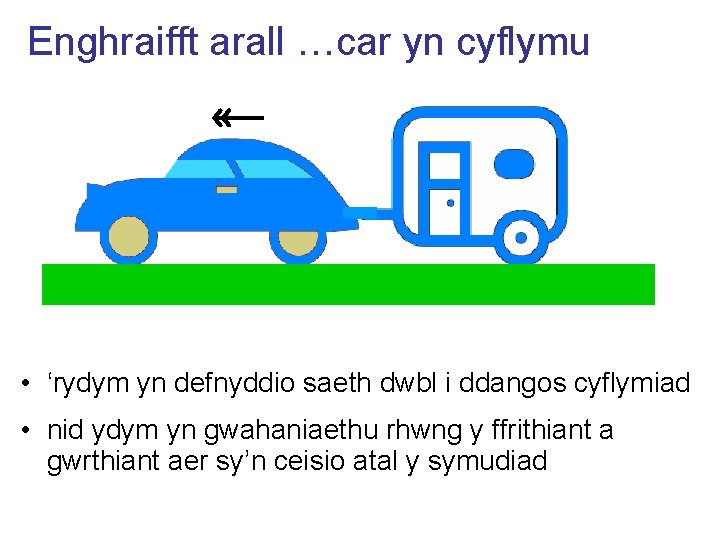
Enghraifft arall …car yn cyflymu • ‘rydym yn defnyddio saeth dwbl i ddangos cyflymiad • nid ydym yn gwahaniaethu rhwng y ffrithiant a gwrthiant aer sy’n ceisio atal y symudiad
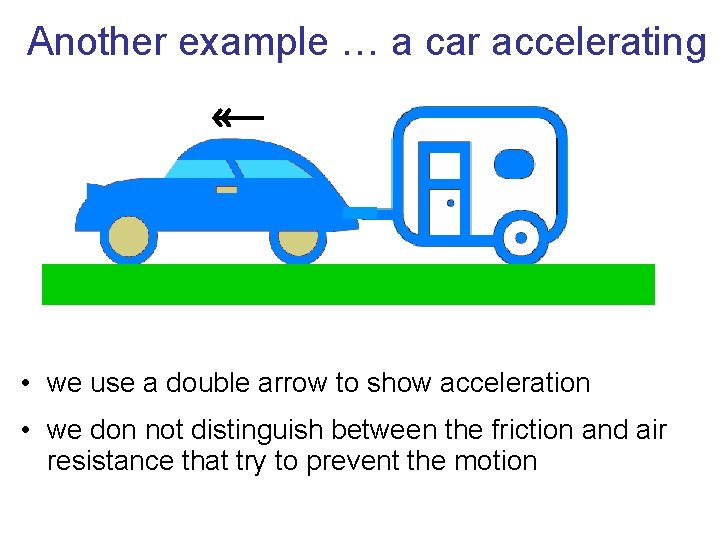
Another example … a car accelerating • we use a double arrow to show acceleration • we don not distinguish between the friction and air resistance that try to prevent the motion
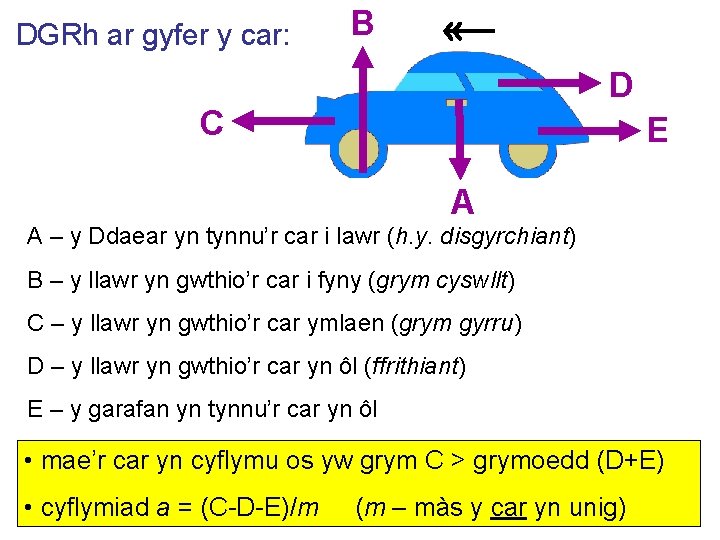
DGRh ar gyfer y car: B D C E A A – y Ddaear yn tynnu’r car i lawr (h. y. disgyrchiant) B – y llawr yn gwthio’r car i fyny (grym cyswllt) C – y llawr yn gwthio’r car ymlaen (grym gyrru) D – y llawr yn gwthio’r car yn ôl (ffrithiant) E – y garafan yn tynnu’r car yn ôl • mae’r car yn cyflymu os yw grym C > grymoedd (D+E) • cyflymiad a = (C-D-E)/m (m – màs y car yn unig)
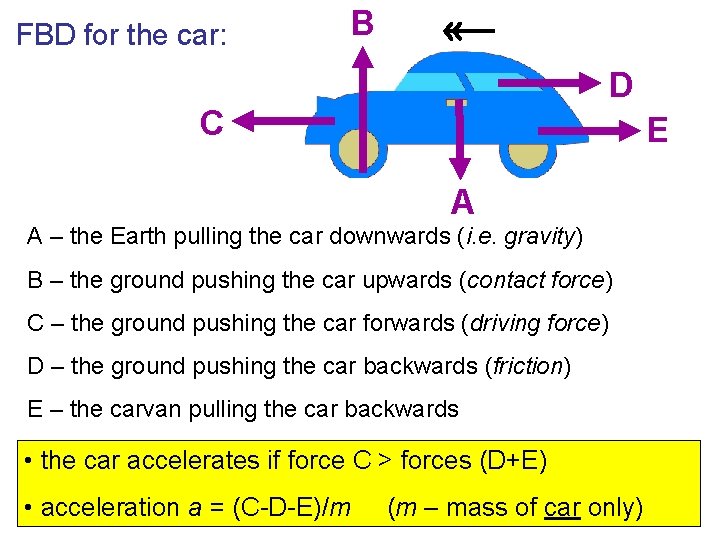
FBD for the car: B D C E A A – the Earth pulling the car downwards (i. e. gravity) B – the ground pushing the car upwards (contact force) C – the ground pushing the car forwards (driving force) D – the ground pushing the car backwards (friction) E – the carvan pulling the car backwards • the car accelerates if force C > forces (D+E) • acceleration a = (C-D-E)/m (m – mass of car only)
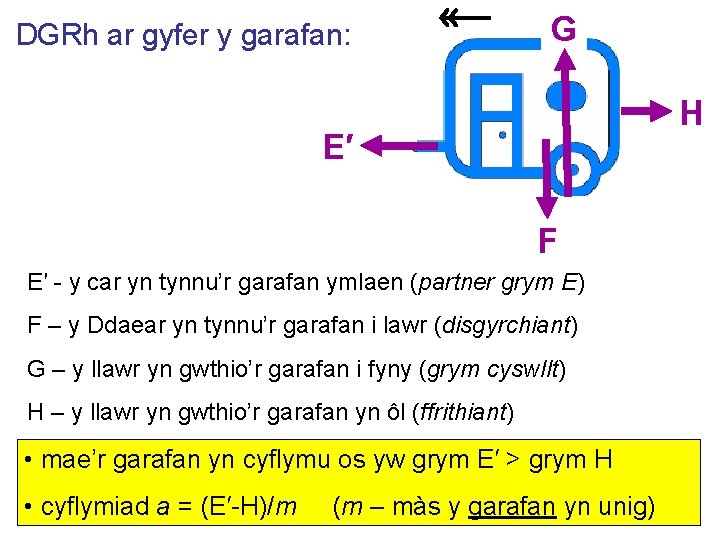
DGRh ar gyfer y garafan: G H E′ F E′ - y car yn tynnu’r garafan ymlaen (partner grym E) F – y Ddaear yn tynnu’r garafan i lawr (disgyrchiant) G – y llawr yn gwthio’r garafan i fyny (grym cyswllt) H – y llawr yn gwthio’r garafan yn ôl (ffrithiant) • mae’r garafan yn cyflymu os yw grym E′ > grym H • cyflymiad a = (E′-H)/m (m – màs y garafan yn unig)
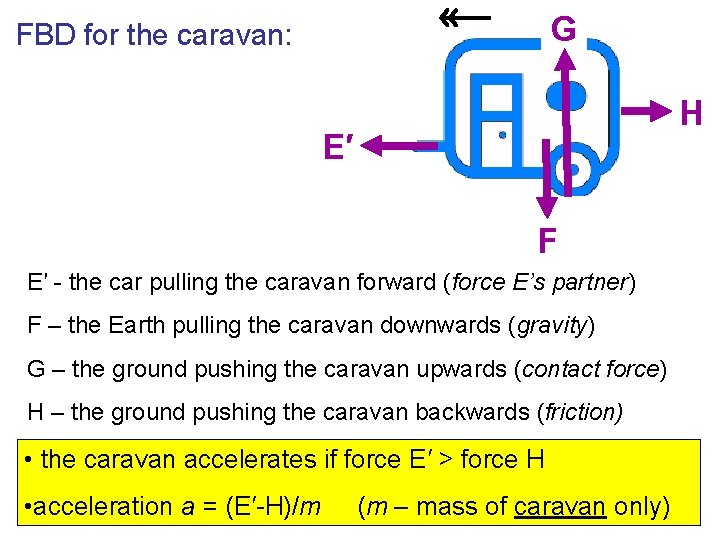
G FBD for the caravan: H E′ F E′ - the car pulling the caravan forward (force E’s partner) F – the Earth pulling the caravan downwards (gravity) G – the ground pushing the caravan upwards (contact force) H – the ground pushing the caravan backwards (friction) • the caravan accelerates if force E′ > force H • acceleration a = (E′-H)/m (m – mass of caravan only)
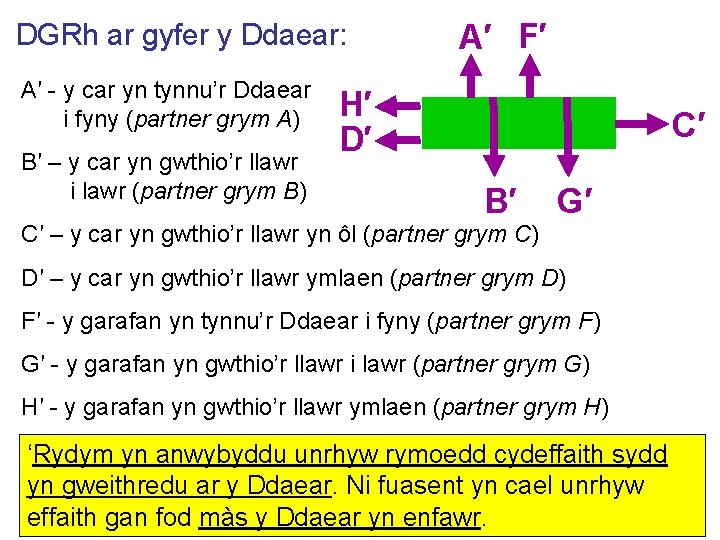
DGRh ar gyfer y Ddaear: A′ - y car yn tynnu’r Ddaear i fyny (partner grym A) B′ – y car yn gwthio’r llawr i lawr (partner grym B) A′ F′ H′ D′ C′ B′ G′ C′ – y car yn gwthio’r llawr yn ôl (partner grym C) D′ – y car yn gwthio’r llawr ymlaen (partner grym D) F′ - y garafan yn tynnu’r Ddaear i fyny (partner grym F) G′ - y garafan yn gwthio’r llawr i lawr (partner grym G) H′ - y garafan yn gwthio’r llawr ymlaen (partner grym H) ‘Rydym yn anwybyddu unrhyw rymoedd cydeffaith sydd yn gweithredu ar y Ddaear. Ni fuasent yn cael unrhyw effaith gan fod màs y Ddaear yn enfawr.
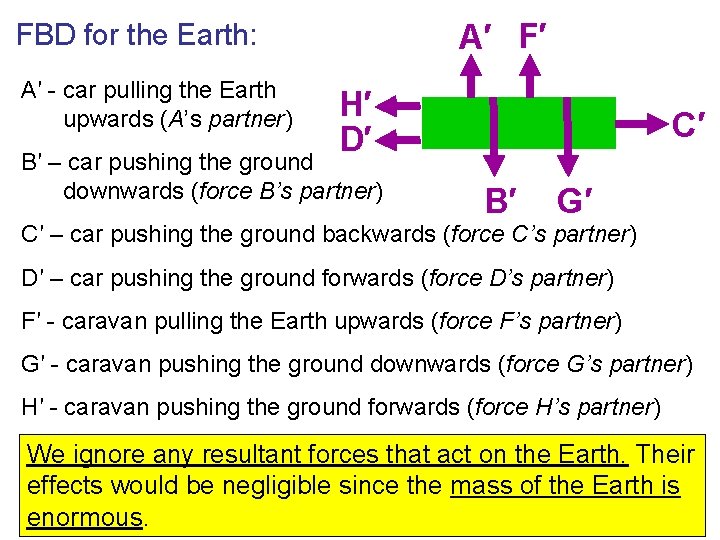
A′ F′ FBD for the Earth: A′ - car pulling the Earth upwards (A’s partner) H′ D′ B′ – car pushing the ground downwards (force B’s partner) C′ B′ G′ C′ – car pushing the ground backwards (force C’s partner) D′ – car pushing the ground forwards (force D’s partner) F′ - caravan pulling the Earth upwards (force F’s partner) G′ - caravan pushing the ground downwards (force G’s partner) H′ - caravan pushing the ground forwards (force H’s partner) We ignore any resultant forces that act on the Earth. Their effects would be negligible since the mass of the Earth is enormous.
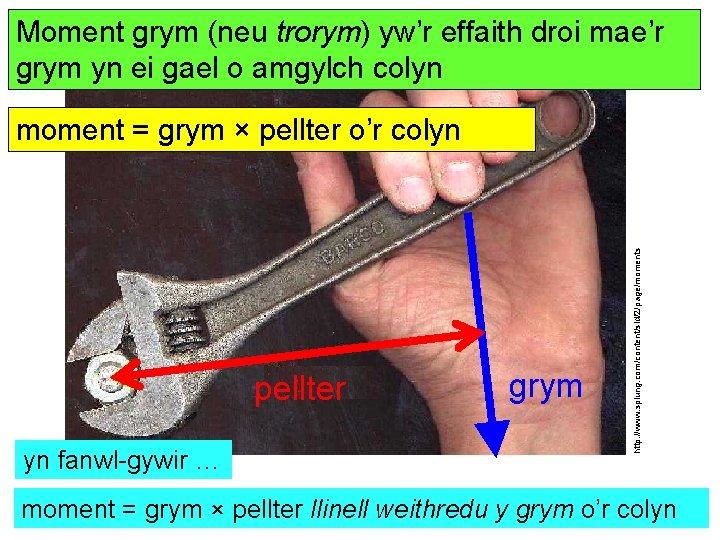
Moment grym (neu trorym) yw’r effaith droi mae’r grym yn ei gael o amgylch colyn pellter yn fanwl-gywir … grym http: //www. splung. com/content/sid/2/page/moments moment = grym × pellter o’r colyn moment = grym × pellter llinell weithredu y grym o’r colyn
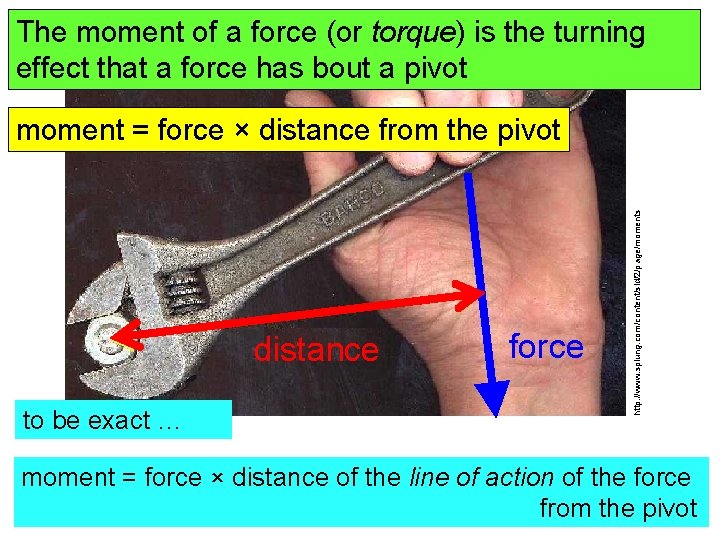
The moment of a force (or torque) is the turning effect that a force has bout a pivot distance to be exact … force http: //www. splung. com/content/sid/2/page/moments moment = force × distance from the pivot moment = force × distance of the line of action of the force from the pivot
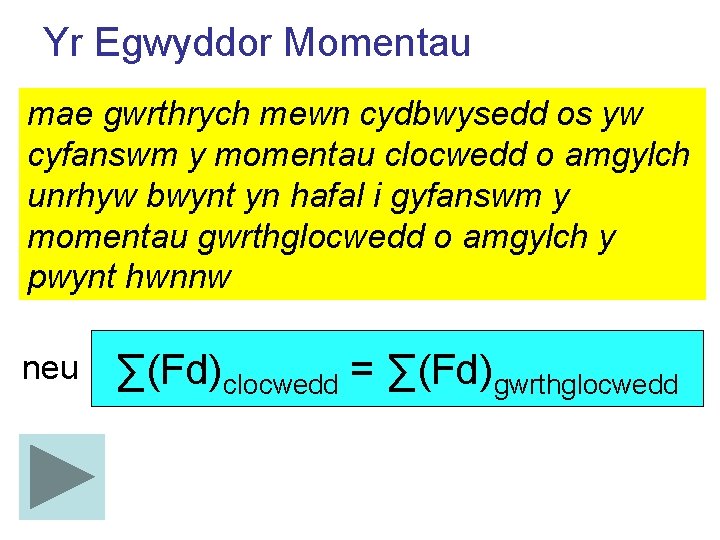
Yr Egwyddor Momentau mae gwrthrych mewn cydbwysedd os yw cyfanswm y momentau clocwedd o amgylch unrhyw bwynt yn hafal i gyfanswm y momentau gwrthglocwedd o amgylch y pwynt hwnnw neu ∑(Fd)clocwedd = ∑(Fd)gwrthglocwedd
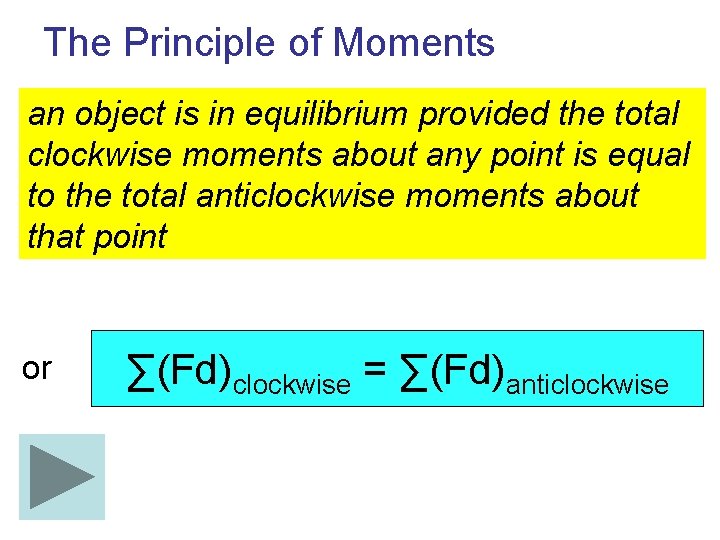
The Principle of Moments an object is in equilibrium provided the total clockwise moments about any point is equal to the total anticlockwise moments about that point or ∑(Fd)clockwise = ∑(Fd)anticlockwise
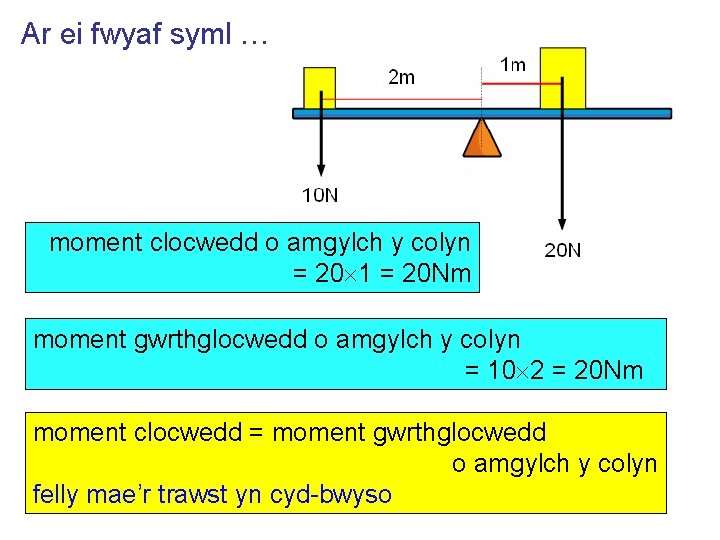
Ar ei fwyaf syml … moment clocwedd o amgylch y colyn = 20 1 = 20 Nm moment gwrthglocwedd o amgylch y colyn = 10 2 = 20 Nm moment clocwedd = moment gwrthglocwedd o amgylch y colyn felly mae’r trawst yn cyd-bwyso
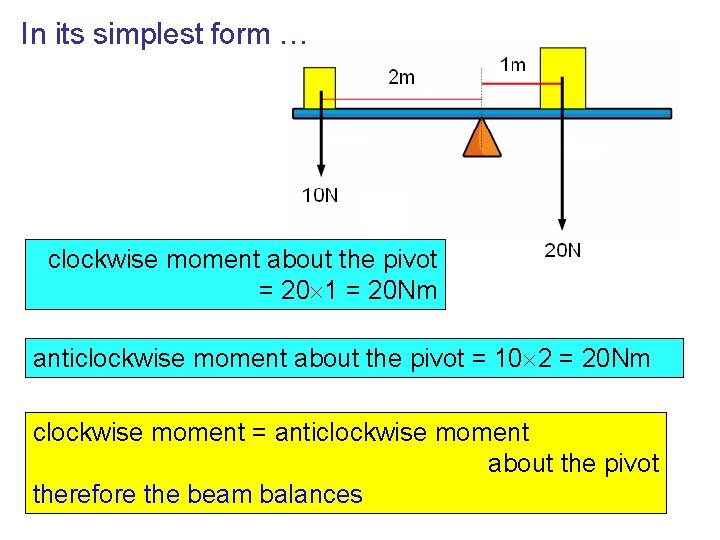
In its simplest form … clockwise moment about the pivot = 20 1 = 20 Nm anticlockwise moment about the pivot = 10 2 = 20 Nm clockwise moment = anticlockwise moment about the pivot therefore the beam balances
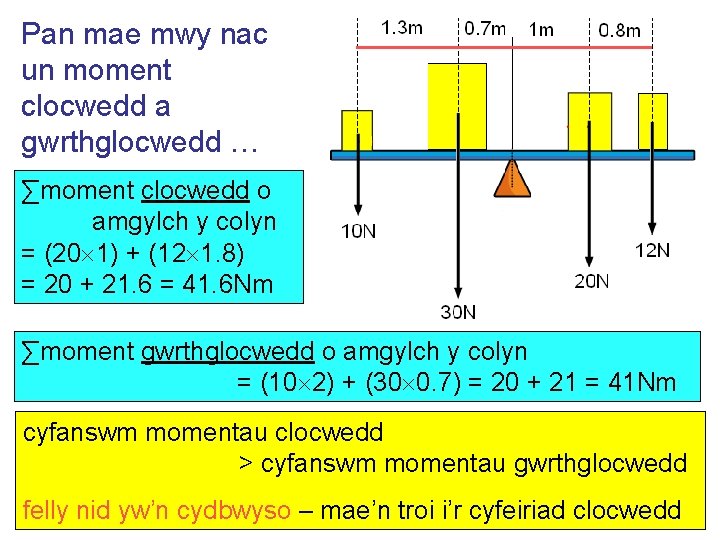
Pan mae mwy nac un moment clocwedd a gwrthglocwedd … ∑moment clocwedd o amgylch y colyn = (20 1) + (12 1. 8) = 20 + 21. 6 = 41. 6 Nm ∑moment gwrthglocwedd o amgylch y colyn = (10 2) + (30 0. 7) = 20 + 21 = 41 Nm cyfanswm momentau clocwedd > cyfanswm momentau gwrthglocwedd felly nid yw’n cydbwyso – mae’n troi i’r cyfeiriad clocwedd
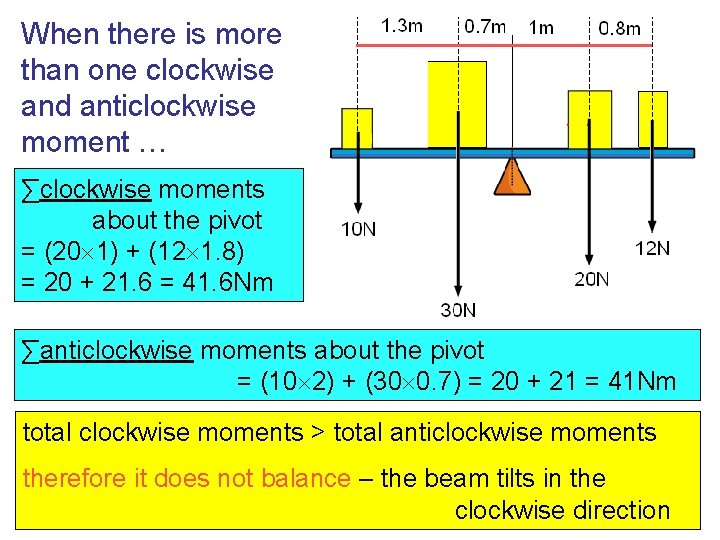
When there is more than one clockwise and anticlockwise moment … ∑clockwise moments about the pivot = (20 1) + (12 1. 8) = 20 + 21. 6 = 41. 6 Nm ∑anticlockwise moments about the pivot = (10 2) + (30 0. 7) = 20 + 21 = 41 Nm total clockwise moments > total anticlockwise moments therefore it does not balance – the beam tilts in the clockwise direction
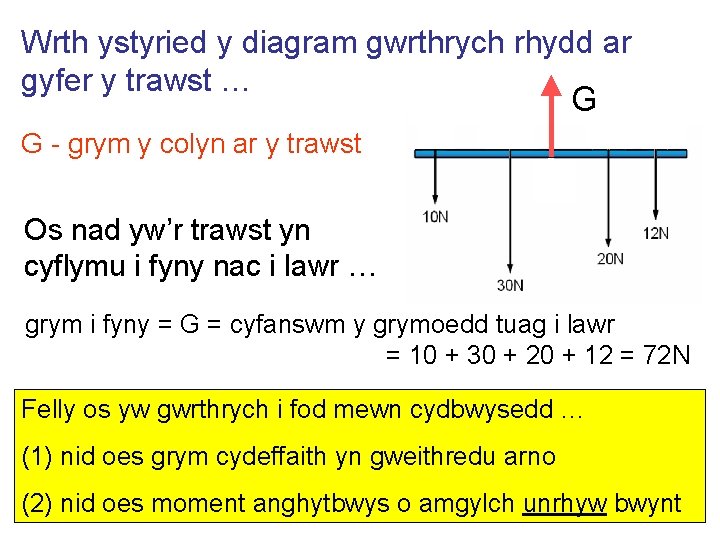
Wrth ystyried y diagram gwrthrych rhydd ar gyfer y trawst … G G - grym y colyn ar y trawst Os nad yw’r trawst yn cyflymu i fyny nac i lawr … grym i fyny = G = cyfanswm y grymoedd tuag i lawr = 10 + 30 + 20 + 12 = 72 N Felly os yw gwrthrych i fod mewn cydbwysedd … (1) nid oes grym cydeffaith yn gweithredu arno (2) nid oes moment anghytbwys o amgylch unrhyw bwynt
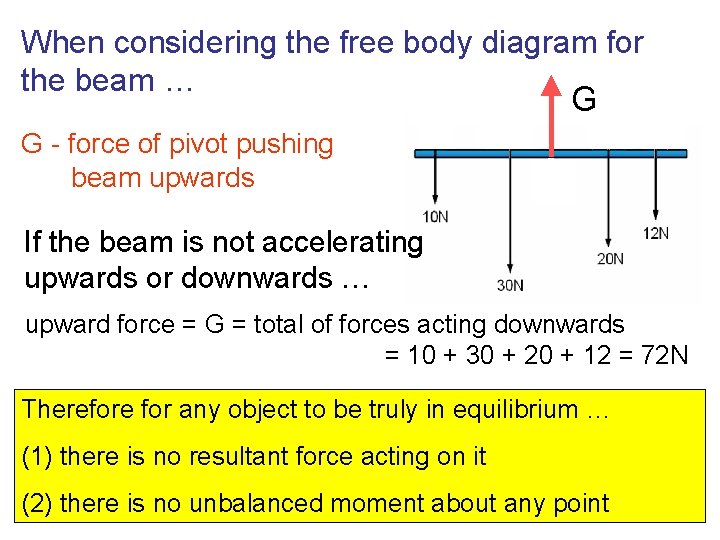
When considering the free body diagram for the beam … G G - force of pivot pushing beam upwards If the beam is not accelerating upwards or downwards … upward force = G = total of forces acting downwards = 10 + 30 + 20 + 12 = 72 N Therefore for any object to be truly in equilibrium … (1) there is no resultant force acting on it (2) there is no unbalanced moment about any point
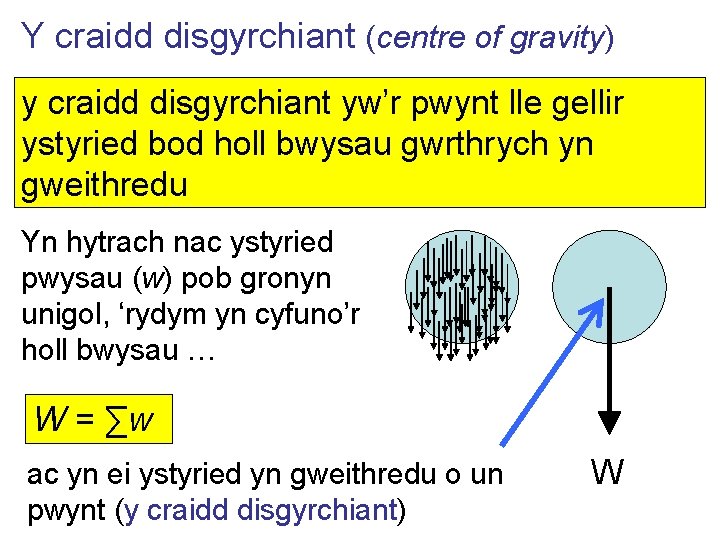
Y craidd disgyrchiant (centre of gravity) y craidd disgyrchiant yw’r pwynt lle gellir ystyried bod holl bwysau gwrthrych yn gweithredu Yn hytrach nac ystyried pwysau (w) pob gronyn unigol, ‘rydym yn cyfuno’r holl bwysau … W = ∑w ac yn ei ystyried yn gweithredu o un pwynt (y craidd disgyrchiant) W
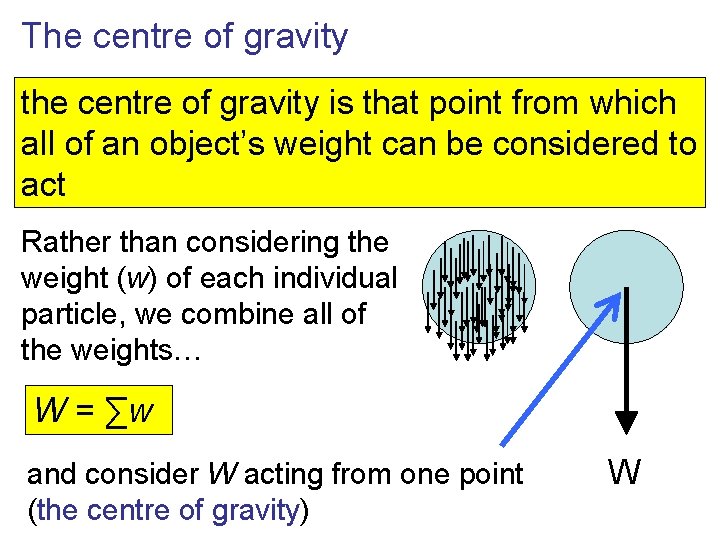
The centre of gravity the centre of gravity is that point from which all of an object’s weight can be considered to act Rather than considering the weight (w) of each individual particle, we combine all of the weights… W = ∑w and consider W acting from one point (the centre of gravity) W
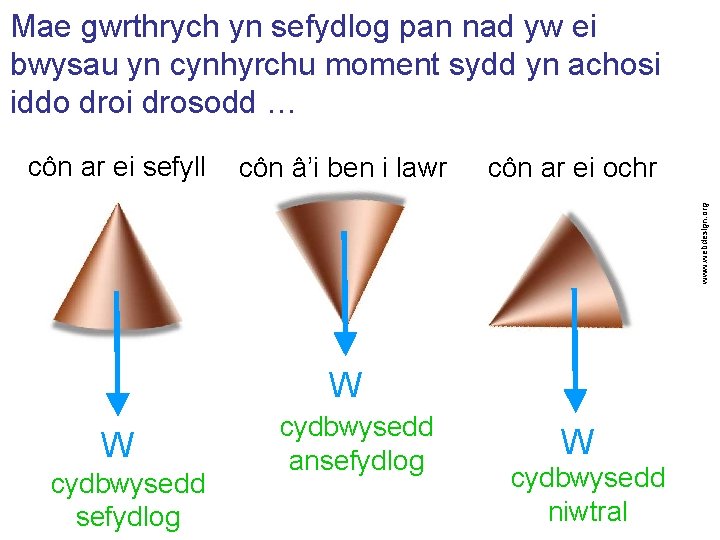
Mae gwrthrych yn sefydlog pan nad yw ei bwysau yn cynhyrchu moment sydd yn achosi iddo droi drosodd … côn â’i ben i lawr côn ar ei ochr www. webdesign. org côn ar ei sefyll W W cydbwysedd sefydlog cydbwysedd ansefydlog W cydbwysedd niwtral
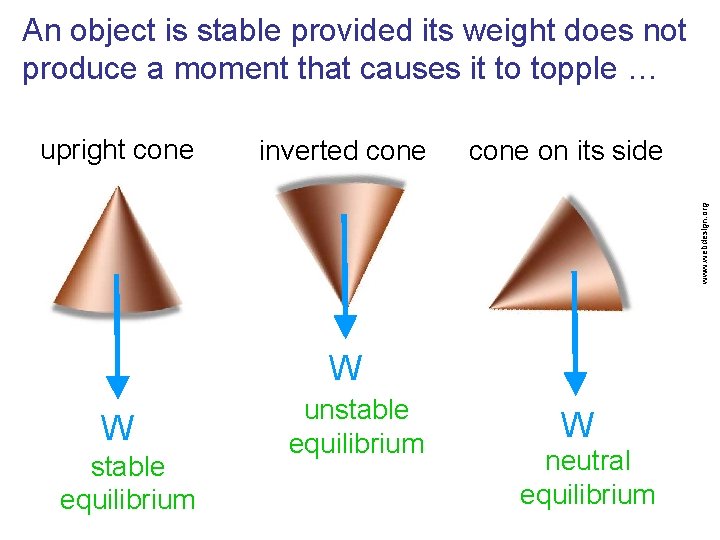
An object is stable provided its weight does not produce a moment that causes it to topple … inverted cone on its side www. webdesign. org upright cone W W stable equilibrium unstable equilibrium W neutral equilibrium
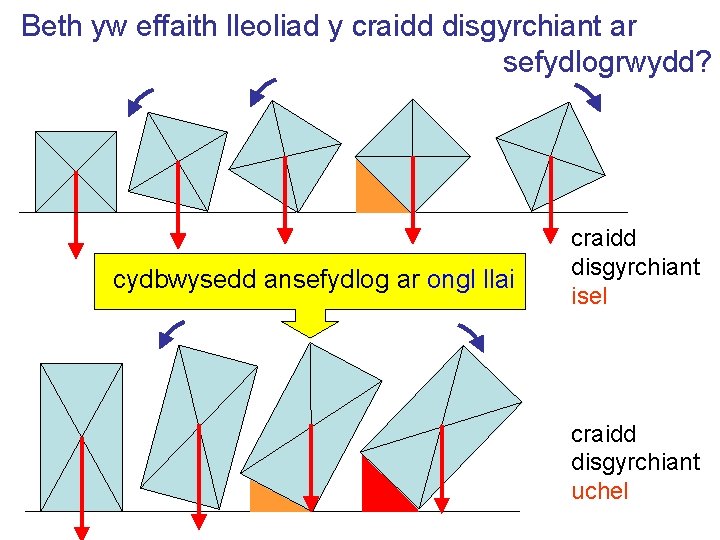
Beth yw effaith lleoliad y craidd disgyrchiant ar sefydlogrwydd? cydbwysedd ansefydlog ar ongl llai craidd disgyrchiant isel craidd disgyrchiant uchel
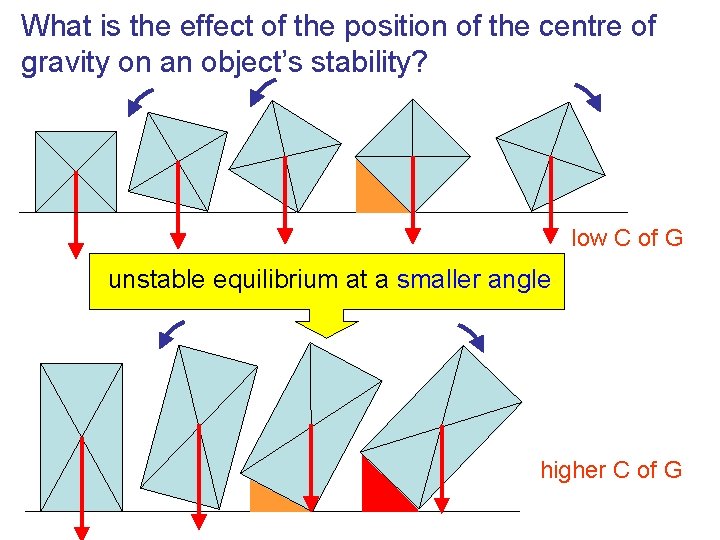
What is the effect of the position of the centre of gravity on an object’s stability? low C of G unstable equilibrium at a smaller angle higher C of G
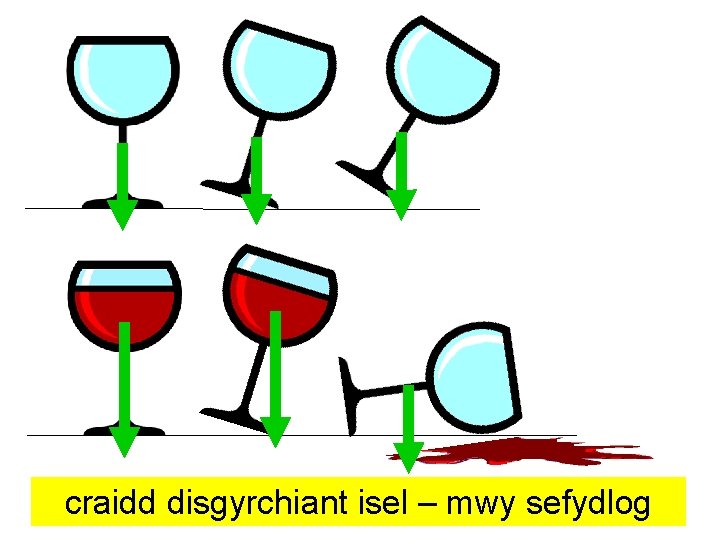
craidd disgyrchiant isel – mwy sefydlog
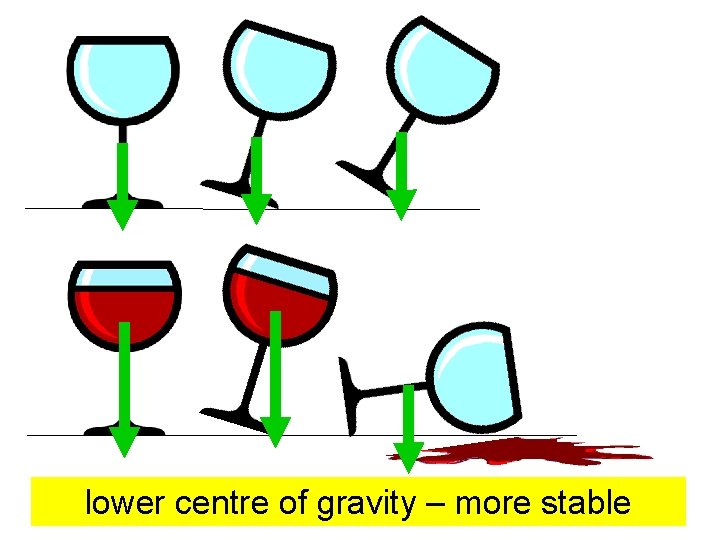
lower centre of gravity – more stable
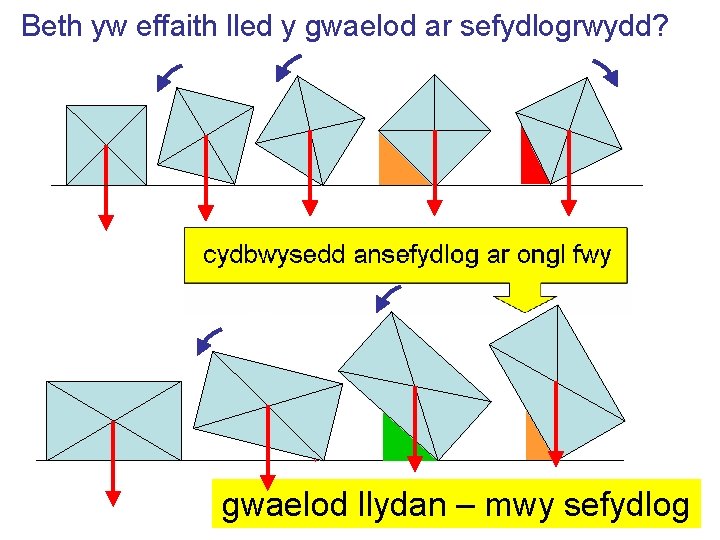
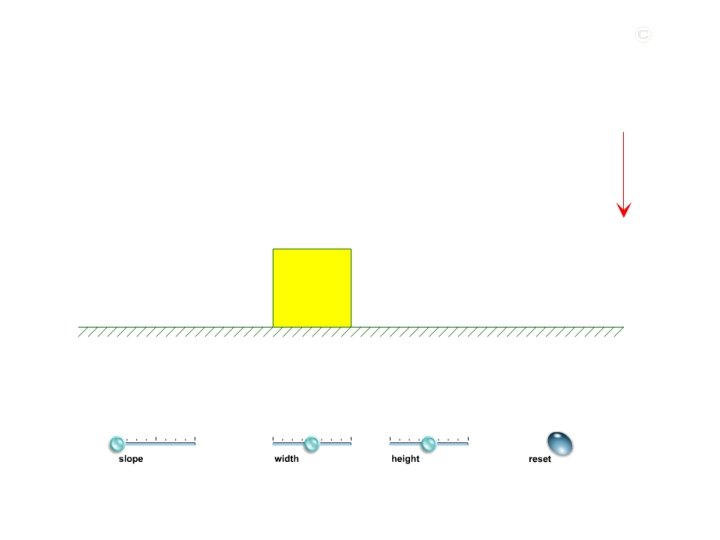
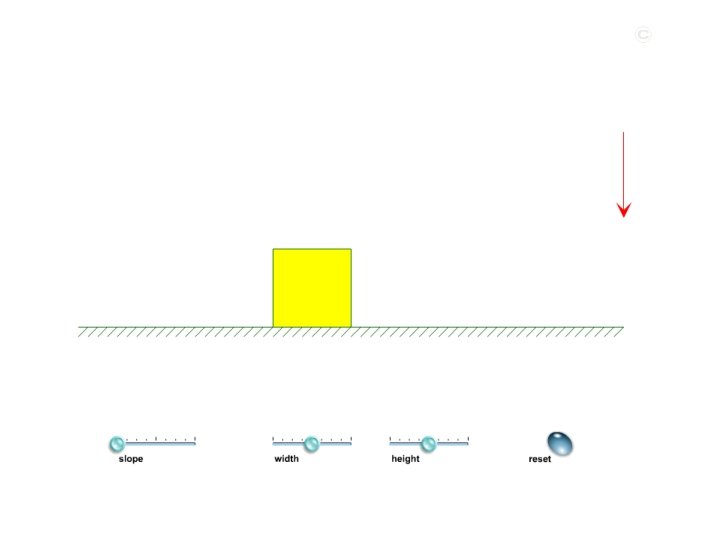
Beth yw effaith lled y gwaelod ar sefydlogrwydd? gwaelod llydan – mwy sefydlog
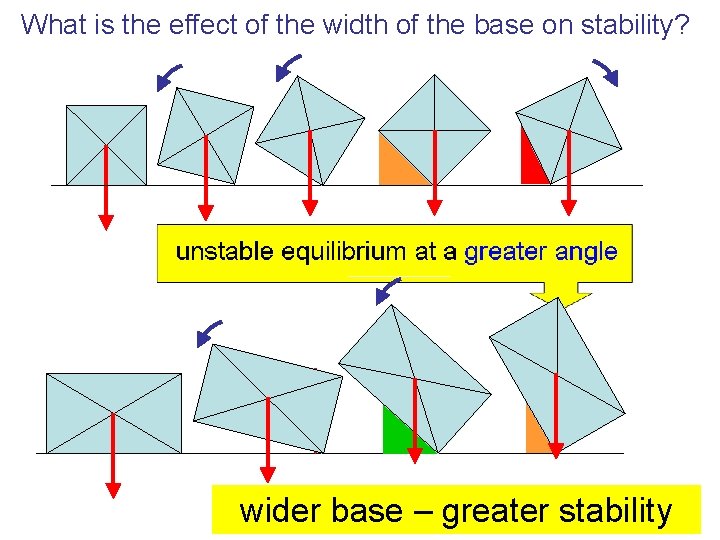
What is the effect of the width of the base on stability? wider base – greater stability
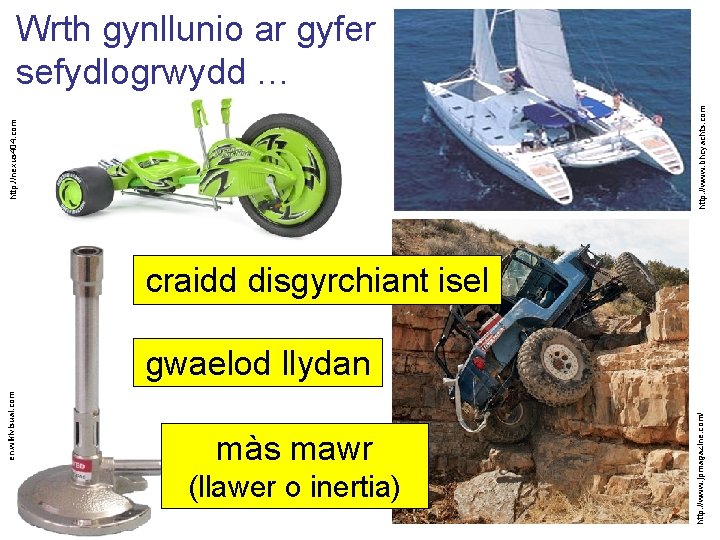
http: //nexus 404. com http: //www. bhcyachts. com Wrth gynllunio ar gyfer sefydlogrwydd … craidd disgyrchiant isel màs mawr (llawer o inertia) http: //www. jpmagazine. com/ en. wikivisual. com gwaelod llydan
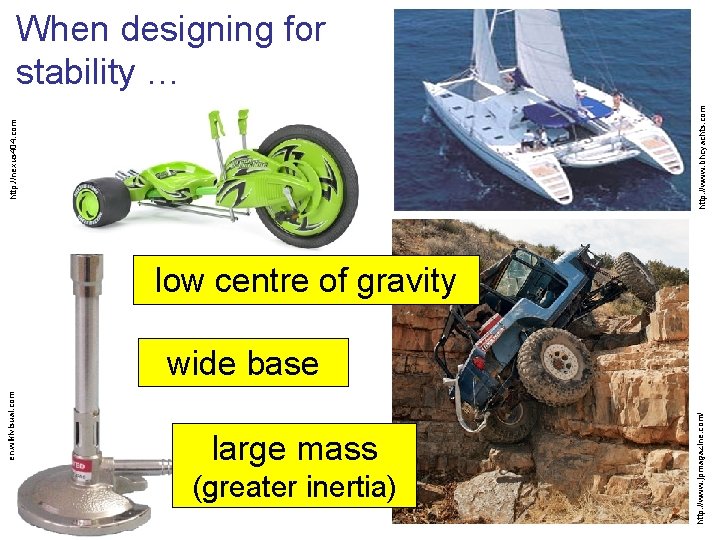
http: //nexus 404. com http: //www. bhcyachts. com When designing for stability … low centre of gravity large mass (greater inertia) http: //www. jpmagazine. com/ en. wikivisual. com wide base
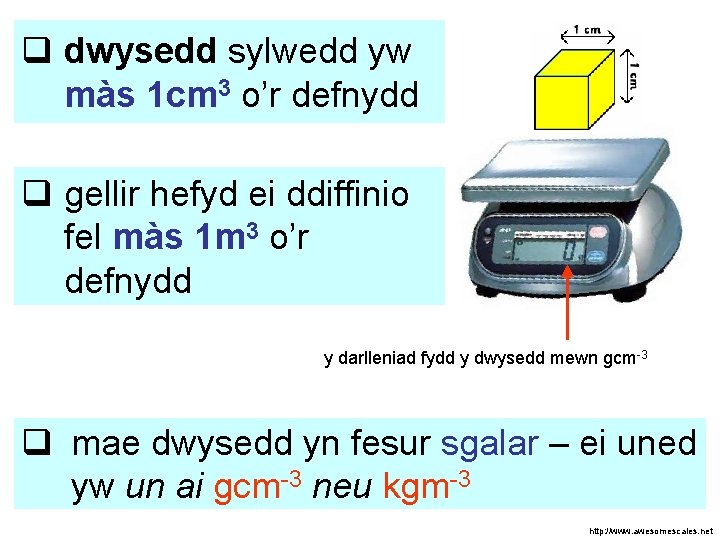
q dwysedd sylwedd yw màs 1 cm 3 o’r defnydd q gellir hefyd ei ddiffinio fel màs 1 m 3 o’r defnydd y darlleniad fydd y dwysedd mewn gcm-3 q mae dwysedd yn fesur sgalar – ei uned yw un ai gcm-3 neu kgm-3 http: //www. awesomescales. net
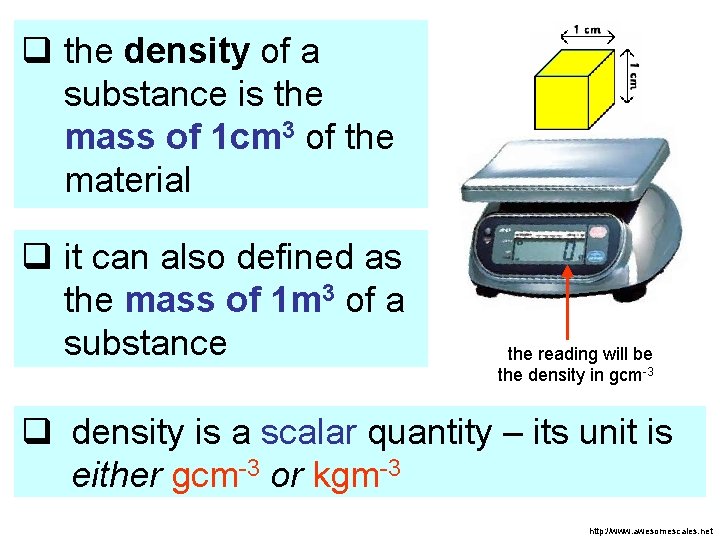
q the density of a substance is the mass of 1 cm 3 of the material q it can also defined as the mass of 1 m 3 of a substance the reading will be the density in gcm-3 q density is a scalar quantity – its unit is either gcm-3 or kgm-3 http: //www. awesomescales. net
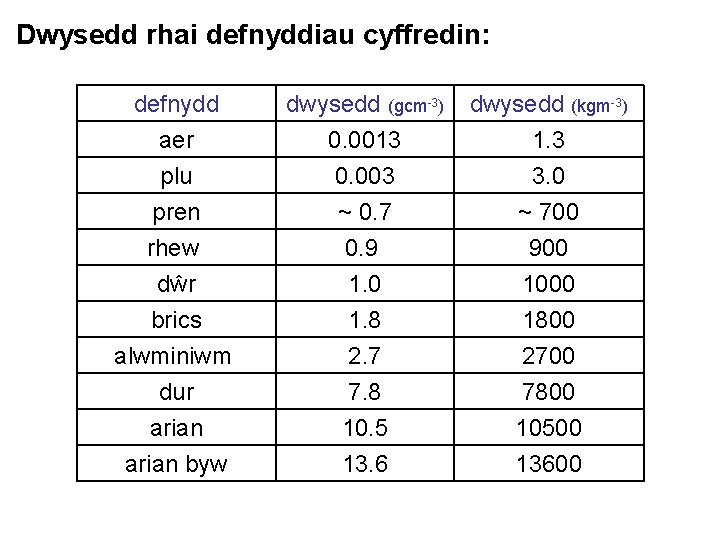
Dwysedd rhai defnyddiau cyffredin: defnydd aer plu pren dwysedd (gcm-3) 0. 0013 0. 003 ~ 0. 7 dwysedd (kgm-3) 1. 3 3. 0 ~ 700 rhew dŵr brics alwminiwm dur arian byw 0. 9 1. 0 1. 8 2. 7 7. 8 10. 5 13. 6 900 1000 1800 2700 7800 10500 13600
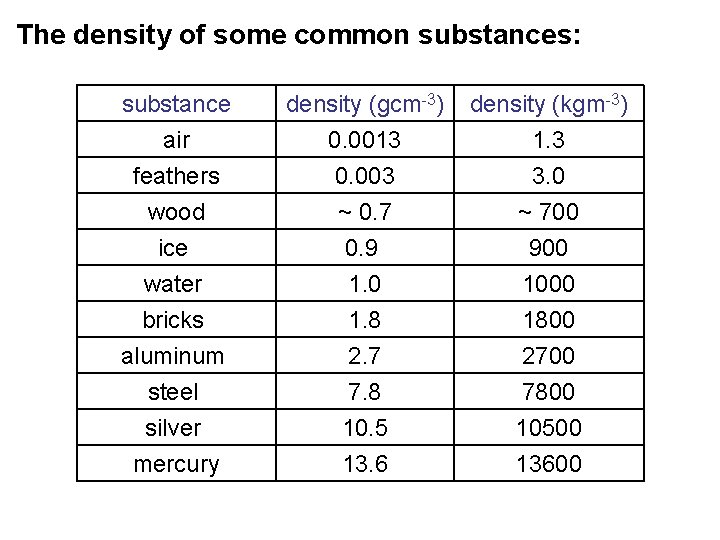
The density of some common substances: substance air feathers wood density (gcm-3) 0. 0013 0. 003 ~ 0. 7 density (kgm-3) 1. 3 3. 0 ~ 700 ice water bricks aluminum steel silver mercury 0. 9 1. 0 1. 8 2. 7 7. 8 10. 5 13. 6 900 1000 1800 2700 7800 10500 13600
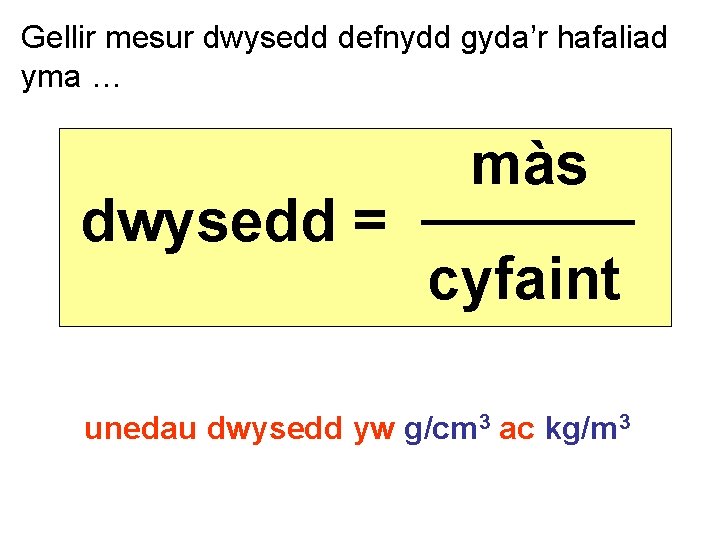
Gellir mesur dwysedd defnydd gyda’r hafaliad yma … màs dwysedd = ───── cyfaint unedau dwysedd yw g/cm 3 ac kg/m 3
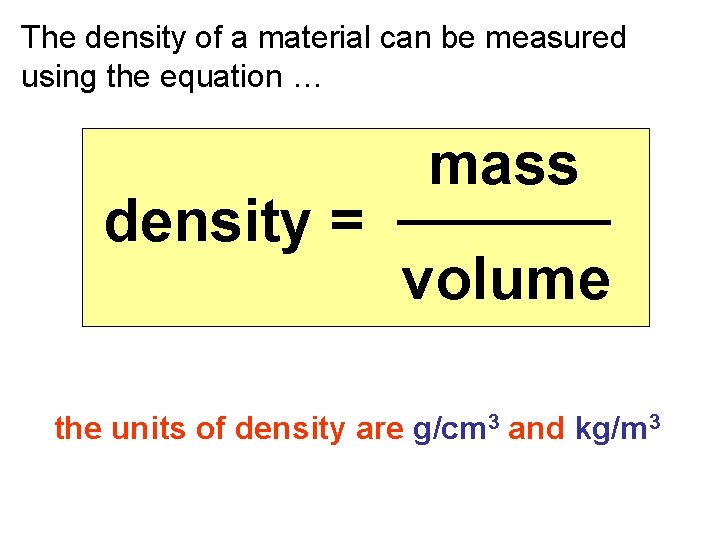
The density of a material can be measured using the equation … mass density = ───── volume the units of density are g/cm 3 and kg/m 3
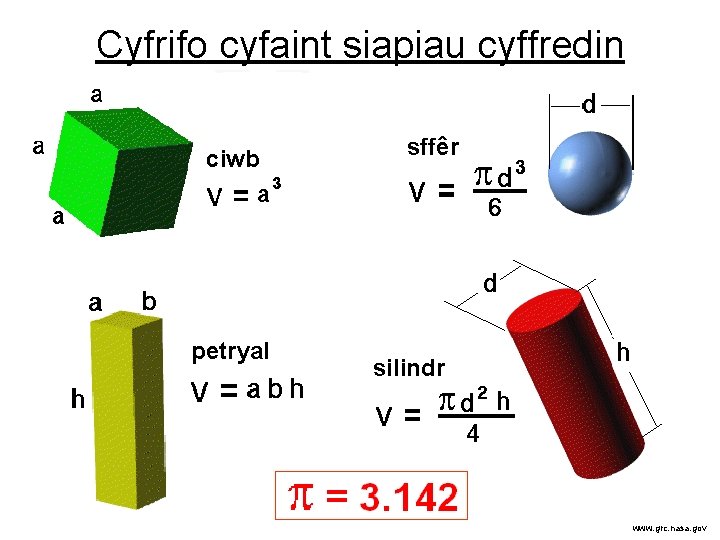
Cyfrifo cyfaint siapiau cyffredin ciwb petryal sffêr silindr www. grc. nasa. gov
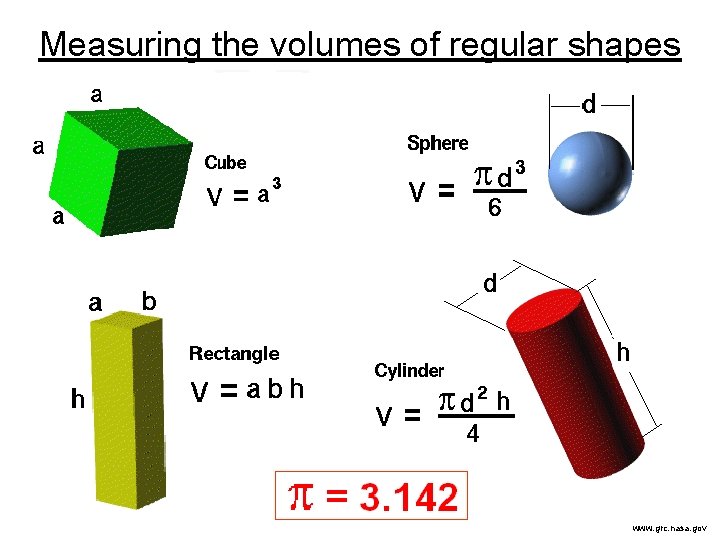
Measuring the volumes of regular shapes www. grc. nasa. gov
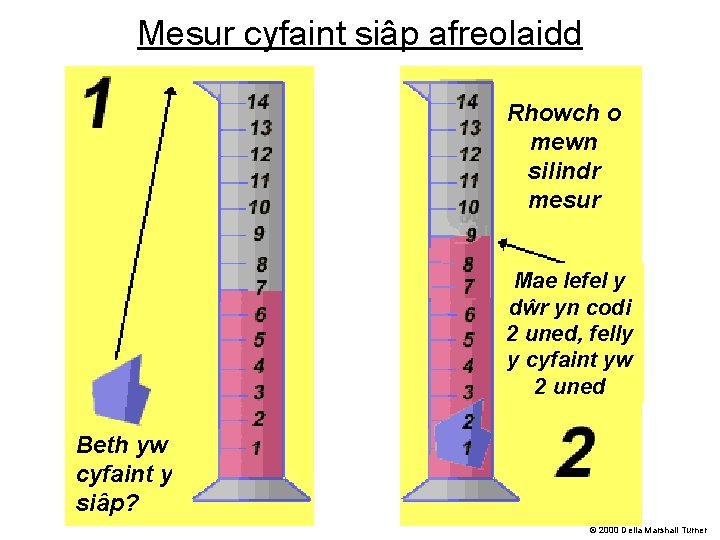
Mesur cyfaint siâp afreolaidd Rhowch o mewn silindr mesur Mae lefel y dŵr yn codi 2 uned, felly y cyfaint yw 2 uned Beth yw cyfaint y siâp? © 2000 Delia Marshall Turner
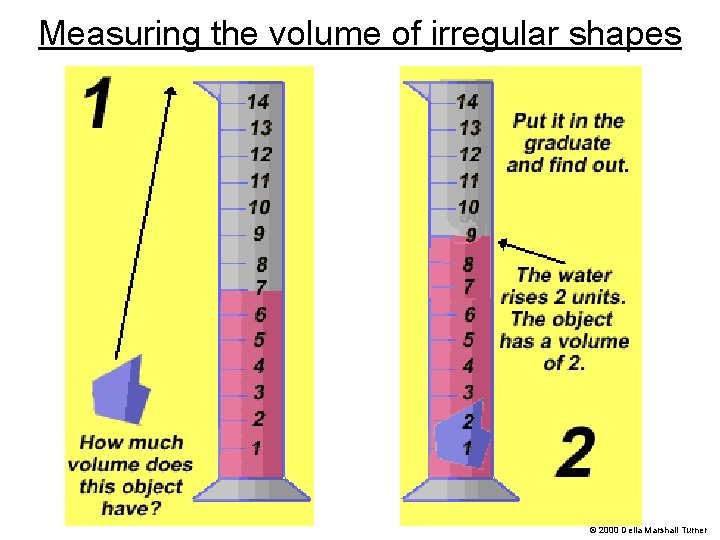
Measuring the volume of irregular shapes © 2000 Delia Marshall Turner
- Slides: 105