
FEWER SCHOOLDAYS MORE INEQUALITY Daiji Kawaguchi Hitotsubashi University
FEWER SCHOOL-DAYS, MORE INEQUALITY Daiji Kawaguchi Hitotsubashi University, RIETI, TCER, and IZA Workshop on Intergenerational Transfers and other Intergenerational Issues @Keio University March 3, 2013
Intensity of Compulsory Education and Intergenerational Dependence of Educational Attainment • 2 or 3 more Saturdays in a month are added as holidays in 2002 in Japan. • The regression coefficient of a child’s study time on parental education becomes 80% steeper. • The regression coefficient of a child’s academic performance on parental education becomes 20 -30% steeper.
Compulsory Education as Leveling Institution • Compulsory education aims at assuring equal educational opportunities for every children. • Extended compulsory education reduces intergenerational dependence of educational attainment - Meghir and Palme (2005), Aakvik, Salvanes, and Vaage (2010), Brunello et. al. (2012) • Test score gap by socioeconomic status tends to increase after summer breaks -Downey, von Hippel and Broh (2004) and Alexander, Entwisle and Olson (2007). • `Incarceration effect’ of school education – Less crime (Jacob and Lefgren (2003)) and less teen age pregnancy (Black et al. (2008)).
School-day reduction in Japan • Primary school (1 st – 6 th grade) and junior high school (7 th - 9 th grade) are compulsory education. • Historically, schools gave a half day classes on every Saturday. • The revision of labor standard act in 1988 reduced hours worked per week. Saturdays and Sundays became holidays in most work places until 1994. • Second Saturday off from September 1992 • Second + fourth Saturday off from April 1995 (5, 785 class units for primary school, 3, 150 class units for junior high school. ) • All Saturdays off from April 2002 (5, 367 class units for primary school, 2, 940 class units for junior high school. )
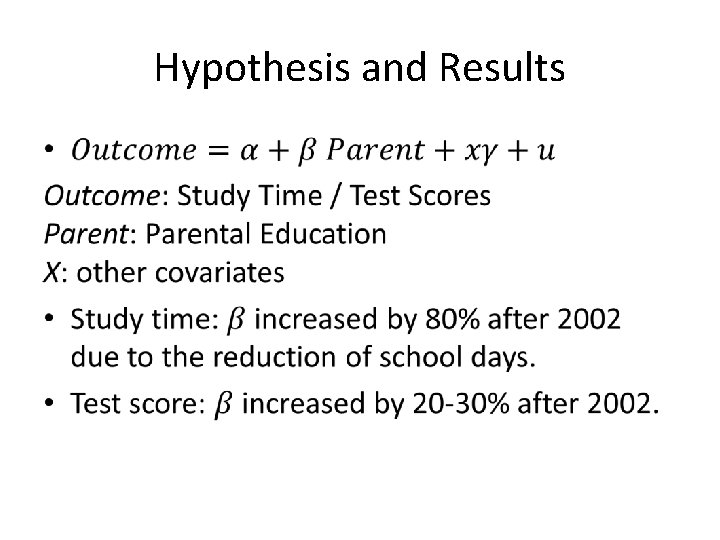
Hypothesis and Results •
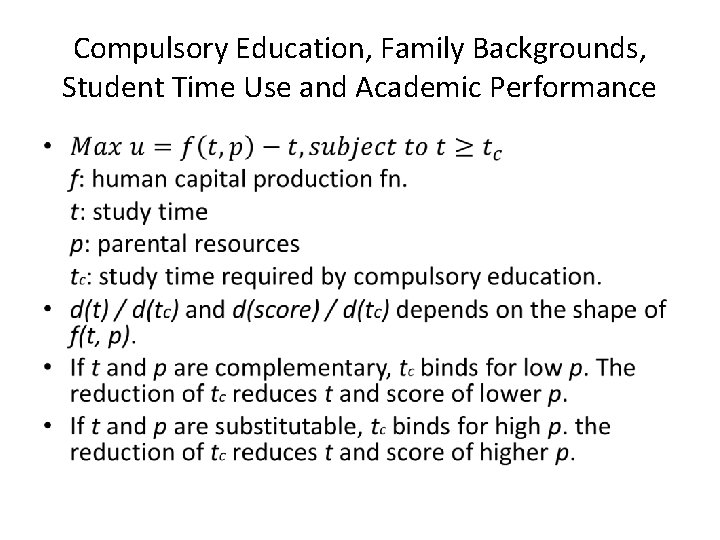
Compulsory Education, Family Backgrounds, Student Time Use and Academic Performance •
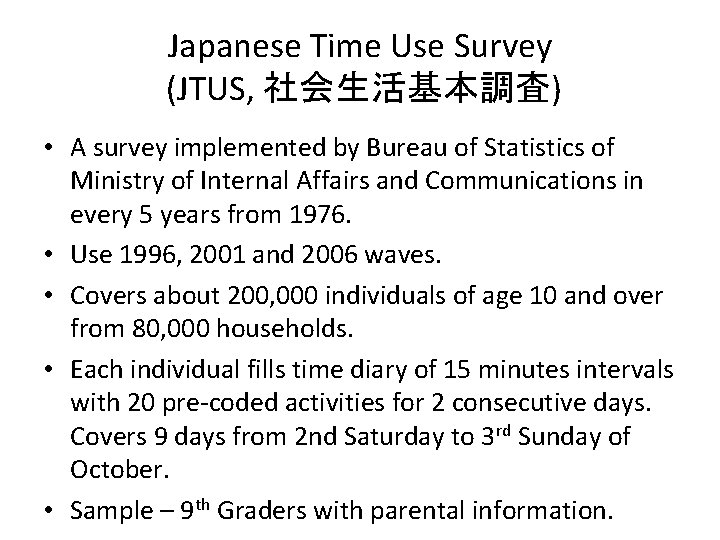
Japanese Time Use Survey (JTUS, 社会生活基本調査) • A survey implemented by Bureau of Statistics of Ministry of Internal Affairs and Communications in every 5 years from 1976. • Use 1996, 2001 and 2006 waves. • Covers about 200, 000 individuals of age 10 and over from 80, 000 households. • Each individual fills time diary of 15 minutes intervals with 20 pre-coded activities for 2 consecutive days. Covers 9 days from 2 nd Saturday to 3 rd Sunday of October. • Sample – 9 th Graders with parental information.
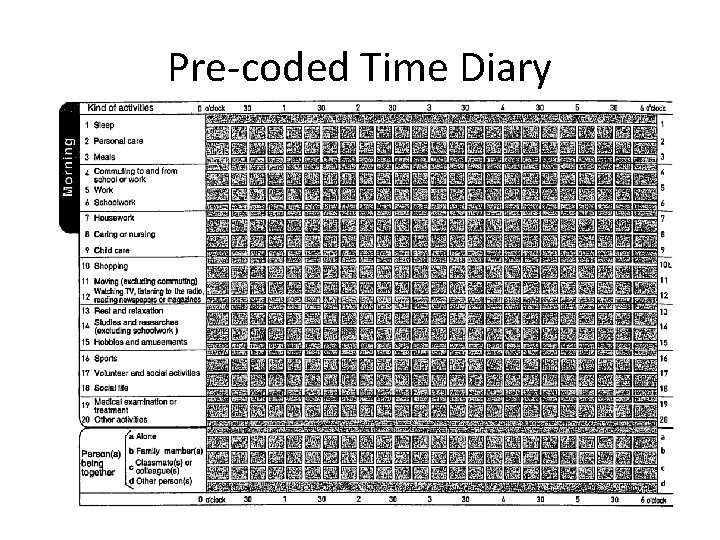
Pre-coded Time Diary
Classification of Time Use • Study includes commute, study, and research. • Leisure includes shopping, moving, watching TV and listening to the radio, hobbies, sports, social activities, and associations. • Other activities includes sleeping, personal care, eating, working, housekeeping, nursing, child rearing, rest, medical care, and “other activities”.
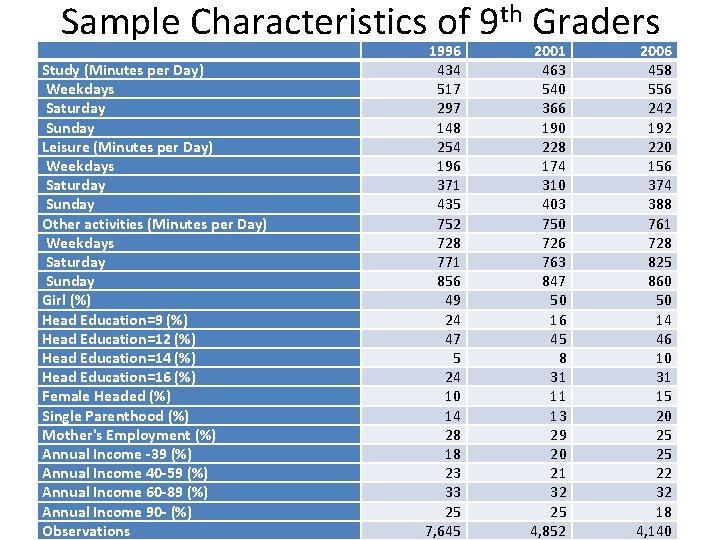
Sample Characteristics of 9 th Graders Study (Minutes per Day) Weekdays Saturday Sunday Leisure (Minutes per Day) Weekdays Saturday Sunday Other activities (Minutes per Day) Weekdays Saturday Sunday Girl (%) Head Education=9 (%) Head Education=12 (%) Head Education=14 (%) Head Education=16 (%) Female Headed (%) Single Parenthood (%) Mother's Employment (%) Annual Income -39 (%) Annual Income 40 -59 (%) Annual Income 60 -89 (%) Annual Income 90 - (%) Observations 1996 434 517 297 148 254 196 371 435 752 728 771 856 49 24 47 5 24 10 14 28 18 23 33 25 7, 645 2001 463 540 366 190 228 174 310 403 750 726 763 847 50 16 45 8 31 11 13 29 20 21 32 25 4, 852 2006 458 556 242 192 220 156 374 388 761 728 825 860 50 14 46 10 31 15 20 25 25 22 32 18 4, 140
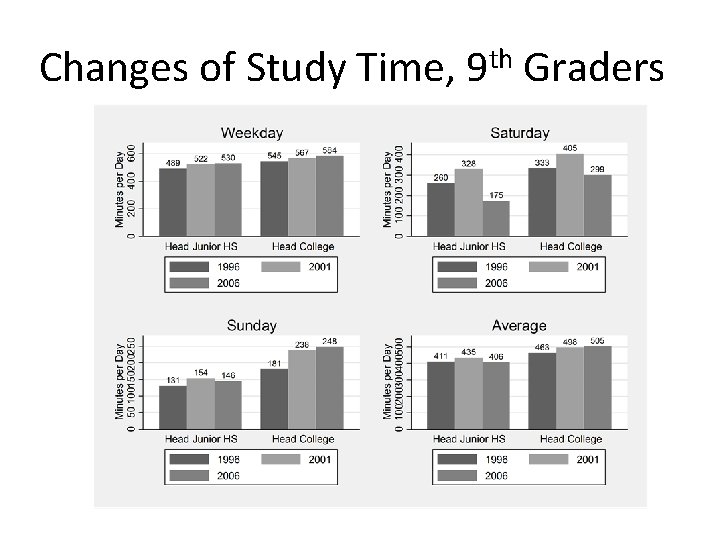
Changes of Study Time, 9 th Graders
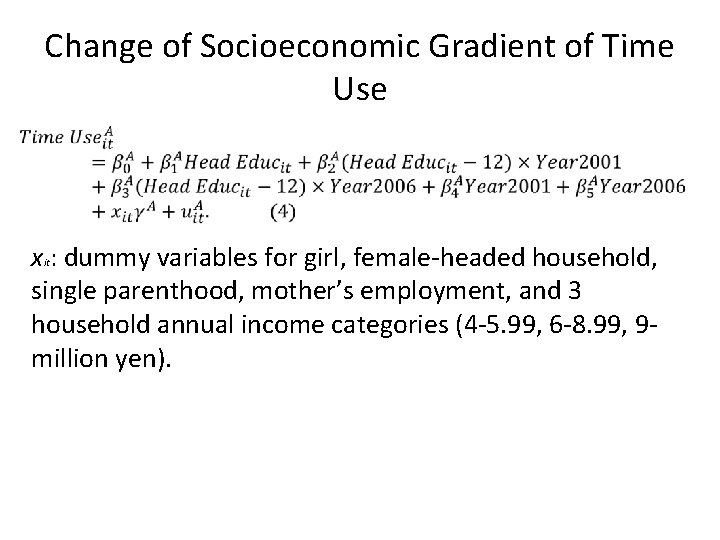
Change of Socioeconomic Gradient of Time Use x : dummy variables for girl, female-headed household, single parenthood, mother’s employment, and 3 household annual income categories (4 -5. 99, 6 -8. 99, 9 million yen). it
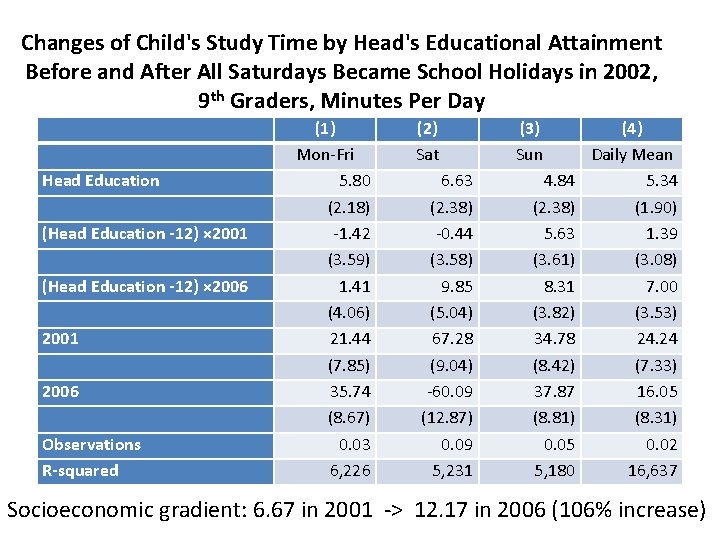
Changes of Child's Study Time by Head's Educational Attainment Before and After All Saturdays Became School Holidays in 2002, 9 th Graders, Minutes Per Day Head Education (Head Education -12) × 2001 (Head Education -12) × 2006 2001 2006 Observations R-squared (1) Mon-Fri 5. 80 (2. 18) -1. 42 (3. 59) 1. 41 (4. 06) 21. 44 (7. 85) 35. 74 (8. 67) 0. 03 6, 226 (2) Sat 6. 63 (2. 38) -0. 44 (3. 58) 9. 85 (5. 04) 67. 28 (9. 04) -60. 09 (12. 87) 0. 09 5, 231 (3) Sun 4. 84 (2. 38) 5. 63 (3. 61) 8. 31 (3. 82) 34. 78 (8. 42) 37. 87 (8. 81) 0. 05 5, 180 (4) Daily Mean 5. 34 (1. 90) 1. 39 (3. 08) 7. 00 (3. 53) 24. 24 (7. 33) 16. 05 (8. 31) 0. 02 16, 637 Socioeconomic gradient: 6. 67 in 2001 -> 12. 17 in 2006 (106% increase)
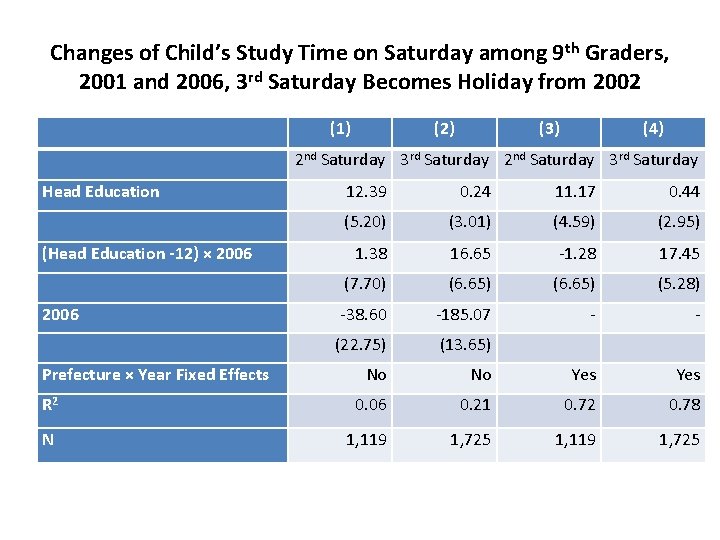
Changes of Child’s Study Time on Saturday among 9 th Graders, 2001 and 2006, 3 rd Saturday Becomes Holiday from 2002 (1) (2) (3) (4) 2 nd Saturday 3 rd Saturday Head Education 12. 39 0. 24 11. 17 0. 44 (5. 20) (3. 01) (4. 59) (2. 95) 1. 38 16. 65 -1. 28 17. 45 (7. 70) (6. 65) (5. 28) -38. 60 -185. 07 - - (22. 75) (13. 65) No No Yes R 2 0. 06 0. 21 0. 72 0. 78 N 1, 119 1, 725 (Head Education -12) × 2006 Prefecture × Year Fixed Effects
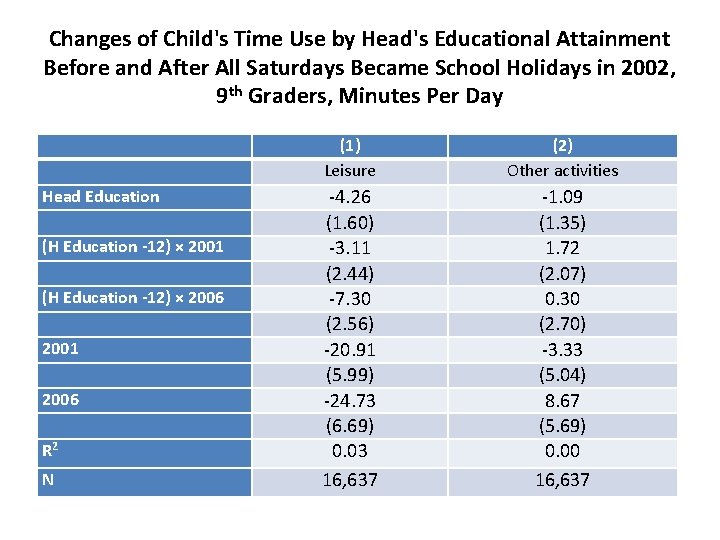
Changes of Child's Time Use by Head's Educational Attainment Before and After All Saturdays Became School Holidays in 2002, 9 th Graders, Minutes Per Day Head Education (H Education -12) × 2001 (H Education -12) × 2006 2001 2006 R 2 N (1) Leisure (2) Other activities -4. 26 (1. 60) -3. 11 (2. 44) -7. 30 (2. 56) -20. 91 (5. 99) -24. 73 (6. 69) 0. 03 16, 637 -1. 09 (1. 35) 1. 72 (2. 07) 0. 30 (2. 70) -3. 33 (5. 04) 8. 67 (5. 69) 0. 00 16, 637
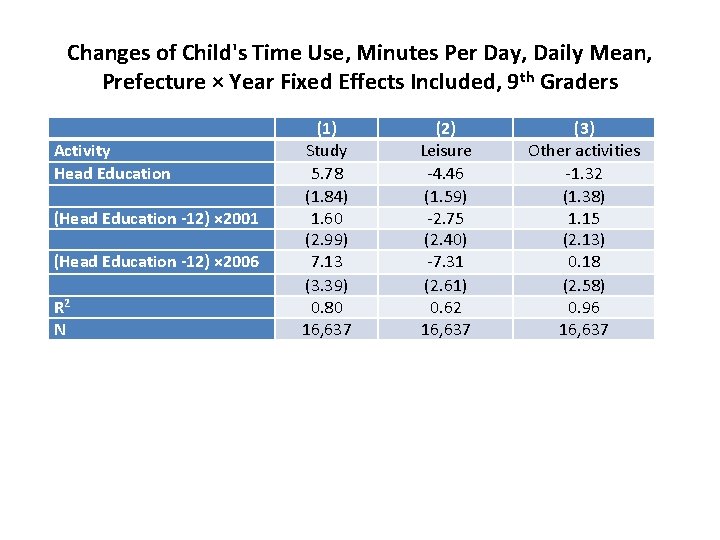
Changes of Child's Time Use, Minutes Per Day, Daily Mean, Prefecture × Year Fixed Effects Included, 9 th Graders Activity Head Education (Head Education -12) × 2001 (Head Education -12) × 2006 R 2 N (1) Study 5. 78 (1. 84) 1. 60 (2. 99) 7. 13 (3. 39) 0. 80 16, 637 (2) Leisure -4. 46 (1. 59) -2. 75 (2. 40) -7. 31 (2. 61) 0. 62 16, 637 (3) Other activities -1. 32 (1. 38) 1. 15 (2. 13) 0. 18 (2. 58) 0. 96 16, 637
Analysis of TIMSS and PISA • Trends in Mathematics and Science Studies (TIMSS), 1999 and 2003 waves, 150 schools, about 4000 8 th graders took mathematics and science examinations, each lasting 90 minutes. Student survey includes the number of books at home and the possessions of computer and other items at home. It also includes parental highest educational attainment in 2003 wave. • The 2000 and 2003 waves of OECD Programme for International Student Assessment (PISA), about 5, 000 10 th graders from 140 schools. Reading, mathematics and science.
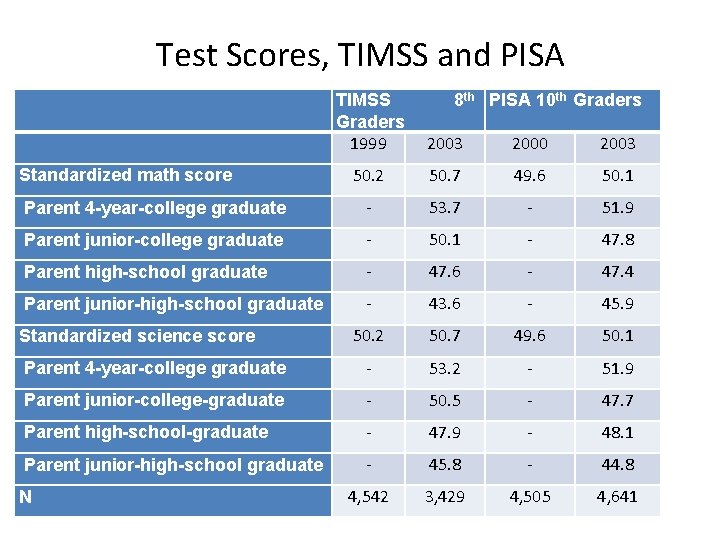
Test Scores, TIMSS and PISA TIMSS Graders 1999 2003 2000 2003 50. 2 50. 7 49. 6 50. 1 Parent 4 -year-college graduate - 53. 7 - 51. 9 Parent junior-college graduate - 50. 1 - 47. 8 Parent high-school graduate - 47. 6 - 47. 4 Parent junior-high-school graduate - 43. 6 - 45. 9 50. 2 50. 7 49. 6 50. 1 Parent 4 -year-college graduate - 53. 2 - 51. 9 Parent junior-college-graduate - 50. 5 - 47. 7 Parent high-school-graduate - 47. 9 - 48. 1 Parent junior-high-school graduate - 45. 8 - 44. 8 4, 542 3, 429 4, 505 4, 641 Standardized math score Standardized science score N 8 th PISA 10 th Graders
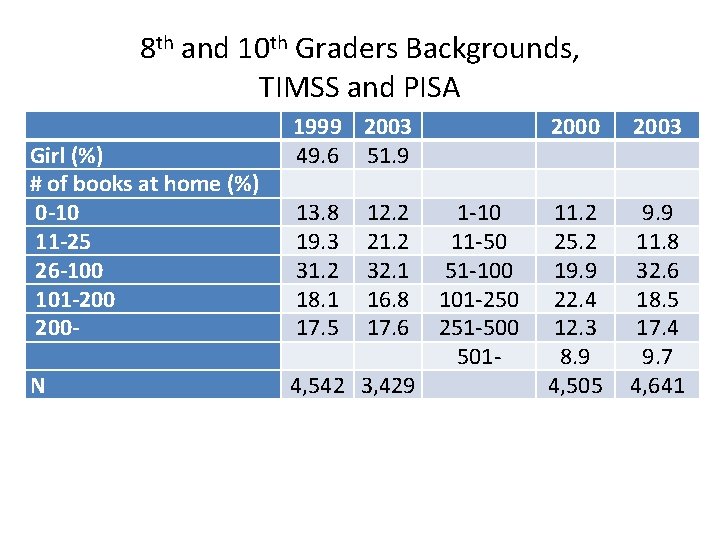
8 th and 10 th Graders Backgrounds, TIMSS and PISA Girl (%) # of books at home (%) 0 -10 11 -25 26 -100 101 -200 200 N 1999 2003 49. 6 51. 9 13. 8 19. 3 31. 2 18. 1 17. 5 12. 2 21. 2 32. 1 16. 8 17. 6 4, 542 3, 429 1 -10 11 -50 51 -100 101 -250 251 -500 501 - 2000 2003 11. 2 25. 2 19. 9 22. 4 12. 3 8. 9 4, 505 9. 9 11. 8 32. 6 18. 5 17. 4 9. 7 4, 641
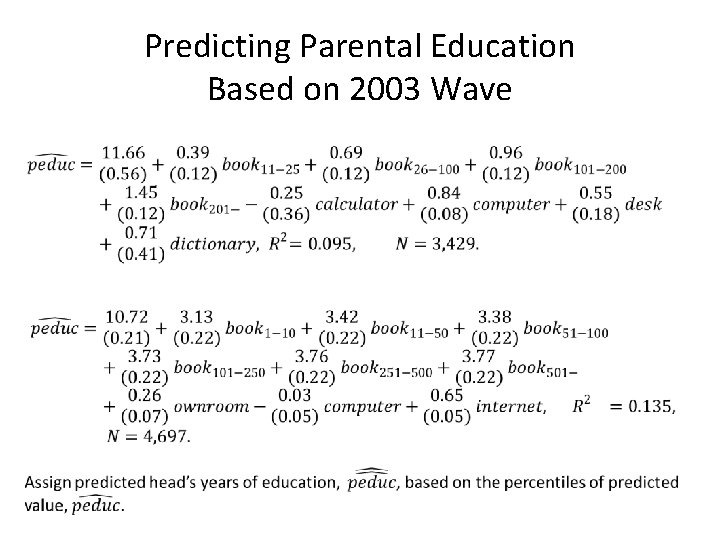
Predicting Parental Education Based on 2003 Wave
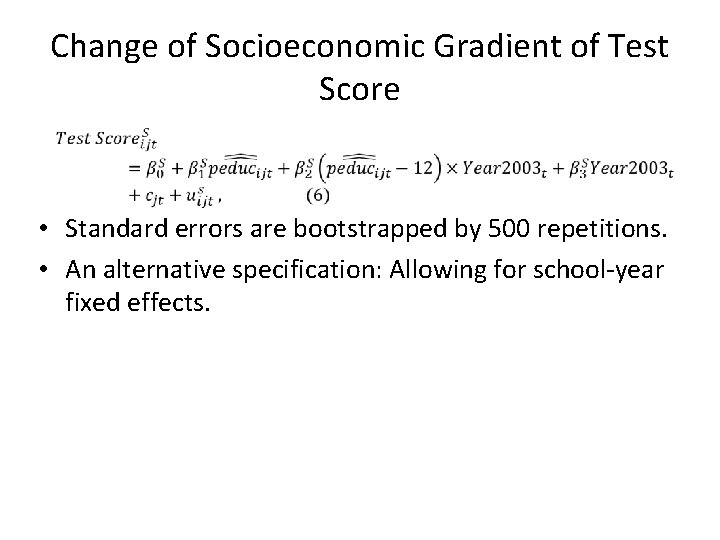
Change of Socioeconomic Gradient of Test Score • Standard errors are bootstrapped by 500 repetitions. • An alternative specification: Allowing for school-year fixed effects.
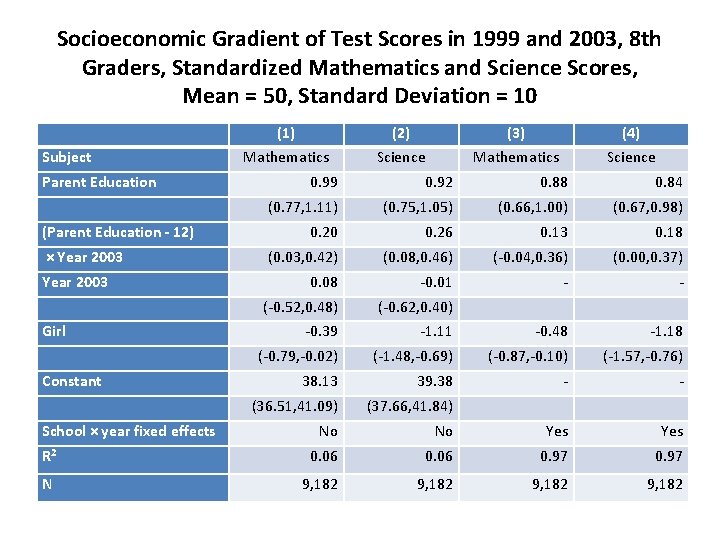
Socioeconomic Gradient of Test Scores in 1999 and 2003, 8 th Graders, Standardized Mathematics and Science Scores, Mean = 50, Standard Deviation = 10 Subject Parent Education (1) (2) (3) (4) Mathematics Science 0. 99 0. 92 0. 88 0. 84 (0. 77, 1. 11) (0. 75, 1. 05) (0. 66, 1. 00) (0. 67, 0. 98) 0. 20 0. 26 0. 13 0. 18 (0. 03, 0. 42) (0. 08, 0. 46) (-0. 04, 0. 36) (0. 00, 0. 37) 0. 08 -0. 01 - - (-0. 52, 0. 48) (-0. 62, 0. 40) -0. 39 -1. 11 -0. 48 -1. 18 (-0. 79, -0. 02) (-1. 48, -0. 69) (-0. 87, -0. 10) (-1. 57, -0. 76) 38. 13 39. 38 - - (36. 51, 41. 09) (37. 66, 41. 84) No No Yes R 2 0. 06 0. 97 N 9, 182 (Parent Education - 12) × Year 2003 Girl Constant School × year fixed effects
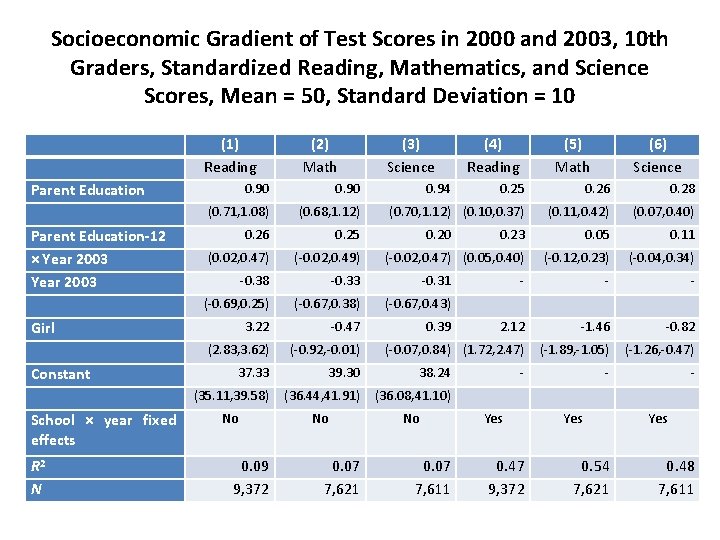
Socioeconomic Gradient of Test Scores in 2000 and 2003, 10 th Graders, Standardized Reading, Mathematics, and Science Scores, Mean = 50, Standard Deviation = 10 (1) Reading Parent Education-12 × Year 2003 School × year fixed effects R 2 N (3) Science 0. 90 (0. 71, 1. 08) (0. 68, 1. 12) 0. 26 0. 25 (0. 02, 0. 47) (-0. 02, 0. 49) -0. 38 -0. 33 -0. 31 (-0. 69, 0. 25) (-0. 67, 0. 38) (-0. 67, 0. 43) 3. 22 -0. 47 0. 39 (2. 83, 3. 62) (-0. 92, -0. 01) 37. 33 39. 30 38. 24 (35. 11, 39. 58) (36. 44, 41. 91) (36. 08, 41. 10) No No No Girl Constant (2) Math 0. 09 9, 372 0. 07 7, 621 0. 94 (4) Reading (5) Math (6) Science 0. 25 0. 26 0. 28 (0. 70, 1. 12) (0. 10, 0. 37) (0. 11, 0. 42) (0. 07, 0. 40) 0. 23 0. 05 0. 11 (-0. 02, 0. 47) (0. 05, 0. 40) (-0. 12, 0. 23) (-0. 04, 0. 34) - - - 2. 12 -1. 46 -0. 82 (-0. 07, 0. 84) (1. 72, 2. 47) (-1. 89, -1. 05) (-1. 26, -0. 47) - - 0. 20 0. 07 7, 611 Yes 0. 47 9, 372 Yes 0. 54 7, 621 Yes 0. 48 7, 611
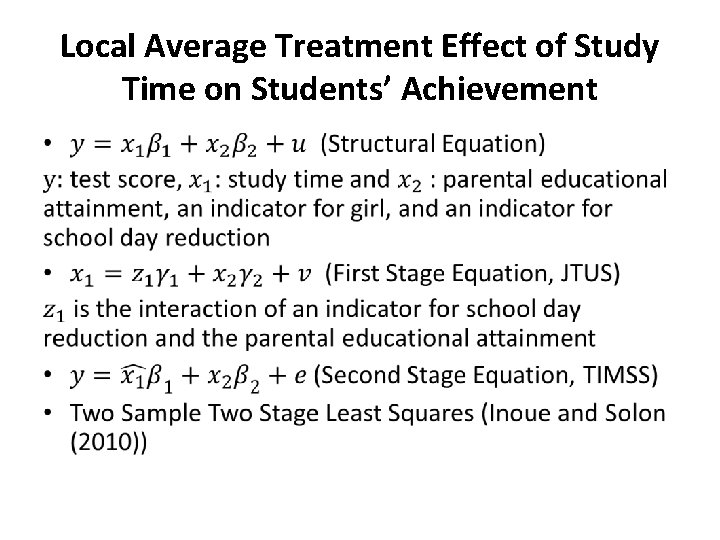
Local Average Treatment Effect of Study Time on Students’ Achievement •
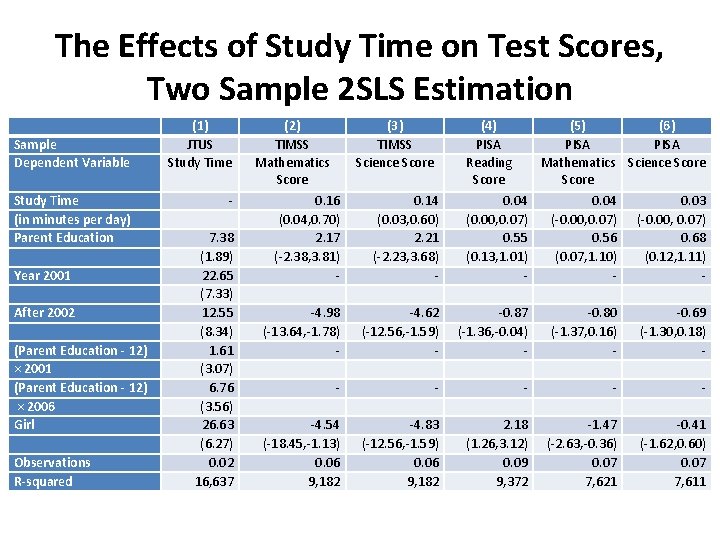
The Effects of Study Time on Test Scores, Two Sample 2 SLS Estimation Sample Dependent Variable Study Time (in minutes per day) Parent Education Year 2001 After 2002 (Parent Education - 12) × 2001 (Parent Education - 12) × 2006 Girl Observations R-squared (1) JTUS Study Time 7. 38 (1. 89) 22. 65 (7. 33) 12. 55 (8. 34) 1. 61 (3. 07) 6. 76 (3. 56) 26. 63 (6. 27) 0. 02 16, 637 (2) TIMSS Mathematics Score 0. 16 (0. 04, 0. 70) 2. 17 (-2. 38, 3. 81) - (3) TIMSS Science Score 0. 14 (0. 03, 0. 60) 2. 21 (-2. 23, 3. 68) - (4) (5) (6) PISA Reading Mathematics Science Score 0. 04 0. 03 (0. 00, 0. 07) (-0. 00, 0. 07) 0. 55 0. 56 0. 68 (0. 13, 1. 01) (0. 07, 1. 10) (0. 12, 1. 11) - -4. 98 (-13. 64, -1. 78) - -4. 62 (-12. 56, -1. 59) - -0. 87 (-1. 36, -0. 04) - -0. 80 (-1. 37, 0. 16) - -0. 69 (-1. 30, 0. 18) - - - -4. 54 (-18. 45, -1. 13) 0. 06 9, 182 -4. 83 (-12. 56, -1. 59) 0. 06 9, 182 2. 18 (1. 26, 3. 12) 0. 09 9, 372 -1. 47 (-2. 63, -0. 36) 0. 07 7, 621 -0. 41 (-1. 62, 0. 60) 0. 07 7, 611
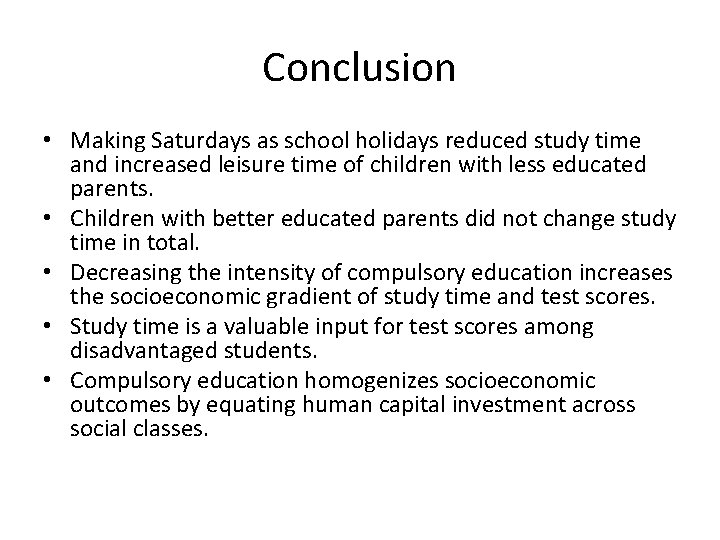
Conclusion • Making Saturdays as school holidays reduced study time and increased leisure time of children with less educated parents. • Children with better educated parents did not change study time in total. • Decreasing the intensity of compulsory education increases the socioeconomic gradient of study time and test scores. • Study time is a valuable input for test scores among disadvantaged students. • Compulsory education homogenizes socioeconomic outcomes by equating human capital investment across social classes.
- Slides: 26