
Fever in ICU Dr CY Yung ICU PYNEH
- Slides: 21
Fever in ICU Dr CY Yung ICU, PYNEH 19 June 2009
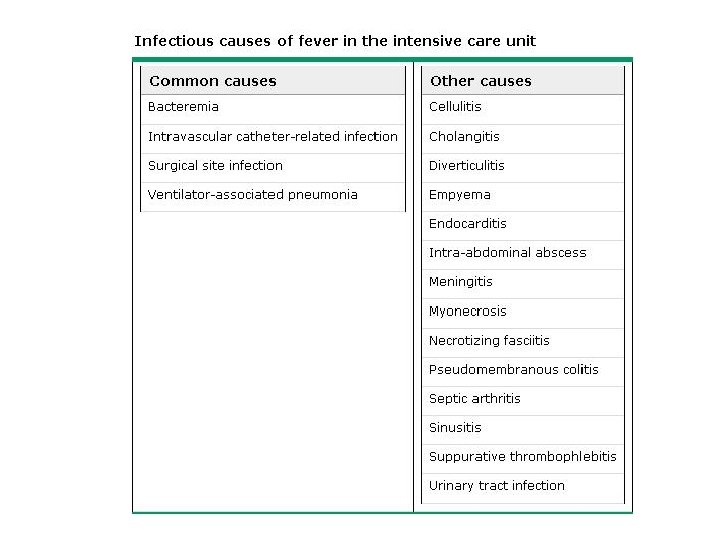
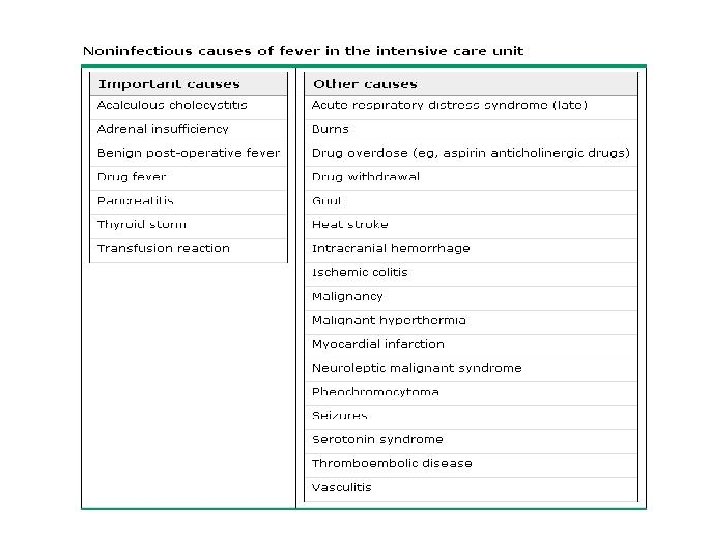
Fever in ICU • • • Definition Methods of measuring body temperature Commons causes Non-infective causes Use of antipyretics
Fever • New hypothalamic set point due to cytokines production in inflammatory status • Shivering and non-shivering thermogenesis • Heat conservation in the peripheries
Body Temperature • The traditional norm of 37°C is the mean axillary temperatures of 25000 healthy adults Wunderlich CA, Sequine E. Medical thermometry and human temperature. New . • A more recent study revealed normal mean oral temperature of 36. 8°C, with fever defined as >37. 2 °C in the morning and >37. 7°C in the afternoon by 99 th percentile York: William Wood, 1871 A critical appraisal of 98. 6 degrees F, the upper limit of the normal body temperature, and other legacies of Carl Reinhold August Wunderlich. Mackowiak PA; Wasserman SS; Levine MM JAMA 1992 Sep 23 -30; 268(12): 1578 -80
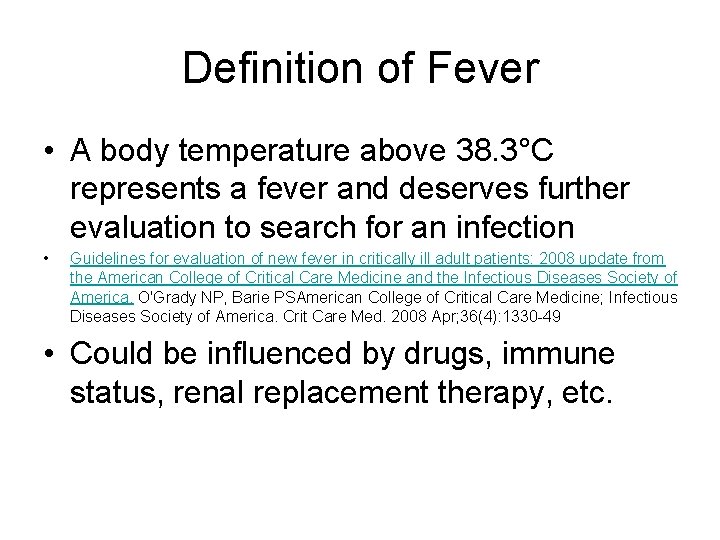
Definition of Fever • A body temperature above 38. 3°C represents a fever and deserves further evaluation to search for an infection • Guidelines for evaluation of new fever in critically ill adult patients: 2008 update from the American College of Critical Care Medicine and the Infectious Diseases Society of America. O'Grady NP, Barie PSAmerican College of Critical Care Medicine; Infectious Diseases Society of America. Crit Care Med. 2008 Apr; 36(4): 1330 -49 • Could be influenced by drugs, immune status, renal replacement therapy, etc.
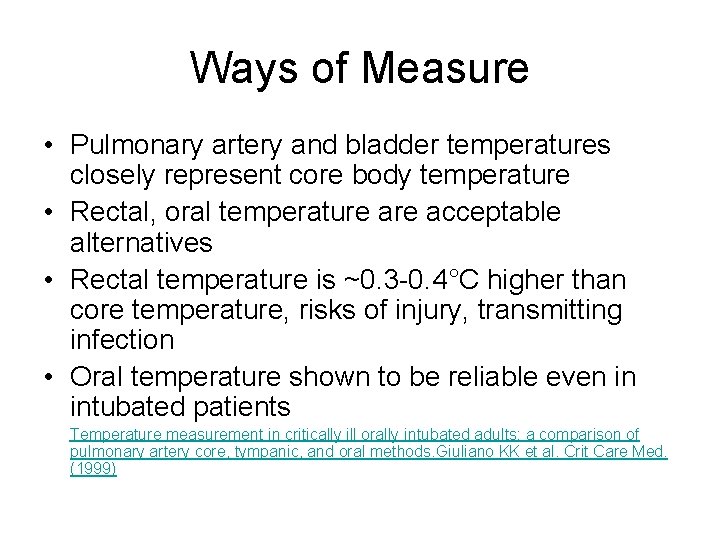
Ways of Measure • Pulmonary artery and bladder temperatures closely represent core body temperature • Rectal, oral temperature acceptable alternatives • Rectal temperature is ~0. 3 -0. 4°C higher than core temperature, risks of injury, transmitting infection • Oral temperature shown to be reliable even in intubated patients Temperature measurement in critically ill orally intubated adults: a comparison of pulmonary artery core, tympanic, and oral methods. Giuliano KK et al. Crit Care Med. (1999)
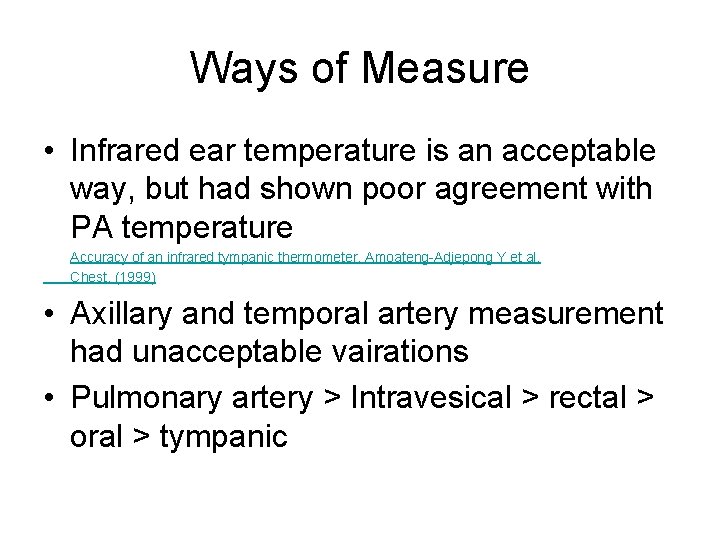
Ways of Measure • Infrared ear temperature is an acceptable way, but had shown poor agreement with PA temperature Accuracy of an infrared tympanic thermometer. Amoateng-Adjepong Y et al. Chest. (1999) • Axillary and temporal artery measurement had unacceptable vairations • Pulmonary artery > Intravesical > rectal > oral > tympanic
Post-operative Fever • 15 -40% after major surgery, but most are not associated with infection Freischlag J, Busuttil RW. The value of postoperative fever evaluation. Surgery 1983; 94: 358 -363 • Usually resolved after 24 -48 hrs • Association with atelectasis, but no direct causal relationship Lack of association between atelectasis and fever Chest 107. n 1 (Jan 1995): pp 81(4).
Bronchoscopy • 5% of patients underwent FOB developed fever • Mean duration of 14 hrs • Maybe associated with underlying diagnosis and bleeding Prospective Analysis of Clinical Characteristics and Risk Factors of Postbronchoscopy Fever Chest - Volume 125, Issue 3 (March 2004)
Drug Fever • Patient can be seriously ill • Common association: amphotericin, cephalosporins, penecillins, phenytoin, procainamide, quinidine • Less common: cimetidine, carbamaepine, hydralazine, rifampacin, streptokinase, vancomycin Mackowiak PA, Le. Maister CF. Drug Fever: a critical apprasal of conventional concepts. Ann Intern Med 1987; 106: 728 -733
Drug Fever • Clinical features Rigors (53%) Myalgias (25%) Leukocytosis (22%) Eosinophillia (22%) Rash (18%) Hypotension (18%) Mackowiak PA, Le. Maister CF. Drug Fever: a critical apprasal of conventional concepts. Ann Intern Med 1987; 106: 728 -733 • Mean lag time of starting drugs and manifestation is 21 days in one series Cunha B. Drug fever: the importance of recognition. Postgrad Med 1986; 80: 123 -129
Drug Fever • Differentials include drug induced hyperthemia • malignant hyperthermia, neuroleptic malignant syndrome, serotonin syndrome
Non-infectious Causes • Blood transfusion: febrile reactions occurs in 5% of patients • Acalculous cholecystitis: could be up to 1. 5% of critically ill patients • Venous thromboembolism • Haemodialysis • Cerebral and myocardial infarction
Treating Fever • Mainly invitro evidence fever can increase immune response, by increasing production of antibodies and cytokines, activating T lymphocytes, enhancing phagocytosis by neutrophils • High body temperature also decrease replication of bacteria in animal models Kluger M, Rothenburg BA. Fever and reduced iron: their interaction as a host defense response to bacterial infection. Science 1979; 203: 374 -376 • There is still definite proof of how fever affect course of infection
Treating Fever • Postaglandin E 2 mediates endogenous pyrogen production in pathogenesis of fever • Aspirin was widely used as antipyretics before discovery of Reye’s Syndrome in 1980’s • Acetaminophen and NSAID • Ibuprofen was shown superior in mean temperature reduction in children (1. 84°C Vs 1. 24°C) Autret E. Comparative efficacy and tolerance of of ibuprufen syrup and acetaminophen syrup in children with pyrexia associated with infectious disesases and reated with antibiotics • Role of systemic corticosteriods
Treating Fever • Treating fever also reduced systemic symptoms of headache, myalagia and arthralgias • Some evidence suggested uncontrolled cytokines production in fever will lead to adverse outcome • Side effects of drugs
Stroke/Brain Injury • Shown in both animal and human studies that worsened clinical outcome Combating hyperthermia in acute stroke: a significant clinical concern. Ginsberg MD; Busto R Stroke 1998 Feb; 29(2): 529 -34 Effects of poststroke pyrexia on stroke outcome : a meta-analysis of studies in patients. Hajat C; Hajat S; Sharma P Stroke 2000 Feb; 31(2): 410 -4. • May also suggest underlying severity of brain damage Body temperature in acute stroke: relation to stroke severity, infarct size, mortality, and outcome. Reith J; Jorgensen HS; Pedersen PM; Nakayama H; Raaschou HO; Jeppesen LL; Olsen TS Lancet 1996 Feb 17; 347(8999): 422 -5 • Suggested in AHA/ASA guideline for antipyretics