
FETAL FIBRONECTIN LEVELS AND PREDICTION OF PRETERM LABOR
FETAL FIBRONECTIN LEVELS AND PREDICTION OF PRETERM LABOR DARCY SUBRAMANIAM & KAYLA ABRAHAMSON UNIVERSITY OF MARY
SCENARIO 32 year old G 2 P 1 female presented to the clinic with lower pelvic cramping that “feels like contractions”. She is currently at 33 weeks gestation with her current pregnancy. The contractions come in waves of intensity every 8 minutes and last for about 2 -3 minutes at a time. Her previous pregnancy, resulted in preterm labor at 32 weeks gestation, and she is concerned that she is going into preterm labor. The obstetrician ordered a fetal fibronectin level and ultrasound for cervical length to help determine if preterm labor was eminent.
PICO QUESTION Does collection of fetal fibronectin levels in women suspected of preterm labor at 27 -34 weeks gestation accurately predict impending delivery when compared to cervical ultrasound to determine preterm labor? P- Women suspected of preterm labor at 27 -34 weeks gestation I- Collection of fetal fibronectin levels C- Compared to cervical ultrasound results O- Prediction of impending preterm delivery
LITERATURE SEARCH Databases Searched Cochrane Database of Systematic Reviews Academic Search Premier CINHAL MEDLINE Google Scholar Qualifiers Scholarly Peer Reviewed Articles Date ranging from 2005 - Present Systematic Reviews, Meta-Analyses, Randomized Controlled Trials, and Cohort Studies
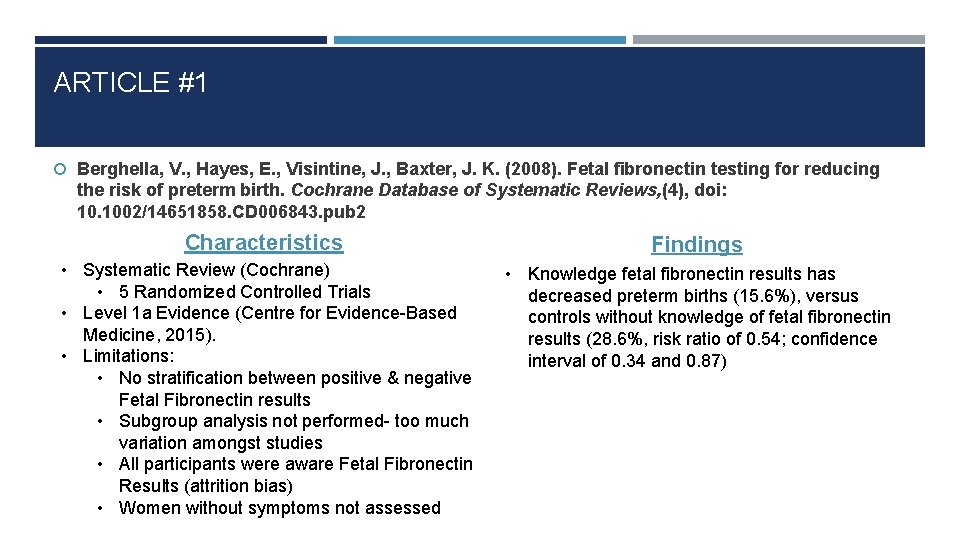
ARTICLE #1 Berghella, V. , Hayes, E. , Visintine, J. , Baxter, J. K. (2008). Fetal fibronectin testing for reducing the risk of preterm birth. Cochrane Database of Systematic Reviews, (4), doi: 10. 1002/14651858. CD 006843. pub 2 Characteristics Findings • Systematic Review (Cochrane) • 5 Randomized Controlled Trials • Level 1 a Evidence (Centre for Evidence-Based Medicine, 2015). • Limitations: • No stratification between positive & negative Fetal Fibronectin results • Subgroup analysis not performed- too much variation amongst studies • All participants were aware Fetal Fibronectin Results (attrition bias) • Women without symptoms not assessed • Knowledge fetal fibronectin results has decreased preterm births (15. 6%), versus controls without knowledge of fetal fibronectin results (28. 6%, risk ratio of 0. 54; confidence interval of 0. 34 and 0. 87)
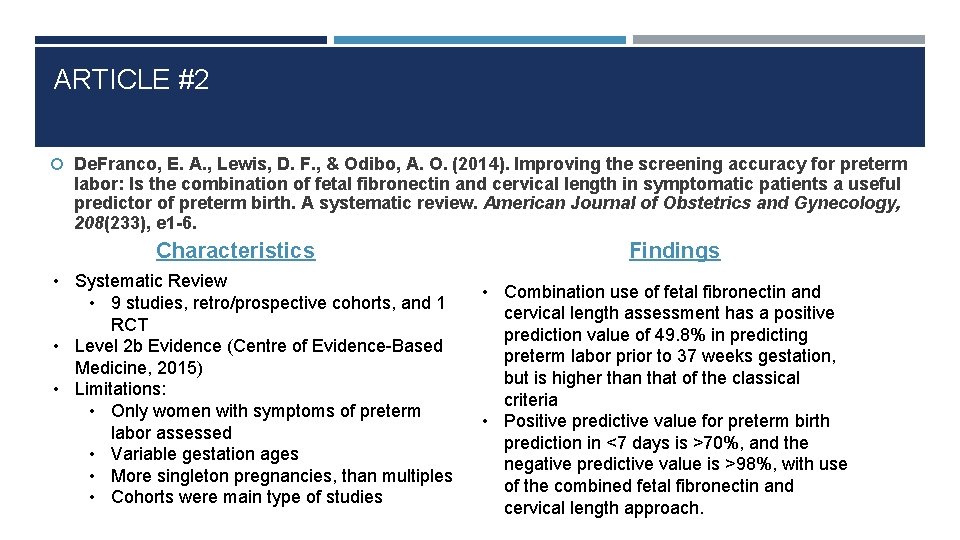
ARTICLE #2 De. Franco, E. A. , Lewis, D. F. , & Odibo, A. O. (2014). Improving the screening accuracy for preterm labor: Is the combination of fetal fibronectin and cervical length in symptomatic patients a useful predictor of preterm birth. A systematic review. American Journal of Obstetrics and Gynecology, 208(233), e 1 -6. Characteristics • Systematic Review • 9 studies, retro/prospective cohorts, and 1 RCT • Level 2 b Evidence (Centre of Evidence-Based Medicine, 2015) • Limitations: • Only women with symptoms of preterm labor assessed • Variable gestation ages • More singleton pregnancies, than multiples • Cohorts were main type of studies Findings • Combination use of fetal fibronectin and cervical length assessment has a positive prediction value of 49. 8% in predicting preterm labor prior to 37 weeks gestation, but is higher than that of the classical criteria • Positive predictive value for preterm birth prediction in <7 days is >70%, and the negative predictive value is >98%, with use of the combined fetal fibronectin and cervical length approach.
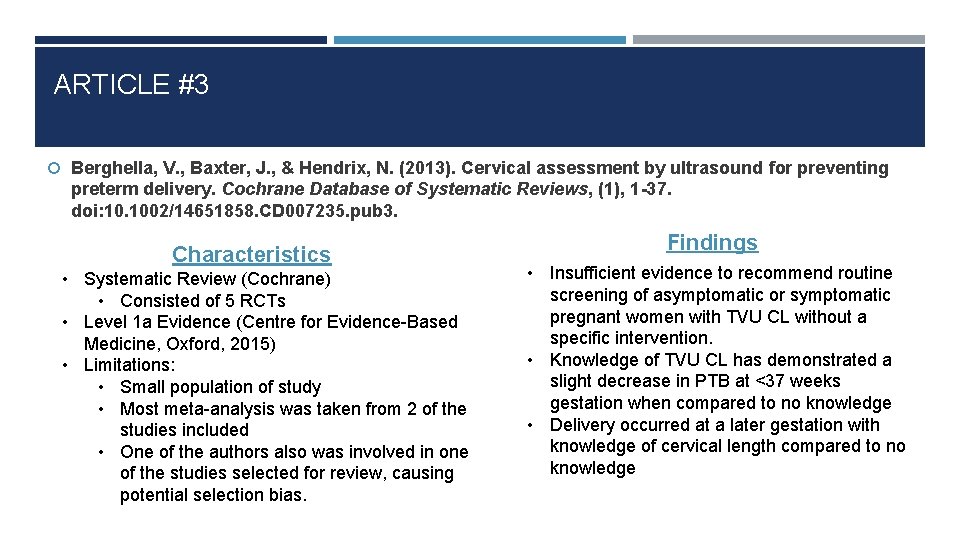
ARTICLE #3 Berghella, V. , Baxter, J. , & Hendrix, N. (2013). Cervical assessment by ultrasound for preventing preterm delivery. Cochrane Database of Systematic Reviews, (1), 1 -37. doi: 10. 1002/14651858. CD 007235. pub 3. Characteristics • Systematic Review (Cochrane) • Consisted of 5 RCTs • Level 1 a Evidence (Centre for Evidence-Based Medicine, Oxford, 2015) • Limitations: • Small population of study • Most meta-analysis was taken from 2 of the studies included • One of the authors also was involved in one of the studies selected for review, causing potential selection bias. Findings • Insufficient evidence to recommend routine screening of asymptomatic or symptomatic pregnant women with TVU CL without a specific intervention. • Knowledge of TVU CL has demonstrated a slight decrease in PTB at <37 weeks gestation when compared to no knowledge • Delivery occurred at a later gestation with knowledge of cervical length compared to no knowledge
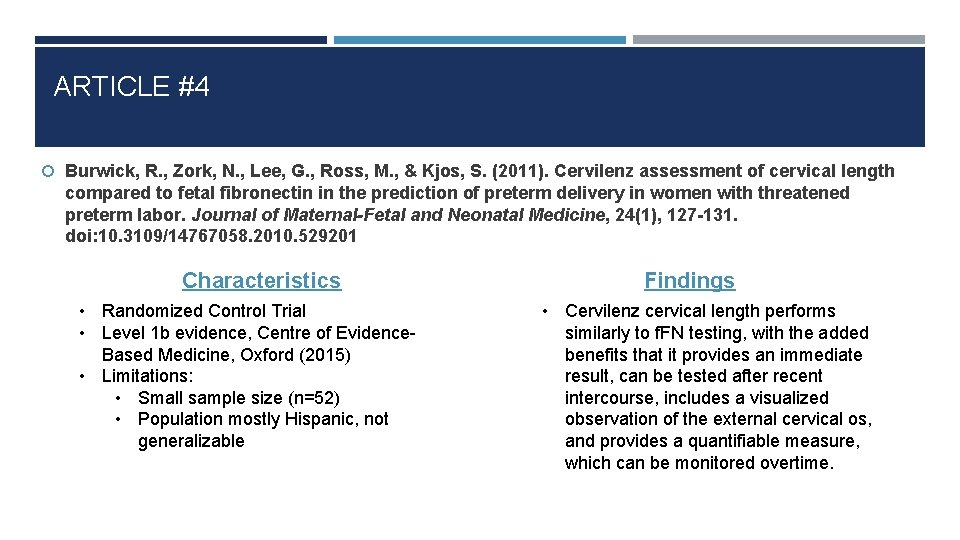
ARTICLE #4 Burwick, R. , Zork, N. , Lee, G. , Ross, M. , & Kjos, S. (2011). Cervilenz assessment of cervical length compared to fetal fibronectin in the prediction of preterm delivery in women with threatened preterm labor. Journal of Maternal-Fetal and Neonatal Medicine, 24(1), 127 -131. doi: 10. 3109/14767058. 2010. 529201 Characteristics • Randomized Control Trial • Level 1 b evidence, Centre of Evidence. Based Medicine, Oxford (2015) • Limitations: • Small sample size (n=52) • Population mostly Hispanic, not generalizable Findings • Cervilenz cervical length performs similarly to f. FN testing, with the added benefits that it provides an immediate result, can be tested after recent intercourse, includes a visualized observation of the external cervical os, and provides a quantifiable measure, which can be monitored overtime.
ARTICLE #5 Conde-Agudelo, A. , & Romero, R. (2011). Cervicovaginal fetal fibronectin for the prediction of spontaneous preterm birth in multiple pregnancies: A systematic review and meta-analysis. Journal of Maternal-Fetal and Neonatal Medicine, 23(12), 1365 -1376. doi: 10. 3109/14767058. 2010. 499484 Characteristics • Systematic Review and Meta-analysis • Level of Evidence 2 a based on Center of Evidence-Based Medicine, Oxford (2015) • Limitations • Methodology flaws of included articles • Quality of included studies • Multiple pregnancies, not singleton Findings • Cervicovaginal f. FN provides moderate to minimal prediction of preterm birth in women with multiple pregnancies. • f. FN is most accurate in predicting spontaneous preterm birth within 7 days of testing in women with twin pregnancies and threatened preterm labor.
SUMMARY OF FINDINGS f. FN assessment can help to decrease PTB CL assessment is just as sensitive and specific for assessment of PTB as f. FN When used in combination, f. FN and CL can help to predict PTL better than each test alone. Research has not shown a great improvement in prevention of PTB with use of f. FN and CL, so these screening tools should not be used in asymptomatic females for screening. CL and f. FN may be better suited to predict PTL and spontaneous PTB within 7 days of testing in twin pregnancies and threated PTL.
CONCLUSION & APPLICATION Use of f. FN and cervical length in the patient suspected of PTL was appropriate based on current evidence-based literature. ACOG (2012) does not recommend use of f. FN or shorten cervix alone to exclusively manage PTL, as the positive predictive value is rather low. The use of f. FN and CL should be considered in females at higher risk for PTL (past history, multiples pregnancy), and not for asymptomatic female screening.
![REFERENCES American College of Obstetrician and Gynecologist [ACOG] (2012). Management of preterm labor. ACOG](http://slidetodoc.com/presentation_image_h2/accd891413a6381e855e854fad870c05/image-12.jpg "REFERENCES American College of Obstetrician and Gynecologist [ACOG] (2012). Management of preterm labor. ACOG")
REFERENCES American College of Obstetrician and Gynecologist [ACOG] (2012). Management of preterm labor. ACOG Practice Bulletin, 127. Retrieved from the National Guideline Clearinghouse at http: //www. guideline. gov/content. aspx? id=38621&search=fetal+fibronectin+for+preterm+labor#Section 420 Beckmann, C. R. B. , Ling, F. W. , Herbert, W. N. P. , Laube, D. W. , Smith, R. P. , Casanova, P. , et al. (2014). Obstetrics and Gynecology, (7 th ed. ). Baltimore, MD: Wolters Kluwer-Lippincott Williams & Wilkins Berghella, V. , Baxter, J. , & Hendrix, N. (2013). Cervical assessment by ultrasound for preventing preterm delivery. Cochrane Database of Systematic Reviews, (1), 1 -37. doi: 10. 1002/14651858. CD 007235. pub 3. Berghella, V. , Hayes, E. , Visintine, J. , Baxter, J. K. (2008). Fetal fibronectin testing for reducing the risk of preterm birth. Cochrane Database of Systematic Reviews. (4), doi: 10. 1002/14651858. CD 006843. pub 2 Burwick, R. , Zork, N. , Lee, G. , Ross, M. , & Kjos, S. (2011). Cervilenz assessment of cervical length compared to fetal fibronectin in the prediction of preterm delivery in women with threatened preterm labor. Journal of Maternal-Fetal and Neonatal Medicine, 24(1), 127 -131. doi: 10. 3109/14767058. 2010. 529201 Center for Evidence Based Medicine (2015). Levels of evidence. Retrieved on 1 December 2015 from https: //www. essentialevidenceplus. com/product/ebm_loe. cfm? show=oxford Conde-Agudelo, A. , & Romero, R. (2010). Cervicovaginal fetal fibronectin for the prediction of spontaneous preterm birth in multiple pregnancies: A systematic review and meta-analysis. The Journal of Maternal-Fetal and Neonatal Medicine, 23(12), 1365 -1376. doi: 10. 3109/14767058. 2010. 499484 De. Franco, E. A. , Lewis, D. F. , & Odibo, A. O. (2014). Improving the screening accuracy for preterm labor: Is the combination of fetal fibronectin and cervical length in symptomatic patients a useful predictor of preterm birth. A systematic review. American Journal of Obstetrics and Gynecology, 208(233), e 1 -6.
- Slides: 12