
Fetal Alcohol Syndrome FAS FOCI 295 A Katie
- Slides: 29
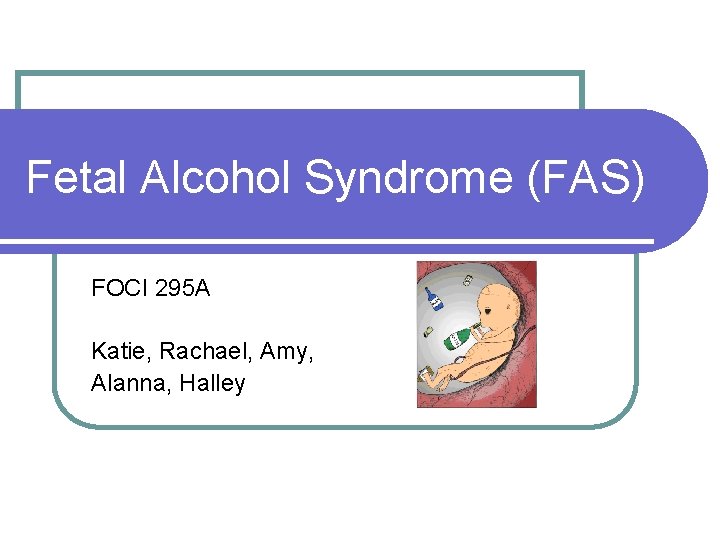
Fetal Alcohol Syndrome (FAS) FOCI 295 A Katie, Rachael, Amy, Alanna, Halley
What is FAS? Definition: a cluster of abnormalities including developmental disabilities and facial abnormalities, that appear in the offspring of mothers who drink heavily during pregnancy. l Difficulties in defining “heavily”: l l l Denial Retrospective accounts Different metabolic rates Lack of information on birth mother
Incidence of FAS l Number one cause of developmental disability l First diagnosed in 1973 l FAS= 1/600 l FAE= 1/300
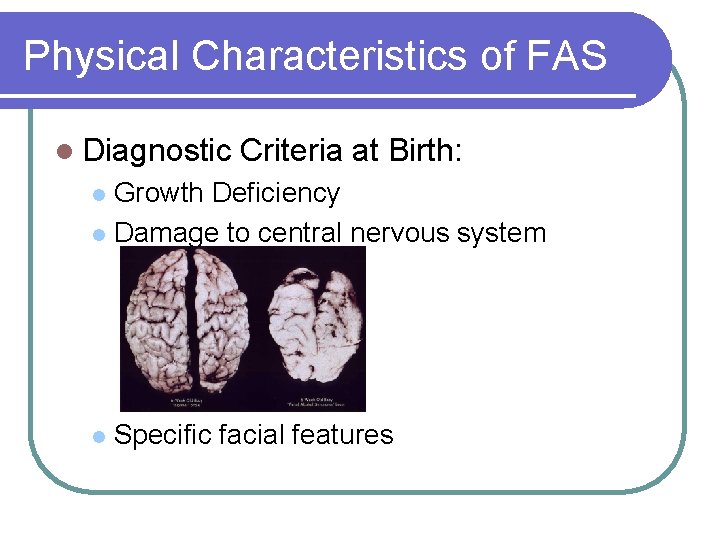
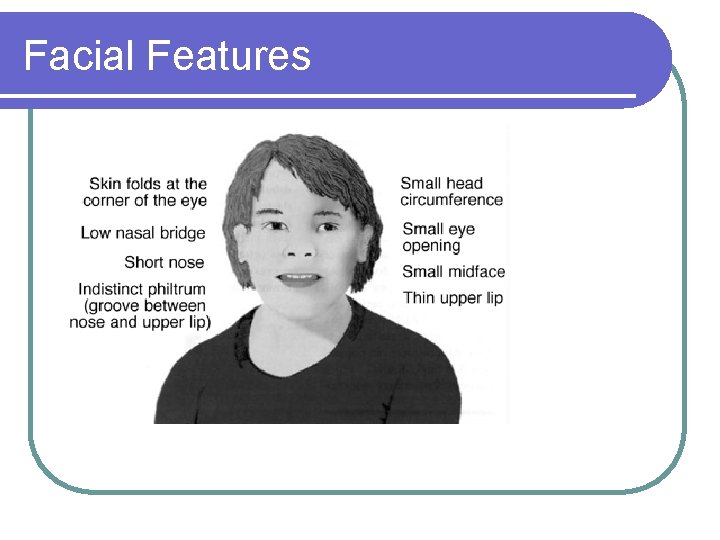
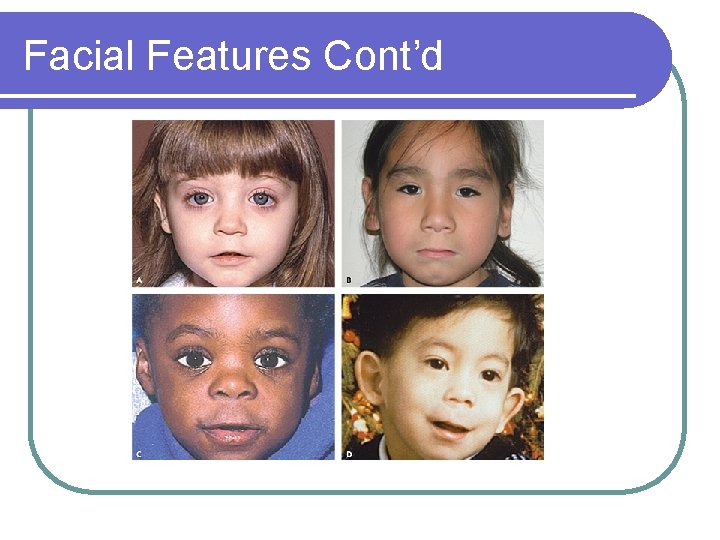
Physical Characteristics of FAS l Diagnostic Criteria at Birth: Growth Deficiency l Damage to central nervous system l l Specific facial features
Facial Features
Facial Features Cont’d
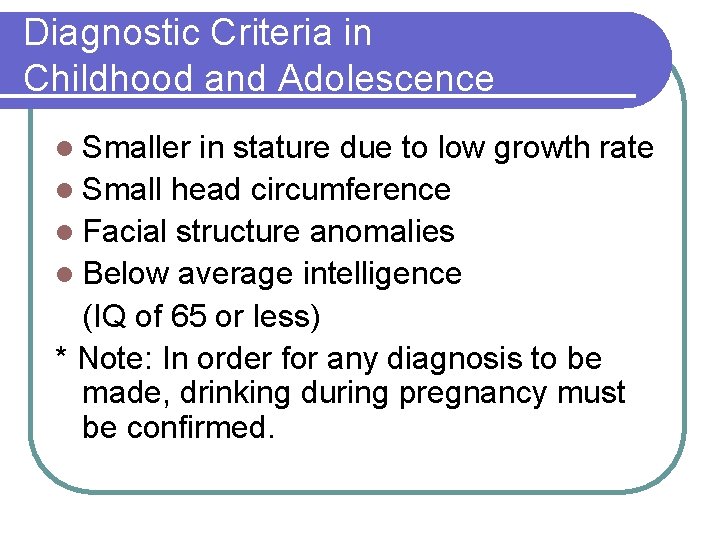
Diagnostic Criteria in Childhood and Adolescence l Smaller in stature due to low growth rate l Small head circumference l Facial structure anomalies l Below average intelligence (IQ of 65 or less) * Note: In order for any diagnosis to be made, drinking during pregnancy must be confirmed.
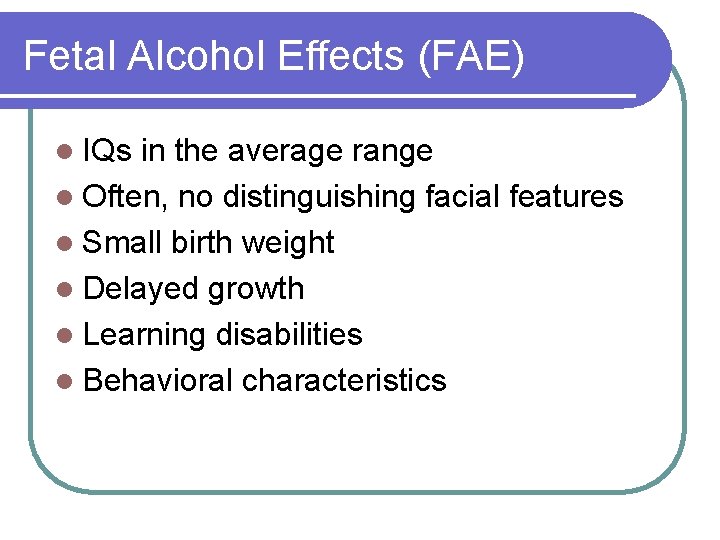
Fetal Alcohol Effects (FAE) l IQs in the average range l Often, no distinguishing facial features l Small birth weight l Delayed growth l Learning disabilities l Behavioral characteristics
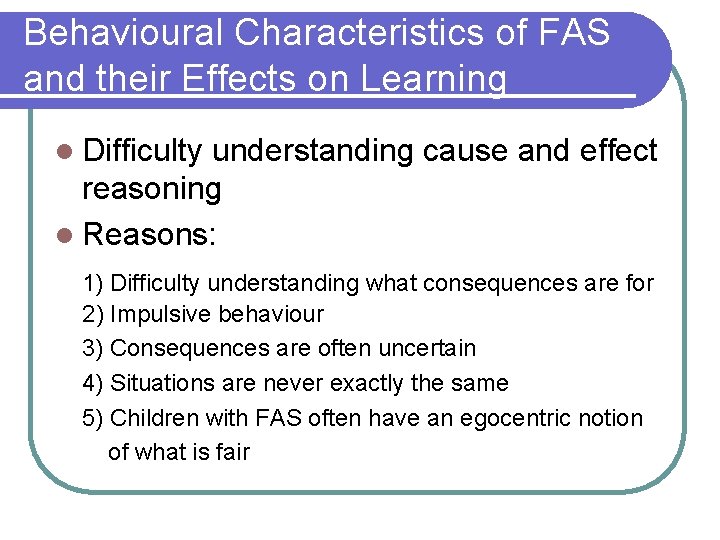
Behavioural Characteristics of FAS and their Effects on Learning l Difficulty understanding cause and effect reasoning l Reasons: 1) Difficulty understanding what consequences are for 2) Impulsive behaviour 3) Consequences are often uncertain 4) Situations are never exactly the same 5) Children with FAS often have an egocentric notion of what is fair
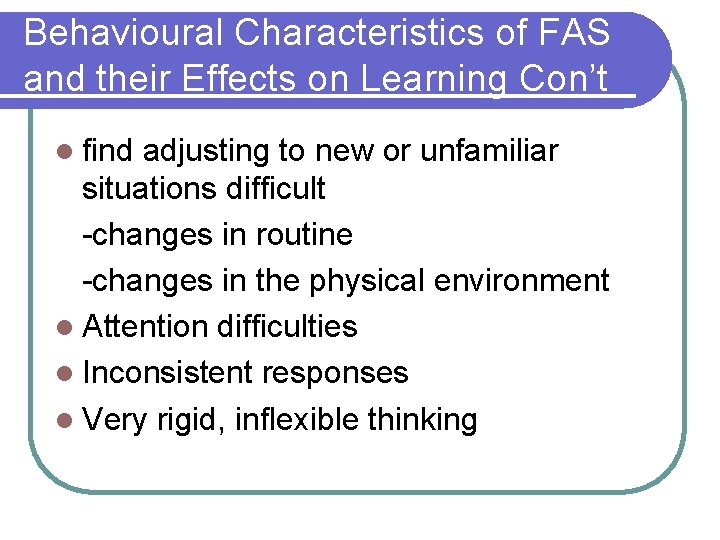
Behavioural Characteristics of FAS and their Effects on Learning Con’t l find adjusting to new or unfamiliar situations difficult -changes in routine -changes in the physical environment l Attention difficulties l Inconsistent responses l Very rigid, inflexible thinking
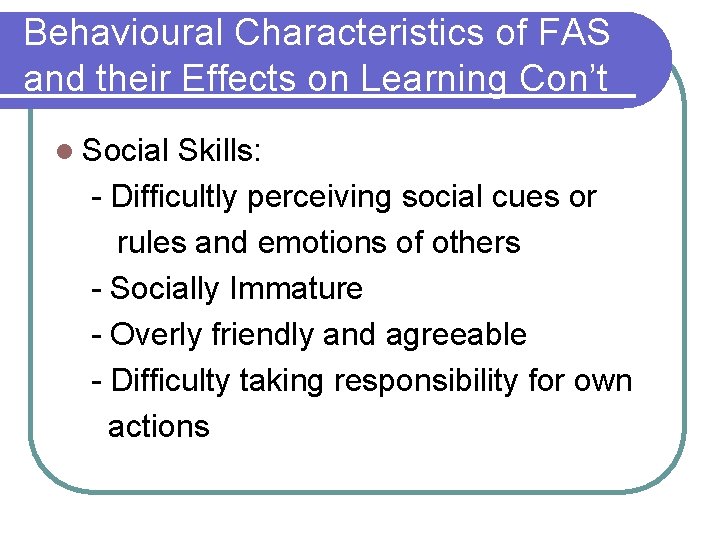
Behavioural Characteristics of FAS and their Effects on Learning Con’t l Social Skills: - Difficultly perceiving social cues or rules and emotions of others - Socially Immature - Overly friendly and agreeable - Difficulty taking responsibility for own actions
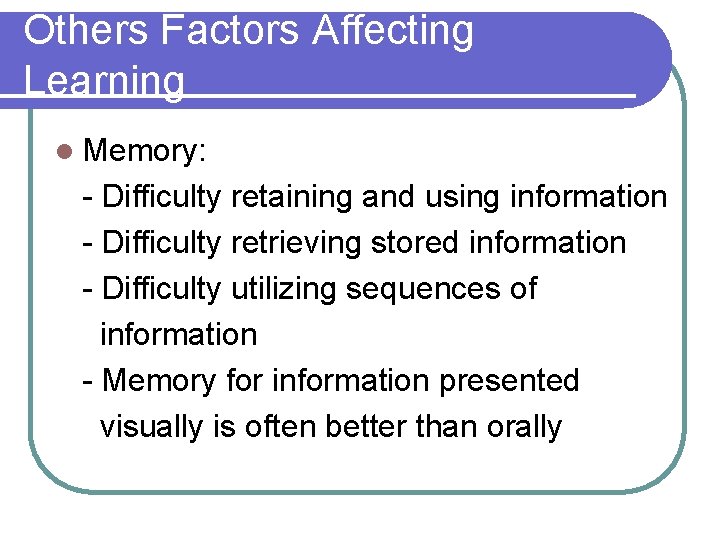
Others Factors Affecting Learning l Memory: - Difficulty retaining and using information - Difficulty retrieving stored information - Difficulty utilizing sequences of information - Memory for information presented visually is often better than orally
Others Factors Affecting Learning Con’t l Language Development - Oral language - May have difficulty producing certain sounds - Communication - Have difficulty starting conversations and responding appropriately in conversation- often respond off topic - Difficulty distinguishing between talking and effectively communicating for a purpose - Reading- difficulty identifying main ideas, making inferences, making predictions
Others Factors Affecting Learning Con’t - Writing - Difficulty getting ideas started, organizing thoughts and getting them down on paper - Difficulty understanding figurative language l Motor Skills: - Poor coordination, small and large muscle tone, eyehand coordination - Physical clumsiness
Others Factors Affecting Learning Con’t l Mathematics Skills: - may have problems with computations and problem solving and with the life-skills concepts of time and money - may have difficulties with mathematics vocabulary - difficulty understanding meaning of symbols - directionality- some problems are worked left to right, and some right to left- can cause confusion - may need more time to learn concepts- more practicepractical/applied mathematics should be a main focus
Long–Term Effects of FAS in Adolescents and Adulthood They can include: l Mental health problems l Problems with employment l Troubles with the law l Inability to live independently l Problems with parenting l Alcohol and drug use l Inappropriate sexual behaviour l Troubles with personal relationships l Disrupted school experiences
Long–Term Effects of FAS (continued) « The long-term effects may be serious, BUT they can be lessened or prevented through better understanding of the disorder and appropriate treatments.
How do you go about recommending testing for FAS? l In table groups develop a list of several possible methods of recommending to parents that you as a teacher think that their child should be tested for FAS. l Case Study 8
Methods of asking parents about testing for FAS l l l We as teachers are not medical doctors, therefore we cannot say we think your child has FAS. Also, it would be in bad taste to accuse someone of excessively drinking during their pregnancy. What we can do, as in any other case, is suggest that we rule out any medical causes that your child may have for acting out or being behind. l Before this I would suggest that you encourage the parent to tell you as much about their child in general. Maybe they have already gone to many doctors, or they are concerned and think that they should see one already. Ask more open ended questions and see where the conversation goes. Also, offer to send classroom notes with the parent to give to the doctor, so that the doctor has a clearer picture of what is going on. One can even use the front of recommending this path to determine if the child has ADHD or a LD, as many children with FAS/FAE do have both of these. Do not incessantly insist that the parent see a doctor, just suggest it and say that you would support it with some classroom notes. Regardless of what the child is diagnosed with, as a teacher we must accommodate them so that they are as successful as they can be in our classroom and in the future.
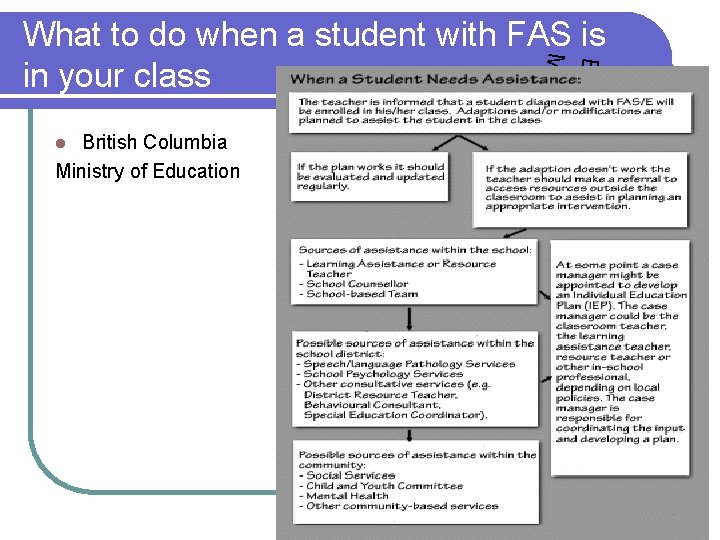
British Columbia Ministry of Education l British C o l u m bia M i n i s t r y of E d u c a tion What to do when a student with FAS is in your class
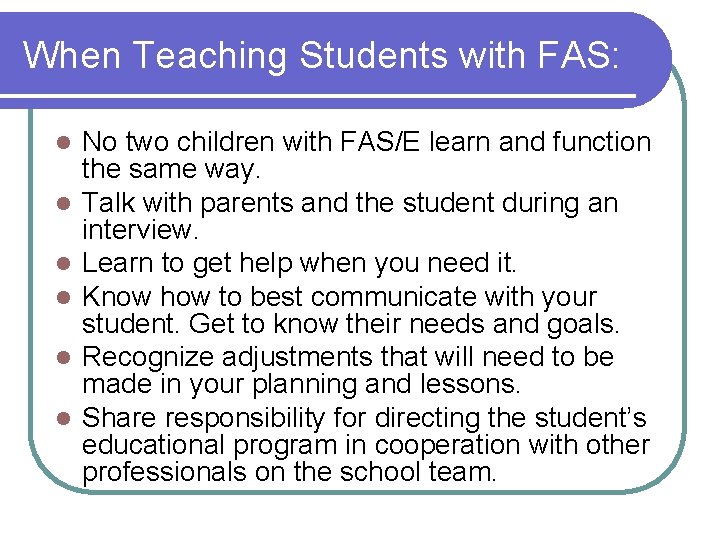
When Teaching Students with FAS: l l l No two children with FAS/E learn and function the same way. Talk with parents and the student during an interview. Learn to get help when you need it. Know how to best communicate with your student. Get to know their needs and goals. Recognize adjustments that will need to be made in your planning and lessons. Share responsibility for directing the student’s educational program in cooperation with other professionals on the school team.
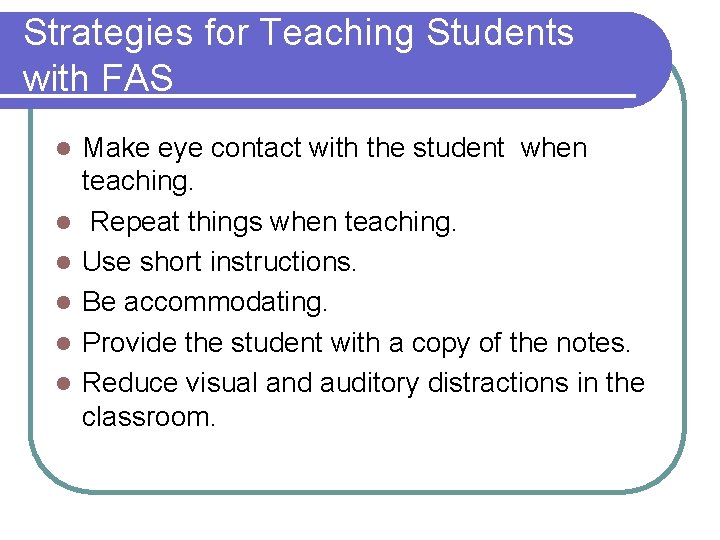
Strategies for Teaching Students with FAS l l l Make eye contact with the student when teaching. Repeat things when teaching. Use short instructions. Be accommodating. Provide the student with a copy of the notes. Reduce visual and auditory distractions in the classroom.
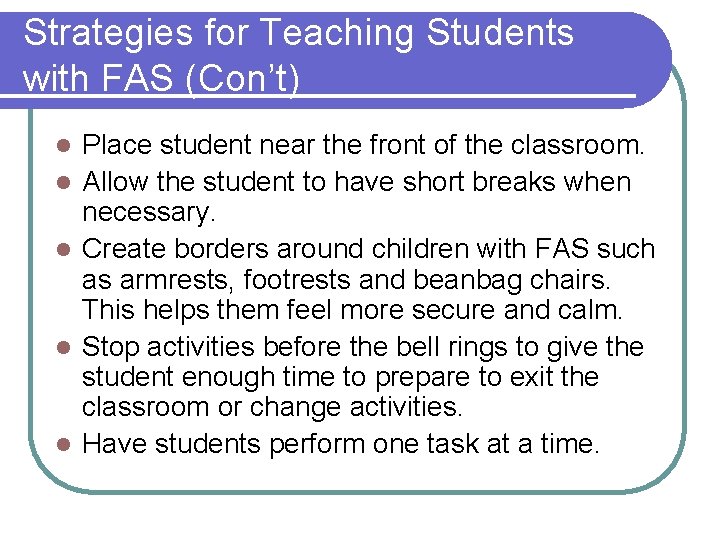
Strategies for Teaching Students with FAS (Con’t) l l l Place student near the front of the classroom. Allow the student to have short breaks when necessary. Create borders around children with FAS such as armrests, footrests and beanbag chairs. This helps them feel more secure and calm. Stop activities before the bell rings to give the student enough time to prepare to exit the classroom or change activities. Have students perform one task at a time.
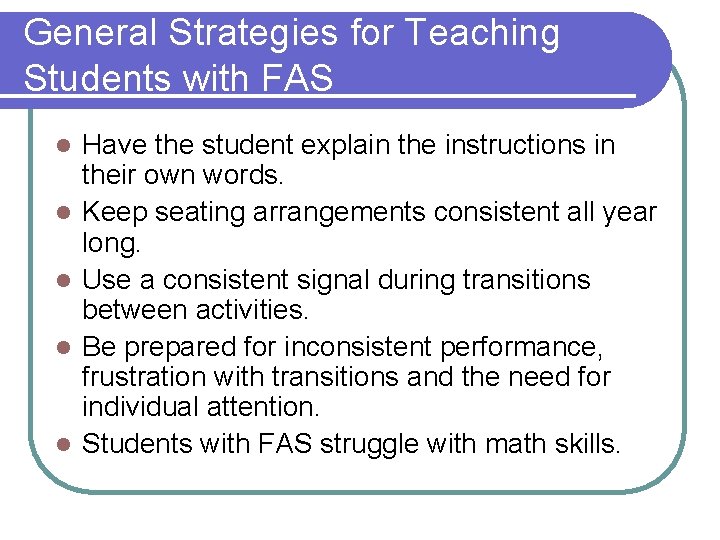
General Strategies for Teaching Students with FAS l l l Have the student explain the instructions in their own words. Keep seating arrangements consistent all year long. Use a consistent signal during transitions between activities. Be prepared for inconsistent performance, frustration with transitions and the need for individual attention. Students with FAS struggle with math skills.
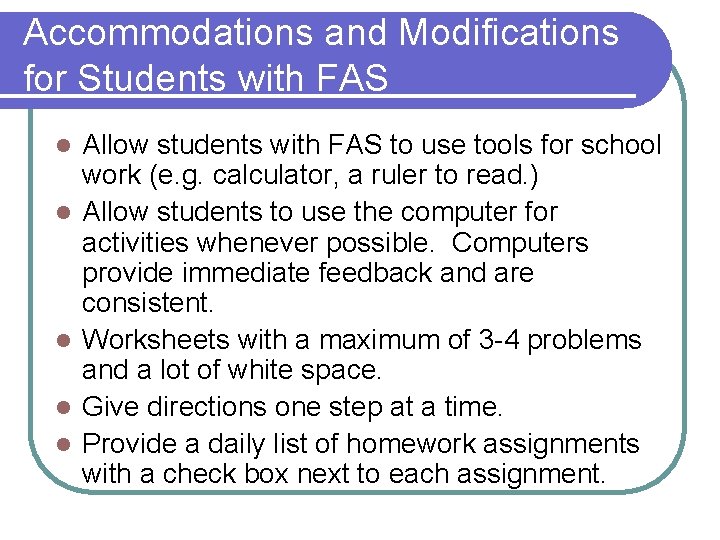
Accommodations and Modifications for Students with FAS l l l Allow students with FAS to use tools for school work (e. g. calculator, a ruler to read. ) Allow students to use the computer for activities whenever possible. Computers provide immediate feedback and are consistent. Worksheets with a maximum of 3 -4 problems and a lot of white space. Give directions one step at a time. Provide a daily list of homework assignments with a check box next to each assignment.
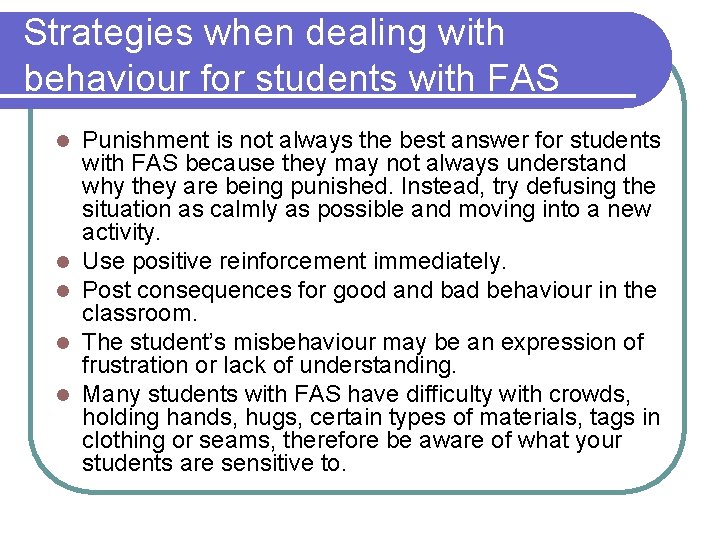
Strategies when dealing with behaviour for students with FAS l l l Punishment is not always the best answer for students with FAS because they may not always understand why they are being punished. Instead, try defusing the situation as calmly as possible and moving into a new activity. Use positive reinforcement immediately. Post consequences for good and bad behaviour in the classroom. The student’s misbehaviour may be an expression of frustration or lack of understanding. Many students with FAS have difficulty with crowds, holding hands, hugs, certain types of materials, tags in clothing or seams, therefore be aware of what your students are sensitive to.
Helpful Resources l British Columbia Ministry of Education: Special Education. Teaching Students with Fetal. 1996. http: //www. bced. gov. bc. ca/specialed/fas/. l National Organization on Fetal Alcohol Syndrome. Teaching Students with FAS/FASD. 2004. http: //www. nofas. org/educator/morestrat. aspx.
References l British Columbia Ministry of Education. 1996. “Teaching Students with Fetal Alcohol Syndrome/Effects: A Resource Guide for Teachers”. British Colombia Ministry of Education: Special Education. Special Programs Branch. http: //www. bced. gov. bc. ca/specialed/fas/. l Davis, D. 1994. Reaching Out to Children with FAS/FAE. New York: The Centre for Applied Research in Education l Herbst, K. (1995). Fetal alcohol syndrome. Thrust for Education Leadership, 25. l Hutchinson, Nancy. 2004. Teaching Exceptional Children and Adolescents: A Canadian Casebook. Second Edition. Faculty of Education, Queen’s University.
References Con’t l National Organization on Fetal Alcohol Syndrome. 2004. “Teaching Students with FAS/FASD: More Strategies”. http: //www. nofas. org/educator/morestrat. aspx. l Statrock, J. , Woloshyn, V. , Gallagher, T. , Di Petta, T. , & Marini, Z. (2004). Educational Psychology. Toronto: Mc. Graw-Hill Ryerson.