
FETAL ALCOHOL SPECTRUM DISORDERS THE INVISIBLE DISABILITY FASD
FETAL ALCOHOL SPECTRUM DISORDERS “THE INVISIBLE DISABILITY” FASD PRESENTED BY: ROBIN VANEERDEN MS, LPC, NCC, NADD-CC
OBJECTIVES � To understand criteria for diagnosing Fetal Alcohol Spectrum Disorders � To have an understanding of how FASD affects development in the areas of learning, communication and behavioral health � To learn strategies that are FASD effective and friendly � To review resources that are available when working with someone with and FASD
TERMINOLOGY � Fetal Alcohol Syndrome � Fetal Alcohol Effects � Alcohol Related Neurodevelopmental Disorder � Fetal Alcohol Spectrum Disorder
TERATOLOGY � Teratogens are anything that produces birth defects as a result of intrauterine exposure � Four classes of effects: death, growth deficiency, deformity, and deficits in functioning � Alcohol can produce all four
FIVE DIFFERENT WAYS ALCOHOL DAMAGES � Kills brain cells � Distorts the migration of nerve cells � Causes abnormal levels of neurotransmitters � Interferes with blood flow to the fetus producing oxygen deprivation � Interferes with genetic expression and the results may not become apparent until the affected genes are activated at various ages.
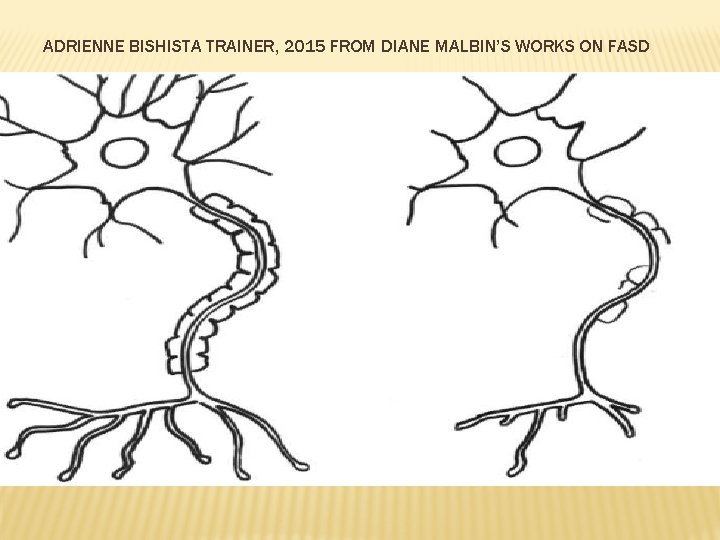
ADRIENNE BISHISTA TRAINER, 2015 FROM DIANE MALBIN’S WORKS ON FASD
PHYSIOLOGY � Affects metabolic capacities and growth hormones � Frequently fall below the tenth percentile in height weight and head circumference � Can be mistaken for failure to thrive � Brain damage can occur at alcohol levels below that required to create physical defects.
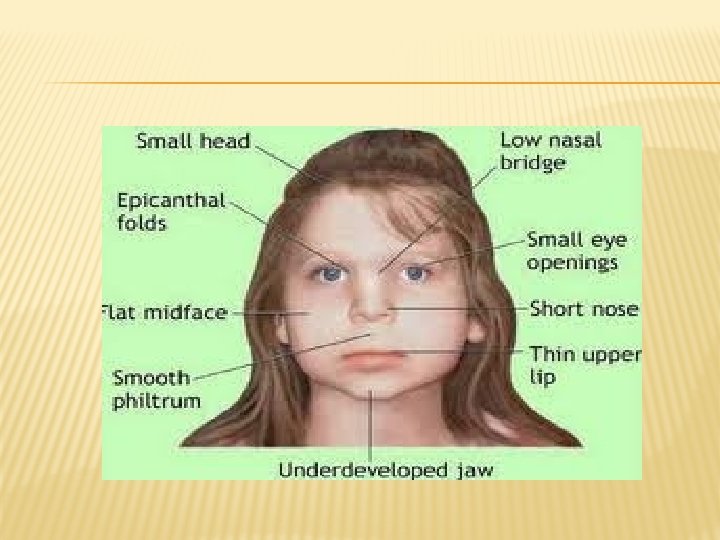
PHYSICAL FEATURES � 1) thin upper lip � 2) flattened philtrum � 3) shortened palpebral fissures which makes the eyes look farther apart � 4) a shortened nose relative to the length of the midface. � The majority of children along the spectrum do NOT exhibit the craniofacial symptoms

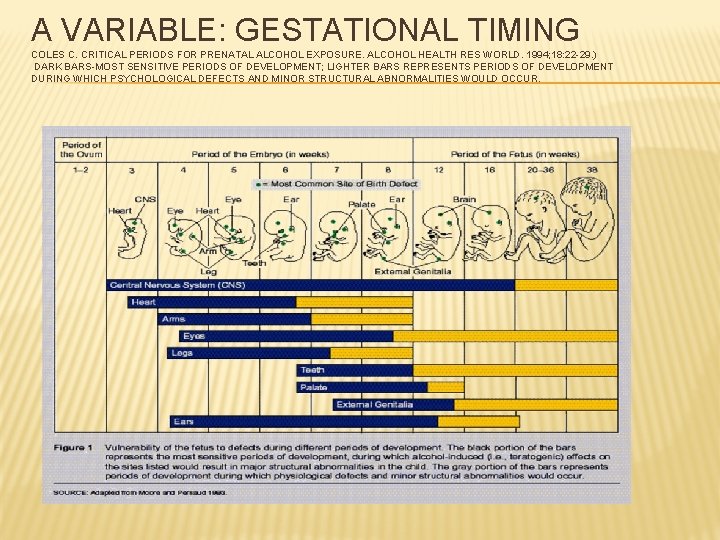
A VARIABLE: GESTATIONAL TIMING COLES C. CRITICAL PERIODS FOR PRENATAL ALCOHOL EXPOSURE. ALCOHOL HEALTH RES WORLD. 1994; 18: 22 -29. ) DARK BARS-MOST SENSITIVE PERIODS OF DEVELOPMENT; LIGHTER BARS REPRESENTS PERIODS OF DEVELOPMENT DURING WHICH PSYCHOLOGICAL DEFECTS AND MINOR STRUCTURAL ABNORMALITIES WOULD OCCUR.
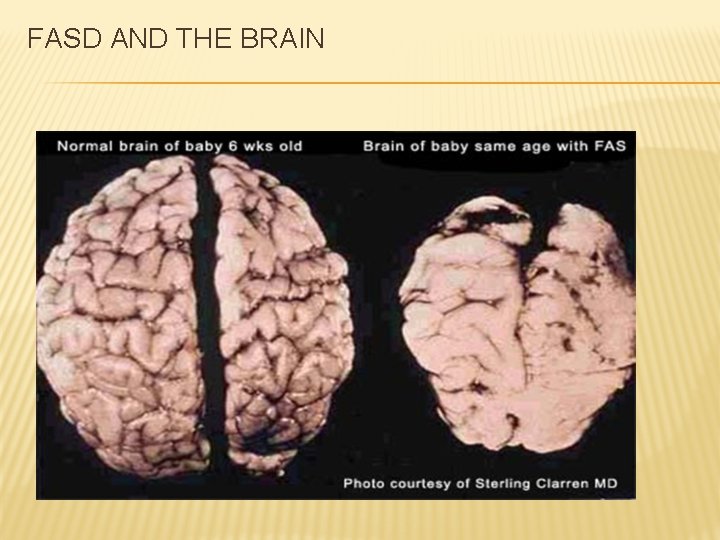
FASD AND THE BRAIN
REGARDING AMOUNT OF ALCOHOL… There’s no safe amount. In addition… Binge drinking (CDC: binge drinking for women = 4 or more alcohol drinks per occasion) is especially hazardous because: � Women who binge prior to pregnancy are more likely to have unwanted pregnancies � Exposure to high levels of blood alcohol is especially likely to cause teratogenicity in the first trimester
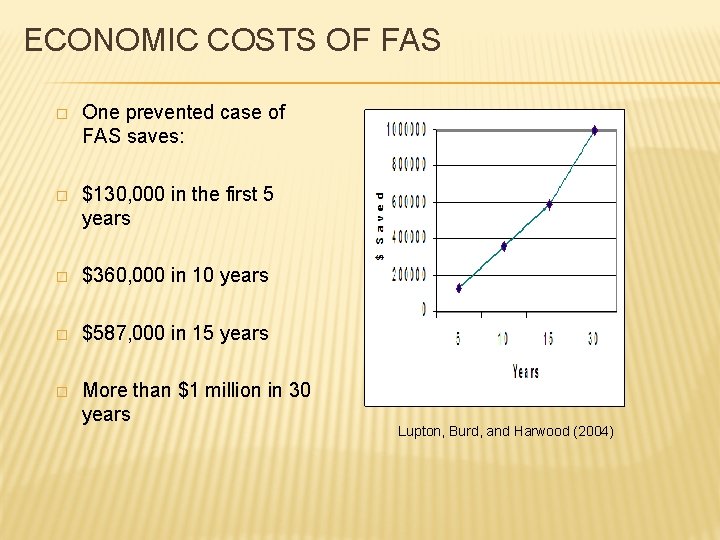
ECONOMIC COSTS OF FAS � One prevented case of FAS saves: � $130, 000 in the first 5 years � $360, 000 in 10 years � $587, 000 in 15 years � More than $1 million in 30 years Lupton, Burd, and Harwood (2004)
100% PREVENTABLE
Because of the challenges of establishing accurate and timely prevalence information, the number of cases of FASD is likely far greater than current data indicate. Current estimates: � FASD occurs in at least 1 per 100 births � FASD affects nearly 40, 000 babies per year � 2015 new research indicates it is closer to 4 per 100 live births (May, 2015) NOFAS Curriculum for Allied Health Professionals
17 Diagnosis Challenges
CHALLENGES TO IDENTIFICATION OF FASD INCLUDE: � Lack of specific and uniformly accepted diagnostic criteria � Only FAS has specific diagnostic guidelines. � No uniform guidelines exist for other types of fetal alcohol spectrum disorders. FASD is an umbrella term and not an actual diagnosis. � Neither FAS nor FASD are in the DSM (MH) nomenclature. � Thus, health providers are hampered in their efforts to screen and identify children (individuals) with FASD. NOFAS Curriculum for Allied Health Professionals
CHALLENGES TO IDENTIFICATION: FAS diagnosis based on clinical examination of features, but not all individuals with FAS or an FASD look or act the same � Because each symptom has a broad range of possible diagnoses, a clinician might miss or misdiagnose FASD. � � Some physicians are aware of the high prevalence of attention deficit/hyperactivity disorders (ADHD), but might not link attention problems to FASD. NOFAS Curriculum for Allied Health Professionals
CHALLENGES TO IDENTIFICATION: ARND and p. FAS lack the distinct clinical facial features of FAS, so these children appear “typical” in appearance, making identification even more difficult. Hence, FASD as “the invisible disorder. ” �
CHALLENGES TO IDENTIFICATION: � Lack of knowledge and misconceptions among primary care providers. � Many professionals believe that FASD can only occur if the mother is an alcoholic, poor, or African American or Native American. Few know about the full range or the progressive nature of the neurobehavioral symptoms that result from prenatal exposure to alcohol. � NOFAS Curriculum for Allied Health Professionals
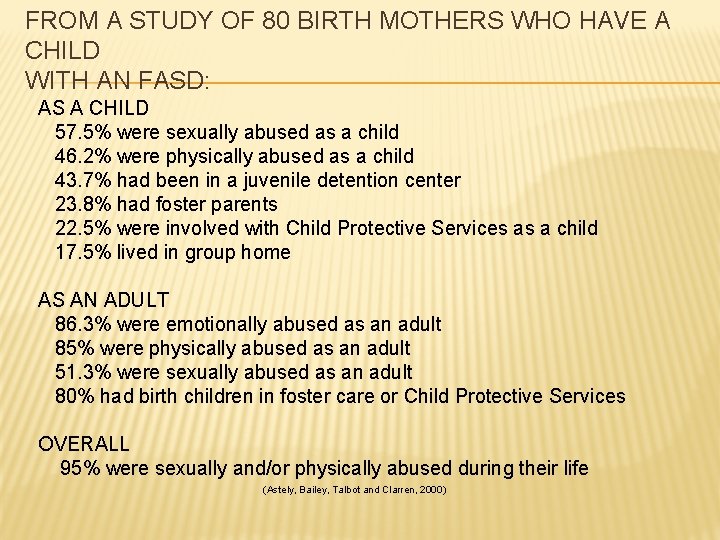
FROM A STUDY OF 80 BIRTH MOTHERS WHO HAVE A CHILD WITH AN FASD: AS A CHILD 57. 5% were sexually abused as a child 46. 2% were physically abused as a child 43. 7% had been in a juvenile detention center 23. 8% had foster parents 22. 5% were involved with Child Protective Services as a child 17. 5% lived in group home AS AN ADULT 86. 3% were emotionally abused as an adult 85% were physically abused as an adult 51. 3% were sexually abused as an adult 80% had birth children in foster care or Child Protective Services OVERALL 95% were sexually and/or physically abused during their life (Astely, Bailey, Talbot and Clarren, 2000)
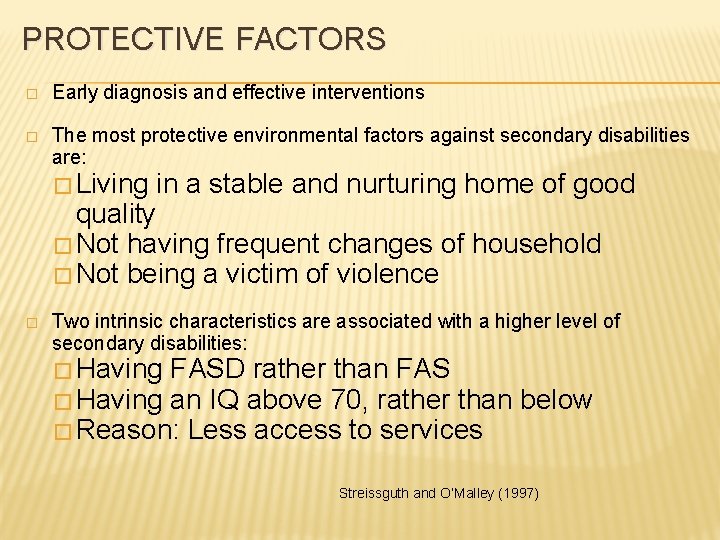
PROTECTIVE FACTORS � Early diagnosis and effective interventions � The most protective environmental factors against secondary disabilities are: � Living in a stable and nurturing home of good quality � Not having frequent changes of household � Not being a victim of violence � Two intrinsic characteristics are associated with a higher level of secondary disabilities: � Having FASD rather than FAS � Having an IQ above 70, rather than below � Reason: Less access to services Streissguth and O’Malley (1997)
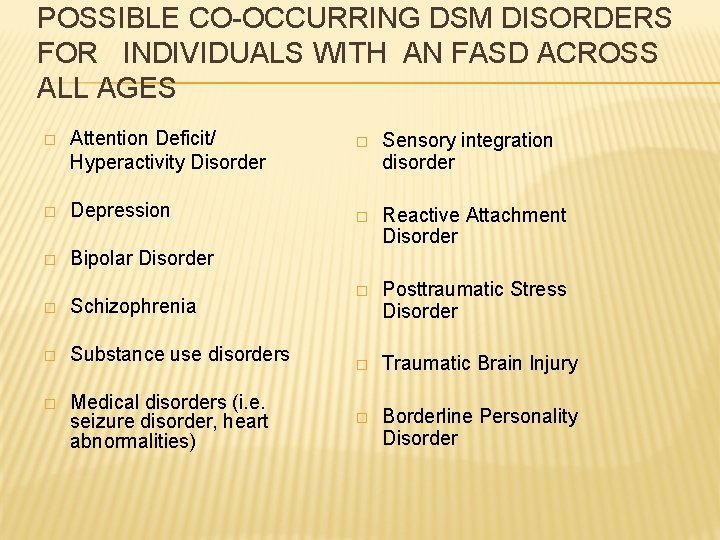
POSSIBLE CO-OCCURRING DSM DISORDERS FOR INDIVIDUALS WITH AN FASD ACROSS ALL AGES � Attention Deficit/ Hyperactivity Disorder � Depression � Bipolar Disorder � Schizophrenia � Substance use disorders � Medical disorders (i. e. seizure disorder, heart abnormalities) � Sensory integration disorder � Reactive Attachment Disorder � Posttraumatic Stress Disorder � Traumatic Brain Injury � Borderline Personality Disorder
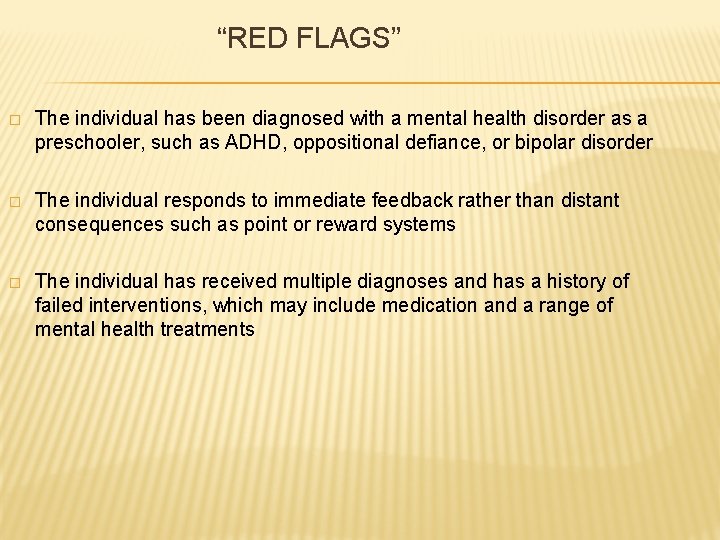
“RED FLAGS” � The individual has been diagnosed with a mental health disorder as a preschooler, such as ADHD, oppositional defiance, or bipolar disorder � The individual responds to immediate feedback rather than distant consequences such as point or reward systems � The individual has received multiple diagnoses and has a history of failed interventions, which may include medication and a range of mental health treatments
“RED FLAGS” � The child has been excluded from another preschool program for behavioral issues � The child requires “hands on” or visual learning, rather than auditory � The child is easily fatigued and overwhelmed by external stimulation � The child has difficulty applying what has been learned, and may make the same mistakes over and over � The child is a concrete thinker and does not understand metaphors or jokes, etc.
STRENGTHS OF INDIVIDUALS WITH AN FASD Friendly and outgoing Verbal Helpful Affectionate and lovable Well-intentioned Generous Determined Artistic May be intelligent and have special abilities and skills
IMPAIRMENTS BY AGE � Infancy: arching of back, poor sleep/wake cycle, adapting to stimuli, muscles rigid or limp, head banging, rocking, prolonged agitation, difficult to soothe � Preschool: hyperactivity, poor eye-hand coordination, poor balance/gait, fine/gross motor problems, slow language development � School age: attention is weak, mathematic disability, impulsive behavior, memory problems, expressive/receptive language deficits.
SOME STATISTICS FROM 2008 � 44% of children with FASD have a mean IQ of 66 � FASD is the leading cause of intellectual disabilities in the US, outpacing Down Syndrome by 2: 1 � 90% have mental health problems of varying kinds � 70% have experienced physical or sexual abuse or both
DIAGNOSTICS � Commonly misdiagnosed as Attention Deficit Hyperactivity Disorder � FASD is not listed in the DSM-IV-TR, however it is listed in the International Classification of Diseases � FASD is also listed in the DM-ID
CRITERIA AS PER THE DM-ID � a. ) An identification of the crucial intra-uterine and extra-uterine growth retardation � b. ) Facial anomalies � c. ) Structural, neurologic and/or neurodevelopmental abnormalities, which can take the form of ID or learning and behavioral deficits � d. ) The confirmation of intra-uterine alcohol exposure
SCHOOL � Preschool and primary grades academic concerns predominate � Achievement is marked by lapses in learning � By later elementary and middle school years, behavioral concerns usually become predominant. � Behaviors may be driven by academic frustration � Academic ceilings are commonly reached between 7 th and 9 th grades.
PEER RELATIONSHIPS/INTERPERSONAL SKILLS � May make friends easily � Difficulties lie in maintaining friendships due to making repeated social mistakes � Do not realize the mistakes � Look like there is no remorse for the social error
DEVELOPMENTAL TIMELINE � Strengths and delays differ significantly between people. � The strengths can obscure the delays, leading others to develop unrealistic expectations.
DYNAMIC CHARACTERISITCS � Stimulus filters � Attention/Executive functions � Visuospatial processing � Language processing � Temporal perception
� Egocentrism � Literal thinking � Rigid thinking � Boundaries � Personal responsibility � Memory/Integration/Generalization
� Lying � Emotional regulation � Behavioral regulations � Behavioral outbursts � Motivation � Attachment
TREATMENT � Protective factors � Medication � Therapy/Mentoring/Coaching � Buffered environment � Language � Comprehension � Structure � Supervision
� Rules � Prevention � Saying “no” � Thinking connectedly � Thinking realistically � Teaching and learning � Social interaction
� Visual and spatial cues � Temporal perception � Consequences � Longer term incentives � Sexuality � Residential
ASSESSMENT, WHEN FASD IS SUSPECTED � � � History � Maternal history, alcohol/substances, pregnancy � Atypical development of child & other “red flags” Physical exam � Check for possible facial features and growth deficits � CNS deficits � Possible use of structural brain imaging (s. MRI) Psychological testing � Standard testing (IQ, achievement tests, & adaptive functioning) � Neuropsychological testing (when indicated)
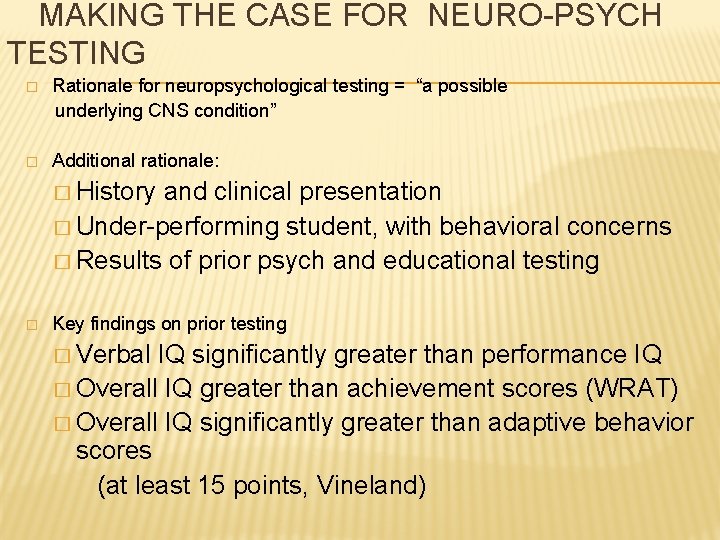
MAKING THE CASE FOR NEURO-PSYCH TESTING Rationale for neuropsychological testing = “a possible underlying CNS condition” � � Additional rationale: � History and clinical presentation � Under-performing student, with behavioral concerns � Results of prior psych and educational testing � Key findings on prior testing � Verbal IQ significantly greater than performance IQ � Overall IQ greater than achievement scores (WRAT) � Overall IQ significantly greater than adaptive behavior scores (at least 15 points, Vineland)
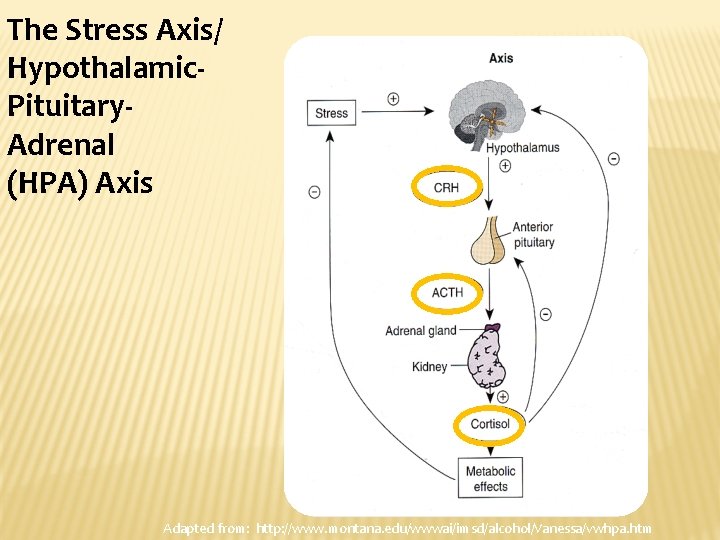
The Stress Axis/ Hypothalamic. Pituitary. Adrenal (HPA) Axis Adapted from: http: //www. montana. edu/wwwai/imsd/alcohol/Vanessa/vwhpa. htm
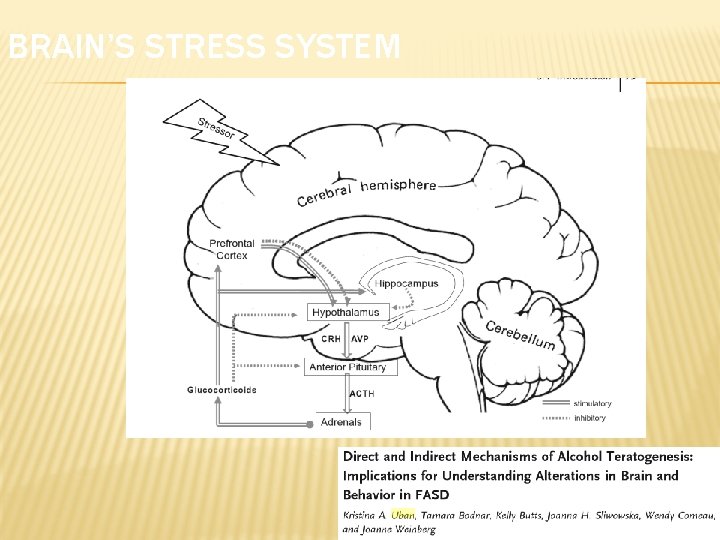
BRAIN’S STRESS SYSTEM
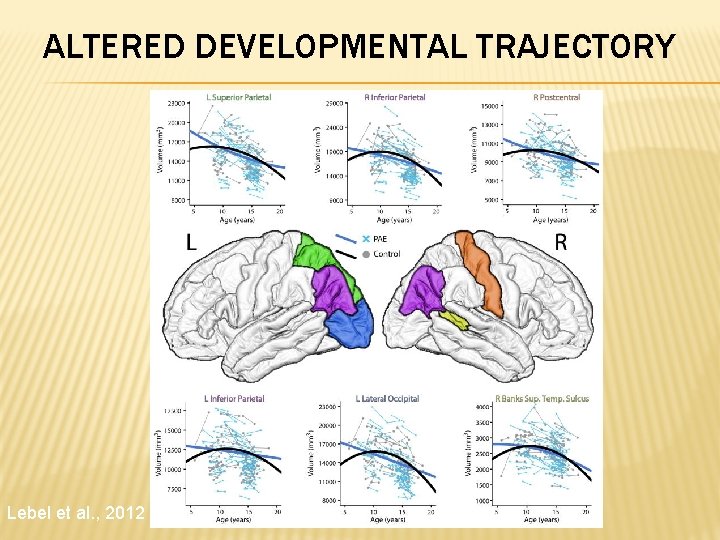
ALTERED DEVELOPMENTAL TRAJECTORY Lebel et al. , 2012

INTRODUCTION
A FASD PERSPECTIVE Primary Symptoms learning disabilities, deficits in executive functioning, hyperactivity, attention and memory deficits, dysmaturity, sensory challenges Secondary Behavioral Symptoms confused, easily frustrated, easily manipulated, easily fatigued, aggression, anxiety Tertiary Symptoms: running away, involved in the legal system, trouble at home/work/school, multiple diagnosis, self injury,
FASD INFORMED SUPPORTS “Behaviors” are a result of a physical-sometimes invisible disability. Damage is permanent but the brain changes during life and so abilities and behaviors may also change. Problems arise when others view behavior symptoms through a lens that assigns judgment and because of a poor fit between needs and environment. This includes targeting behavioral change instead of looking for reasonable and appropriate accommodations in communication, the physical environment, activities, etc. ---FASD Centre--Failure to recognize the brain based condition leads to effort without results and everyone being frustrated. ---FASD Centre---
CHALLENGES TO FASD INFORMED SUPPORTS Reliance on the use of standard learning theories Lack of understanding and knowledge about FASD
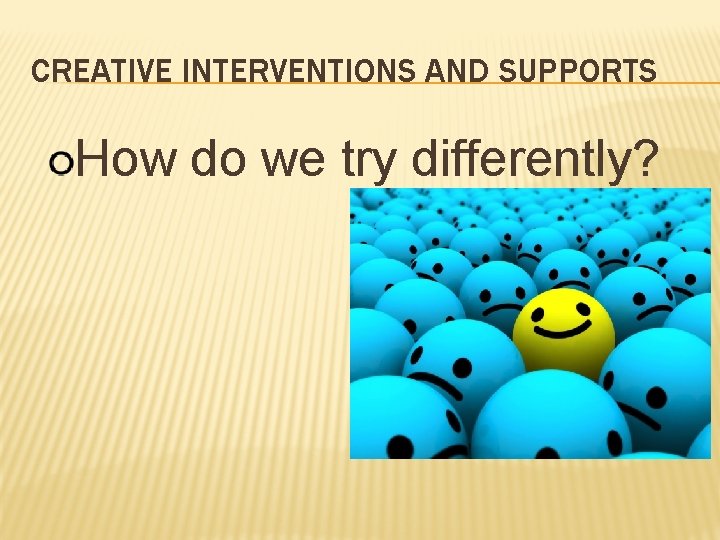
CREATIVE INTERVENTIONS AND SUPPORTS How do we try differently?
DIAGNOSIS AND EDUCATION Acknowledgement and Understanding that the FASD is the underlying cause of difficulties can decrease anger and frustration Develop the right circle of supports-a trusted, caring group who understands FASD Ongoing training and education for the community, all support members, judicial system, the community, etc. Appropriate and ongoing assessment
THE EXTERNAL EXECUTIVE FUNCTION FASD Interpretation Primary deficits: limited ability to understand cause/effect, An individual with an FASD will always need an external executive function. ---Sterling Clarren Possible Strategies Trusted group of mentors, coaches, and support staff-that are consistent provide positive feedback and support the person in decision making Interdependence vs. Independence
EF STRATEGIES Visual is King Reasonable Accommodations Who can we actually trust Model and Role Play! Structure-lists, schedules, timers- assisting in managing these aids may always be needed
MEMORY AND COMPREHENSION FASD Interpretation May on surface appear to understand/agree in order please others, save face but underneath do not fully understand the conversation, direction, etc. Unable to keep track of events and may “fill in the blanks” if cornered Possible Strategies Change the way we communicate concrete-avoid conditional words ( likely/however); keep it simple (1 -2 directions at a time);
SENSORY ISSUES FASD Interpretation Possible Strategies simple uncluttered environment putt away in the same place Be aware of an over stimulating environment!
SELF REGULATION FASD Interpretation Possible Strategies If the person is frustrated: STOP and try a different strategy Put feelings into words-then help to identify a coping skills (ask for a break/walk away/count to 10 listen to music) Start simple-keep it simple What is the current developmental age(sometimes this fluctuates) and what accommodations are appropriate while still acknowledging and treating the person as an adult.
STRENGTHS FOCUSED Who is this person and what are their strengths? curious, artistic, creative, generals, tenacious Accept the difference between can’t and won’t (and sometimes can one day and can’t the next)

RESOURCES AND QUESTIONS
RECOGNIZE THE NEED TO INDIVIDUALIZE THE APPROACH TO THOSE WITH AN FASD: “We must move from viewing the individual as failing if s/he does not do well in a program to viewing the program as not providing what the individual needs in order to succeed. ” Dubovsky, 2000
REFERENCES � Resources The Challenge of Fetal Alcohol Syndrome. Ed. : Ann Streissguth Jonathan Kanter. 1997 Fetal Alcohol Syndrome: A Guide for Families and Communities. Ann Streissguth. 1997. National Organization on Fetal Alcohol Syndrome. NOFAS. org 800 -666 -6327. June 1, 2008 � DM-ID Diagnostic Manual-Intellectual Disability: A Textbook of Diagnosis of Mental Disorders in Persons with Intellectual Disability, 2000, NADD Press

61 Resources

� BEAMS: The Fasstar Trek Method: http: //www. comeover. to/FAS/BEAM. htm- � The Eight Magic Keys for Teachers: http: //www. fasdcenter. samhsa. gov/documents/eightmagickeys. pdf � SCREAMS: http: //www. come-over. to/FAS/Screams. Article. htm � SAMHSA: http: //www. fasdcenter. samhsa. gov/documents/FASDGuide 12_01 � 4 Digit Code – Washington State University: http: //depts. washington. edu/fasdpn/index. htm
63 • National Screening Tool Kit - Canadian Association of Paediatric Health Centres: http: //www. caphc. org • PA Families, Inc : http: //pafamiliesinc. com/about. php • Fetal Alcohol Spectrum Disorder Support Group – Pittsburgh area contact kimjaxon 1218@yahoo. com • Stone Soup (support group): www. stonesoupgroup. org/FASDnetwork. html • Adrienne Bishista Trainer, 2015 from Diane Malbin’s works on FASD slide #6
ASSESSMENTS FOR INFANTS AND CHILDREN � Recommended Evaluation Tools: (Please read the articles on Early Intervention for Infants with FAS first) � Bayley Scales of Infant Development for cognitive and motor evaluations from ages 0 -2. � K-ABC is useful for cognitive evaluations for children ages 3 -5. � Peabody Individual Achievement Test-Revised (PIAT-R) measures scholastic achievement in children, grades K-12. � Vineland Adaptive Behavior Scales for children of all ages is essential to measure functional abilities and life skills. Source: FAS Community Resource Center, FAStar http: //come-over. to/FASCRC � � � http: //www. usd. edu/~/media/files/medicine/center-for-disabilities/fasd-educationalstrategies-handbook. ashx? la=en - FASD Educational Strategies Book Free download http: //store. samhsa. gov/product/TIP-58 -Addressing-Fetal-Alcohol-Spectrum. Disorders-FASD-/SMA 13 -4803 - Free download
- Slides: 64