
Fertilisers AS 90766 Level 2 Four Credits External
- Slides: 43
Fertilisers AS 90766 Level 2 Four Credits External Exam
Types of Fertilisers § § § Fertilisers include but are not limited to inorganic: Superphosphate Urea Ammonium nitrate Ammonium sulphate Potassium sulphate Organic: manures, blood and bone.
Key Concepts § The properties of fertilisers will be limited to: ionic bonding – in a crystal lattice - p. H – measurement, release of H+ ions - solubility – relationship to polarity of water molecule, effect on formulation for application (eg slow release fertilisers) - melting point and boiling point - percentage composition - availability of ions to plants.
Key Concepts § The effects of fertilisers will be limited to the chemistry of the: - elements in plant growth (N, P, K, S, Mg, Co, Mo, B) - soil particle charge in holding and releasing ions. - ions in pollution and eutrophication.
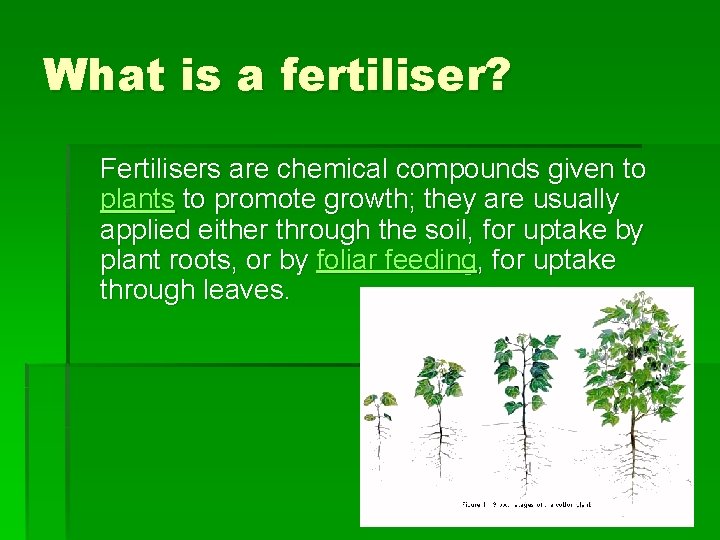
What is a fertiliser? Fertilisers are chemical compounds given to plants to promote growth; they are usually applied either through the soil, for uptake by plant roots, or by foliar feeding, for uptake through leaves.
Definition § These are substances that contain nutrients essential to plants and soils. § Nutrients are molecules which help to form food molecules; c_______, l______ (fats and oils), p____, v_____ and m______. § Nutrients in the fertilisers are usually contained within the compounds that make up the fertiliser. The most important nutrients include; _____(N), _________(P) and ________(K).
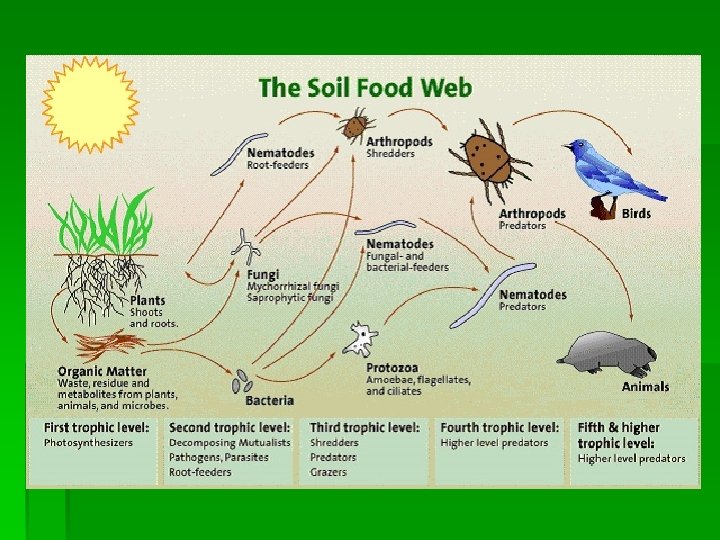
Importance of Fertilisers § When living things die, decomposers break down the remains into simple, useable remains. § Nutrients are also returned to the soil via animal faeces and urine. § While fertilisers are important to autotrophs they are also heterotrophs and other organisms in the food chain.
What is in fertilisers? § They typically provide, in varying proportions, the three major plant nutrients (nitrogen, phosphorus, potassium: N-P-K), the secondary plant nutrients (calcium, sulfur, magnesium) and sometimes trace elements (or micronutrients) with a role in plant or animal nutrition: boron, chlorine, manganese, iron, zinc, copper, molybdenum and (in some countries) selenium.
Pop Quiz 1 § What is the purpose of fertilisers? § What is a nutrient? § State three main nutrients found in fertilisers. § State three organisms which could be found in healthy soil. § What is the difference between a secondary plant nutrient and a trace element?
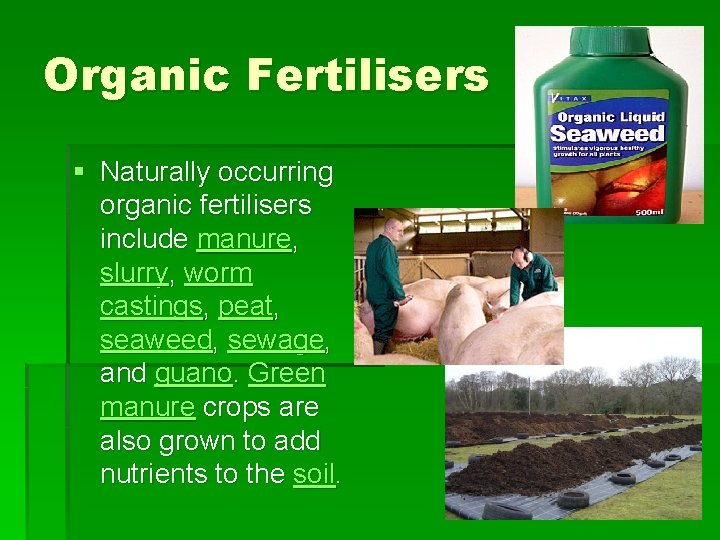
Organic Fertilisers § Naturally occurring organic fertilisers include manure, slurry, worm castings, peat, seaweed, sewage, and guano. Green manure crops are also grown to add nutrients to the soil.
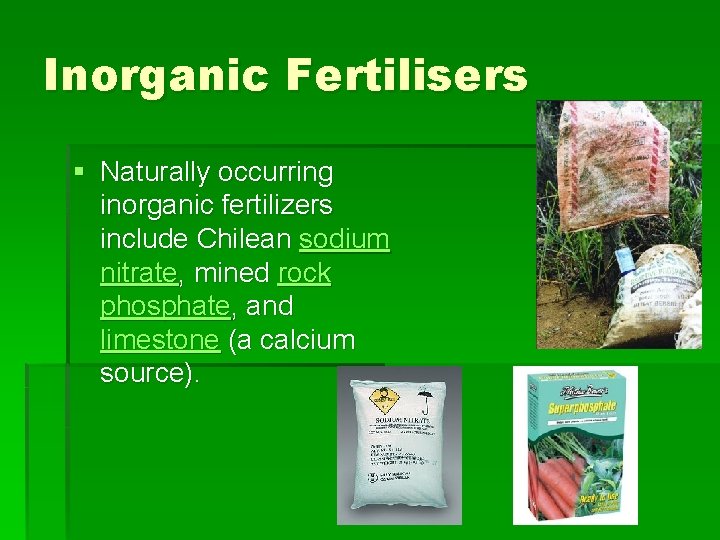
Inorganic Fertilisers § Naturally occurring inorganic fertilizers include Chilean sodium nitrate, mined rock phosphate, and limestone (a calcium source).
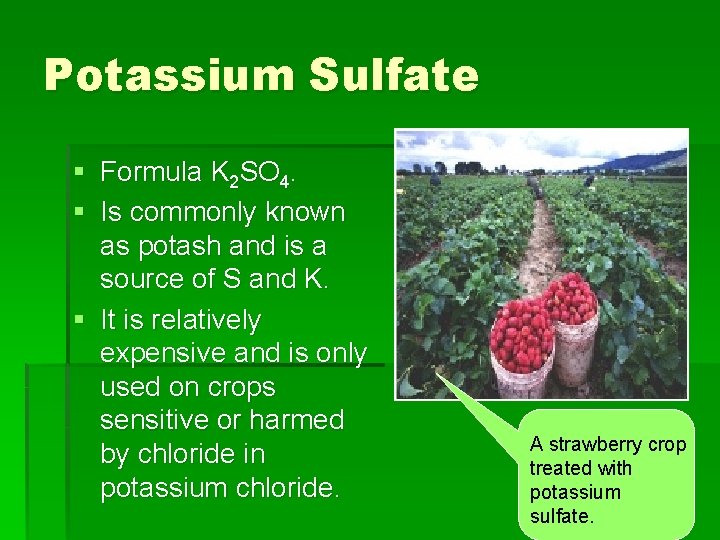
Potassium Sulfate § Formula K 2 SO 4. § Is commonly known as potash and is a source of S and K. § It is relatively expensive and is only used on crops sensitive or harmed by chloride in potassium chloride. A strawberry crop treated with potassium sulfate.
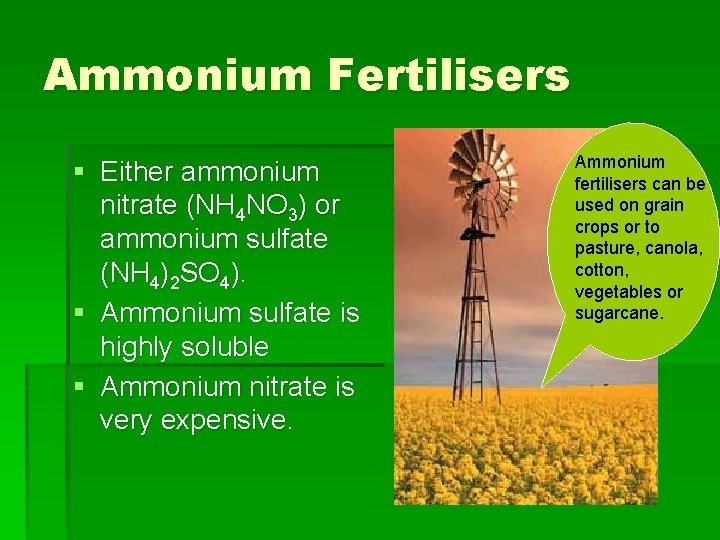
Ammonium Fertilisers § Either ammonium nitrate (NH 4 NO 3) or ammonium sulfate (NH 4)2 SO 4). § Ammonium sulfate is highly soluble § Ammonium nitrate is very expensive. Ammonium fertilisers can be used on grain crops or to pasture, canola, cotton, vegetables or sugarcane.
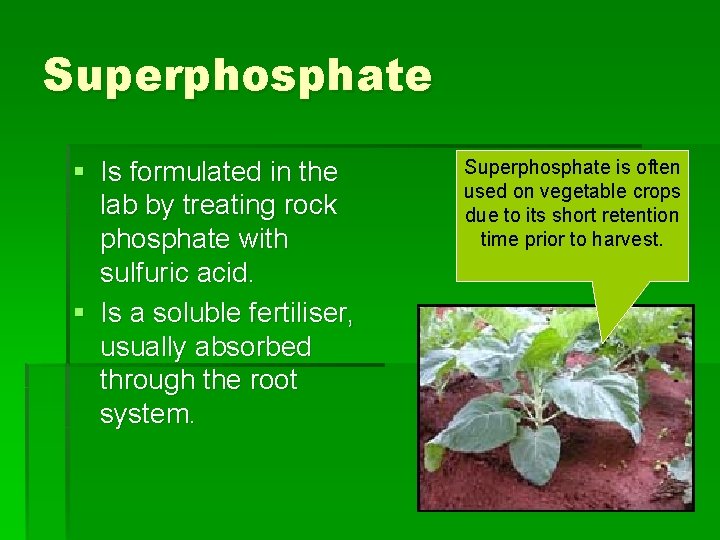
Superphosphate § Is formulated in the lab by treating rock phosphate with sulfuric acid. § Is a soluble fertiliser, usually absorbed through the root system. Superphosphate is often used on vegetable crops due to its short retention time prior to harvest.
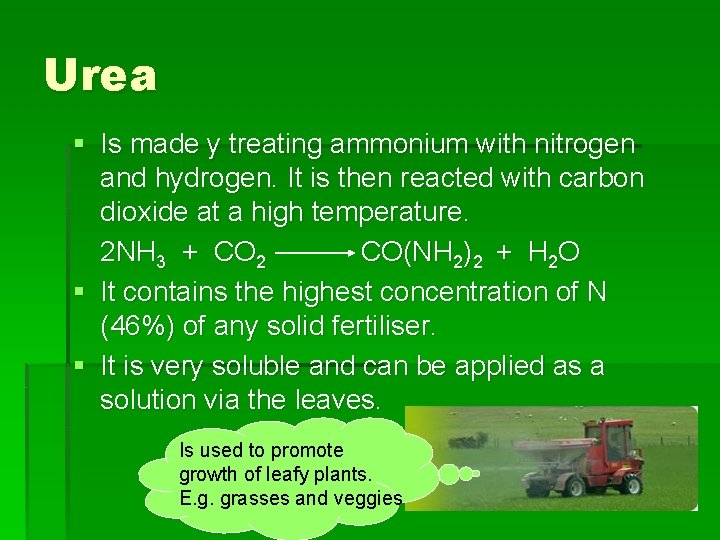
Urea § Is made y treating ammonium with nitrogen and hydrogen. It is then reacted with carbon dioxide at a high temperature. 2 NH 3 + CO 2 CO(NH 2)2 + H 2 O § It contains the highest concentration of N (46%) of any solid fertiliser. § It is very soluble and can be applied as a solution via the leaves. Is used to promote growth of leafy plants. E. g. grasses and veggies
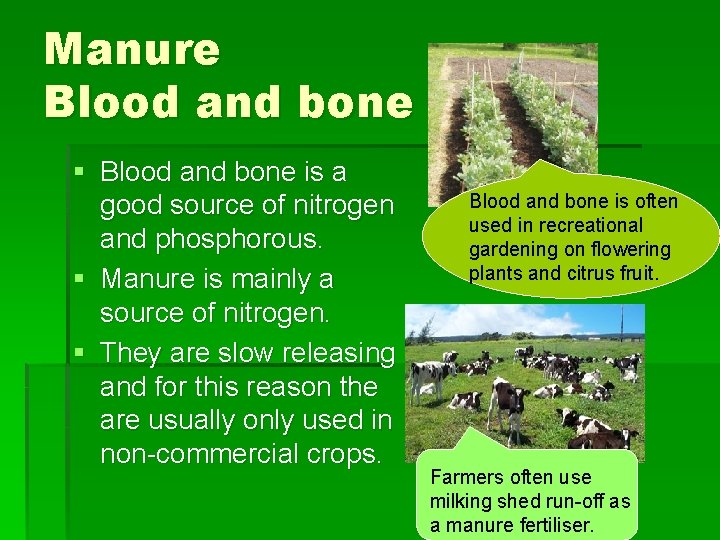
Manure Blood and bone § Blood and bone is a good source of nitrogen and phosphorous. § Manure is mainly a source of nitrogen. § They are slow releasing and for this reason the are usually only used in non-commercial crops. Blood and bone is often used in recreational gardening on flowering plants and citrus fruit. Farmers often use milking shed run-off as a manure fertiliser.
Why use fertilisers? Fertilisers are generally applied to pastures and gardens for the following reasons: 1. To replace lost nutrients through cropping or animal grazing. 2. Replace nutrients lost through leaching. 3. To balance the soil p. H.
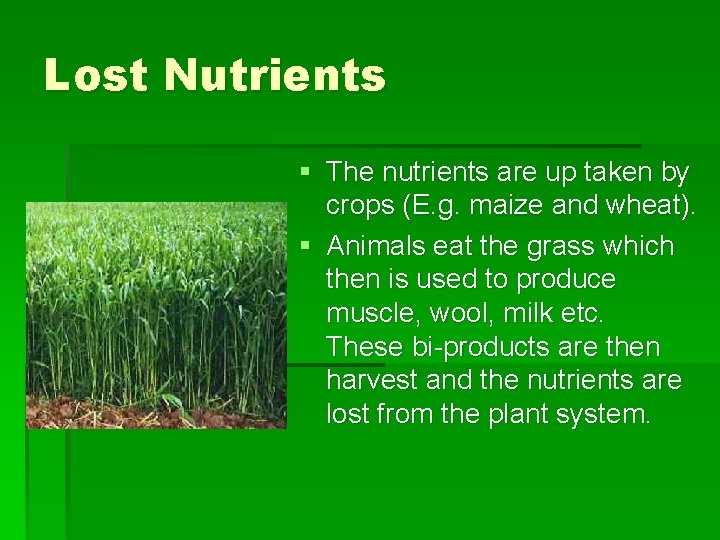
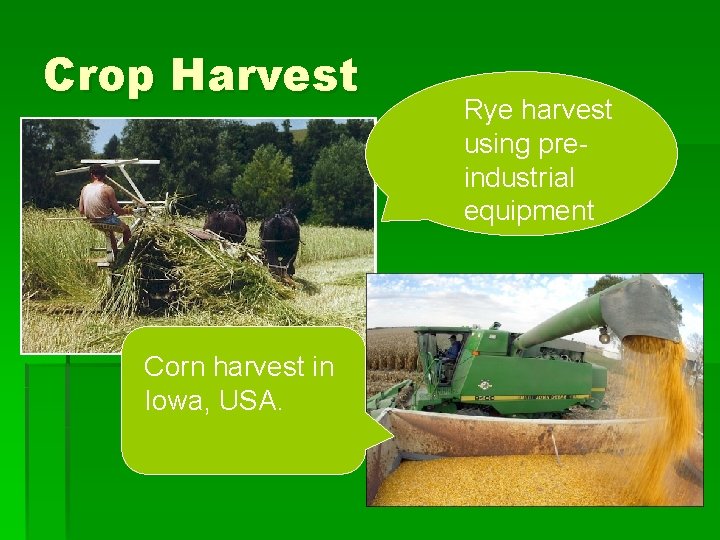
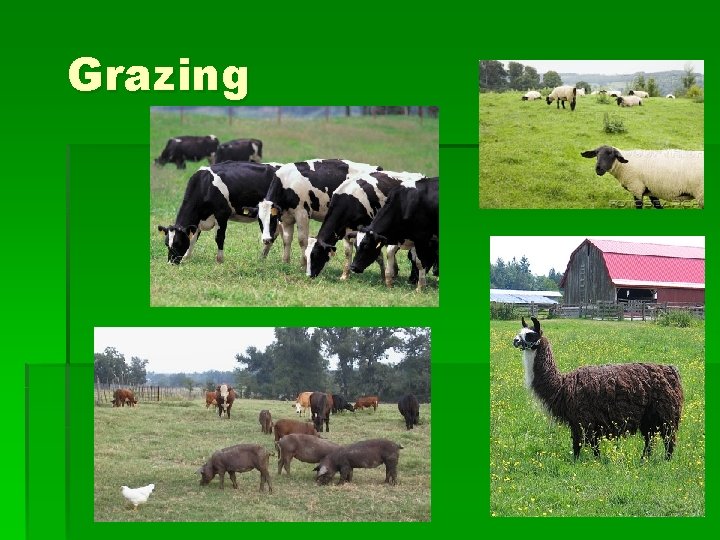
Lost Nutrients § The nutrients are up taken by crops (E. g. maize and wheat). § Animals eat the grass which then is used to produce muscle, wool, milk etc. These bi-products are then harvest and the nutrients are lost from the plant system.
Crop Harvest Corn harvest in Iowa, USA. Rye harvest using preindustrial equipment
Grazing
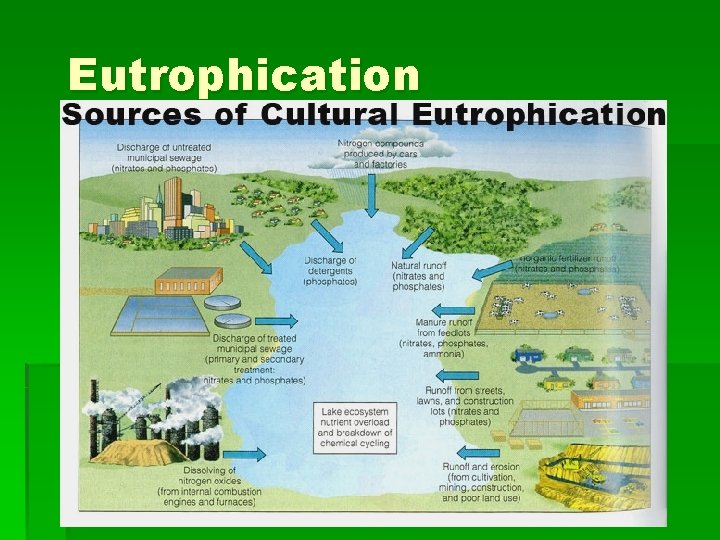
Leaching § Leaching is a process by which nutrients are washed out of the soil by excessive rain fall. § The excess water reduces the nutrients in the soil and carries it away via the rivers and streams into lakes and oceans. § Excessive leaching can cause rapid weed growth, decrease clarity and a change in p. H and salinity.
Eutrophication
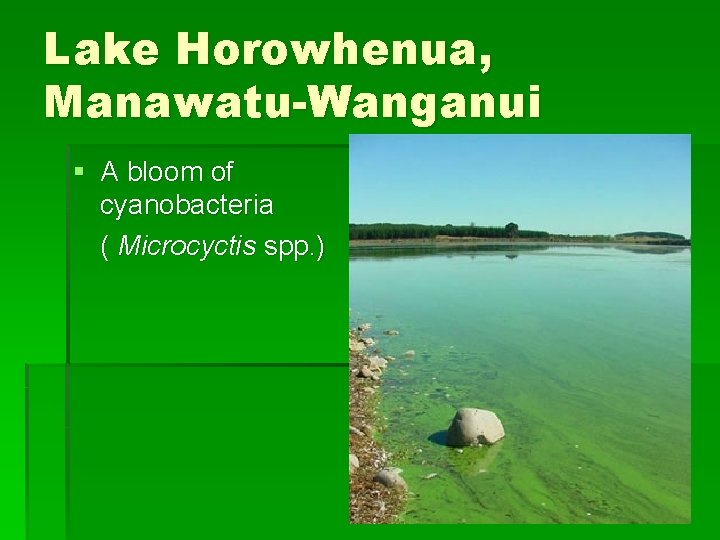
Lake Horowhenua, Manawatu-Wanganui § A bloom of cyanobacteria ( Microcyctis spp. )
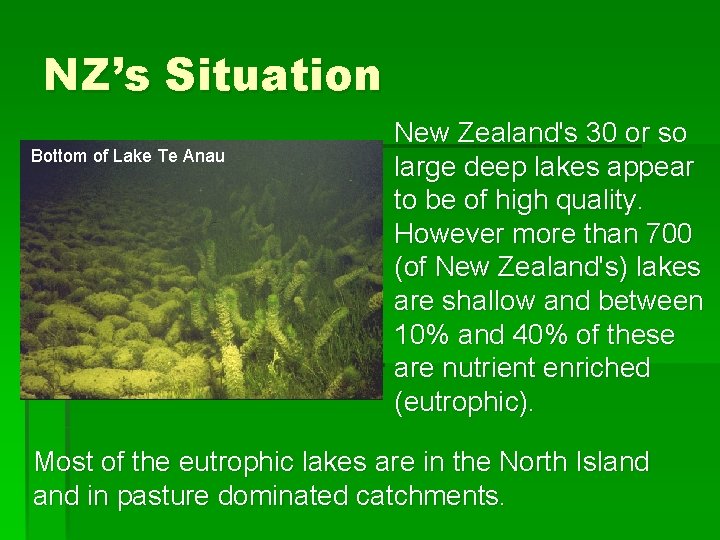
NZ’s Situation Bottom of Lake Te Anau New Zealand's 30 or so large deep lakes appear to be of high quality. However more than 700 (of New Zealand's) lakes are shallow and between 10% and 40% of these are nutrient enriched (eutrophic). Most of the eutrophic lakes are in the North Island in pasture dominated catchments.
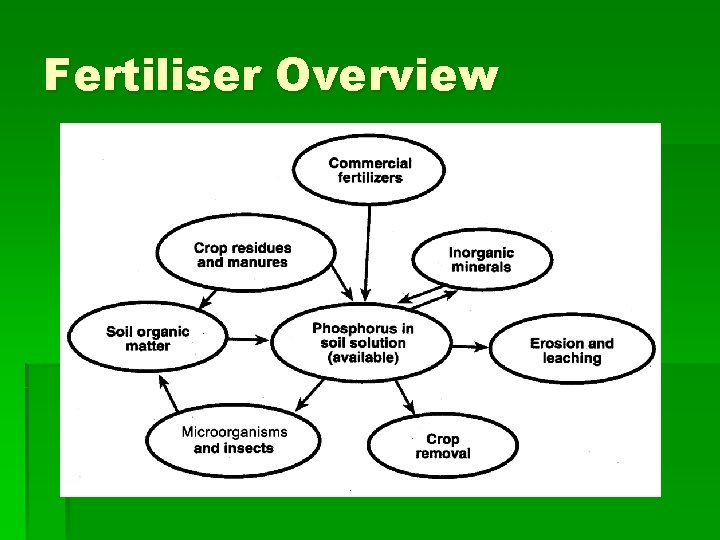
Fertiliser Overview
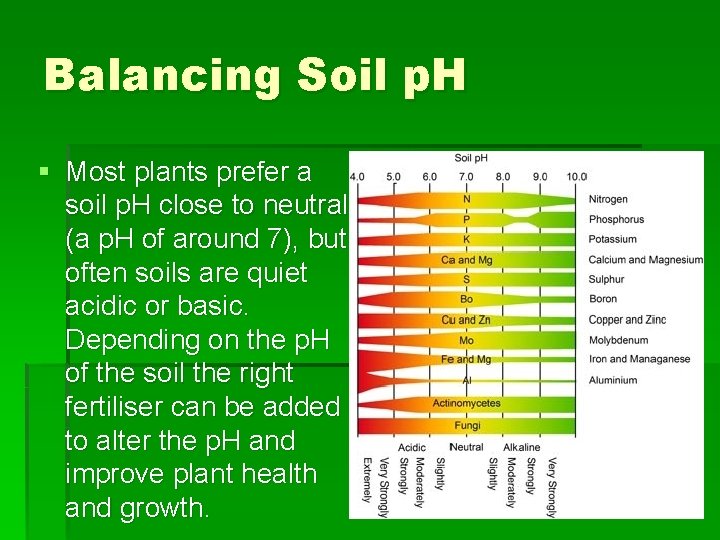
Balancing Soil p. H § Most plants prefer a soil p. H close to neutral (a p. H of around 7), but often soils are quiet acidic or basic. Depending on the p. H of the soil the right fertiliser can be added to alter the p. H and improve plant health and growth.
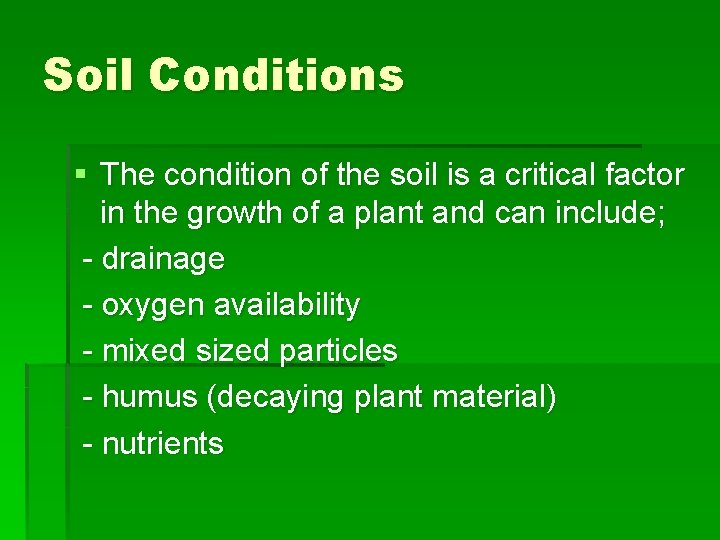
Soil Conditions § The condition of the soil is a critical factor in the growth of a plant and can include; - drainage - oxygen availability - mixed sized particles - humus (decaying plant material) - nutrients
Pop Quiz 2 § What is the 3 main reasons we use fertiliser? § What is leaching? § Give a likely location of eutrophication. § What is soil p. H? § State 3 critical factors required for plant growth.
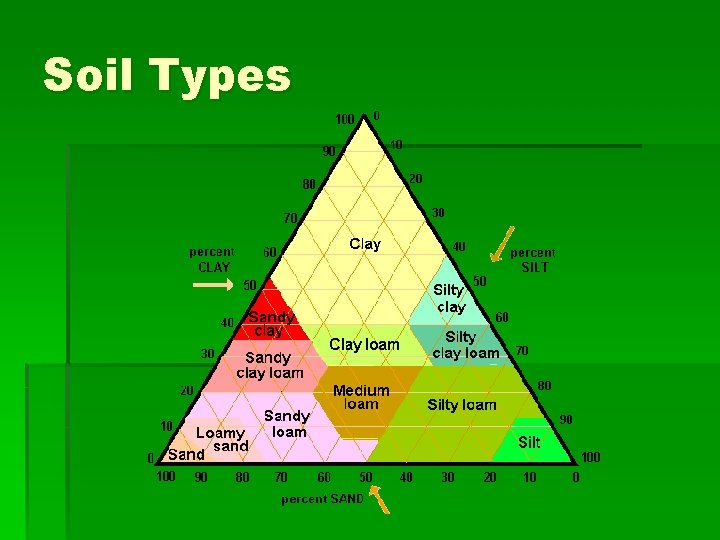
Soil Types
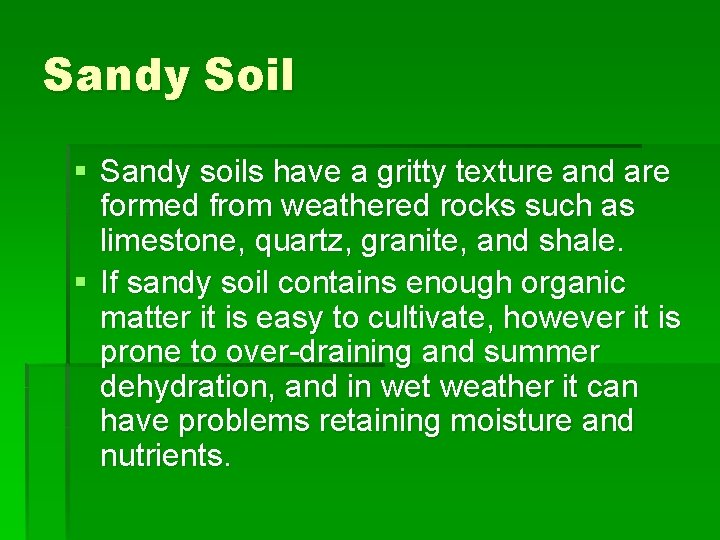
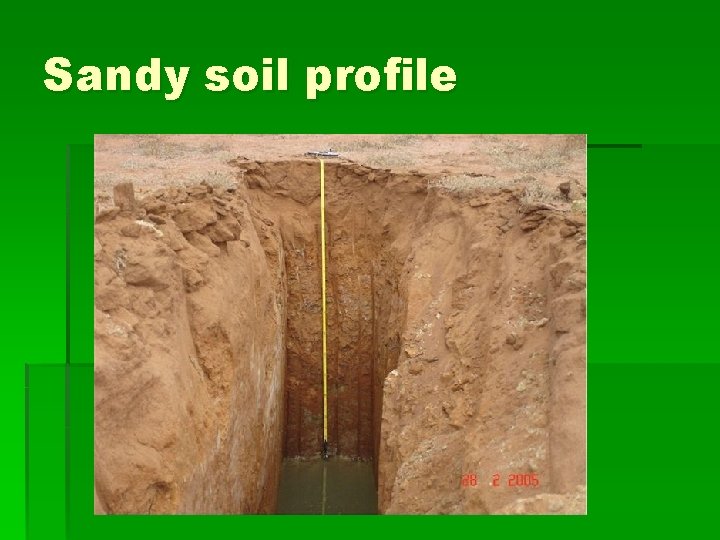
Sandy Soil § Sandy soils have a gritty texture and are formed from weathered rocks such as limestone, quartz, granite, and shale. § If sandy soil contains enough organic matter it is easy to cultivate, however it is prone to over-draining and summer dehydration, and in wet weather it can have problems retaining moisture and nutrients.
Sandy soil profile
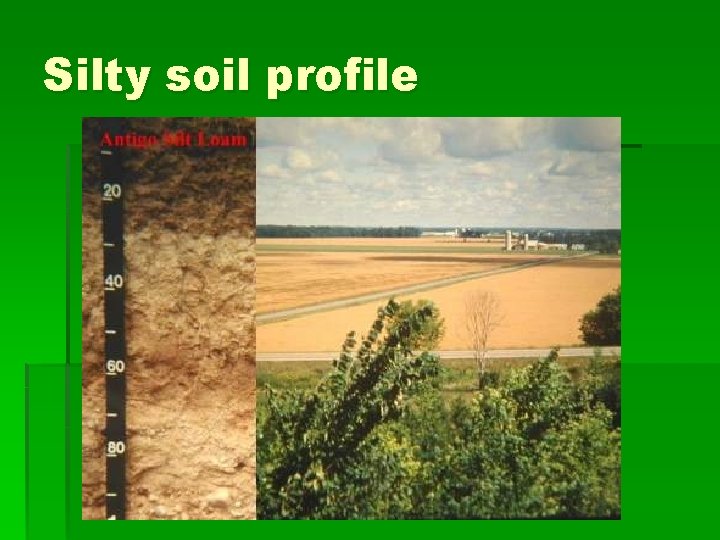
Silty Soils § Silty soil is considered to be among the most fertile of soils. Usually composed of minerals (predominantly quartz) and fine organic particles, it has more nutrients than sandy soil yet still offers good drainage. When dry it has rather a smooth texture and looks like dark sand. § Its weak soil structure means that it is easy to work with when moist and it holds moisture well.
Silty soil profile
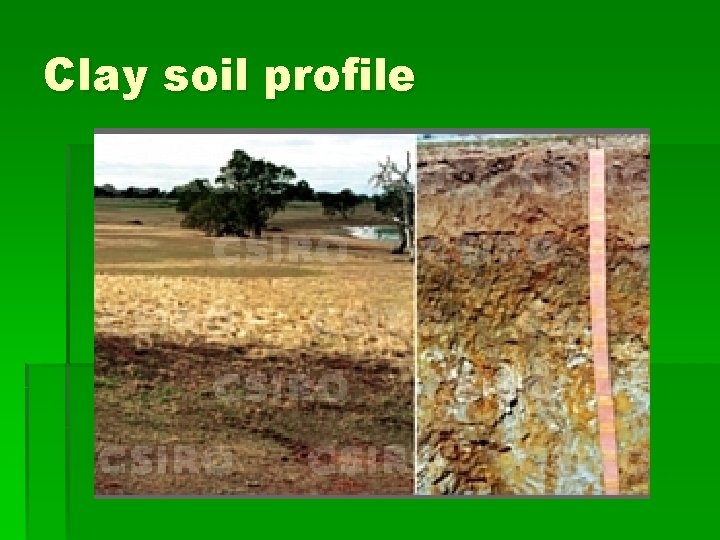
Clay Soils § When clay soils are wet they are very sticky, lumpy and pliable but when they dry they form rock-hard clots. § Clay soils are composed of very fine particles with few air spaces, thus they are hard to work and often drain poorly - they are also prone to water logging in spring. § As clay contains high nutrient levels plants grow well if drainage is adequate.
Clay soil profile
Additional soil features § Loamy soil are considered to be the perfect soil, loamy soils are a combination of roughly 40 % sand, 40% silt and 20% clay. § Peaty soil contains more organic material than other soils because its acidity inhibits the process of decomposition. § Chalky soils are alkaline, usually light brown in colour, and contain large quantities of stones of varying sizes.
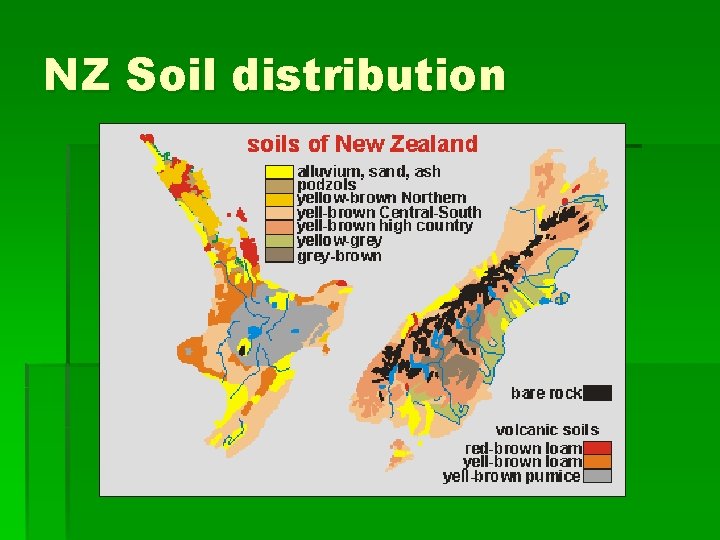
NZ Soil distribution
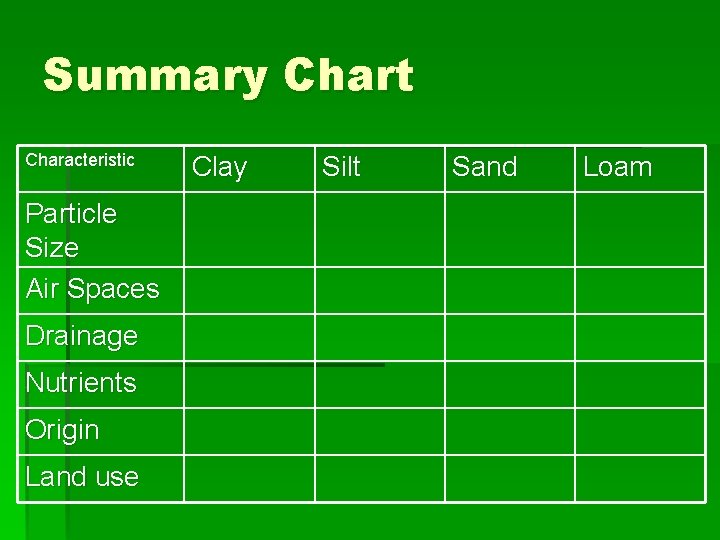
Summary Chart Characteristic Particle Size Air Spaces Drainage Nutrients Origin Land use Clay Silt Sand Loam
Clay Particles § Clay particles often cover silt and sand particles, forming a glue hold the soil structure together. § The more clay present in a soil, the better its ability to retain water. Soils with minimal clay content are said to be freedraining and can be easily leached.
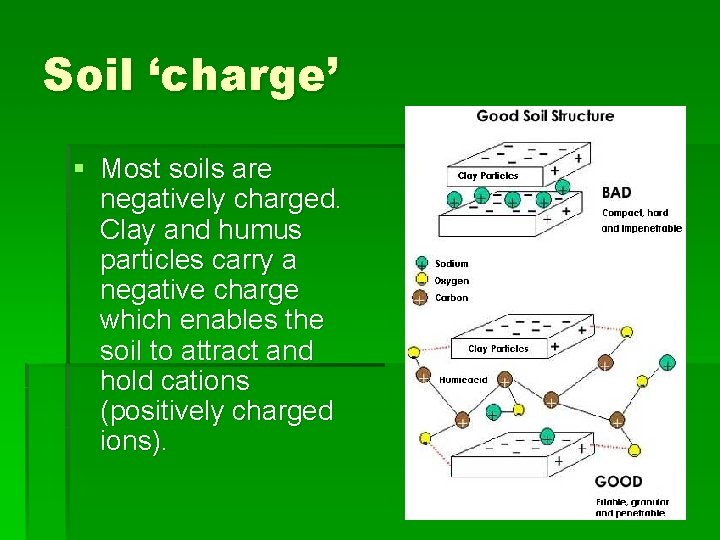
Soil ‘charge’ § Most soils are negatively charged. Clay and humus particles carry a negative charge which enables the soil to attract and hold cations (positively charged ions).
Pop Quiz 3 § What is one problem associated with a sandy soil? § Which soil type is thought to be the most fertile? § Which soil type has poor drainage? § What is the composition of a loamy soil? § Which soil particles are said to have a ‘charge’?