
Fermis Golden Rule Io I l Harry Kroto



- Slides: 26
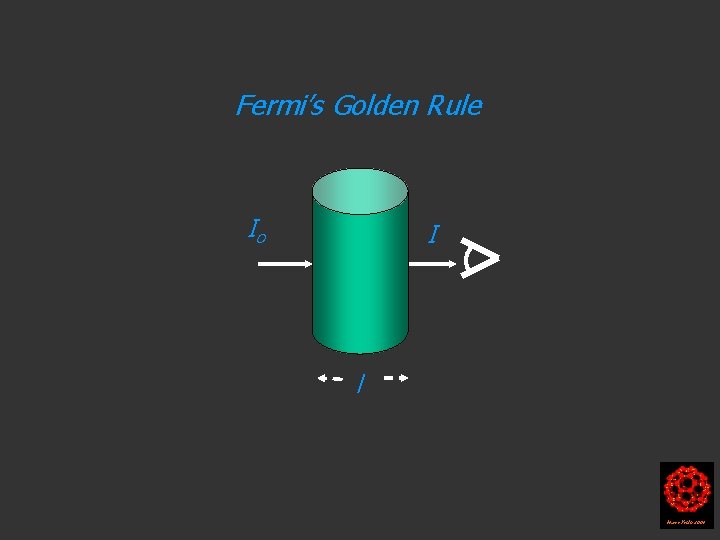
Fermi’s Golden Rule Io I l Harry Kroto 2004
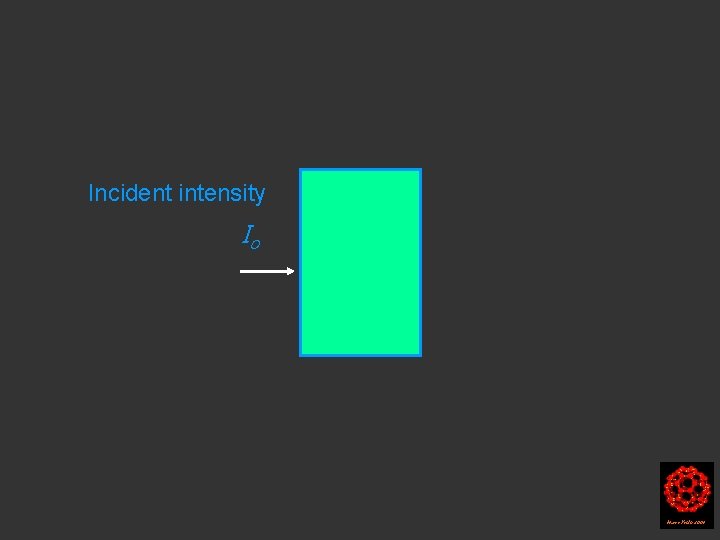
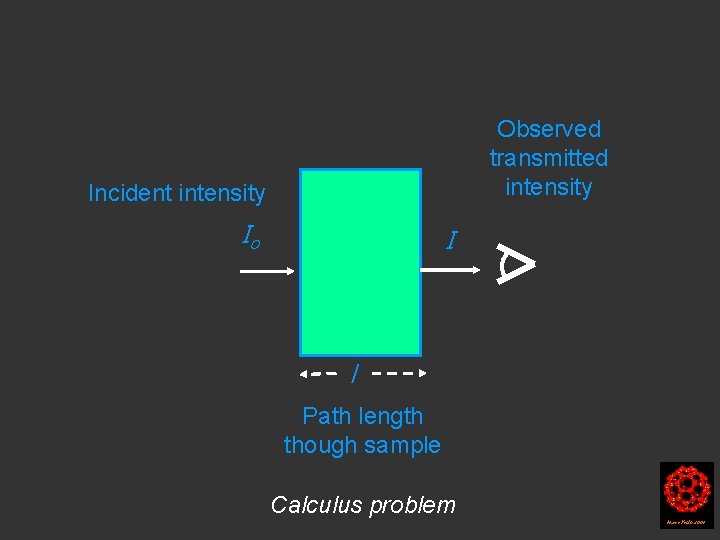
Incident intensity Io Harry Kroto 2004
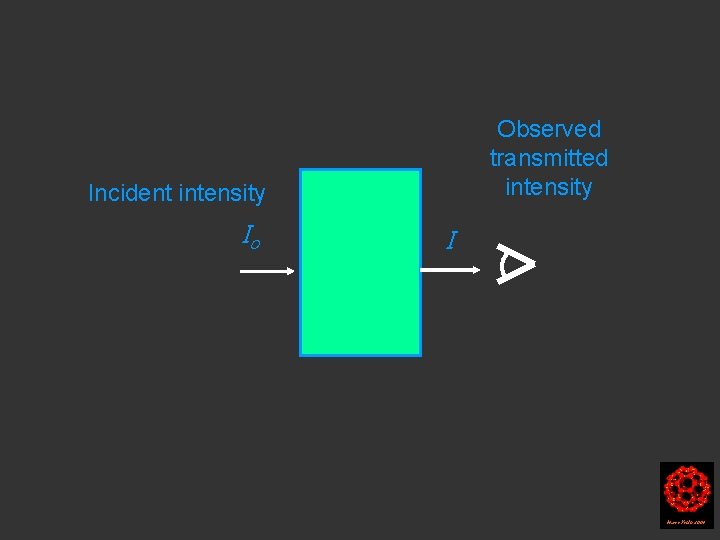
Observed transmitted intensity Incident intensity Io I Harry Kroto 2004
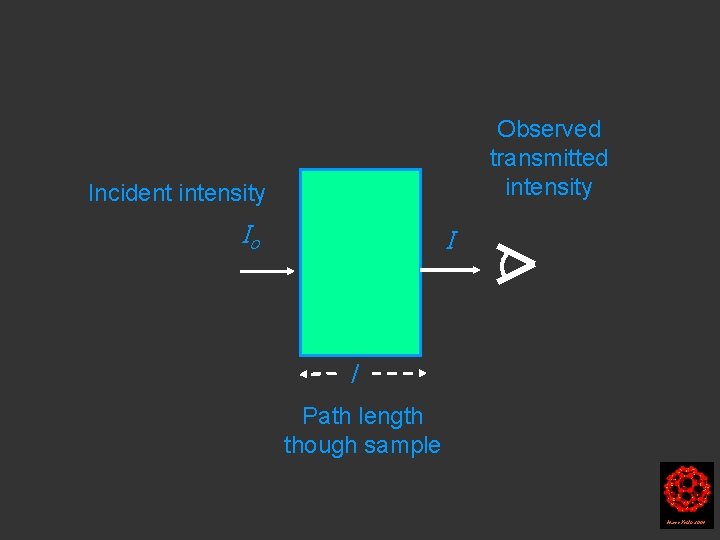
Observed transmitted intensity Incident intensity Io I l Path length though sample Harry Kroto 2004
Observed transmitted intensity Incident intensity Io I l Path length though sample Calculus problem Harry Kroto 2004
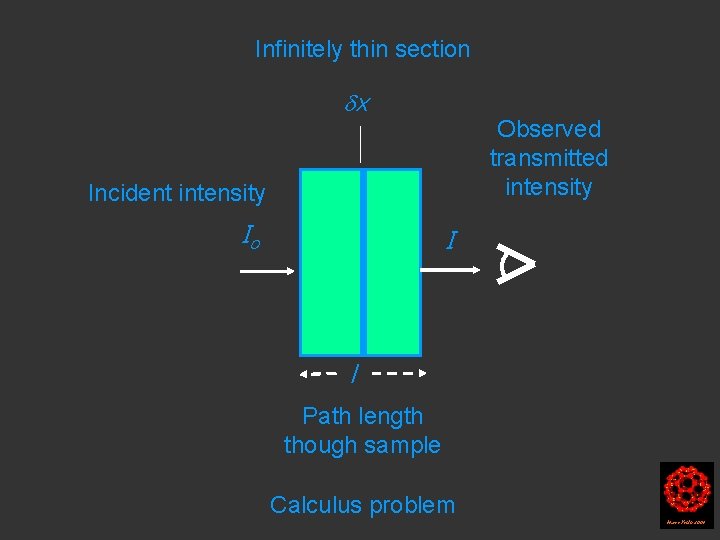
Infinitely thin section x Observed transmitted intensity Incident intensity Io I l Path length though sample Calculus problem Harry Kroto 2004
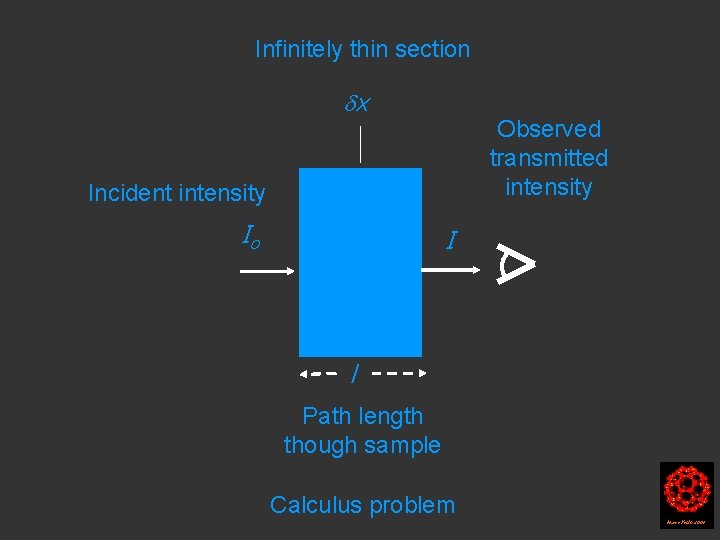
Infinitely thin section x Observed transmitted intensity Incident intensity Io I l Path length though sample Calculus problem Harry Kroto 2004
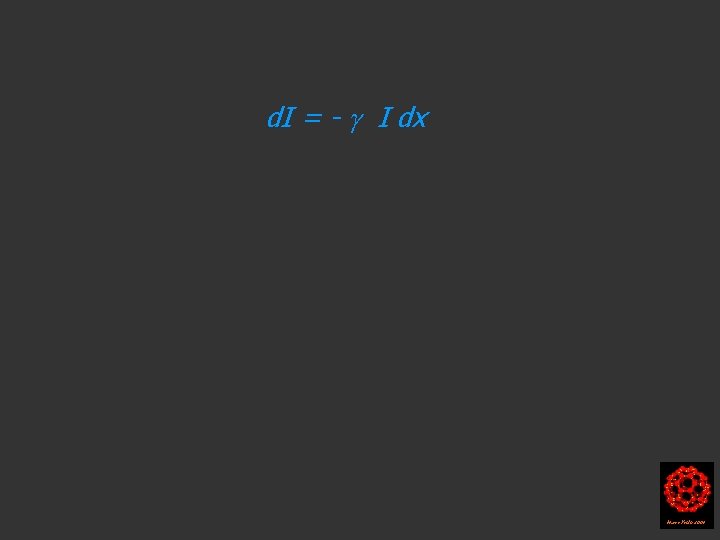
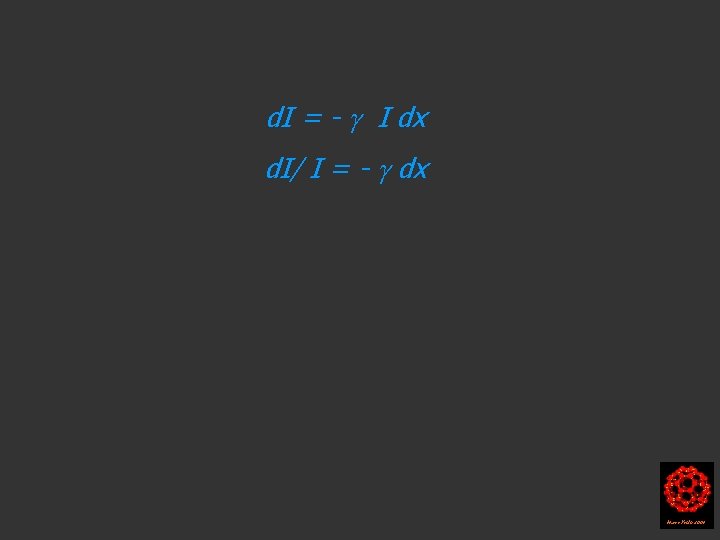
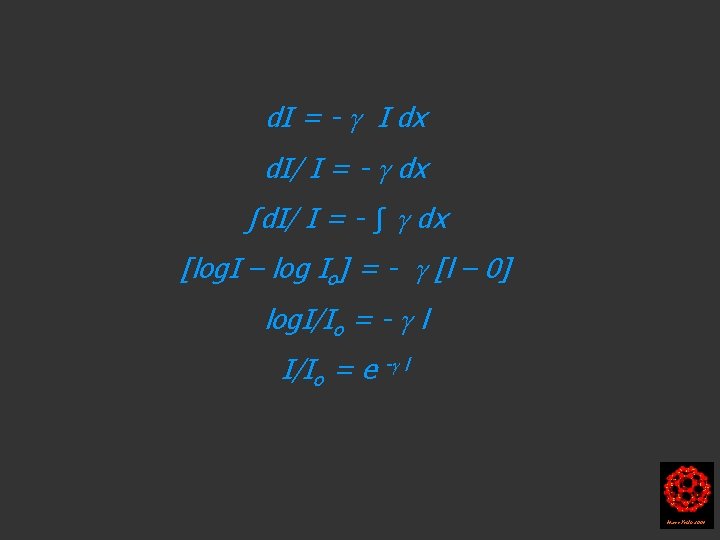
d. I = - I dx Harry Kroto 2004
d. I = - I dx d. I/ I = - dx Harry Kroto 2004
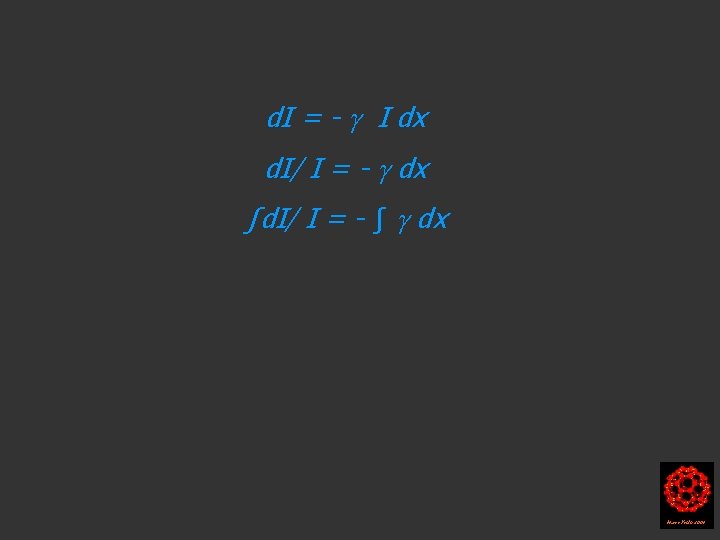
d. I = - I dx d. I/ I = - dx ∫d. I/ I = - ∫ dx Harry Kroto 2004
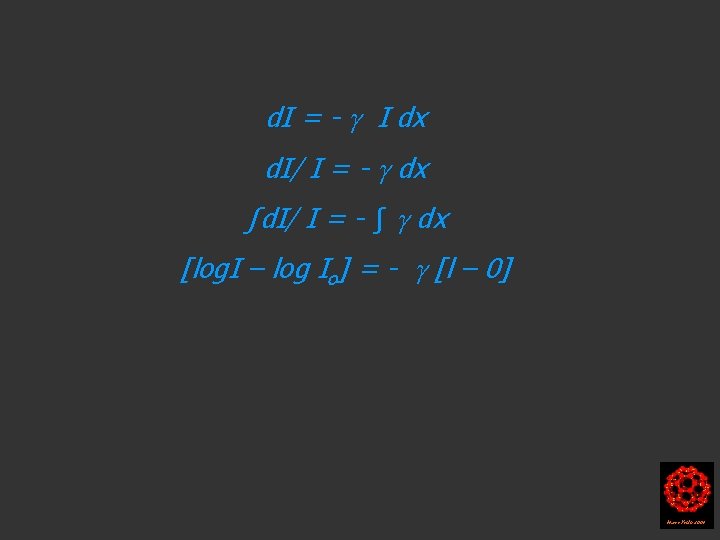
d. I = - I dx d. I/ I = - dx ∫d. I/ I = - ∫ dx [log. I – log Io] = - [l – 0] Harry Kroto 2004
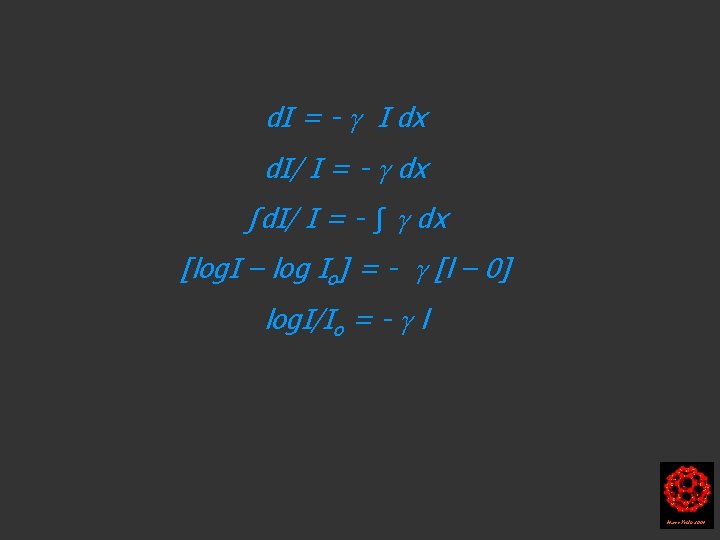
d. I = - I dx d. I/ I = - dx ∫d. I/ I = - ∫ dx [log. I – log Io] = - [l – 0] log. I/Io = - l Harry Kroto 2004
d. I = - I dx d. I/ I = - dx ∫d. I/ I = - ∫ dx [log. I – log Io] = - [l – 0] log. I/Io = - l I/Io = e - l Harry Kroto 2004
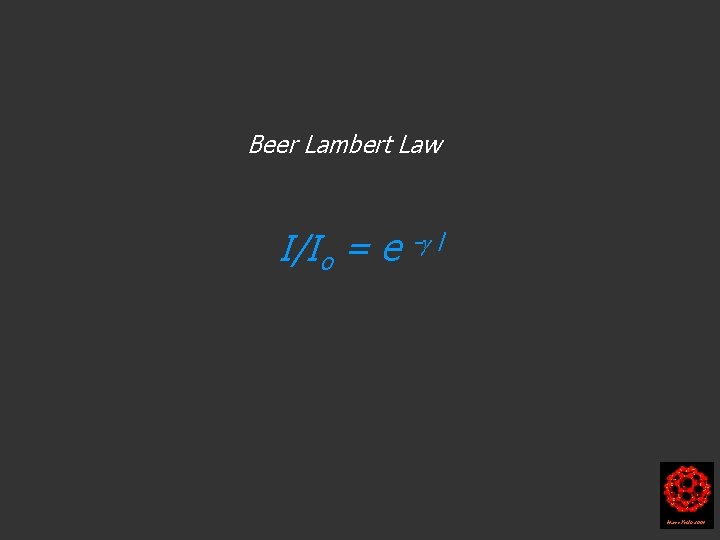
Beer Lambert Law I/Io = e - l Harry Kroto 2004
Harry Kroto 2004
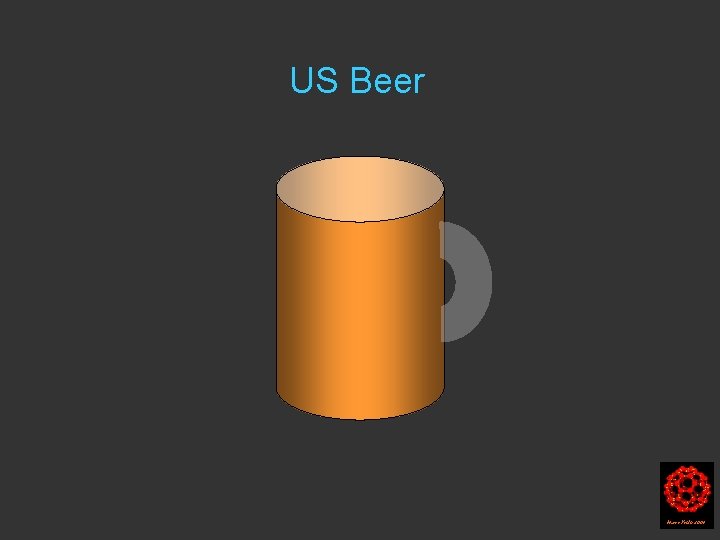
US Beer Harry Kroto 2004
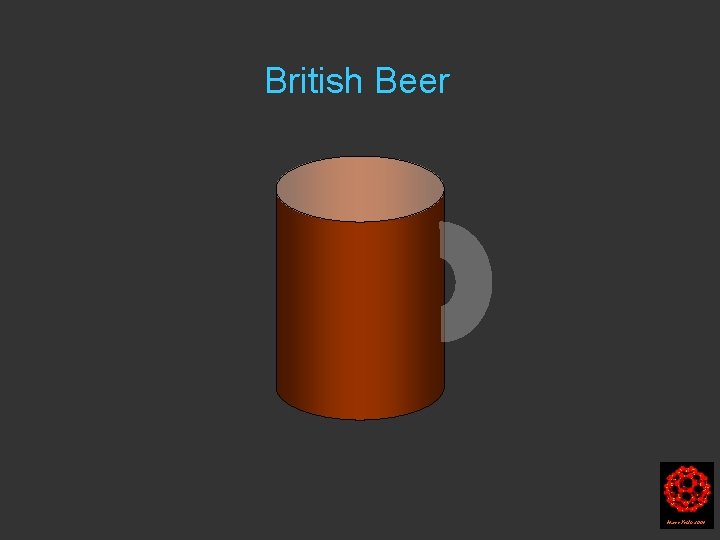
British Beer Harry Kroto 2004
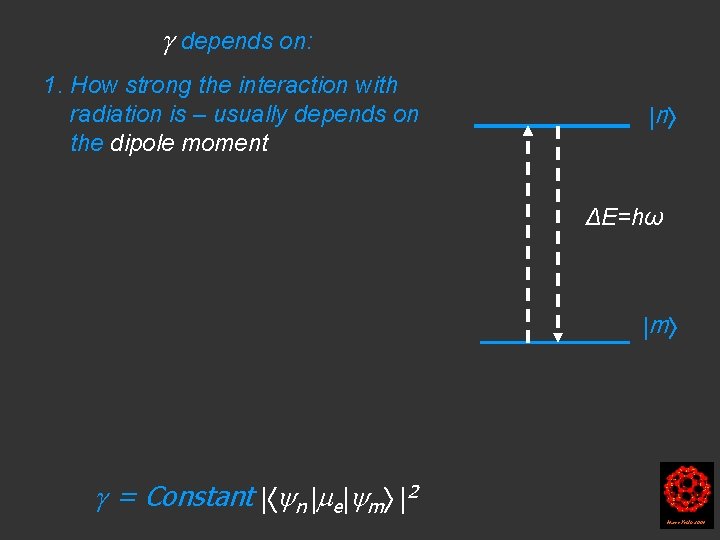
depends on: 1. How strong the interaction with radiation is – usually depends on the dipole moment n ΔE=hω m = Constant n e m 2 (Nm-Nn) ( o- ) Harry Kroto 2004
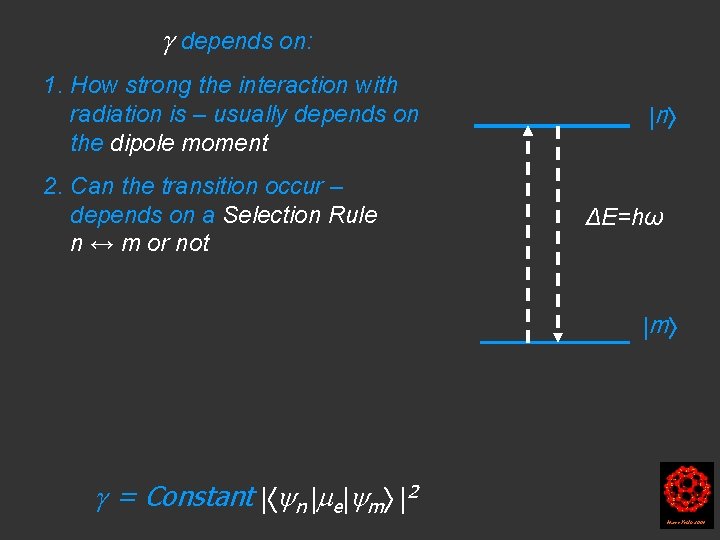
depends on: 1. How strong the interaction with radiation is – usually depends on the dipole moment 2. Can the transition occur – depends on a Selection Rule n ↔ m or not n ΔE=hω m = Constant n e m 2 (Nm-Nn) ( o- ) Harry Kroto 2004
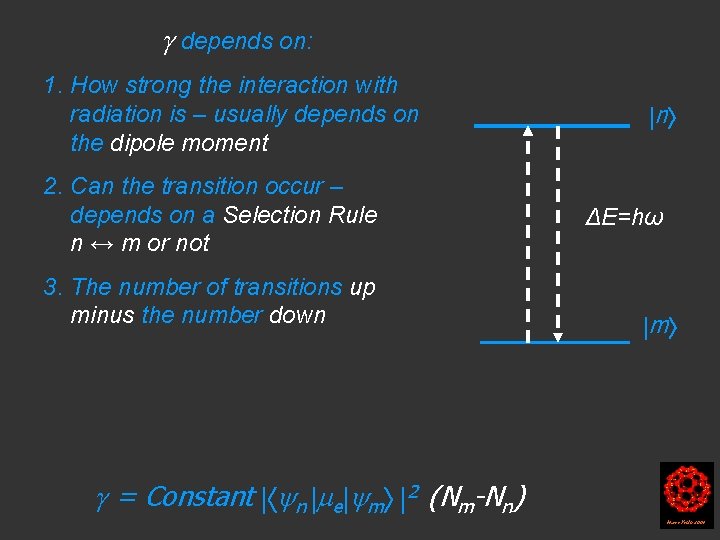
depends on: 1. How strong the interaction with radiation is – usually depends on the dipole moment 2. Can the transition occur – depends on a Selection Rule n ↔ m or not n ΔE=hω 3. The number of transitions up minus the number down m = Constant n e m 2 (Nm-Nn) ( o- ) Harry Kroto 2004
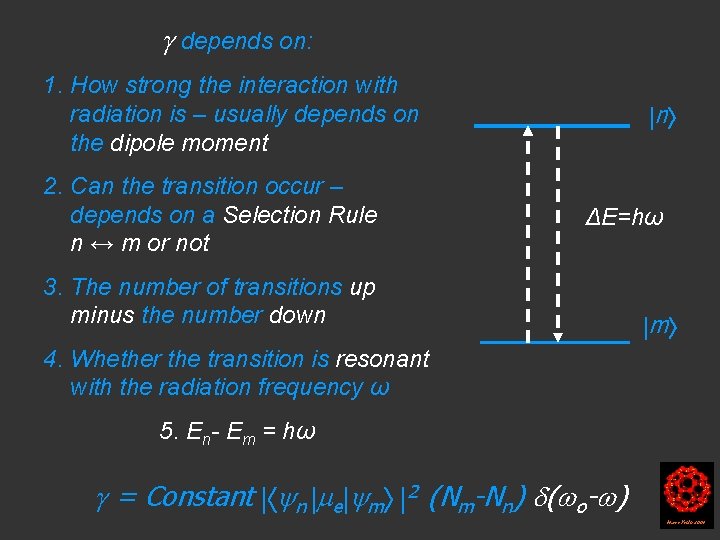
depends on: 1. How strong the interaction with radiation is – usually depends on the dipole moment 2. Can the transition occur – depends on a Selection Rule n ↔ m or not n ΔE=hω 3. The number of transitions up minus the number down m 4. Whether the transition is resonant with the radiation frequency ω 5. En- Em = hω = Constant n e m 2 (Nm-Nn) ( o- ) Harry Kroto 2004
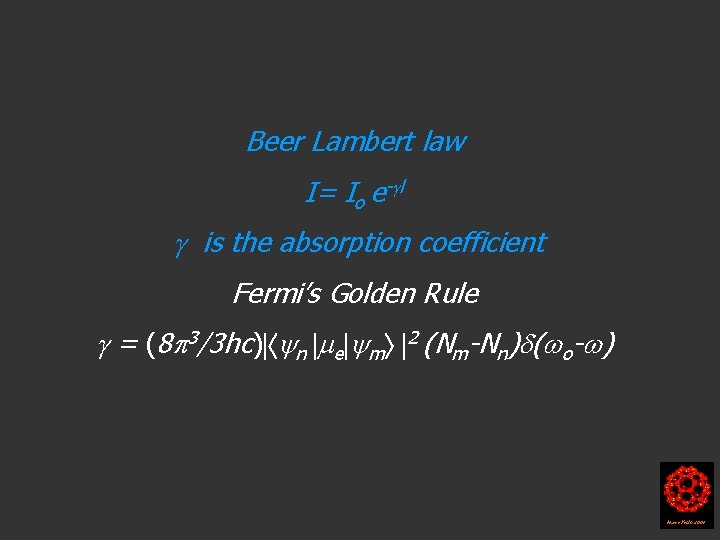
Beer Lambert law I= Io e- l is the absorption coefficient Fermi’s Golden Rule = (8 3/3 hc) n e m 2 (Nm-Nn) ( o- ) Harry Kroto 2004
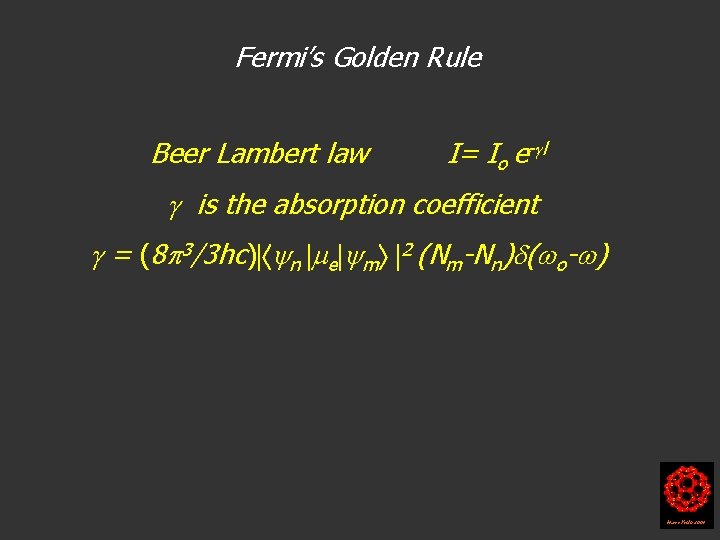
Fermi’s Golden Rule Beer Lambert law I= Io e- l is the absorption coefficient = (8 3/3 hc) n e m 2 (Nm-Nn) ( o- ) Harry Kroto 2004
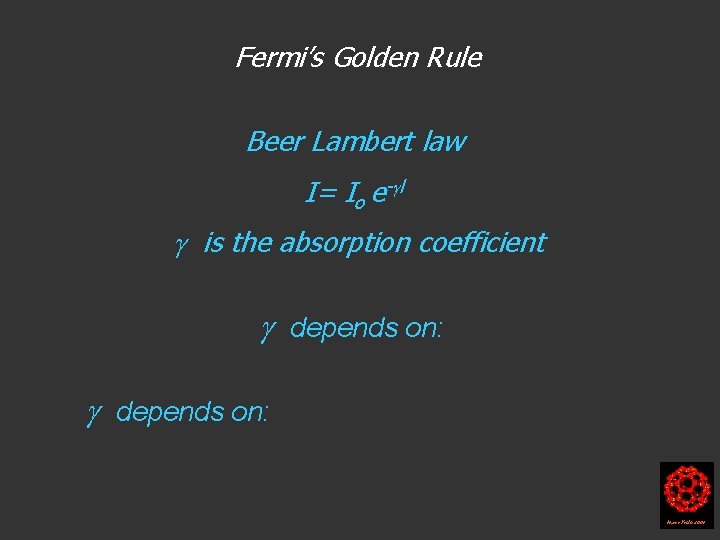
Fermi’s Golden Rule Beer Lambert law I= Io e- l is the absorption coefficient depends on: Harry Kroto 2004