
FermiLAT A Retrospective on Design Construction and Operation

- Slides: 28
Fermi-LAT: A Retrospective on Design, Construction, and Operation and a Look Towards the Future Bill Atwood Dec 6, 2011 HSTD-8 1
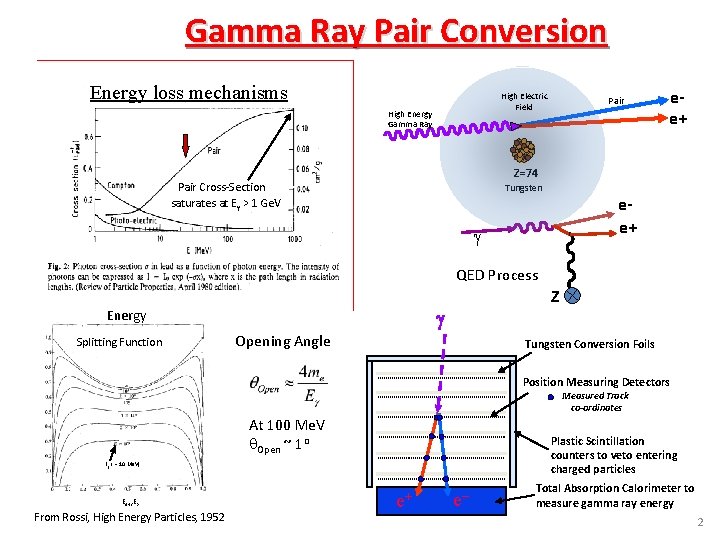
Gamma Ray Pair Conversion Energy loss mechanisms High Electric Field High Energy Gamma Ray Pair ee+ Z=74 Pair Cross-Section saturates at E > 1 Ge. V Tungsten ee+ QED Process Energy Splitting Function Z Opening Angle Tungsten Conversion Foils Position Measuring Detectors Measured Track co-ordinates At 100 Me. V q. Open ~ 1 o Plastic Scintillation counters to veto entering charged particles E ( = 10 Me. V) Ee+/E From Rossi, High Energy Particles, 1952 e+ e– Total Absorption Calorimeter to measure gamma ray energy 2
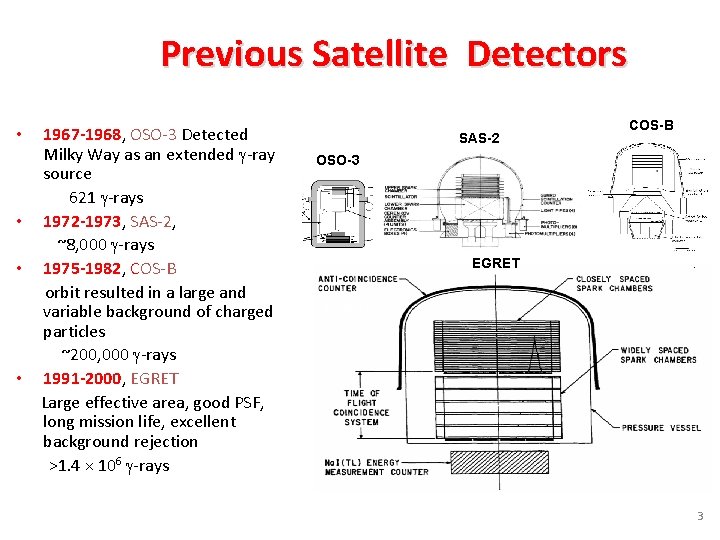
Previous Satellite Detectors 1967 -1968, OSO-3 Detected Milky Way as an extended -ray source 621 -rays • 1972 -1973, SAS-2, ~8, 000 -rays • 1975 -1982, COS-B orbit resulted in a large and variable background of charged particles ~200, 000 -rays • 1991 -2000, EGRET Large effective area, good PSF, long mission life, excellent background rejection >1. 4 × 10⁶ -rays • SAS-2 OSO-3 COS-B SAS-2 COS-B EGRET 3
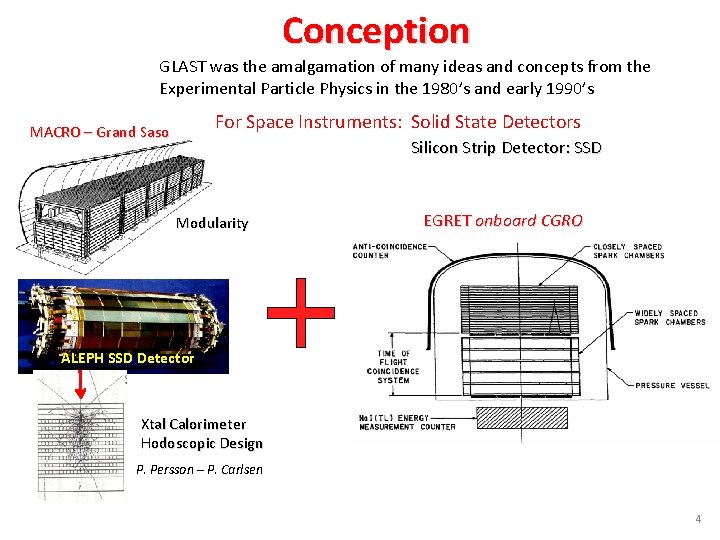
Conception GLAST was the amalgamation of many ideas and concepts from the Experimental Particle Physics in the 1980’s and early 1990’s For Space Instruments: Solid State Detectors MACRO – Grand Saso Silicon Strip Detector: SSD Modularity EGRET onboard CGRO ALEPH SSD Detector Xtal Calorimeter Hodoscopic Design P. Persson – P. Carlsen 4
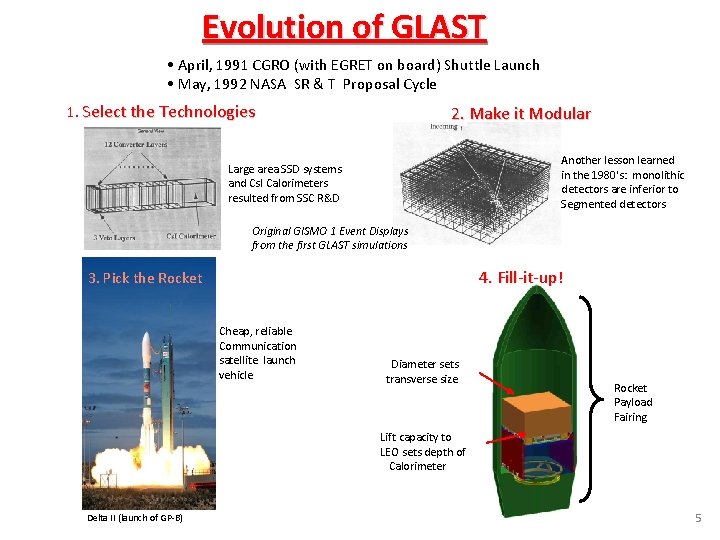
Evolution of GLAST • April, 1991 CGRO (with EGRET on board) Shuttle Launch • May, 1992 NASA SR & T Proposal Cycle 1. Select the Technologies 2. Make it Modular Another lesson learned in the 1980's: monolithic detectors are inferior to Segmented detectors Large area SSD systems and Cs. I Calorimeters resulted from SSC R&D Original GISMO 1 Event Displays from the first GLAST simulations 4. Fill-it-up! 3. Pick the Rocket Cheap, reliable Communication satellite launch vehicle Diameter sets transverse size Rocket Payload Fairing Lift capacity to LEO sets depth of Calorimeter Delta II (launch of GP-B) 5
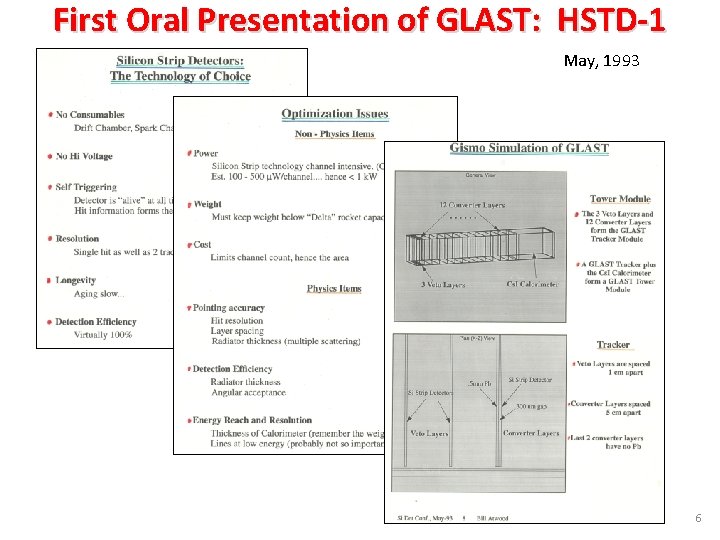
First Oral Presentation of GLAST: HSTD-1 May, 1993 6
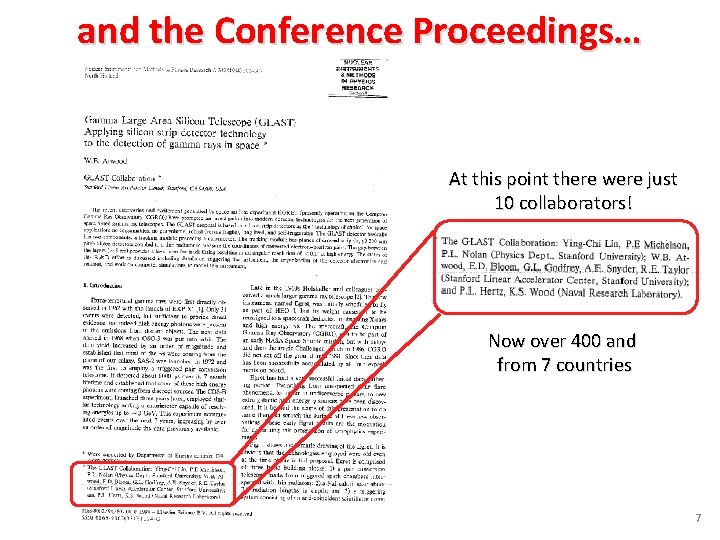
and the Conference Proceedings… At this point there were just 10 collaborators! Now over 400 and from 7 countries 7
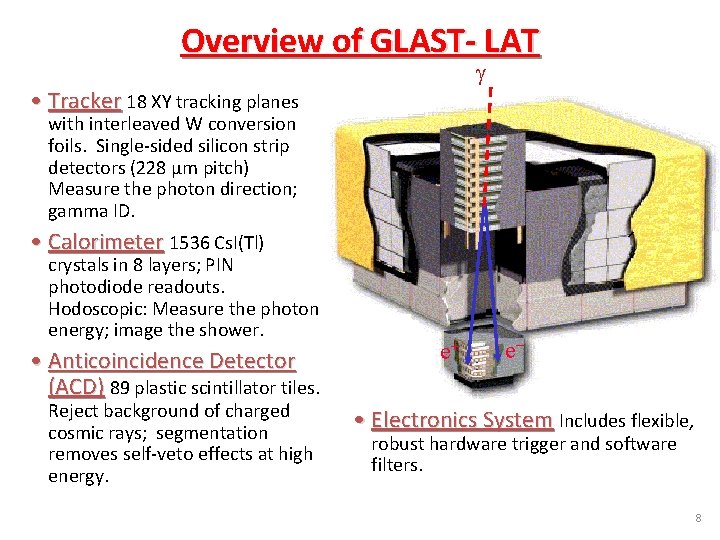
Overview of GLAST- LAT • Tracker 18 XY tracking planes Tracker with interleaved W conversion foils. Single-sided silicon strip detectors (228 μm pitch) Measure the photon direction; gamma ID. • Calorimeter 1536 Cs. I(Tl) crystals in 8 layers; PIN photodiode readouts. Hodoscopic: Measure the photon energy; image the shower. • Anticoincidence Detector (ACD) 89 plastic scintillator tiles. Reject background of charged cosmic rays; segmentation removes self-veto effects at high energy. ACD e+ e– Calorimeter • Electronics System Includes flexible, robust hardware trigger and software filters. 8
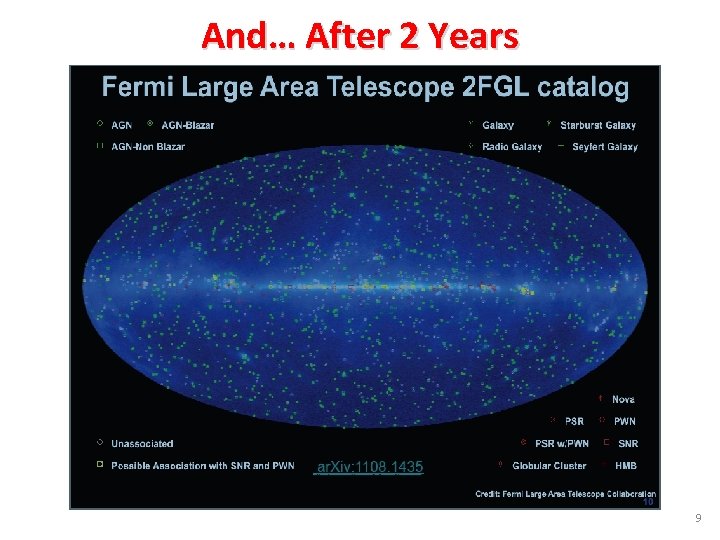
And… After 2 Years 9
Silicon Detectors: the choice that keeps on giving! Ø Ø Ø Thin detectors leads to optimal arrangement of radiators Near 100% efficiency leads to new tracking paradigms and more Extremely low noise results in few false triggers and low confusion in tracking Long term stability promotes optimal recon strategies Fine granularity allows for a precision snap shot of the conversion and resulting tracks What follows are several examples capitalizing on these properties, which were not anticipated from the outset. 10
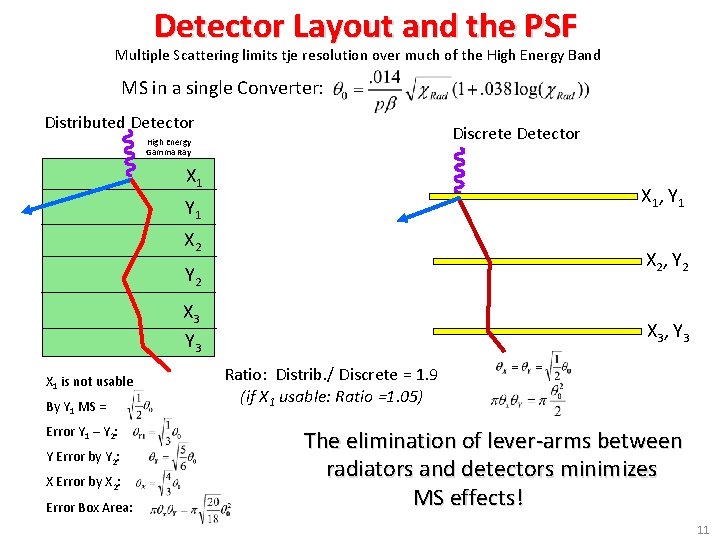
Detector Layout and the PSF Multiple Scattering limits tje resolution over much of the High Energy Band MS in a single Converter: Distributed Detector Discrete Detector High Energy Gamma Ray X 1 , Y 1 X 2 , Y 2 X 3 Y 3 X 1 is not usable By Y 1 MS = Error Y 1 – Y 2: Y Error by Y 2: X Error by X 2: Error Box Area: X 3 , Y 3 Ratio: Distrib. / Discrete = 1. 9 (if X 1 usable: Ratio =1. 05) The elimination of lever-arms between radiators and detectors minimizes MS effects! 11
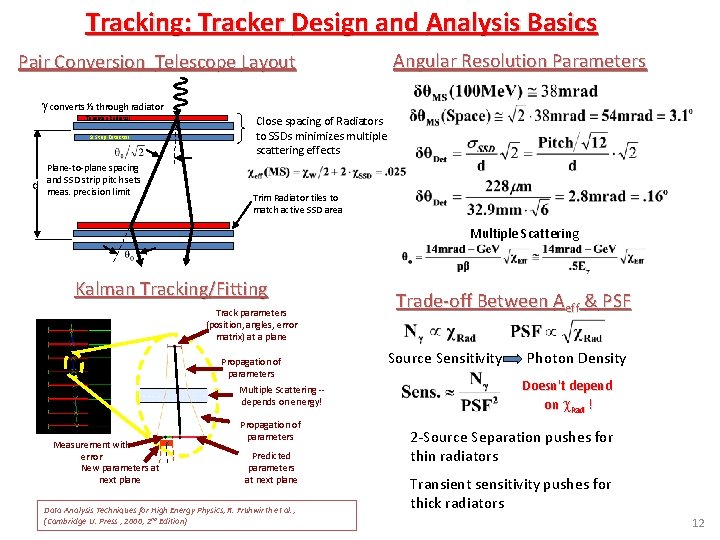
Tracking: Tracker Design and Analysis Basics Pair Conversion Telescope Layout Angular Resolution Parameters converts ½ through radiator Tungsten Radiator Si Strip Detector d Plane-to-plane spacing and SSD strip pitch sets meas. precision limit Close spacing of Radiators to SSDs minimizes multiple scattering effects Trim Radiator tiles to match active SSD area Multiple Scattering Kalman Tracking/Fitting Track parameters (position, angles, error matrix) at a plane Propagation of parameters Multiple Scattering -depends on energy! Measurement with error New parameters at next plane Propagation of parameters Predicted parameters at next plane Data Analysis Techniques for High Energy Physics, R. Fruhwirth et al. , (Cambridge U. Press , 2000, 2 nd Edition) Trade-off Between Aeff & PSF Source Sensitivity Photon Density Doesn't depend on c. Rad ! 2 -Source Separation pushes for thin radiators Transient sensitivity pushes for thick radiators 12
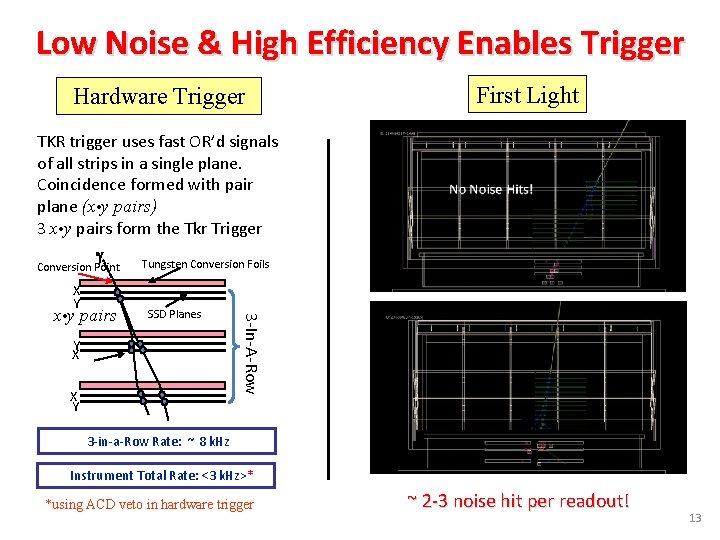
Low Noise & High Efficiency Enables Trigger Hardware Trigger First Light TKR trigger uses fast OR’d signals of all strips in a single plane. Coincidence formed with pair plane (x • y pairs) 3 x • y pairs form the Tkr Trigger Tungsten Conversion Foils Conversion Point X Y SSD Planes Y X X Y 3 -In-A-Row x • y pairs 3 -in-a-Row Rate: ~ 8 k. Hz Instrument Total Rate: <3 k. Hz>* *using ACD veto in hardware trigger ~ 2 -3 noise hit per readout! 13
Low Noise & High Efficiency Determines Track Length Ø “Missing Hits” on tracks not easily excused. § Check closeness to gaps § Check on presences of dead strips § No excuse – Track terminated at last hit Ø Allows testing of track hypothesis – improves track finding accuracy by eliminating false solutions 14
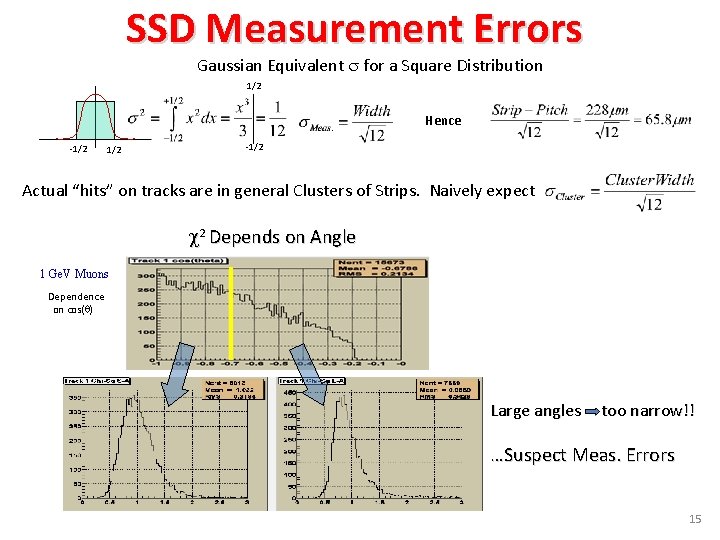
SSD Measurement Errors Gaussian Equivalent s for a Square Distribution 1/2 Hence -1/2 Actual “hits” on tracks are in general Clusters of Strips. Naively expect c 2 Depends on Angle 1 Ge. V Muons Dependence on cos(q) Large angles too narrow!! …Suspect Meas. Errors 15
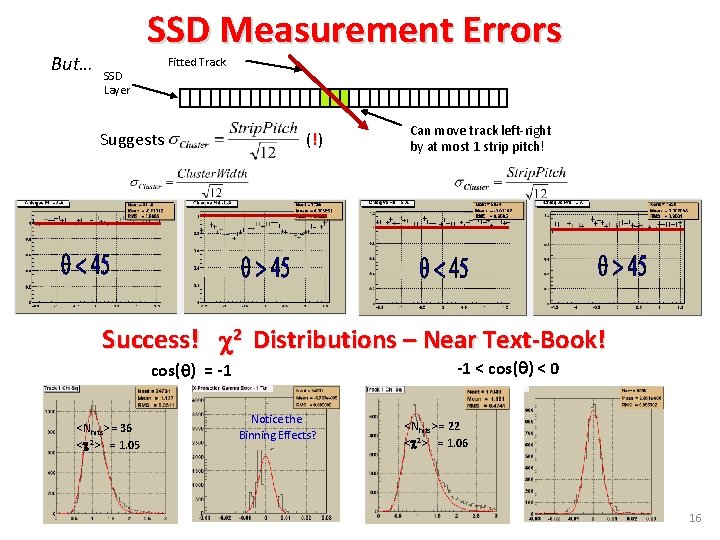
But… SSD Measurement Errors Fitted Track SSD Layer Suggests ( !) Can move track left-right by at most 1 strip pitch! Success! c 2 Distributions – Near Text-Book! -1 < cos(q) < 0 cos(q) = -1 <Nhits> = 36 <c 2> = 1. 05 Notice the Binning Effects? <Nhits> = 22 <c 2> = 1. 06 16
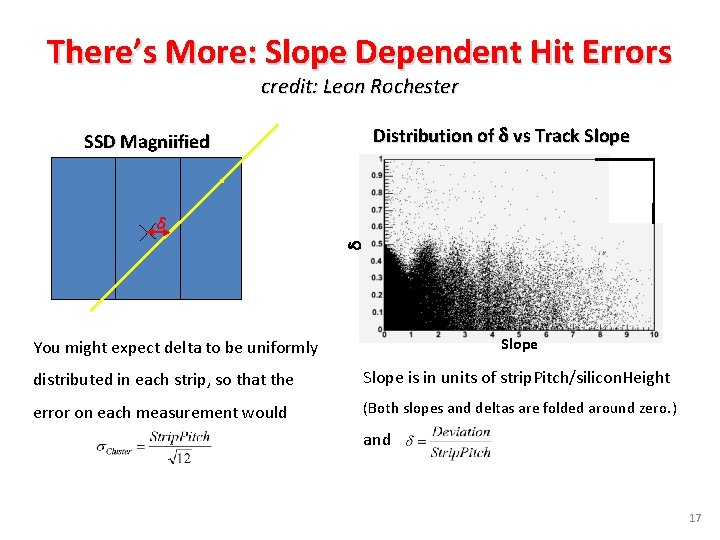
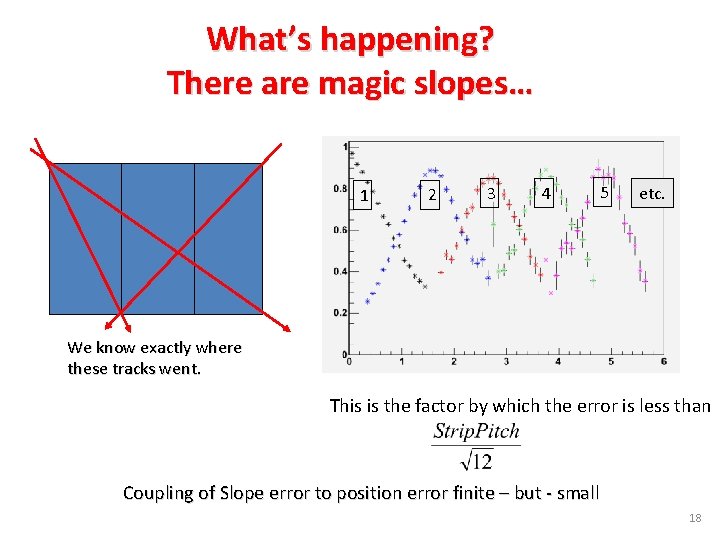
There’s More: Slope Dependent Hit Errors credit: Leon Rochester Distribution of d vs Track Slope SSD Magniified d δ Slope You might expect delta to be uniformly distributed in each strip, so that the Slope is in units of strip. Pitch/silicon. Height error on each measurement would (Both slopes and deltas are folded around zero. ) and 17
What’s happening? There are magic slopes… 1 2 3 4 5 etc. We know exactly where these tracks went. This is the factor by which the error is less than Coupling of Slope error to position error finite – but - small 18
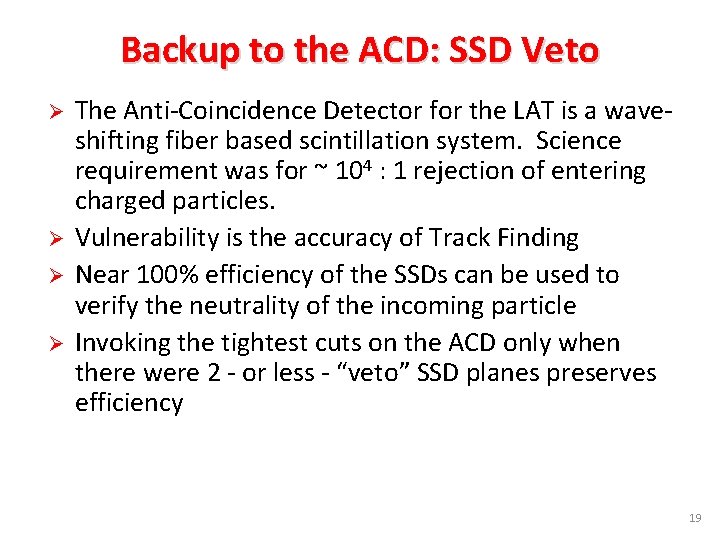
Backup to the ACD: SSD Veto Ø Ø The Anti-Coincidence Detector for the LAT is a waveshifting fiber based scintillation system. Science requirement was for ~ 104 : 1 rejection of entering charged particles. Vulnerability is the accuracy of Track Finding Near 100% efficiency of the SSDs can be used to verify the neutrality of the incoming particle Invoking the tightest cuts on the ACD only when there were 2 - or less - “veto” SSD planes preserves efficiency 19
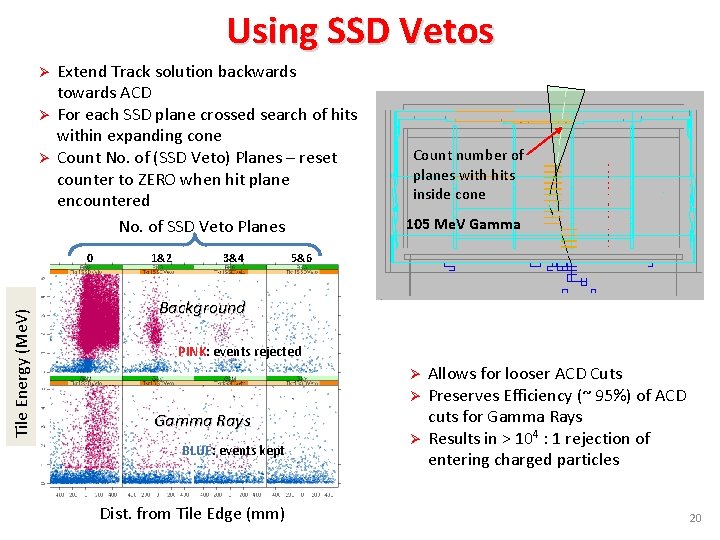
Using SSD Vetos Ø Ø Ø Extend Track solution backwards towards ACD For each SSD plane crossed search of hits within expanding cone Count No. of (SSD Veto) Planes – reset counter to ZERO when hit plane encountered No. of SSD Veto Planes Tile Energy (Me. V) 0 1&2 3&4 Count number of planes with hits inside cone 105 Me. V Gamma 5&6 Background PINK: events rejected Ø Ø Gamma Rays BLUE: events kept Dist. from Tile Edge (mm) Ø Allows for looser ACD Cuts Preserves Efficiency (~ 95%) of ACD cuts for Gamma Rays Results in > 104 : 1 rejection of entering charged particles 20
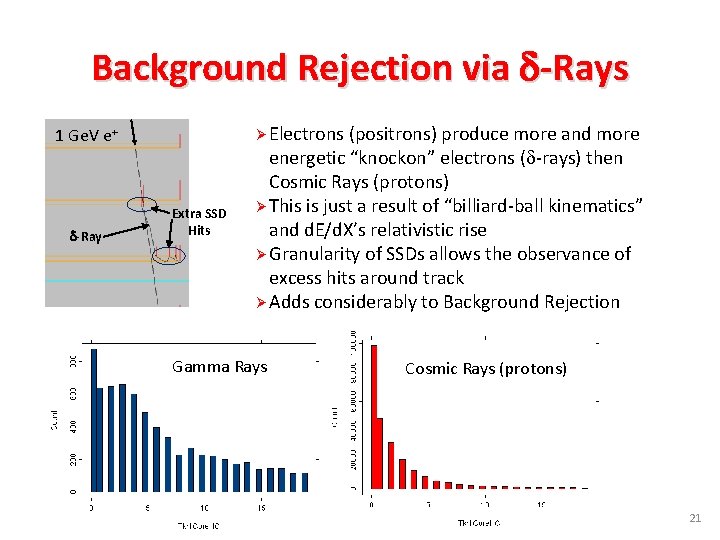
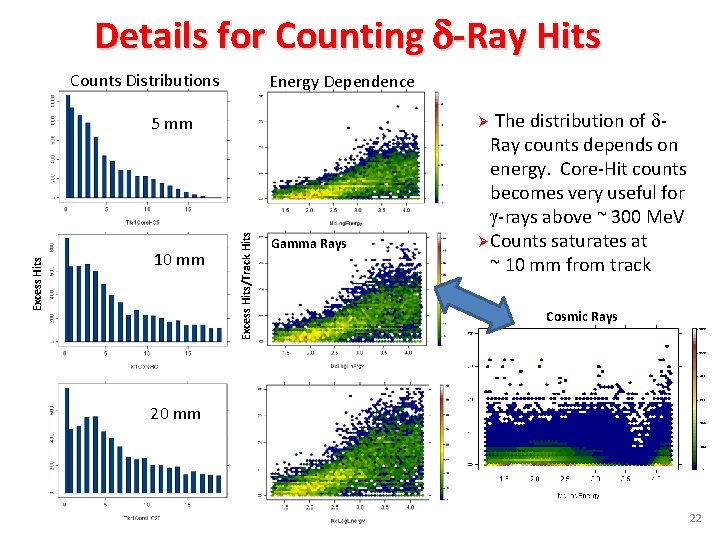
Background Rejection via d-Rays Ø Electrons (positrons) produce more and more 1 Ge. V e+ d-Ray Extra SSD Hits energetic “knockon” electrons (d-rays) then Cosmic Rays (protons) Ø This is just a result of “billiard-ball kinematics” and d. E/d. X’s relativistic rise Ø Granularity of SSDs allows the observance of excess hits around track Ø Adds considerably to Background Rejection Gamma Rays Cosmic Rays (protons) 21
Details for Counting d-Ray Hits Counts Distributions Energy Dependence 10 mm The distribution of d. Ray counts depends on energy. Core-Hit counts becomes very useful for -rays above ~ 300 Me. V Ø Counts saturates at ~ 10 mm from track Ø Excess Hits/Track Hits Excess Hits 5 mm Gamma Rays Cosmic Rays 20 mm 22
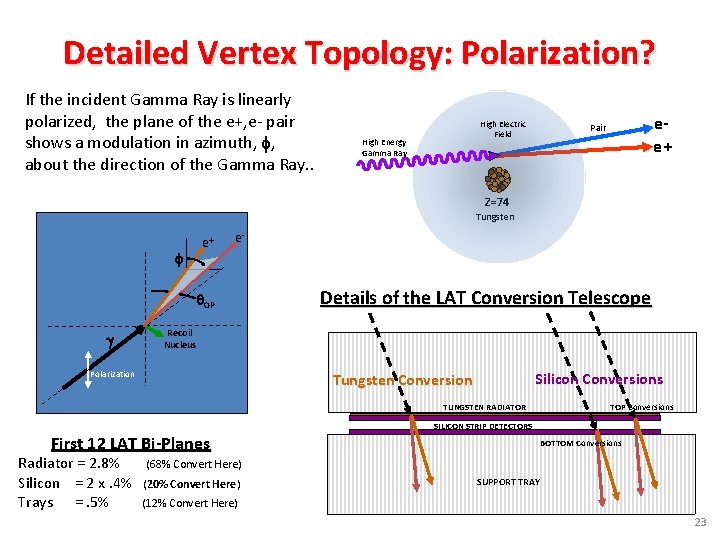
Detailed Vertex Topology: Polarization? If the incident Gamma Ray is linearly polarized, the plane of the e+, e- pair shows a modulation in azimuth, f, about the direction of the Gamma Ray. . High Electric Field High Energy Gamma Ray ee+ Pair Z=74 Tungsten f e+ e- q. OP Details of the LAT Conversion Telescope Recoil Nucleus Polarization Silicon Conversions Tungsten Conversion TOP Conversions TUNGSTEN RADIATOR First 12 LAT Bi-Planes Radiator = 2. 8% Silicon = 2 x. 4% Trays =. 5% SILICON STRIP DETECTORS BOTTOM Conversions (68% Convert Here) (20% Convert Here) SUPPORT TRAY (12% Convert Here) 23
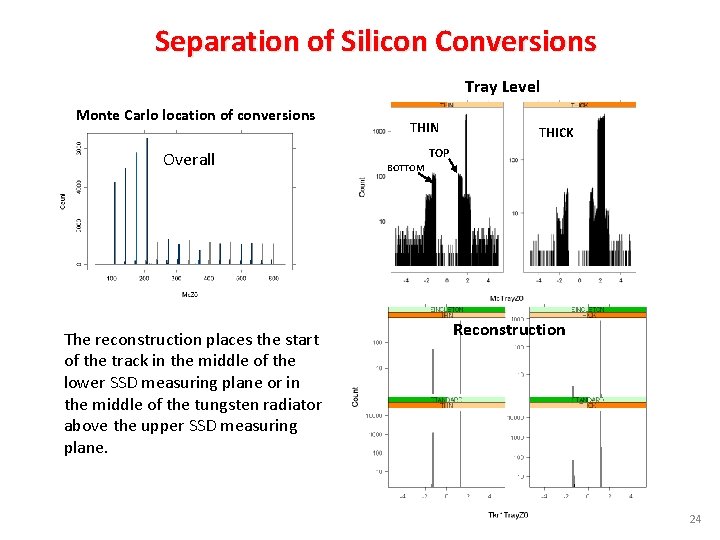
Separation of Silicon Conversions Tray Level Monte Carlo location of conversions Overall The reconstruction places the start of the track in the middle of the lower SSD measuring plane or in the middle of the tungsten radiator above the upper SSD measuring plane. THIN THICK TOP BOTTOM Reconstruction 24
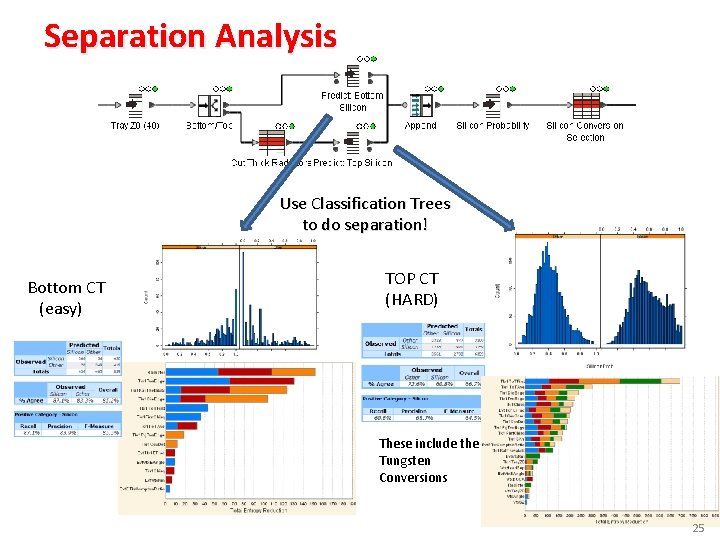
Separation Analysis Use Classification Trees to do separation! Bottom CT (easy) TOP CT (HARD) These include the Tungsten Conversions 25
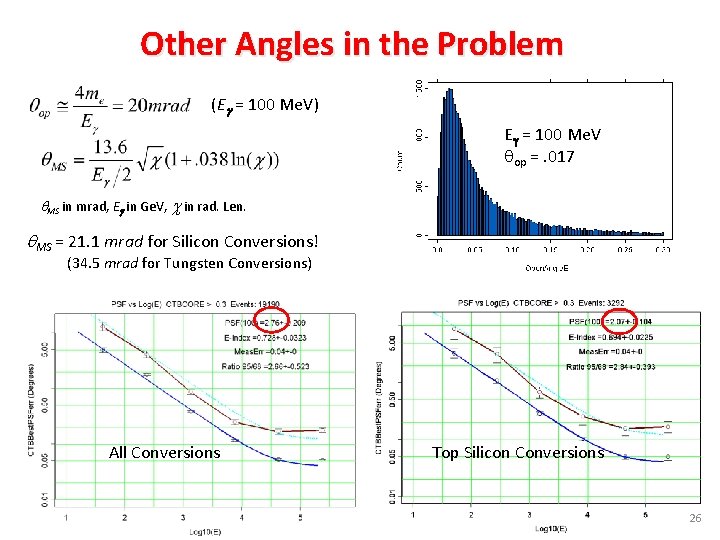
Other Angles in the Problem (Eg = 100 Me. V) E = 100 Me. V qop =. 017 q. MS in mrad, Eg in Ge. V, c in rad. Len. q. MS = 21. 1 mrad for Silicon Conversions! (34. 5 mrad for Tungsten Conversions) All Conversions Top Silicon Conversions 26
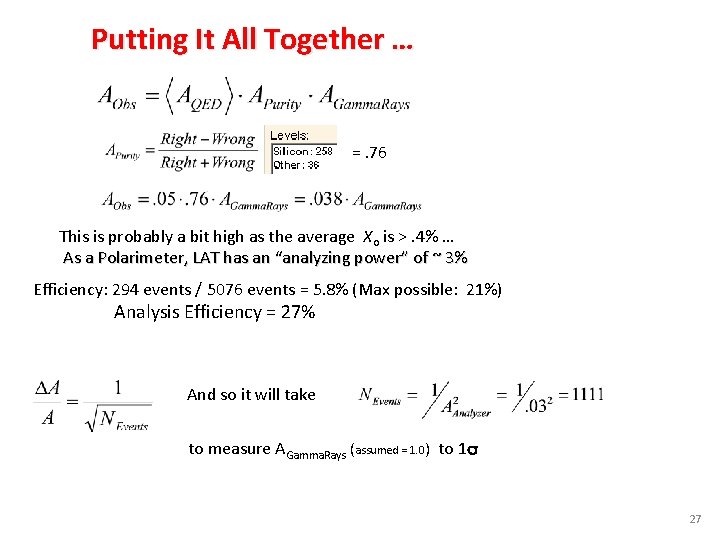
Putting It All Together … =. 76 This is probably a bit high as the average Xo is >. 4% … As a Polarimeter, LAT has an “analyzing power” of ~ 3% Efficiency: 294 events / 5076 events = 5. 8% (Max possible: 21%) Analysis Efficiency = 27% And so it will take to measure AGamma. Rays (assumed = 1. 0) to 1 s 27
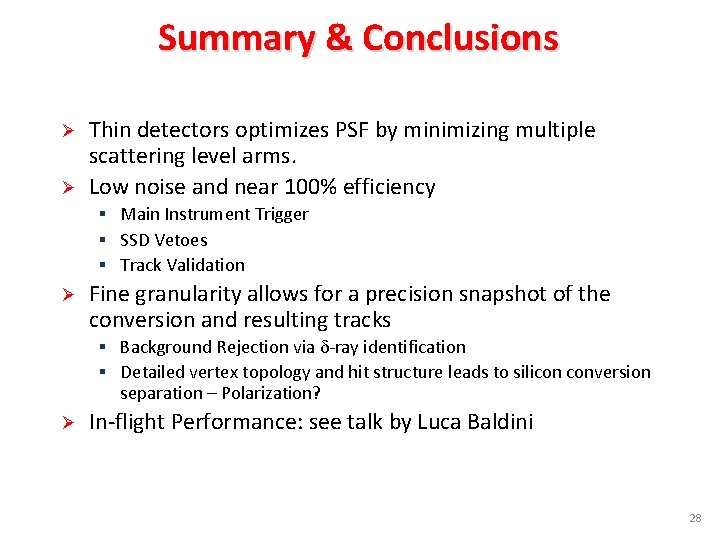
Summary & Conclusions Ø Ø Thin detectors optimizes PSF by minimizing multiple scattering level arms. Low noise and near 100% efficiency § Main Instrument Trigger § SSD Vetoes § Track Validation Ø Fine granularity allows for a precision snapshot of the conversion and resulting tracks § Background Rejection via d-ray identification § Detailed vertex topology and hit structure leads to silicon conversion separation – Polarization? Ø In-flight Performance: see talk by Luca Baldini 28