
Fermilab Tevatron Collimator Experience Dean Still April 14
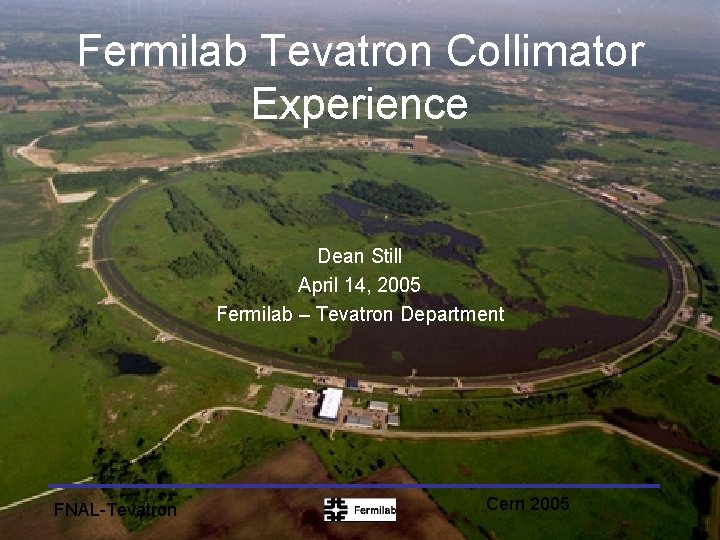
Fermilab Tevatron Collimator Experience Dean Still April 14, 2005 Fermilab – Tevatron Department FNAL-Tevatron Cern 2005
Tevatron Collimator Experience • Introduction: – Tevatron Machine Parameters – Overview Tevatron Collimator System • Halo Removal Performance • Protecting Against Abort Kicker Prefires • Collimators , Quenching and Damage FNAL-Tevatron Cern 2005
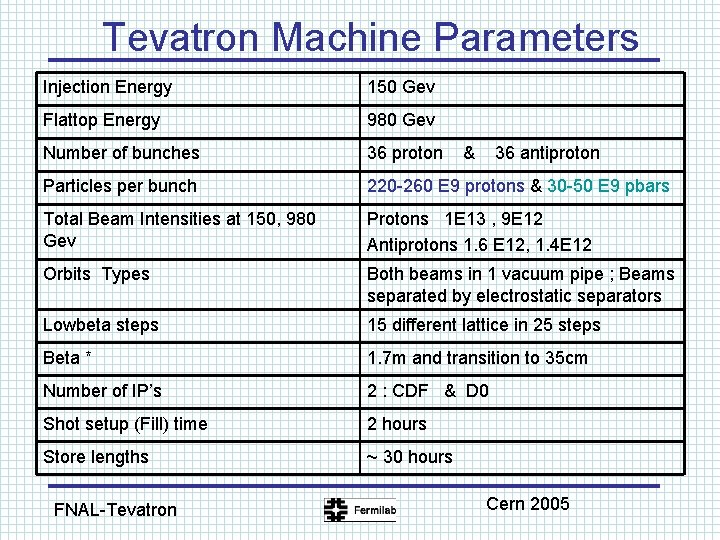
Tevatron Machine Parameters Injection Energy 150 Gev Flattop Energy 980 Gev Number of bunches 36 proton Particles per bunch 220 -260 E 9 protons & 30 -50 E 9 pbars Total Beam Intensities at 150, 980 Gev Protons 1 E 13 , 9 E 12 Antiprotons 1. 6 E 12, 1. 4 E 12 Orbits Types Both beams in 1 vacuum pipe ; Beams separated by electrostatic separators Lowbeta steps 15 different lattice in 25 steps Beta * 1. 7 m and transition to 35 cm Number of IP’s 2 : CDF & D 0 Shot setup (Fill) time 2 hours Store lengths ~ 30 hours FNAL-Tevatron & 36 antiproton Cern 2005
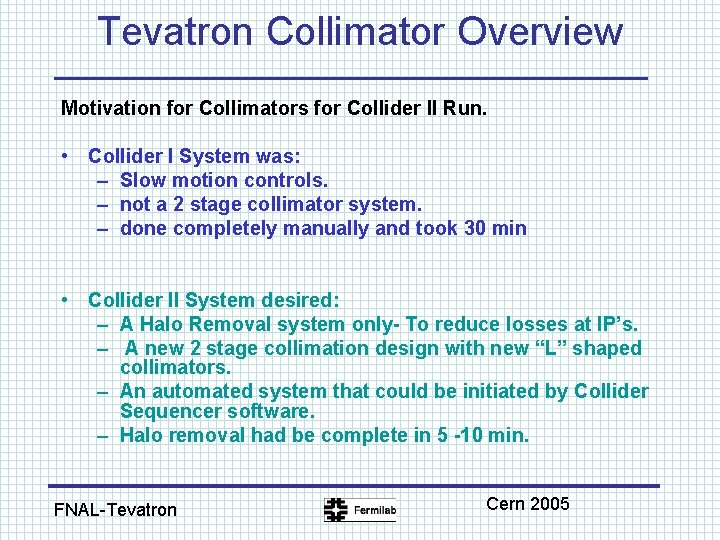
Tevatron Collimator Overview Motivation for Collimators for Collider II Run. • Collider I System was: – Slow motion controls. – not a 2 stage collimator system. – done completely manually and took 30 min • Collider II System desired: – A Halo Removal system only- To reduce losses at IP’s. – A new 2 stage collimation design with new “L” shaped collimators. – An automated system that could be initiated by Collider Sequencer software. – Halo removal had be complete in 5 -10 min. FNAL-Tevatron Cern 2005
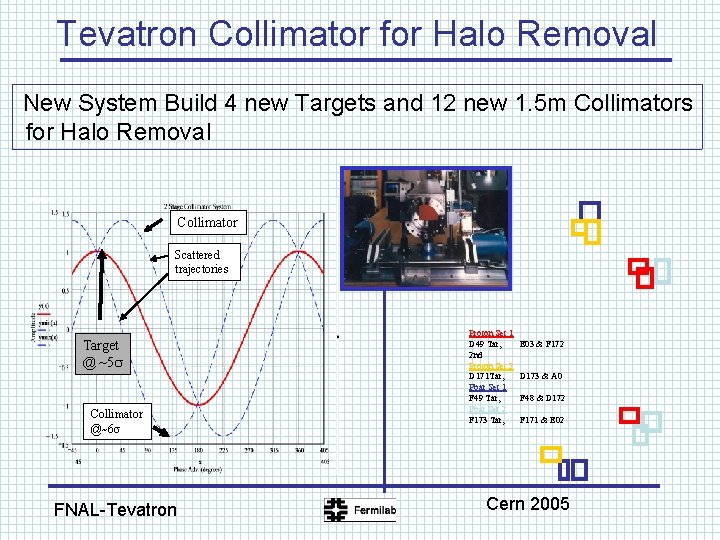
Tevatron Collimator for Halo Removal New System Build 4 new Targets and 12 new 1. 5 m Collimators for Halo Removal Collimator Scattered trajectories Target @ ~5 s Collimator @~6 s FNAL-Tevatron Proton Set 1 D 49 Tar, 2 nd Proton Set 2 D 171 Tar, Pbar Set 1 F 49 Tar, Pbar Set 2 F 173 Tar, E 03 & F 172 D 173 & A 0 F 48 & D 172 F 171 & E 02 Cern 2005
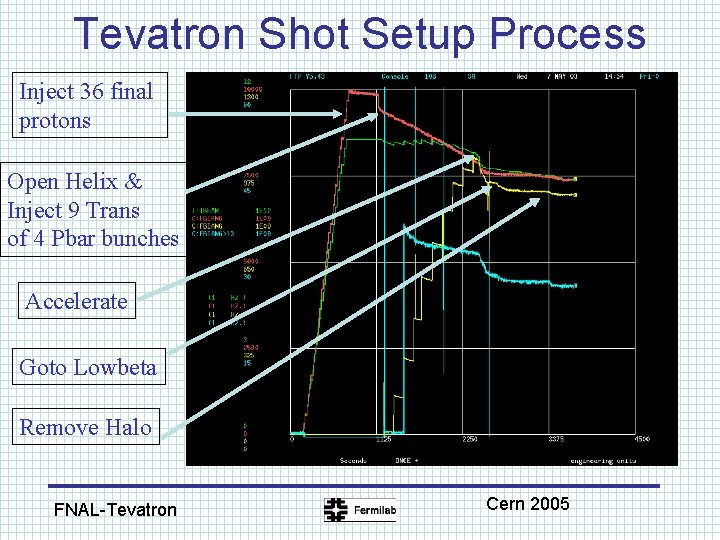
Tevatron Shot Setup Process Inject 36 final protons Open Helix & Inject 9 Trans of 4 Pbar bunches Accelerate Goto Lowbeta Remove Halo FNAL-Tevatron Cern 2005
Collimator Moving Order for Halo Removal Collimators move under 2 types of feedback: 1) Loss monitor Feedback 2) Beam intensity and Loss monitor feedback FNAL-Tevatron Cern 2005
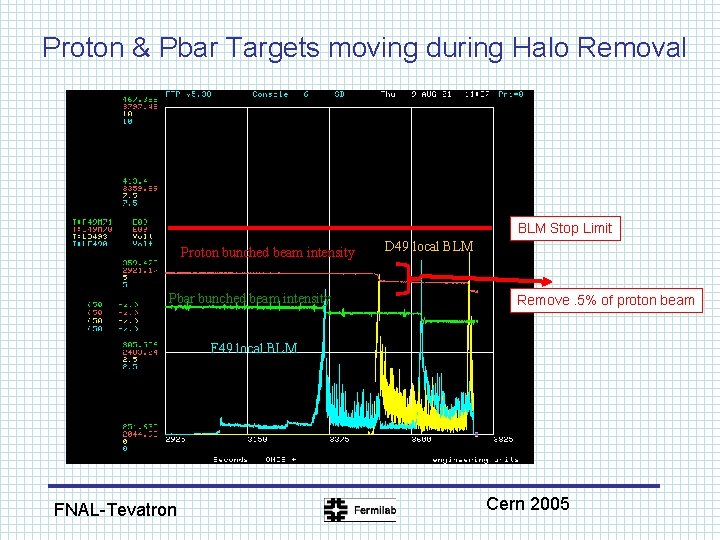
Proton & Pbar Targets moving during Halo Removal BLM Stop Limit Proton bunched beam intensity Pbar bunched beam intensity D 49 local BLM Remove. 5% of proton beam F 49 local BLM FNAL-Tevatron Cern 2005
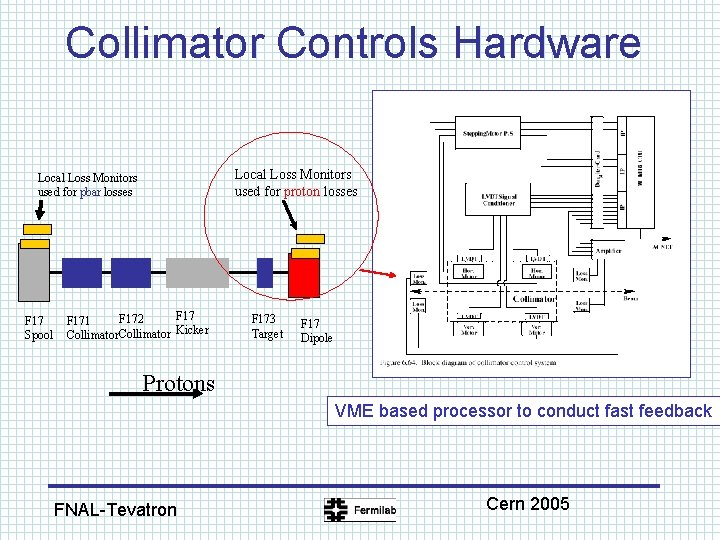
Collimator Controls Hardware Local Loss Monitors used for proton losses Local Loss Monitors used for pbar losses F 17 Spool F 172 F 171 Collimator Kicker F 173 Target F 17 Dipole Protons VME based processor to conduct fast feedback FNAL-Tevatron Cern 2005
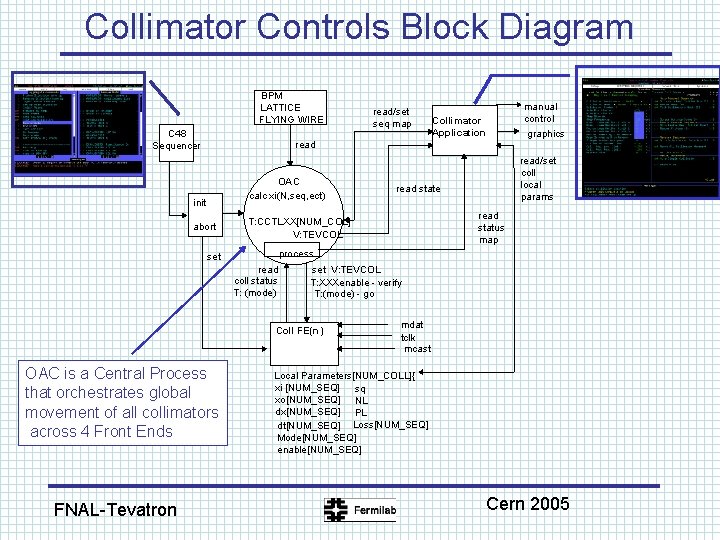
Collimator Controls Block Diagram BPM LATTICE FLYING WIRE C 48 Sequencer Collimator Application manual control graphics read OAC calc xi(N, seq, ect) init abort read status map process read coll status T: (mode) set V: TEVCOL T: XXXenable - verify T: (mode) - go Coll FE(n) OAC is a Central Process that orchestrates global movement of all collimators across 4 Front Ends read/set coll local params read state T: CCTLXX[NUM_COL] V: TEVCOL set FNAL-Tevatron read/set seq map mdat tclk mcast Local Parameters[NUM_COLL]{ xi [NUM_SEQ] sq xo[NUM_SEQ] NL dx[NUM_SEQ] PL dt[NUM_SEQ] Loss[NUM_SEQ] Mode[NUM_SEQ] enable[NUM_SEQ] Cern 2005
Tevatron Collimator Experience • Introduction: – Tevatron Machine Parameters – Overview Tevatron Collimator System • Halo Removal Performance • Protecting Against Abort Kicker Prefires • Collimators , Quenching and Damage FNAL-Tevatron Cern 2005
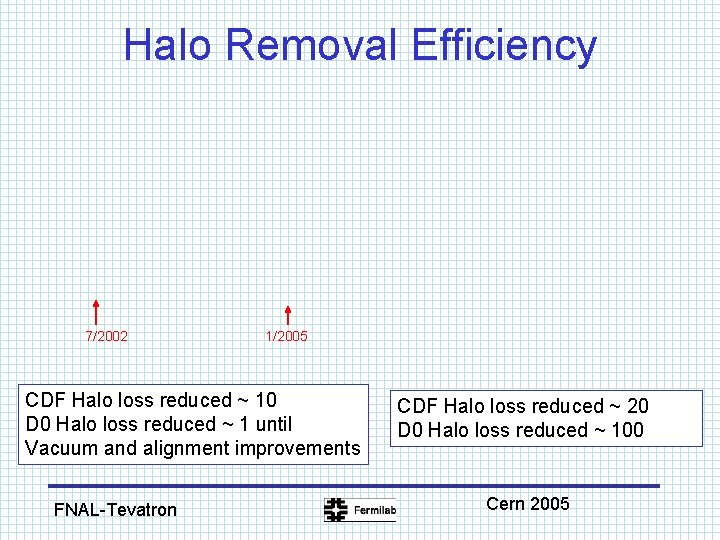
Halo Removal Efficiency 7/2002 1/2005 CDF Halo loss reduced ~ 10 D 0 Halo loss reduced ~ 1 until Vacuum and alignment improvements FNAL-Tevatron CDF Halo loss reduced ~ 20 D 0 Halo loss reduced ~ 100 Cern 2005
CDF & D 0 Halo Loss vs. Store FNAL-Tevatron Cern 2005
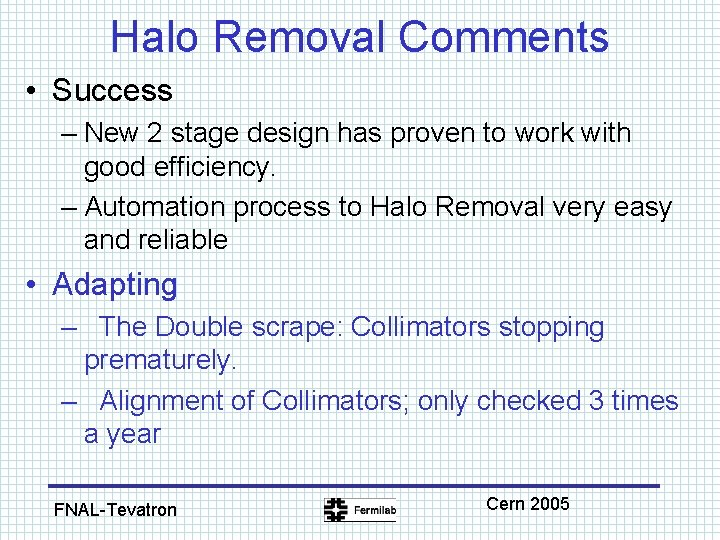
Halo Removal Comments • Success – New 2 stage design has proven to work with good efficiency. – Automation process to Halo Removal very easy and reliable • Adapting – The Double scrape: Collimators stopping prematurely. – Alignment of Collimators; only checked 3 times a year FNAL-Tevatron Cern 2005
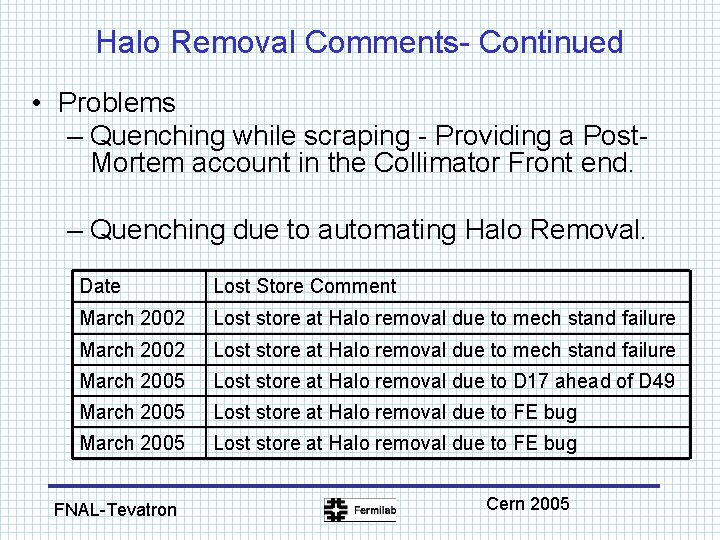
Halo Removal Comments- Continued • Problems – Quenching while scraping - Providing a Post. Mortem account in the Collimator Front end. – Quenching due to automating Halo Removal. Date Lost Store Comment March 2002 Lost store at Halo removal due to mech stand failure March 2005 Lost store at Halo removal due to D 17 ahead of D 49 March 2005 Lost store at Halo removal due to FE bug FNAL-Tevatron Cern 2005
Tevatron Collimator Experience • Introduction: – Tevatron Machine Parameters – Overview Tevatron Collimator System • Halo Removal Performance • Protecting Against Abort Kicker Prefires • Collimators , Quenching and Damage FNAL-Tevatron Cern 2005
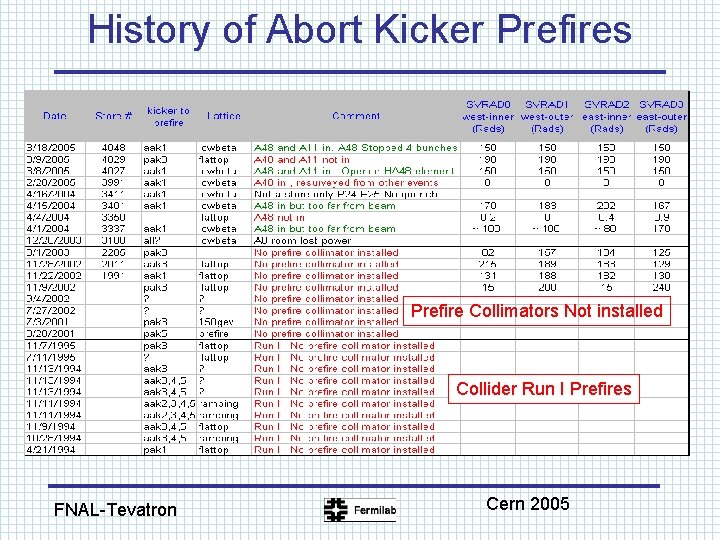
History of Abort Kicker Prefires Prefire Collimators Not installed Collider Run I Prefires FNAL-Tevatron Cern 2005
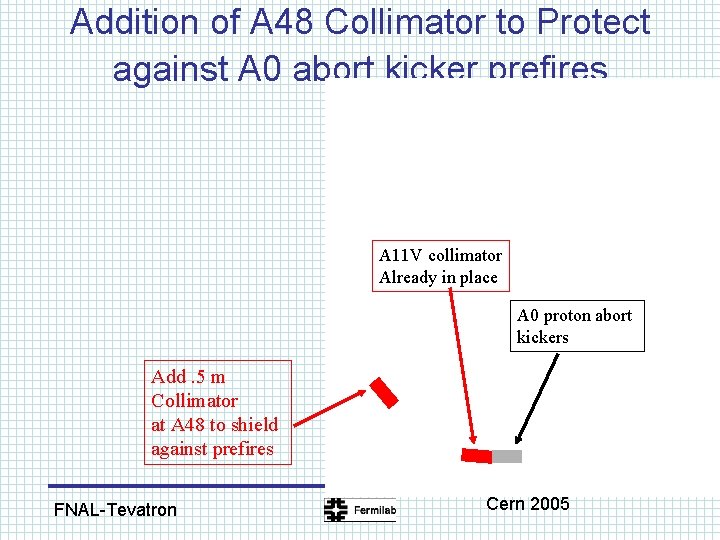
Addition of A 48 Collimator to Protect against A 0 abort kicker prefires A 11 V collimator Already in place A 0 proton abort kickers Add. 5 m Collimator at A 48 to shield against prefires FNAL-Tevatron Cern 2005
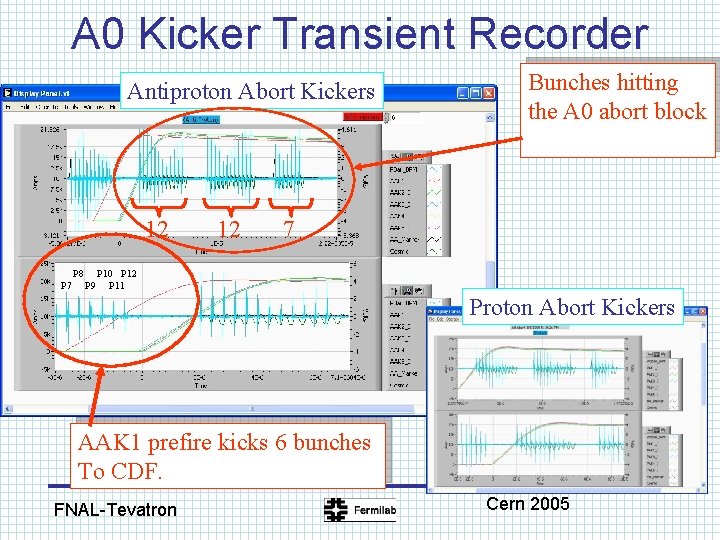
A 0 Kicker Transient Recorder Antiproton Abort Kickers 12 P 8 P 7 P 9 12 Bunches hitting the A 0 abort block 7 P 10 P 12 P 11 Proton Abort Kickers AAK 1 prefire kicks 6 bunches To CDF. FNAL-Tevatron Cern 2005
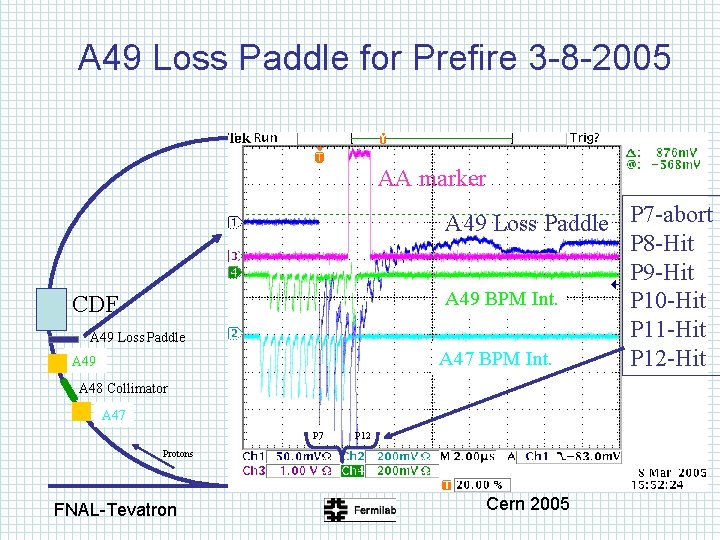
A 49 Loss Paddle for Prefire 3 -8 -2005 AA marker A 49 Loss Paddle P 7 -abort P 8 -Hit P 9 -Hit A 49 BPM Int. P 10 -Hit P 11 -Hit A 47 BPM Int. P 12 -Hit CDF A 49 Loss Paddle A 49 A 48 Collimator A 47 P 12 Protons FNAL-Tevatron Cern 2005
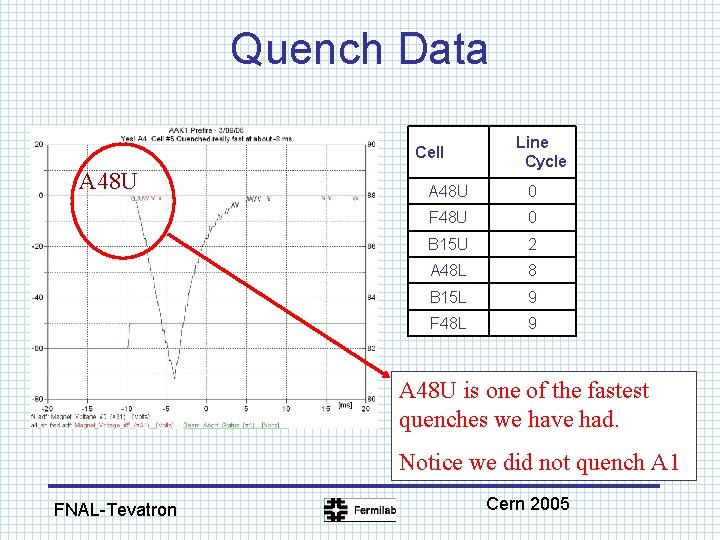
Quench Data Cell A 48 U Line Cycle A 48 U 0 F 48 U 0 B 15 U 2 A 48 L 8 B 15 L 9 F 48 L 9 A 48 U is one of the fastest quenches we have had. Notice we did not quench A 1 FNAL-Tevatron Cern 2005
Comments on Kicker Prefire and Collimators • Tevatron did not originally design a collimator system to protect against kicker prefires. • Once the collimator was installed, it was hard to tell if the prefired beam was hitting it. • Once confident prefired beam hit the collimator, may need to increase length to protect downstream cold spool. • Need a better post-mortem system to determine where all kicked bunches went. FNAL-Tevatron Cern 2005
Tevatron Collimator Experience • Introduction: – Tevatron Machine Parameters – Overview Tevatron Collimator System • Halo Removal Performance • Protecting Against Abort Kicker Prefires • Collimators , Quenching and Damage FNAL-Tevatron Cern 2005
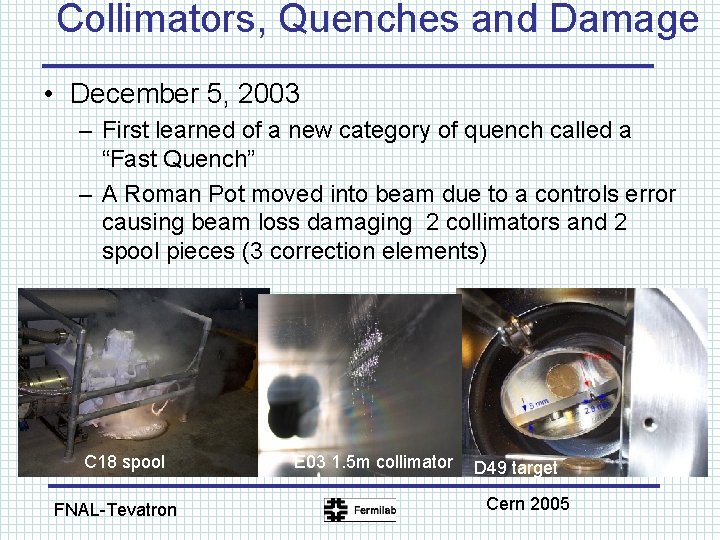
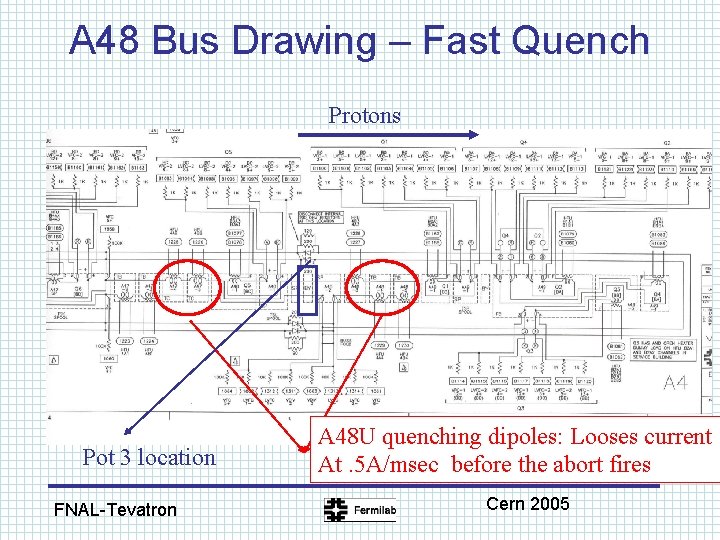
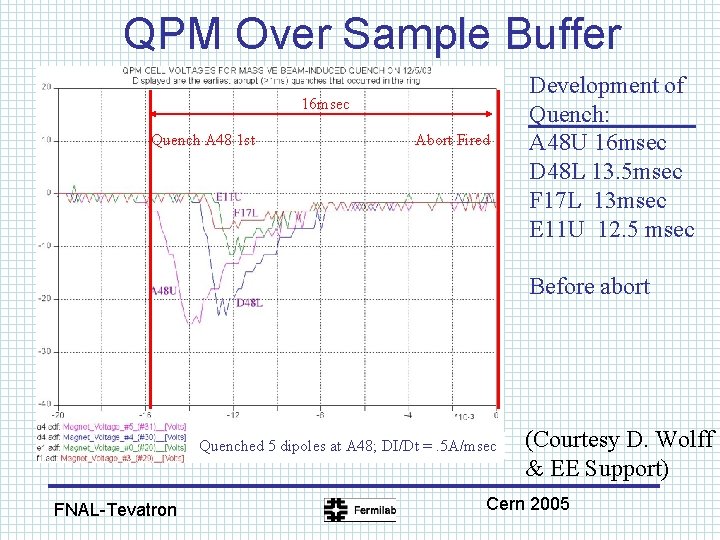
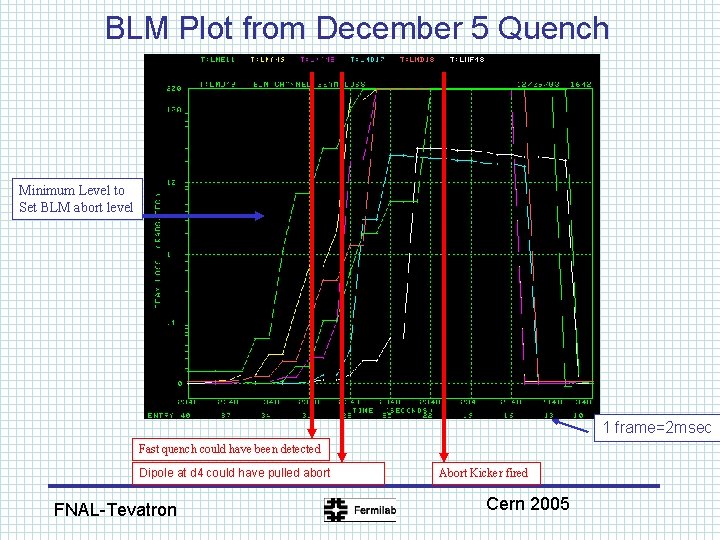
Collimators, Quenches and Damage • December 5, 2003 – First learned of a new category of quench called a “Fast Quench” – A Roman Pot moved into beam due to a controls error causing beam loss damaging 2 collimators and 2 spool pieces (3 correction elements) C 18 spool FNAL-Tevatron E 03 1. 5 m collimator D 49 target Cern 2005
A 48 Bus Drawing – Fast Quench Protons Pot 3 location FNAL-Tevatron A 48 U quenching dipoles: Looses current At. 5 A/msec before the abort fires Cern 2005
QPM Over Sample Buffer 16 msec Quench A 48 1 st Abort Fired Development of Quench: A 48 U 16 msec D 48 L 13. 5 msec F 17 L 13 msec E 11 U 12. 5 msec Before abort Quenched 5 dipoles at A 48; DI/Dt =. 5 A/msec FNAL-Tevatron (Courtesy D. Wolff & EE Support) Cern 2005
July 8, 2004 – B 11 Horizontal Separator Spark Quench Estimate of Orbit growth w/ QPM Fast Abort Fast Quench Resulting Orbit Due to fast quench Fast QPM abort would have stopped quenches in 4 other houses FNAL-Tevatron Cern 2005
BLM Plot from December 5 Quench Minimum Level to Set BLM abort level 1 frame=2 msec Fast quench could have been detected Dipole at d 4 could have pulled abort FNAL-Tevatron Abort Kicker fired Cern 2005
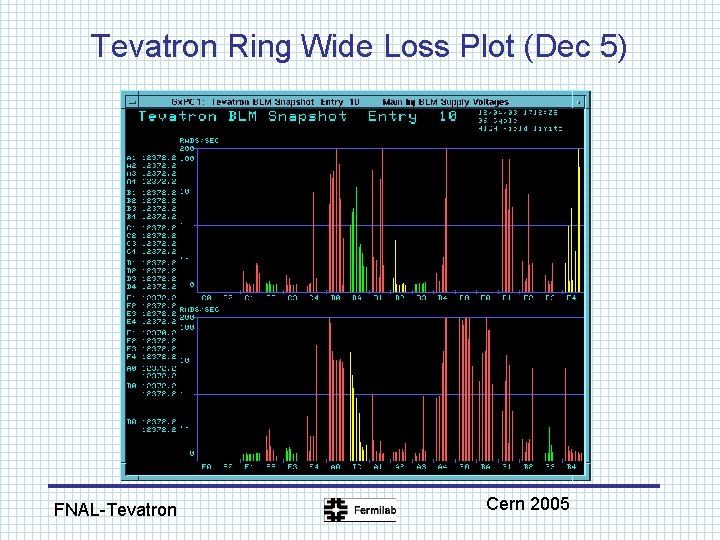
Tevatron Ring Wide Loss Plot (Dec 5) FNAL-Tevatron Cern 2005
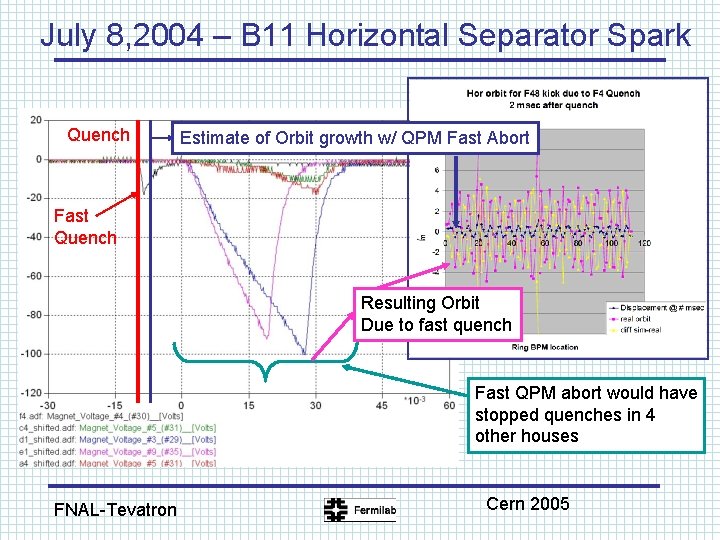
Comments on Fast Quench • Tevatron masks all BLM inputs during a store due to very high probability of false abort. • Fixed the Fast Quench by QPM code; over sample and detect a large quench. Pulls abort within 2 msec instead of 16 msec. • BLM upgrade is in the works to gain additional protection. • Host of mechanisms to create fast quench – Separator sparks – Motion controlled device, Vacuum values, pots, mirrors for sync light, collimators FNAL-Tevatron Cern 2005
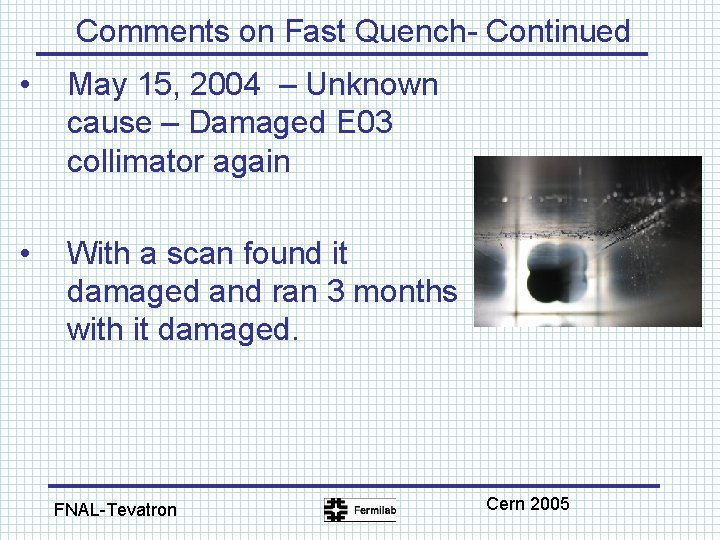
Comments on Fast Quench- Continued • May 15, 2004 – Unknown cause – Damaged E 03 collimator again • With a scan found it damaged and ran 3 months with it damaged. FNAL-Tevatron Cern 2005
Summary • Collider II Halo removal system has worked well as far as halo removal efficiency and automatic process. • Still working on improving collimator and post –mortem system for abort kicker prefires. • Dec 5, 2003 quench and damage was “wake up call” to rethink Tevatron beam loss protection. • Learned details of new category of “fast quenches”. • Implemented new QPM code to abort on detection of quench within 1 -2 msec, instead of 16 msec. But still mask BLM during stores due to false aborts. • Reviewed all motion controlled devices with appropriate Abort. – Vacuum abort upgrade done. – Pot motion upgrade done. • Insufficient process for gathering systematic and automatic data for analyzing past quenches involving beam loss. Working on better record keeping of data for every quench. • Provided input to new BLM system coming in 2005. FNAL-Tevatron Cern 2005
- Slides: 32