
Fermilab SRF Linac Development Steve Holmes Workshop on
Fermilab SRF Linac Development Steve Holmes Workshop on High Intensity Proton Accelerators October 19, 2009
Outline • Strategic Context/Evolution of the Fermilab Complex • Project X Goals and Initial Configurations • Research, Design, and Development Plan • Relationships to other Programs Project X website: Page 2 http: //projectx. fnal. gov/ HIPA Workshop - S. Holmes
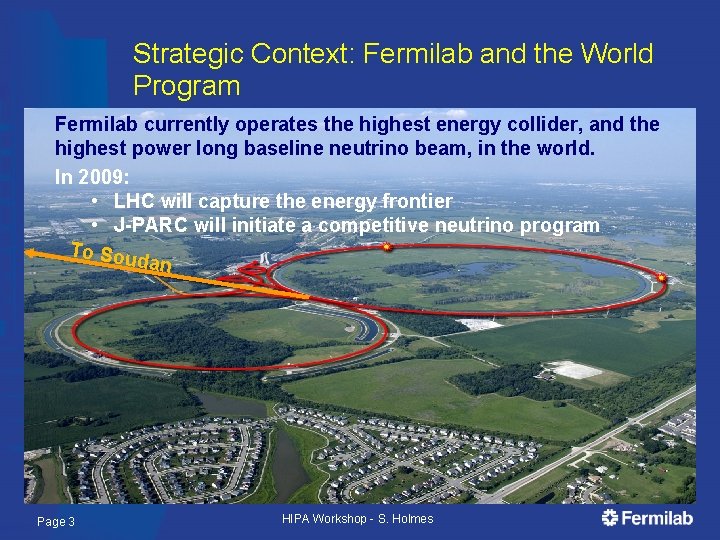
Strategic Context: Fermilab and the World Program Fermilab currently operates the highest energy collider, and the highest power long baseline neutrino beam, in the world. In 2009: • LHC will capture the energy frontier • J-PARC will initiate a competitive neutrino program To Sou dan Page 3 HIPA Workshop - S. Holmes
Evolution of the Fermilab Accelerator Complex • A multi-MW Proton Source, Project X, is the • linchpin of Fermilab’s strategy for future development of the accelerator complex. Provides long term flexibility/opportunities § Energy Frontier: Tevatron ILC or Muon Collider Ø Technology alignment Ø Fermilab as host site for ILC or MC § Intensity Frontier: Nu. MI NOn. A LBNE/mu 2 e PX Nu. Fact Ø World leading program in neutrino physics and other beyond the standard model phenomena Page 4 HIPA Workshop - S. Holmes
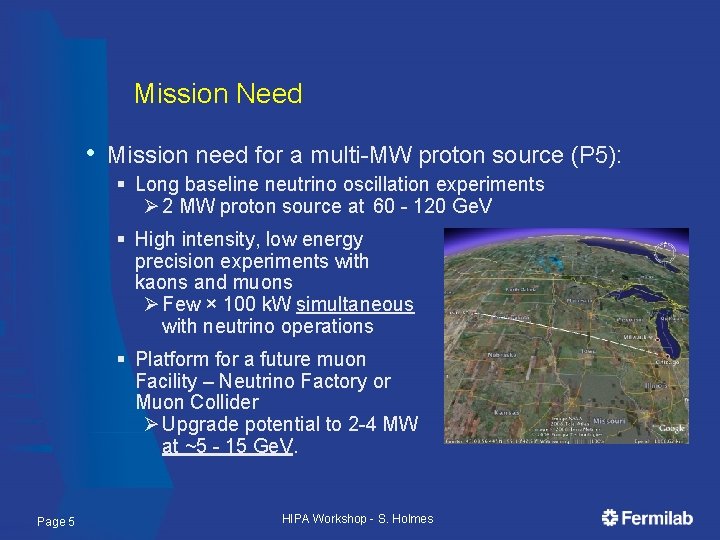
Mission Need • Mission need for a multi-MW proton source (P 5): § Long baseline neutrino oscillation experiments Ø 2 MW proton source at 60 - 120 Ge. V § High intensity, low energy precision experiments with kaons and muons Ø Few × 100 k. W simultaneous with neutrino operations § Platform for a future muon Facility – Neutrino Factory or Muon Collider Ø Upgrade potential to 2 -4 MW at ~5 - 15 Ge. V. Page 5 HIPA Workshop - S. Holmes
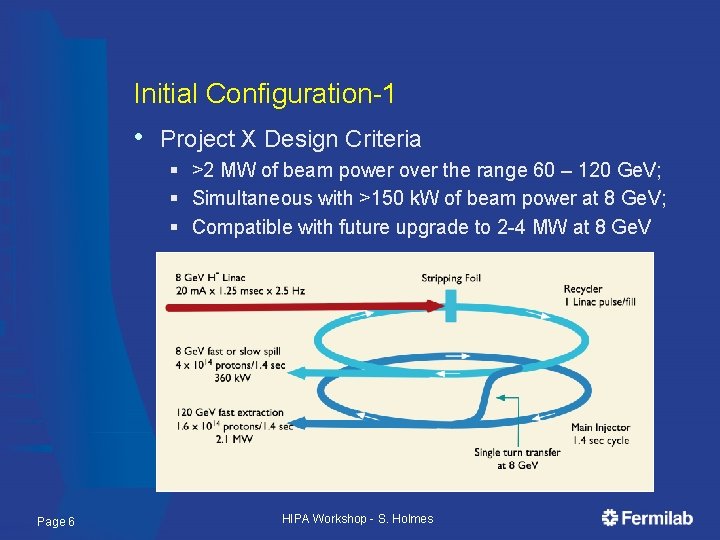
Initial Configuration-1 • Project X Design Criteria § >2 MW of beam power over the range 60 – 120 Ge. V; § Simultaneous with >150 k. W of beam power at 8 Ge. V; § Compatible with future upgrade to 2 -4 MW at 8 Ge. V Page 6 HIPA Workshop - S. Holmes
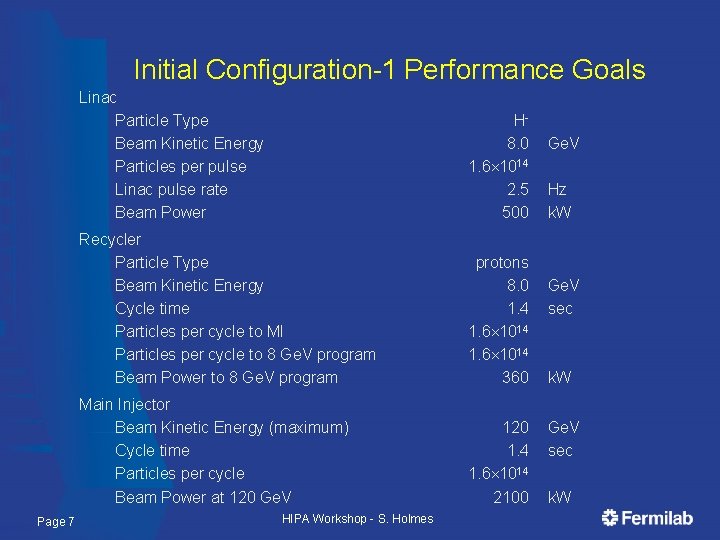
Initial Configuration-1 Performance Goals Page 7 Linac Particle Type Beam Kinetic Energy Particles per pulse Linac pulse rate Beam Power H 8. 0 1. 6 1014 2. 5 500 Recycler Particle Type Beam Kinetic Energy Cycle time Particles per cycle to MI Particles per cycle to 8 Ge. V program Beam Power to 8 Ge. V program protons 8. 0 1. 4 1. 6 1014 360 Main Injector Beam Kinetic Energy (maximum) Cycle time Particles per cycle Beam Power at 120 Ge. V 120 1. 4 1. 6 1014 2100 HIPA Workshop - S. Holmes Ge. V Hz k. W Ge. V sec k. W
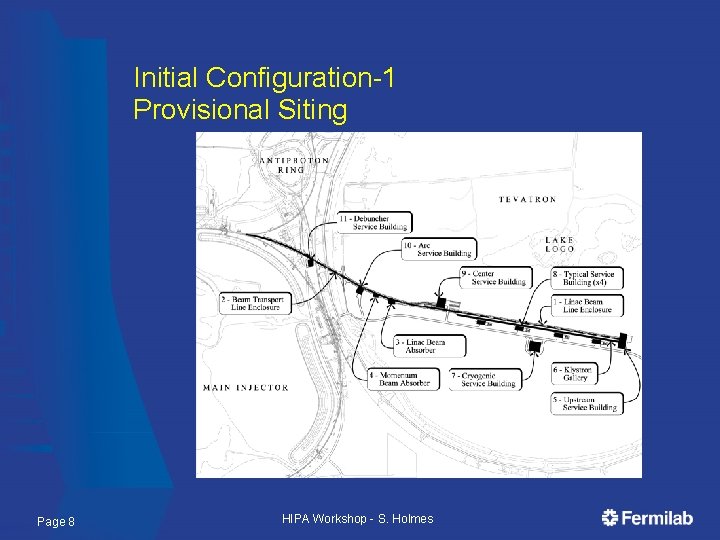
Initial Configuration-1 Provisional Siting Page 8 HIPA Workshop - S. Holmes
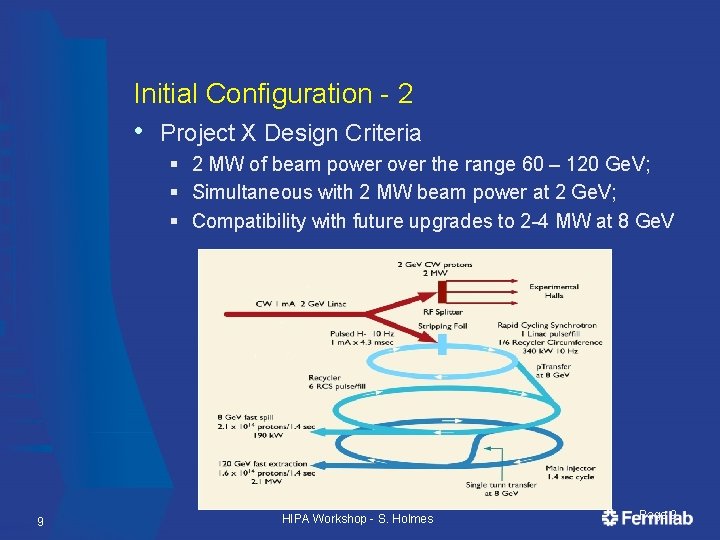
Initial Configuration - 2 • Project X Design Criteria § 2 MW of beam power over the range 60 – 120 Ge. V; § Simultaneous with 2 MW beam power at 2 Ge. V; § Compatibility with future upgrades to 2 -4 MW at 8 Ge. V 9 HIPA Workshop - S. Holmes Page 9
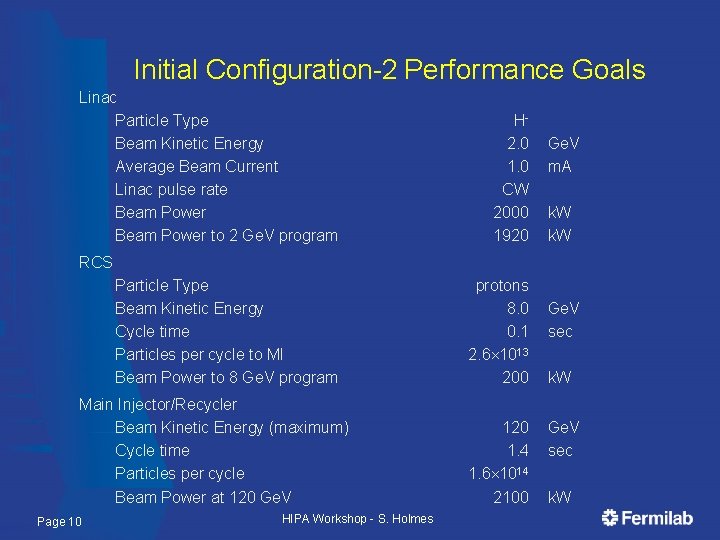
Initial Configuration-2 Performance Goals Linac Particle Type Beam Kinetic Energy Average Beam Current Linac pulse rate Beam Power to 2 Ge. V program H 2. 0 1. 0 CW 2000 1920 Ge. V m. A k. W RCS Particle Type Beam Kinetic Energy Cycle time Particles per cycle to MI Beam Power to 8 Ge. V program Main Injector/Recycler Beam Kinetic Energy (maximum) Cycle time Particles per cycle Beam Power at 120 Ge. V Page 10 HIPA Workshop - S. Holmes protons 8. 0 0. 1 2. 6 1013 200 120 1. 4 1. 6 1014 2100 Ge. V sec k. W
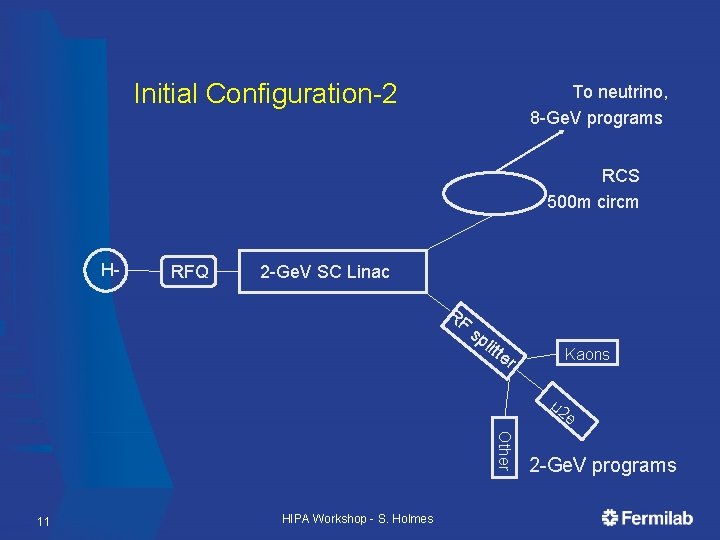
Initial Configuration-2 To neutrino, 8 -Ge. V programs RCS 500 m circm H- RFQ 2 -Ge. V SC Linac RF sp litt er Kaons µ 2 e Other 11 HIPA Workshop - S. Holmes 2 -Ge. V programs
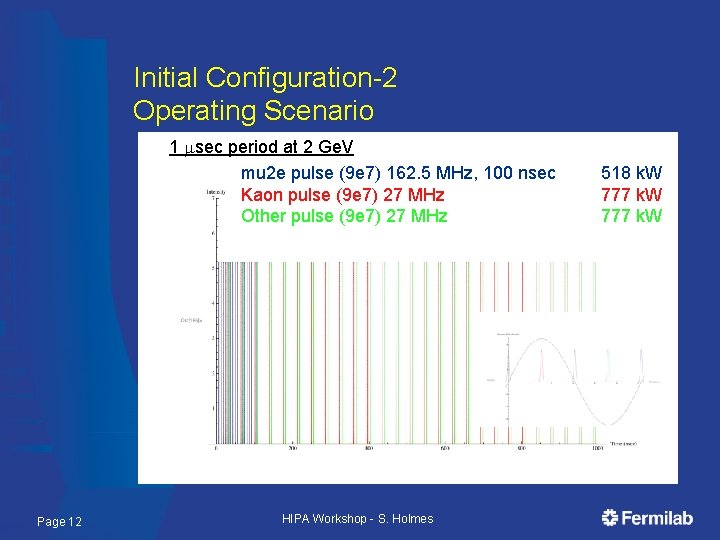
Initial Configuration-2 Operating Scenario 1 msec period at 2 Ge. V mu 2 e pulse (9 e 7) 162. 5 MHz, 100 nsec Kaon pulse (9 e 7) 27 MHz Other pulse (9 e 7) 27 MHz Page 12 HIPA Workshop - S. Holmes 518 k. W 777 k. W
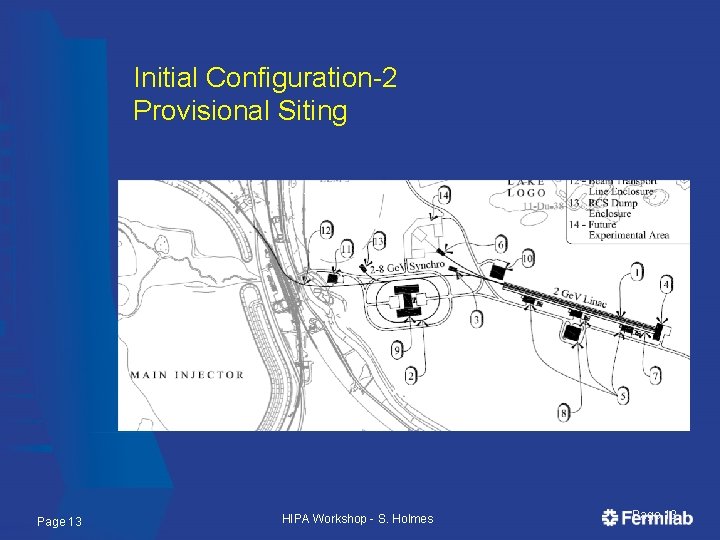
Initial Configuration-2 Provisional Siting Page 13 HIPA Workshop - S. Holmes Page 13
Near-term Strategy • Develop an Initial Configuration Document § Meeting the high level design criteria Released V 1. 1, March 2009: available at http: //projectx. fnal. gov/ • Revise/update the current RD&D Plan § Based on the ICD-1 Released V 2. 2, March 2009 following mid-February AAC evaluation • Create a preliminary cost range estimate § Based on the ICD-1 Complete and subject of Director’s Review March 16 -17, 2009 Page 14 HIPA Workshop - S. Holmes
Near-term Strategy • Establish design criteria and operating scenarios for alternative configurations § Alternative configuration (ICD-2) under development • Establish a multi-institutional collaboration for the RD&D phase § Collaboration established • CD-0 in 2010 § Based on: ICDs, preliminary cost estimates, P 5 mission definition § Coordinated with very long baseline (LBNE) and mu 2 e Page 15 HIPA Workshop - S. Holmes
Research Design and Development (RD&D) Plan • Primary goal is to complete a fully developed baseline scope, cost estimate, and schedule in 2012 -13 (CD-2). § Design and technical component development; § Undertaken by a multi-institutional collaboration capable of executing both the RD&D plan and the follow-on construction project • Secondary goals: § Coordinate Project X and ILC SCRF development programs; § Retain alignment with Neutrino Factory and Muon Collider programs Page 16 HIPA Workshop - S. Holmes
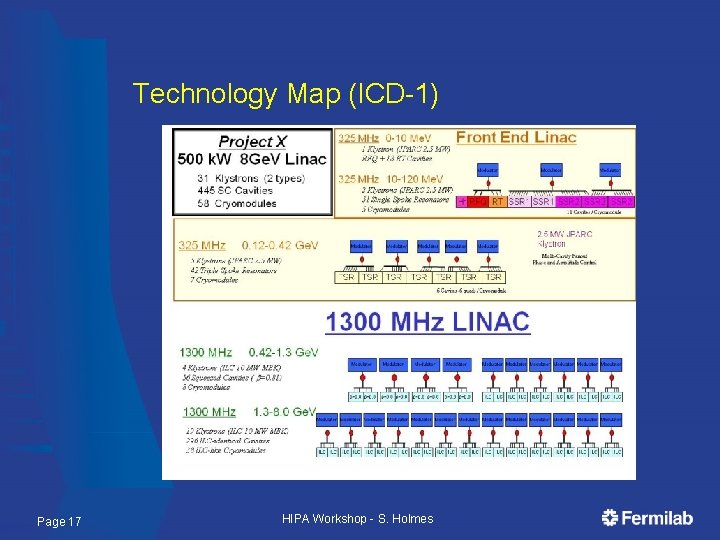
Technology Map (ICD-1) Page 17 HIPA Workshop - S. Holmes
Joint PX/HINS Strategy • The High Intensity Neutrino Source (HINS) program was established to pursue a new approach to high intensity, low energy ion acceleration. • HINS is a candidate for the Project X front end. § Designed for 27 m. A x 1 msec x 10 Hz • Primary goals: § Accelerate axially symmetric beam (solenoidal focusing) to 30 Me. V, utilizing superconducting rf technology beyond 10 Me. V § Demonstrate vector modulators for phase/amplitude control of individual cavities fed by a common rf source § Demonstrate high-speed (nsec) beam chopping at 2. 5 Me. V Goal is to complete facility (@30 Me. V) in ~2012 Page 18 HIPA Workshop - S. Holmes
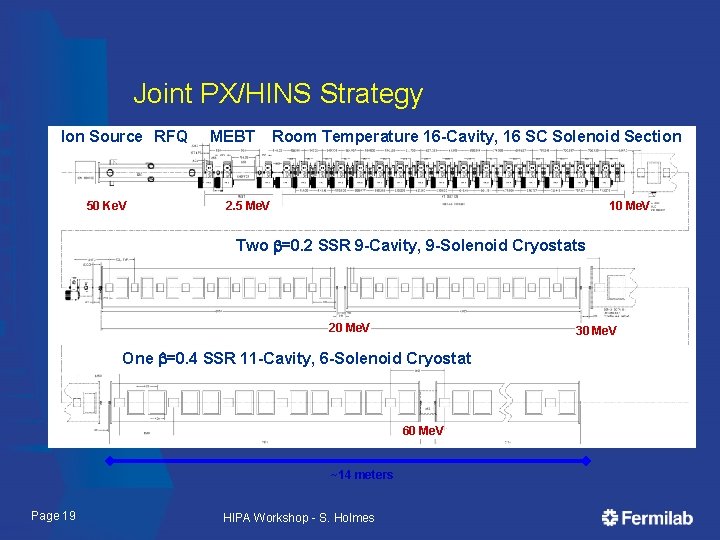
Joint PX/HINS Strategy Ion Source RFQ 50 Ke. V MEBT Room Temperature 16 -Cavity, 16 SC Solenoid Section 2. 5 Me. V 10 Me. V Two b=0. 2 SSR 9 -Cavity, 9 -Solenoid Cryostats 20 Me. V 30 Me. V One b=0. 4 SSR 11 -Cavity, 6 -Solenoid Cryostat 60 Me. V ~14 meters Page 19 HIPA Workshop - S. Holmes
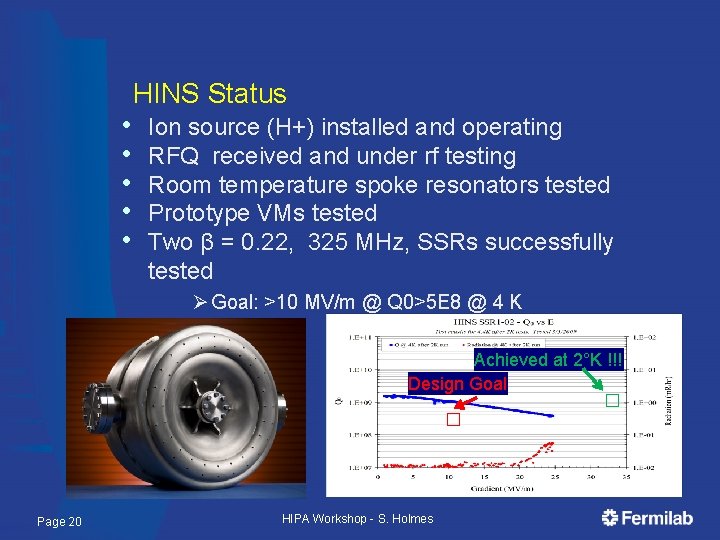
• • • HINS Status Ion source (H+) installed and operating RFQ received and under rf testing Room temperature spoke resonators tested Prototype VMs tested Two β = 0. 22, 325 MHz, SSRs successfully tested Ø Goal: >10 MV/m @ Q 0>5 E 8 @ 4 K Achieved at 2°K !!! Design Goal � � Page 20 HIPA Workshop - S. Holmes
Joint PX/ILC/SRF Strategy • Project X shares 1. 3 GHz technology with ILC § ICD-1/ICD-2 requires 46/20 ILC-like cryomodules. In detail they will not be identical to ILC: Ø Beam current: (3 ILC charge/pulse, ICD-1) Ø Focusing required in all CMs Ø Gradient: 25/16 MV/m • 4 year construction period 1 CM/month • Close coordination with GDE § Common development effort § Shared facilities for assembly and testing § Yield vs gradient is key metric Page 21 HIPA Workshop - S. Holmes
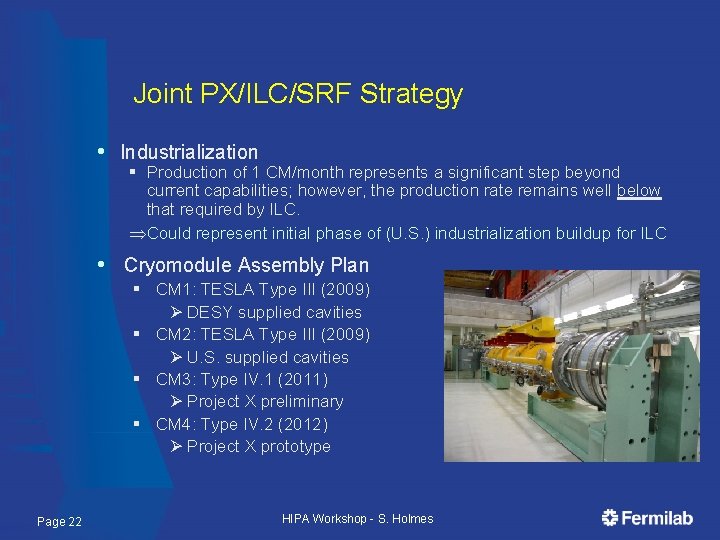
Joint PX/ILC/SRF Strategy • Industrialization § Production of 1 CM/month represents a significant step beyond current capabilities; however, the production rate remains well below that required by ILC. Could represent initial phase of (U. S. ) industrialization buildup for ILC • Cryomodule Assembly Plan § CM 1: TESLA Type III (2009) Ø DESY supplied cavities § CM 2: TESLA Type III (2009) Ø U. S. supplied cavities § CM 3: Type IV. 1 (2011) Ø Project X preliminary § CM 4: Type IV. 2 (2012) Ø Project X prototype Page 22 HIPA Workshop - S. Holmes
Collaboration Plan • Multi-institutional collaboration established to execute the Project X RD&D Program. § Organized as a “national project with international participation”. Ø Fermilab as lead laboratory Ø International participation via in-kind contributions, established via bi-lateral MOUs. (First MOU with India in place) Page 23 HIPA Workshop - S. Holmes
Collaboration Plan § (National) Collaboration MOU for the RD&D phase outlines basic goals, and the means of organizing and executing the work. Signatories: ANL ORNL/SNS BNL MSU Cornell TJNAF Fermilab SLAC LBNL ILC/ART § Collaborators to assume responsibility for components and sub-system design, development, cost estimating, and potentially construction. Page 24 HIPA Workshop - S. Holmes
Working Timeline (technically limited) • FY 2010 § CD-0: Mission Need § Initiate work on Conceptual Design Report • FY 2012 § CD-1: Initial Baseline Range • FY 2013 § CD-2: Baseline Project • FY 2014 § CD-3: Initiate Construction • ~FY 2014~2018 § Construct Page 25 HIPA Workshop - S. Holmes
Other Synergies • We are well aware that the technology we are developing is broadly applicable beyond Elementary Particle Physics: § § § Accelerator Driven Energy Systems Rare isotope production for nuclear physics Neutron Sources (e. g. SNS) X-ray FELs Energy recovery linacs Muon facilities for materials research… Hence, this workshop 26 HIPA Workshop - S. Holmes
Summary • Project X is central to Fermilab’s strategy for future development of the accelerator complex: § Energy Frontier: Aligned with ILC technology development; Fermilab as potential site for ILC or a Muon Collider § Intensity Frontier: World leading program in neutrinos and rare processes; Fermilab as potential Neutrino Factory site • Initial configurations established § >2 MW at 60 -120 Ge. V, simultaneous with up to 2 MW at 2 Ge. V • Strong technology synergies with many other applications • Work done in this workshop will be carried forward into the DOE Accelerators for America Workshop next week Page 27 HIPA Workshop - S. Holmes
- Slides: 27