
Fermentation process of silage The first stage Respiratory

- Slides: 26
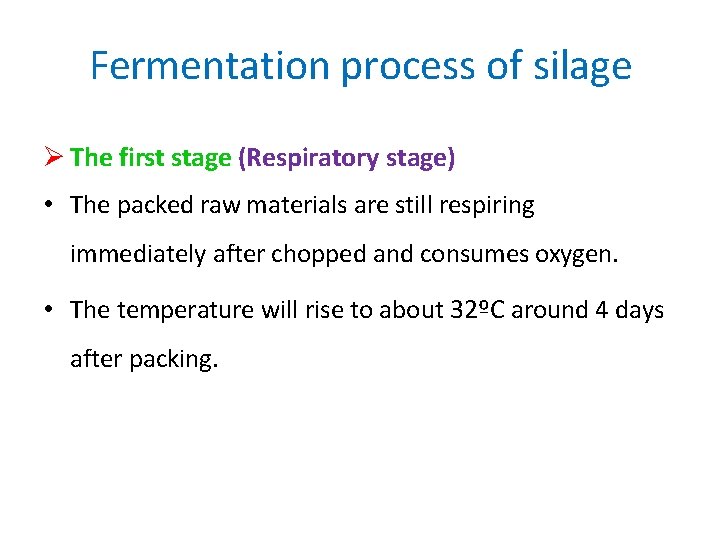
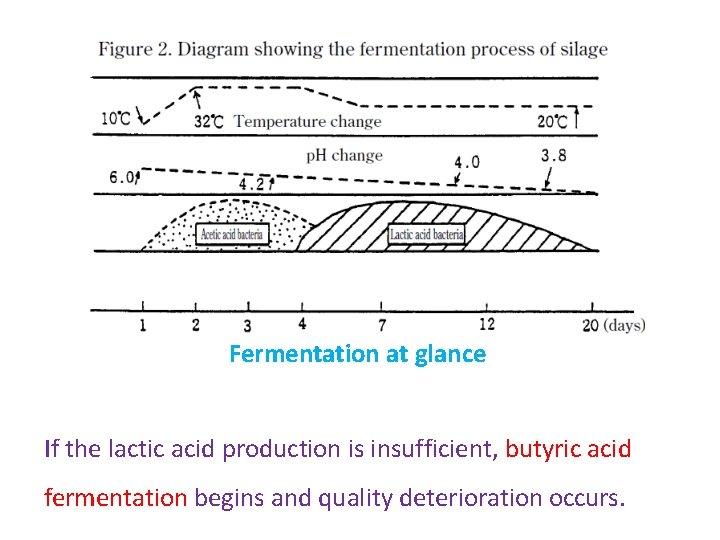
Fermentation process of silage The first stage (Respiratory stage) • The packed raw materials are still respiring immediately after chopped and consumes oxygen. • The temperature will rise to about 32ºC around 4 days after packing.
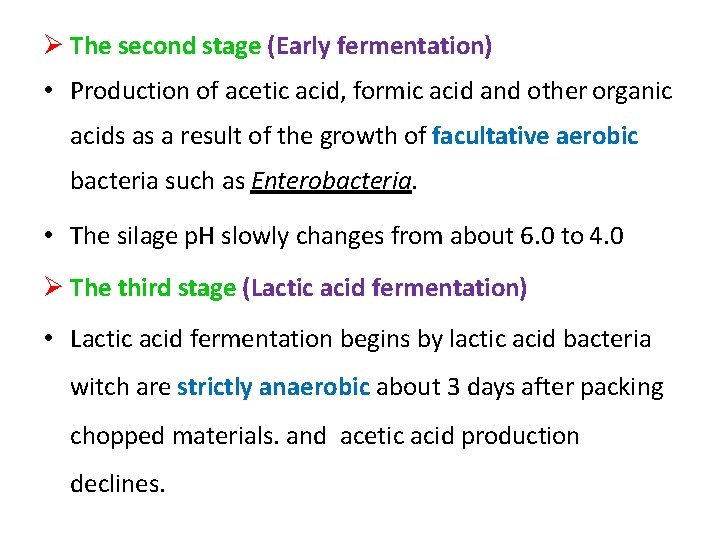
The second stage (Early fermentation) • Production of acetic acid, formic acid and other organic acids as a result of the growth of facultative aerobic bacteria such as Enterobacteria. • The silage p. H slowly changes from about 6. 0 to 4. 0 The third stage (Lactic acid fermentation) • Lactic acid fermentation begins by lactic acid bacteria witch are strictly anaerobic about 3 days after packing chopped materials. and acetic acid production declines.
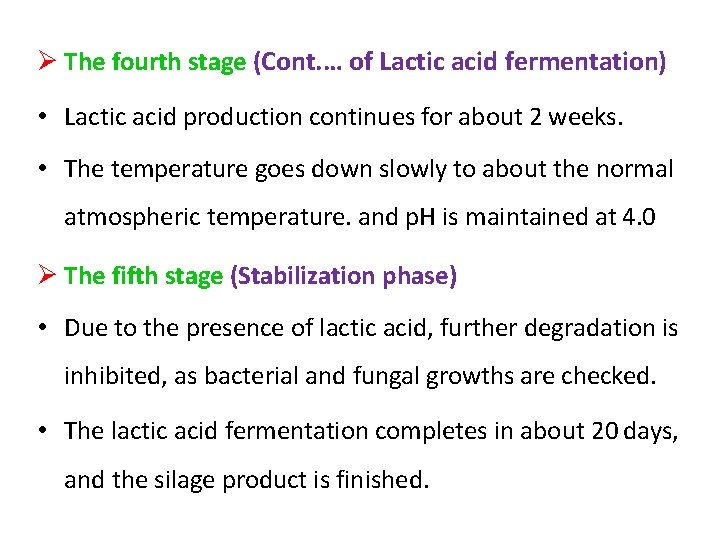
The fourth stage (Cont. … of Lactic acid fermentation) • Lactic acid production continues for about 2 weeks. • The temperature goes down slowly to about the normal atmospheric temperature. and p. H is maintained at 4. 0 The fifth stage (Stabilization phase) • Due to the presence of lactic acid, further degradation is inhibited, as bacterial and fungal growths are checked. • The lactic acid fermentation completes in about 20 days, and the silage product is finished.
Fermentation at glance If the lactic acid production is insufficient, butyric acid fermentation begins and quality deterioration occurs.
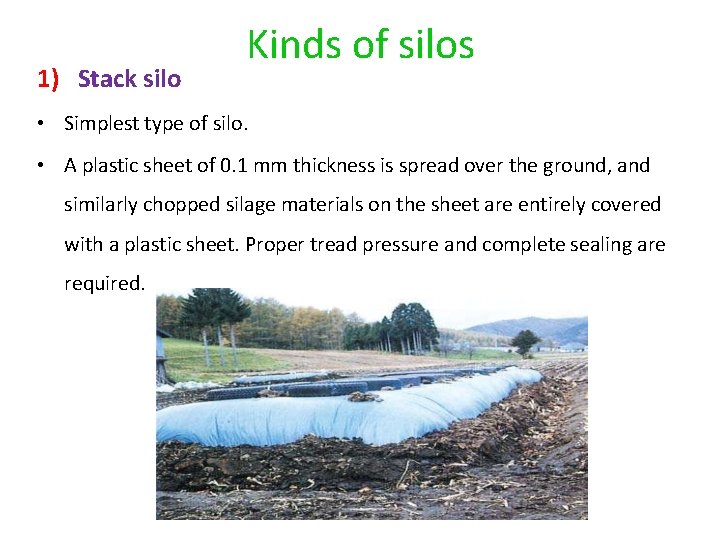
1) Stack silo Kinds of silos • Simplest type of silo. • A plastic sheet of 0. 1 mm thickness is spread over the ground, and similarly chopped silage materials on the sheet are entirely covered with a plastic sheet. Proper tread pressure and complete sealing are required.
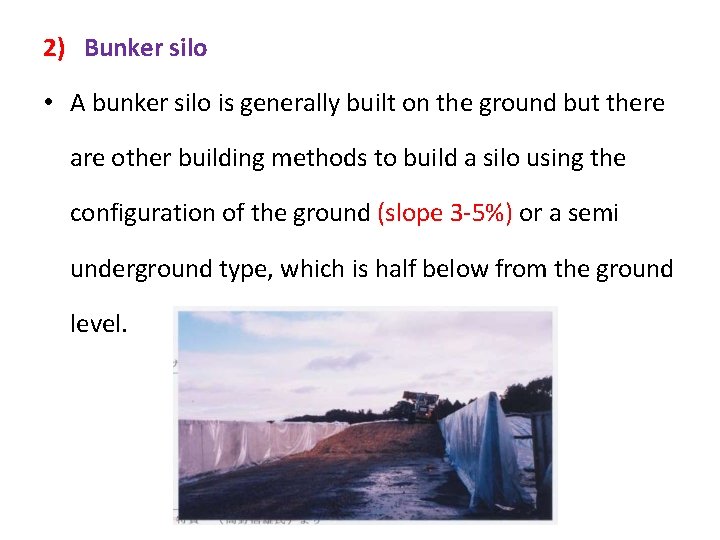
2) Bunker silo • A bunker silo is generally built on the ground but there are other building methods to build a silo using the configuration of the ground (slope 3 -5%) or a semi underground type, which is half below from the ground level.
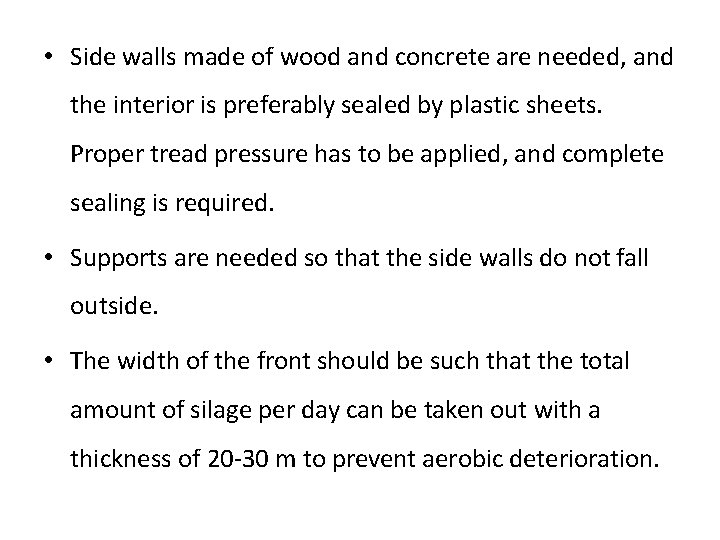
• Side walls made of wood and concrete are needed, and the interior is preferably sealed by plastic sheets. Proper tread pressure has to be applied, and complete sealing is required. • Supports are needed so that the side walls do not fall outside. • The width of the front should be such that the total amount of silage per day can be taken out with a thickness of 20 -30 m to prevent aerobic deterioration.
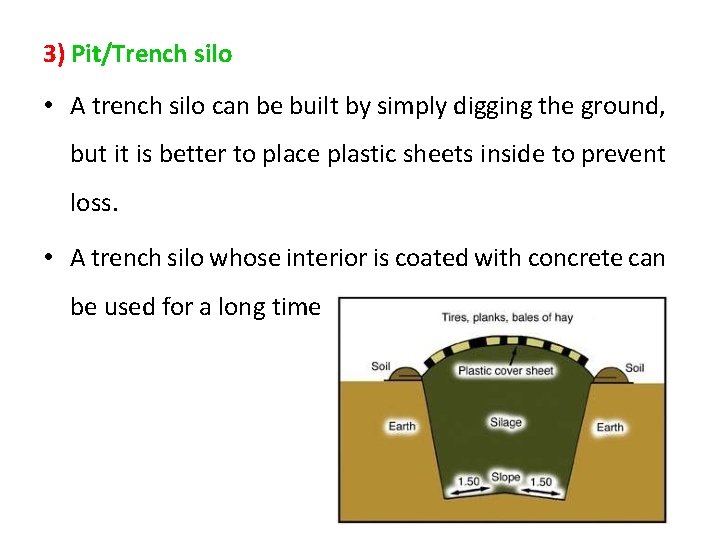
3) Pit/Trench silo • A trench silo can be built by simply digging the ground, but it is better to place plastic sheets inside to prevent loss. • A trench silo whose interior is coated with concrete can be used for a long time
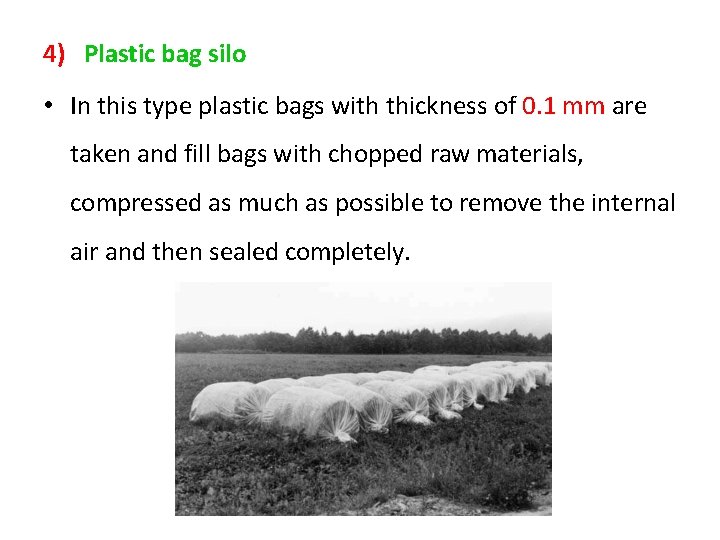
4) Plastic bag silo • In this type plastic bags with thickness of 0. 1 mm are taken and fill bags with chopped raw materials, compressed as much as possible to remove the internal air and then sealed completely.
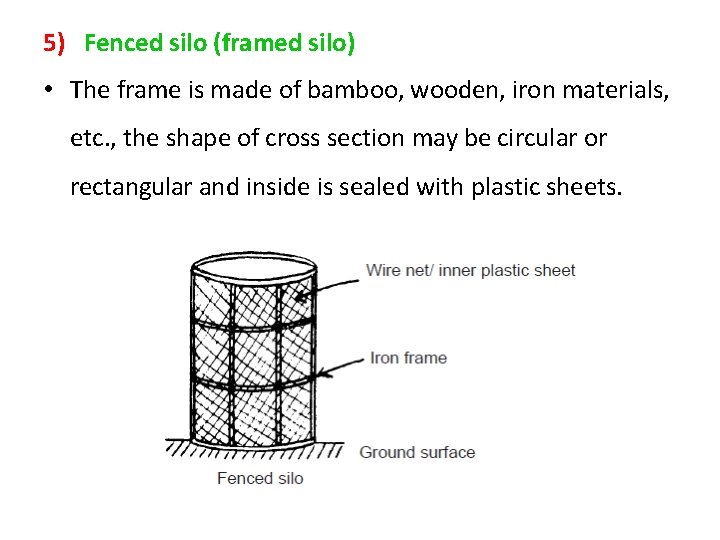
5) Fenced silo (framed silo) • The frame is made of bamboo, wooden, iron materials, etc. , the shape of cross section may be circular or rectangular and inside is sealed with plastic sheets.
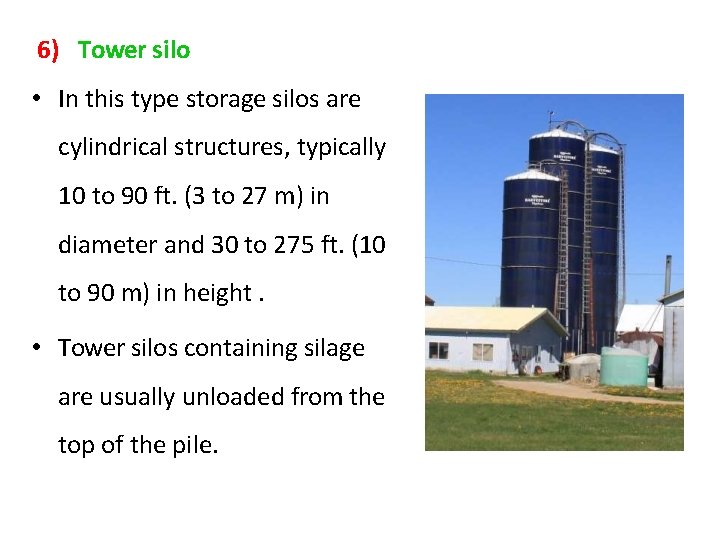
6) Tower silo • In this type storage silos are cylindrical structures, typically 10 to 90 ft. (3 to 27 m) in diameter and 30 to 275 ft. (10 to 90 m) in height. • Tower silos containing silage are usually unloaded from the top of the pile.
Judging the quality of silage • The quality of silage can be judged by its color, smell, • taste and touch. • Color: In general, yellowish or brownish green some time Golden color indicates good quality. That is due to action of organic acids on chlorophyll and producing Mg free pigment Phaeophytin. If the color is from dark brown or black, the silage underwent bad fermentation and is of bad quality.
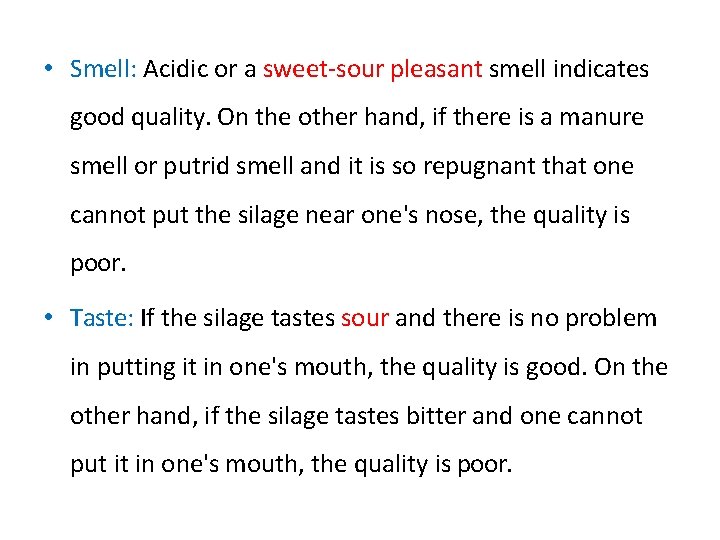
• Smell: Acidic or a sweet-sour pleasant smell indicates good quality. On the other hand, if there is a manure smell or putrid smell and it is so repugnant that one cannot put the silage near one's nose, the quality is poor. • Taste: If the silage tastes sour and there is no problem in putting it in one's mouth, the quality is good. On the other hand, if the silage tastes bitter and one cannot put it in one's mouth, the quality is poor.
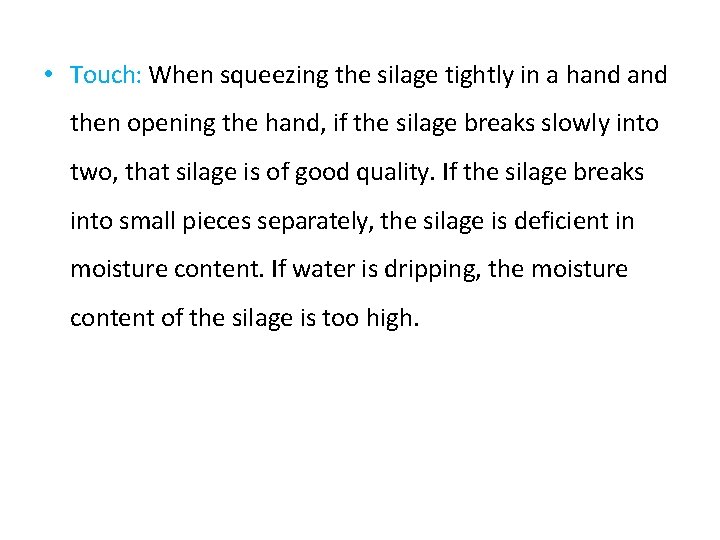
• Touch: When squeezing the silage tightly in a hand then opening the hand, if the silage breaks slowly into two, that silage is of good quality. If the silage breaks into small pieces separately, the silage is deficient in moisture content. If water is dripping, the moisture content of the silage is too high.
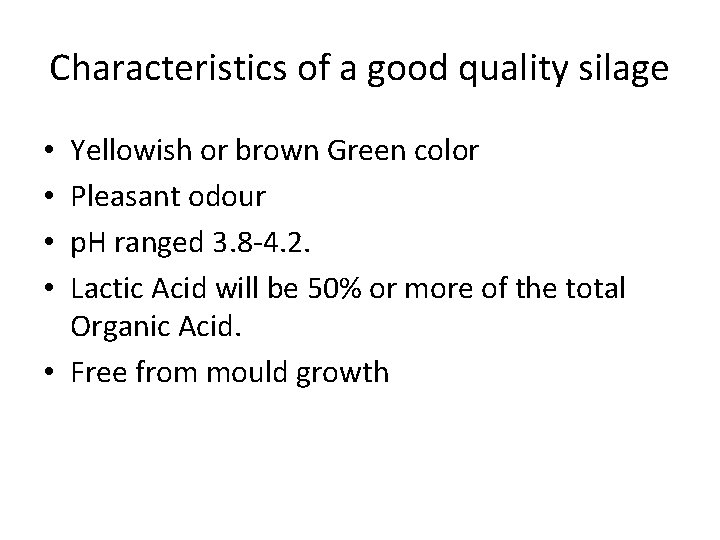
Characteristics of a good quality silage Yellowish or brown Green color Pleasant odour p. H ranged 3. 8 -4. 2. Lactic Acid will be 50% or more of the total Organic Acid. • Free from mould growth • •
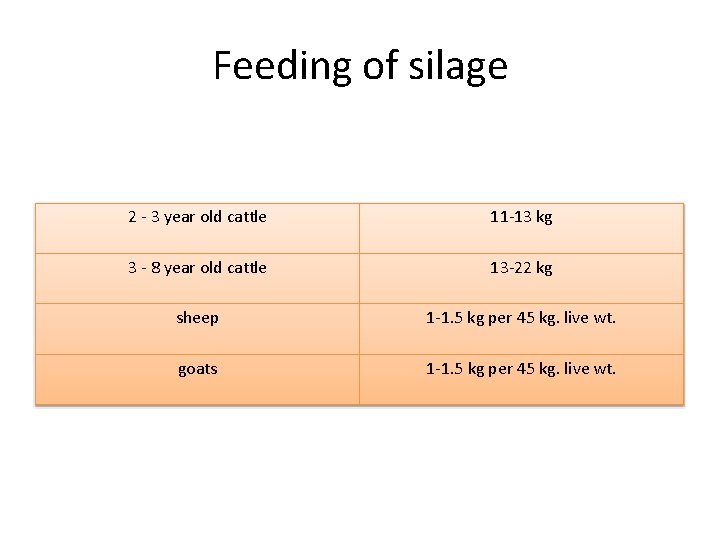
Feeding of silage 2 - 3 year old cattle 11 -13 kg 3 - 8 year old cattle 13 -22 kg sheep 1 -1. 5 kg per 45 kg. live wt. goats 1 -1. 5 kg per 45 kg. live wt.
Factors enhance the nutrient quality of silage Add dry matter to reduce moisture content: To reduce seepage losses and To provide a more suitable medium for the fermentation process. • Generally, grasses and legumes are wilted or dried to an average of about 65% moisture or less depending on the type of storage used.
• If in any case, forage crops are harvested at too wet for silage, the following guideline for dry matter addition may be used. Coarsely ground cereal grains or chopped grasses are used @ for 5% reduction moisture about 150 to 200 pounds of material is added per ton of wet forage weight.
Add water to increase moisture content: • If forage crops to be stored as silage are too dry, then packing to exclude air is difficult. • Under such conditions, water must be added to raise the moisture content to the desired level to increase forage moisture content 1% unit approximately 5 to 6 gallons/ ton of ensiled material.
Rate, amount and kind of acid production: • The rate, amount and kind of acid produced is influenced by the moisture content of the chopped forage and the readily available carbohydrate content of the forage. • Acid production is essential in the keeping qualities of silage.
Adding of molasses • Molasses is an excellent carbohydrate or sugar source for legumes and grasses containing 75 to 80% moisture. • For legumes, about 80 pounds of molasses per ton is required, and for grasses 40 pounds is generally used.
Acidifying the silage: • Acidifying silage, using a strong acid, generally practiced in Europe on high-moisture grass silage. • The purpose was to produce an immediate acid condition rather than waiting for the silage to produce its own acid. • This practice is not recommended in the USA because of its high cost, the corrosive nature of the acids and low forage palatability.
Inhibition of bacteria and mold growth: • Generally formic and propionic acids are commonly used as preservative to prevent bacterial and mold growth. • The major benefit of adding these acids to silage is reduce the spoilage in open storage structures. • Formic acid is added to hay crop silages @ 0. 45% of the wet weight or 2. 25% of the DM weight. • Propionic acid is added @ 0. 5 to 1. 0% of the wet forage weight.
Increasing the nutrient content of silage • To increase the nutritive value of silages, Materials such as cereal grains, molasses, dry forages, limestone, urea and anhydrous ammonia etc. , are added to silage. • Commercial products are also available that contain one or more of the above materials.
• Limestone (calcium carbonate) is sometimes added to corn silage to increase the calcium content and extend the fermentation process @ 10 to 20 pounds per ton of corn silage. • To increase the protein content of silage, Sometimes Urea and anhydrous ammonia, NP sources are also added. • Usually they increase the forage protein content about 4% units on a dry matter basis.
THANK YOU