
Fenwick Tree binary indexed tree The Problem There

Fenwick Tree (binary indexed tree)
The Problem �There are several boxes �Labeled from 1 to N �We can �Add N marble(s) into ith box � We say box #i has frequency N �We want to know �Total number of marbles in box #1 to #j
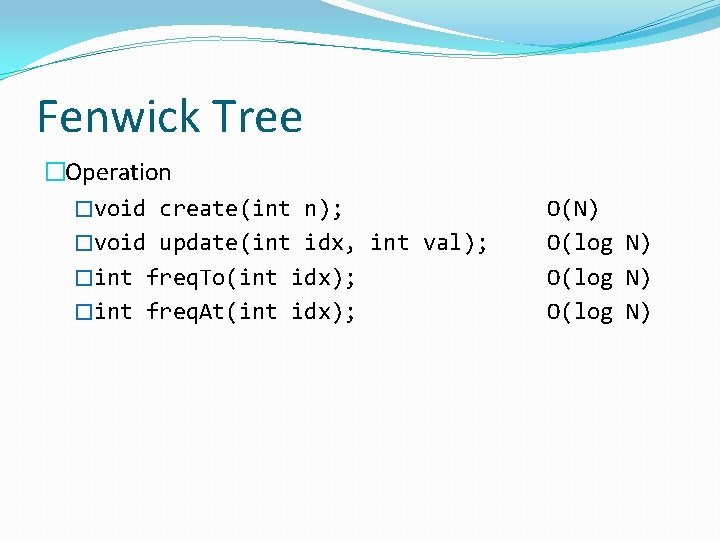
Fenwick Tree �Operation �void create(int n); �void update(int idx, int val); �int freq. To(int idx); �int freq. At(int idx); O(N) O(log N)
Storage �Data �An int array of size N
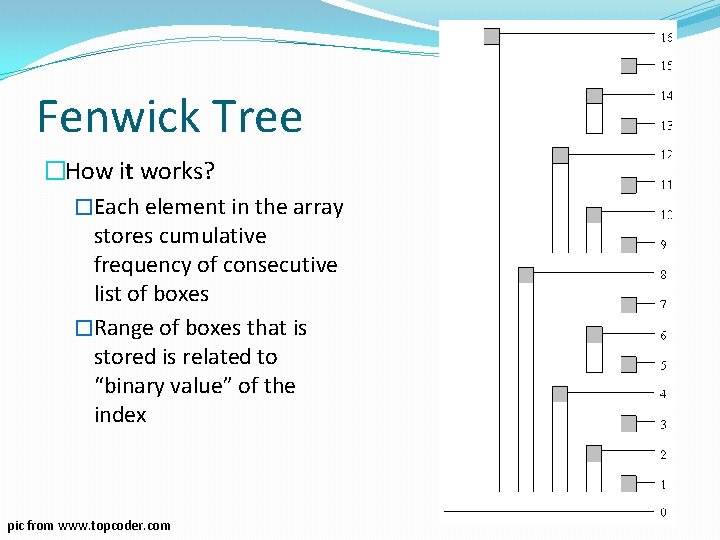
Fenwick Tree �How it works? �Each element in the array stores cumulative frequency of consecutive list of boxes �Range of boxes that is stored is related to “binary value” of the index pic from www. topcoder. com
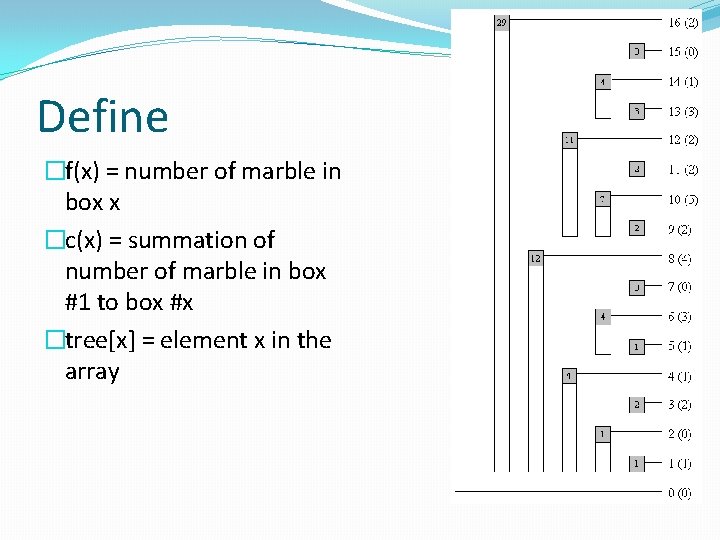
Define �f(x) = number of marble in box x �c(x) = summation of number of marble in box #1 to box #x �tree[x] = element x in the array
![Storage Solution Tree[16] = f(1) + f(2) + … + f(16) Tree[12] = f(9)](http://slidetodoc.com/presentation_image_h/f59236878d7cd558f6bdda901c54cb11/image-7.jpg "Storage Solution Tree[16] = f(1) + f(2) + … + f(16) Tree[12] = f(9)")
Storage Solution Tree[16] = f(1) + f(2) + … + f(16) Tree[12] = f(9) + f(10) + … + f(12) Tree[6] = f(5) + f(6) Tree[3] = f(3)
![f(16) = 2 Cumulative Freq tree[16] = 29 Cumulative frequency From 1 to 16](http://slidetodoc.com/presentation_image_h/f59236878d7cd558f6bdda901c54cb11/image-8.jpg "f(16) = 2 Cumulative Freq tree[16] = 29 Cumulative frequency From 1 to 16")
f(16) = 2 Cumulative Freq tree[16] = 29 Cumulative frequency From 1 to 16 Index of the array tree[14] Cumulative frequency From 13 to 14 pic from www. topcoder. com Actual frequency
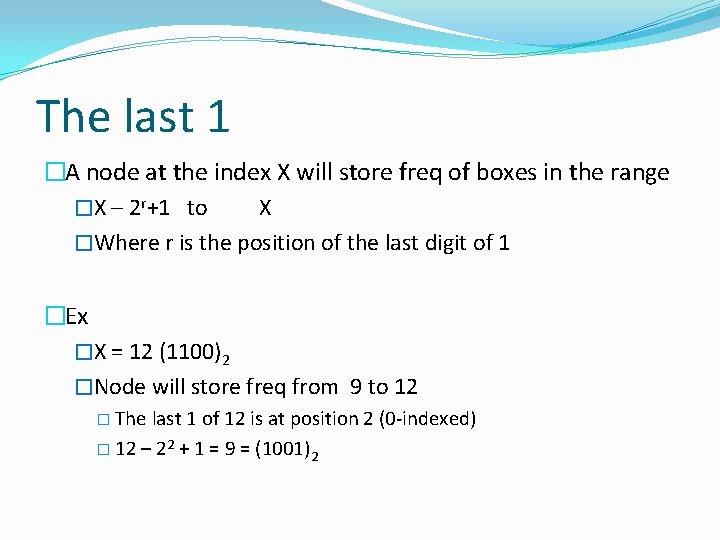
The last 1 �A node at the index X will store freq of boxes in the range �X – 2 r+1 to X �Where r is the position of the last digit of 1 �Ex �X = 12 (1100)2 �Node will store freq from 9 to 12 � The last 1 of 12 is at position 2 (0 -indexed) � 12 – 22 + 1 = 9 = (1001)2
![Read Cumulative Freq c(13) = tree[13] + tree[12] + tree[8] In base-2 c(11012) =](http://slidetodoc.com/presentation_image_h/f59236878d7cd558f6bdda901c54cb11/image-10.jpg "Read Cumulative Freq c(13) = tree[13] + tree[12] + tree[8] In base-2 c(11012) =")
Read Cumulative Freq c(13) = tree[13] + tree[12] + tree[8] In base-2 c(11012) = tree[11012] + tree[11002] + tree[10002] pic from www. topcoder. com
![Update Freq Update f(5) by -1 involve Tree[16] (100002) Tree[8] (010002) Tree[6] (001102) Tree[5]](http://slidetodoc.com/presentation_image_h/f59236878d7cd558f6bdda901c54cb11/image-11.jpg "Update Freq Update f(5) by -1 involve Tree[16] (100002) Tree[8] (010002) Tree[6] (001102) Tree[5]")
Update Freq Update f(5) by -1 involve Tree[16] (100002) Tree[8] (010002) Tree[6] (001102) Tree[5] (001012) pic from www. topcoder. com
![Read actual Freq What is f(12)? Easy, it’s c(12) – c(11) easier Tree[12] =](http://slidetodoc.com/presentation_image_h/f59236878d7cd558f6bdda901c54cb11/image-12.jpg "Read actual Freq What is f(12)? Easy, it’s c(12) – c(11) easier Tree[12] =")
Read actual Freq What is f(12)? Easy, it’s c(12) – c(11) easier Tree[12] = f(9) + f(10) + f(11) + f(12) Tree[11] = f(11) Tree[10] = f(9) + f(10) Hence, f(12) = Tree[12] – Tree[11] – Tree[10] pic from www. topcoder. com
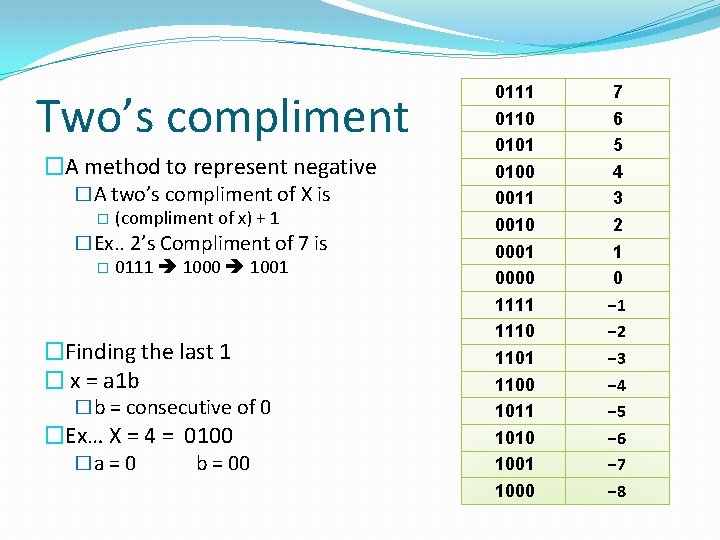
Two’s compliment �A method to represent negative �A two’s compliment of X is � (compliment of x) + 1 �Ex. . 2’s Compliment of 7 is � 0111 1000 1001 �Finding the last 1 � x = a 1 b �b = consecutive of 0 �Ex… X = 4 = 0100 �a = 0 b = 00 0111 0110 0101 0100 0011 0010 0001 0000 1111 1110 1101 1100 1011 1010 1001 1000 7 6 5 4 3 2 1 0 − 1 − 2 − 3 − 4 − 5 − 6 − 7 − 8
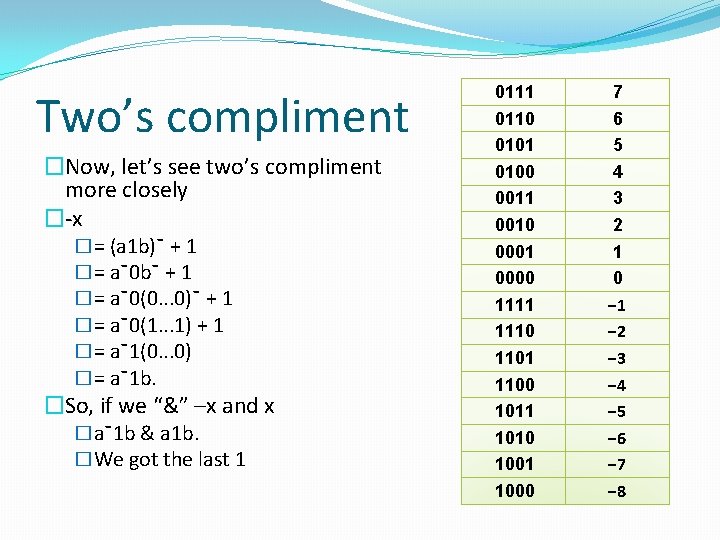
Two’s compliment �Now, let’s see two’s compliment more closely �-x �= (a 1 b)¯ + 1 �= a¯ 0 b¯ + 1 �= a¯ 0(0. . . 0)¯ + 1 �= a¯ 0(1. . . 1) + 1 �= a¯ 1(0. . . 0) �= a¯ 1 b. �So, if we “&” –x and x �a¯ 1 b & a 1 b. �We got the last 1 0110 0101 0100 0011 0010 0001 0000 1111 1110 1101 1100 1011 1010 1001 1000 7 6 5 4 3 2 1 0 − 1 − 2 − 3 − 4 − 5 − 6 − 7 − 8
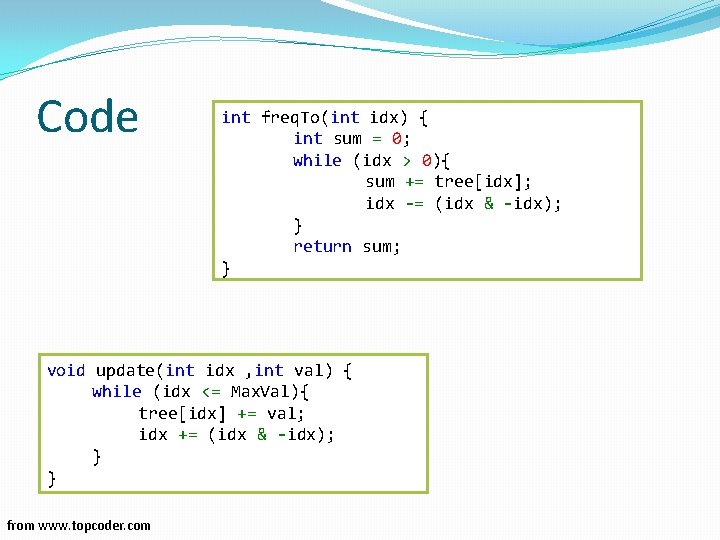
Code int freq. To(int idx) { int sum = 0; while (idx > 0){ sum += tree[idx]; idx -= (idx & -idx); } return sum; } void update(int idx , int val) { while (idx <= Max. Val){ tree[idx] += val; idx += (idx & -idx); } } from www. topcoder. com
![Code int freq. At(int idx){ int sum = tree[idx]; if (idx > 0) {](http://slidetodoc.com/presentation_image_h/f59236878d7cd558f6bdda901c54cb11/image-16.jpg "Code int freq. At(int idx){ int sum = tree[idx]; if (idx > 0) {")
Code int freq. At(int idx){ int sum = tree[idx]; if (idx > 0) { int z = idx - (idx & -idx); y = idx - 1; while (y != z){ sum -= tree[y]; y -= (y & -y); } } return sum; } from www. topcoder. com
2 D BIT �Box is arrange at x-y coordinate �Operation �Update(x, y, val) (add “val” marble in position (x, y)) �How many points in the range (x 1, y 1) to (x 2, y 2)
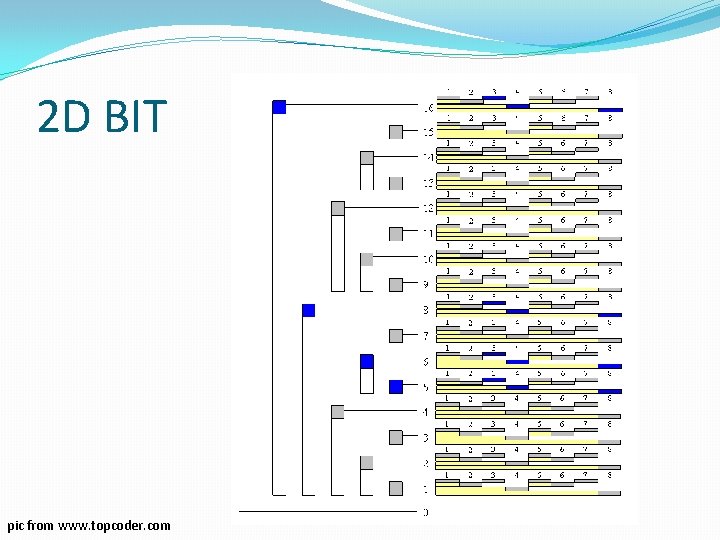
2 D BIT pic from www. topcoder. com
- Slides: 18