
Femtosecond Laser Induced Periodic Surface Structures on Zn
- Slides: 1
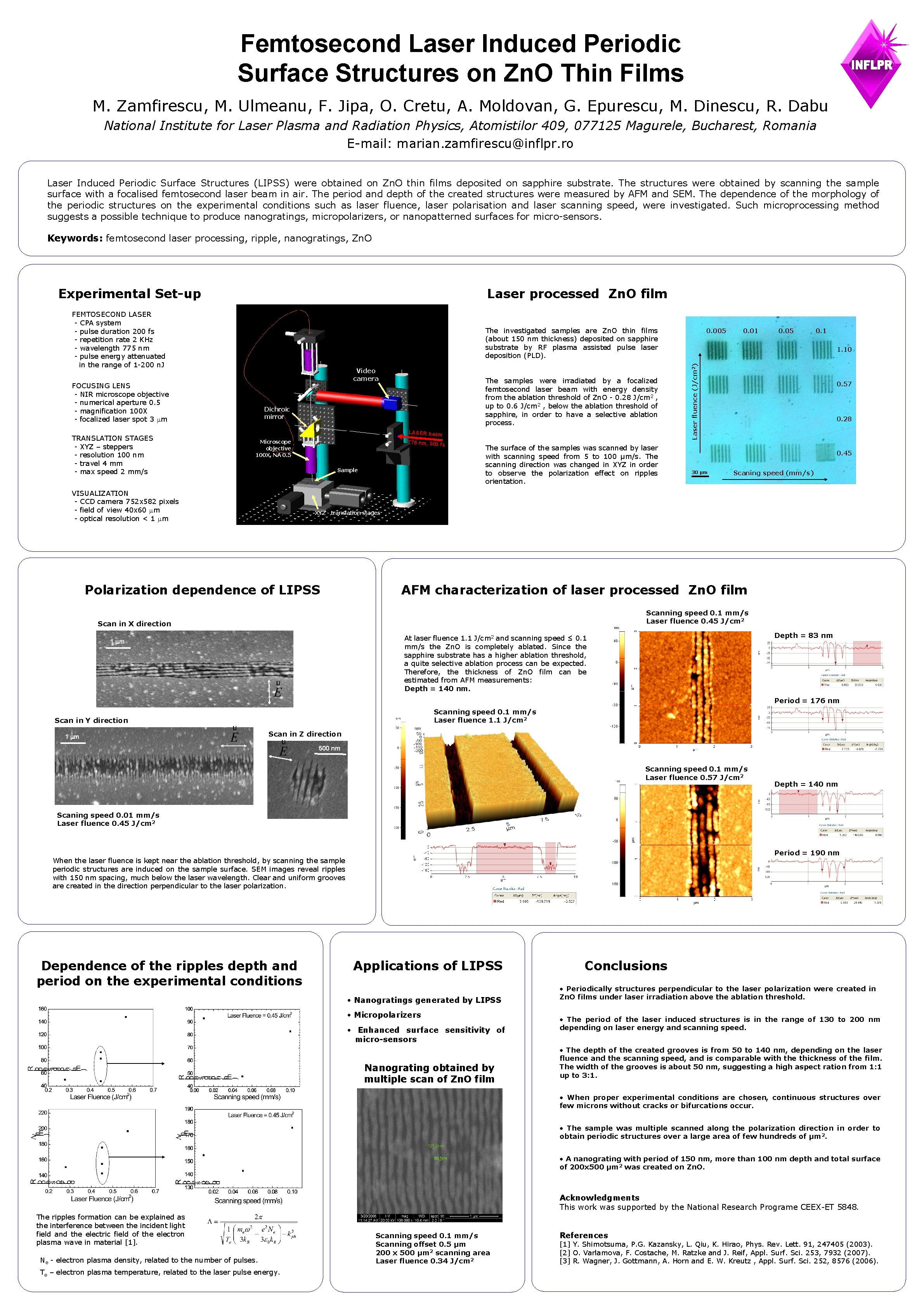
Femtosecond Laser Induced Periodic Surface Structures on Zn. O Thin Films M. Zamfirescu, M. Ulmeanu, F. Jipa, O. Cretu, A. Moldovan, G. Epurescu, M. Dinescu, R. Dabu National Institute for Laser Plasma and Radiation Physics, Atomistilor 409, 077125 Magurele, Bucharest, Romania E-mail: marian. zamfirescu@inflpr. ro Laser Induced Periodic Surface Structures (LIPSS) were obtained on Zn. O thin films deposited on sapphire substrate. The structures were obtained by scanning the sample surface with a focalised femtosecond laser beam in air. The period and depth of the created structures were measured by AFM and SEM. The dependence of the morphology of the periodic structures on the experimental conditions such as laser fluence, laser polarisation and laser scanning speed, were investigated. Such microprocessing method suggests a possible technique to produce nanogratings, micropolarizers, or nanopatterned surfaces for micro-sensors. Keywords: femtosecond laser processing, ripple, nanogratings, Zn. O Experimental Set-up Laser processed Zn. O film FEMTOSECOND LASER - CPA system - pulse duration 200 fs - repetition rate 2 KHz - wavelength 775 nm - pulse energy attenuated in the range of 1 -200 n. J The investigated samples are Zn. O thin films (about 150 nm thickness) deposited on sapphire substrate by RF plasma assisted pulse laser deposition (PLD). FOCUSING LENS - NIR microscope objective - numerical aperture 0. 5 - magnification 100 X - focalized laser spot 3 mm TRANSLATION STAGES - XYZ – steppers - resolution 100 nm - travel 4 mm - max speed 2 mm/s The samples were irradiated by a focalized femtosecond laser beam with energy density from the ablation threshold of Zn. O - 0. 28 J/cm 2 , up to 0. 6 J/cm 2 , below the ablation threshold of sapphire, in order to have a selective ablation process. Dichroic mirror LASER beam Microscope objective 100 X, NA 0. 5 775 nm, 200 fs Sample VISUALIZATION - CCD camera 752 x 582 pixels - field of view 40 x 60 mm - optical resolution < 1 mm The surface of the samples was scanned by laser with scanning speed from 5 to 100 µm/s. The scanning direction was changed in XYZ in order to observe the polarization effect on ripples orientation. 0. 01 0. 05 0. 1 1. 10 Laser fluence (J/cm 2) Video camera 0. 005 0. 57 0. 28 0. 45 30 µm Scaning speed (mm/s) XYZ - translation stages Polarization dependence of LIPSS AFM characterization of laser processed Zn. O film Scanning speed 0. 1 mm/s Laser fluence 0. 45 J/cm 2 Scan in X direction Depth = 83 nm At laser fluence 1. 1 J/cm 2 and scanning speed ≤ 0. 1 mm/s the Zn. O is completely ablated. Since the sapphire substrate has a higher ablation threshold, a quite selective ablation process can be expected. Therefore, the thickness of Zn. O film can be estimated from AFM measurements: Depth = 140 nm. 1 mm Period = 176 nm Scanning speed 0. 1 mm/s Laser fluence 1. 1 J/cm 2 Scan in Y direction 1 mm Scan in Z direction 500 nm Scanning speed 0. 1 mm/s Laser fluence 0. 57 J/cm 2 Depth = 140 nm Scaning speed 0. 01 mm/s Laser fluence 0. 45 J/cm 2 Period = 190 nm When the laser fluence is kept near the ablation threshold, by scanning the sample periodic structures are induced on the sample surface. SEM images reveal ripples with 150 nm spacing, much below the laser wavelength. Clear and uniform grooves are created in the direction perpendicular to the laser polarization. Dependence of the ripples depth and period on the experimental conditions Applications of LIPSS • Nanogratings generated by LIPSS • Micropolarizers • Enhanced surface sensitivity of micro-sensors Nanograting obtained by multiple scan of Zn. O film Conclusions • Periodically structures perpendicular to the laser polarization were created in Zn. O films under laser irradiation above the ablation threshold. • The period of the laser induced structures is in the range of 130 to 200 nm depending on laser energy and scanning speed. • The depth of the created grooves is from 50 to 140 nm, depending on the laser fluence and the scanning speed, and is comparable with the thickness of the film. The width of the grooves is about 50 nm, suggesting a high aspect ration from 1: 1 up to 3: 1. • When proper experimental conditions are chosen, continuous structures over few microns without cracks or bifurcations occur. • The sample was multiple scanned along the polarization direction in order to obtain periodic structures over a large area of few hundreds of µm 2. • A nanograting with period of 150 nm, more than 100 nm depth and total surface of 200 x 500 µm 2 was created on Zn. O. Acknowledgments This work was supported by the National Research Programe CEEX-ET 5848. The ripples formation can be explained as the interference between the incident light field and the electric field of the electron plasma wave in material [1]. Ne - electron plasma density, related to the number of pulses. Te – electron plasma temperature, related to the laser pulse energy. Scanning speed 0. 1 mm/s Scanning offset 0. 5 µm 200 x 500 µm 2 scanning area Laser fluence 0. 34 J/cm 2 References [1] Y. Shimotsuma, P. G. Kazansky, L. Qiu, K. Hirao, Phys. Rev. Lett. 91, 247405 (2003). [2] O. Varlamova, F. Costache, M. Ratzke and J. Reif, Appl. Surf. Sci. 253, 7932 (2007). [3] R. Wagner, J. Gottmann, A. Horn and E. W. Kreutz , Appl. Surf. Sci. 252, 8576 (2006).