
Femoral vs Subclavian Catherization Department of Emergency Medicine
Femoral vs. Subclavian Catherization Department of Emergency Medicine University of Pennsylvania Health System Sumeru Mehta December 09, 2003

The study… “Complications of Femoral and Subclavian Venous Catherization in Critically Ill Patients: A Randomized Controlled Trial. ” l l Merrer J. et al. JAMA. 286(6): 700 -7, 2001 Aug 8. l First randomized study to directly compare three most common complications associated with femoral or subclavian CVC.
Study Design IRB approved. l Conducted 12/1997 to 07/2000 in 8 ICUs. l Random assignment at central randomization center. l Standard CVC was inserted, in sterile fashion, by staff physician or resident housestaff. l Inclusion criteria: Age > 18 y and first CVC. l
Study Design l Exclusion criteria: – CVC at placed at admission (prior to ICU) – CVC within 15 days prior admission – Emergency catherization – Contraindication 2/2 coagulation disorder – Severe hypoxemia – Anatomic defect precluding catherization. – Skin lesion or recent surgery at CVC site. – BMI > 35 kg/m 2 (male) or 30 kg/m 2 (female)
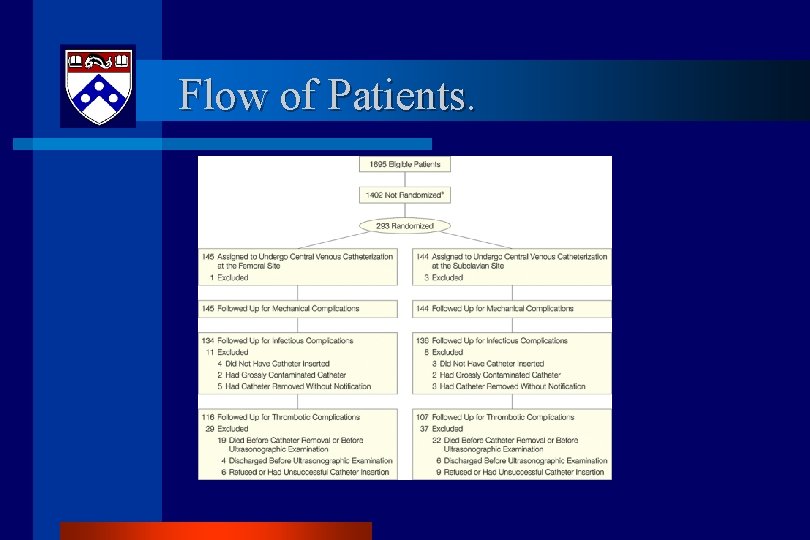
Flow of Patients.
Catheter-related Complications l l l Mechanical complications included were: arterial puncture, pneumothorax, hemothorax or mediastinal hematoma, misplacement of the catherter tip, hematoma or bleeding, air embolism. Thrombotic complication was noted when there was partial or complete thrombosis was noted by compression sonography (sens. and spec. were 96% and 93%, respectively) and duplex Doppler US (81% and 77%) 4 days after CVC removal. Infectious complications were classified into: – 1) Catheter contamination (<1000 CFU/m. L and no sepsis) – 2) Catheter colonization (>1000 CFU/m. L and no sepsis) – 3) Probable catheter related clinical sepsis w/o bloodstream infection – 4) Catheter related clinical sepsis w/ bloodstream infection – 5) Discrimination between catergories 2 and 3 not possible.
Mechanical complications 25/145 (17. 3%) with femoral CVC and 27/144 (18. 8%) with subclavian CVC (p=0. 74). l 2 major complications (hematoma) in the femoral (1. 4%) CVC and 4 major complications (PTX) in the subclavian (2. 8%) CVC (p=0. 44). l

Infectious complications l Analyzed in 270/289 patients (93. 4%).
Thrombotic complication Analyzed in 223/289 patients (77. 2%) – Among the 66 not US… • 41 (65%) died, 10 were dc’d, and 15 refused. l Catheter related thrombosis in 25/116 (21. 5%) femoral CVC and 2/107 (1. 9%) subclavian CVC (p<0. 001) – Complete thrombosis in 5 of the femoral CVC. l
Conclusions l l l Catherization of the femoral vein was associated with a significant higher risk of overall complications compared with catherization of the subclavian vein. Femoral catherization increased the risk of catheterrelated infection and thrombosis, whereas the rate of mechanical complications did not differ between the two groups. Subclavian CVC insertion in an will yield lower overall rates of complications.
HUP-ism l In non-emergent situations when a CVC can be placed in a sterile, timely manner, subclavian central venous catheter placement will yield lower infectious and thrombotic complications.

- Slides: 12