
FEMAs Open Obligation Validation Process Sharon Gill October
FEMA’s Open Obligation Validation Process Sharon Gill October 20, 2020 mds

FEMA Background □ After the FY 2006 Audit, FEMA was cited with a material weakness on its budgetary accounting internal controls. UDO validation was one factor contributing to the material weakness. □ An invalid UDO means that the obligation balance may be overstated, as supporting documentation demonstrating a future outlay of funds could not be provided. □ Process of risk analysis provided FEMA with better identification of potential invalid UDO’s, enabling FEMA to write-off invalid UDO balances starting YE FY 2012. □ As a result of the FY 2014 audit, no audit adjustment on UDO balances was recommended by KPMG, for the first time in FEMA’s history. Slide 2
DEFINITIONS □ Obligation: a legal agreement that binds the Federal Government to outlays, immediately or in the future. Ex: contracts, grants, travel orders, mission assignments. □ Outlay: a payment to liquidate an obligation □ Undelivered Order (UDO): The value of goods and services ordered and obligated that have not been received. □ Unliquidated Obligation (ULO): Undelivered Orders + Accounts Payable □ Excess Funds and Remaining Funds: Funds obligated in excess of the funding needed to complete performance. For the purposes of the directive, excess funds are all funds that are no longer necessary for future outlays. Slide 3

Key Changes to the UDO Monitoring Process □ OLD METHOD NEW METHOD □ FEMA posted UDO balances to shared site quarterly for the UDO working group Members. □ FEMA performs a Risk Analysis of UDO balances prior to dissemination to program offices. □ FEMA collected each Program Office's open obligation information and consolidated the submissions for DHS reporting. □ Program offices provide comments and reason codes for all UDO balances identified as high risk, regardless of age category. □ FEMA corroborates High Risk UDO’s identified as Status 1 with other data sources or supporting documentation provided by program office. □ UDO Bulletin provides for quarterly deobligation of UDO’s normally identified as status 3. □ Risk Assessment process identifies UDO’s recommended for closeout. UDO’s and priority lists are coordinated at the beginning of the fiscal year, and reported as Status 4 during the year. □ What can’t be validated is JV’d at 6/30 and year end Slide 4 — Process relied heavily on status codes provided by the program office. — Process relied heavily on program office’s ability to actively manage open obligations and identify status codes properly. — Follow-up primarily focused on blank responses and UDO’s identified as status 3 or 4.
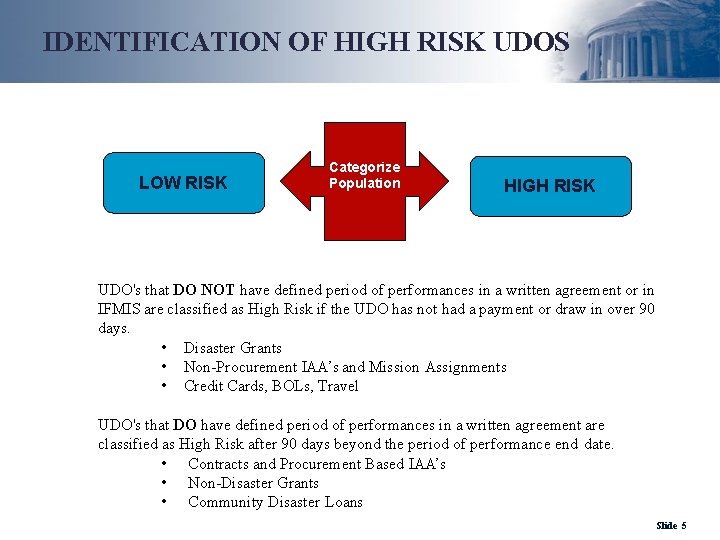
IDENTIFICATION OF HIGH RISK UDOS LOW RISK Categorize Population HIGH RISK UDO's that DO NOT have defined period of performances in a written agreement or in IFMIS are classified as High Risk if the UDO has not had a payment or draw in over 90 days. • Disaster Grants • Non-Procurement IAA’s and Mission Assignments • Credit Cards, BOLs, Travel UDO's that DO have defined period of performances in a written agreement are classified as High Risk after 90 days beyond the period of performance end date. • Contracts and Procurement Based IAA’s • Non-Disaster Grants • Community Disaster Loans Slide 5
Criteria for High Risk UDOs □ High Risk attributes vary by the type of UDO and were derived based on how we can expect to validate UDO’s when audit samples are selected. □ Main attribute requiring follow up and reason codes is risk, not necessarily age. □ Involves incorporating information from other external systems (AAMS, NEMIS, AFG, etc. ) and UDO Reference number is not always consistent among those systems. □ High Risk and Cancelling fund UDOs are the main focus of metrics at Sr. Management Level Slide 6
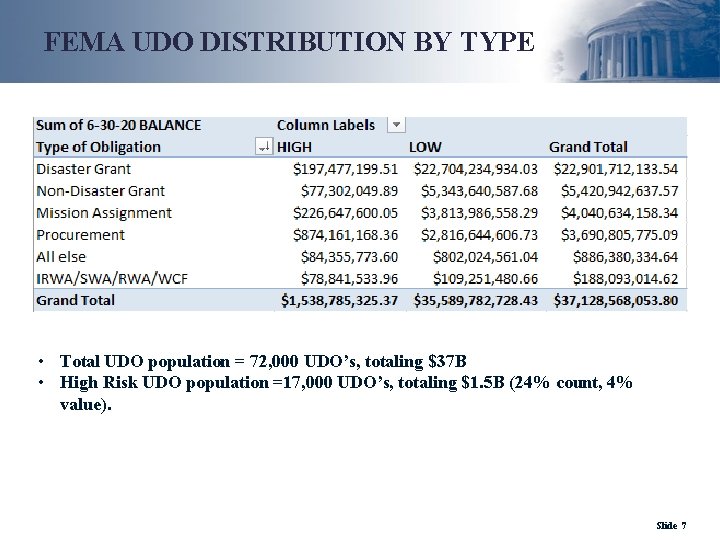
FEMA UDO DISTRIBUTION BY TYPE • Total UDO population = 72, 000 UDO’s, totaling $37 B • High Risk UDO population =17, 000 UDO’s, totaling $1. 5 B (24% count, 4% value). Slide 7
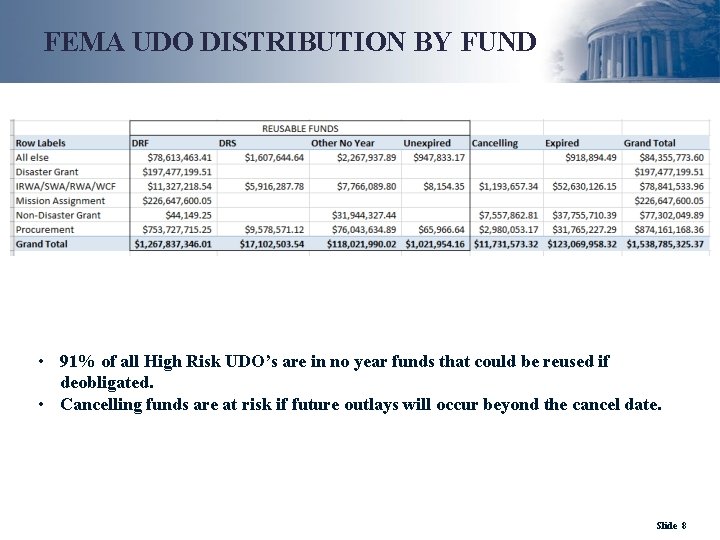
FEMA UDO DISTRIBUTION BY FUND • 91% of all High Risk UDO’s are in no year funds that could be reused if deobligated. • Cancelling funds are at risk if future outlays will occur beyond the cancel date. Slide 8

FEMA Strategic Focus and Risk Assessment Beginning October 2012, strategic focus was to identify UDO’s that are “high risk” for failing validation during the audit. Focus was to obtain data elements from subsidiary systems not interfaced in the accounting system, but which were necessary to assess risk: • Period of Performance dates • Final SF-425 dates • OFA Validation of Mission Assignments • Contract Type • Disaster Declaration dates and Disaster Status • Disaster Grant Open Projects Slide 9
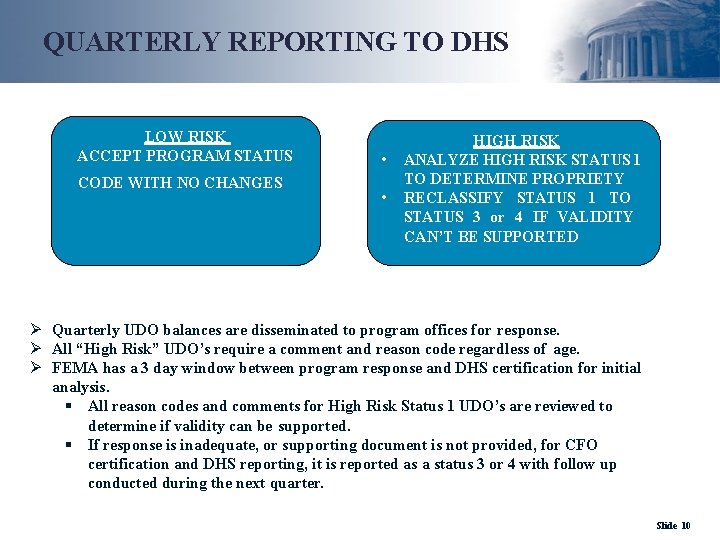
QUARTERLY REPORTING TO DHS LOW RISK ACCEPT PROGRAM STATUS CODE WITH NO CHANGES • • HIGH RISK ANALYZE HIGH RISK STATUS 1 TO DETERMINE PROPRIETY RECLASSIFY STATUS 1 TO STATUS 3 or 4 IF VALIDITY CAN’T BE SUPPORTED Quarterly UDO balances are disseminated to program offices for response. All “High Risk” UDO’s require a comment and reason code regardless of age. FEMA has a 3 day window between program response and DHS certification for initial analysis. All reason codes and comments for High Risk Status 1 UDO’s are reviewed to determine if validity can be supported. If response is inadequate, or supporting document is not provided, for CFO certification and DHS reporting, it is reported as a status 3 or 4 with follow up conducted during the next quarter. Slide 10
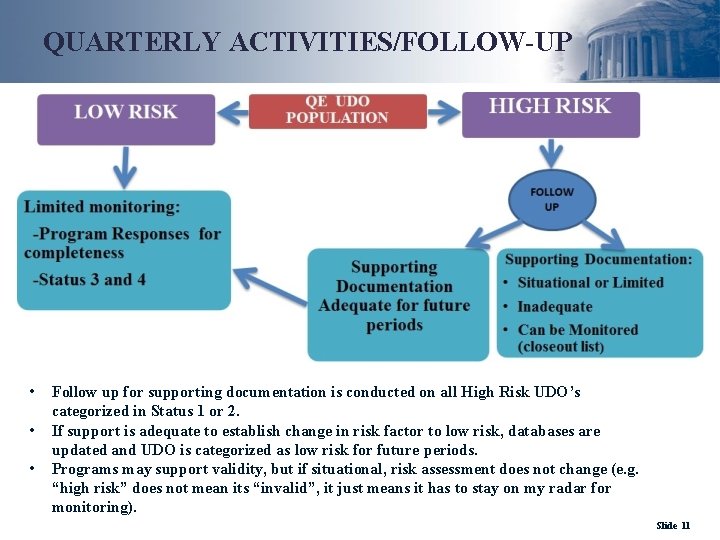
QUARTERLY ACTIVITIES/FOLLOW-UP • • • Follow up for supporting documentation is conducted on all High Risk UDO’s categorized in Status 1 or 2. If support is adequate to establish change in risk factor to low risk, databases are updated and UDO is categorized as low risk for future periods. Programs may support validity, but if situational, risk assessment does not change (e. g. “high risk” does not mean its “invalid”, it just means it has to stay on my radar for monitoring). Slide 11
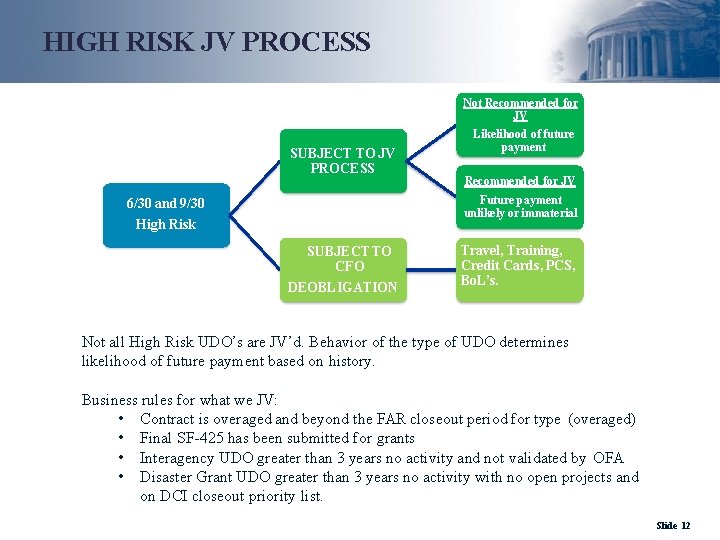
HIGH RISK JV PROCESS SUBJECT TO JV PROCESS Not Recommended for JV Likelihood of future payment Recommended for JV Future payment unlikely or immaterial 6/30 and 9/30 High Risk SUBJECT TO CFO DEOBLIGATION Travel, Training, Credit Cards, PCS, Bo. L’s. Not all High Risk UDO’s are JV’d. Behavior of the type of UDO determines likelihood of future payment based on history. Business rules for what we JV: • Contract is overaged and beyond the FAR closeout period for type (overaged) • Final SF-425 has been submitted for grants • Interagency UDO greater than 3 years no activity and not validated by OFA • Disaster Grant UDO greater than 3 years no activity with no open projects and on DCI closeout priority list. Slide 12
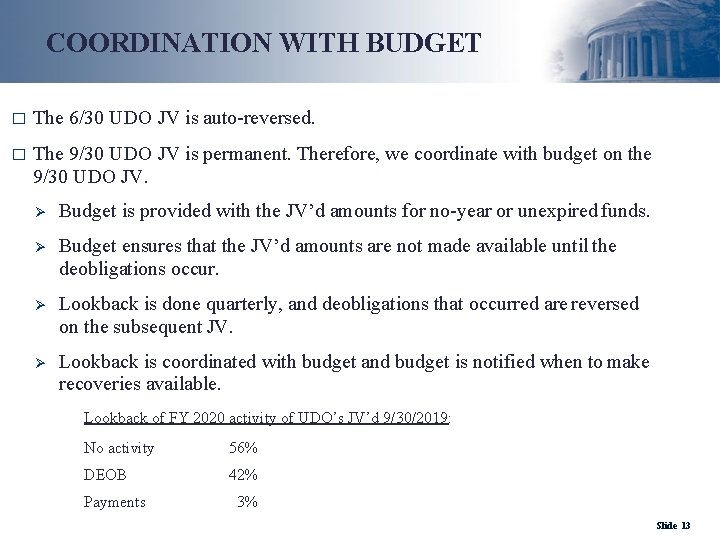
COORDINATION WITH BUDGET □ The 6/30 UDO JV is auto-reversed. □ The 9/30 UDO JV is permanent. Therefore, we coordinate with budget on the 9/30 UDO JV. Budget is provided with the JV’d amounts for no-year or unexpired funds. Budget ensures that the JV’d amounts are not made available until the deobligations occur. Lookback is done quarterly, and deobligations that occurred are reversed on the subsequent JV. Lookback is coordinated with budget and budget is notified when to make recoveries available. Lookback of FY 2020 activity of UDO’s JV’d 9/30/2019: No activity 56% DEOB 42% Payments 3% Slide 13

Questions
- Slides: 14