
FEMALE REPRODUCTIVE SYSTEM Anatomy Physiology Cont The female










- Slides: 52
FEMALE REPRODUCTIVE SYSTEM
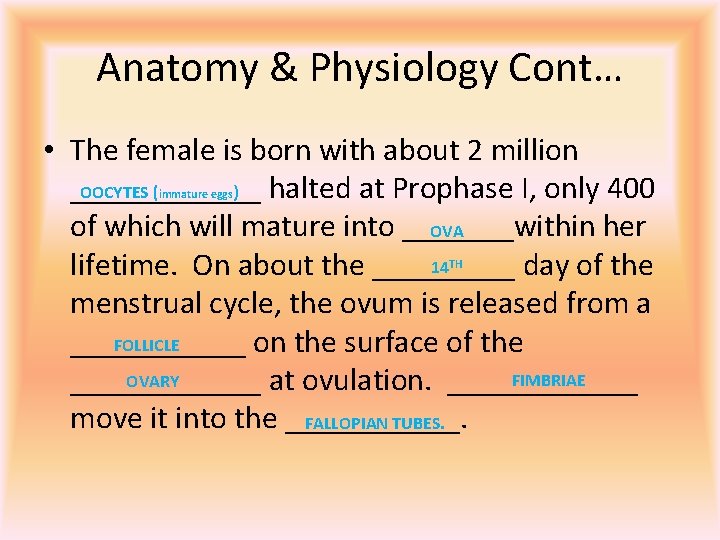
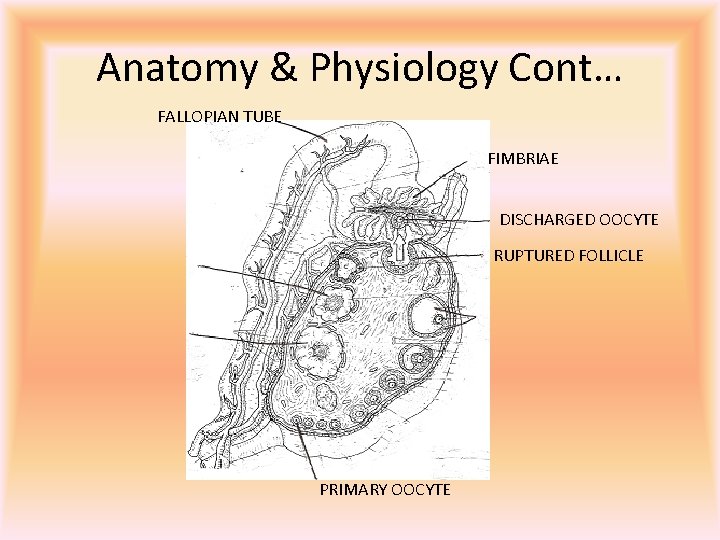
Anatomy & Physiology Cont… • The female is born with about 2 million OOCYTES ( ) ______ halted at Prophase I, only 400 of which will mature into _______within her OVA 14 lifetime. On about the _____ day of the menstrual cycle, the ovum is released from a FOLLICLE ______ on the surface of the FIMBRIAE OVARY ______ at ovulation. ______ move it into the ______. FALLOPIAN TUBES. immature eggs TH
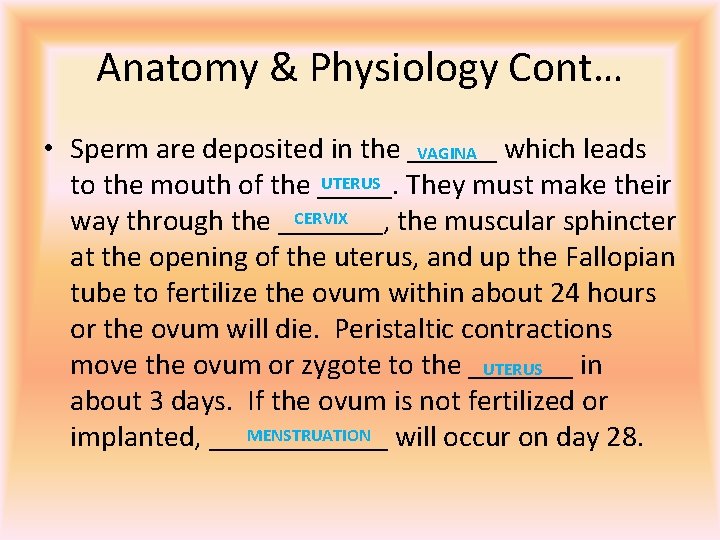
Anatomy & Physiology Cont… • Sperm are deposited in the ______ VAGINA which leads UTERUS They must make their to the mouth of the _____. CERVIX way through the _______, the muscular sphincter at the opening of the uterus, and up the Fallopian tube to fertilize the ovum within about 24 hours or the ovum will die. Peristaltic contractions move the ovum or zygote to the _______ in UTERUS about 3 days. If the ovum is not fertilized or MENSTRUATION will occur on day 28. implanted, ______
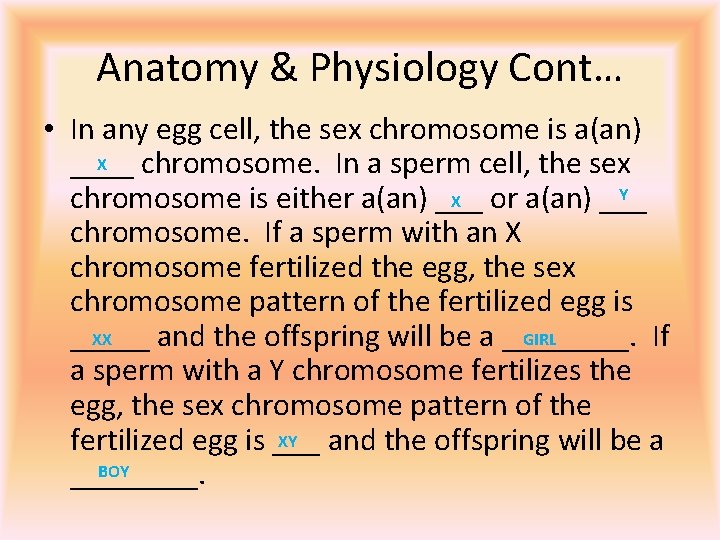
Anatomy & Physiology Cont… • In any egg cell, the sex chromosome is a(an) X ____ chromosome. In a sperm cell, the sex Y X chromosome is either a(an) ___ or a(an) ___ chromosome. If a sperm with an X chromosome fertilized the egg, the sex chromosome pattern of the fertilized egg is XX GIRL _____ and the offspring will be a ____. If a sperm with a Y chromosome fertilizes the egg, the sex chromosome pattern of the XY fertilized egg is ___ and the offspring will be a BOY ____.
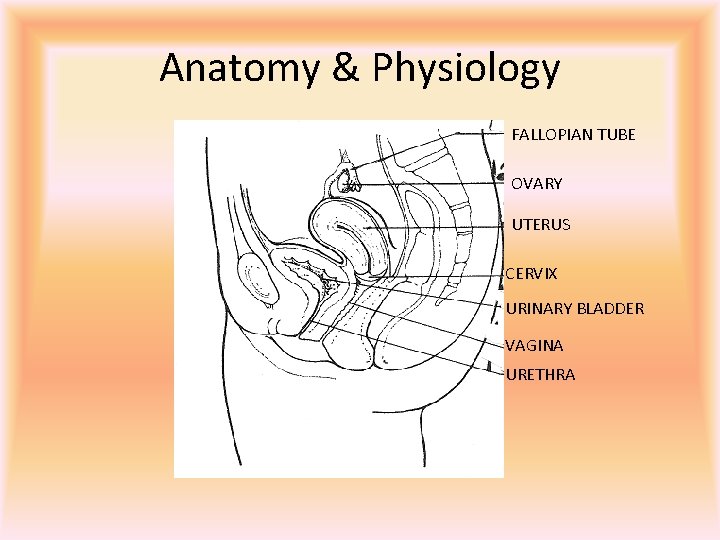
Anatomy & Physiology FALLOPIAN TUBE OVARY UTERUS CERVIX URINARY BLADDER VAGINA URETHRA
Anatomy & Physiology Cont… FALLOPIAN TUBE FIMBRIAE DISCHARGED OOCYTE RUPTURED FOLLICLE PRIMARY OOCYTE
External Anatomy
• VULVA – All of the external organs of the (F. R. S. ) • MONS PUBIS – Rounded, fatty pad of tissue – Covered in pubic hair after puberty begins – Front of body, on top of pubic bone (protection)
• LABIA – Rich in nerve endings and blood vessels (similar…) – Protects internal organs against pathogens – Functions in sexual arousal – Labia Majora • OUTER fold of tissue on either side of the vaginal opening • Covered in pubic hair after puberty begins – Labia Minora • INNER fold of tissue, just inside the majora • Extends forward covering the clitoris
• Vaginal Opening – Hymen • Located just inside the vaginal opening • Thin tissue stretching across the opening • No known function; not always present – Some females may be born w/o; usually has several holes – Allows passage of menstrual flow • 1 ST time w/intercourse – female may experience pain & bleeding, NOT ALWAYS true with all females! • Tissue is very flexible & may stay intact during intercourse! – b/c it has openings, sperm released at the vaginal opening can swim into vagina and up to the ovum » Can get pregnant & still have hymen intact!
• Clitoris – Small knob of tissue above & in front of vaginal opening – Rich supply of nerve endings & blood vessels – Important in sexual arousal • Similar in sensitivity & # of nerve endings to head of penis
INTERNAL ANATOMY
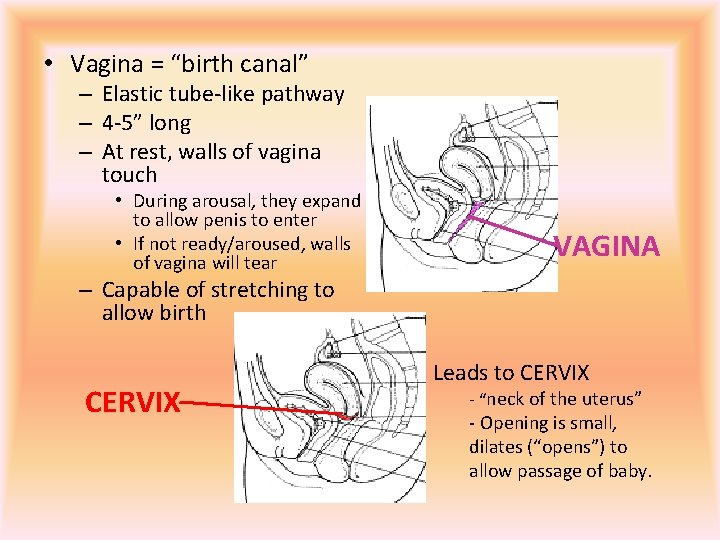
• Vagina = “birth canal” – Elastic tube-like pathway – 4 -5” long – At rest, walls of vagina touch • During arousal, they expand to allow penis to enter • If not ready/aroused, walls of vagina will tear VAGINA – Capable of stretching to allow birth CERVIX Leads to CERVIX - “neck of the uterus” - Opening is small, dilates (“opens”) to allow passage of baby.
• UTERUS – Strong elastic muscle; about the size of a fist – Primary fxn – hold & nourish developing embryo & fetus – Endometrium • Inner lining of uterus • Rich supply of blood vessels – Builds up w/blood tissue to prepare for a possible pregnancy UTERUS
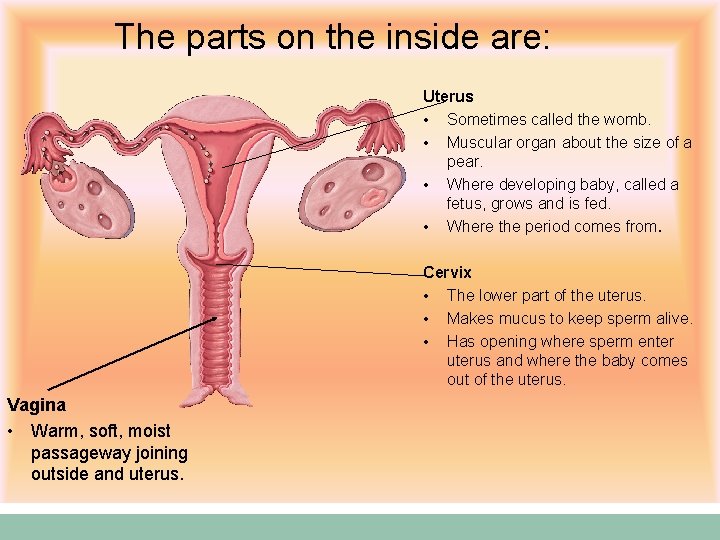
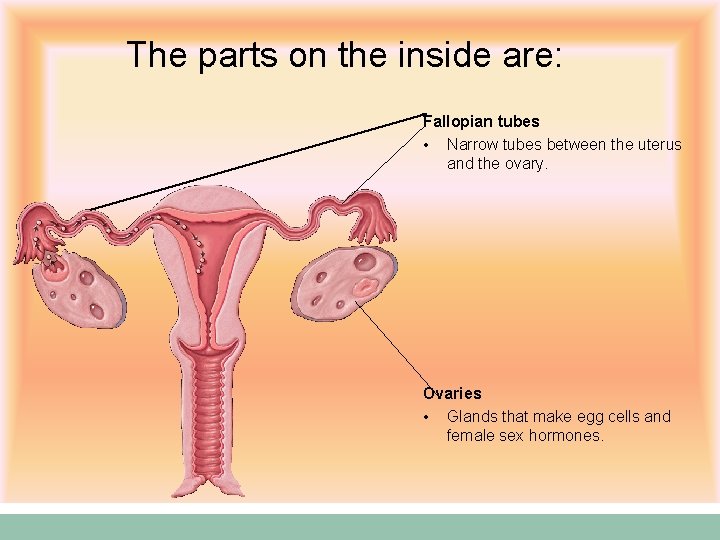
The parts on the inside are: Uterus • Sometimes called the womb. • Muscular organ about the size of a pear. • Where developing baby, called a fetus, grows and is fed. • Where the period comes from. Cervix • The lower part of the uterus. • Makes mucus to keep sperm alive. • Has opening where sperm enter uterus and where the baby comes out of the uterus. Vagina • Warm, soft, moist passageway joining outside and uterus.
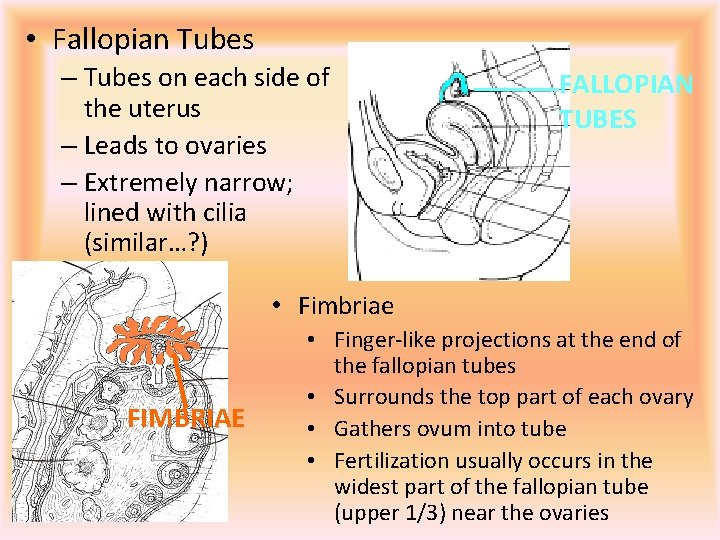
• Fallopian Tubes – Tubes on each side of the uterus – Leads to ovaries – Extremely narrow; lined with cilia (similar…? ) FALLOPIAN TUBES • Fimbriae FIMBRIAE • Finger-like projections at the end of the fallopian tubes • Surrounds the top part of each ovary • Gathers ovum into tube • Fertilization usually occurs in the widest part of the fallopian tube (upper 1/3) near the ovaries
OVARIES • Female sex glands/organs • Situated on both sides of the uterus; end of fallopian tubes • 2 main functions – House ova – Produce female sex hormones • Estrogen & Progesterone OVARY
The parts on the inside are: Fallopian tubes • Narrow tubes between the uterus and the ovary. Ovaries • Glands that make egg cells and female sex hormones.
Ovulation • Process of releasing one mature ovum each month into that ovary’s fallopian tube • 2 -300, 000 immature ova in ovaries at birth • Hormones from pituitary cause ovaries to begin producing female sex hormones • Ova begin to mature • Ovum can live about 2 days in fallopian tube • One sperm will enter ovum = fertilization/conception
MENSTRUATION
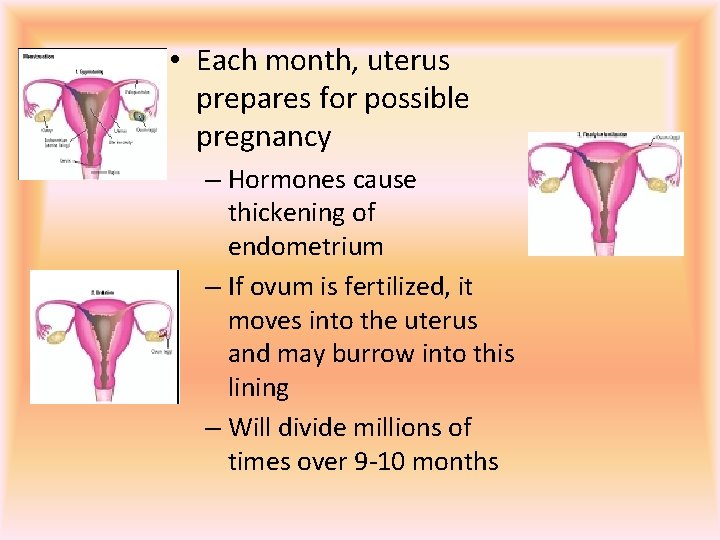
• Each month, uterus prepares for possible pregnancy – Hormones cause thickening of endometrium – If ovum is fertilized, it moves into the uterus and may burrow into this lining – Will divide millions of times over 9 -10 months
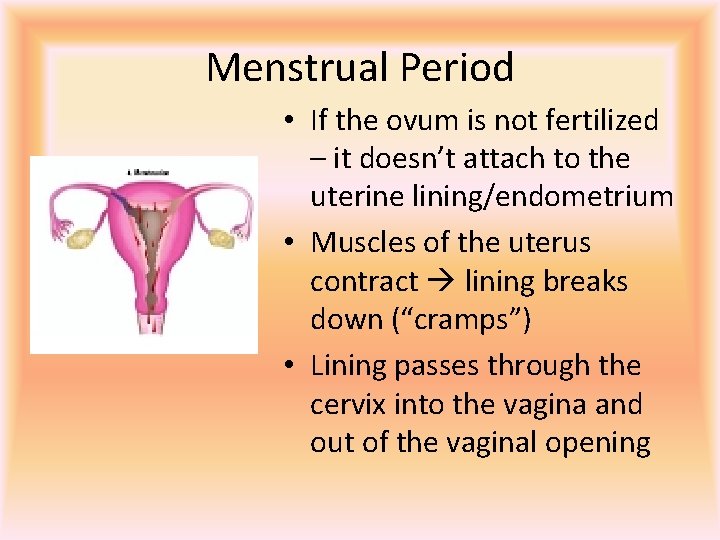
Menstrual Period • If the ovum is not fertilized – it doesn’t attach to the uterine lining/endometrium • Muscles of the uterus contract lining breaks down (“cramps”) • Lining passes through the cervix into the vagina and out of the vaginal opening
Menstruation • Process of shedding the lining of the uterus • Usually lasts 4 -7 days (may be shorter or longer depending on the female’s individual cycle) • Regulated by hormones • 2 -3 tablespoons of blood • Rest of flow is other tissue that makes up the endometrium – Blood and tissue are not needed, person should not be weak or ill from loss – After period (“menses”), cycle begins again.
Menstruation cont… • Most females begin menstruation between 10 -15 • As with males, many hormonal changes are occurring, so the body may take a couple of years to adjust • Cycle may be irregular Menopause – Ceasing of menstruation – Between 45 -50 • Hormones control the cycle – Nutrition, stress & diet can influence cycle
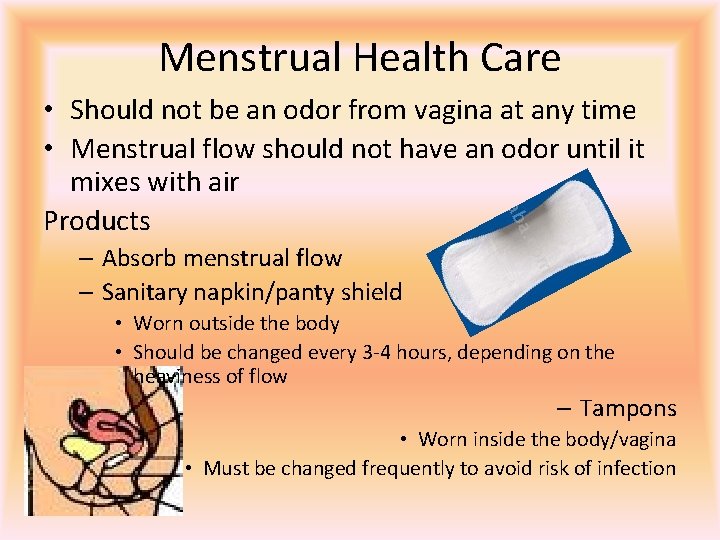
Menstrual Health Care • Should not be an odor from vagina at any time • Menstrual flow should not have an odor until it mixes with air Products – Absorb menstrual flow – Sanitary napkin/panty shield • Worn outside the body • Should be changed every 3 -4 hours, depending on the heaviness of flow – Tampons • Worn inside the body/vagina • Must be changed frequently to avoid risk of infection
FEMALE MENSTRUAL CYCLE Structural & Hormonal Changes
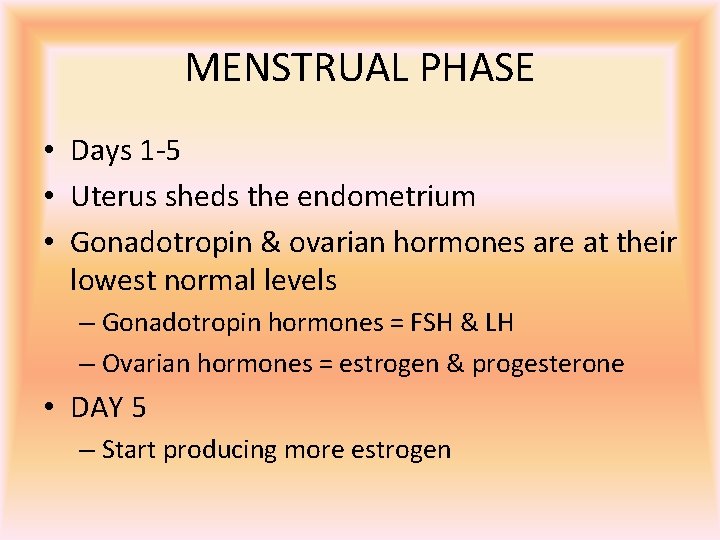
MENSTRUAL PHASE • Days 1 -5 • Uterus sheds the endometrium • Gonadotropin & ovarian hormones are at their lowest normal levels – Gonadotropin hormones = FSH & LH – Ovarian hormones = estrogen & progesterone • DAY 5 – Start producing more estrogen
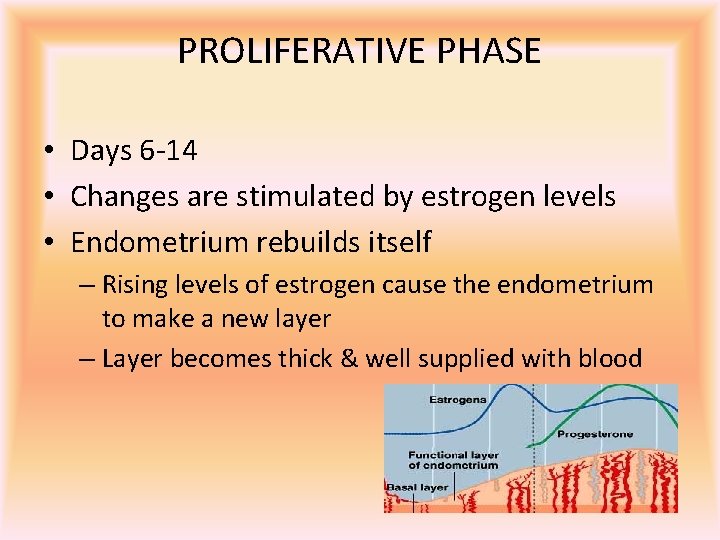
PROLIFERATIVE PHASE • Days 6 -14 • Changes are stimulated by estrogen levels • Endometrium rebuilds itself – Rising levels of estrogen cause the endometrium to make a new layer – Layer becomes thick & well supplied with blood
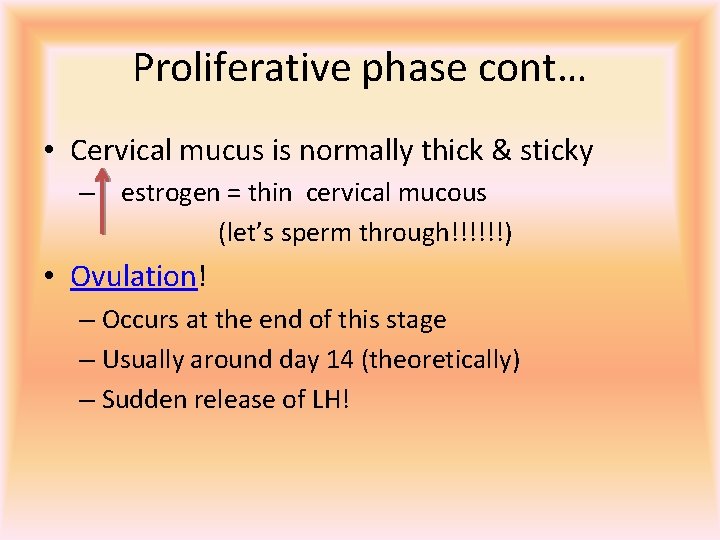
Proliferative phase cont… • Cervical mucus is normally thick & sticky – estrogen = thin cervical mucous (let’s sperm through!!!!!!) • Ovulation! – Occurs at the end of this stage – Usually around day 14 (theoretically) – Sudden release of LH!
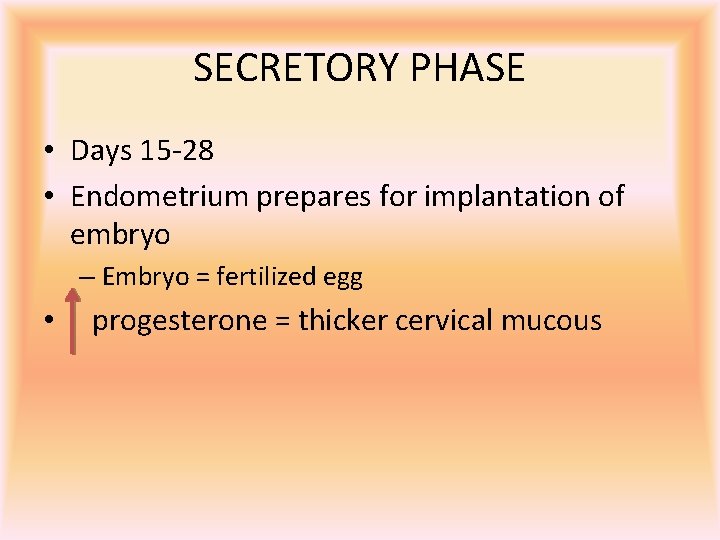
SECRETORY PHASE • Days 15 -28 • Endometrium prepares for implantation of embryo – Embryo = fertilized egg • progesterone = thicker cervical mucous
Secretory phase cont… IF NOT FERTILIZED!!! • Endometrial cells begin to die • As the blood vessels die, they constrict and then open wide, causing blood to gush out, causing the functional layer of the endometrium to slough off MENSTRUAL CYCLE STARTS ALL OVER AGAIN
CONCERNS ABOUT THE FEMALE REPRODUCTIVE SYSTEM
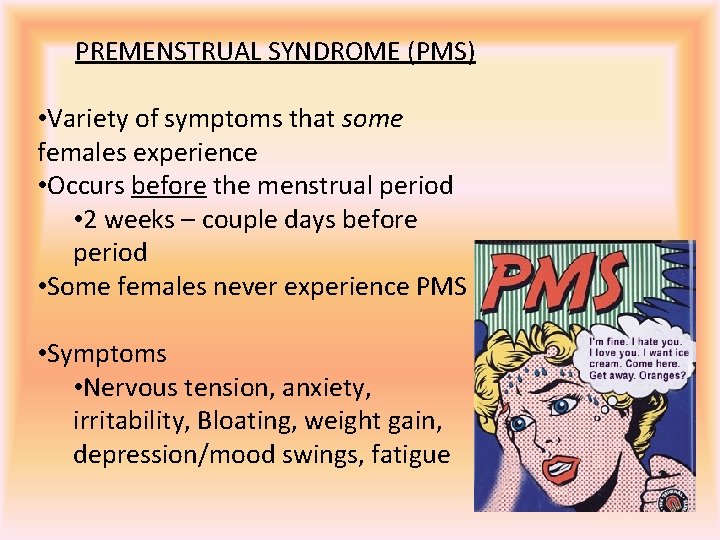
PREMENSTRUAL SYNDROME (PMS) • Variety of symptoms that some females experience • Occurs before the menstrual period • 2 weeks – couple days before period • Some females never experience PMS • Symptoms • Nervous tension, anxiety, irritability, Bloating, weight gain, depression/mood swings, fatigue
PMS cont… • Causes aren’t completely understood… – More common in 30’s women – Related to hormone imbalance – Nutritional deficiency • Treatment – Change in diet & exercise – Serious cases = antidepressant meds
Dysmenorrhea • Aka “menstrual cramps – Painful contractions in the uterus – Usually mild – lasting several hours – More painful cramping lasting 1 -2 days is normal Treatment * Light exercise * OTC pain reliever can help (except aspirin!) * Warm bath/heating pad may relax muscles * Severe or persistent cramping may be an indication that medical attention is necessary*
Amenorrhea • Lack of menstruation by age 16 or stopping of menstrual cycle in a female who previously menstruated • Cause – Physical defects in sex organs – Diseases • • Diabetes Tumors Infections Lack of maturation of the endocrine system – Excessive athletic activities – Emotional distress – Eating disorders/starvation
Toxic Shock Syndrome (TSS) • Rare disease caused by common pathogen – Staphylococcus aureus – Commonly found on skin, in mouth, and in vagina – Under certain conditions, bacterium can produce a poison/toxin that affects the immune system and liver • Symptoms – High fever -- Vomiting -- Diarrhea --Dizziness – Low blood pressure – Fainting – Rash resembling a sunburn
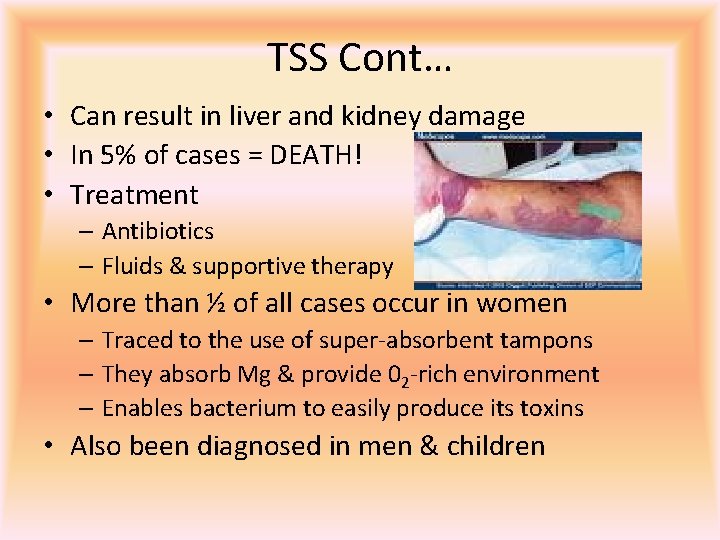
TSS Cont… • Can result in liver and kidney damage • In 5% of cases = DEATH! • Treatment – Antibiotics – Fluids & supportive therapy • More than ½ of all cases occur in women – Traced to the use of super-absorbent tampons – They absorb Mg & provide 02 -rich environment – Enables bacterium to easily produce its toxins • Also been diagnosed in men & children
Vaginitis • Common term for vaginal infections • Will affect most females at some point PICTURES ARE AVAILABLE ON • 3 common types GOOGLE, BUT THEY – Yeast infection ARE NOT FUN TO LOOK – Nonspecific vaginitis AT… – trichomoniasis
Vaginitis Types YEAST INFECTION • Caused by a fungus • White odorous discharge • Genital itching NONSPECIFIC VAGINITIS • Caused by bacteria • Itching • Odorless discharge • Burning sensation during urination TRICHOMONIASIS • Caused by a protozoan • Often occurs at the end of the menstrual period • Odorous discharge • Genital itching • Occasionally burning sensation during urination
Vaginitis Treatment • * Contact doctor for proper diagnosis !* • Yeast Infection – Yeast-killing cream – Suppository medication, placed in the vagina • Trich & NSV – Antibiotic prescribed by Doctor • mostly the result of imbalance of organisms normally present in the vagina • Some can also be the result of sexual contact with an infected person
Sterility • Inability to reproduce • Causes – Blocking of 1 or both fallopian tubes • Ova cannot pass into the uterus – Female does not ovulate – Endometriosis • Endometrial tissue grows outside the uterus in other areas of the pelvic cavity • Surgery can sometimes correct this problem! – Untreated STDs • Untreated Chlamydia & gonorrhea are the most common STDs that cause sterility
BREAST CANCER • Most common form of cancer in females • 2 ND leading cause of death in females (1 ST = lung cancer) • Prevention – Maintain ideal weight for height – Eat foods high in Vitamin A & C • Treatment – Most treatable & curable when detected early – Limited & less disfiguring if detected when in a small area of the breast
Breast Cancer Cont… • Symptoms – Change in breast or nipple appearance – Lump or swelling in breast – Lump under the armpit • 90% of all breast lumps in females are discovered by the females themselves! – Most are benign (harmless)
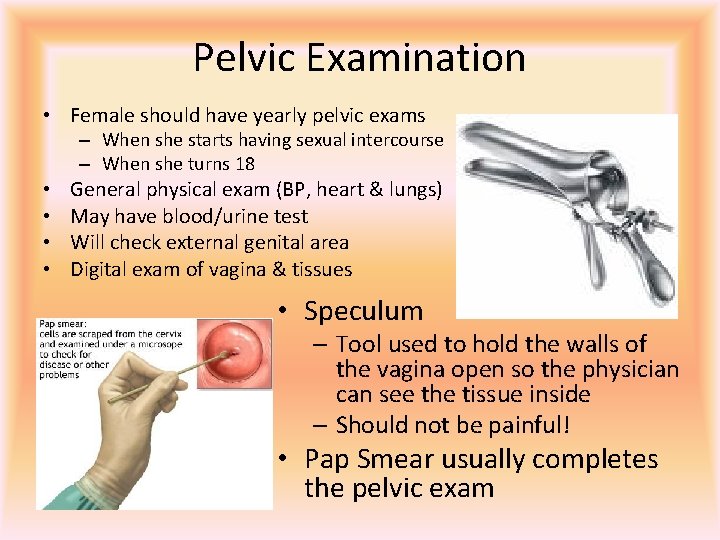
CERVICAL CANCER • Pap Smear – Test done by Doctors to detect abnormal cells – Uses along instrument to gather cells from cervix – Lab techs examine the cells for cancer/precancerous cells – Female should have a pap smear every year from age 18 (earlier if she’s sexually active!) • If not detected early, cancer cells spread more deeply into the cervix & its surrounding areas
Cervical Cancer Cont… • Symptoms – No Early Symptoms – Risk Factors • • Age 20 -30 Never having a pap smear Sexual intercourse at an early age Multiple sex partners • Treatment – Can be treated with surgery to remove part or all of the cervix and other affected areas – Radiation or chemotherapy
OVARIAN CANCER • 2 types – Lining of the ovary – Cells that make eggs • “germ cell tumor” of the ovary • Usually occur in teen girls or young women • RARE
Ovarian Cancer Cont… • Symptoms – Early • Vague gastrointestinal discomfort • Pelvic pressure • pain – Later Deepened voice Unusual hair growth Unexplained weight loss Enlarged, hard and sometimes tender mass in lower abdomen • Painful interourse • Anemia • By this time… the disease is quite advanced • •
FEMALE REPRODUCTIVE HEALTH
• Common hygiene methods are important • Vagina is self-cleaning – Cells in the lining of the vagina are constantly being shed – Forms a slight vaginal discharge (NORMAL!) • Douches & feminine hygiene sprays are not necessary – May cause irritation – Disrupt female’s natural cleansing method
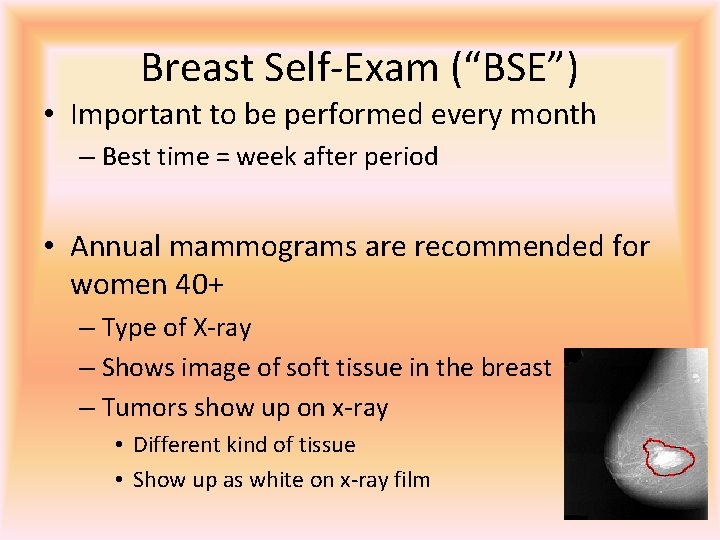
Breast Self-Exam (“BSE”) • Important to be performed every month – Best time = week after period • Annual mammograms are recommended for women 40+ – Type of X-ray – Shows image of soft tissue in the breast – Tumors show up on x-ray • Different kind of tissue • Show up as white on x-ray film
Pelvic Examination • Female should have yearly pelvic exams – When she starts having sexual intercourse – When she turns 18 • • General physical exam (BP, heart & lungs) May have blood/urine test Will check external genital area Digital exam of vagina & tissues • Speculum – Tool used to hold the walls of the vagina open so the physician can see the tissue inside – Should not be painful! • Pap Smear usually completes the pelvic exam