
FEMA4538 DRMS Public Assistance Applicant Briefing FEMA4538 Declared
FEMA-4538 -DR-MS Public Assistance Applicant Briefing FEMA-4538 Declared: April 23, 2020 Incident Period: February 1018, 2020
Outline • • • Public Assistance Definition Applicant Facility Work Cost

Public Assistance Defined Supplemental financial assistance to State and local governments and certain private non-profit organizations for response and recovery activities required as a result of a federally declared disaster. Funding is cost shared at a federal share of no less than 75% of eligible costs.

Public Assistance Applied • The Public Assistance Program assists in the restoration of community infrastructure. • It is a supplemental cost REIMBURSEMENT program with specific eligibility requirements. • The FEMA share of eligible costs will be awarded to the recipient (grantee) for disbursement to the applicants.

Public Assistance Applied • Public Assistance is NOT – • Assistance to local populations for damages to private houses, commercial property, local businesses, etc.
Partnership • FEMA – manages the program, provides technical assistance, approves grants. • State (Recipient) – educates applicants, works with FEMA to manage the program, implements and monitors grants awarded. • Applicant (Subrecipient) – identifies damage, provides documentation, manages funded projects.
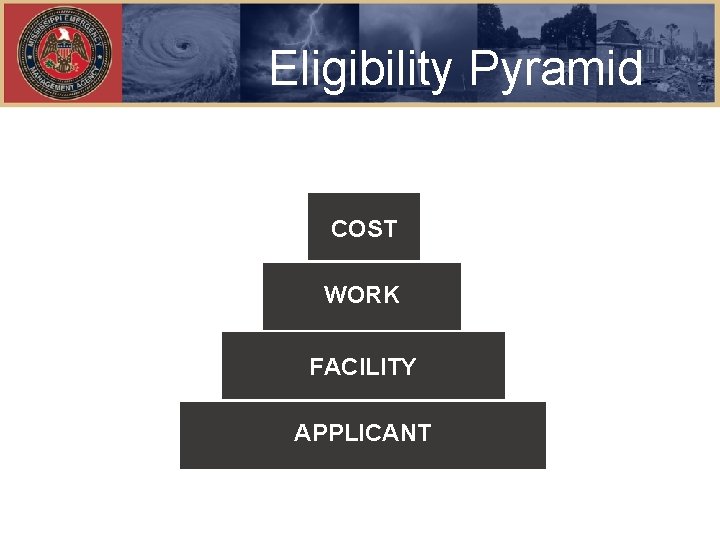
Eligibility Pyramid COST WORK FACILITY APPLICANT
Eligible Applicants • State • Declared Counties • City / Town / Village within Declared Counties • Other political subdivision of the State • Native American Tribal Governments and Tribal Organizations • Certain Private Non-Profit Organizations
Private Non- Profit Entities (PNP) To be an eligible PNP Applicant, the PNP must show that is has: • A current ruling letter from the IRS granting tax exemption under 501(c/d/e) or Internal Revenue Code of 1954 or • Documentation from MS Secretary of State substantiating it is a non-revenue producing nonprofit entity doing business under the State Law.
Private Non- Profit Entities (PNP) Two categories of PNP • Critical Services Eligible for both Emergency Work and Permanent Work: • Fire / Emergency Rescue • Medical Treatment • Power, Water, & Sewer Utilities • Communications Systems • Educational Facilities
Private Non- Profit Entities (PNP) Two categories of PNP • Non-Critical/Essential Services Eligible for Emergency Work : Museums, Community Centers, Libraries, Homeless Shelters, Senior Citizens Centers, Zoos, Day-Care Centers, etc. Non-critical/Essential PNPs must first apply to the Small Business Administration (SBA) for a disaster loan for permanent repair work before applying to FEMA.
Facility Eligibility To be eligible, the facility must: §Be damaged as a Result of the Declared Event. §Located Within the Presidentially Declared Area. §Be the Legal Responsibility of an eligible Applicant. §Not be under the Authority of a Federal Agency.
Types of Work Emergency Work A. Debris Removal B. Emergency Protective Measures Permanent Work C. Roads and Bridge Systems D. Water Control Facilities E. Public Buildings / Equipment F. Public Utilities G. Other (Parks, Recreation, etc. )
Emergency Work Categories A & B FEMA is authorized to provide Public Assistance funding for Emergency Work, including emergency protective measures and debris removal. Emergency Work is that which must be done immediately to: § Save lives § Protect public health and safety § Protect improved property § Eliminate or lessen an immediate threat of additional damage.
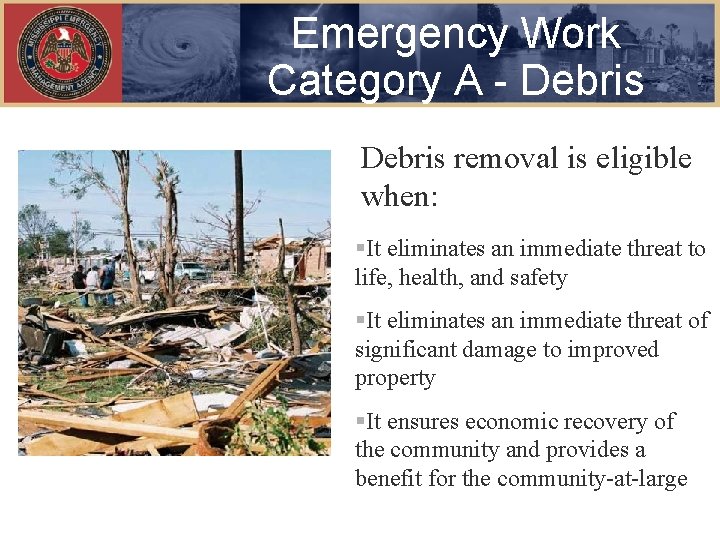
Emergency Work Category A - Debris removal is eligible when: §It eliminates an immediate threat to life, health, and safety §It eliminates an immediate threat of significant damage to improved property §It ensures economic recovery of the community and provides a benefit for the community-at-large
Emergency Work Category A - Debris Do’s – - Contact MDEQ for Staging Sites - Truck Certifications - Monitor Debris - Activate your prepositioned Contractor - Bid out debris work beyond 30 days from storm
Emergency Work Category A - Debris Don’ts – - Stage your debris wherever you want. - Place debris in unpermitted sites. - Continue with Prepositioned Contractor beyond 30 days. - Ignore debris monitoring.
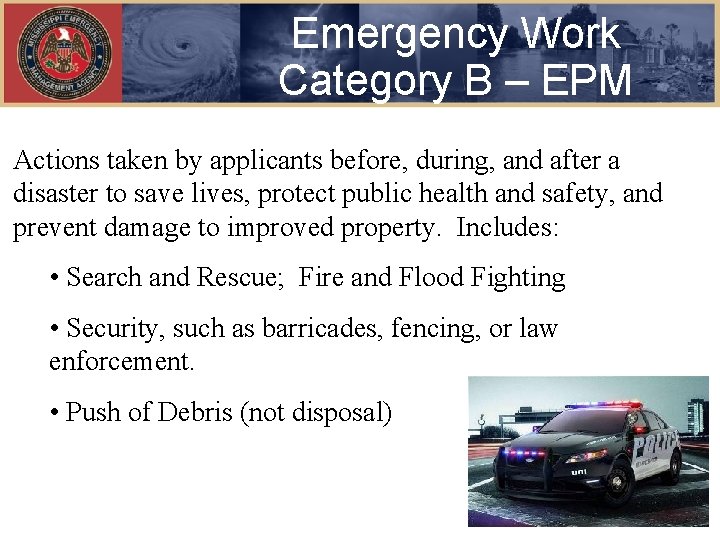
Emergency Work Category B – EPM Actions taken by applicants before, during, and after a disaster to save lives, protect public health and safety, and prevent damage to improved property. Includes: • Search and Rescue; Fire and Flood Fighting • Security, such as barricades, fencing, or law enforcement. • Push of Debris (not disposal)
Permanent Work Categories C-G Eligible Permanent Work: § Must repair, restore or replace disaster-damaged facilities in accordance with regulations § Must restore to pre-disaster design, capacity and function in accordance with applicable codes and standards § Must be required as a result of the disaster § May include cost effective hazard mitigation measures
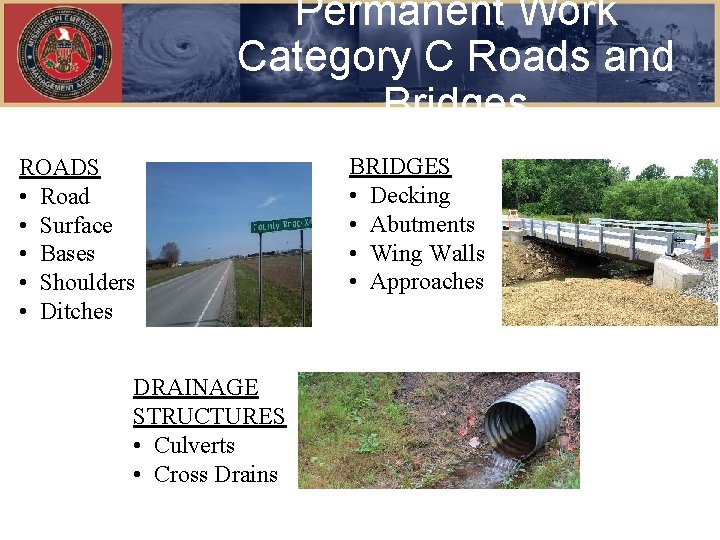
Permanent Work Category C Roads and Bridges ROADS • Road • Surface • Bases • Shoulders • Ditches DRAINAGE STRUCTURES • Culverts • Cross Drains BRIDGES • Decking • Abutments • Wing Walls • Approaches
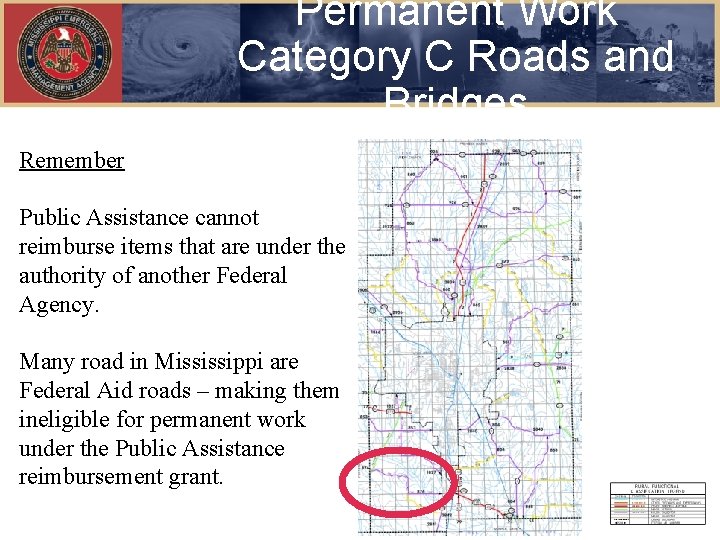
Permanent Work Category C Roads and Bridges Remember Public Assistance cannot reimburse items that are under the authority of another Federal Agency. Many road in Mississippi are Federal Aid roads – making them ineligible for permanent work under the Public Assistance reimbursement grant.
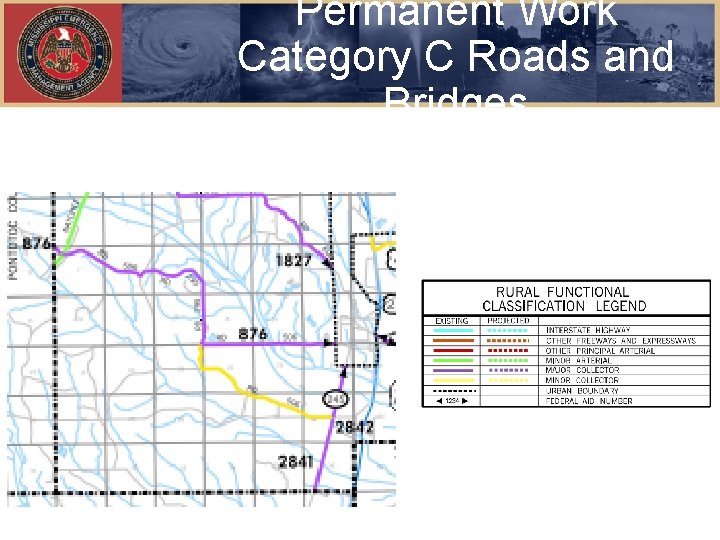
Permanent Work Category C Roads and Bridges
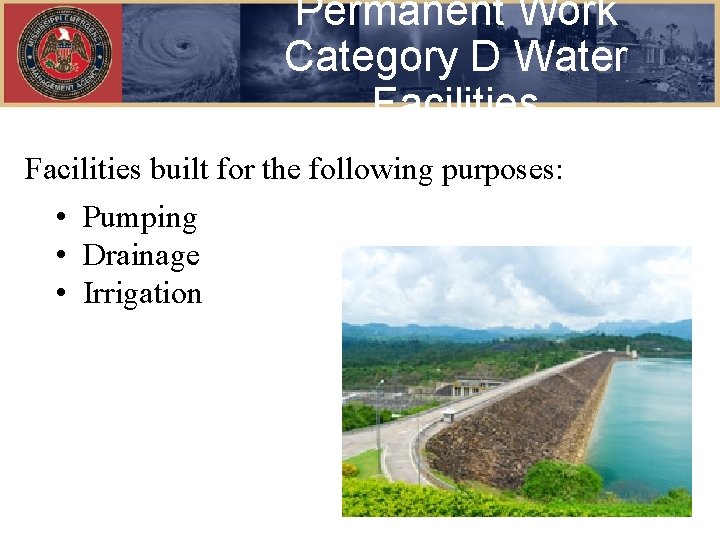
Permanent Work Category D Water Facilities built for the following purposes: • Pumping • Drainage • Irrigation
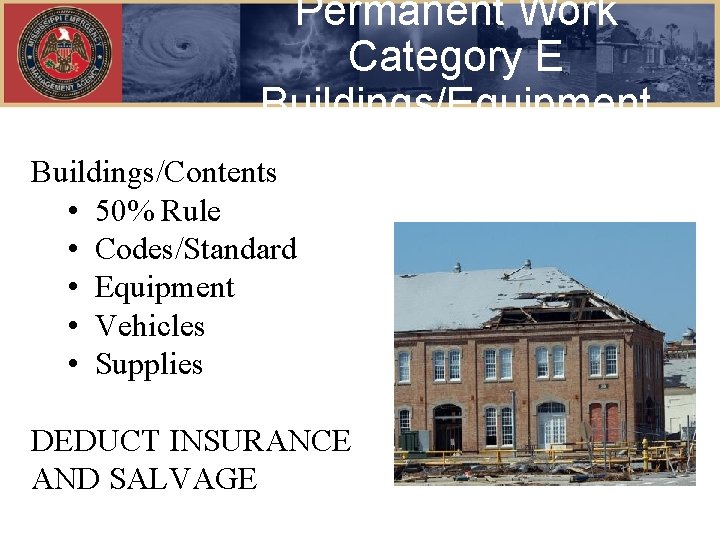
Permanent Work Category E Buildings/Equipment Buildings/Contents • 50% Rule • Codes/Standard • Equipment • Vehicles • Supplies DEDUCT INSURANCE AND SALVAGE
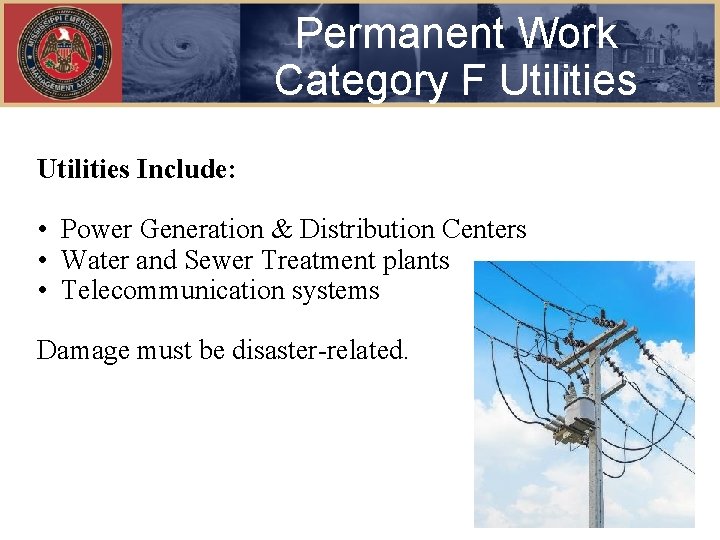
Permanent Work Category F Utilities Include: • Power Generation & Distribution Centers • Water and Sewer Treatment plants • Telecommunication systems Damage must be disaster-related.
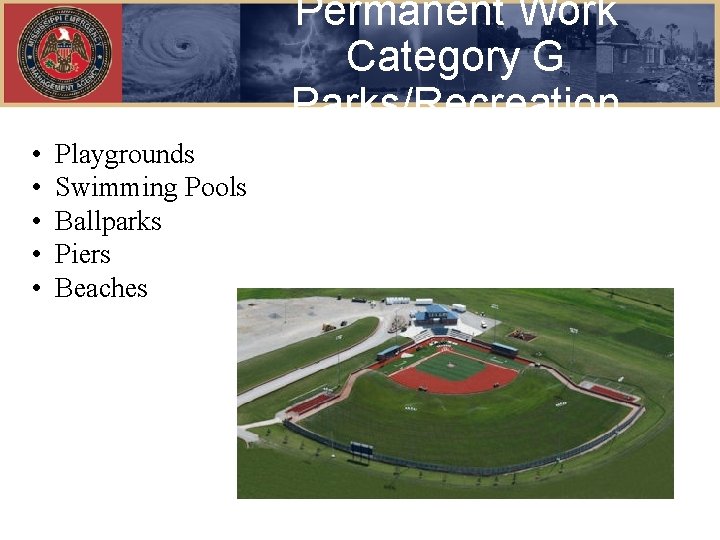
Permanent Work Category G Parks/Recreation • • • Playgrounds Swimming Pools Ballparks Piers Beaches
Category Z Administrative Cost Stafford Act – Section 324 authorizes PA funding for management costs (indirect costs, administrative expenses, etc. ) • Preliminary Damage Assessments • Meetings regarding the PA Program • Organizing damage sites into logical groups • Correspondence Funding is based on actual costs up to a specified amount at 100% federal funding. Applicant must track costs.
Cost Eligibility To be eligible for reimbursement, costs must: § Be reasonable and necessary to accomplish eligible work § A cost is reasonable if, in its nature and amount, it does not exceed that which would be incurred by a prudent person under the circumstances prevailing at the time the Applicant makes the decision to incur the cost
Cost Eligibility To be eligible for reimbursement, costs must: § Comply with federal, state, and local laws and regulations. § Authorized and not prohibited under Federal, State, Territorial, Tribal, or local government laws or regulations. § Consistent with the Applicant’s internal policies, regulations, and procedures that apply uniformly to both Federal awards and other activities of the Applicant.
Cost Eligibility To be eligible for reimbursement, costs must: § Include deductions of insurance proceeds, salvage value, and purchase discounts.
Eligible Cost Force Account “LABOR” Category A – Debris Removal/Clearance – Regular/Straight Time and Overtime (including Fringe Benefits) are eligible (new Sandy Recovery Improvement Act of 2013). Category B – Emergency Protective Measures – Only Overtime is eligible (including Fringe Benefits). Category C-G – Regular/Straight Time and Overtime (including Fringe Benefits) are eligible.
Eligible Cost • Materials – The costs for items used from applicant’s inventory and for items purchased to make authorized repairs to meet the scope of work are eligible. • Applicant owned Equipment – The costs associated with the equipment used to perform authorized repairs, all operating equipment hours are eligible, should be supported by Labor Time Sheets. Rates based on FEMA Schedule of Equipment Rates.

Types of Projects • Small Projects • Large Projects • Improved Projects • Alternate Projects
Thresholds Public Assistance projects are processed as either small or large projects. If the project cost is less than the annually updated cost threshold amount (currently $131, 100) the project is processed as a small project. If the project cost equals or exceeds the threshold the project is processed as a large project.
Types of Projects Small Projects Funding is based on work completed (if available) or initial cost estimate. Federal cost share is paid upon project approval. When the cost of work is less than $3, 300, that work is not eligible. Large Projects Initially approved based on estimated costs. Funding is based on documented actual costs. Federal cost share is paid as work is accomplished.
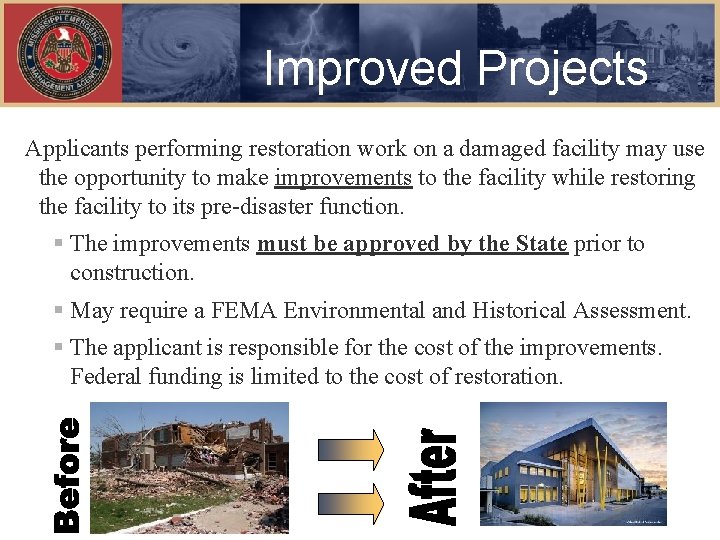
Improved Projects Applicants performing restoration work on a damaged facility may use the opportunity to make improvements to the facility while restoring the facility to its pre-disaster function. § The improvements must be approved by the State prior to construction. § May require a FEMA Environmental and Historical Assessment. § The applicant is responsible for the cost of the improvements. Federal funding is limited to the cost of restoration.
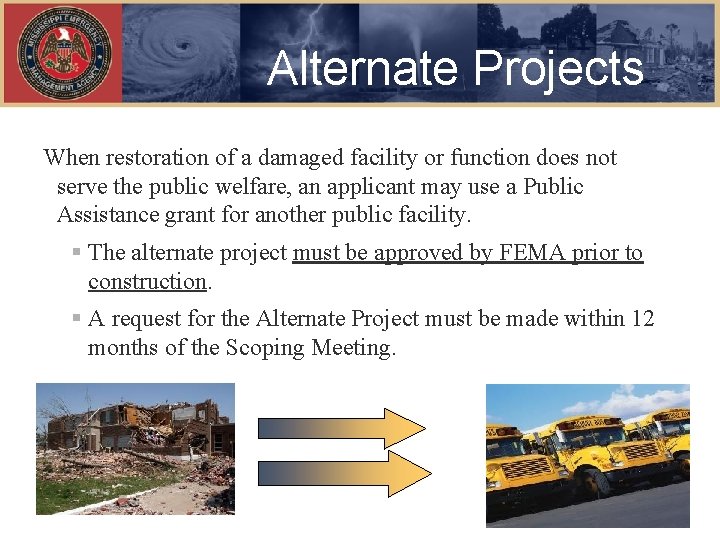
Alternate Projects When restoration of a damaged facility or function does not serve the public welfare, an applicant may use a Public Assistance grant for another public facility. § The alternate project must be approved by FEMA prior to construction. § A request for the Alternate Project must be made within 12 months of the Scoping Meeting.
Alternate Projects § The alternate project may require an environmental assessment. § Federal funding is limited to 90% of the federal share of the original project estimate or actual Alternate Project costs (whichever is less) for State and local governments, or 75% for PNP applicants, utilizing the traditional Alternate Project program.
Project Period of Performance Time limits for project completion begin on the disaster declaration date. § Emergency work must be completed within 6 months § Permanent work must be completed within 18 months
Project Period of Performance The Recipient can grant time extension for extenuating circumstances. Those extensions are: § Emergency work: § Permanent work: up to 6 additional months up to 30 additional months The Regional Administrator may increase these time extensions on a case-by-case basis. NOTE: If the deadline for any project has been reached, without an approved time extension, no costs past the deadline date will be eligible for funding!
Special Considerations Special considerations are issues other than program eligibility that could affect the scope of work and funding of a project. These issues include: § Insurance § Hazard Mitigation § Environmental Protection § Floodplain Management § Historic Preservation and Cultural Resources
Insurance § Actual or anticipated insurance proceeds will be deducted from the eligible project costs for facilities that are insured. § All applicants are required to obtain and maintain insurance coverage on all insurable facilities as a condition of Public Assistance funding. § For flood damaged facilities located within a Special Flood Hazard Area that are not covered by flood insurance, FEDERAL ASSISTANCE WILL BE REDUCED BY THE MAXIMUM FLOOD INSURANCE PROCEEDS THAT WOULD HAVE BEEN PAYABLE HAD THE FACILITY BEEN INSURED.
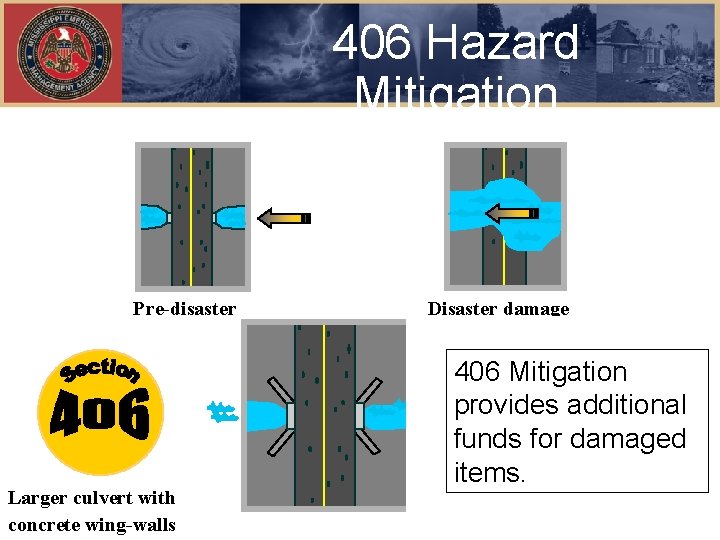
406 Hazard Mitigation Pre-disaster Larger culvert with concrete wing-walls Disaster damage 406 Mitigation provides additional funds for damaged items.
Environmental and Historical Preservation (EHP) Compliance § All FEMA funded projects must comply with a variety of EHP Laws, Regulations and Executive Orders § EHP Review is done prior to funding to ensure compliance with applicable Federal laws. § EHP Review is a collaboration between FEMA, the State, applicants, tribal entities, and local organizations § Construction of new facilities, alternate projects, modification, expansion, or mitigation of existing facilities may require more extensive EHP review. § FEMA must complete review before work starts.
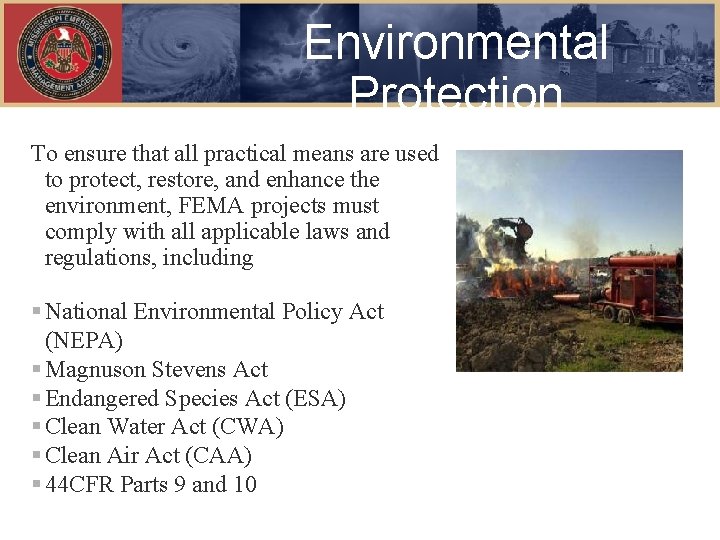
Environmental Protection To ensure that all practical means are used to protect, restore, and enhance the environment, FEMA projects must comply with all applicable laws and regulations, including § National Environmental Policy Act (NEPA) § Magnuson Stevens Act § Endangered Species Act (ESA) § Clean Water Act (CWA) § Clean Air Act (CAA) § 44 CFR Parts 9 and 10
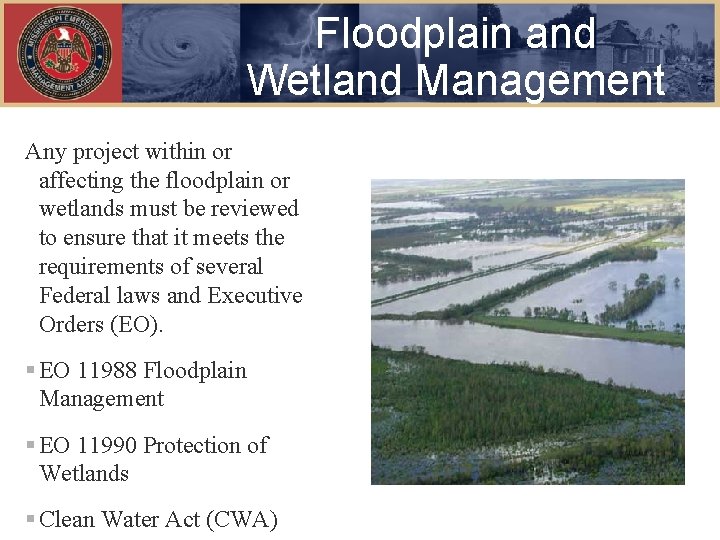
Floodplain and Wetland Management Any project within or affecting the floodplain or wetlands must be reviewed to ensure that it meets the requirements of several Federal laws and Executive Orders (EO). § EO 11988 Floodplain Management § EO 11990 Protection of Wetlands § Clean Water Act (CWA)
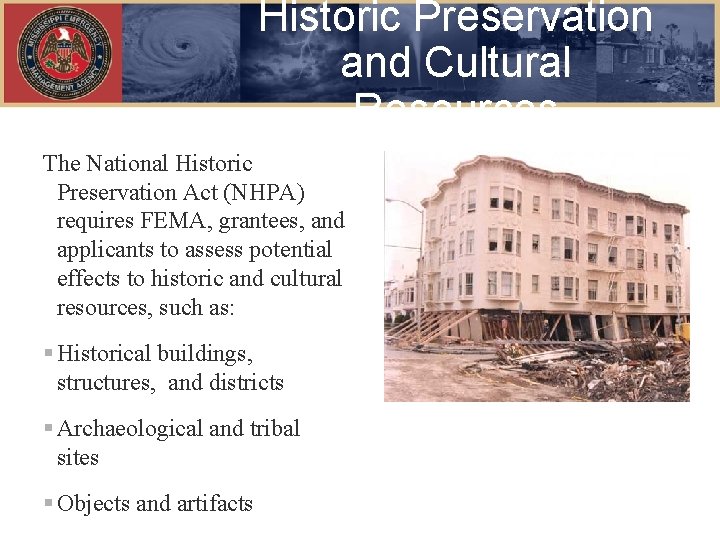
Historic Preservation and Cultural Resources The National Historic Preservation Act (NHPA) requires FEMA, grantees, and applicants to assess potential effects to historic and cultural resources, such as: § Historical buildings, structures, and districts § Archaeological and tribal sites § Objects and artifacts
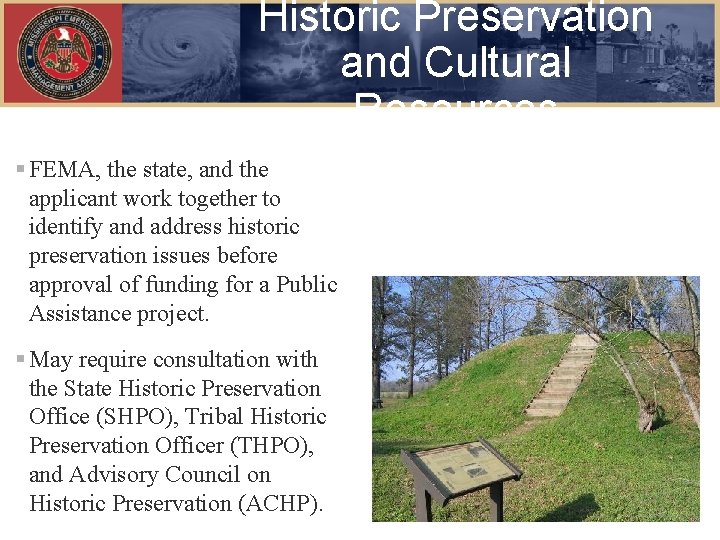
Historic Preservation and Cultural Resources § FEMA, the state, and the applicant work together to identify and address historic preservation issues before approval of funding for a Public Assistance project. § May require consultation with the State Historic Preservation Office (SHPO), Tribal Historic Preservation Officer (THPO), and Advisory Council on Historic Preservation (ACHP).
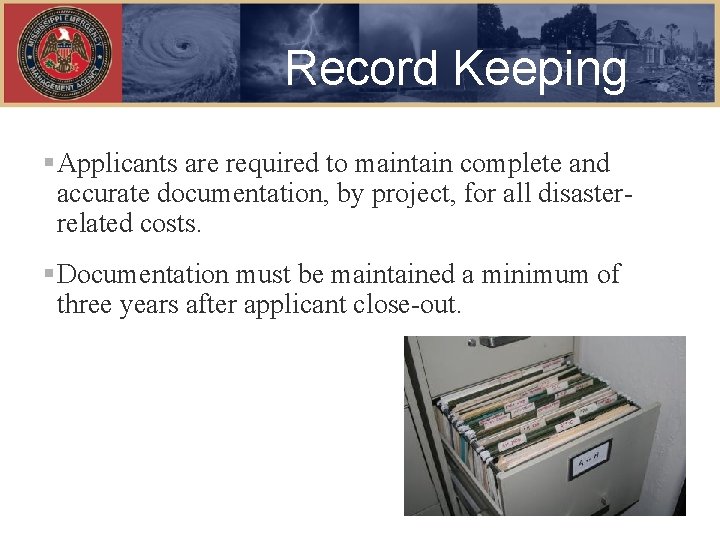
Record Keeping §Applicants are required to maintain complete and accurate documentation, by project, for all disasterrelated costs. §Documentation must be maintained a minimum of three years after applicant close-out.
Documentation • • • Force Account Labor Force Account Equipment Material Rented Contract
Force Account Labor • Applicant’s Payroll Policy (prior to disaster) • Applicant’s Benefits Calculation Worksheet • Applicant’s Complete Employee List – Should include Employee rate – Exempt vs. Non-Exempt Employees • Time Sheets and Payroll Records • Copies of Cancelled Checks / Proof of Direct Deposit
Force Account Equipment • Applicant’s Equipment Listing • Equipment documentation sheets • Employee timesheets reflecting equipment operated time, date of use etc. • FEMA Schedule of Equipment Rates
Force Account Materials • Material Summary Record • Applicant’s Materials Inventory List dated prior to disaster (i. e. Assets Inventory) • Materials Requisition Sheets – if available • Invoices for materials purchased and put in inventory and copies of checks paying the invoices.
Procurement • Procurement – Federal, State , Local Requirement, whichever is the most stringent – Training available. Web Search – “Procurement Disaster Assistance Team” or https: //www. fema. gov/procurement-disaster-assistance-team and click “Procurement Under Grants 2. 0 Webinar Series
Rental Equipment Rented Equipment • Copies of the signed Rental Agreement(s) • Invoices • Verify proof of payment
Appeals Any determination related to Federal Assistance may be appealed. The appeal must be submitted in writing to the State (Grantee) within 60 days of receipt of notice of the action being appealed. • State has 60 days from receipt of appeal letter to forward it to FEMA. • FEMA has 90 days to render a decision. Two levels of appeal are available: 1) to the Regional Administrator and 2) to the Assistant Administrator for Disaster Assistance Directorate.
Time Limits Applying for a Public Assistance Grant §Applicant must submit a Request for Public Assistance (RPA) within 30 days of the respective area being designated in the declaration. §Applicant must submit all damages within 60 days from the RECOVERY SCOPING MEETING (formerly called the kick-off meeting).
Sandy Recovery Act Changes Debris Removal Operations • Straight time F/A Labor eligible. • Applicant can retain earnings from recycling.
Sandy Recovery Act Changes • Permanent Work – Section 428 • Grants Based on Estimates (Capped) • Cost overrun absorbed by applicant • Under run can be used by applicant for specific mitigation uses (must be approved by FEMA) • Applicant may consolidate multiple projects in one Project Worksheet • FEMA may accept applicant’s licensed engineer’s cost estimates • Must be very sure of costs • Over runs in permanent work is common
Grants Portal The Public Assistance Grant now utilizes the Grants Portal for application, documentation and project development. Applicants will trained on the use of the Grants Portal by MEMA/FEMA.
How to submit an RPA To submit your “Request for Public Assistance” (RPA) through your Grants Portal Account, simply • Log In • Click “Submit Request for Public Assistance” • Follow the prompts If you don’t have an account, follow the prompts on the next page.
How to submit an RPA If you do NOT have an account in the Grants Portal, please send an e-mail to recovery 1@mema. ms. gov. Include the name of your organization, Tax ID #, DUNS #, Point of Contact Name/Position/Phone # email address.
Next Steps Once the RPA is approved, you will be contacted by a Program Delivery Manager (PDMG) from either MEMA or FEMA to initiate several meetings.
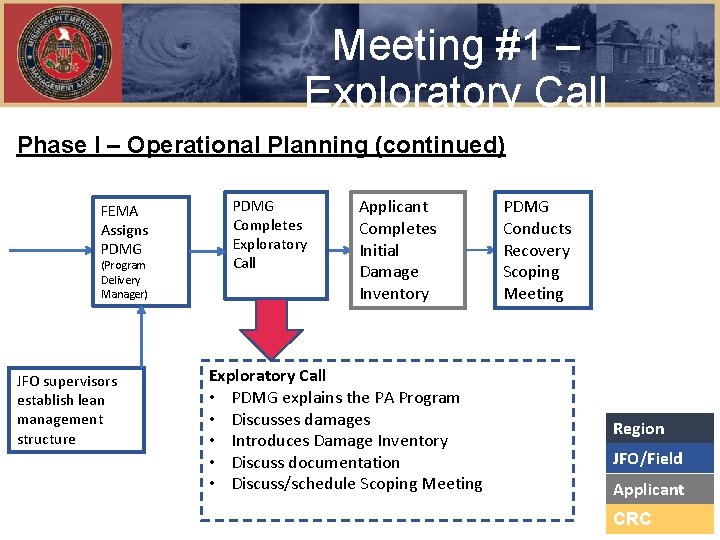
Meeting #1 – Exploratory Call Phase I – Operational Planning (continued) FEMA Assigns PDMG (Program Delivery Manager) JFO supervisors establish lean management structure PDMG Completes Exploratory Call Applicant Completes Initial Damage Inventory Exploratory Call • PDMG explains the PA Program • Discusses damages • Introduces Damage Inventory • Discuss documentation • Discuss/schedule Scoping Meeting PDMG Conducts Recovery Scoping Meeting Region JFO/Field Applicant CRC
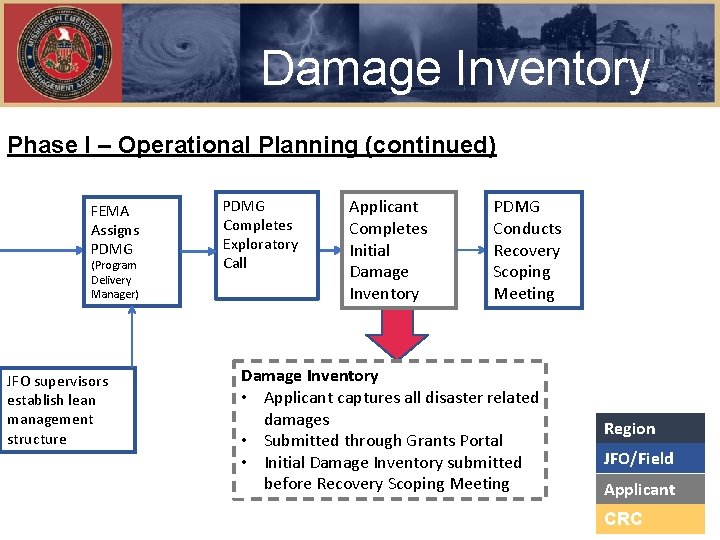
Damage Inventory Phase I – Operational Planning (continued) FEMA Assigns PDMG (Program Delivery Manager) JFO supervisors establish lean management structure PDMG Completes Exploratory Call Applicant Completes Initial Damage Inventory PDMG Conducts Recovery Scoping Meeting Damage Inventory • Applicant captures all disaster related damages • Submitted through Grants Portal • Initial Damage Inventory submitted before Recovery Scoping Meeting Region JFO/Field Applicant CRC
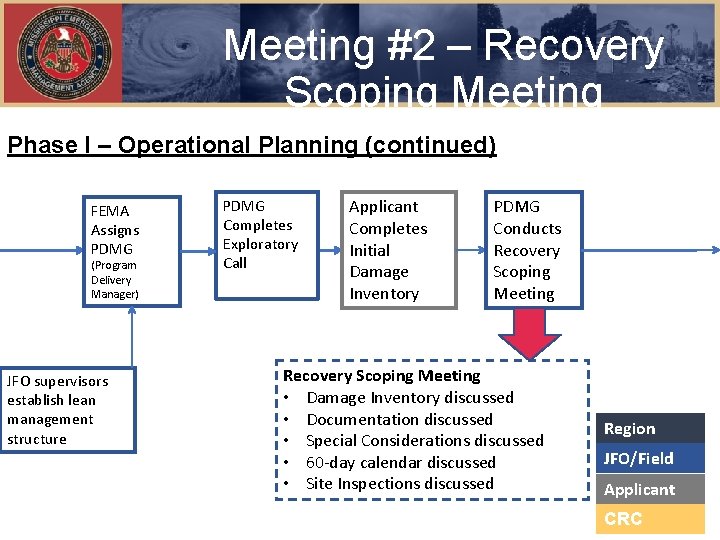
Meeting #2 – Recovery Scoping Meeting Phase I – Operational Planning (continued) FEMA Assigns PDMG (Program Delivery Manager) JFO supervisors establish lean management structure PDMG Completes Exploratory Call Applicant Completes Initial Damage Inventory PDMG Conducts Recovery Scoping Meeting • Damage Inventory discussed • Documentation discussed • Special Considerations discussed • 60 -day calendar discussed • Site Inspections discussed Region JFO/Field Applicant CRC
Next Steps After the Recovery Scoping Meeting, your project will be developed by your Project Team.
Applicant Agent Who should be your Applicant Agent? §Understands Program Elements §Familiar with Computer §Well Organized §Readily Available
Observation §The Delivery Model, in effect, will demand more responsibility and work on the Applicant.
Summary §The Public Assistance Program assists in the restoration of community infrastructure. §It is a supplemental cost REIMBURSEMENT program with specific eligibility requirements.
MEMA Contacts Greg Michel Executive Director 601 -933 -6362 or gmichel@mema. ms. gov Stephen Mc. Craney Deputy Director 601 -933 -6635 or smccraney@mema. ms. gov Todd De. Muth State Coordinating Officer 601 -933 -6653 or tdemuth@mema. ms. gov Clayton French State Public Assistance Officer 601 -933 -6886 or cfrench@mema. ms. gov
FEMA-4538 -DR-MS Public Assistance Applicant Briefing FEMA-4538 Declared: April 23, 2020 Incident Period: February 1018, 2020
- Slides: 72