
FEMA Region 1 HigherEducation Center of Excellence Strengthening
- Slides: 17
FEMA Region 1 “Higher-Education Center of Excellence”: Strengthening the Emergency Management Academic Community 14 th Annual Emergency Management Conference June 6 -9 th, 2011 Presented By: Robert Pesapane, FEMA Region 1 Christopher Lynch, FEMA Region 1
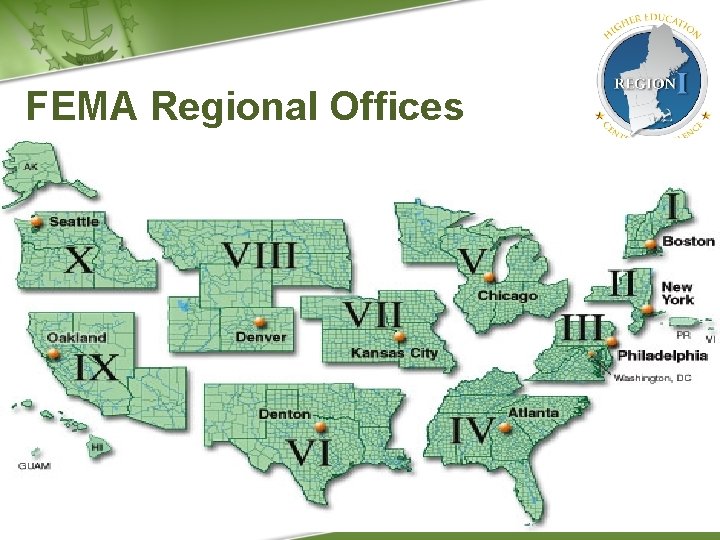
FEMA Regional Offices
Hi. Ed Center of Excellence Program • Works to build relationships with Hi. Eed learning institutions • Develops partnerships with public and private sector • Promotes best practices from within the region • Explores competitive training grant program (CTGP) opportunities and links existing CTGP recipients to ongoing initiatives in the public/private sector (Community College Citizen Preparedness Program [3 CP 2] Citizen Preparedness) 3
5 -Year Vision • Working with State partners, markedly improve New England preparedness culture • Enhance individual preparedness through integrated educational programs • Connect age groups through emergency management/homeland security programs • Distribute Student Tools for Emergency Planning (STEP) to 100% of 4 th or 5 th grade students • Provide alternative emergency management educational programs for high school, Outward Bound, Scouts • Enhance emergency management/homeland security knowledge base through Hi. Ed network connecting them with their emergency management communities, exemplars, Federal Centers of Excellence, and others 4
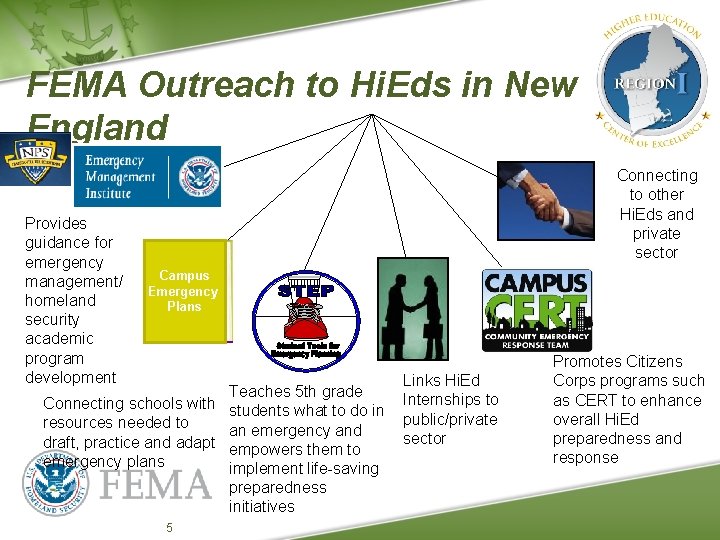
FEMA Outreach to Hi. Eds in New England Provides guidance for emergency management/ homeland security academic program development Connecting to other Hi. Eds and private sector Campus Emergency Plans Teaches 5 th grade Connecting schools with students what to do in resources needed to an emergency and draft, practice and adapt empowers them to emergency plans implement life-saving preparedness initiatives 5 Links Hi. Ed Internships to public/private sector Promotes Citizens Corps programs such as CERT to enhance overall Hi. Ed preparedness and response
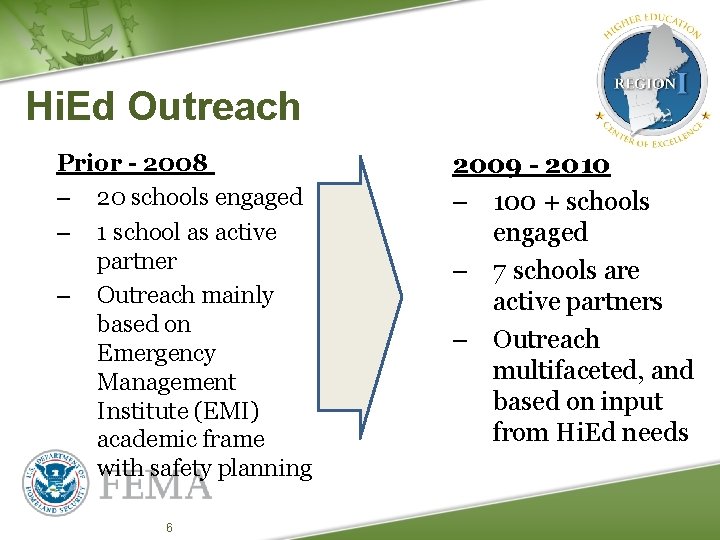
Hi. Ed Outreach Prior - 2008 – 20 schools engaged – 1 school as active partner – Outreach mainly based on Emergency Management Institute (EMI) academic frame with safety planning 6 2009 - 2010 – 100 + schools engaged – 7 schools are active partners – Outreach multifaceted, and based on input from Hi. Ed needs
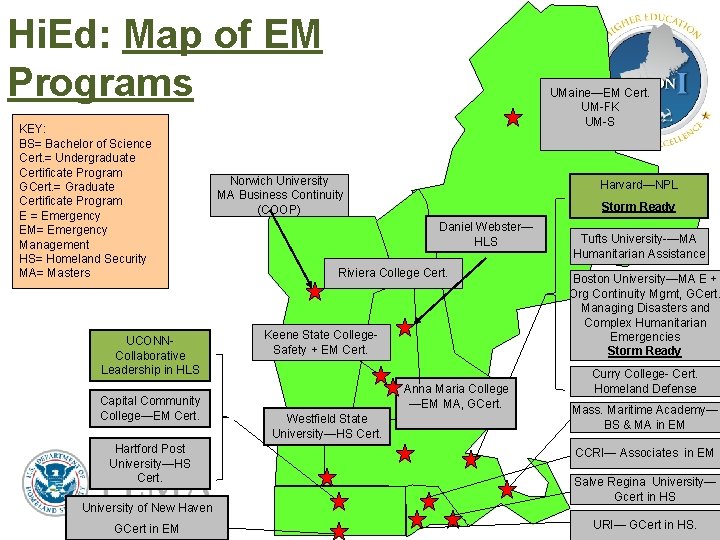
Hi. Ed: Map of EM Programs KEY: BS= Bachelor of Science Cert. = Undergraduate Certificate Program GCert. = Graduate Certificate Program E = Emergency EM= Emergency Management HS= Homeland Security MA= Masters UCONNCollaborative Leadership in HLS Capital Community College—EM Cert. Hartford Post University—HS Cert. University of New Haven GCert in 7 EM UMaine—EM Cert. UM-FK UM-S Norwich University MA Business Continuity (COOP) Harvard—NPL Storm Ready Daniel Webster— HLS Riviera College Cert. Keene State College. Safety + EM Cert. Anna Maria College —EM MA, GCert. Westfield State University—HS Cert. Tufts University-—MA Humanitarian Assistance Boston University—MA E + Org Continuity Mgmt, GCert. Managing Disasters and Complex Humanitarian Emergencies Storm Ready Curry College- Cert. Homeland Defense Mass. Maritime Academy— BS & MA in EM CCRI— Associates in EM Salve Regina University— Gcert in HS URI— GCert in HS.
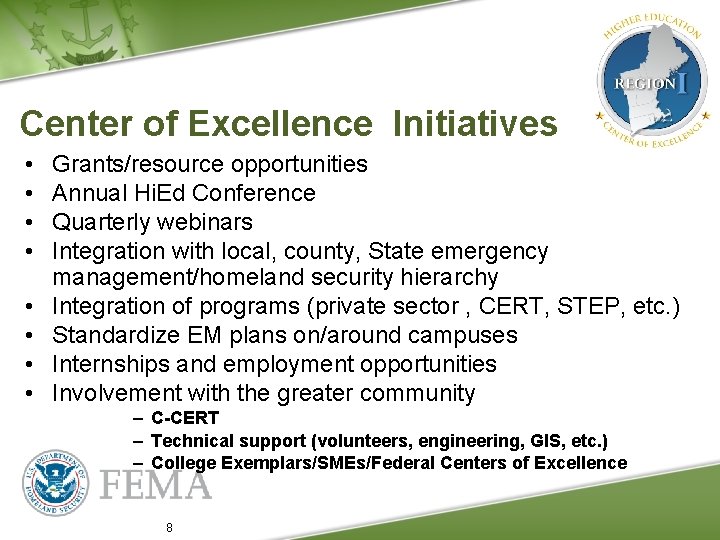
Center of Excellence Initiatives • • Grants/resource opportunities Annual Hi. Ed Conference Quarterly webinars Integration with local, county, State emergency management/homeland security hierarchy Integration of programs (private sector , CERT, STEP, etc. ) Standardize EM plans on/around campuses Internships and employment opportunities Involvement with the greater community – C-CERT – Technical support (volunteers, engineering, GIS, etc. ) – College Exemplars/SMEs/Federal Centers of Excellence 8
Case Study: University of Rhode Island (URI) • Requested assistance with school emergency management plans • Competitive Training Grant Program (CTGP) Recipient • Strong leadership as recommended by Rhode Island Emergency Management Agency (RIEMA) • Standard brief yields added concerns and emphasis areas (law enforcement officer relations, Virginia Tech scenario, student mental health assessments) 9
Results: URI • Pursuing FEMA Emergency Management Curricula (Graduate Cert) • Cross-connect to University of Connecticut (UCONN) school emergency management plan exemplar (previous CTGP recipient) • Possible C-CERT via Michigan State University CTGP • Referral to Purdue for mental health forms • Coordinate with U. S. Transportation Security Administration (TSA) for November 2009 URI to host statewide behavioral detection training • Referral to UCONN Department of Education Emergency Management for Higher Education (EMHE) recipient 10
Case Study: Massachusetts Maritime Academy (MMA) • Longest-tenured emergency management program in New England • Solid campus emergency management plans • Concern for emergency management students’ motivation due to employment issues • Interest in STEP • Summer camp program opportunities 11
Results: MMA • Coordination for STEP taught by cadets in nearby schools • Co-development of summer preparedness program for camp students • New England Disaster Recovery Information Exchange (NEDRIX) internship opportunities • Collaborate with other Hi. Ed institutions on outreach initiatives 12
Higher-Education Regional Exercise • Intelligence based exercise on information sharing between law enforcement and fusion centers. • Multiple coordinated attacks throughout the Northeast. • Exercise Three Part Series Ø Seminar Conducted on March 10 th with well over 100 attendees from Higher-Education, Federal, State and Local officials. Ø Table-Top Exercise Scheduled for June 18 th, 2011 Ø Full-Scale Exercise September (TBD)
Strengthening Academic Programs • FEMA Regional Office Providing subject matter expertise in Mitigation, Preparedness, Response and Recovery. • Serving as Non-Voting Members of academic programs. • Review and write letters of support for curriculum development. • Conferences, Seminars and Workshop support.
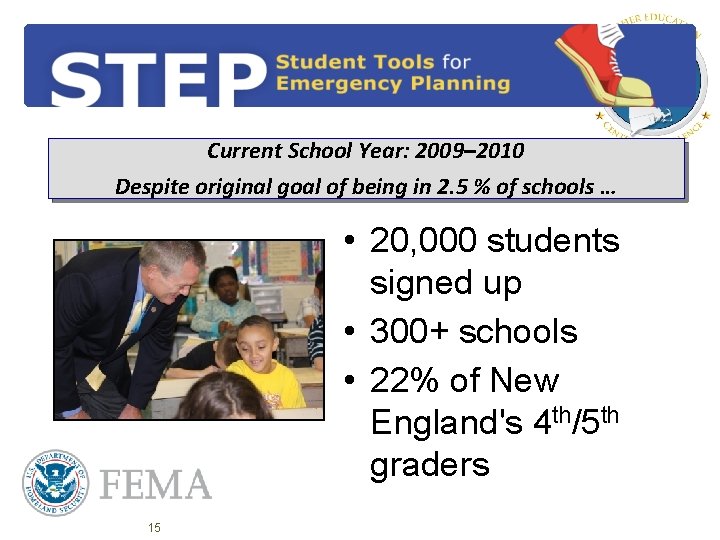
Current School Year: 2009– 2010 Despite original goal of being in 2. 5 % of schools … • 20, 000 students signed up • 300+ schools • 22% of New England's 4 th/5 th graders 15
Within 5 Years • Working with the States, markedly change New England’s preparedness culture • Enhance individual preparedness through integrated educational programs • Connect age groups through emergency management/homeland security educational programs • Provide alternative emergency management educational programs for high school, Outward Bound, Scouts • Enhance emergency management/homeland security knowledge base through Hi. Ed “network”; connecting them with their emergency management communities, exemplars, Federal Centers of Excellence, and others 16
QUESTIONS? Robert Pesapane robert. pesapane@dhs. gov Christopher Lynch christopher. lynch@dhs. gov 17