
FEMA NFIP Community Rating System and Crediting Tsunami
- Slides: 14
FEMA NFIP Community Rating System and Crediting Tsunami Mitigation Mike Mahoney, FEMA Mitigation
CRS Quick Facts What is the CRS? § Voluntary incentive program for NFIP participating communities. § Reduced flood insurance premiums for citizens in return for better floodplain management by communities. § CRS is modeled after the ISO fire insurance rating system.
CRS Quick Facts CRS Goals ü Reduce flood damage to insurable property. ü Strengthen/support insurance aspects of NFIP. ü Encourage a comprehensive approach to Floodplain Management.
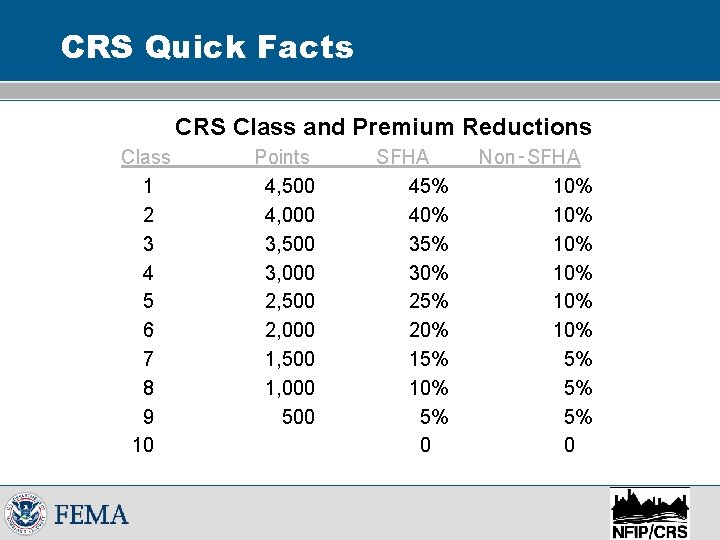
CRS Quick Facts CRS Class and Premium Reductions Class 1 2 3 4 5 6 7 8 9 10 Points 4, 500 4, 000 3, 500 3, 000 2, 500 2, 000 1, 500 1, 000 500 SFHA 45% 40% 35% 30% 25% 20% 15% 10% 5% 0 Non‑SFHA 10% 10% 10% 5% 5% 5% 0
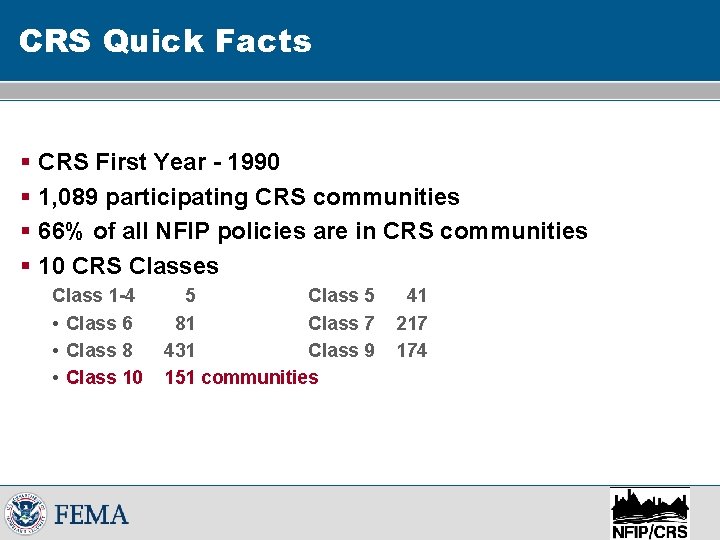
CRS Quick Facts § CRS First Year - 1990 § 1, 089 participating CRS communities § 66% of all NFIP policies are in CRS communities § 10 CRS Classes Class 1 -4 • Class 6 • Class 8 • Class 10 5 Class 5 41 81 Class 7 217 431 Class 9 174 151 communities
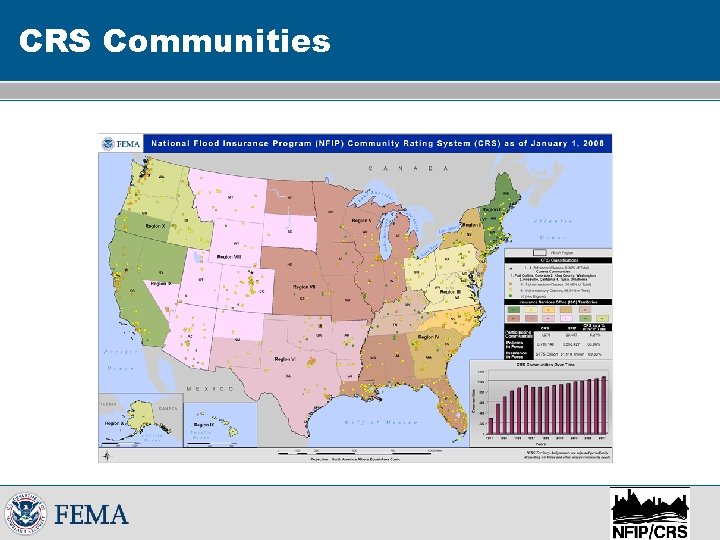
CRS Communities
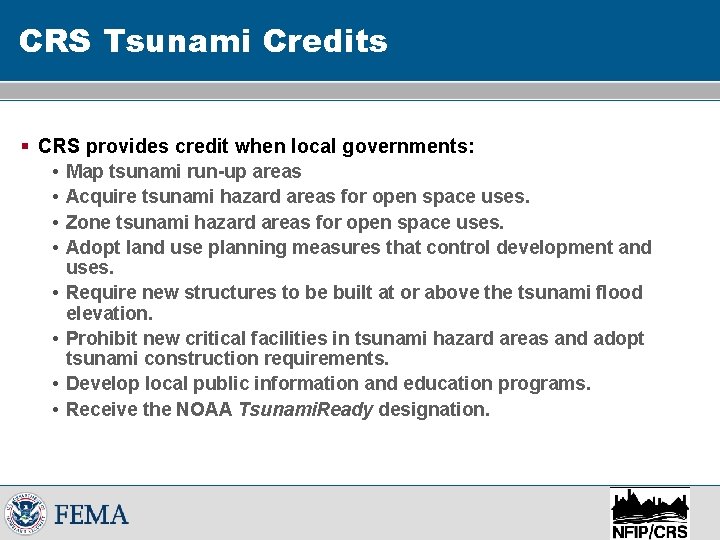
CRS Tsunami Credits § CRS provides credit when local governments: • Map tsunami run-up areas • Acquire tsunami hazard areas for open space uses. • Zone tsunami hazard areas for open space uses. • Adopt land use planning measures that control development and • • uses. Require new structures to be built at or above the tsunami flood elevation. Prohibit new critical facilities in tsunami hazard areas and adopt tsunami construction requirements. Develop local public information and education programs. Receive the NOAA Tsunami. Ready designation.
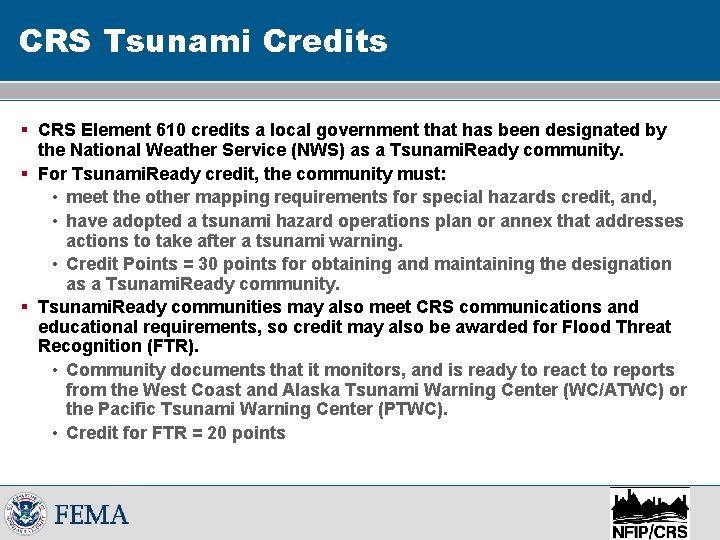
CRS Tsunami Credits § CRS Element 610 credits a local government that has been designated by the National Weather Service (NWS) as a Tsunami. Ready community. § For Tsunami. Ready credit, the community must: • meet the other mapping requirements for special hazards credit, and, • have adopted a tsunami hazard operations plan or annex that addresses actions to take after a tsunami warning. • Credit Points = 30 points for obtaining and maintaining the designation as a Tsunami. Ready community. § Tsunami. Ready communities may also meet CRS communications and educational requirements, so credit may also be awarded for Flood Threat Recognition (FTR). • Community documents that it monitors, and is ready to react to reports from the West Coast and Alaska Tsunami Warning Center (WC/ATWC) or the Pacific Tsunami Warning Center (PTWC). • Credit for FTR = 20 points
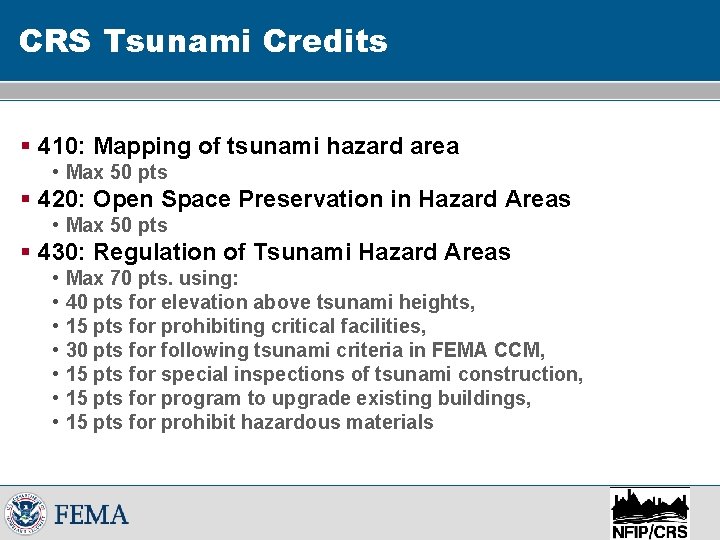
CRS Tsunami Credits § 410: Mapping of tsunami hazard area • Max 50 pts § 420: Open Space Preservation in Hazard Areas • Max 50 pts § 430: Regulation of Tsunami Hazard Areas • • Max 70 pts. using: 40 pts for elevation above tsunami heights, 15 pts for prohibiting critical facilities, 30 pts for following tsunami criteria in FEMA CCM, 15 pts for special inspections of tsunami construction, 15 pts for program to upgrade existing buildings, 15 pts for prohibit hazardous materials
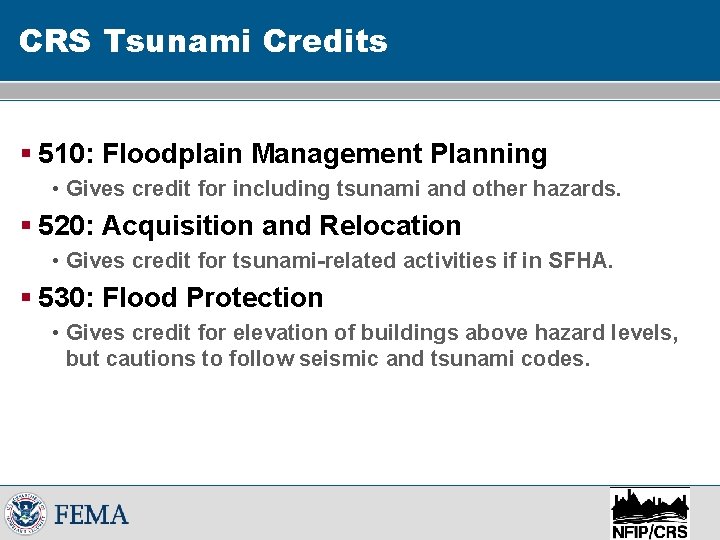
CRS Tsunami Credits § 510: Floodplain Management Planning • Gives credit for including tsunami and other hazards. § 520: Acquisition and Relocation • Gives credit for tsunami-related activities if in SFHA. § 530: Flood Protection • Gives credit for elevation of buildings above hazard levels, but cautions to follow seismic and tsunami codes.
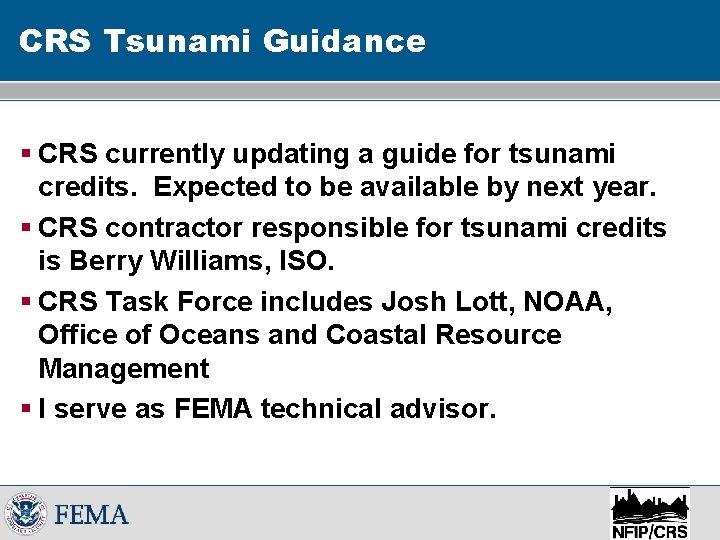
CRS Tsunami Guidance § CRS currently updating a guide for tsunami credits. Expected to be available by next year. § CRS contractor responsible for tsunami credits is Berry Williams, ISO. § CRS Task Force includes Josh Lott, NOAA, Office of Oceans and Coastal Resource Management § I serve as FEMA technical advisor.
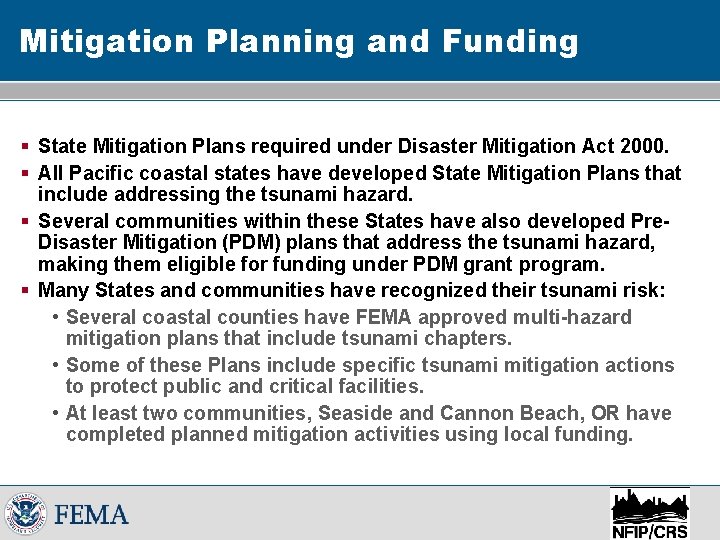
Mitigation Planning and Funding § State Mitigation Plans required under Disaster Mitigation Act 2000. § All Pacific coastal states have developed State Mitigation Plans that include addressing the tsunami hazard. § Several communities within these States have also developed Pre. Disaster Mitigation (PDM) plans that address the tsunami hazard, making them eligible for funding under PDM grant program. § Many States and communities have recognized their tsunami risk: • Several coastal counties have FEMA approved multi-hazard mitigation plans that include tsunami chapters. • Some of these Plans include specific tsunami mitigation actions to protect public and critical facilities. • At least two communities, Seaside and Cannon Beach, OR have completed planned mitigation activities using local funding.
Tsunami Hazard Mitigation § Tsunami hazard mitigation eligible under the Hazard Mitigation Grant Program (HMGP), which provides mitigation funds for any hazard after a Federally declared disaster. § States allowed to use HMGP funds for any applicable hazard, but project must meet cost benefit rules. § FEMA supported development of a Tsunami Hazard Mitigation Program and mitigation projects in Puerto Rico using HMGP funds following Hurricane Georges.
NEHRP Tsunami Activities § Tsunami is an earthquake-related hazard covered under the National Earthquake Hazards Reduction Program (NEHRP). § Improving tsunami hazard awareness, planning, and mitigation is a goal of FEMA and its NEHRP partners. § FEMA funds the public/private consortium Cascadia Region Earthquake Workgroup (CREW), who has developed a subduction zone earthquake and tsunami scenario for planning for affected corporations, lifeline, and government entities. § FEMA is working with the at-risk States to increase public awareness for residents and visitors through NEHRP funding. § FEMA is working on translating tsunami products into non-English languages and to provide more exposure for tsunami preparedness and mitigation products on FEMA’s website.