
FEMA GRANT PROGRAMS DIRECTORATE Port Security Grant Program



- Slides: 30
FEMA GRANT PROGRAMS DIRECTORATE Port Security Grant Program (PSGP) FY 2020 Rollout Briefing February 2020
Background 2
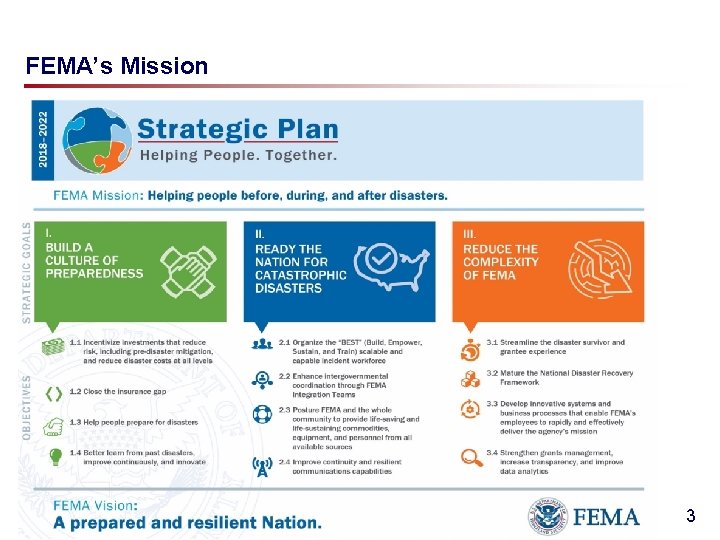
FEMA’s Mission 3
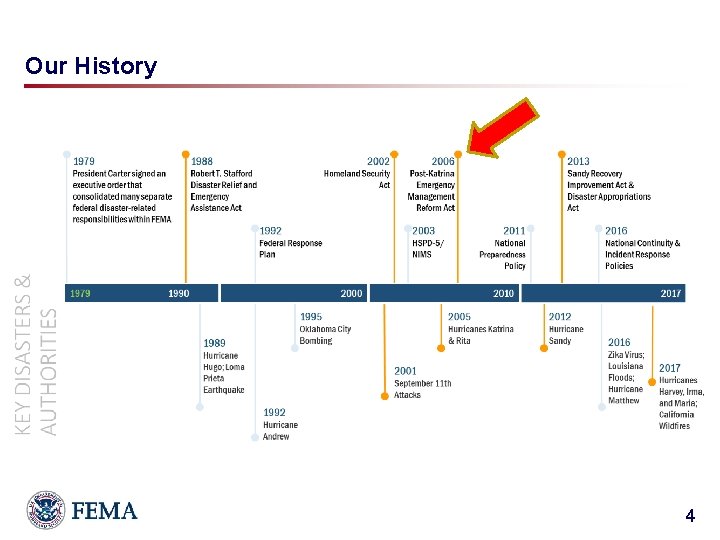
Our History 4
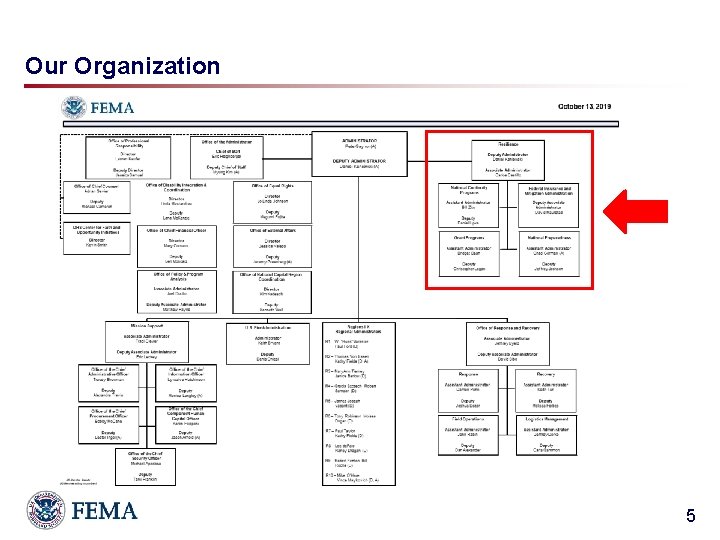
Our Organization 5
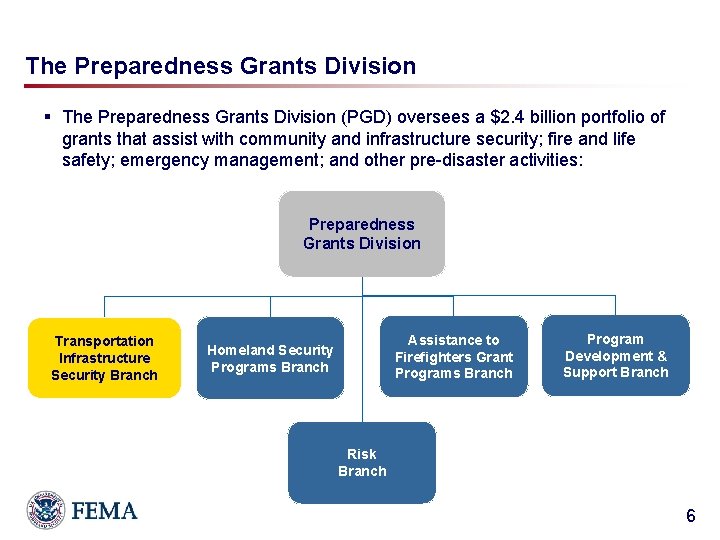
Overview The Preparedness Grants Division § The Preparedness Grants Division (PGD) oversees a $2. 4 billion portfolio of grants that assist with community and infrastructure security; fire and life safety; emergency management; and other pre-disaster activities: Preparedness Grants Division Transportation Infrastructure Security Branch (TISB) Transportation Infrastructure Security Branch Assistance to Firefighters Grant Programs Branch Homeland Security Programs Branch Program Development & Support Branch Risk Branch 6
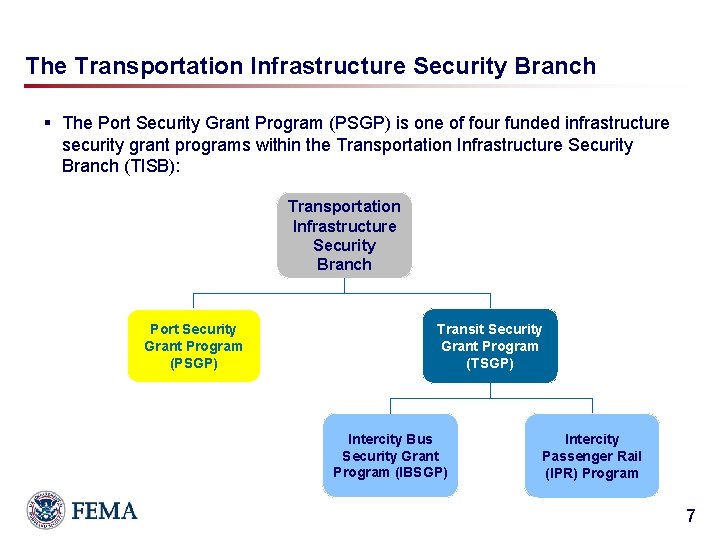
Overview The Transportation Infrastructure Security Branch § The Port Security Grant Program (PSGP) is one of four funded infrastructure security grant programs within the Transportation Infrastructure Security Branch (TISB): Transportation Infrastructure Security Transportation Branch Infrastructure Security Branch (TISB) Port Security Grant Program (PSGP) Transit Security Grant Program (TSGP) Intercity Bus Security Grant Program (IBSGP) Intercity Passenger Rail (IPR) Program 7
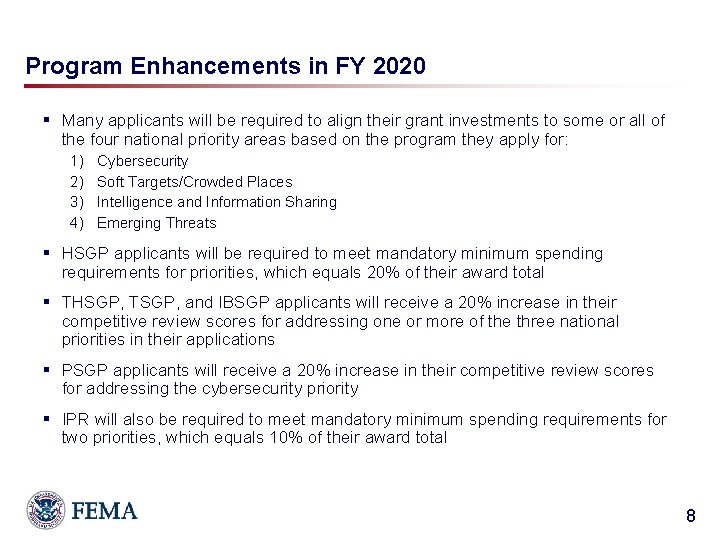
Program Enhancements in FY 2020 § Many applicants will be required to align their grant investments to some or all of the four national priority areas based on the program they apply for: 1) 2) 3) 4) Cybersecurity Soft Targets/Crowded Places Intelligence and Information Sharing Emerging Threats § HSGP applicants will be required to meet mandatory minimum spending requirements for priorities, which equals 20% of their award total § THSGP, TSGP, and IBSGP applicants will receive a 20% increase in their competitive review scores for addressing one or more of the three national priorities in their applications § PSGP applicants will receive a 20% increase in their competitive review scores for addressing the cybersecurity priority § IPR will also be required to meet mandatory minimum spending requirements for two priorities, which equals 10% of their award total 8
The Port Security Grant Program (PSGP) 9
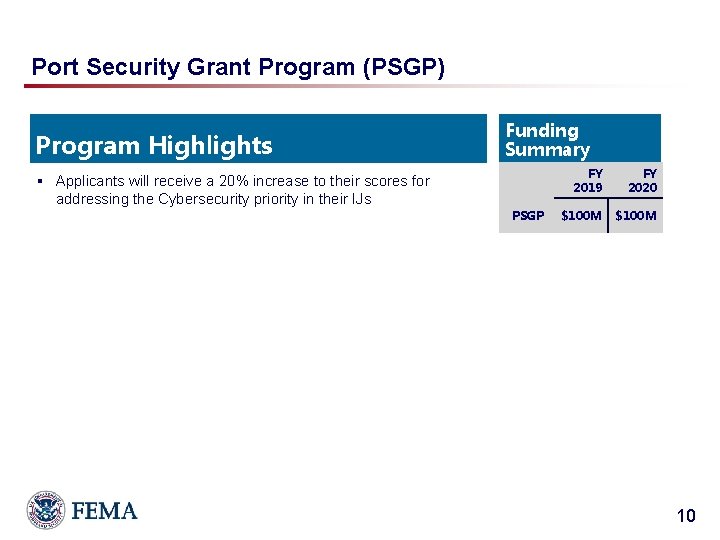
Port Security Grant Program (PSGP) Program Highlights Funding Summary § Applicants will receive a 20% increase to their scores for addressing the Cybersecurity priority in their IJs PSGP FY 2019 FY 2020 $100 M 10
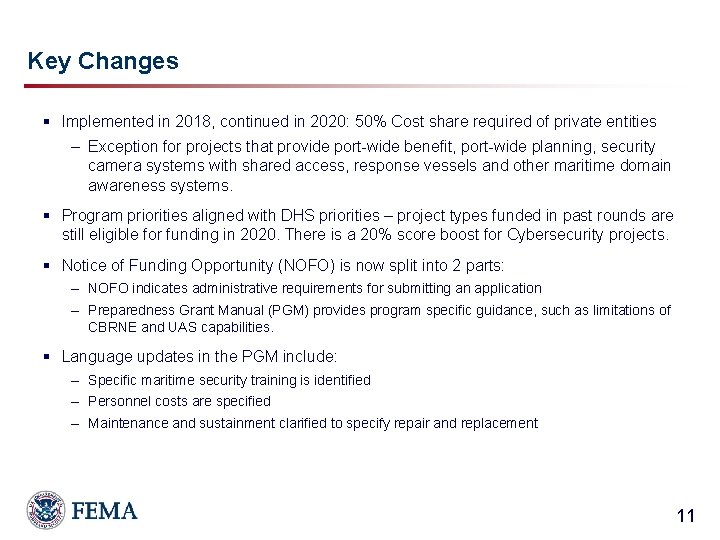
Key Changes § Implemented in 2018, continued in 2020: 50% Cost share required of private entities – Exception for projects that provide port-wide benefit, port-wide planning, security camera systems with shared access, response vessels and other maritime domain awareness systems. § Program priorities aligned with DHS priorities – project types funded in past rounds are still eligible for funding in 2020. There is a 20% score boost for Cybersecurity projects. § Notice of Funding Opportunity (NOFO) is now split into 2 parts: – NOFO indicates administrative requirements for submitting an application – Preparedness Grant Manual (PGM) provides program specific guidance, such as limitations of CBRNE and UAS capabilities. § Language updates in the PGM include: – Specific maritime security training is identified – Personnel costs are specified – Maintenance and sustainment clarified to specify repair and replacement 11
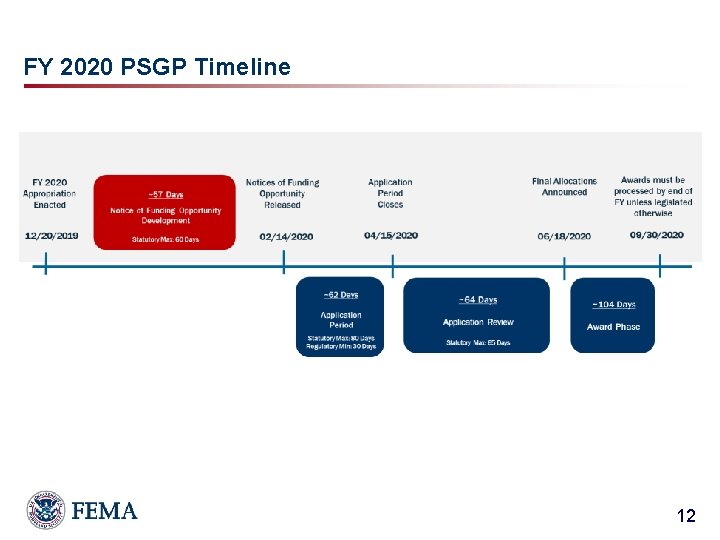
FY 2020 PSGP Timeline 12
Project Planning § 46 U. S. C. § 70107 … funding the correction of Coast Guard identified vulnerabilities in port security and ensuring compliance with Area Maritime Transportation Security Plans and facility security plans… § Participate in your Area Maritime Security Committee (AMSC) meetings and understand your port area priorities!! § Socialize your projects with the AMSC and COTP prior to applying – if your project doesn’t address port area priorities, your COTP or PSS should let you know. § Read the NOFO and PGM to verify that you and your project(s) are eligible! § Develop a business plan – Identify grant team: Project manager, grant manager, budget analyst 13
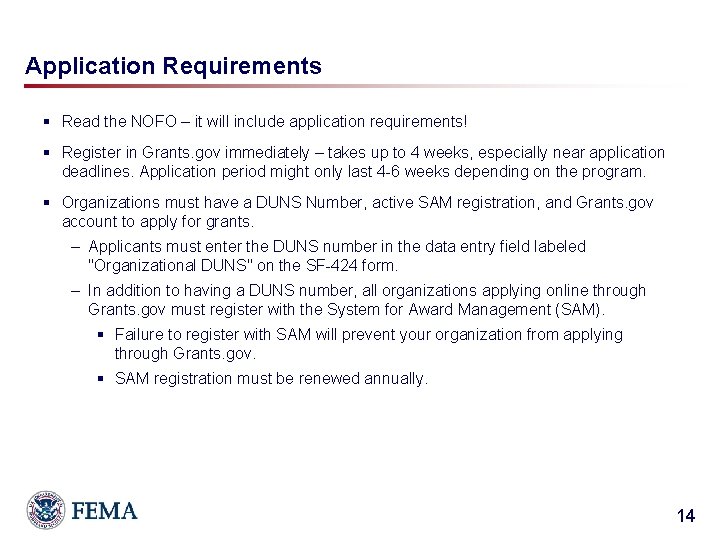
Application Requirements § Read the NOFO – it will include application requirements! § Register in Grants. gov immediately – takes up to 4 weeks, especially near application deadlines. Application period might only last 4 -6 weeks depending on the program. § Organizations must have a DUNS Number, active SAM registration, and Grants. gov account to apply for grants. – Applicants must enter the DUNS number in the data entry field labeled "Organizational DUNS" on the SF-424 form. – In addition to having a DUNS number, all organizations applying online through Grants. gov must register with the System for Award Management (SAM). § Failure to register with SAM will prevent your organization from applying through Grants. gov. § SAM registration must be renewed annually. 14
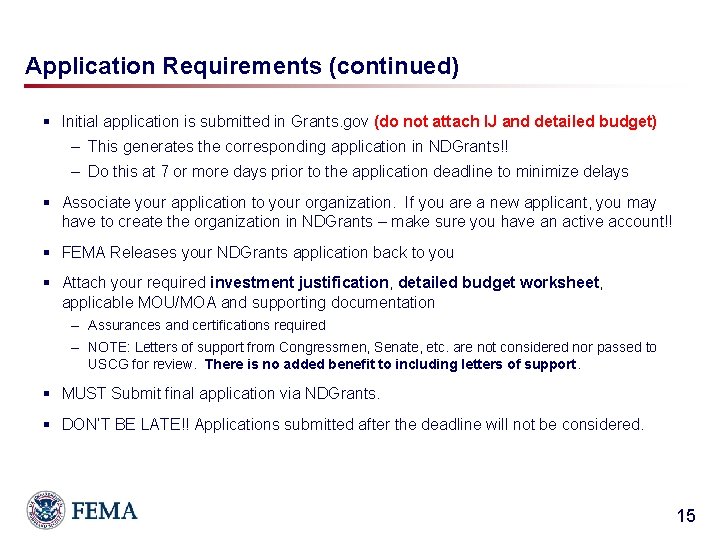
Application Requirements (continued) § Initial application is submitted in Grants. gov (do not attach IJ and detailed budget) – This generates the corresponding application in NDGrants!! – Do this at 7 or more days prior to the application deadline to minimize delays § Associate your application to your organization. If you are a new applicant, you may have to create the organization in NDGrants – make sure you have an active account!! § FEMA Releases your NDGrants application back to you § Attach your required investment justification, detailed budget worksheet, applicable MOU/MOA and supporting documentation – Assurances and certifications required – NOTE: Letters of support from Congressmen, Senate, etc. are not considered nor passed to USCG for review. There is no added benefit to including letters of support. § MUST Submit final application via NDGrants. § DON’T BE LATE!! Applications submitted after the deadline will not be considered. 15
Quick Reference Guide – How to Submit a Grants. gov Application § The first step in applying for a FEMA non-disaster grant is to register and submit an application in Grants. gov is a central storehouse for information on Federal Grants and is the starting point for obtaining an application for FEMA grants. Additionally, Grants. gov provides resources and training materials to assist people with submitting their grant applications. All applicant resources can be found at http: //www. grants. gov/applicants/app_help_reso. jsp § Using Grants. gov, you can find available grant opportunities, download the application package, and submit your application. Once an application is completed and submitted in Grants. gov, it will become available to FEMA personnel to review and then released back to the applicant to finish in ND Grants. Please see the steps that need to occur before a grant application is submitted, as shown below. 16
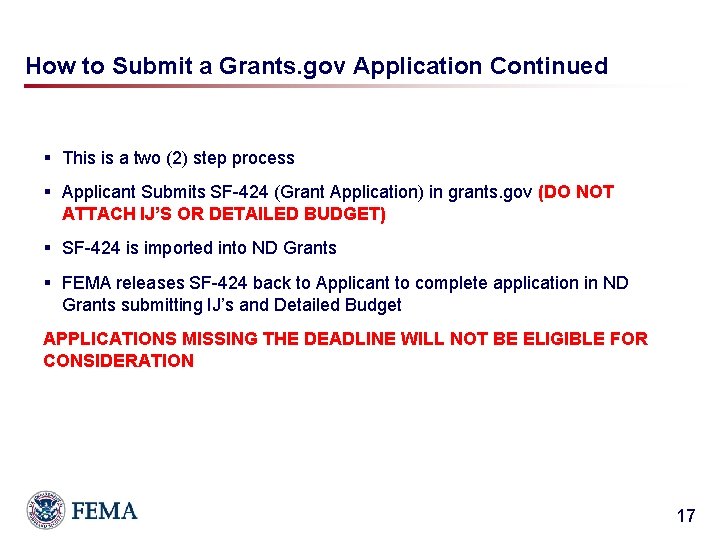
How to Submit a Grants. gov Application Continued § This is a two (2) step process § Applicant Submits SF-424 (Grant Application) in grants. gov (DO NOT ATTACH IJ’S OR DETAILED BUDGET) § SF-424 is imported into ND Grants § FEMA releases SF-424 back to Applicant to complete application in ND Grants submitting IJ’s and Detailed Budget APPLICATIONS MISSING THE DEADLINE WILL NOT BE ELIGIBLE FOR CONSIDERATION 17
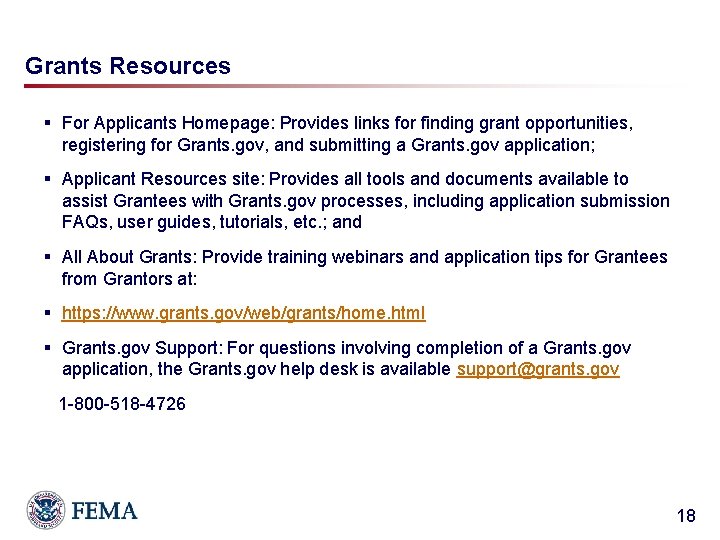
Grants Resources § For Applicants Homepage: Provides links for finding grant opportunities, registering for Grants. gov, and submitting a Grants. gov application; § Applicant Resources site: Provides all tools and documents available to assist Grantees with Grants. gov processes, including application submission FAQs, user guides, tutorials, etc. ; and § All About Grants: Provide training webinars and application tips for Grantees from Grantors at: § https: //www. grants. gov/web/grants/home. html § Grants. gov Support: For questions involving completion of a Grants. gov application, the Grants. gov help desk is available support@grants. gov 1 -800 -518 -4726 18
Application Review § All eligible applications receive an initial review by FEMA to ensure that they are completed in accordance with the application requirements – Include detailed budget worksheet and IJ – Submitted on time – FEMA will notify applicants of incomplete applications during the application period. § All completed/eligible applications are securely transmitted to USCG § USCG conducts a field review to score and recommend projects based on: – Verifies if the applicant is an eligible service provider or facility within the port area – Effectiveness of project in reducing COTP identified vulnerabilities and PSGP Priorities (note that city-wide projects may be denied in part or full). – Projects may be reduced or denied due to ineligible and/or unjustified costs – Identify projects that provide a port-wide benefit (affects for-profit applicant cost share and 10% score boost) 19
Application Review (continued) § Field Review scores are provided to FEMA to incorporate risk scores – Projects that are not recommended by the Field Review will not be considered for funding. – Prior discussions within AMSC may give you a feel for how well your project addresses port area and program priorities. – Don’t surprise your COTP!! Unfamiliar projects may not be funded due to the short field review time and the extensive nature of determining maritime security needs. § FEMA hosts a National Review Panel to verify projects – Validate COTP recommendations – Determine if project addresses National Priorities to receive 10% score boost, including: Enhancing protection of soft targets/crowded places; and Enhancing WMD & IED Prevention, Detection, Response & Recovery Capabilities 20
Application Review (continued) § FEMA conducts an administrative review of all projects recommended for funding by the field review – Ensure cost share is included – Ensure project costs are eligible under PSGP – May reduce funding by eliminating ineligible costs § NOTE: If we can’t figure it out, we reserve the right to deny the project!! § FEMA applies the DHS Risk formula based on port area. Scores generated determine port area by ranking projects based on Risk x Effectiveness. Funds applied to highest ranked projects within each port area until expended. Port area funding (typically 150% of risk score) may be limited to ensure broadest distribution of funds. § Based on the Field Review, NRP, Admin Review, and ranked in funding categories by their risk and effectiveness scores, a funding decision is recommended to the Secretary of Homeland Security, who makes the final funding determination. 21
Examples of Funded Projects § Rapid Response Boats: ─ High speed, 24/7 patrol boats critical for quick response to waterways or other maritime infrastructure § Equipment: ─ All life safety operations including fire suppression, evacuations, rescue of victims, dewatering, mass decontamination, swift transport of first responders to a waterborne or waterfront incident, and removal of victims from a vessel in distress § Training and Exercises: – Live situational exercises involving various threat and disaster scenarios, table top exercises, and the debriefing of the exercises to continually improve utilization of plans and equipment procured with grant funding § Expansion and hardening of TWIC compliant access control: – Installation of TWIC card and secure vehicle barriers, for activation during times of heightened security measures – Hardening of secondary access points to the Port, to include the addition of reinforced gates used to prevent un-authorized vehicles from accessing the perimeter of the Port 22
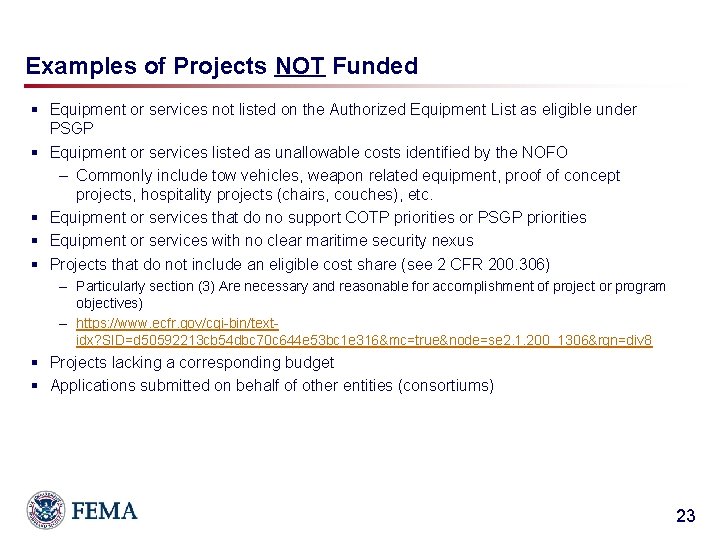
Examples of Projects NOT Funded § Equipment or services not listed on the Authorized Equipment List as eligible under PSGP § Equipment or services listed as unallowable costs identified by the NOFO – Commonly include tow vehicles, weapon related equipment, proof of concept projects, hospitality projects (chairs, couches), etc. § Equipment or services that do no support COTP priorities or PSGP priorities § Equipment or services with no clear maritime security nexus § Projects that do not include an eligible cost share (see 2 CFR 200. 306) – Particularly section (3) Are necessary and reasonable for accomplishment of project or program objectives) – https: //www. ecfr. gov/cgi-bin/textidx? SID=d 50592213 cb 54 dbc 70 c 644 e 53 bc 1 e 316&mc=true&node=se 2. 1. 200_1306&rgn=div 8 § Projects lacking a corresponding budget § Applications submitted on behalf of other entities (consortiums) 23
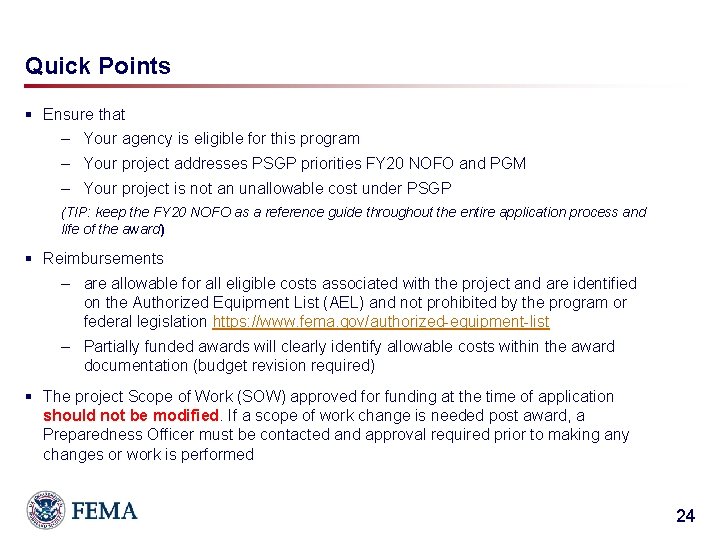
Quick Points § Ensure that – Your agency is eligible for this program – Your project addresses PSGP priorities FY 20 NOFO and PGM – Your project is not an unallowable cost under PSGP (TIP: keep the FY 20 NOFO as a reference guide throughout the entire application process and life of the award) § Reimbursements – are allowable for all eligible costs associated with the project and are identified on the Authorized Equipment List (AEL) and not prohibited by the program or federal legislation https: //www. fema. gov/authorized-equipment-list – Partially funded awards will clearly identify allowable costs within the award documentation (budget revision required) § The project Scope of Work (SOW) approved for funding at the time of application should not be modified. If a scope of work change is needed post award, a Preparedness Officer must be contacted and approval required prior to making any changes or work is performed 24
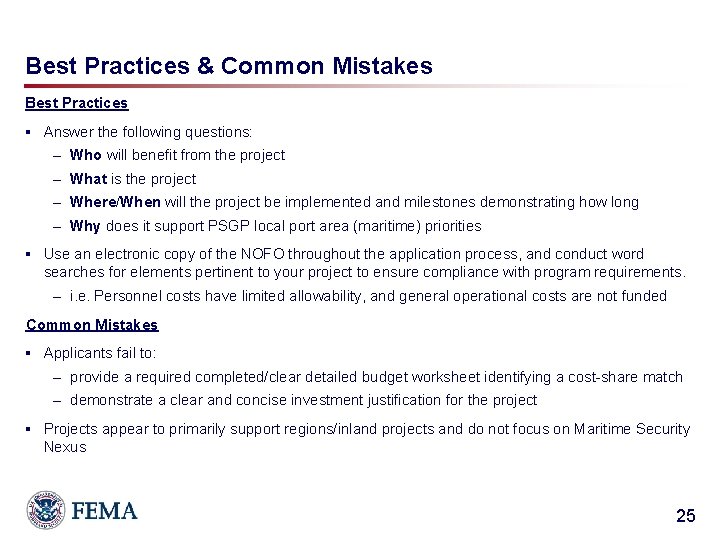
Best Practices & Common Mistakes Best Practices § Answer the following questions: – Who will benefit from the project – What is the project – Where/When will the project be implemented and milestones demonstrating how long – Why does it support PSGP local port area (maritime) priorities § Use an electronic copy of the NOFO throughout the application process, and conduct word searches for elements pertinent to your project to ensure compliance with program requirements. – i. e. Personnel costs have limited allowability, and general operational costs are not funded Common Mistakes § Applicants fail to: – provide a required completed/clear detailed budget worksheet identifying a cost-share match – demonstrate a clear and concise investment justification for the project § Projects appear to primarily support regions/inland projects and do not focus on Maritime Security Nexus 25
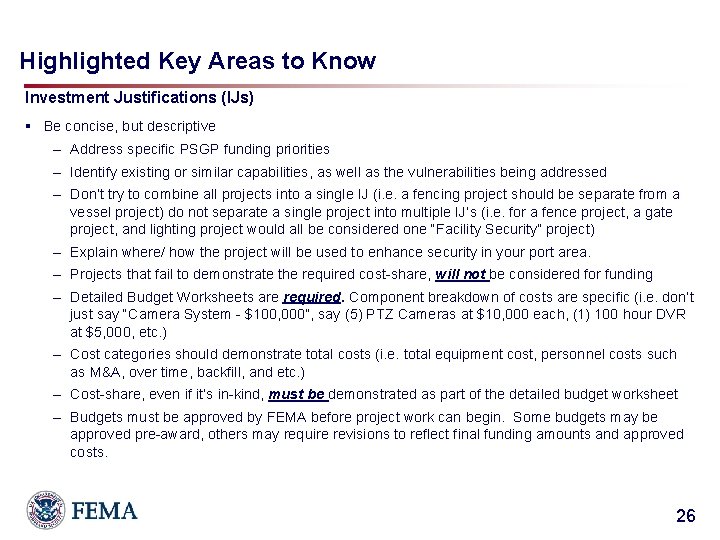
Highlighted Key Areas to Know Investment Justifications (IJs) § Be concise, but descriptive – Address specific PSGP funding priorities – Identify existing or similar capabilities, as well as the vulnerabilities being addressed – Don’t try to combine all projects into a single IJ (i. e. a fencing project should be separate from a vessel project) do not separate a single project into multiple IJ’s (i. e. for a fence project, a gate project, and lighting project would all be considered one “Facility Security” project) – Explain where/ how the project will be used to enhance security in your port area. – Projects that fail to demonstrate the required cost-share, will not be considered for funding – Detailed Budget Worksheets are required. Component breakdown of costs are specific (i. e. don’t just say “Camera System - $100, 000”, say (5) PTZ Cameras at $10, 000 each, (1) 100 hour DVR at $5, 000, etc. ) – Cost categories should demonstrate total costs (i. e. total equipment cost, personnel costs such as M&A, over time, backfill, and etc. ) – Cost-share, even if it’s in-kind, must be demonstrated as part of the detailed budget worksheet – Budgets must be approved by FEMA before project work can begin. Some budgets may be approved pre-award, others may require revisions to reflect final funding amounts and approved costs. 26
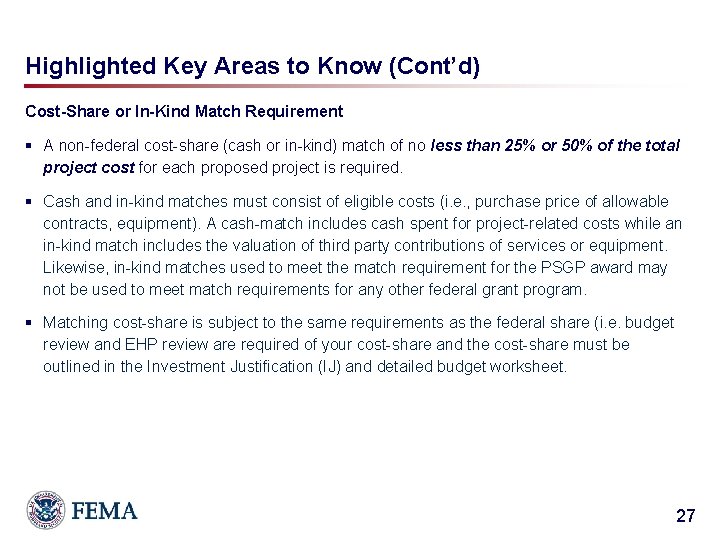
Highlighted Key Areas to Know (Cont’d) Cost-Share or In-Kind Match Requirement § A non-federal cost-share (cash or in-kind) match of no less than 25% or 50% of the total project cost for each proposed project is required. § Cash and in-kind matches must consist of eligible costs (i. e. , purchase price of allowable contracts, equipment). A cash-match includes cash spent for project-related costs while an in-kind match includes the valuation of third party contributions of services or equipment. Likewise, in-kind matches used to meet the match requirement for the PSGP award may not be used to meet match requirements for any other federal grant program. § Matching cost-share is subject to the same requirements as the federal share (i. e. budget review and EHP review are required of your cost-share and the cost-share must be outlined in the Investment Justification (IJ) and detailed budget worksheet. 27
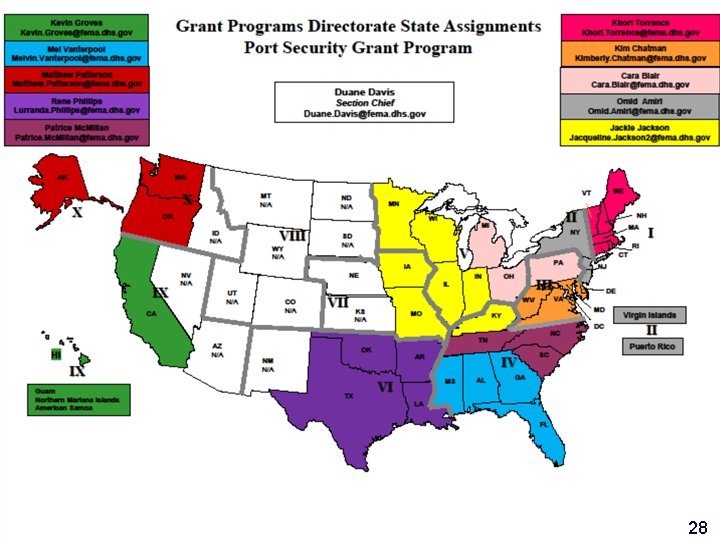
28 28
Questions? 29
CONTACT INFORMATION Preparedness Officer. Title Email Address (Work) Cell Phone Number Duane Davis Section Chief duane. davis@dhs. gov 202 -680 -4060 Jackie Jackson Preparedness Officer jacqueline. jackson 2@fema. dhs. gov 202 -302 -9518 Khori Torrence Preparedness Officer khori. torrence@fema. dhs. gov 202 -406 -0939 Kimberly Chatman Preparedness Officer kimberly. chatman@fema. dhs. gov 202 -340 -6719 Omid Amiri Preparedness Officer omid. amiri@dhs. gov 202 -262 -7549 Kevin Groves Preparedness Officer kevin. groves@fema. dhs. gov 202 -330 -3836 Rene Phillips Preparedness Officer lurranda. phillips@fema. dhs. gov 202 -368 -5487 Melvin Vanterpool Preparedness Officer melvin. vanterpool@fema. dhs. gov 202 -445 -8497 Cara Blair Preparedness Officer cara. blair@fema. dhs. gov 202 -769 -8296 Matthew Patterson Preparedness Officer matthew. patterson@fema. dhs. gov 202 -733 -7906 Patrice Mc. Millan Preparedness Officer patrice. mcmillan@fema. dhs. gov 240 -280 -5055 30