
FEM simulation and reverse engineering of an Electronic
- Slides: 1
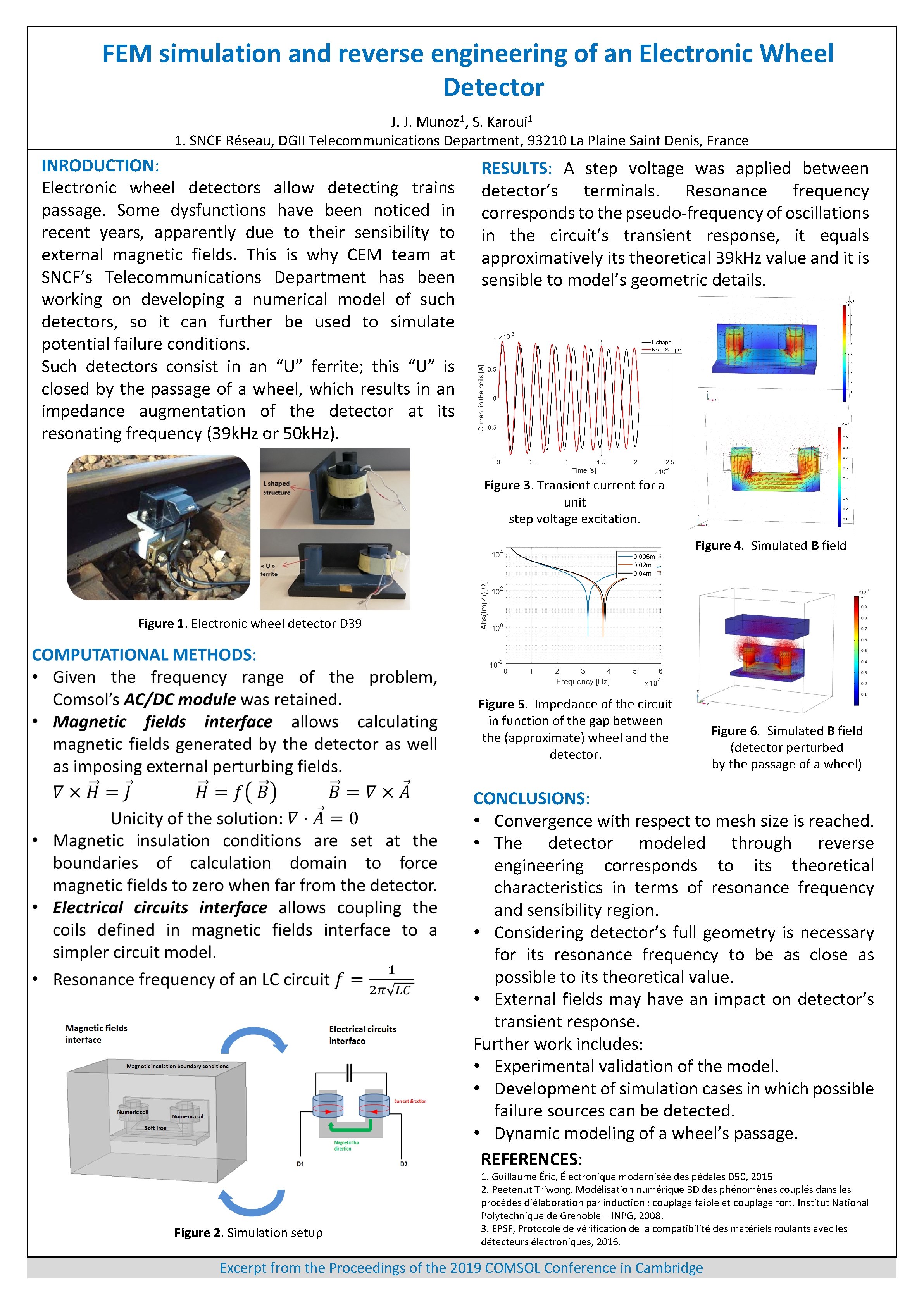
FEM simulation and reverse engineering of an Electronic Wheel Detector J. J. Munoz 1, S. Karoui 1 1. SNCF Réseau, DGII Telecommunications Department, 93210 La Plaine Saint Denis, France INRODUCTION: Electronic wheel detectors allow detecting trains passage. Some dysfunctions have been noticed in recent years, apparently due to their sensibility to external magnetic fields. This is why CEM team at SNCF’s Telecommunications Department has been working on developing a numerical model of such detectors, so it can further be used to simulate potential failure conditions. Such detectors consist in an “U” ferrite; this “U” is closed by the passage of a wheel, which results in an impedance augmentation of the detector at its resonating frequency (39 k. Hz or 50 k. Hz). RESULTS: A step voltage was applied between detector’s terminals. Resonance frequency corresponds to the pseudo-frequency of oscillations in the circuit’s transient response, it equals approximatively its theoretical 39 k. Hz value and it is sensible to model’s geometric details. Figure 3. Transient current for a unit step voltage excitation. Figure 4. Simulated B field Figure 1. Electronic wheel detector D 39 Figure 5. Impedance of the circuit in function of the gap between the (approximate) wheel and the detector. Figure 6. Simulated B field (detector perturbed by the passage of a wheel) CONCLUSIONS: • Convergence with respect to mesh size is reached. • The detector modeled through reverse engineering corresponds to its theoretical characteristics in terms of resonance frequency and sensibility region. • Considering detector’s full geometry is necessary for its resonance frequency to be as close as possible to its theoretical value. • External fields may have an impact on detector’s transient response. Further work includes: • Experimental validation of the model. • Development of simulation cases in which possible failure sources can be detected. • Dynamic modeling of a wheel’s passage. REFERENCES: Figure 2. Simulation setup 1. Guillaume Éric, Électronique modernisée des pédales D 50, 2015 2. Peetenut Triwong. Modélisation numérique 3 D des phénomènes couplés dans les procédés d’élaboration par induction : couplage faible et couplage fort. Institut National Polytechnique de Grenoble – INPG, 2008. 3. EPSF, Protocole de vérification de la compatibilité des matériels roulants avec les détecteurs électroniques, 2016. Excerpt from the Proceedings of the 2019 COMSOL Conference in Cambridge