
FEM and Free Surface Flow n Three basic
FEM and Free Surface Flow n Three basic approaches: 1. Fixed mesh and free boundary is tracked 2. Deformed spatial mesh using a 3 -stage iterative cycle » Stage 1: Assume shape of free boundary » Stage 2: BVP solved after discarding 1 BC on free boundary » Stage 3: Shape of boundary is updated using previously neglected BC » Cylce repeated until convergence is acheived 3. Deformed mesh and define nodes on free boundary » Nodes give extra degrees of freedom » Field variables and boundary position solved simultaneously using a Newton-Rapson interative procedure
FEM and Free Surfaces: New Approach n Combination of FEM and VOF technique – FEM solves for the field variables on a deforming boundary – VOF used to advect the boundary interface n Advantages: – Simulate Large Surface Deformations (i. e. Mergering and Breaking) – Accurate implementation of Boundary Conditions – Increases computational efficiency
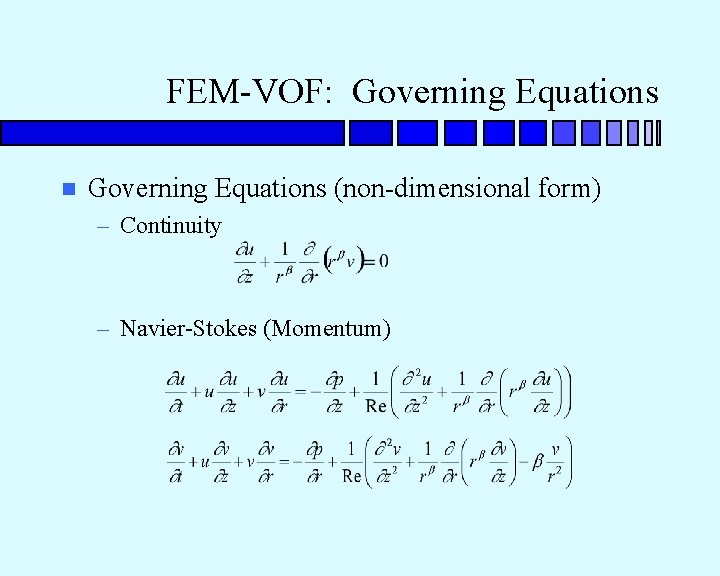
FEM-VOF: Governing Equations n Governing Equations (non-dimensional form) – Continuity – Navier-Stokes (Momentum)
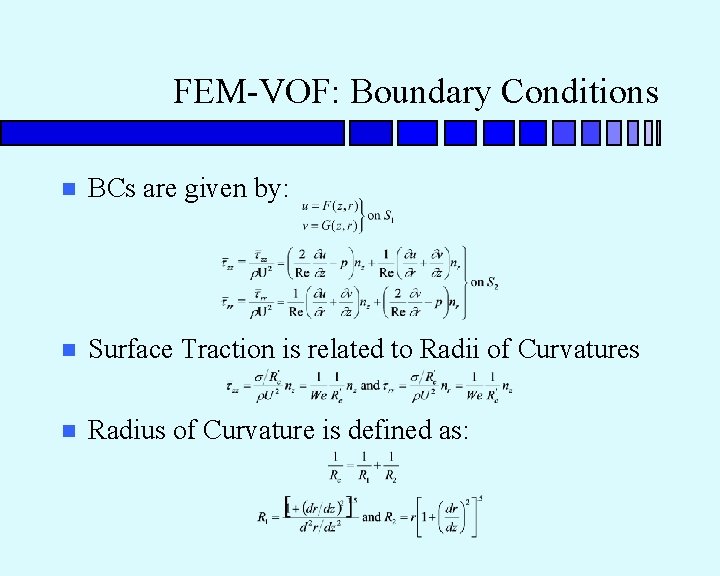
FEM-VOF: Boundary Conditions n BCs are given by: n Surface Traction is related to Radii of Curvatures n Radius of Curvature is defined as:

FEM-VOF: Formulation n Two restictions 1. Solution in terms of primitive variables based on linear quadrilateral elements 2. Model must handle: pressure, velocity, velcoity gradient and stress boundary conditions directly n Penalty function n Apply Galerkin Method to Momentum equations
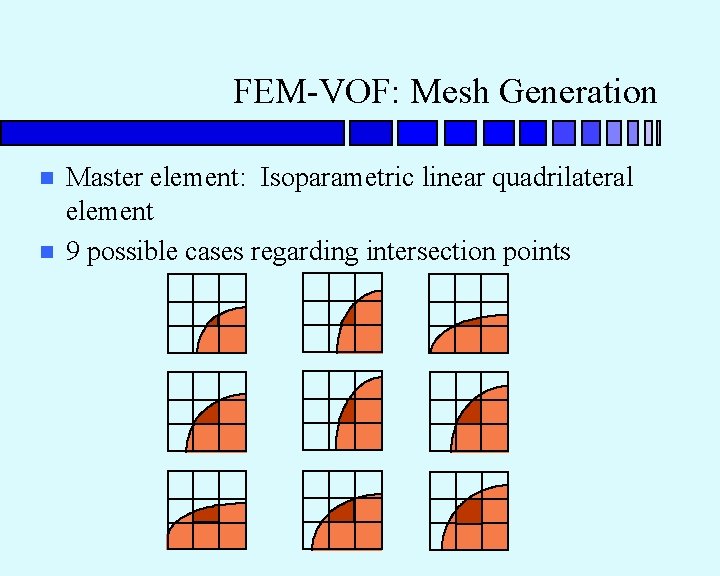
FEM-VOF: Mesh Generation n n Master element: Isoparametric linear quadrilateral element 9 possible cases regarding intersection points

FEM-VOF: Surface Advection n Once velocities obtained advected using FLAIR interface is n Velocities at nodes NOT adequate for advection technique – Calculate “mean” velocity fom two node velocities n Axisymmetric r-z plane mapped to master element in plane
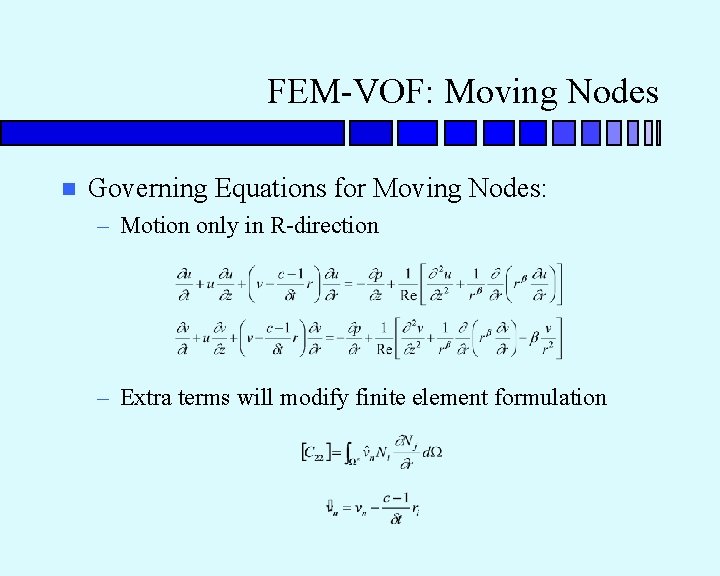
FEM-VOF: Moving Nodes n Governing Equations for Moving Nodes: – Motion only in R-direction – Extra terms will modify finite element formulation
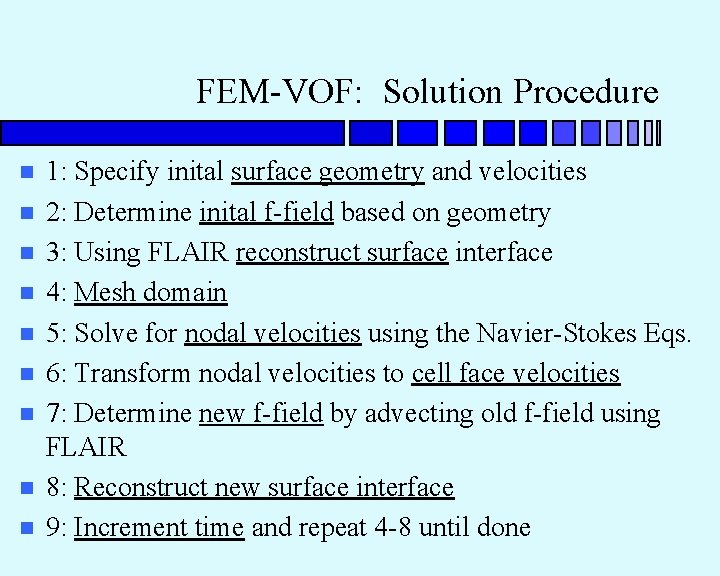
FEM-VOF: Solution Procedure n n n n n 1: Specify inital surface geometry and velocities 2: Determine inital f-field based on geometry 3: Using FLAIR reconstruct surface interface 4: Mesh domain 5: Solve for nodal velocities using the Navier-Stokes Eqs. 6: Transform nodal velocities to cell face velocities 7: Determine new f-field by advecting old f-field using FLAIR 8: Reconstruct new surface interface 9: Increment time and repeat 4 -8 until done
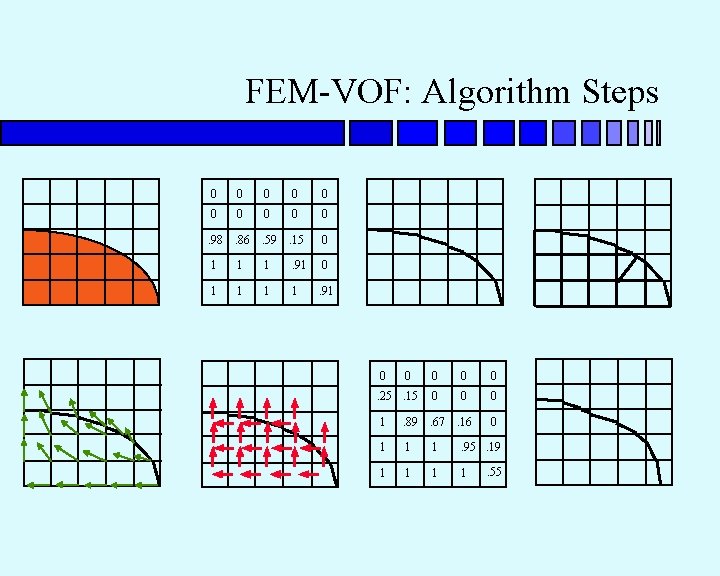
FEM-VOF: Algorithm Steps 0 0 0 0 0 . 15 0 . 98. 86. 59 1 1 1 . 91 1 1 0. 91 0 0 . 25. 15 0 0 0 1 . 89. 67. 16 0 1 1 1 . 95. 19 1 1 . 55
Conclusion n Volume of Fluid (VOF) Methods: – – n Reconstructs interface surfaces Able to handle large surface deformation Easy implementation Many forms exist Hybrid FEM-VOF technique for Free Surface Flows – Combination eliminates short-comings of each method » Handles BCs accurately » Handles Large Surface Deformation (i. e. Merging & Breakup) – Accurate and versatile
- Slides: 11