
FEM 0 Structural Health Monitoring Education Unit Purpose
















- Slides: 44
FEM 0: Structural Health Monitoring Education Unit
Purpose • To briefly introduce you to the field of Structural Health Monitoring which is the “What” • To provide a rationale for the “Why” • To outline a description of the “How”
WHAT am I being asked to do? (1) • Within the framework of your required structural analysis and design courses you will be introduced to the principles, tools, methods, purposes, utility, and limitations of Structural Health Monitoring (SHM). • This information will be presented through a series of Foundational Education Modules (FEMs).
WHAT am I being asked to do? (2) Structural Health Monitoring Review (a) • Take some time to review the Wikipedia entry on SHM (link is below). • It provides a reasonably comprehensive overview of the background, elements, and status of SHM. • Specific details are not important at this time, as the subsequent Foundation Education Modules (FEMs) will address the specific fundamentals of SHM. https: //en. wikipedia. org/wiki/Structural_health_monitoring
WHAT am I being asked to do? (3) Structural Health Monitoring Review (b) • Still vague on the concept and purposes of SHM? • Take a look at this brief You. Tube video which demonstrates the basic concept of SHM with a simple model demonstration. https: //www. youtube. com/watch? v=PKy. TOj 8 C 9 do
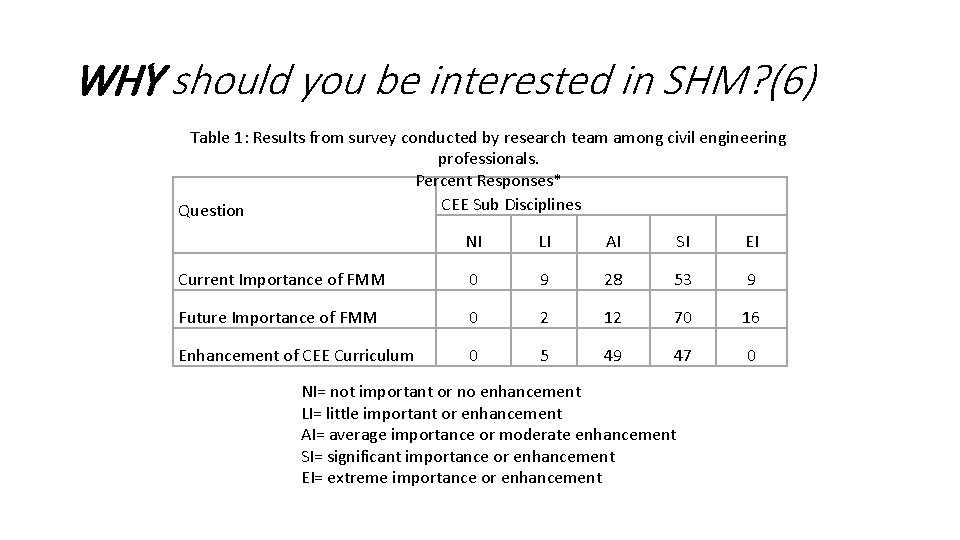
WHY should you be interested in SHM? (1) • Let’s examine the results of a survey of civil engineering professionals on the importance and need for FMM content in the undergraduate curriculum. • FMM- Field Monitoring and Measurements- a broader field which encompasses SHM.
WHY should you be interested in SHM? (2) • A survey was directed to a broad sampling of CEE professionals by email solicitations to local consulting firms, the Louisiana Department of Natural Resources, the Louisiana Department of Transportation and Development, LTRC, and out of state transportation research organizations.
WHY should you be interested in SHM? (3) • The three essential questions posed by the survey were: • the current perceived importance of FMM • the future perceived importance of FMM • the perceived enhancement of the undergraduate CEE curriculum with the addition of FMM education
WHY should you be interested in SHM? (4) • Forty-three professionals from a broad sampling of CEE sub disciplines completed the survey. • The years of practice of the respondents varied from 0 -2 years to over 31 years. • Respondents with 6 or more years of experience exceeded 86%. • The respondents were somewhat skewed towards structural engineering (44%).
WHY should you be interested in SHM? (5) • Only 9% of the respondents reported that they had a structured FMM education (a formal course or applicable content in one or more courses) at the undergraduate level. • 24% of the respondents indicated that the lack of a structured SHM education made them less likely to employ SHM techniques. • Direct your attention to the results of the question on the “Future Importance of FMM” where a total of 86% of the responses indicated either Significant or Extreme Importance.
WHY should you be interested in SHM? (6) Table 1: Results from survey conducted by research team among civil engineering professionals. Percent Responses* CEE Sub Disciplines Question NI LI AI SI EI Current Importance of FMM 0 9 28 53 9 Future Importance of FMM 0 2 12 70 16 Enhancement of CEE Curriculum 0 5 49 47 0 NI= not important or no enhancement LI= little important or enhancement AI= average importance or moderate enhancement SI= significant importance or enhancement EI= extreme importance or enhancement
WHY should you be interested in SHM? (7) Other Indicators of the Importance of SHM (a) • The International Society for Structural Health Monitoring of Intelligent Infrastructure (ISHMII) • Take a moment and scan their website at http: //www. ishmii. org/ 1
WHY should you be interested in SHM? (8) Other Indicators of the Importance of SHM (b) • The Structural Engineering Institute (SEI) of the American Society of Civil Engineers (ASCE) has at least two technical committees that are concerned with the principles of SHM. • Structural Control and Sensing • Methods of Monitoring Structural Performance 2
WHY should you be interested in SHM? (9) Other Indicators of the Importance of SHM (c) Structural Control and Sensing • Purpose: To integrate and interface the discipline of structural control and sensing with the applications and specialties of civil engineering problems. • Emphasis placed on the computing technology for the development, application and modification of active/passive/semi-active/hybrid control to achieve designed intelligence of civil engineering structures, integrated sensing and control of structures, advanced sensing technologies, control oriented health monitoring, hybrid simulation and real-time hybrid testing
WHY should you be interested in SHM? (10) Other Indicators of the Importance of SHM (d) Methods of Monitoring Structural Performance • Purpose: To identify methods and technologies for measuring structural response, deterioration and existing conditions that are useful in the physical evaluation of structural performance and to disseminate information of such techniques.
WHY should you be interested in SHM? (11) Other Indicators of the Importance of SHM (e) • The Transportation Research Board (TRB) has at least one Standing Committee that deals with issues of SHM, principally oriented towards highway bridges. • Field Testing and Nondestructive Evaluation (NDE) of Transportation Structures (AFF 40) 3
WHY should you be interested in SHM? (12) Other Indicators of the Importance of SHM (f) Field Testing and Nondestructive Evaluation (NDE) of Transportation Structures (AFF 40) (1) • This committee is concerned with the research, development, and application of technologies and methods to assess the condition and evaluate the performance of transportation structures subjected to static and dynamic (excluding seismic) forces.
WHY should you be interested in SHM? (13) Other Indicators of the Importance of SHM (g) Field Testing and Nondestructive Evaluation (NDE) of Transportation Structures (AFF 40) (2) • It addresses the use of laboratory testing, field testing, monitoring, and nondestructive evaluation (NDE) methods to assess the load carrying capacity of structures, detect and quantify defects, and assess condition. • This includes the development of analytical methods for use in planning and interpreting these tests and the development of methods applicable to the different materials and systems used for transportation structures.
WHY should you be interested in SHM? (14) • Development of a fundamental knowledge of and ability to use the tools of SHM may be vital to your practice and success as an engineer. • Whereas this unit is specifically designed for SHM, particularly bridge structures, realize that field monitoring and measurements have important roles in geotechnical engineering, transportation engineering, environmental engineering, and water resources engineering. • Many of the tools and concepts for structural engineering applications are applicable to other fields of civil engineering as well.
Caveat! • Satisfactory completion of the modules in this STRUCTURAL HEALTH MONITORING EDUCATIONAL UNIT will not prepare you to immediately design and implement SHM systems. • However, you will have a firm grasp of the fundamentals of these systems which, with additional study and experience, will allow you to implement SHM systems with competence and success.
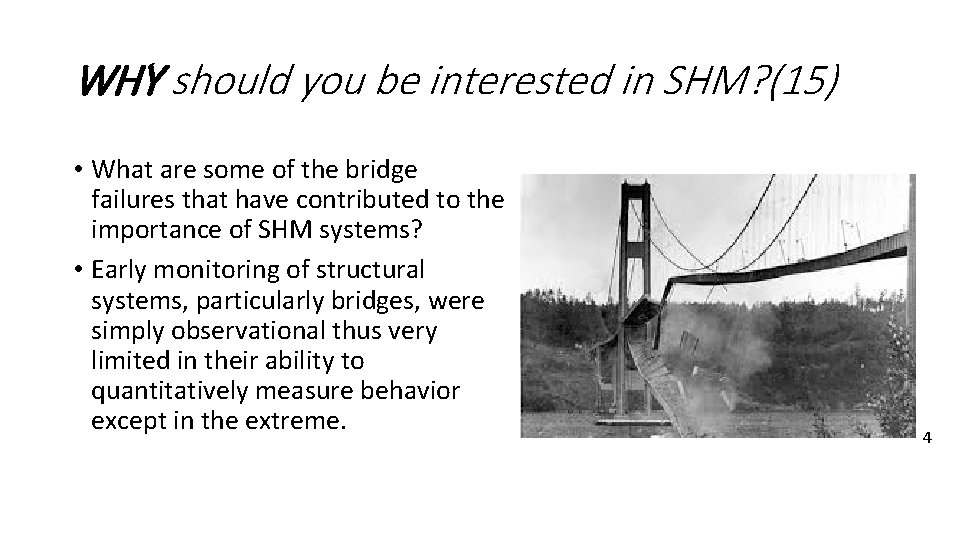
WHY should you be interested in SHM? (15) • What are some of the bridge failures that have contributed to the importance of SHM systems? • Early monitoring of structural systems, particularly bridges, were simply observational thus very limited in their ability to quantitatively measure behavior except in the extreme. 4
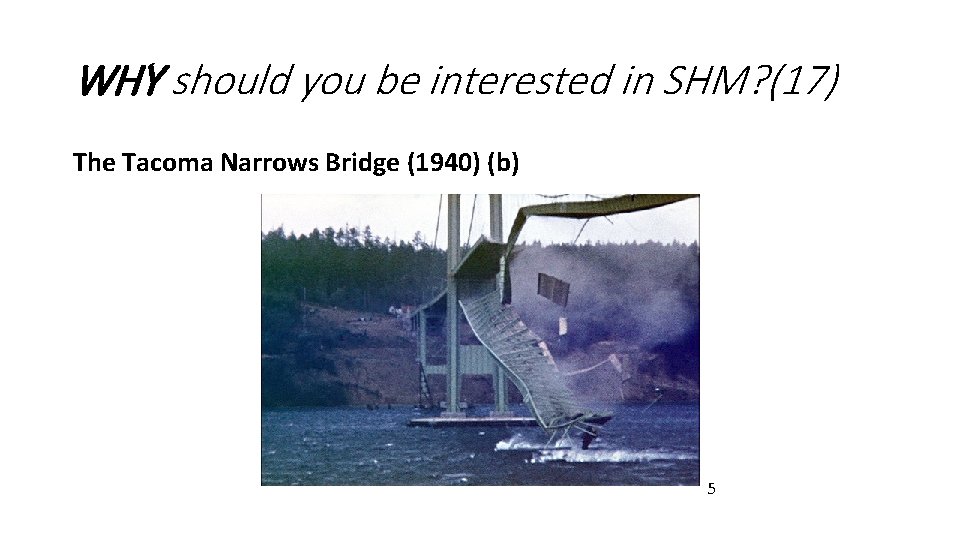
WHY should you be interested in SHM? (16) The Tacoma Narrows Bridge (1940) (a) • A prime example is the Tacoma Narrows Bridge failure which was due to aerodynamic forces either not considered or under estimated in the design process. • Luckily, the aerodynamically-induced oscillations were so dramatic and sustained which dictated closure of the bridge before the catastrophic and dramatic failure of its deck! • Check it out…. https: //www. youtube. com/watch? v=l. Xy. G 68_ca. V 4
WHY should you be interested in SHM? (17) The Tacoma Narrows Bridge (1940) (b) 5
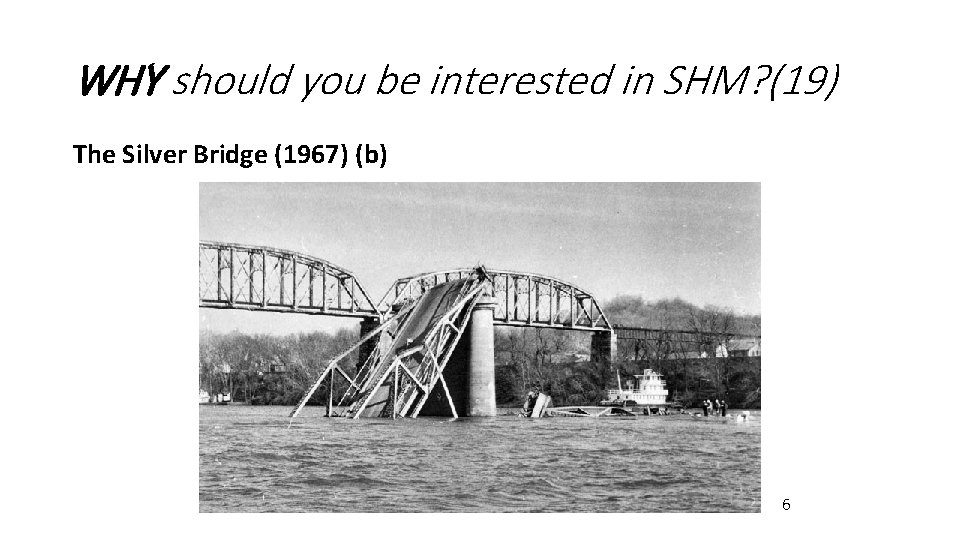
WHY should you be interested in SHM? (18) The Silver Bridge (1967) (a) • Unfortunately, this failure caused the deaths of 46 people. • A description of the failure is provided at https: //en. wikipedia. org/wiki/Silver_Bridge • A gallery of photos is available at http: //www. heralddispatch. com/multimedia/photo_galleries/photos_news/galleryhistorical-photos-of-the-collapse-of-the-silverbridge/article_89262253 -73 c 6 -53 d 9 -a 1 a 9 -9 d 027 cdbd 755. html
WHY should you be interested in SHM? (19) The Silver Bridge (1967) (b) 6
WHY should you be interested in SHM? (20) • An outcome of the Silver Bridge failure was the development and implementation of a National Bridge Inspection Program (NBIB). • “The NBIS, developed by FHWA in cooperation with the American Association of State Highway and Transportation Officials, was enacted as part of the Federal-Aid Highway Act of 1970. This landmark legislation was enacted on December 31, 1970, and established, for the first time in U. S. history, uniform, national-level standards for bridge inspection and safety evaluation. The Act also designated funding for the replacement of deficient bridges on the Federal-aid highway system. ”
WHY should you be interested in SHM? (21) Through the legislation: • All States were required to perform periodic inspection of bridges in excess of 6. 1 meters (20 feet) located on Federal-aid highway systems. • Bridge inspection data collection requirements were established. • Qualifications for key bridge inspection personnel were defined. • Training programs for bridge inspectors were developed and implemented. • The Special Bridge Replacement Program (SBRP) was established to provide funding for the replacement of bridges located on the Federal-aid system. • Source: https: //www. fhwa. dot. gov/policy/2004 cpr/chap 15 a. cfm
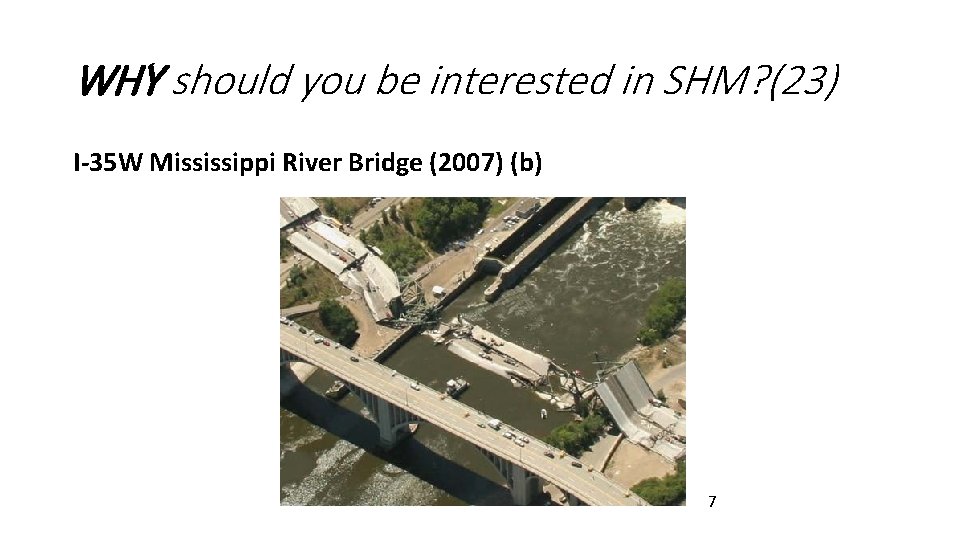
WHY should you be interested in SHM? (22) I-35 W Mississippi River Bridge (2007) (a) • The collapse of this bridge caused the deaths of 13 people with 145 injured. • Details are provided at https: //upload. wikimedia. org/wikipedia/commons/thumb/e/e 9/I 35 W_Bridge. jpg/325 px-I 35 W_Bridge. jpg
WHY should you be interested in SHM? (23) I-35 W Mississippi River Bridge (2007) (b) 7
WHY should you be interested in SHM? (24) I-35 W Mississippi River Bridge (2007) (c) • So even with a National Bridge Inspection Program in-place, a catastrophic and unexpected failure still occurred. • Would have a SHM system either identified the impending failure so that remedial action could have been taken to prevent the failure or at the minimal alerted officials of the impending failure in time to close the bridge to traffic?
WHY should you be interested in SHM? (25) I-35 W Mississippi River Bridge (2007) (d) • Records indicated that the bridge had been inspected annually since 1993 but no inspection had been completed in 2007 due to construction. • A study of the bridge conducted in 2001 recommended the installation of a SHM system and the use of strain gages were suggested. • There is no evidence that either were implemented.
WHY should you be interested in SHM? (26) • The new I-35 W St. Anthony Falls Bridge, completed in September 2008, consists of two parallel structures for northbound and southbound traffic. • Each structure consists of post-tensioned concrete box girders, or hollow bridge beams. Post-tensioning involves running steel strands through ducts within the beams and tightening them with a hydraulic jack, which compresses the beam and makes it less susceptible to cracking. • The bridge was also constructed to include a “smart bridge” system consisting of hundreds of sensors to monitor how the structure bends and deforms in response to traffic loads, temperature changes and the effects of material deformations due to creep and shrinkage.
WHY should you be interested in SHM? (27) • For several years, the University of Minnesota has been monitoring and analyzing these data to help improve future bridge designs. (See http: //www. dot. state. mn. us/research/TS/201224 TS. pdf) • For a complete description of the new bridge and its instrumentation see http: //www. smartec. ch/content/download/683/5067/file/c 202. pdf
WHY should you be interested in SHM? (28) • There is no evidence that a SHM system would have provided sufficient notice of an impending failure to allow for remedial measures to prevent the failures or closure of the bridges. • But such systems currently provide the most effective means to monitor the performance and integrity of highway bridges.
How? (1) • You will complete a series of education modules across two courses specifically designed to provide you with a fundamental knowledge of SHM systems. • A structural analysis course • A structural design course
How? (2) • Along with other courses, this knowledge will contribute to several student learning outcomes established by the Accreditation Board for Engineering and Technology (ABET) as essential to engineering graduates. Specifically: • an ability to design and conduct experiments, as well as to analyze and interpret data • an ability to design a system, component, or process to meet desired needs within realistic constraints such as economic, environmental, social, political, ethical, health and safety, manufacturability, and sustainability • an ability to use the techniques, skills, and modern engineering tools necessary for engineering
How? (3) • Within the context of your structural analysis course, you will complete four Foundational Education Modules (FEMs): • • FEM 1: An Introduction to Structural Health Monitoring FEM 2: SHM Methodology and Testing Categories FEM 3: Sensor and Data Acquisition Technology FEM 4: Analysis and Interpretation of SHM Sensor Data • These modules will build upon fundamentals from your courses in Mechanics of Materials and Mechanics of Materials Laboratory as well as Structural Analysis.
How? (4) • Within the context of your structural design course, you will: • complete several Structural Engineering Education Modules (SEEMs) • examine SHM case histories • complete a Structural Engineering Assignment Module (SEAM) • The sequence of the modules is designed to develop your cognitive knowledge progressively through Bloom’s Cognitive Levels of Learning.
How? (5) Bloom’s Cognitive Levels of Learning (lower to higher) • Knowledge: rote memorization, recognition or recall of facts (information gathering) • Comprehension: understanding what the facts mean (confirming- information gathering or use of information) • Application: correct use of the facts, rule or ideas (making use of the knowledge) • Analysis: breaking down the information into component parts (taking apart) • Synthesis: combination of facts, ideas and information to make a new whole (putting together) • Evaluation: judging or forming an opinion about the information or (judging the outcome)
How? (6) • The instructional methodology for the Foundational Education Modules (FEMs) will consist of the following sequential elements: • You will read and study the content for the module on-line. You will be provided with a detailed schedule for completion of the education module and the dates of the classroom discussions. • You will complete a mastery exam on the content of the module. Must complete with a score of 90% or greater. If you do not score 90%, you will be requested to take a second Mastery exam. Students failing to achieve the required score on the second exam will be asked to meet with Dr. Okeil in a timely manner. • A document will be provided on Moodle for you to respond to a specific classroom discussion question as well as list any questions you may have about the content of the module and submit your responses.
How? (7) Instructional methodology for the Foundational Education Modules (FEMs) continued: • You will actively discuss your responses with a classmate in a subsequent class and be prepared to discuss the responses of your “team” in a classroom setting. • At the end of the class discussion, you will submit a “one minute paper” in which you will be asked list of any of your unanswered questions. • Within time constraints, every effort will be made to answer all students’ questions at the subsequent class discussion. Those questions that cannot be answered due to time limitations will be included in a Frequently Asked Questions (FAQ) document to be posted on Moodle.
How? (8) • Normally, you should be able to complete the reading and studying the module, the mastery exam and your response to questions within about 1 to 2 hours. The classroom discussion will be limited to about 15 minutes.
Your Assignment…. (1) Answer the following question. Save a copy of your response for discussion in a subsequent class period. • List the criteria, in order of importance, which you believe should be used to determine if a bridge should be monitored with a Structural Health Monitoring System. Be prepared to justify your criteria and their order of importance.
Sources: 1. http: //www. geotechnicalmonitoring. com/en/ishmii-is-supporting-theinternational-course-on-geotechnical-and-structural-monitoring/ 2. http: //engineering. unl. edu/current-students/american-society-civilengineers-asce/ 3. http: //www. driverlesstransportation. com/event/transportation-research -board-93 rd-annual-meeting 4. http: //www. wsj. com/articles/SB 118608348257386422 5. http: //www. atlasobscura. com/places/tacoma-narrows-bridge 6. http: //www. mywvhome. com/twenties/depot. htm 7. http: //www. pbs. org/wgbh/nova/sciencenow/0304/04 -whyt-09. html