
FEi 4 Module Production Testing for Ring 0


- Slides: 31
FEi 4 Module Production & Testing for Ring 0 at Oxford Richard Plackett, on behalf OPMD
Outline • Module Production – – – Oxford has produced 6 FEi 4 modules for the Ring 0 effort Four production modules sent to RAL and two mechanical dummies 5 modules encapsulated, and now Two of the modules produced by Liverpool Another 5 -10 FEi 4 quads will be made next year for further confirming parameters Next setting up for single Chip FEI 4 test production and then RD 53 A quad production • Module Testing – – 2/20/2021 Testing completed for all modules through production Testing Method Readout system proliferation Looking towards RD 53 richard. plackett@physics. ox. ac. uk 2
Ring 0 Module Production • • 2/20/2021 Over the last few months the UK Endcap groups have been producing a series of FEI 4 modules to populate a Ring 0 demonstrator. Six electrical quads are being produced at each of Glasgow, Liverpool and Oxford. Of these 12 are currently being mounted on a realistic ring structure at RAL. An excellent opportunity to practise and learn lessons for module production and module mounting richard. plackett@physics. ox. ac. uk 3
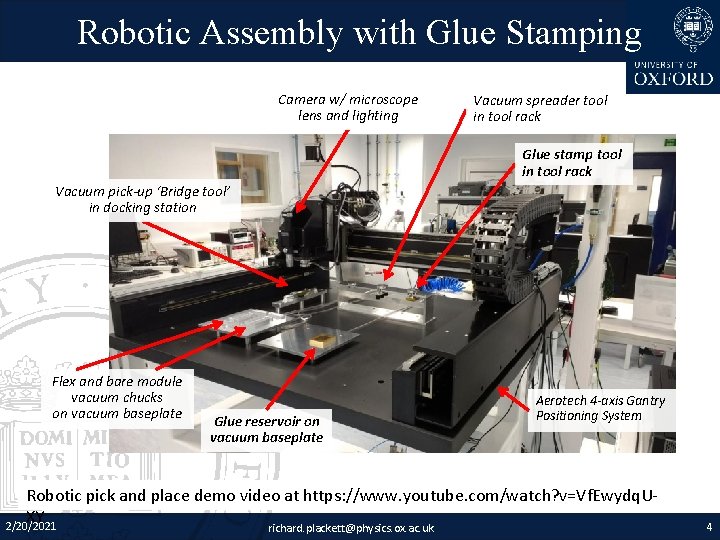
Robotic Assembly with Glue Stamping Camera w/ microscope lens and lighting Vacuum spreader tool in tool rack Glue stamp tool in tool rack Vacuum pick-up ‘Bridge tool’ in docking station Flex and bare module vacuum chucks on vacuum baseplate Glue reservoir on vacuum baseplate Aerotech 4 -axis Gantry Positioning System Robotic pick and place demo video at https: //www. youtube. com/watch? v=Vf. Ewydq. UXY 2/20/2021 richard. plackett@physics. ox. ac. uk 4
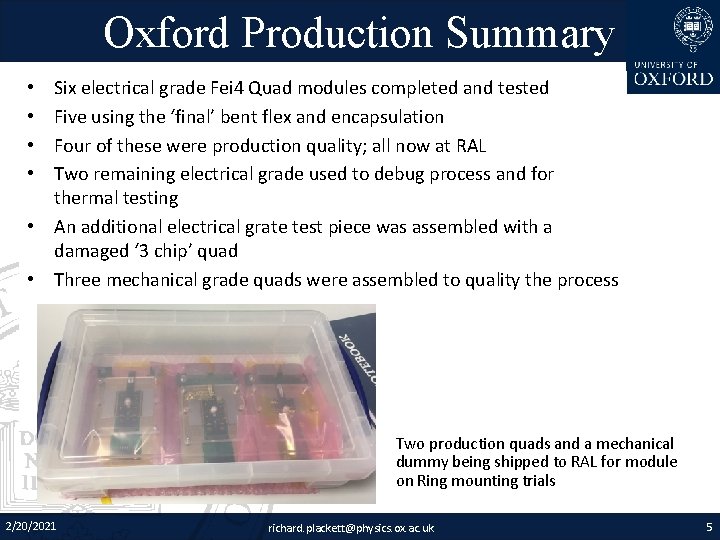
Oxford Production Summary Six electrical grade Fei 4 Quad modules completed and tested Five using the ‘final’ bent flex and encapsulation Four of these were production quality; all now at RAL Two remaining electrical grade used to debug process and for thermal testing • An additional electrical grate test piece was assembled with a damaged ‘ 3 chip’ quad • Three mechanical grade quads were assembled to quality the process • • Two production quads and a mechanical dummy being shipped to RAL for module on Ring mounting trials 2/20/2021 richard. plackett@physics. ox. ac. uk 5
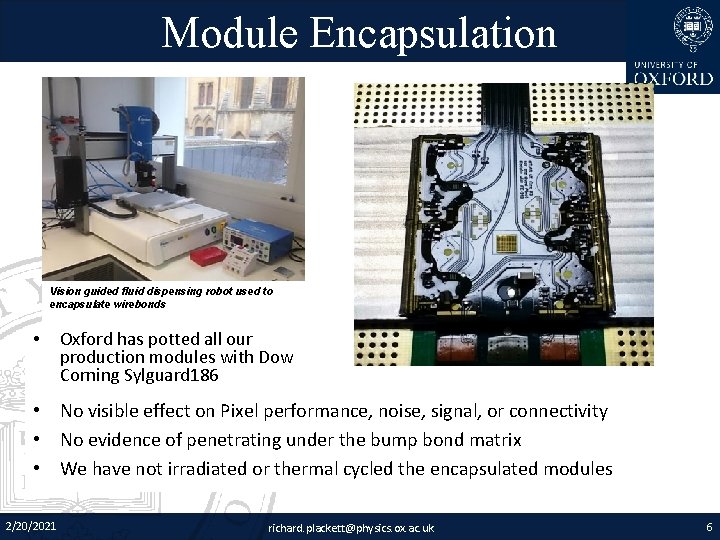
Module Encapsulation Vision guided fluid dispensing robot used to encapsulate wirebonds • Oxford has potted all our production modules with Dow Corning Sylguard 186 • No visible effect on Pixel performance, noise, signal, or connectivity • No evidence of penetrating under the bump bond matrix • We have not irradiated or thermal cycled the encapsulated modules 2/20/2021 richard. plackett@physics. ox. ac. uk 6
Ring 0 Parts to be Encapsulated • John Matherson at RAL has decided that the potted parts are much less risky to work with. • Has asked that an additional 2 modules will be encapsulated (complete and now back at RAL) • Further descision about the final 6 to be made later. 2/20/2021 richard. plackett@physics. ox. ac. uk 7
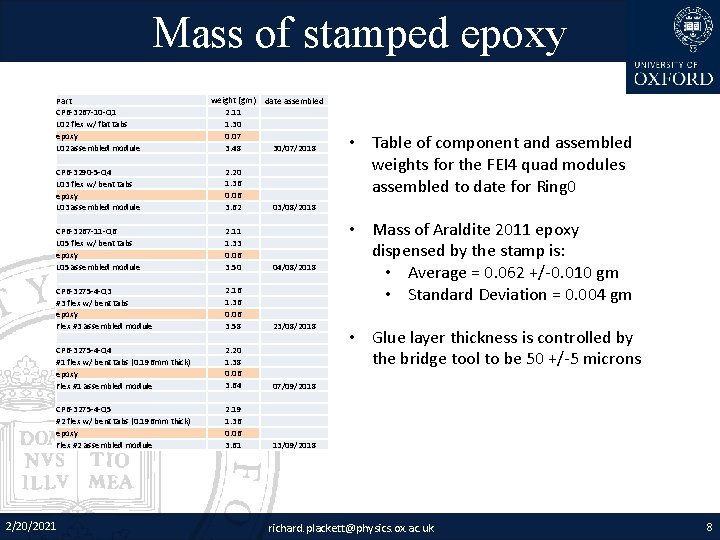
Mass of stamped epoxy Part CP 6 -3267 -10 -Q 1 L 02 flex w/ flat tabs epoxy L 02 assembled module weight (gm) 2. 11 1. 30 0. 07 3. 48 CP 6 -3290 -5 -Q 4 L 03 flex w/ bent tabs epoxy L 03 assembled module 2. 20 1. 36 0. 06 3. 62 CP 6 -3267 -11 -Q 6 L 05 flex w/ bent tabs epoxy L 05 assembled module 2. 11 1. 33 0. 06 3. 50 04/08/2018 CP 6 -3275 -4 -Q 3 #3 flex w/ bent tabs epoxy Flex #3 assembled module 2. 16 1. 36 0. 06 3. 58 23/08/2018 CP 6 -3275 -4 -Q 4 #1 flex w/ bent tabs (0. 196 mm thick) epoxy Flex #1 assembled module 2. 20 1. 38 0. 06 3. 64 07/09/2018 CP 6 -3275 -4 -Q 5 #2 flex w/ bent tabs (0. 196 mm thick) epoxy Flex #2 assembled module 2. 19 1. 36 0. 06 3. 61 13/09/2018 2/20/2021 date assembled 30/07/2018 • Table of component and assembled weights for the FEI 4 quad modules assembled to date for Ring 0 03/08/2018 • Mass of Araldite 2011 epoxy dispensed by the stamp is: • Average = 0. 062 +/-0. 010 gm • Standard Deviation = 0. 004 gm • Glue layer thickness is controlled by the bridge tool to be 50 +/-5 microns richard. plackett@physics. ox. ac. uk 8
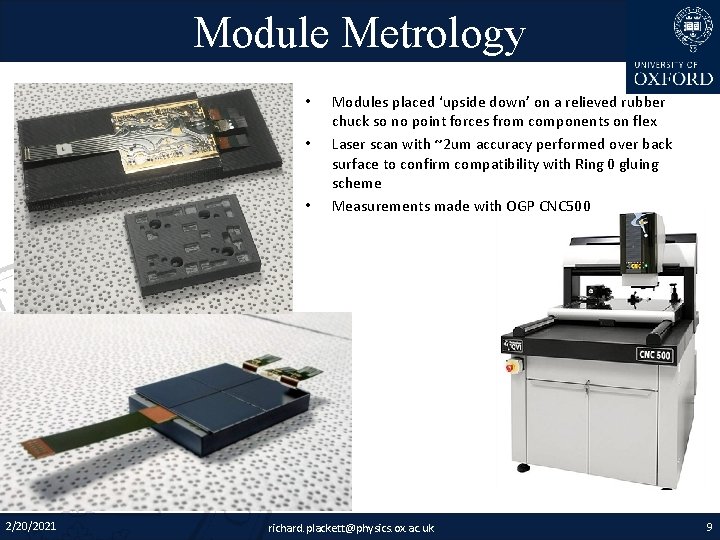
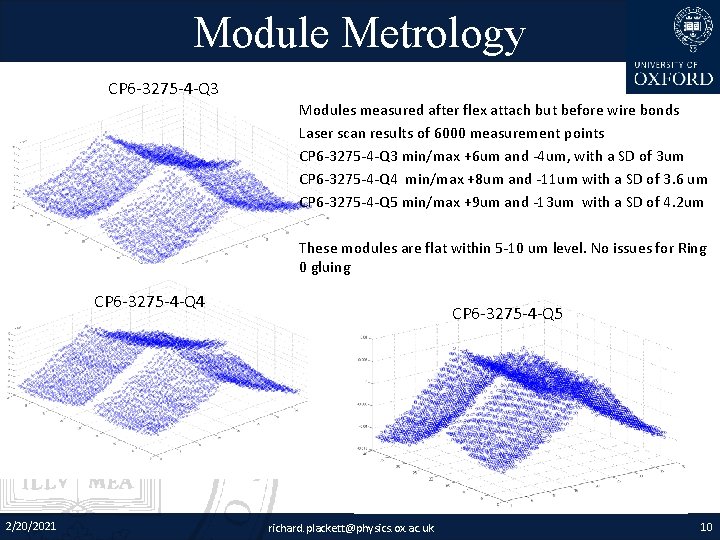
Module Metrology • • • 2/20/2021 Modules placed ‘upside down’ on a relieved rubber chuck so no point forces from components on flex Laser scan with ~2 um accuracy performed over back surface to confirm compatibility with Ring 0 gluing scheme Measurements made with OGP CNC 500 richard. plackett@physics. ox. ac. uk 9
Module Metrology CP 6 -3275 -4 -Q 3 Modules measured after flex attach but before wire bonds Laser scan results of 6000 measurement points CP 6 -3275 -4 -Q 3 min/max +6 um and -4 um, with a SD of 3 um CP 6 -3275 -4 -Q 4 min/max +8 um and -11 um with a SD of 3. 6 um CP 6 -3275 -4 -Q 5 min/max +9 um and -13 um with a SD of 4. 2 um These modules are flat within 5 -10 um level. No issues for Ring 0 gluing CP 6 -3275 -4 -Q 4 2/20/2021 CP 6 -3275 -4 -Q 5 richard. plackett@physics. ox. ac. uk 10
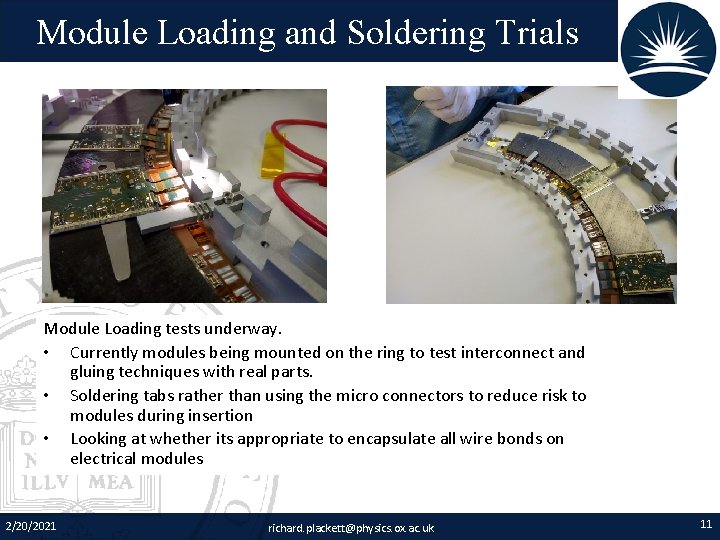
Module Loading and Soldering Trials Module Loading tests underway. • Currently modules being mounted on the ring to test interconnect and gluing techniques with real parts. • Soldering tabs rather than using the micro connectors to reduce risk to modules during insertion • Looking at whether its appropriate to encapsulate all wire bonds on electrical modules 2/20/2021 richard. plackett@physics. ox. ac. uk 11
More Modules to Build… • More Modules to build next year • 10 FEi 4 singles for HV isolation and flex studies – Requires new tooling • 5 -10 Fei 4 quads to confirm final design. – Very similar tooling to current production • 5 -10 RD 53 A quads. – Requires new tooling 2/20/2021 richard. plackett@physics. ox. ac. uk 12
Intermission 2/20/2021 richard. plackett@physics. ox. ac. uk 13
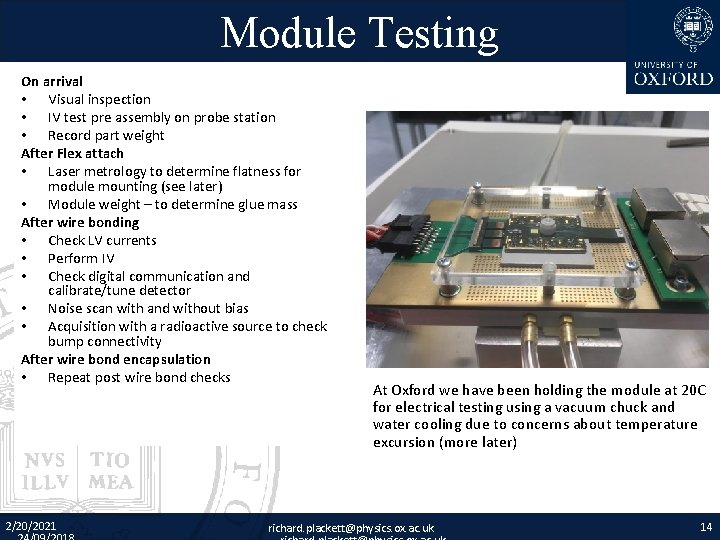
Module Testing On arrival • Visual inspection • IV test pre assembly on probe station • Record part weight After Flex attach • Laser metrology to determine flatness for module mounting (see later) • Module weight – to determine glue mass After wire bonding • Check LV currents • Perform IV • Check digital communication and calibrate/tune detector • Noise scan with and without bias • Acquisition with a radioactive source to check bump connectivity After wire bond encapsulation • Repeat post wire bond checks 2/20/2021 At Oxford we have been holding the module at 20 C for electrical testing using a vacuum chuck and water cooling due to concerns about temperature excursion (more later) richard. plackett@physics. ox. ac. uk 14
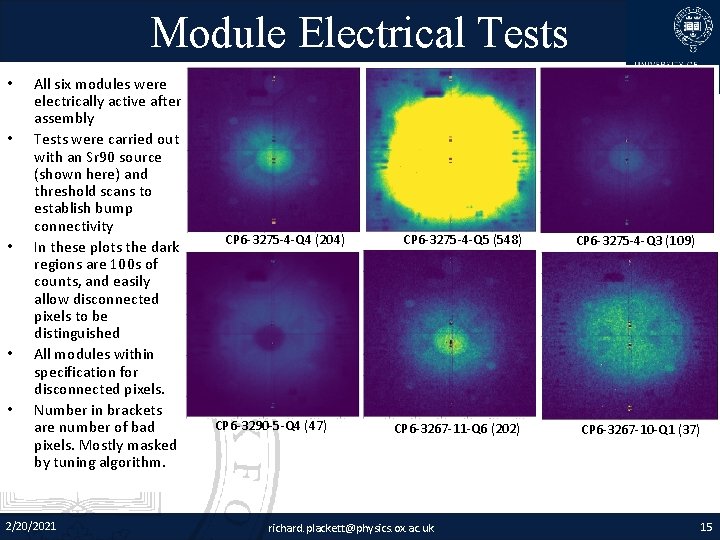
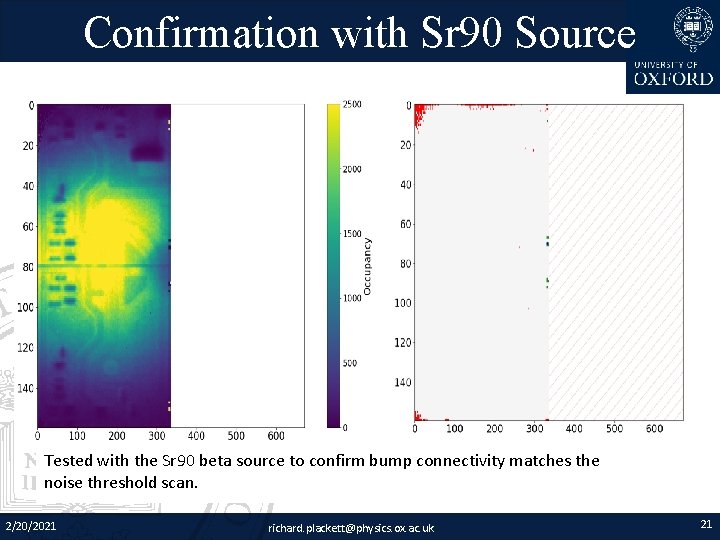
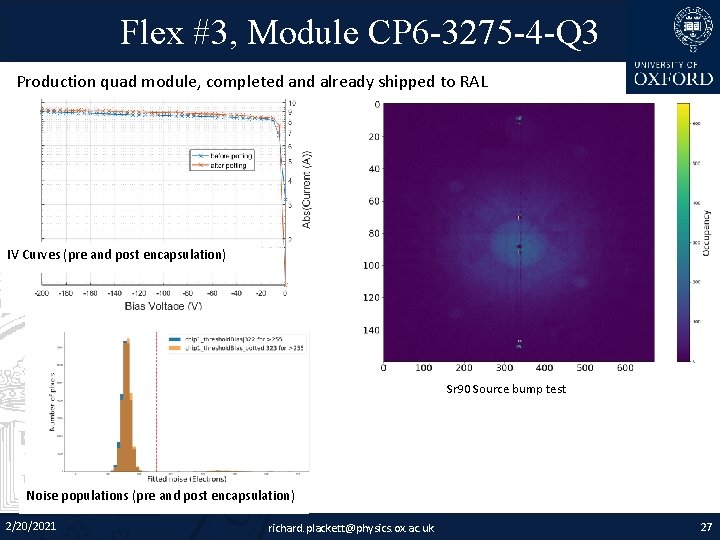
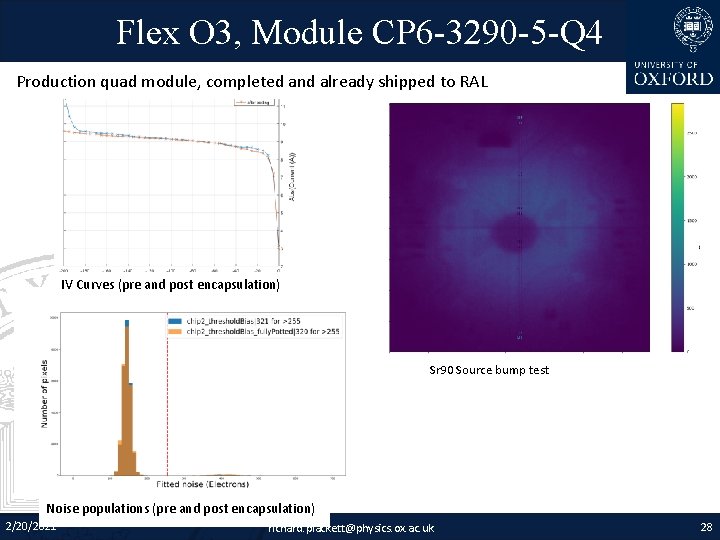
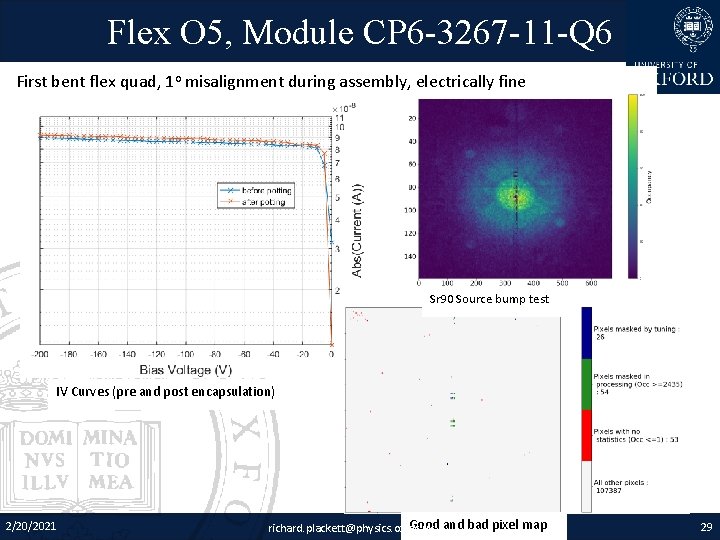
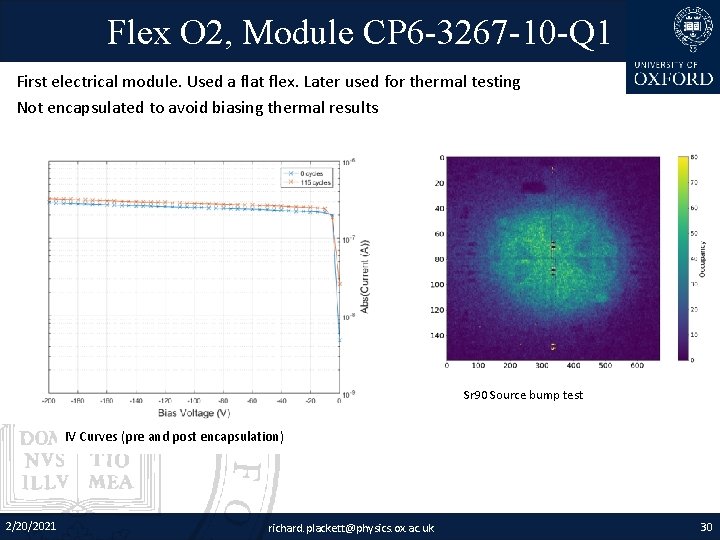
Module Electrical Tests • • • All six modules were electrically active after assembly Tests were carried out with an Sr 90 source (shown here) and threshold scans to establish bump connectivity In these plots the dark regions are 100 s of counts, and easily allow disconnected pixels to be distinguished All modules within specification for disconnected pixels. Number in brackets are number of bad pixels. Mostly masked by tuning algorithm. 2/20/2021 CP 6 -3275 -4 -Q 4 (204) CP 6 -3290 -5 -Q 4 (47) CP 6 -3275 -4 -Q 5 (548) CP 6 -3267 -11 -Q 6 (202) richard. plackett@physics. ox. ac. uk CP 6 -3275 -4 -Q 3 (109) CP 6 -3267 -10 -Q 1 (37) 15
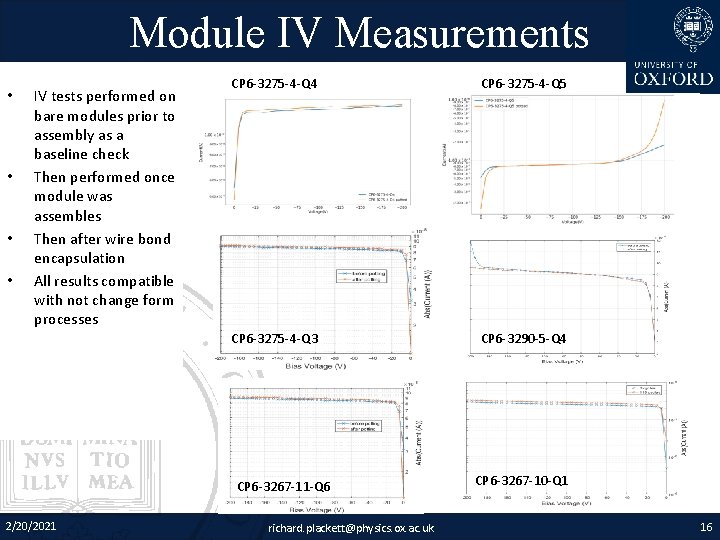
Module IV Measurements • • IV tests performed on bare modules prior to assembly as a baseline check Then performed once module was assembles Then after wire bond encapsulation All results compatible with not change form processes CP 6 -3275 -4 -Q 4 CP 6 -3275 -4 -Q 5 CP 6 -3275 -4 -Q 3 CP 6 -3290 -5 -Q 4 CP 6 -3267 -11 -Q 6 2/20/2021 richard. plackett@physics. ox. ac. uk CP 6 -3267 -10 -Q 1 16
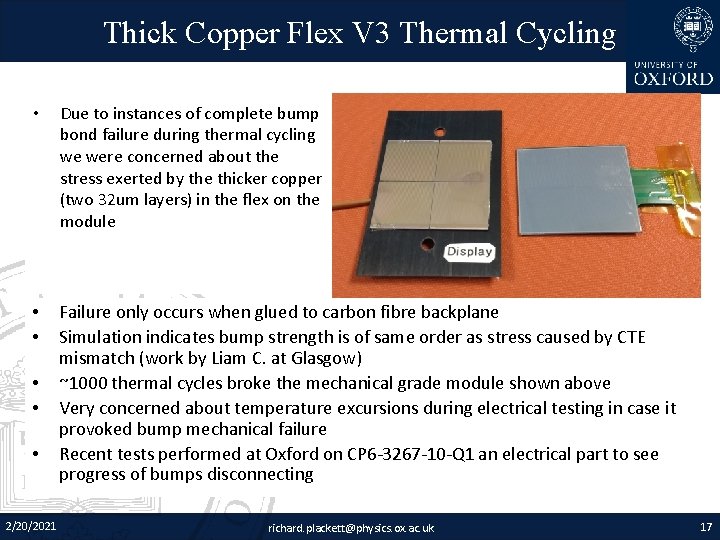
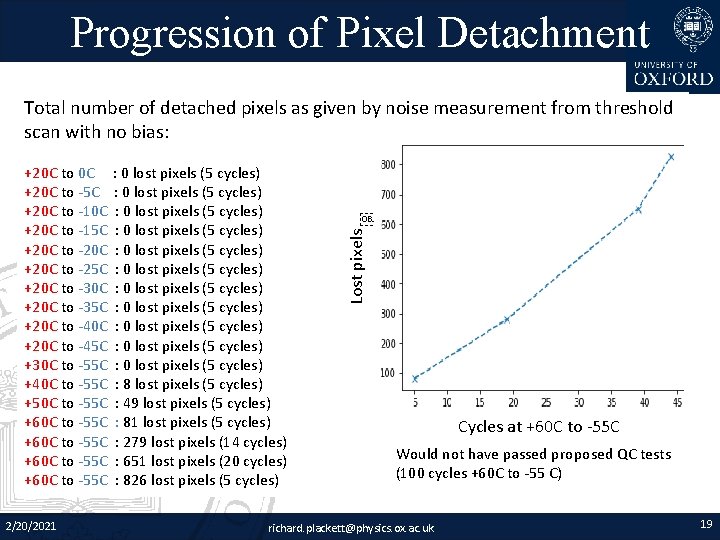
Thick Copper Flex V 3 Thermal Cycling • Due to instances of complete bump bond failure during thermal cycling we were concerned about the stress exerted by the thicker copper (two 32 um layers) in the flex on the module • • Failure only occurs when glued to carbon fibre backplane Simulation indicates bump strength is of same order as stress caused by CTE mismatch (work by Liam C. at Glasgow) ~1000 thermal cycles broke the mechanical grade module shown above Very concerned about temperature excursions during electrical testing in case it provoked bump mechanical failure Recent tests performed at Oxford on CP 6 -3267 -10 -Q 1 an electrical part to see progress of bumps disconnecting • • • 2/20/2021 richard. plackett@physics. ox. ac. uk 17
Thermal Tester • • 2/20/2021 For QA testing we make use of our MPI Thermal. Air system Air flow chiller – cold dry air stream at 10 L/s Built in air dryer and chiller Delivers thermal shock temperature change speeds 10 C/s Can take parts down to -80 C For these tests we used it in a reduced flow and power mode to perform a cycling with a period of 30 minutes This better simulates low number of thermal cycles Ring 0 would see richard. plackett@physics. ox. ac. uk 18
Progression of Pixel Detachment Total number of detached pixels as given by noise measurement from threshold scan with no bias: 2/20/2021  Lost pixels +20 C to 0 C : 0 lost pixels (5 cycles) +20 C to -5 C : 0 lost pixels (5 cycles) +20 C to -10 C : 0 lost pixels (5 cycles) +20 C to -15 C : 0 lost pixels (5 cycles) +20 C to -20 C : 0 lost pixels (5 cycles) +20 C to -25 C : 0 lost pixels (5 cycles) +20 C to -30 C : 0 lost pixels (5 cycles) +20 C to -35 C : 0 lost pixels (5 cycles) +20 C to -40 C : 0 lost pixels (5 cycles) +20 C to -45 C : 0 lost pixels (5 cycles) +30 C to -55 C : 0 lost pixels (5 cycles) +40 C to -55 C : 8 lost pixels (5 cycles) +50 C to -55 C : 49 lost pixels (5 cycles) +60 C to -55 C : 81 lost pixels (5 cycles) +60 C to -55 C : 279 lost pixels (14 cycles) +60 C to -55 C : 651 lost pixels (20 cycles) +60 C to -55 C : 826 lost pixels (5 cycles) Cycles at +60 C to -55 C Would not have passed proposed QC tests (100 cycles +60 C to -55 C) richard. plackett@physics. ox. ac. uk 19
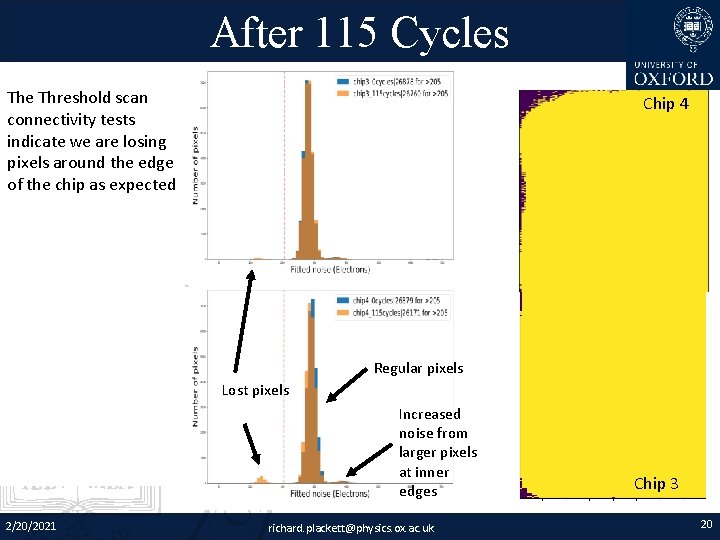
After 115 Cycles The Threshold scan connectivity tests indicate we are losing pixels around the edge of the chip as expected Chip 4 Regular pixels Lost pixels Increased noise from larger pixels at inner edges 2/20/2021 richard. plackett@physics. ox. ac. uk Chip 3 20
Confirmation with Sr 90 Source Tested with the Sr 90 beta source to confirm bump connectivity matches the noise threshold scan. 2/20/2021 richard. plackett@physics. ox. ac. uk 21
Readout System Proliferation YARR (Fei 4) – Commercial parts development effort unsuccessful – Used at Glasgow with mixed results • USBpix (MMC 3) – used for testing (here and RAL) but only one available • HSIO 2 (+cosmic) – brief set up effort here but abandoned – Used at Liverpool as part of RCE system • Mini Felix (FEi 4) – taking a system from CERN for continued FEi 4 work • YARR (RD 53) – Currently trying to set up a copy of the system at Berkeley and Glasgow • BDAQ (KC 705) – Used successfully at the testbeam – Will pursue as a backup • Felix (RD 53) – Hopefully not needed We may end up having tried all of these by the end of next year… Disappointing amount of effort duplicated but sadly not a great surprise • 2/20/2021 richard. plackett@physics. ox. ac. uk 22
Backup Slides 2/20/2021 richard. plackett@physics. ox. ac. uk 23
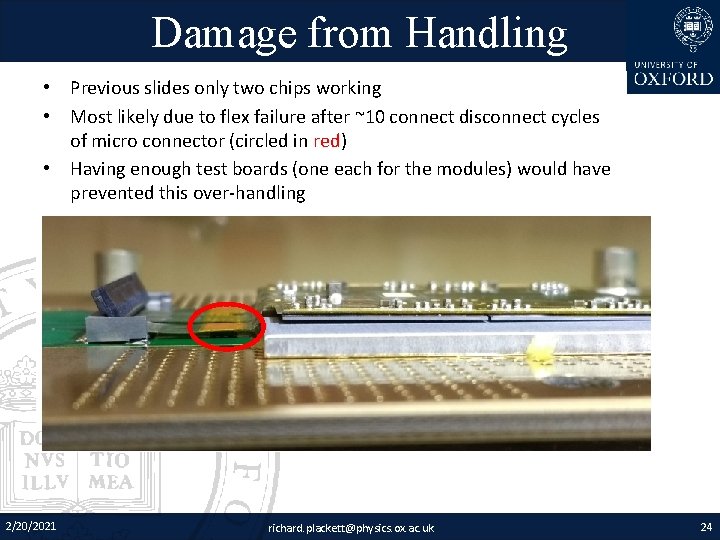
Damage from Handling • Previous slides only two chips working • Most likely due to flex failure after ~10 connect disconnect cycles of micro connector (circled in red) • Having enough test boards (one each for the modules) would have prevented this over-handling 2/20/2021 richard. plackett@physics. ox. ac. uk 24
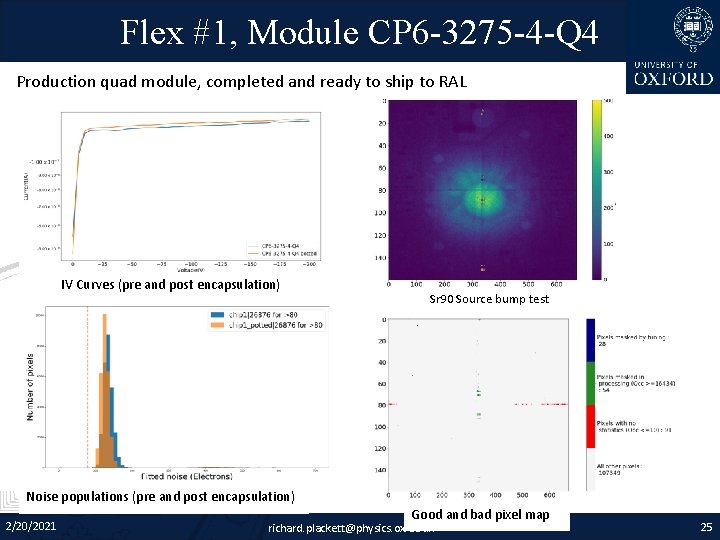
Flex #1, Module CP 6 -3275 -4 -Q 4 Production quad module, completed and ready to ship to RAL IV Curves (pre and post encapsulation) Sr 90 Source bump test Noise populations (pre and post encapsulation) 2/20/2021 Good and bad pixel map richard. plackett@physics. ox. ac. uk 25
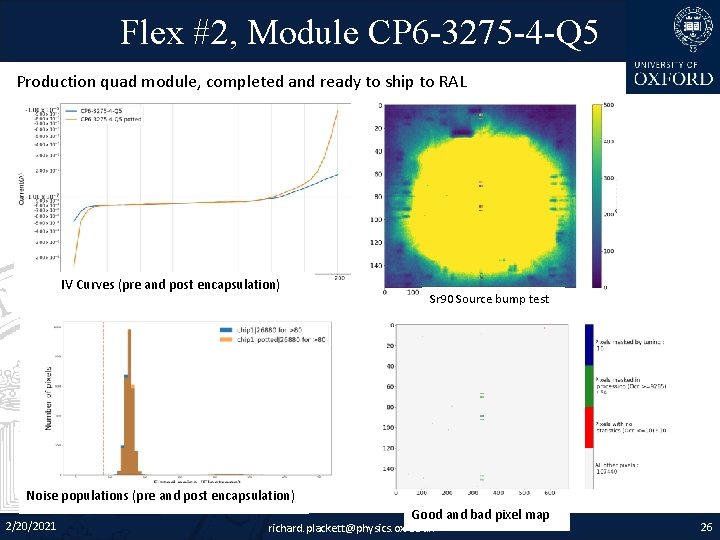
Flex #2, Module CP 6 -3275 -4 -Q 5 Production quad module, completed and ready to ship to RAL IV Curves (pre and post encapsulation) Sr 90 Source bump test Noise populations (pre and post encapsulation) 2/20/2021 Good and bad pixel map richard. plackett@physics. ox. ac. uk 26
Flex #3, Module CP 6 -3275 -4 -Q 3 Production quad module, completed and already shipped to RAL IV Curves (pre and post encapsulation) Sr 90 Source bump test Noise populations (pre and post encapsulation) 2/20/2021 richard. plackett@physics. ox. ac. uk 27
Flex O 3, Module CP 6 -3290 -5 -Q 4 Production quad module, completed and already shipped to RAL IV Curves (pre and post encapsulation) Sr 90 Source bump test Noise populations (pre and post encapsulation) 2/20/2021 richard. plackett@physics. ox. ac. uk 28
Flex O 5, Module CP 6 -3267 -11 -Q 6 First bent flex quad, 1 o misalignment during assembly, electrically fine Sr 90 Source bump test IV Curves (pre and post encapsulation) 2/20/2021 Good and bad pixel map richard. plackett@physics. ox. ac. uk 29
Flex O 2, Module CP 6 -3267 -10 -Q 1 First electrical module. Used a flat flex. Later used for thermal testing Not encapsulated to avoid biasing thermal results Sr 90 Source bump test IV Curves (pre and post encapsulation) 2/20/2021 richard. plackett@physics. ox. ac. uk 30
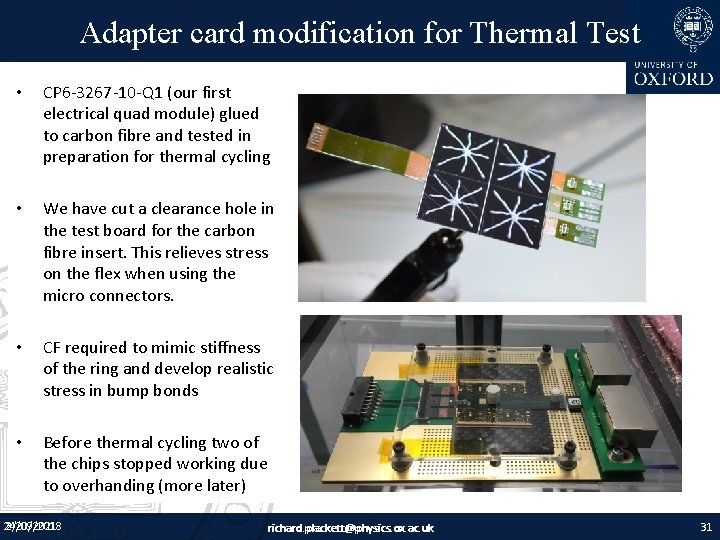
Adapter card modification for Thermal Test • CP 6 -3267 -10 -Q 1 (our first electrical quad module) glued to carbon fibre and tested in preparation for thermal cycling • We have cut a clearance hole in the test board for the carbon fibre insert. This relieves stress on the flex when using the micro connectors. • CF required to mimic stiffness of the ring and develop realistic stress in bump bonds • Before thermal cycling two of the chips stopped working due to overhanding (more later) 24/09/2018 2/20/2021 richard. plackett@physics. ox. ac. uk 31