
Feeds and Feed Label Ms Wellborn Objectives Identify
Feeds and Feed Label Ms. Wellborn
Objectives: Identify sources of nutrients and classes of feed. Identify vitamins, minerals, and feed additives.
A Little Review Can anyone tell me what we talked about yesterday? Can anyone remember and name the 6 essential nutrients? Can someone tell me what palatability means? Can someone tell me the two- types of vitamins there are?
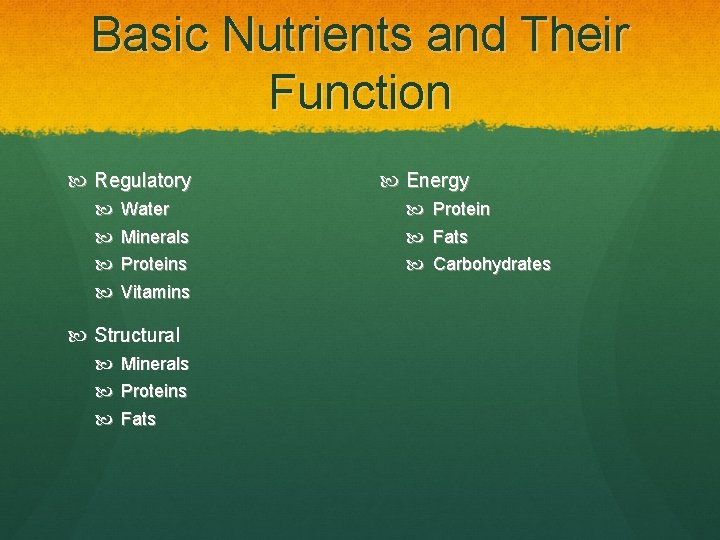
Basic Nutrients and Their Function Regulatory Water Minerals Proteins Vitamins Structural Minerals Proteins Fats Energy Protein Fats Carbohydrates
Water Cheapest and most abundant nutrient Most important Functions: Regulates body temp. Nutrient/waste transportation Aids in digestion/absorption Regulate ionic concentrations
Carbohydrates Occurance: Plants 60 -80% Cell content- sugar and starch Cell wall- cellulose and hemicellulose Different classifications Can anyone name some classifications of carbohydrates? Functions: Energy Heat Building Blocks Fat Disposition
Fats (Lipids) Contain 2. 25 x more than carbohydrates Functions: Dietary energy supply Source of heat, insulation, and protection for the body Sources of essential fatty acids Serve as a carrier for absorption of fat- soluble vitamins Classification: Simple Compound Derived
Protein Principal component of organs and soft structures in the body Digestible protein- portion of crude protein which the animal digests Crude protein- composed of true protein and any other nitrogenous product Functions: Structural- collagen, elastin, blood proteins Body metabolism- enzymes, hormones, immune antibodies Distinct functions- defense mechanism, hooves, cell membranes
Minerals Natural Sources Forage plants Grains Macro Minerals normally preset at greater levels in the body or needed in relatively large amounts in the diet Ca, P, Na, Cl, Mg, K, S Micro Normally present at love levels in the body or needed in very small amounts in the diet Co, Cu, F, I, Fe, Mn, Mo, Se, Zn Functions: Structural and skeletal development Function in protein synthesis Oxygen transport Fluid balance Regulating acid-base balance Activation of many enzyme systems
Vitamins Fat soluble- A, D, E, K Water soluble- thiamine, riboflavin, niacin, pyridoxine, pantothenic acid, biotin, choline, folic acid, B 12 Functions: Regulators of metabolism Growth and maintenance of life Antibody synthesis Requirements increase with age
Now Take a minute to look at the feeds in front of you Fill out the worksheet to the best of your ability. What are the feed additives added to the feeds in front of you? What do you think those additives are used for?
Objectives Identify sources of nutrients and classes of feed. What sources of nutrients and classes of feed did we look at today? Identify vitamins, minerals, and feed additives. What kind of vitamins, minerals, and additives did we find in the feeds we looked at?

- Slides: 13