
Feeding Time How Nutrients Drive Phytoplankton Growth Symbols
Feeding Time ― How Nutrients Drive Phytoplankton Growth Symbols courtesy of the Integration and Application Network, University of Maryland Center for Environmental Science
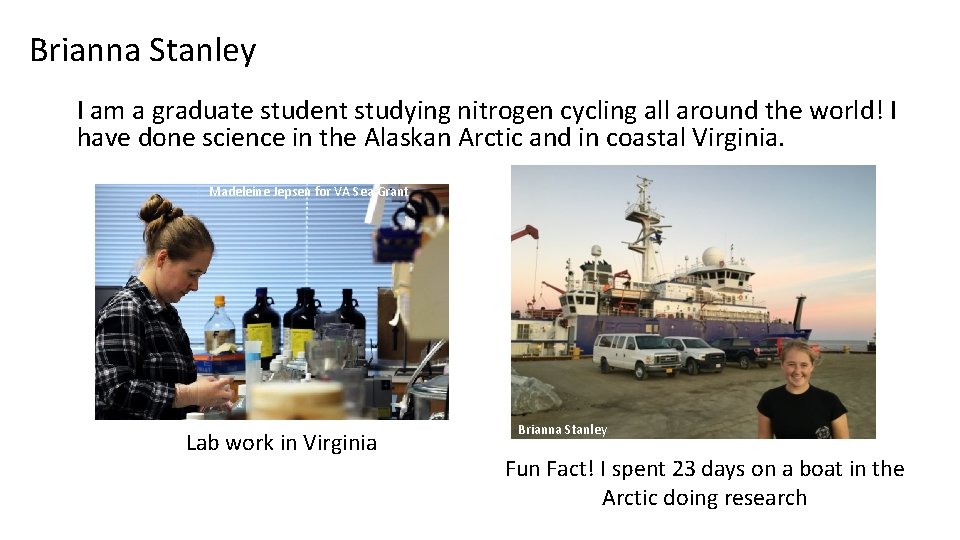
Brianna Stanley I am a graduate student studying nitrogen cycling all around the world! I have done science in the Alaskan Arctic and in coastal Virginia. Madeleine Jepsen for VA Sea Grant Lab work in Virginia Brianna Stanley Fun Fact! I spent 23 days on a boat in the Arctic doing research

Liebig’s Law of the Minimum Biological growth is not controlled by total resource availability, but rather by the availability of the scarcest resource. This scarce resource is known as the limiting factor. For example VS Limiting factor Shorter slat No matter how much water you have, you will never fully fill this barrel
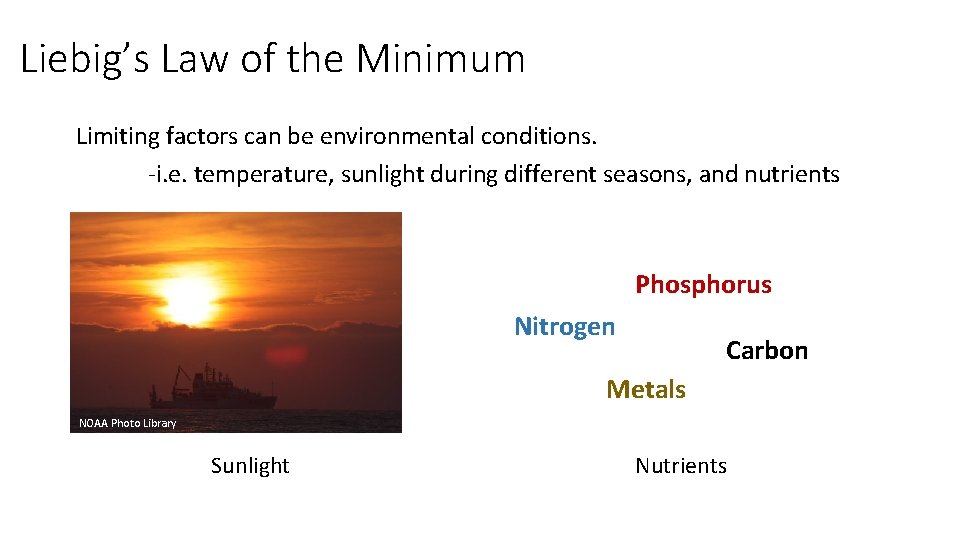
Liebig’s Law of the Minimum Limiting factors can be environmental conditions. -i. e. temperature, sunlight during different seasons, and nutrients Phosphorus Nitrogen Carbon Metals NOAA Photo Library Sunlight Nutrients

Redfield Ratios – Limiting Nutrient Factors for Marine Systems The ratio of inorganic nutrients in the both the ocean and inside phytoplankton biomass! 106 carbon : 16 nitrogen : 1 phosphorus (106 C: 16 N: 1 P) While ratios measured by scientists may vary by conditions and locations, this is the general nutrient proportion found throughout the world’s marine systems. Symbols courtesy of the Integration and Application Network, University of Maryland Center for Environmental Science
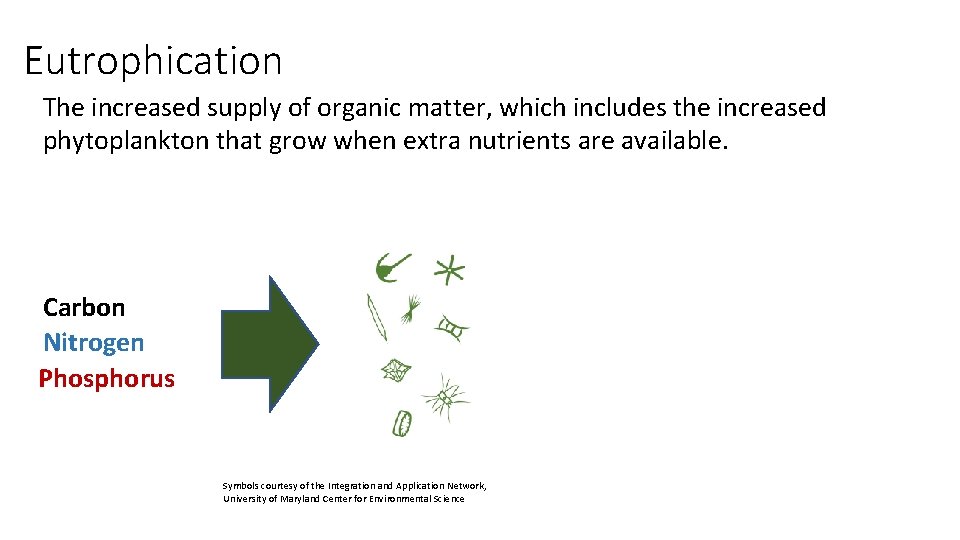
Eutrophication The increased supply of organic matter, which includes the increased phytoplankton that grow when extra nutrients are available. Carbon Nitrogen Phosphorus Symbols courtesy of the Integration and Application Network, University of Maryland Center for Environmental Science
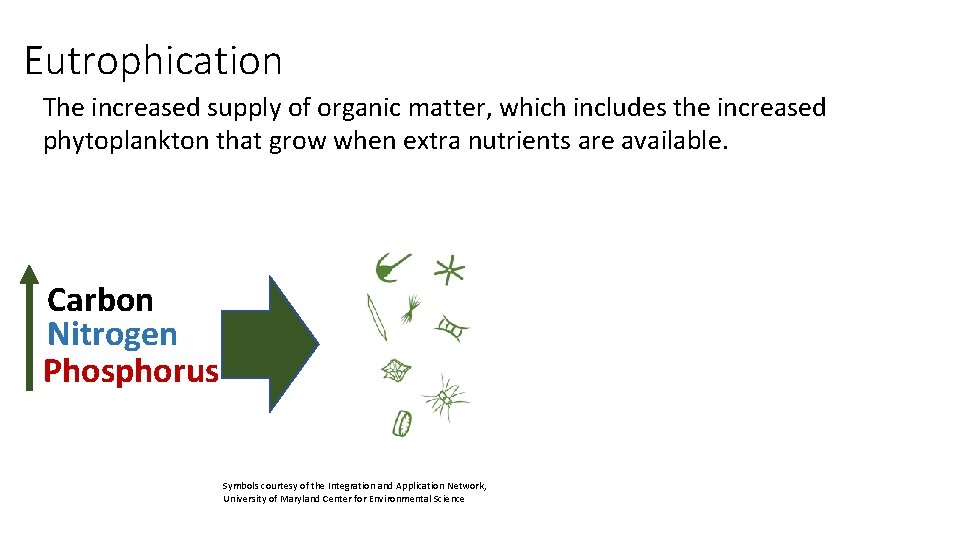
Eutrophication The increased supply of organic matter, which includes the increased phytoplankton that grow when extra nutrients are available. Carbon Nitrogen Phosphorus Symbols courtesy of the Integration and Application Network, University of Maryland Center for Environmental Science
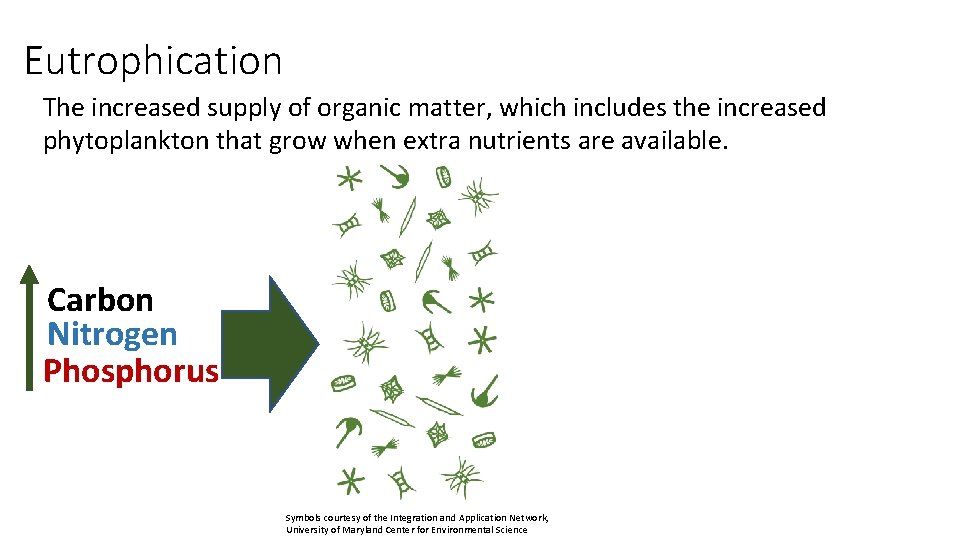
Eutrophication The increased supply of organic matter, which includes the increased phytoplankton that grow when extra nutrients are available. Carbon Nitrogen Phosphorus Symbols courtesy of the Integration and Application Network, University of Maryland Center for Environmental Science
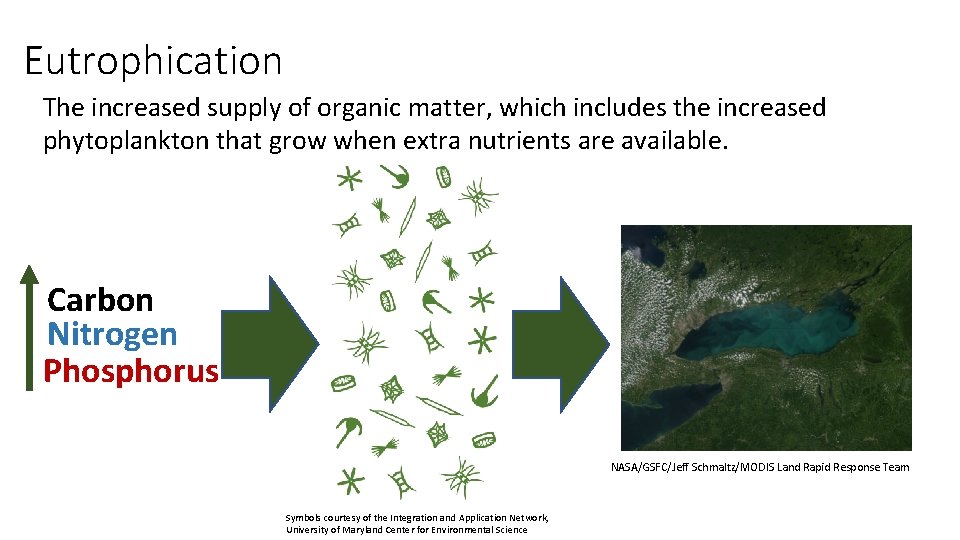
Eutrophication The increased supply of organic matter, which includes the increased phytoplankton that grow when extra nutrients are available. Carbon Nitrogen Phosphorus NASA/GSFC/Jeff Schmaltz/MODIS Land Rapid Response Team Symbols courtesy of the Integration and Application Network, University of Maryland Center for Environmental Science
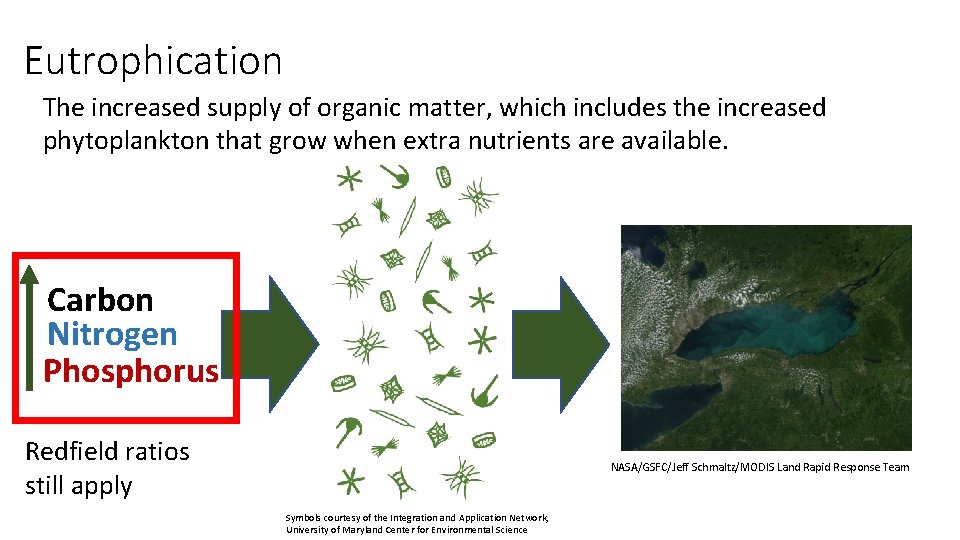
Eutrophication The increased supply of organic matter, which includes the increased phytoplankton that grow when extra nutrients are available. Carbon Nitrogen Phosphorus Redfield ratios still apply NASA/GSFC/Jeff Schmaltz/MODIS Land Rapid Response Team Symbols courtesy of the Integration and Application Network, University of Maryland Center for Environmental Science
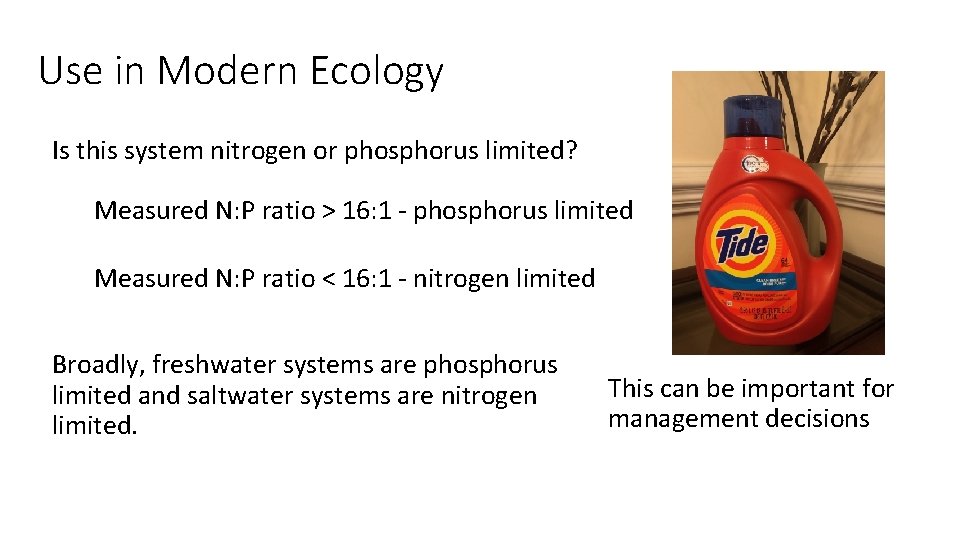
Use in Modern Ecology Is this system nitrogen or phosphorus limited? Measured N: P ratio > 16: 1 - phosphorus limited Measured N: P ratio < 16: 1 - nitrogen limited Broadly, freshwater systems are phosphorus limited and saltwater systems are nitrogen limited. This can be important for management decisions
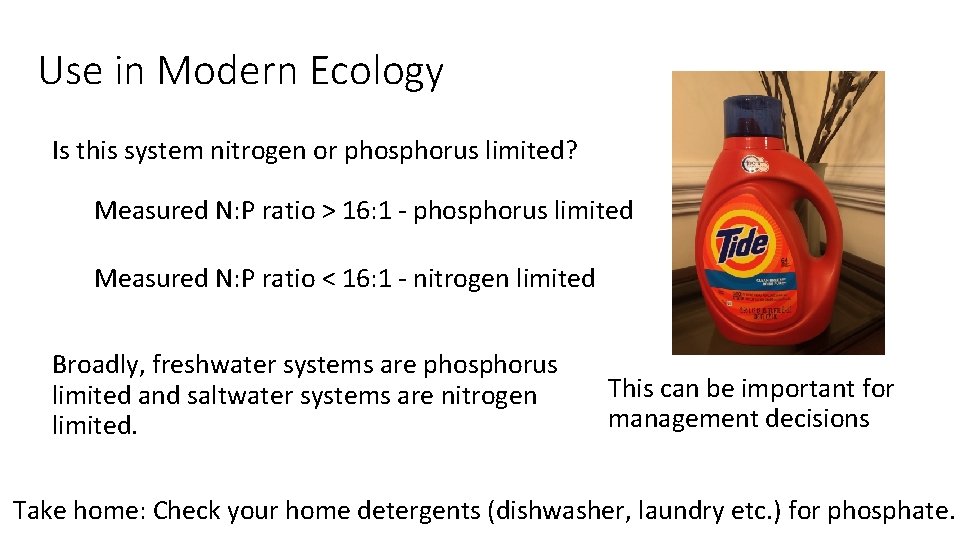
Use in Modern Ecology Is this system nitrogen or phosphorus limited? Measured N: P ratio > 16: 1 - phosphorus limited Measured N: P ratio < 16: 1 - nitrogen limited Broadly, freshwater systems are phosphorus limited and saltwater systems are nitrogen limited. This can be important for management decisions Take home: Check your home detergents (dishwasher, laundry etc. ) for phosphate.
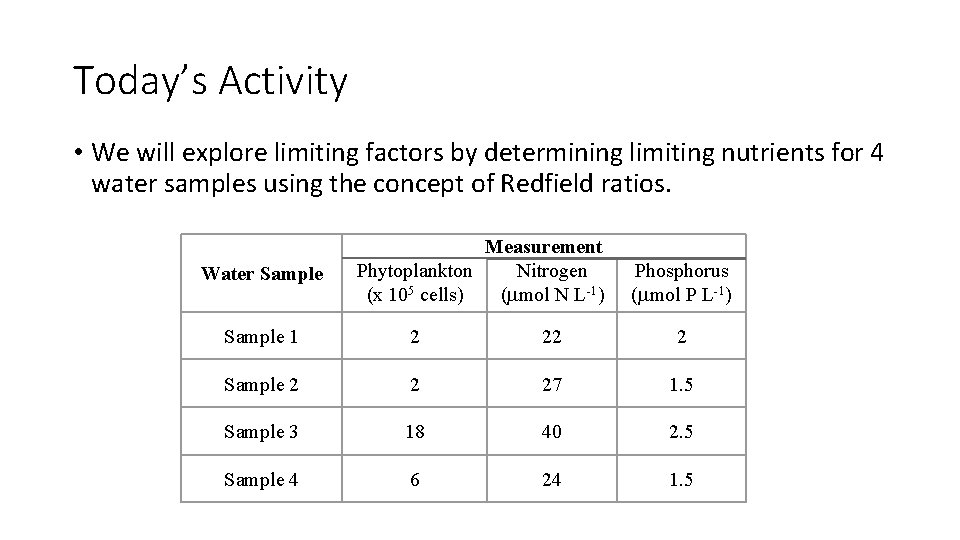
Today’s Activity • We will explore limiting factors by determining limiting nutrients for 4 water samples using the concept of Redfield ratios. Water Sample Measurement Phytoplankton Nitrogen (x 105 cells) ( mol N L-1) Phosphorus ( mol P L-1) Sample 1 2 22 2 Sample 2 2 27 1. 5 Sample 3 18 40 2. 5 Sample 4 6 24 1. 5
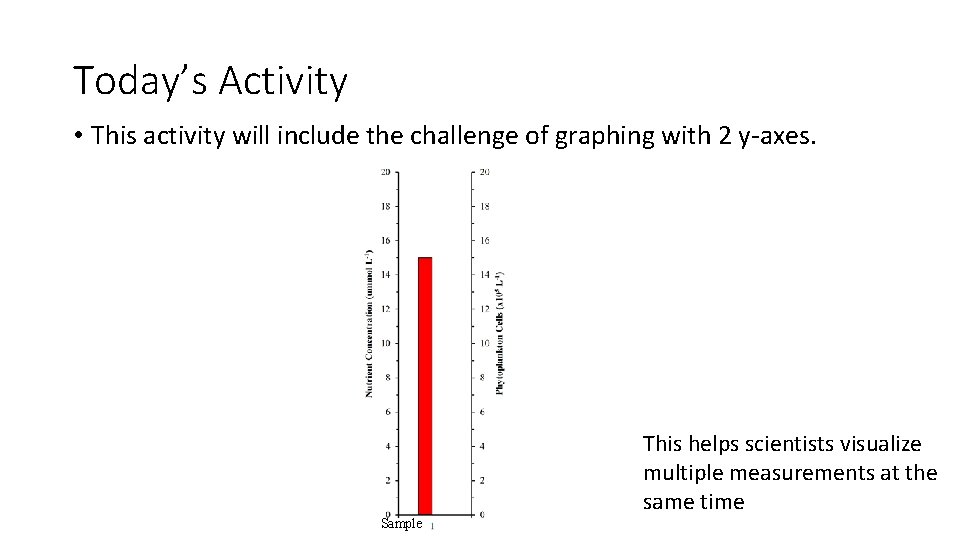
Today’s Activity • This activity will include the challenge of graphing with 2 y-axes. Sample This helps scientists visualize multiple measurements at the same time
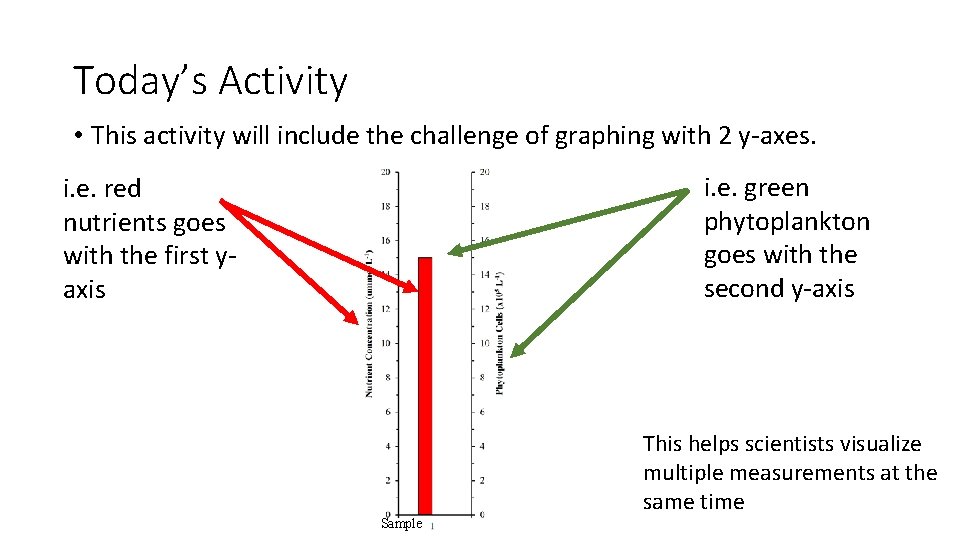
Today’s Activity • This activity will include the challenge of graphing with 2 y-axes. i. e. green phytoplankton goes with the second y-axis i. e. red nutrients goes with the first yaxis Sample This helps scientists visualize multiple measurements at the same time
Today’s Activity 1. In your groups, use the provided data to create a graph and answer questions. 2. Now that you have viewed your data, answer the worksheet questions about the data. 3. If time, answer questions about eutrophication with your group. 4. Discuss findings as a class.
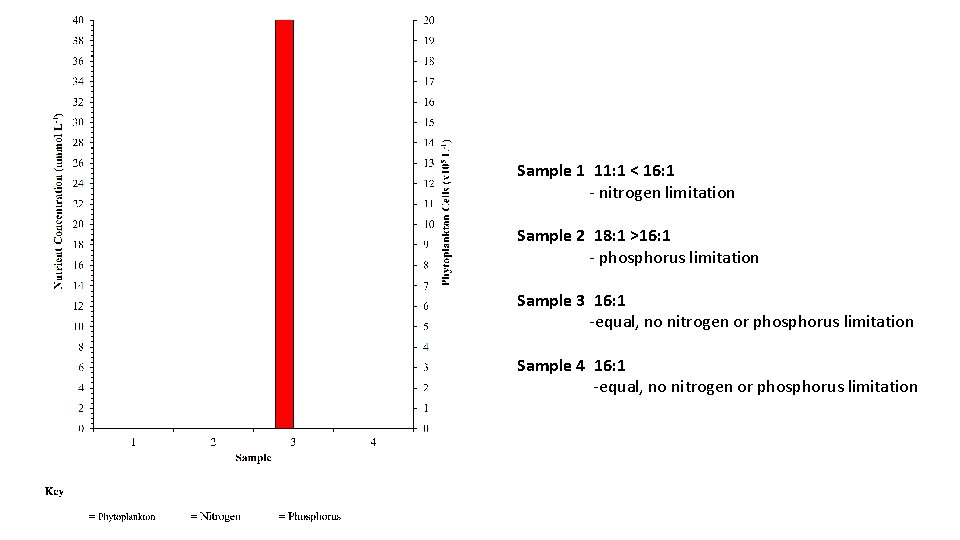
Sample 1 11: 1 < 16: 1 - nitrogen limitation Sample 2 18: 1 >16: 1 - phosphorus limitation Sample 3 16: 1 -equal, no nitrogen or phosphorus limitation Sample 4 16: 1 -equal, no nitrogen or phosphorus limitation
- Slides: 17