
FEEDING OF FISH By Prof Dr ABDELBASET N
FEEDING OF FISH By Prof. Dr. ABDEL-BASET N. S. AHMED Prof. Of Animal & Poultry Nutrition Faculty of Vet. Medicine-Assiut Univ.
FEEDING OF FISH B-According to environment: 1 -Warm water fish: Tilapia & Carp 2 -Cold water fish: Rainbow trout C-Accord to water: 1 -Fresh-water fish 2 -Marine fish
FEEDING OF FISH
FEEDING OF FISH Nutrient requirements of fish: The Standard Environmental Temp. (SET) for cold-water fish about 10 C (salmon) & warm-water fish 30 C (channel catfish). If water temp. deviates upward than SET , nutrient requirements increased & vise versa
FEEDING OF FISH 1 -Protein requirements: Function of protein for fish: A-Provide energy B-To supply amino acids C-Functional proteins, hormones & enzymes Sources of protein: A-Animal products (fish & meat meal ) B-Agriculture by-products (algae, ceeals, legumes) C-Industrial waste products
FEEDING OF FISH Fish contain 60 -93% crude protein, thus, fish diets are higher in protein than birds & animals. Fish appear to be relatively efficient utilized of protein to energy with 84%. Fish can not synthesize their amino acids & obtained chiefly from the diet & absence affect growth of fish
FEEDING OF FISH Factors affecting protein requirement: 1 -Species 2 -Age 3 -Stocking density 4 -Water temperature 5 -Production stage
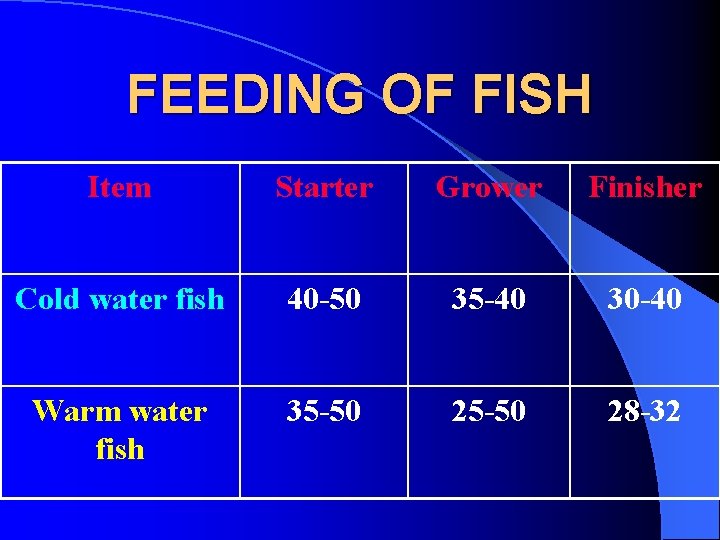
FEEDING OF FISH Item Starter Grower Finisher Cold water fish 40 -50 35 -40 30 -40 Warm water fish 35 -50 28 -32
FEEDING OF FISH Deficiency symptoms of amino acids: Def. of lysine dorsal & caudal fin erosin & increased mortality Def. of methionine cataract Def. of tryptophan scoliosis, renal calcinosis, cataract, caudal fin erosin & decreased carcass lipid content
FEEDING OF FISH
FEEDING OF FISH 2 -Energy requirements: A-Carbohydrates: Fish digest simple sugar efficiently & decrease digestibility of large molecule. Efficiency of carbohydrate in fish 39% compared to 96% in mammals. Carbohydrates can be used to spare protein since less protein will be used for energy. Fibres as cellulose & hemicellulose controlling passage of feed through gut & not exceed 8%, while 10% reduction in nutrient intake & digestibility.
FEEDING OF FISH B- Fat: Fish can utilize energy of fat by 84% efficiency Functions of fat: 1 -Providing energy 2 -Cushions for vital organs 3 -Energy reserves 4 -Insulators & lubricants 5 -Transports of fat-soluble vitamins
FEEDING OF FISH The best suppl. Of fat are fish oils & SBOM. Fish oil (5%) is the best source of EFAs Def. of EFAs: 1 -Reduced growth & poor feed conversion 2 -Increased mortality 3 -Elevated muscle water content 4 -Increased susceptibility to caudal fin erosin 5 -Fatty infiltration in liver
FEEDING OF FISH C-Energy metabolism in fish: Fish do not spend much energy towards maintaining body temp. (cold blooded). Factors affecting energy requirement: 1 -Species 2 -Size 3 -Light exposure 4 -Composition of diet 5 -Physiological activity 6 -Age 7 -Temp. of water 8 -Other environmental factors (water flow, water composition, pollution)
FEEDING OF FISH
FEEDING OF FISH 3 -Vitamin requirements: Vitamin req. of fish resemble those of poultry. There is not enough bacterial activity in gut to satisfy B-complex & vit. K requirements Fish feed contain high levels of oils oxidation may result inactivation amounts must be in excess to ensure adequate levels of requirements.
FEEDING OF FISH
FEEDING OF FISH 4 -Minerals requirements: Fish have the ability to absorb a number of minerals directly from water reducing mineral req. in the diet. Fish require all macro-and micro-elements required by other animals for enzymes & cofactors. Fish in soft water (low mineral content) require additional suppl. In diet.
FEEDING OF FISH
FEEDING OF FISH Fish farming: 1 -Fish farming with agriculture: Fish culture with agricultural crops as rice & banana. It is economical & required little extra-labour 2 -Fish farming with livestock: As ducks, chicks, pigs & cattle Duck dropping contain 25% organic substances Duck eradicate the unwanted insect, snails & their larvae
FEEDING OF FISH 3 -Fish farming with sewage: Sewage treated before letting out to fish ponds due to lack of oxygen. Bacteriological tests conducted on the skin, gut & muscles of fish grown in sewage.
FEEDING OF FISH
FEEDING OF FISH Feeding methods: 1 -Hand feeding: Advantages: 1 -Operator can note feeding behavior guage the feed required 2 -Operator can ensure that feed is dispersed over wide area. Disadvantages: 1 -high labour cost 2 -increased handling of the feed.
FEEDING OF FISH 2 -Automatic feeding: Advantages: 1 -Reducing labour cost 2 -Known quantity of feed dispersed to fish Disadvantages: 1 -Less observation of the fish
FEEDING OF FISH 3 -Demand feeders: Fish can obtain food on demand by depressing a trigger. Advantages: Fish can obtain much food as require Disadvantages: Trigger happy feed wastage & water pollution
- Slides: 25