
Feeding and Management of Feeder Cattle Chapter 16
- Slides: 38
Feeding and Management of Feeder Cattle Chapter 16
Objectives • Describe systems of cattle feeding and kinds of cattle that may be fed • Identify grades of feeder cattle • Describe the economics of buying feeder cattle • Select feeds and develop feeding programs for various kinds of feeder cattle
Objectives (cont. ) • List approved practices for managing various feeder cattle operations
Systems of Cattle Feeding • Most located in central and western parts of the United States • Most fed high rates of grains, though there is a fast-growing demand for grass-fed beef – Both have advantages and disadvantages
Systems of Cattle Feeding (cont. ) • Types of Feeding Operations – Commercial cattle feedlots • Capacity of 1, 000 cattle or more • Many cattle in feedlot at same time – Farmer-feeders • Capacity usually less than 1, 000 • Feed cattle mainly to market feed raised on farm
Systems of Cattle Feeding (cont. ) • Types of Finishing – Finishing type depends on • • Kind of cattle How long they are fed Feed used Market demand
Systems of Cattle Feeding (cont. ) • Types of Finishing (cont. ) – Finishing Immediately • Feeder cattle are brought to a full feed of grain • Fed until ready for harvest – Deferred Finishing Systems • Use more roughage and less grain • Fed roughage during winter, pastured next summer • Placed in feedlot for 90 -120 days in fall
Kinds of Cattle to Feed • There are many choices • Selection is based on – Sex – Age and weight – Grade of cattle
Kinds of Cattle to Feed (cont. ) • Sex – Heifers • Some kept for replacement • Can be fed for slaughter – Steers • Available for feeding • Steers have higher efficiency in gain than heifers – Prices fluctuate based on many factors
Kinds of Cattle to Feed (cont. ) • Age and Weight – Feeders are divided into three groups based on age and weight • Calves • Yearlings • Older feeders
Kinds of Cattle to Feed (cont. ) • Age and Weight (cont. ) – Calves • • • Feeders that are less than 1 year old Weigh between 350 -450 pounds Gaining in calves is slower Death losses are higher with calves Success in feeding depends on feeding skill
Kinds of Cattle to Feed (cont. ) • Age and Weight (cont. ) – Yearlings • • • Feeders that are between 1 and 2 years old Weigh between 550 -700 pounds Well adapted to feeding programs Often clean up crop residues Fewer health problems
Kinds of Cattle to Feed (cont. ) • Age and Weight (cont. ) – Older feeders • • Cattle that are 2 years old or older Weigh about 800 -1, 000 pounds Fed for only a short period of time More skill in buying and selling is needed for this type of feeder
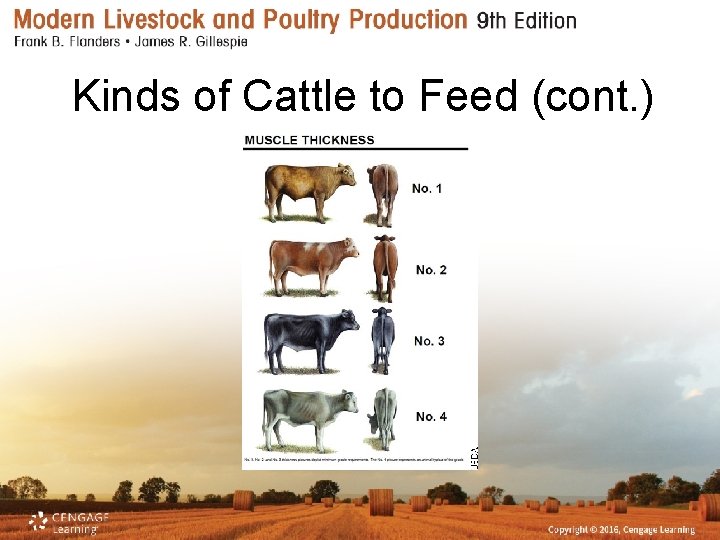
Kinds of Cattle to Feed (cont. ) • Grade – Used by USDA as basis for market prices – Apply to cattle less than 36 months of age – Three factors determine the grade • Thriftiness • Frame size • Thickness
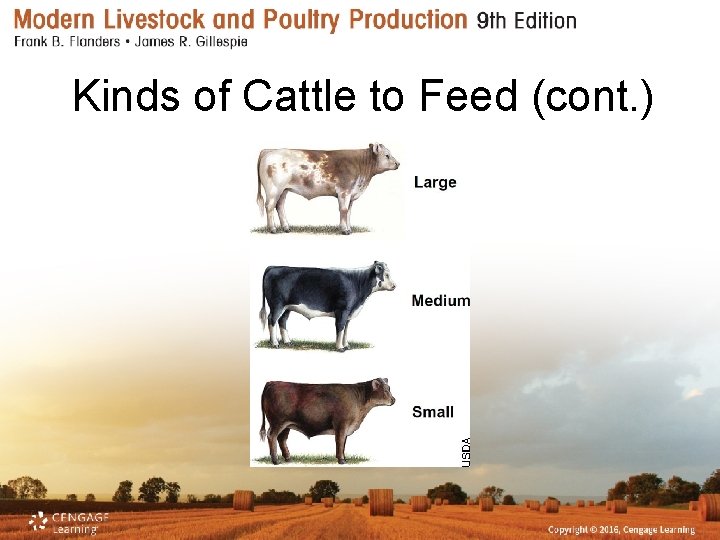
Kinds of Cattle to Feed (cont. ) • Grade (cont. ) – Thriftiness • Apparent health, ability to grow and fatten normally – Frame size • Size of the animal’s skeleton in relation to its age – Thickness • Development of muscles in relation to skeleton size
Kinds of Cattle to Feed (cont. )
Kinds of Cattle to Feed (cont. )
Buying Feeder Cattle • Auction markets – Main source for buying cattle • Buying directly from farms or ranches is a second source • Price trends for different cattle vary • Price should not be the only factor when selecting cattle
Selection of Feeds • Roughages – Limited use of roughages in finishing rations – Amount of roughage varies in the ration – Roughage has little effect on gain – Hay • Most commonly used roughage • Legumes make the best kind of hay
Selection of Feeds (cont. ) • Roughages (cont. ) – Corn silage • One of the best roughages to use for finishing cattle • One ton of corn silage = 100 pounds produced • Cattle gain slower on corn silage
Selection of Feeds (cont. ) • Roughages (cont. ) – Sorghum silage • Have 60 -90% of the feeding value as corn silage • Low in protein • Protein and mineral supplement must be added to the ration
Selection of Feeds (cont. ) • Roughages (cont. ) – Grass silage • Made from grass, legume, or grass-legume mix • Lower in energy content than other silages • Haylage is low-moisture grass silage, more palatable than grass, contains more energy, protein
Selection of Feeds (cont. ) • Roughages (cont. ) – Small grains • Can be used for silage for finishing cattle • Protein content is high and silage palatable • Quality and nutrient value can be increased by the addition of a carbohydrate source
Selection of Feeds (cont. ) • Roughages (cont. ) – Lower-quality by-product roughages • Examples: corncobs, cottonseed hulls, beet tops, straw, etc. • Low in protein, minerals, and vitamins • Must be carefully supplemented if used
Selection of Feeds (cont. ) • Pasture – Good quality pasture lowers the cost of gain – Rotation grazing and continuous grazing can be considered – Bloating can occur on pasture • Prevent with poloxalene – Use of a protein supplement may be needed for poor-quality pastures
Selection of Feeds (cont. ) • Concentrates – Grains fed for finishing cattle • Corn, milo, barley, oats, and wheat – Corn and milo are the most commonly used – All grain compared to corn for feeding value – Each grain added depends on value
Selection of Feeds (cont. ) • Methods of Processing Feeds – Grinding • Processing feed through a hammer mill • Improves the value of grains fed, feed intake – High-moisture storage • Harvesting the grain at a high moisture content and storing it in a silo
Selection of Feeds (cont. ) • Methods of Processing Feeds (cont. ) – Rolling • Processing grain through a set of smooth rollers • Flaking: feed rolled then pressed into flakes • Steam flaking: grain heated with steam, then rolled, broken into flakes • Dry-rolled grain: grain that is dry
Selection of Feeds (cont. ) • Methods of Processing Feeds (cont. ) – Crimping • Same as rolling, except rolling surface is corrugated – Pelleting • Grinding feed, forming into pellets • Gives an increase in feed efficiency of 5% – Cubing • Grinding feed into larger cubes
Selection of Feeds (cont. ) • Protein Supplements – Natural sources often used are • Soybean • Linseed • Cottonseed meal • Urea Fermentation Potential – Measures amount of fermentable energy
Selection of Feeds (cont. ) • Feeding Raw Soybeans to Beef Cattle – Can be profitable when soybean price is low – Beans dried to 13 percent moisture for storage – Beans should be coarsely crushed when fed • Feeding Wheat Middlings to Beef Cattle – By-product of flour milling industry – Cattle need to be acclimated to this feed
Selection of Feeds (cont. ) • Distiller’s Grains as a Protein Source – By-product of grain alcohol fermentation – Good source of protein, energy, phosphorus – Equal to soybean meal or corn gluten meal in meeting total supplementary protein requirement for growing, finishing beef cattle
Selection of Feeds (cont. ) • Minerals – Salt, calcium, and phosphorus are the main minerals needed for finishing – Salt to provide sodium and chlorine – Calcium from limestone or oyster shell flour – Phosphorus supplied by bonemeal or dicalcium phosphate
Selection of Feeds (cont. ) • Vitamins – Most commonly added are A, D, and E – Vitamin A most important to add to the ration – In certain circumstances, more or less of each vitamin is needed
Selection of Feeds (cont. ) • Additives and Implants – Number of feed additives and hormone implants available for finishing cattle – Can result in significant improvement in growth rate and efficiency
Feeding Cattle • Feed Intake – Cattle with high feed intake typically have higher feed efficiency • Feeding Management – Time of year cattle placed on feed affects feed efficiency and rate of gain
Feeding Cattle (cont. ) • Starting Cattle on Feed – Cattle should be moved to a full feed of grain as rapidly as possible without going off feed • Rations for Finishing Cattle – Quality and price of available feeds may make it necessary for variable rations
Feeding Cattle (cont. ) • Sorting Cattle into Feeding Groups – Technology available to aid in sorting • Calculating Total Feed Needed – Exact amounts vary according to age, cattle’s condition, feed used, weather, other factors • Care of New Feeder Cattle – First 2 to 3 weeks in feedlot are critical