
Feedback on GCSE Science Double Award and Physics
Feedback on GCSE Science (Double Award) and Physics
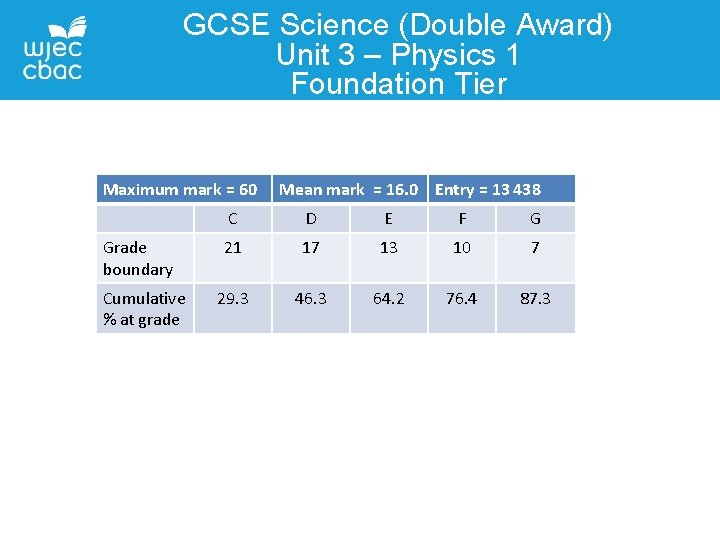
GCSE Science (Double Award) Unit 3 – Physics 1 Foundation Tier Maximum mark = 60 Grade boundary Cumulative % at grade Mean mark = 16. 0 Entry = 13 438 C D E F G 21 17 13 10 7 29. 3 46. 3 64. 2 76. 4 87. 3
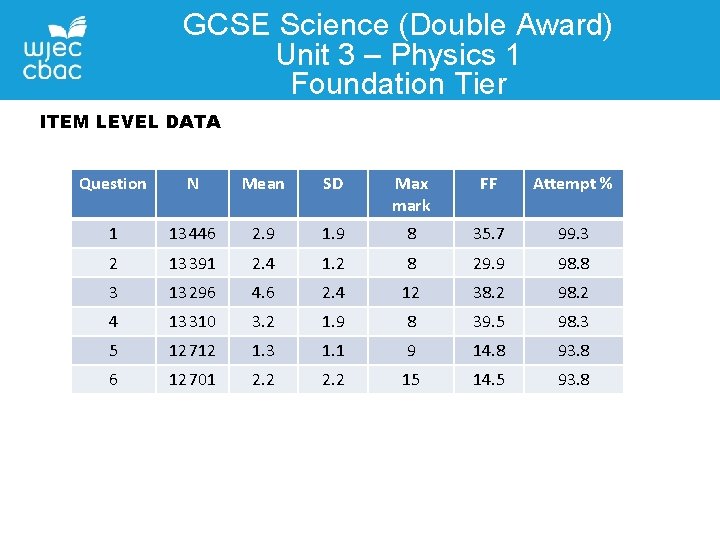
GCSE Science (Double Award) Unit 3 – Physics 1 Foundation Tier ITEM LEVEL DATA Question N Mean SD Max mark FF Attempt % 1 13 446 2. 9 1. 9 8 35. 7 99. 3 2 13 391 2. 4 1. 2 8 29. 9 98. 8 3 13 296 4. 6 2. 4 12 38. 2 98. 2 4 13 310 3. 2 1. 9 8 39. 5 98. 3 5 12 712 1. 3 1. 1 9 14. 8 93. 8 6 12 701 2. 2 15 14. 5 93. 8
GENERAL COMMENTS FROM PRINCIPAL EXAMINER • Pisa style questions were problematic for many – little evidence candidates were able to access the information given to them • Knowledge of experimental methods from the specified practical work was weak • Recall of facts was extremely poor – particularly evident in the heat transfer question • Poor expression and use of scientific vocabulary was evident throughout the paper
GCSE Science (Double Award) Unit 3 – Physics 1 Foundation Tier QUESTION 1 (a) Stating the amplitude was generally well done but many could not identify the wavelength from the diagram. (b) (i) The meaning of frequency was not well known and few candidates identified the correct value. (c) This was done poorly despite the wave direction being given. Candidates drew their own reflections in a variety of directions. Where wavefronts were drawn they often did not have a consistent wavelength and were not parallel to the wave direction. The diagram should have been completed with a ruler.
GCSE Science (Double Award) Unit 3 – Physics 1 Foundation Tier QUESTION 2 The stem provided candidates with useful information to answer the question – this was missed by many. (b) Very few candidates could recall the definition of a transverse wave. (c) It was evident from the responses that both the knowledge of the topic and the ability to synthesise information from the stem was lacking for many. (d) Many candidates were able to identify that gamma rays had a higher frequency and earned the first mark but very few were able to link the frequency with the ionising ability despite the prompt in the stem of the question.
GCSE Science (Double Award) Unit 3 – Physics 1 Foundation Tier QUESTION 3 Based on a specified practical (a) (i) (ii) A large number of candidates connected a voltmeter in series. It was rare to find candidates who understood the use of the variable resistor in this circuit even though all candidates should have carried out the experiment. (b) Point plotting was good but the quality of the curves seen was generally poor so few candidates earned all 3 marks. (c) (i) Generally well done however it was common for candidates to misinterpret the graph and identify the current to be 64 A rather than 0. 64 A. (ii) Very few were able to identify the trend that indicated the increasing resistance.
GCSE Science (Double Award) Unit 3 – Physics 1 Foundation Tier QUESTION 4 This question was generally well done so very little to say except: (b) (iii) Many candidates were able to identify that step-up transformers increase the voltage and earned one mark but making the link with energy loss eluded many.

GCSE Science (Double Award) Unit 3 – Physics 1 Foundation Tier QUESTION 5 (a) QER question - The vast majority of candidates were limited to the lower band on this question and it was most common to award 0 or 1 mark. The knowledge of heat transfer was very limited as was the standard of written communication. Many accounts were incoherent and contained no credit worthy response. (b) (ii) Typical responses to this question lacked clarity and often it was not evident in the response what cost the candidates were referring to. Few candidates were able to gain both, if any, marks.
GCSE Science (Double Award) Unit 3 – Physics 1 Foundation Tier QUESTION 6 – common question Pisa style question (a) (i) A multistage calculation - many candidates were able to select the correct power and time although it was unusual to see correct, if indeed any, unit conversions so they gained one mark. Those who calculated a cost usually gained marks via error carried forward. It was not uncommon to see candidates multiplying a temperature by the cost per unit. (ii) Very few candidates were able to access this question with few attempts to calculate the percentage reduction in energy use at 30 o. C. Typically candidates made vague statements about lower temperatures using less energy. (iii) Statements were often poorly expressed and not specific enough to earn credit. Common responses referred to reducing pollution or saving money.
GCSE Science (Double Award) Unit 3 – Physics 1 Foundation Tier QUESTION 6 ctd (b) (ii) The function of the earth wire was not known by most and this was poorly answered with very few obtaining marks. Again poor use of language let candidates down with references to electricity rather than current being taken to ground, or to the casing becoming ‘electrified’. (c) This was poorly done. Very few candidates attempted a calculation and hence could not access any marks in this question.

GCSE Science (Double Award) Unit 3 – Physics 1 Higher Tier Maximum mark = 60 Mean mark = 21. 9 Entry = 6 063 A* A B C D Grade boundary 36 28 20 13 6 Cumulative % at grade 8. 6 23. 9 49. 9 77. 4 96. 1
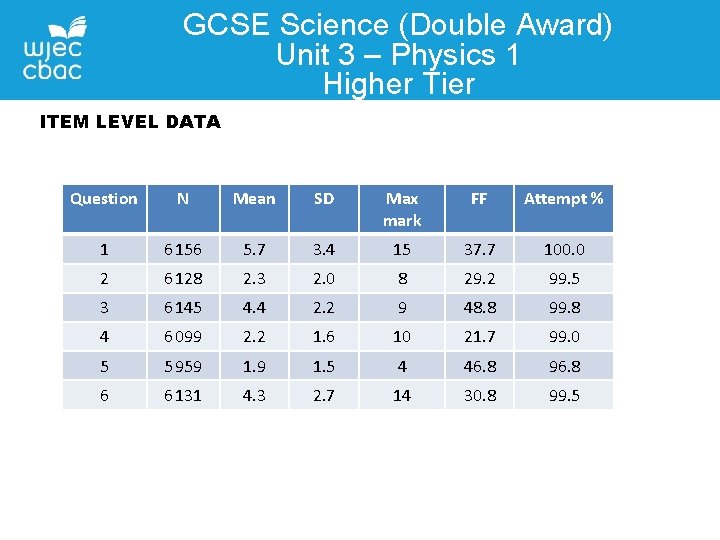
GCSE Science (Double Award) Unit 3 – Physics 1 Higher Tier ITEM LEVEL DATA Question N Mean SD Max mark FF Attempt % 1 6 156 5. 7 3. 4 15 37. 7 100. 0 2 6 128 2. 3 2. 0 8 29. 2 99. 5 3 6 145 4. 4 2. 2 9 48. 8 99. 8 4 6 099 2. 2 1. 6 10 21. 7 99. 0 5 5 959 1. 5 4 46. 8 96. 8 6 6 131 4. 3 2. 7 14 30. 8 99. 5
GENERAL COMMENTS FROM PRINCIPAL EXAMINER • Most candidates appeared to be correctly entered for the paper. • Pleasing to see how candidates coped with the open ended calculations and the different methods they adopted in their answers. • Two topics were badly answered - heat transfer and the reflection of wavefronts • Candidates need to read the questions carefully - often evidence of careless reading • Some candidates do not consider units when substituting values into an equation
GCSE Science (Double Award) Unit 3 – Physics 1 Higher Tier QUESTION 1 – common question (a) (i) Most candidates earned some credit for calculating a cost, however few made the correct conversions for power and time. Calculating the cost was generally well done, however a few thought that 90 minutes was equivalent to 1. 3 hours. (ii) There were a number of ways this question could have been answered. To gain full marks the 3 temperatures needed to be considered – sometimes this was not the case. A concluding statement was needed to access full marks. Some commented on the validity of the claim without any calculations so they earned zero. (iii) Only a minority earned any credit here. The question referred to saving energy so answers stating ‘less energy is used’ just repeated the question.
GCSE Science (Double Award) Unit 3 – Physics 1 Higher Tier QUESTION 1 ctd (b) (ii) Most candidates could state that the earth wire is a safety feature but unless qualified further no mark was awarded. A minority of candidates knew the particular fault associated with earth protection. A common misconception was that ‘extra electricity’ flows through the earth wire. (c) Those candidates that successfully answered the question chose one of three different routes. Candidates needed to add a final correct statement to earn the third mark. This was not always the case. Some candidates ignored the space for calculations and just gave a comment so were awarded zero.
GCSE Science (Double Award) Unit 3 – Physics 1 Higher Tier QUESTION 2 (a) (ii) This was an example where values were substituted into an equation regardless of their units. It was common to see the wave equation being used with 40 cm and 5 s being substituted as the wave speed (m/s) and wavelength (m) respectively. The answer of 8 Hz was then written on the answer line. (b) Responses were very poor. Many examples of refraction were seen even though ‘reflect’ was stated in the question. Even when reflection was shown, the reflected angle did not approximate to the incident angle. Other errors included wavefronts not being parallel or having a constant separation, which was equal to the separation of the incident wavefronts. A ruler should have been used.
GCSE Science (Double Award) Unit 3 – Physics 1 Higher Tier QUESTION 3 The best answered question on the paper! A specified practical. (a) The circuit diagrams were poor. Common errors were: - not including a cell or variable resistor; - joining cells together with incorrect polarity; - not including a lamp; - using square symbols for ammeters and voltmeters; - adding a voltmeter in series; - adding a voltmeter in parallel across something other than the lamp; - using a thermistor symbol instead of a variable resistor symbol; - omitting the arrow head from the variable resistor symbol. (b) (i) Most candidates gained two marks for their graph. The third mark was lost for a number of reasons e. g. incorrect scale on x-axis due to the omission of the value of 8. (ii) Most candidates earned credit for two correct calculations although not all gave a concluding statement.
GCSE Science (Double Award) Unit 3 – Physics 1 Higher Tier QUESTION 4 (a) (i) Very many incorrect facts were included with very low marks being awarded. If a mark was awarded it was either for stating aluminium is a good conductor or that u. PVC is an insulator. There were few references to particles and usually it was described that ‘when heated, particles begin to vibrate’ rather than vibrate more vigorously. There were even fewer references to free electrons transferring energy. (ii) The heat transfer methods of interest here were conduction and convection. These methods were often confused and statements such as ‘hot air convects through the ceiling’ were seen. (b) A common misconception seen was that the heat escaping from homes is a cause of global warming.
GCSE Science (Double Award) Unit 3 – Physics 1 Higher Tier QUESTION 5 (a) Many candidates obtained three marks here. A common error was reversing the two wavelength values. It is doubtful whether all candidates know the significance of the symbols > and < in front of a number. (b) Probably half of the candidates knew which end of the spectrum has more energy so were able to complete the column correctly.
GCSE Science (Double Award) Unit 3 – Physics 1 Higher Tier QUESTION 6 (a) QER question - there were three aspects that needed inclusion in the descriptions: the structure of the National Grid, how it provides reliability and also efficiency. Candidates tended to focus on the reliability aspect or the efficiency and not both. (b) (i) It was pleasing to see how many used the data. There were a number of different routes available to candidates to answer the question – generally it was well done. (ii) Candidates were required to select the only energy value from the information provided. This was not always successfully achieved. Many candidates failed in the required conversion. (iii) A full range of marks was awarded for identifying the correct statements.
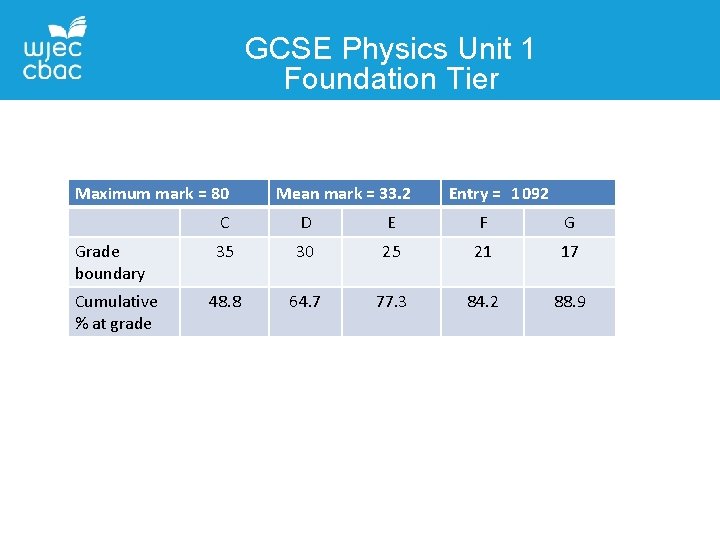
GCSE Physics Unit 1 Foundation Tier Maximum mark = 80 Grade boundary Cumulative % at grade Mean mark = 33. 2 Entry = 1 092 C D E F G 35 30 25 21 17 48. 8 64. 7 77. 3 84. 2 88. 9
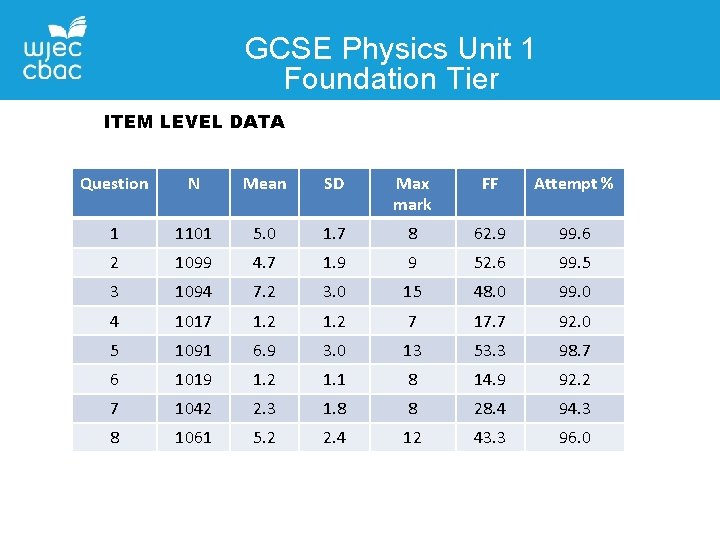
GCSE Physics Unit 1 Foundation Tier ITEM LEVEL DATA Question N Mean SD Max mark FF Attempt % 1 1 101 5. 0 1. 7 8 62. 9 99. 6 2 1 099 4. 7 1. 9 9 52. 6 99. 5 3 1 094 7. 2 3. 0 15 48. 0 99. 0 4 1 017 1. 2 7 17. 7 92. 0 5 1 091 6. 9 3. 0 13 53. 3 98. 7 6 1 019 1. 2 1. 1 8 14. 9 92. 2 7 1 042 2. 3 1. 8 8 28. 4 94. 3 8 1 061 5. 2 2. 4 12 43. 3 96. 0
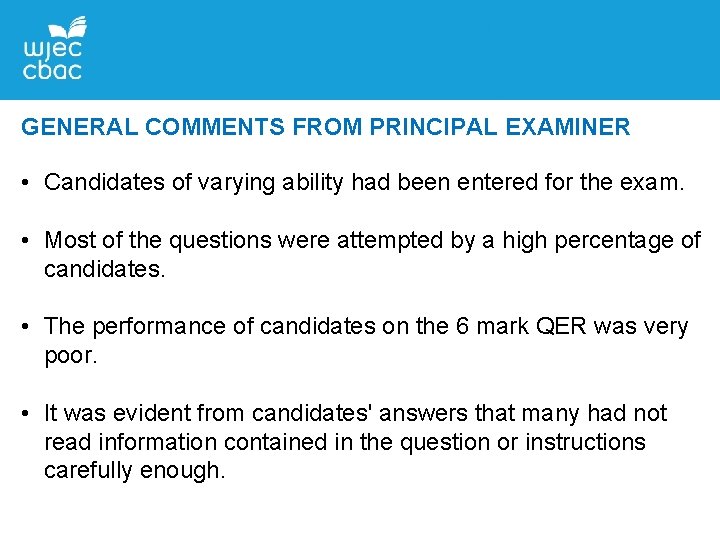
GENERAL COMMENTS FROM PRINCIPAL EXAMINER • Candidates of varying ability had been entered for the exam. • Most of the questions were attempted by a high percentage of candidates. • The performance of candidates on the 6 mark QER was very poor. • It was evident from candidates' answers that many had not read information contained in the question or instructions carefully enough.
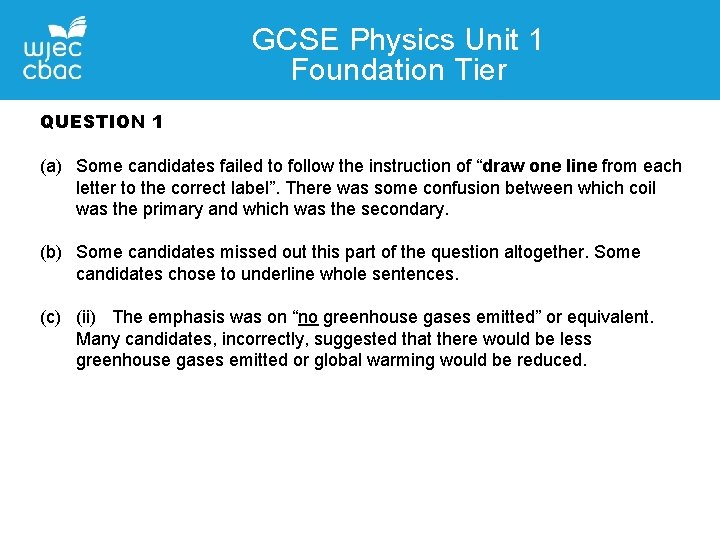
GCSE Physics Unit 1 Foundation Tier QUESTION 1 (a) Some candidates failed to follow the instruction of “draw one line from each letter to the correct label”. There was some confusion between which coil was the primary and which was the secondary. (b) Some candidates missed out this part of the question altogether. Some candidates chose to underline whole sentences. (c) (ii) The emphasis was on “no greenhouse gases emitted” or equivalent. Many candidates, incorrectly, suggested that there would be less greenhouse gases emitted or global warming would be reduced.
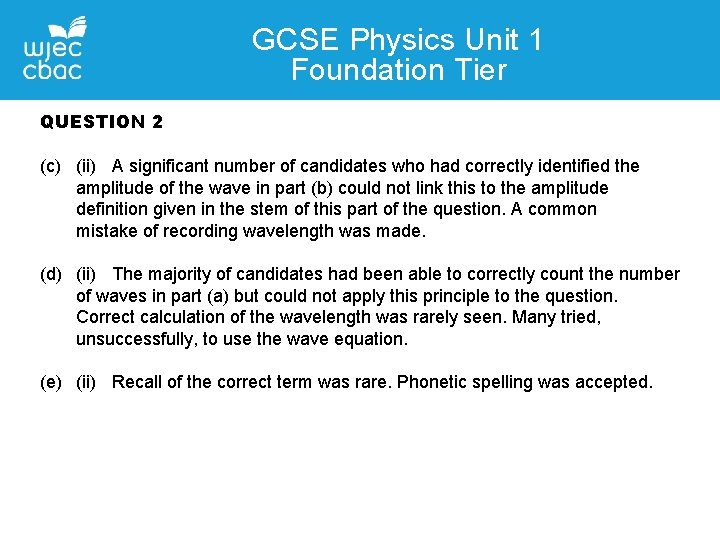
GCSE Physics Unit 1 Foundation Tier QUESTION 2 (c) (ii) A significant number of candidates who had correctly identified the amplitude of the wave in part (b) could not link this to the amplitude definition given in the stem of this part of the question. A common mistake of recording wavelength was made. (d) (ii) The majority of candidates had been able to correctly count the number of waves in part (a) but could not apply this principle to the question. Correct calculation of the wavelength was rarely seen. Many tried, unsuccessfully, to use the wave equation. (e) (ii) Recall of the correct term was rare. Phonetic spelling was accepted.
GCSE Physics Unit 1 Foundation Tier QUESTION 3 A practical based question (a) Candidates showed a good knowledge of the main circuit symbols. The variable resistor was the symbol that was correctly identified the least. Ampmeter and voltagemeter were frequently seen but not credited. (b) (ii) I. Many selected the correct current from the table. Only a minority of candidates could correctly do the conversion from m. A. (iii) The points were generally plotted well. The curve of best fit was often poorly drawn. (v) Many correctly recognised the basic relationship between current and voltage. Very few included “at an increasing rate” to earn a second mark. (vi) Very few identified the component correctly. Candidates failed to link the graph characteristics to a diode/LED.
GCSE Physics Unit 1 Foundation Tier QUESTION 4 A poorly answered question. A triple science topic only. Knowledge and application of the motor effect was displayed by few candidates. (a) (i) Few identified that the current carrying copper rod would produce a magnetic field. (ii) Only a minority of candidates realised that Fleming's left hand motor rule was needed. (iii) Generally, most candidates gained one of the marks on this part. However, some answers were unclear and vague. For example, “bigger magnet” was not credit worthy.
GCSE Physics Unit 1 Foundation Tier QUESTION 5 A high scoring question! (b) Generally well answered. However, there were a considerable number of candidates who failed to follow the instruction of identifying two statements. Sometimes there were more than two ticked, sometimes less. (c) (ii) An incorrect answer of 5 100 s was frequently recorded by some candidates. (d) (i) Substitution into the equation was generally good. Correct conversions into k. W was rarely seen. Many candidates did not even attempt to convert. (e) This required a straight forward substitution into the given latent heat equation. Many neglected to notice that the mass had been given in the stem of the question instead they used their calculated mass from (d)(ii).
GCSE Physics Unit 1 Foundation Tier QUESTION 6 Least well answered question! (a) QER question - secure knowledge of conduction, convection and radiation was rarely seen. Linking these processes to the labelled features was poorly carried out by candidates. There were few answers that reached middle band, even fewer were worthy of top band.
GCSE Physics Unit 1 Foundation Tier QUESTION 7 – common question A triple science topic only – seismic waves (a) (ii) Not many candidates attained full marks on this question as they neglected the need for a third station. The circles on the map were meant to guide or help candidates with their explanation. (c) The arrival time at T 1 was usually correct. However, many candidates struggled with the arrival time at T 2. Many candidates were unable to link the change in distance/diameter and its effect on the time of travel.
GCSE Physics Unit 1 Foundation Tier QUESTION 8 – common question Pisa style question – generally well answered (b) (i) Many candidates failed to describe three main features on the graph. The increase and decrease were frequently listed but the constant values from May to July were neglected. (c) (ii) Frequently a correct calculation was carried out by candidates. There were three methods possible. The award of a second mark could not be made unless they linked their answer to the claim. (d) (i) Some good attempts were made by candidates. Some tried an unnecessary conversion between pounds and pence.
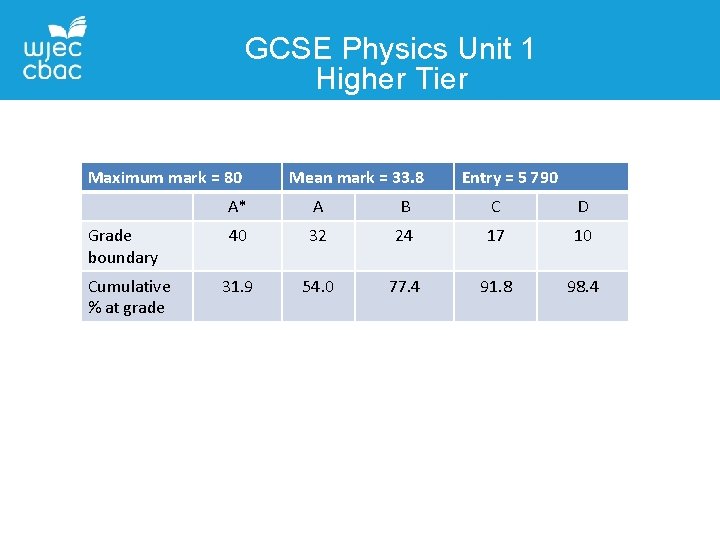
GCSE Physics Unit 1 Higher Tier Maximum mark = 80 Grade boundary Cumulative % at grade Mean mark = 33. 8 Entry = 5 790 A* A B C D 40 32 24 17 10 31. 9 54. 0 77. 4 91. 8 98. 4
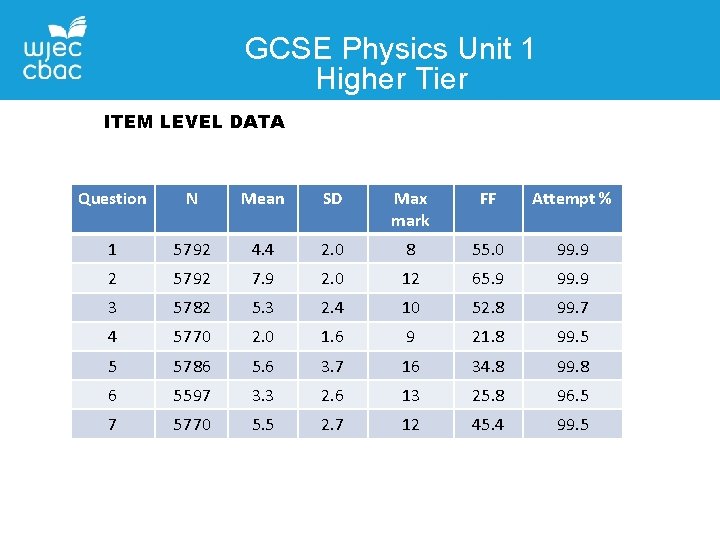
GCSE Physics Unit 1 Higher Tier ITEM LEVEL DATA Question N Mean SD Max mark FF Attempt % 1 5 792 4. 4 2. 0 8 55. 0 99. 9 2 5 792 7. 9 2. 0 12 65. 9 99. 9 3 5 782 5. 3 2. 4 10 52. 8 99. 7 4 5 770 2. 0 1. 6 9 21. 8 99. 5 5 5 786 5. 6 3. 7 16 34. 8 99. 8 6 5 597 3. 3 2. 6 13 25. 8 96. 5 770 5. 5 2. 7 12 45. 4 99. 5
GENERAL COMMENTS FROM PRINCIPAL EXAMINER • The fourth question proved to be the least popular on the paper with one aspect of the question dealing with heat transfer. • Handling numbers in equations, manipulating them and using numbers in standard form were all well done on the whole. • Candidates’ abilities to explain aspects of physics theory and apply them to new situations is in need of improvement.
GCSE Physics Unit 1 Higher Tier QUESTION 1 – common question Very similar comments as for the foundation tier (a) (ii) The candidates could apply their knowledge but had difficulty in explaining why three monitoring stations were required to actually locate it. (c) This was not answered at all well with just one mark being earned on average. The interval between the instant that the earthquake struck and the timing of the P and S waves at station A could not be explained as being halved to give their times of arrival at B. Of those who did find the times successfully, the explanation often omitted the “time interval” aspect of the answer.
GCSE Physics Unit 1 Higher Tier QUESTION 2 – common question (a) In this Pisa style question only one mark could be awarded to candidates who simply totalled the energy values given by the bars on the chart without stating that the claim was valid, based on their calculation. (b) (i) The general shape of the curves needed to be compared in some detail to earn the mark. (c) (ii) This was answered well but a comment was demanded to validate the claim for both marks to be awarded. (d) (i) Only about 50% of candidates could correctly subtract the two figures and multiply by 29 p to give the answer in pence. Many confused themselves by trying to work in £ and then convert back to pence (or not).
GCSE Physics Unit 1 Higher Tier QUESTION 3 A triple science only question (a) Very poorly answered - just how a transformer works is a mystery to most candidates. (b) (ii) Candidates are well advised to substitute the numbers into the transformer equation before trying to manipulate it. By attempting to do otherwise often results in the loss of both marks. Answers of thousands of volts applied to the toothbrush were not unusual! (iii) Given that the answer from the previous part now had to be brought into this part, the need to convert 100 m. A into amps produced a loss of one mark for failure to convert correctly. There were some interesting calculations which sometimes resulted in a toothbrush having a power that compared well to the output of a small power station!
GCSE Physics Unit 1 Higher Tier QUESTION 4 (a) (i) The function of the earth wire was not well understood – see the teacher guide. (ii) The advantages of an mcb were not well known – see the teacher guide. (iii) This was poorly answered. Candidates had to apply their knowledge by realising that the total current drawn by the three appliances was 24 A but there exists two routes for the current to get to and away from each socket. This means that neither cable should pass a current as large as anything approaching 21 A (in this simplified approach to the ring main). (b) Questions on heat transfer continue to be answered badly. However some very good answers were seen.
GCSE Physics Unit 1 Higher Tier QUESTION 5 Based on practical work (a) (i) A number of candidates failed to answer this part at all (they may not have seen it at the beginning of the question? ) (ii) The answers seen were usually at the standard of foundation tier candidate level. The fact that the current increases at a decreasing rate as the voltage increases was noted. (b) (i)-(iii) The calculations were either well done or marks were earned on the error-carried-forward principle. It was interesting to see how many candidates chose the more demanding route to find the total circuit resistance using the reciprocals of resistance relationship. Often they failed to invert the result of their calculation to get the final answer. (iv)-(vi) These parts were poorly answered.
GCSE Physics Unit 1 Higher Tier QUESTION 6 A triple science topic only (a) QER question - answers were very poor on the whole. Many failed to even recognise that latent heat is associated with change of state, let alone show any knowledge of bond breaking being involved in the processes. See the teacher guide. (b) (i) Many candidates could apply numbers to the equations to get answers of 200 million J and 288 million J but then they subtracted the two values. Very few knew how to relate the total energy to the power of the heater to come up with a time. There were very few complete, successful answers.
GCSE Physics Unit 1 Higher Tier QUESTION 7 (a) (i) Some candidates could not name the two missing parts of the em spectrum. (b) (i)-(ii) The light passing into the prism was incident on the side AB at 45 o. This simple geometrical fact was lost on many candidates who could state correct answers to part (b)(ii). So (b)(i) was answered poorly whereas (b)(ii) was answered well. (iii) The rather complex two stage calculation required in this part was done very well – except for failing to halve the final answer in many cases. Three marks out of the four were often awarded. (iv) Most candidates failed to relate the pulse interval to the return time of 2. 5626 s.
PHYSICS RESOURCES • Teacher guide – very useful for the new topics • Revision guides from Bangor University (Year 11 currently being produced) • Online exam review available for all of the Summer 17 units • New digital resources – Energy and electricity

Any Questions?
- Slides: 44