
Feedback National support for moderation Feedback is only
Feedback National support for moderation “Feedback is only successful if students use it to improve their performance. ” – Dylan Wiliam
Aims • Explore and understand the importance of feedback • Identify key features of effective, high quality feedback • Engage in professional dialogue through reflective questions • Evaluate existing practice and identify areas for improvement
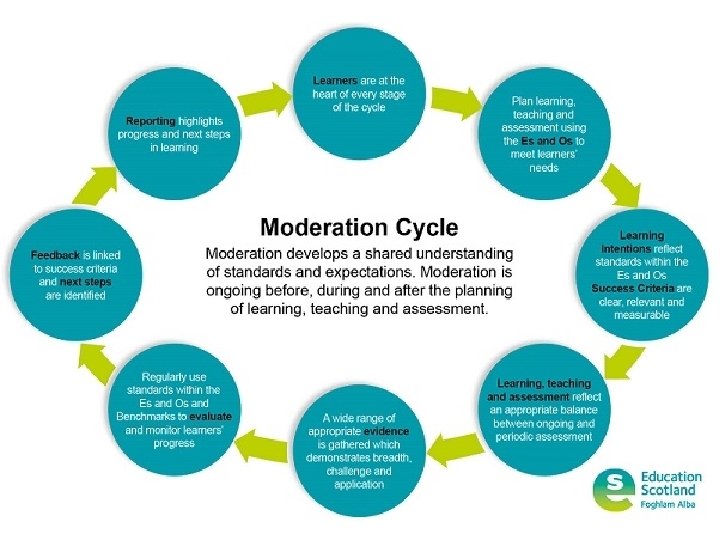
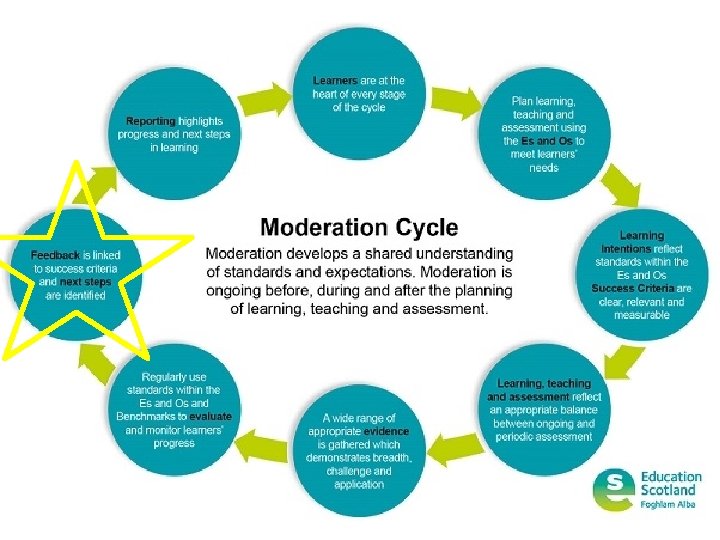
Moderation • Moderation is an ongoing process. • It is not the same as cross-marking (colleagues marking the same piece of work to ensure it is accurately marked) or verification (the process to make sure that centres' assessment decisions are valid, reliable and in line with national standards) though these three areas do overlap. • Effective moderation is where teachers work together to: • plan learning, teaching and assessment • review evidence of learners’ progress and achievement • plan next steps in learning.
Feedback Workshop activities You will need: • Board paper • Pen(s)
Discussion Questions - Feedback • How do you provide feedback to your pupils? • What are the common issues affecting the quality of feedback in your context? • How do you make use of feedback? • Which do you find more effective – written or verbal feedback? Why?
Why is feedback important? What are the key features of effective feedback? (8 minutes to discuss)
Why is feedback important? • Ensures learners are clear about what they have done well • Provides areas for improvement • Ensures learners are engaged in high quality interactions throughout the learning process • Supports learners when target setting/profiling/personal learning planning • Ensures appropriate, pace, progression and challenge • Ensures practitioners are clear about areas for further development within short and longer term planning
What are the key features of effective feedback? Based on a set of clear and measurable Success Criteria Clearly states areas of strength and next steps Age and stage appropriate Involves both quality dialogue and/or written comments • Appropriately timed and based on observation of learning • Based on learner progress both in the short term and over a longer period of time • •
What are the key features of effective feedback? Helpful to the learner Tailored to the individual learner Agreed together with the learner Focused and manageable Give clear indication of both what and how the learner can move forward • Focused on aspects of learning the learner will have the opportunity to take forward in the near future • • •
‘We observe learners closely to inform appropriate and well-timed interventions and future learning. We use feedback effectively to inform and support progress in learning. ’ (HGIOS 4 2. 3 Learning, Teaching and Assessment: Level 5 illustration - Quality of Teaching) tea
‘Learners receive high-quality feedback and have an accurate understanding of their progress in learning and what they need to do to improve’ ‘Learners are able to give effective feedback to peers on their learning and suggest ways in which they can improve’ (HGIOS 4 2. 3 Learning, Teaching and Assessment Features of highly effective practice: Quality of Teaching)
‘Children and young people value the professional advice and expertise of school staff and others who support their learning and decision-making. They actively engage in communication and discussions about their next steps and contribute to planning learning pathways which meet their needs and aspirations. ’ (HGIOS 4 QI 1. 2 Leadership of Learning Level 5 illustration: Children and young people leading learning)
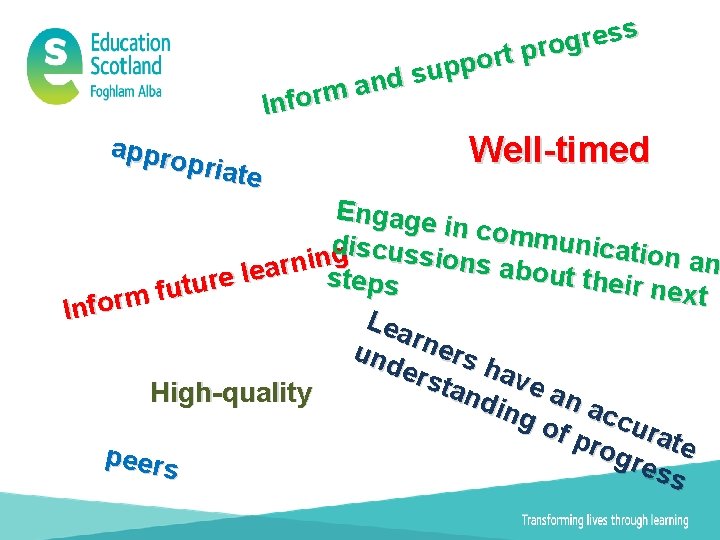
s s e r g o r p t r po p u s d n a m Infor appro priate Well-timed Engage in comm u d nication i s c u s g s i n ons abo and ni s r a e l u t their n e t e r p u s t u ext f m r o f In Lea und rners hav ers ea tan High-quality na din ccu go rate f pr ogr peers ess
“Good feedback causes thinking” https: //glowscotland. sharepoint. com/portals/hub/_layouts/15/Point. Publishing. aspx? app=video&p=p&chid=01 e 457 d 7 -d 42 d-458 c-9 cf 5 ec 8 de 2 ec 11 c 4&vid=e 8 e 948 da-b 3 d 3 -4383 -adb 3 -90 fb 0 d 359143
Common issues with feedback… • Feedback focused solely on completion of task or score achieved without comments • “Ego-involving” feedback • Feedback focused solely on ‘right or wrong’ rather than process • Feedback and next steps which don’t refer to the intended focus for learning • ‘Generic’ feedback focused solely on effort, not specific or including references to learning and Success Criteria • Can be difficult for pupils to access • Difficult to ensure high quality peer feedback • Very time consuming • Comes at the end of learning and is not acted upon
Common issues with feedback… • Feedback focused solely on completion of task or score achieved without comments • “Ego-involving” feedback • Feedback focused solely on ‘right or wrong’ rather than process • Feedback and next steps which don’t refer to the intended focus for learning • ‘Generic’ feedback focused solely on effort, not specific or including references to learning and Success Criteria • Can be difficult for pupils to access • Difficult to ensure high quality peer feedback • Very time consuming • Comes at the end of learning and is not acted upon
How do you give learners time and opportunity to reflect and act on feedback?
Building feedback into day learning: • Mid-lesson reviews using Success Criteria • Sharing examples of work mid-lesson (Modelling Review) • Plenary sessions • Effective questioning and interventions during lessons • Discussions and verbal feedback • Giving time to respond to written and verbal feedback from previous lesson at the start of the next lesson • Opportunities for learners to engage in self and peer assessment
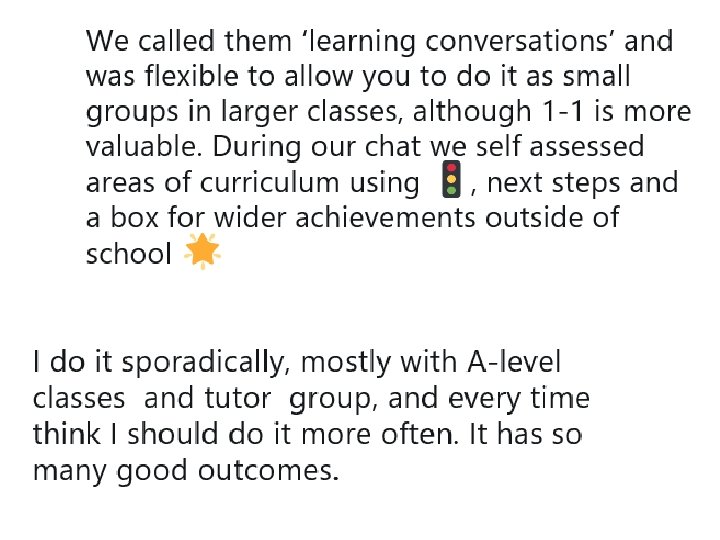
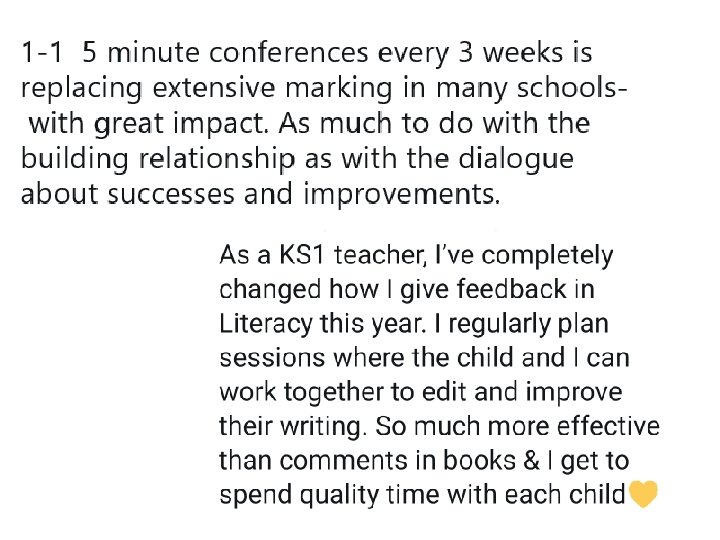
Building feedback into longer term learning: • Planned opportunities to reflect on learning over time • One to one planned learning conversations • Personal Learning Planning • Use of Learning Logs or Journals • Profiling Feedback can be given by the practitioner or learners.
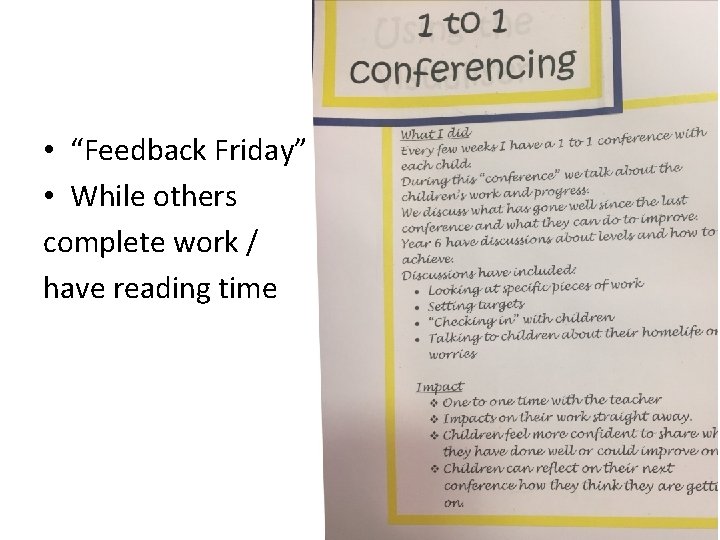
• “Feedback Friday” • While others complete work / have reading time
How do you ensure peer feedback is effective?
Effective Peer Feedback • Consistently modelled by teacher – ensure pupils are familiar with basing comment on SC, using two stars and a wish, being very specific… • Giving pupils a clear structure to follow – a checklist • Having pupils discuss work together (Self and United Improvements; as a whole class when Discussing Excellence) • Giving opportunities for all pupils to see everyone’s work – by having them move around the room with post its for example
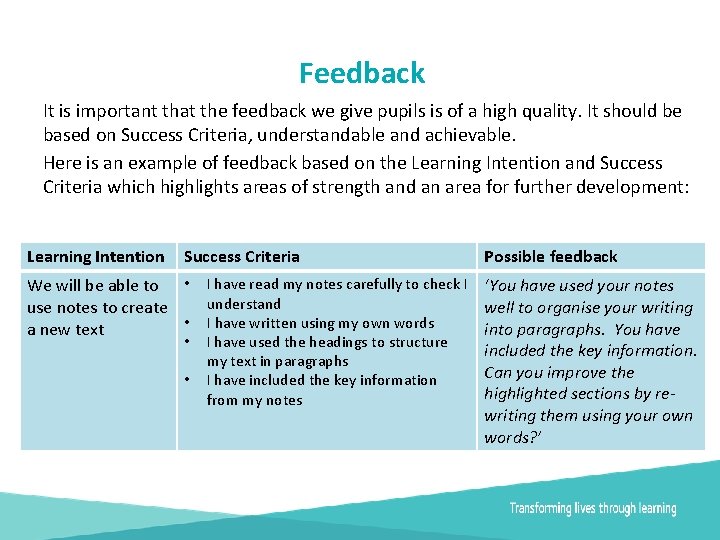
Feedback It is important that the feedback we give pupils is of a high quality. It should be based on Success Criteria, understandable and achievable. Here is an example of feedback based on the Learning Intention and Success Criteria which highlights areas of strength and an area for further development: Learning Intention Success Criteria Possible feedback We will be able to • I have read my notes carefully to check I ‘You have used your notes understand use notes to create well to organise your writing • I have written using my own words a new text into paragraphs. You have • I have used the headings to structure included the key information. my text in paragraphs Can you improve the • I have included the key information highlighted sections by refrom my notes writing them using your own words? ’
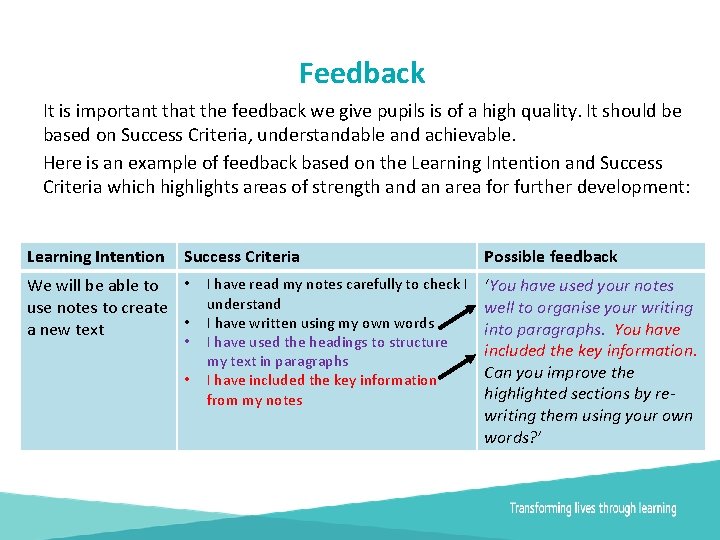
Feedback It is important that the feedback we give pupils is of a high quality. It should be based on Success Criteria, understandable and achievable. Here is an example of feedback based on the Learning Intention and Success Criteria which highlights areas of strength and an area for further development: Learning Intention Success Criteria Possible feedback We will be able to • I have read my notes carefully to check I ‘You have used your notes understand use notes to create well to organise your writing • I have written using my own words a new text into paragraphs. You have • I have used the headings to structure included the key information. my text in paragraphs Can you improve the • I have included the key information highlighted sections by refrom my notes writing them using your own words? ’
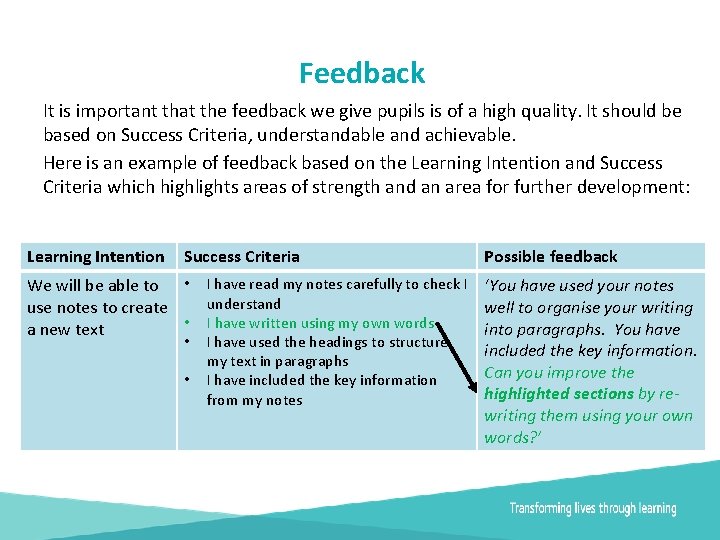
Feedback It is important that the feedback we give pupils is of a high quality. It should be based on Success Criteria, understandable and achievable. Here is an example of feedback based on the Learning Intention and Success Criteria which highlights areas of strength and an area for further development: Learning Intention Success Criteria Possible feedback We will be able to • I have read my notes carefully to check I ‘You have used your notes understand use notes to create well to organise your writing • I have written using my own words a new text into paragraphs. You have • I have used the headings to structure included the key information. my text in paragraphs Can you improve the • I have included the key information highlighted sections by refrom my notes writing them using your own words? ’
Moderation questions The following slide contains some examples of questions that could be used when moderating feedback.
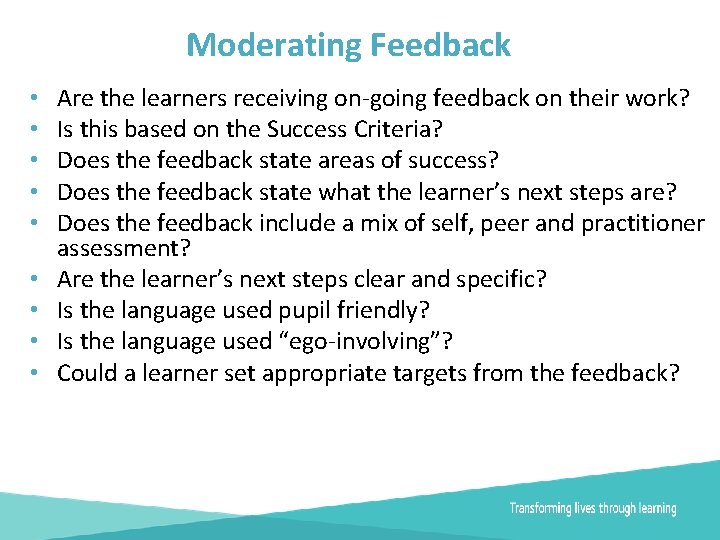
Moderating Feedback • • • Are the learners receiving on-going feedback on their work? Is this based on the Success Criteria? Does the feedback state areas of success? Does the feedback state what the learner’s next steps are? Does the feedback include a mix of self, peer and practitioner assessment? Are the learner’s next steps clear and specific? Is the language used pupil friendly? Is the language used “ego-involving”? Could a learner set appropriate targets from the feedback?
Workshop activities You will need: • A pen and an activity sheet
Feedback Activity 1 1. Look at the feedback comments on the next slide 2. Discuss with colleagues any issues you see with the feedback 3. Look at the comments on the following slide. Do you agree with them?
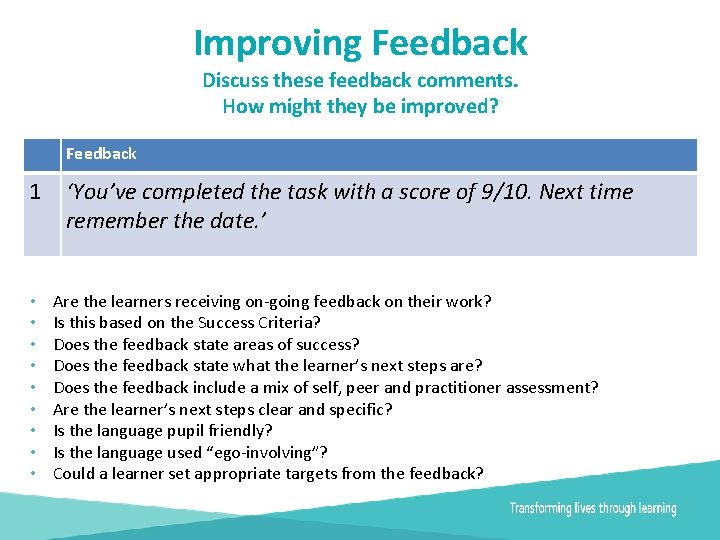
Improving Feedback Discuss these feedback comments. How might they be improved? Feedback 1 • • • ‘You’ve completed the task with a score of 9/10. Next time remember the date. ’ Are the learners receiving on-going feedback on their work? Is this based on the Success Criteria? Does the feedback state areas of success? Does the feedback state what the learner’s next steps are? Does the feedback include a mix of self, peer and practitioner assessment? Are the learner’s next steps clear and specific? Is the language pupil friendly? Is the language used “ego-involving”? Could a learner set appropriate targets from the feedback?
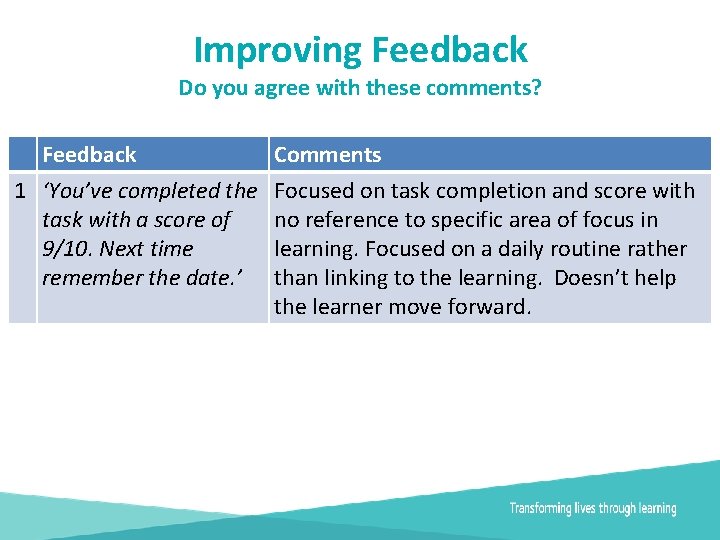
Improving Feedback Do you agree with these comments? Feedback 1 ‘You’ve completed the task with a score of 9/10. Next time remember the date. ’ Comments Focused on task completion and score with no reference to specific area of focus in learning. Focused on a daily routine rather than linking to the learning. Doesn’t help the learner move forward.
Feedback Activity 2 1. Look at the rest of the feedback comments on your sheet 2. Discuss with colleagues any issues you see with the feedback, using the moderation questions to help
Moderating Feedback • • • Are the learners receiving on-going feedback on their work? Is this based on the Success Criteria? Does the feedback state areas of success? Does the feedback state what the learner’s next steps are? Does the feedback include a mix of self, peer and practitioner assessment? Are the learner’s next steps clear and specific? Is the language pupil friendly? Is the language used “ego-involving”? Could a learner set appropriate targets from the feedback?
Feedback Activity 3 1. Look at the comments on the following slides. Do you agree with them?
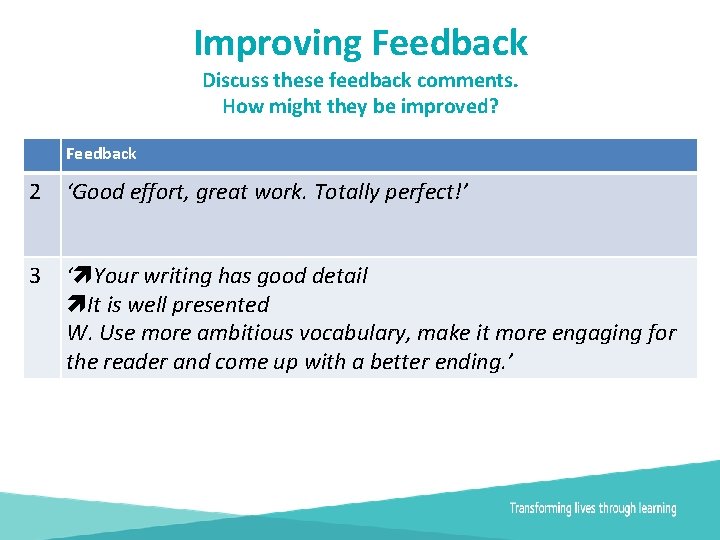
Improving Feedback Discuss these feedback comments. How might they be improved? Feedback 2 ‘Good effort, great work. Totally perfect!’ 3 ‘ Your writing has good detail It is well presented W. Use more ambitious vocabulary, make it more engaging for the reader and come up with a better ending. ’
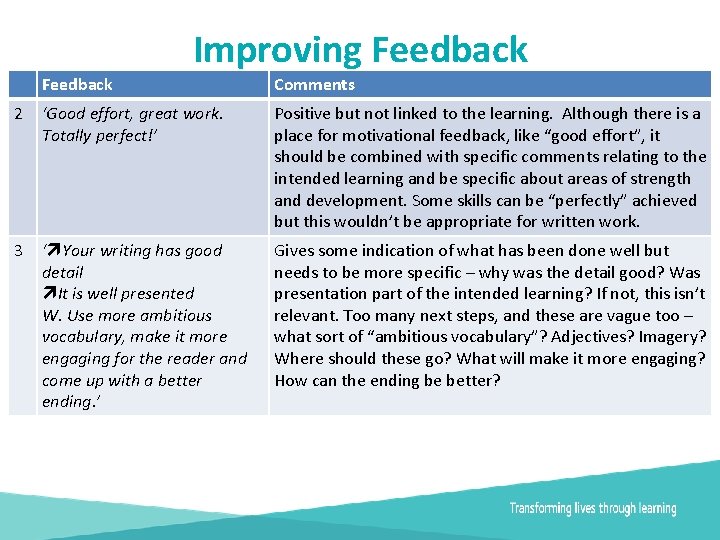
Improving Feedback Comments Do you agree with these comments? 2 ‘Good effort, great work. Totally perfect!’ Positive but not linked to the learning. Although there is a place for motivational feedback, like “good effort”, it should be combined with specific comments relating to the intended learning and be specific about areas of strength and development. Some skills can be “perfectly” achieved but this wouldn’t be appropriate for written work. 3 ‘ Your writing has good detail It is well presented W. Use more ambitious vocabulary, make it more engaging for the reader and come up with a better ending. ’ Gives some indication of what has been done well but needs to be more specific – why was the detail good? Was presentation part of the intended learning? If not, this isn’t relevant. Too many next steps, and these are vague too – what sort of “ambitious vocabulary”? Adjectives? Imagery? Where should these go? What will make it more engaging? How can the ending be better?
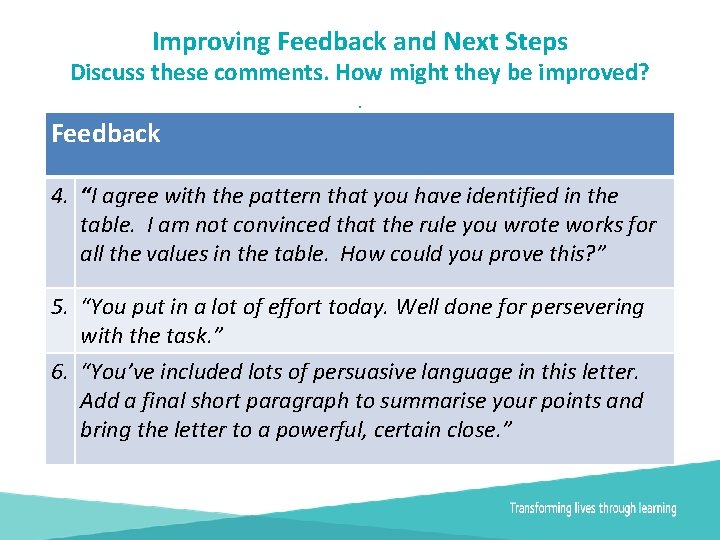
Improving Feedback and Next Steps Discuss these comments. How might they be improved? . Feedback 4. “I agree with the pattern that you have identified in the table. I am not convinced that the rule you wrote works for all the values in the table. How could you prove this? ” 5. “You put in a lot of effort today. Well done for persevering with the task. ” 6. “You’ve included lots of persuasive language in this letter. Add a final short paragraph to summarise your points and bring the letter to a powerful, certain close. ”
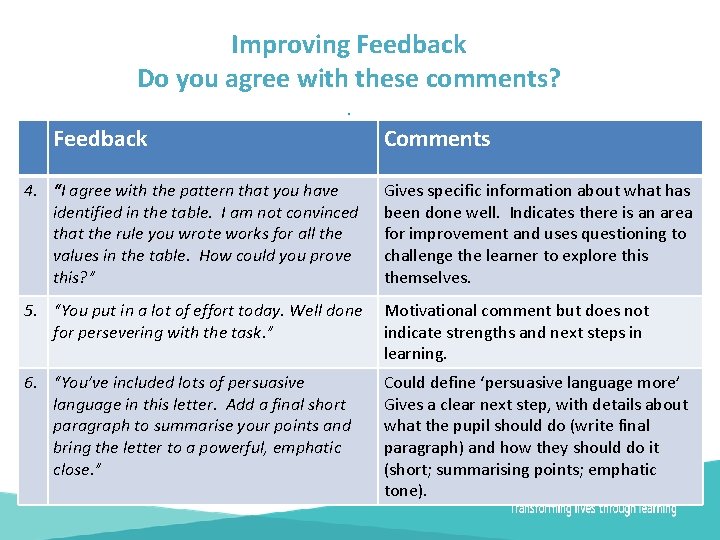
Improving Feedback Do you agree with these comments? . Feedback Comments 4. “I agree with the pattern that you have identified in the table. I am not convinced that the rule you wrote works for all the values in the table. How could you prove this? ” Gives specific information about what has been done well. Indicates there is an area for improvement and uses questioning to challenge the learner to explore this themselves. 5. “You put in a lot of effort today. Well done for persevering with the task. ” Motivational comment but does not indicate strengths and next steps in learning. 6. “You’ve included lots of persuasive language in this letter. Add a final short paragraph to summarise your points and bring the letter to a powerful, emphatic close. ” Could define ‘persuasive language more’ Gives a clear next step, with details about what the pupil should do (write final paragraph) and how they should do it (short; summarising points; emphatic tone).
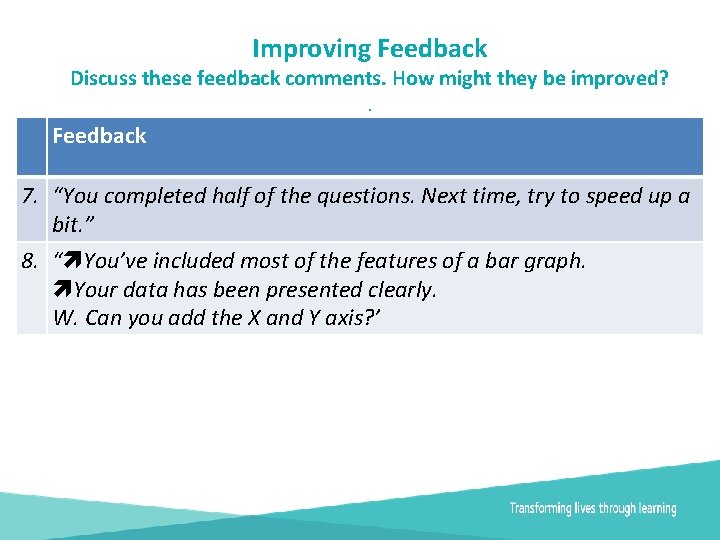
Improving Feedback Discuss these feedback comments. How might they be improved? . Feedback 7. “You completed half of the questions. Next time, try to speed up a bit. ” 8. “ You’ve included most of the features of a bar graph. Your data has been presented clearly. W. Can you add the X and Y axis? ’
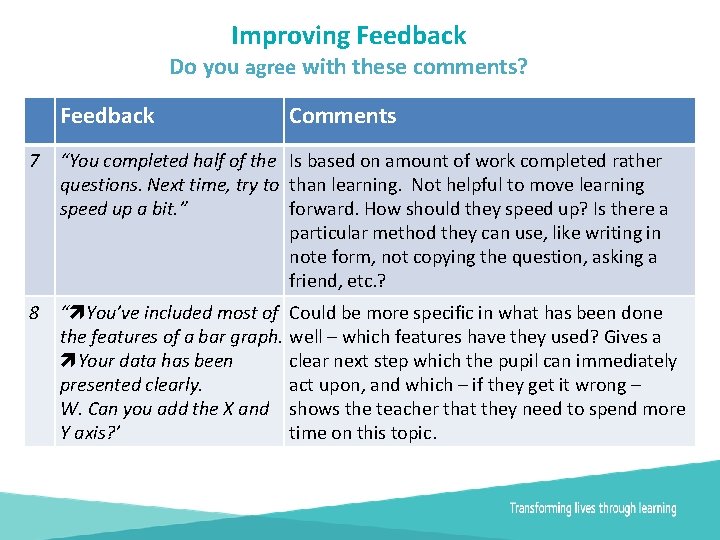
Improving Feedback Do you agree with these comments? Feedback . Comments 7 “You completed half of the Is based on amount of work completed rather questions. Next time, try to than learning. Not helpful to move learning speed up a bit. ” forward. How should they speed up? Is there a particular method they can use, like writing in note form, not copying the question, asking a friend, etc. ? 8 “ You’ve included most of the features of a bar graph. Your data has been presented clearly. W. Can you add the X and Y axis? ’ Could be more specific in what has been done well – which features have they used? Gives a clear next step which the pupil can immediately act upon, and which – if they get it wrong – shows the teacher that they need to spend more time on this topic.
Feedback Activity 4 • Look at some evidence with feedback and next steps from your own context • Use the moderation questions on the next slide to discuss the feedback and next steps • Make notes on your post its about your feedback – what are its strengths, and is there anything you could improve?
Moderating Feedback • • • Are the learners receiving on-going feedback on their work? Is this based on the Success Criteria? Does the feedback state areas of success? Does the feedback state what the learner’s next steps are? Does the feedback include a mix of self, peer and practitioner assessment? Are the learner’s next steps clear and specific? Is the language pupil friendly? Is the language used “ego-involving”? Could a learner set appropriate targets from the feedback?
Reflective Questions • The following reflective questions are designed to promote professional dialogue
Reflective Questions - Feedback • Do you make use of Success Criteria when providing feedback? • Do you give pupils specific, targeted advice on how to improve their work? • Do you give pupils an opportunity to act on the feedback they have received as soon as possible? • Do you provide opportunities for peer assessment? • Do your pupils base their targets on feedback provided? • Do you use the feedback you provide as a basis for your ongoing planning?
Next Steps… • Aim to incorporate in lesson feedback the next time your class are working on a task • Consider the next batch of marking you plan to do – can you give feedback in a more meaningful, simple manner? • When next marking pupil work, consider the moderation questions we have looked at today • Take part in lesson observations which focus on in lesson feedback
- Slides: 49