
Feedback Loops feedback loops manage homeostasis in the
Feedback Loops -feedback loops manage homeostasis in the body through the nervous system -negative feedback is the regulating of a system so that it doesn’t stray too far in one direction ex: a thermostat that regulates temperature if it gets too hot or too cold An example of negative feedback: -Fat cells produce the hormone leptin when they become filled -Leptin is carried by the blood to the brain where it acts to inhibit the appetite center -When fat reserves diminish, the concentration of leptin decreases which causes the appetite center in the brain to start the hunger stimulus and activate the urge to eat.
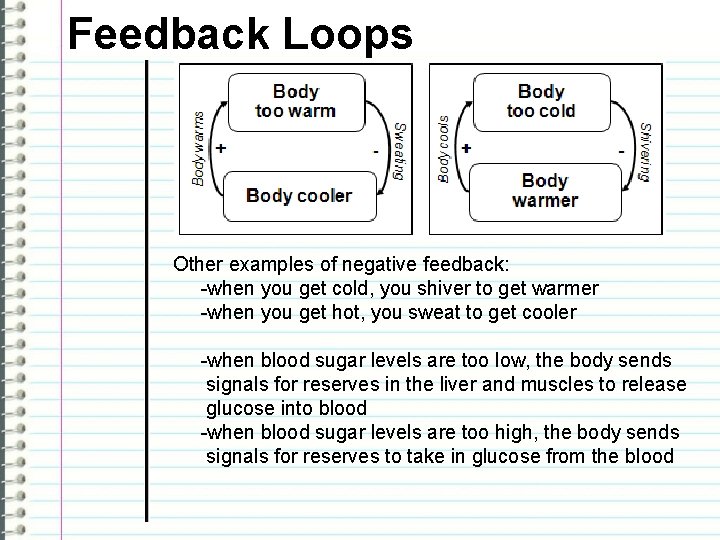
Feedback Loops Other examples of negative feedback: -when you get cold, you shiver to get warmer -when you get hot, you sweat to get cooler -when blood sugar levels are too low, the body sends signals for reserves in the liver and muscles to release glucose into blood -when blood sugar levels are too high, the body sends signals for reserves to take in glucose from the blood
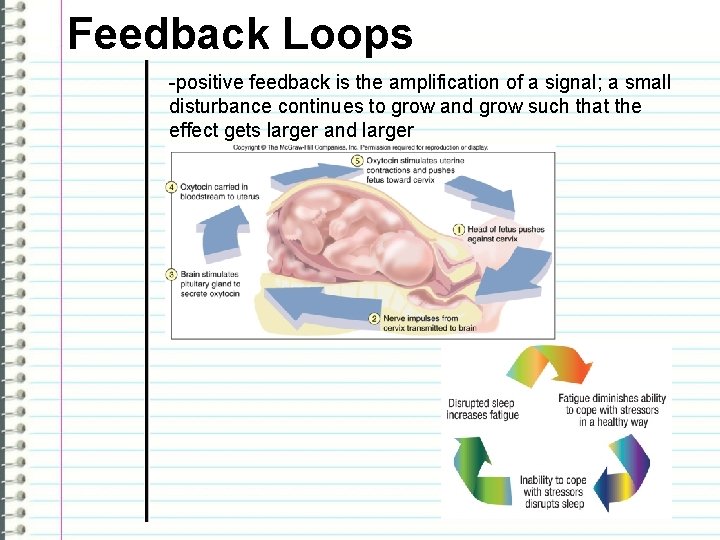
Feedback Loops -positive feedback is the amplification of a signal; a small disturbance continues to grow and grow such that the effect gets larger and larger
Feedback Loops -Systems that regulate homeostasis: -Pancreas secretes insulin that manages blood sugar levels -Thyroid gland secretes thyroxine that manages metabolism -Pituitary gland (controlled by the hypothalamus) secretes many different hormones that serve various purposes: -growth -sex organ function -pregnancy and child birth -and more! -Adrenal glands secretes adrenaline manages fightor-flight response
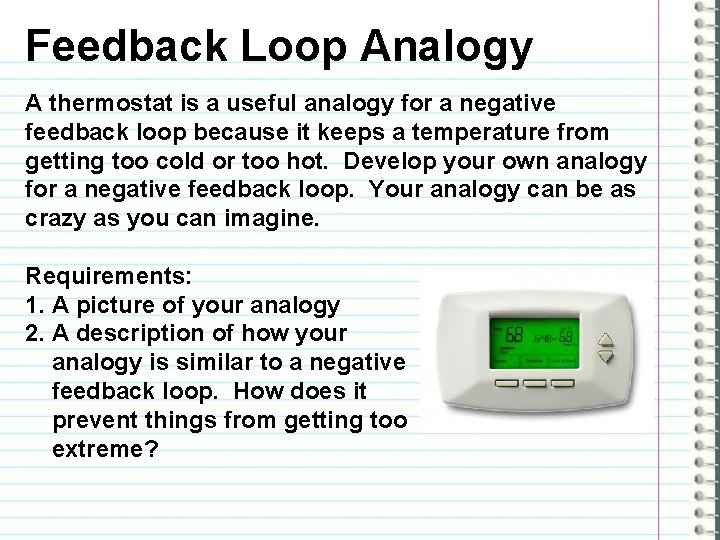
Feedback Loop Analogy A thermostat is a useful analogy for a negative feedback loop because it keeps a temperature from getting too cold or too hot. Develop your own analogy for a negative feedback loop. Your analogy can be as crazy as you can imagine. Requirements: 1. A picture of your analogy 2. A description of how your analogy is similar to a negative feedback loop. How does it prevent things from getting too extreme?
- Slides: 5