
Feedback in Clinical Supervision Lois A Ehrmann MA
Feedback in Clinical Supervision Lois A. Ehrmann MA, LPC/ACS, CAC/CCS- Diplomate Counseling Alternatives Group 444 East College Avenue, Suite 460 State College, PA 16801 (814) 231 -0940 1
In TWO hours or less, we will discuss…… ► Assumptions about counselor development and clinical supervision ► IDM of Clinical Supervision ► Feedback Matching to Counselor Development ► Formative versus Summative Feedback ► Feedback within a Positive Supervisory Environment ► Formative Feedback ► Small Group Exercises and Closure 2
Assumptions 3 l Counselors are…. l The self as a therapeutic tool l Personal and professional development l Clinical Supervision should be life long
Important Issues for Supervision 1. Personal issues 2. When should they be discussed? 3. Changing nature of supervision based on developmental stage 4. Structure and methods of feedback may need to change over time too. 4
The Integrated Developmental Model of Supervision (Stoltenberg, Mc Neill & Delworth, 1998 u Three movements across development: motivation, autonomy and awareness u Domains of counseling: assessment, diagnostics, conceptualization, treatment goals and implementation of interventions u Review the chart 5
Feedback for the Level 1 Counselor ¡ Establishing structure ¡ Clear communication of expectations ¡ Encouragement and affirmation ¡ Specific recommendations of strategies ¡ Encouragement to link theory to strategies selected ¡ Late Level 1 challenges or confrontations 6
Feedback for the Level 2 Counselor l l l Supervisors must be very flexible Balance between direct guidance and counselor autonomy Expressions of care and support Disclosure of past failures or difficult times Rationales and conceptualizations Increase catalytic interventions 7
Feedback for the Level 3 Counselor n n n Affirmation and support are needed but are less crucial Challenges to the counselors thinking and affective responses to clients Catalytic responses if counselor gets stuck in a client counselor situation 8
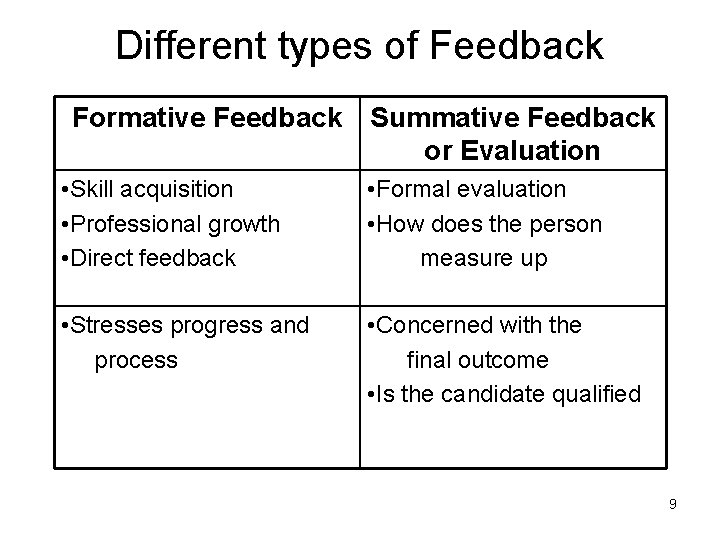
Different types of Feedback Formative Feedback Summative Feedback or Evaluation • Skill acquisition • Professional growth • Direct feedback • Formal evaluation • How does the person measure up • Stresses progress and process • Concerned with the final outcome • Is the candidate qualified 9
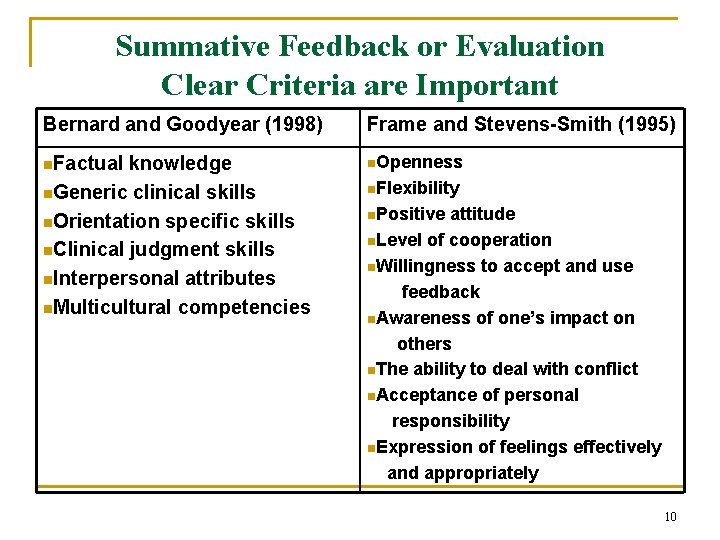
Summative Feedback or Evaluation Clear Criteria are Important Bernard and Goodyear (1998) Frame and Stevens-Smith (1995) n. Factual n. Openness knowledge n. Generic clinical skills n. Orientation specific skills n. Clinical judgment skills n. Interpersonal attributes n. Multicultural competencies n. Flexibility n. Positive attitude n. Level of cooperation n. Willingness to accept and use feedback n. Awareness of one’s impact on others n. The ability to deal with conflict n. Acceptance of personal responsibility n. Expression of feelings effectively and appropriately 10
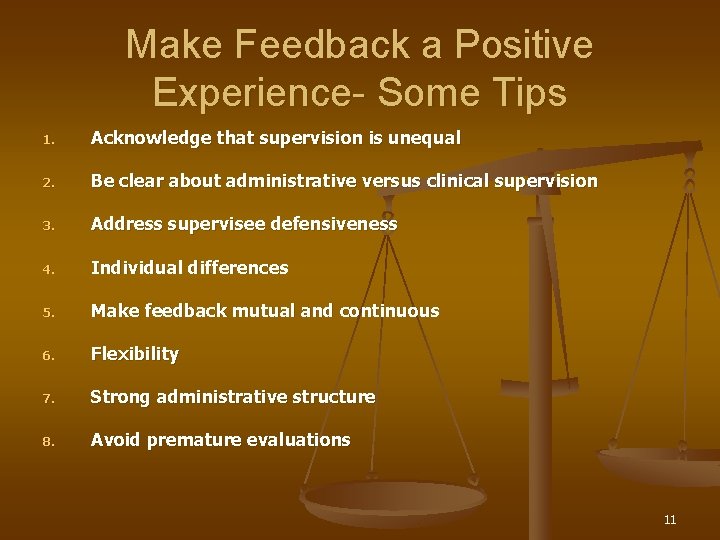
Make Feedback a Positive Experience- Some Tips 1. Acknowledge that supervision is unequal 2. Be clear about administrative versus clinical supervision 3. Address supervisee defensiveness 4. Individual differences 5. Make feedback mutual and continuous 6. Flexibility 7. Strong administrative structure 8. Avoid premature evaluations 11
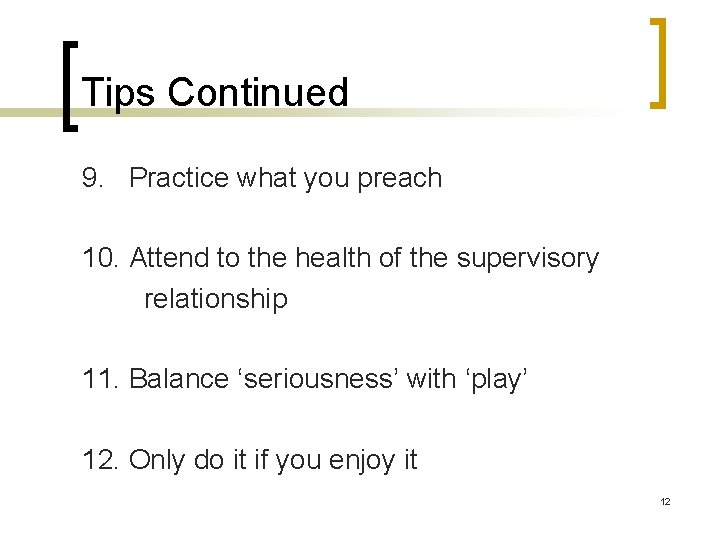
Tips Continued 9. Practice what you preach 10. Attend to the health of the supervisory relationship 11. Balance ‘seriousness’ with ‘play’ 12. Only do it if you enjoy it 12
Always Remember “Whenever a trainee (or counseling professional) is denied appropriate supervision and evaluation, the professional community is diminished. ” (Bernard and Goodyear, 1998) 13
Formative Feedback It’s an ongoing interactional process You cannot NOT communicate because even when you say nothing you are communicating something! Any communication to another person contains both (A) a message about the relationship and (B) a message about some particular content. 14
Interactional Process Example Cn: “I had a difficult silent moment with this client we have been talking about. He was really angry at me and I had trouble figuring out what to do. I thought…. ” Sp: (interrupting the CN): Excuse me for interrupting but I need to get some clarity here first. The client was angry at you or someone else or…. -----------------------------------------------What are the possible relationship messages of the Cn to the SP and the SP to the CN? What are the content messages? 15
Tips for Formative Feedback Focus on changeable behaviors Offer criticism as an opinion Separate personal feelings out Steer away from accusatory comments or ultimatums 16
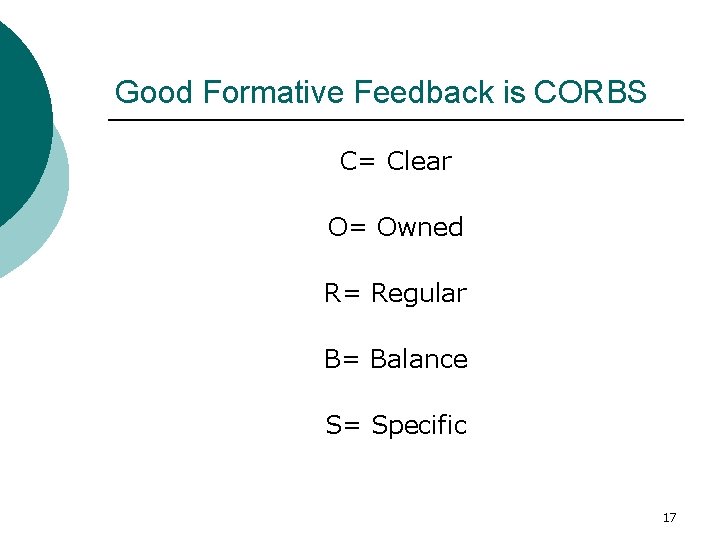
Good Formative Feedback is CORBS C= Clear O= Owned R= Regular B= Balance S= Specific 17
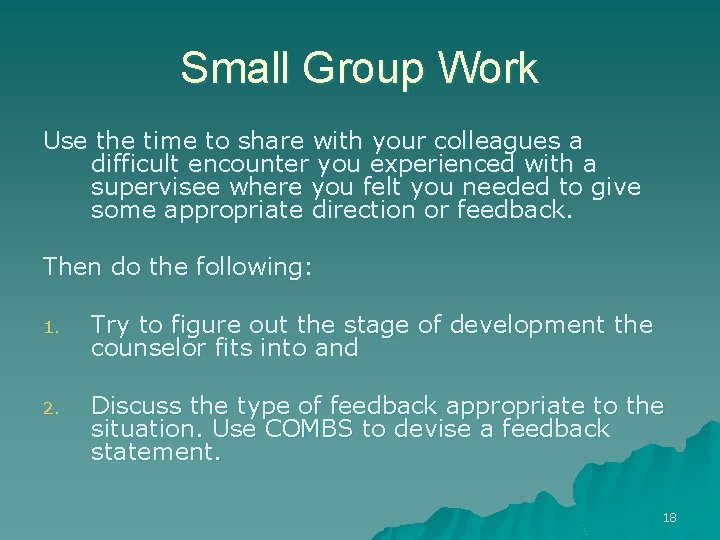
Small Group Work Use the time to share with your colleagues a difficult encounter you experienced with a supervisee where you felt you needed to give some appropriate direction or feedback. Then do the following: 1. Try to figure out the stage of development the counselor fits into and 2. Discuss the type of feedback appropriate to the situation. Use COMBS to devise a feedback statement. 18
Closure • How did it go? • Anything new learned that could help in future supervision sessions? • References • Thanks for joining me today for this workshop! 19
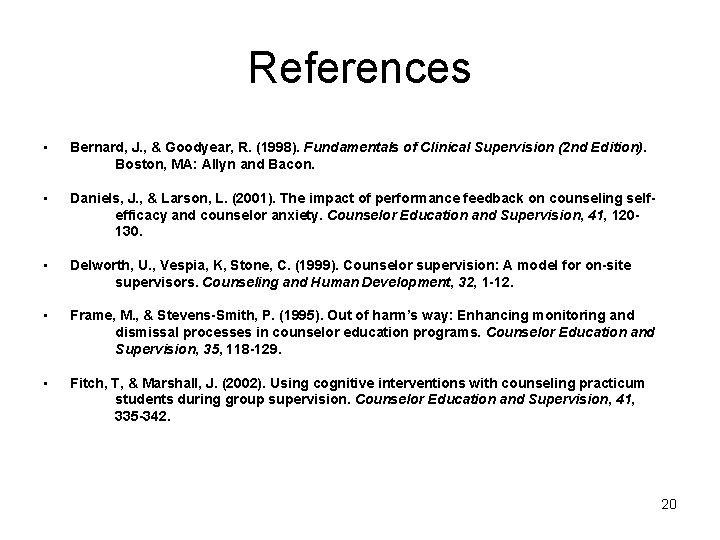
References • Bernard, J. , & Goodyear, R. (1998). Fundamentals of Clinical Supervision (2 nd Edition). Boston, MA: Allyn and Bacon. • Daniels, J. , & Larson, L. (2001). The impact of performance feedback on counseling selfefficacy and counselor anxiety. Counselor Education and Supervision, 41, 120130. • Delworth, U. , Vespia, K, Stone, C. (1999). Counselor supervision: A model for on-site supervisors. Counseling and Human Development, 32, 1 -12. • Frame, M. , & Stevens-Smith, P. (1995). Out of harm’s way: Enhancing monitoring and dismissal processes in counselor education programs. Counselor Education and Supervision, 35, 118 -129. • Fitch, T, & Marshall, J. (2002). Using cognitive interventions with counseling practicum students during group supervision. Counselor Education and Supervision, 41, 335 -342. 20
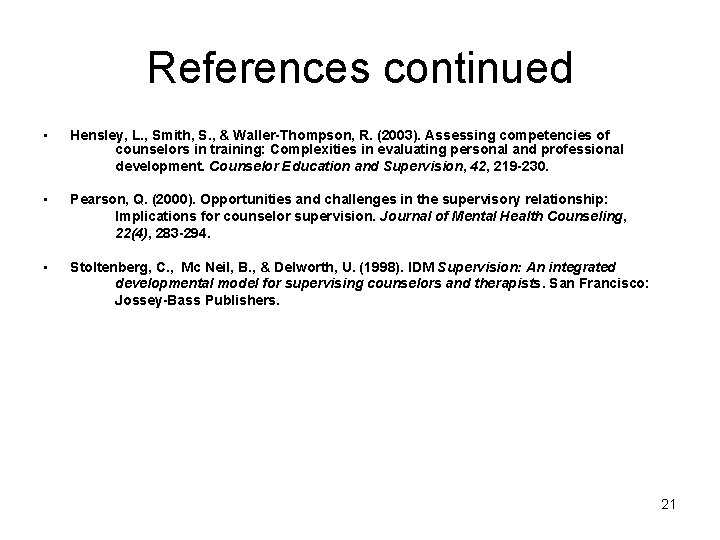
References continued • Hensley, L. , Smith, S. , & Waller-Thompson, R. (2003). Assessing competencies of counselors in training: Complexities in evaluating personal and professional development. Counselor Education and Supervision, 42, 219 -230. • Pearson, Q. (2000). Opportunities and challenges in the supervisory relationship: Implications for counselor supervision. Journal of Mental Health Counseling, 22(4), 283 -294. • Stoltenberg, C. , Mc Neil, B. , & Delworth, U. (1998). IDM Supervision: An integrated developmental model for supervising counselors and therapists. San Francisco: Jossey-Bass Publishers. 21
- Slides: 21