
Feedback Control Systems FCS Lecture1 2 Introduction to
Feedback Control Systems (FCS) Lecture-1 & 2 Introduction to the Subject Dr. Imtiaz Hussain email: imtiaz. hussain@faculty. muet. edu. pk URL : http: //imtiazhussainkalwar. weebly. com/
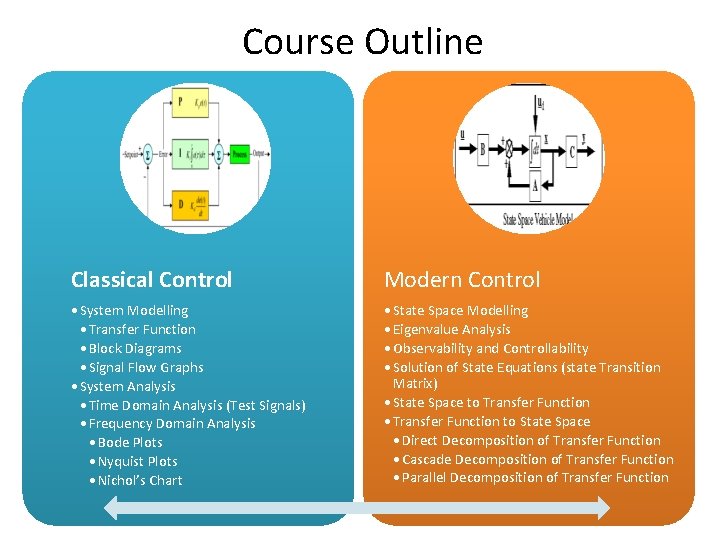
Course Outline Classical Control Modern Control • System Modelling • Transfer Function • Block Diagrams • Signal Flow Graphs • System Analysis • Time Domain Analysis (Test Signals) • Frequency Domain Analysis • Bode Plots • Nyquist Plots • Nichol’s Chart • State Space Modelling • Eigenvalue Analysis • Observability and Controllability • Solution of State Equations (state Transition Matrix) • State Space to Transfer Function • Transfer Function to State Space • Direct Decomposition of Transfer Function • Cascade Decomposition of Transfer Function • Parallel Decomposition of Transfer Function
Text Books 1. Modern Control Engineering, (5 th Edition) By: Katsuhiko Ogata. (Prof Emeritus) Mechanical Engineering University of Minnesota 2. Control Systems Engineering, (6 th Edition) By: Norman S. Nise. (Professor Emeritus) Electrical and Computer Engineering Department at California State Polytechnic University
Reference Books 1. Modern Control Systems, (12 th Edition) By: Richard C. Dorf and Robert H. Bishop. 2. Automatic Control Systems, (9 th Edition) By: Golnaraghi and B. C. Kuo.
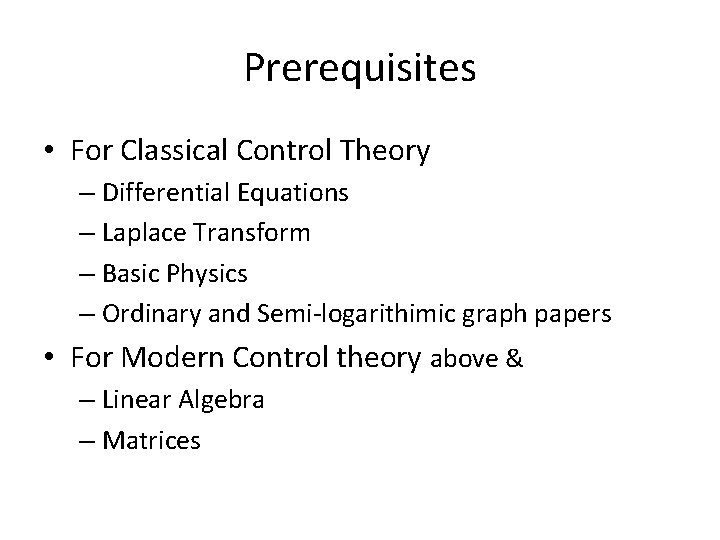
Prerequisites • For Classical Control Theory – Differential Equations – Laplace Transform – Basic Physics – Ordinary and Semi-logarithimic graph papers • For Modern Control theory above & – Linear Algebra – Matrices
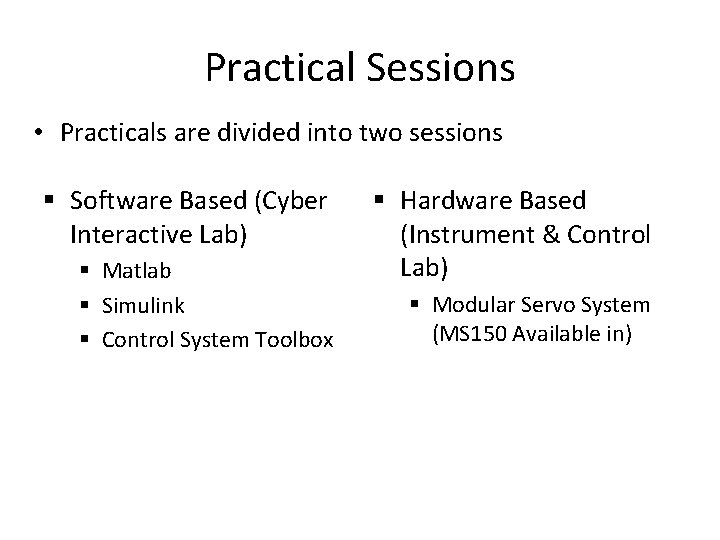
Practical Sessions • Practicals are divided into two sessions § Software Based (Cyber Interactive Lab) § Matlab § Simulink § Control System Toolbox § Hardware Based (Instrument & Control Lab) § Modular Servo System (MS 150 Available in)
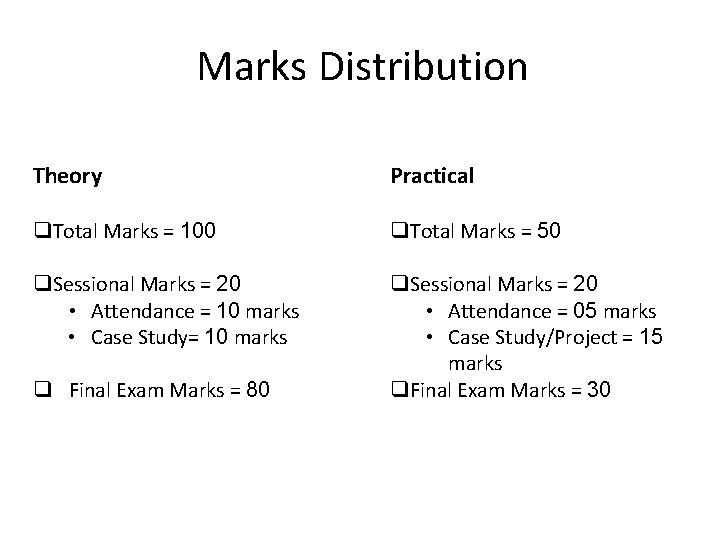
Marks Distribution Theory Practical q. Total Marks = 100 q. Total Marks = 50 q. Sessional Marks = 20 • Attendance = 10 marks • Case Study= 10 marks q. Sessional Marks = 20 • Attendance = 05 marks • Case Study/Project = 15 marks q. Final Exam Marks = 30 q Final Exam Marks = 80
What is Control System? • A system Controlling the operation of another system. • A system that can regulate itself and another system. • A control System is a device, or set of devices to manage, command, direct or regulate the behaviour of other device(s) or system(s).
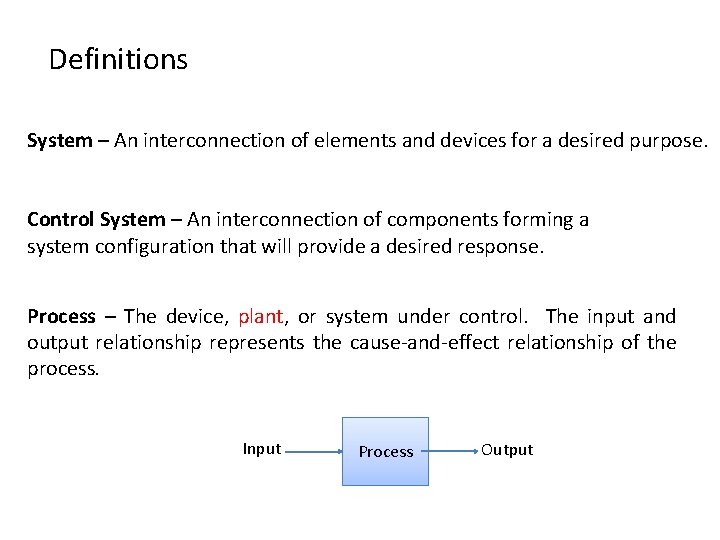
Definitions System – An interconnection of elements and devices for a desired purpose. Control System – An interconnection of components forming a system configuration that will provide a desired response. Process – The device, plant, or system under control. The input and output relationship represents the cause-and-effect relationship of the process. Input Process Output
Definitions Controlled Variable– It is the quantity or condition that is measured and Controlled. Normally controlled variable is the output of the control system. Manipulated Variable– It is the quantity of the condition that is varied by the controller so as to affect the value of controlled variable. Control – Control means measuring the value of controlled variable of the system and applying the manipulated variable to the system to correct or limit the deviation of the measured value from a desired value.
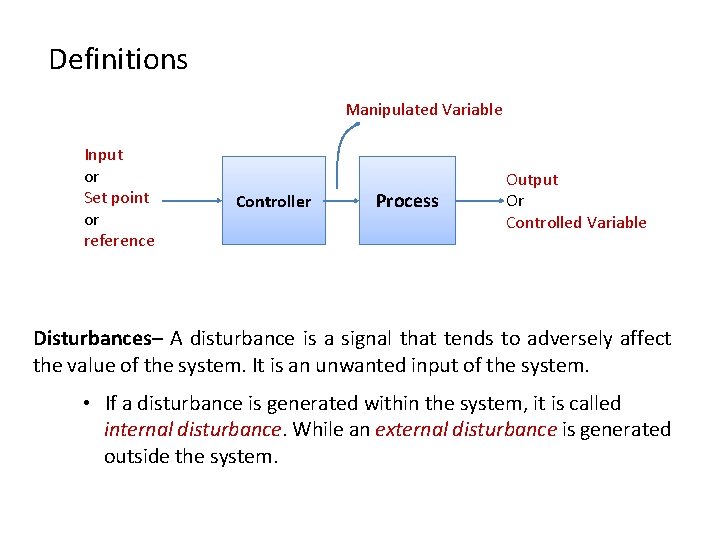
Definitions Manipulated Variable Input or Set point or reference Controller Process Output Or Controlled Variable Disturbances– A disturbance is a signal that tends to adversely affect the value of the system. It is an unwanted input of the system. • If a disturbance is generated within the system, it is called internal disturbance. While an external disturbance is generated outside the system.
Types of Control System • Natural Control System – Universe – Human Body • Manmade Control System – Vehicles – Aeroplanes
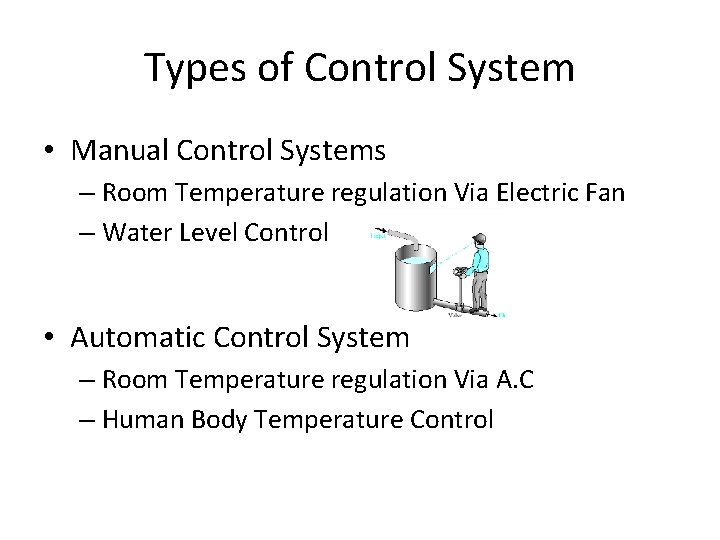
Types of Control System • Manual Control Systems – Room Temperature regulation Via Electric Fan – Water Level Control • Automatic Control System – Room Temperature regulation Via A. C – Human Body Temperature Control
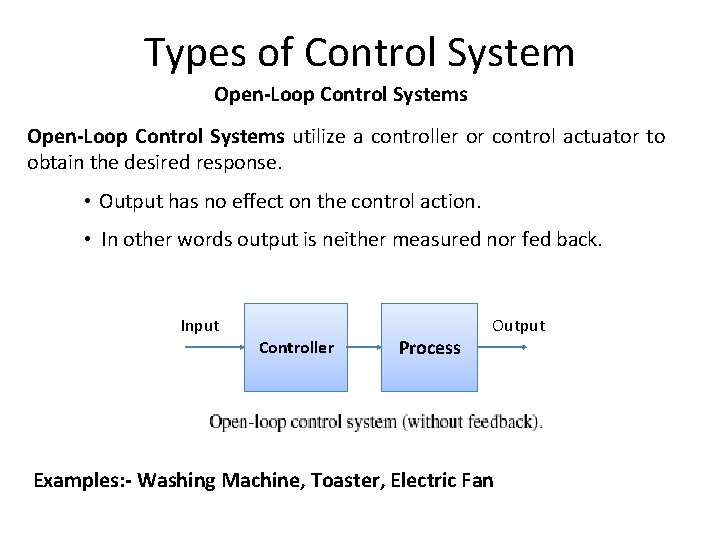
Types of Control System Open-Loop Control Systems utilize a controller or control actuator to obtain the desired response. • Output has no effect on the control action. • In other words output is neither measured nor fed back. Input Controller Process Output Examples: - Washing Machine, Toaster, Electric Fan
Types of Control System Open-Loop Control Systems • Since in open loop control systems reference input is not compared with measured output, for each reference input there is fixed operating condition. • Therefore, the accuracy of the system depends on calibration. • The performance of open loop system is severely affected by the presence of disturbances, or variation in operating/ environmental conditions.
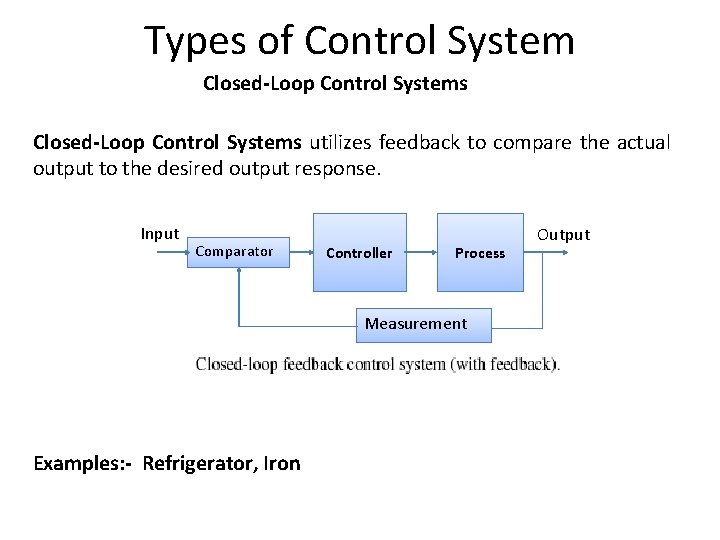
Types of Control System Closed-Loop Control Systems utilizes feedback to compare the actual output to the desired output response. Input Comparator Controller Process Measurement Examples: - Refrigerator, Iron Output
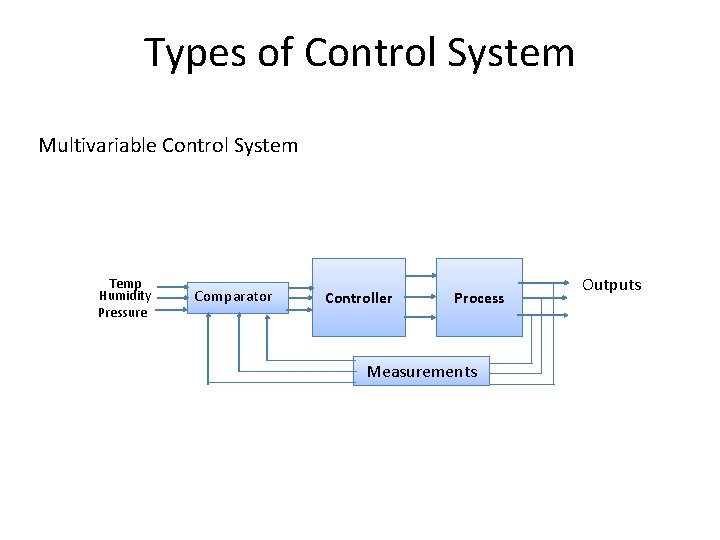
Types of Control System Multivariable Control System Temp Humidity Pressure Comparator Controller Process Measurements Outputs
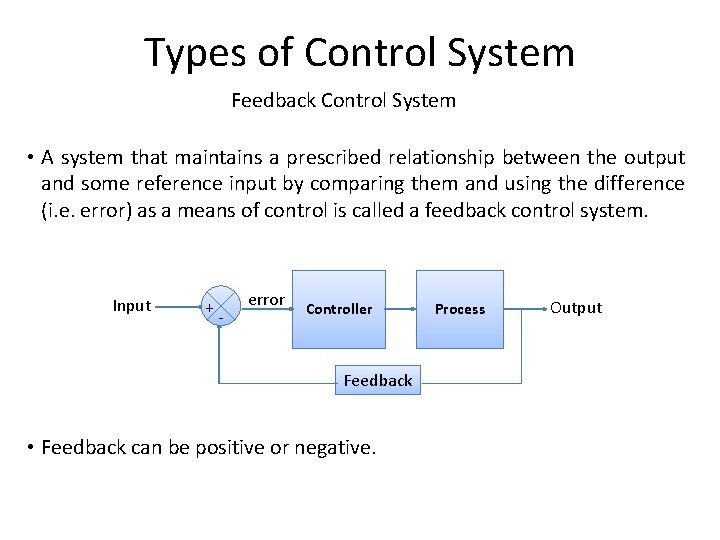
Types of Control System Feedback Control System • A system that maintains a prescribed relationship between the output and some reference input by comparing them and using the difference (i. e. error) as a means of control is called a feedback control system. Input + - error Controller Feedback • Feedback can be positive or negative. Process Output
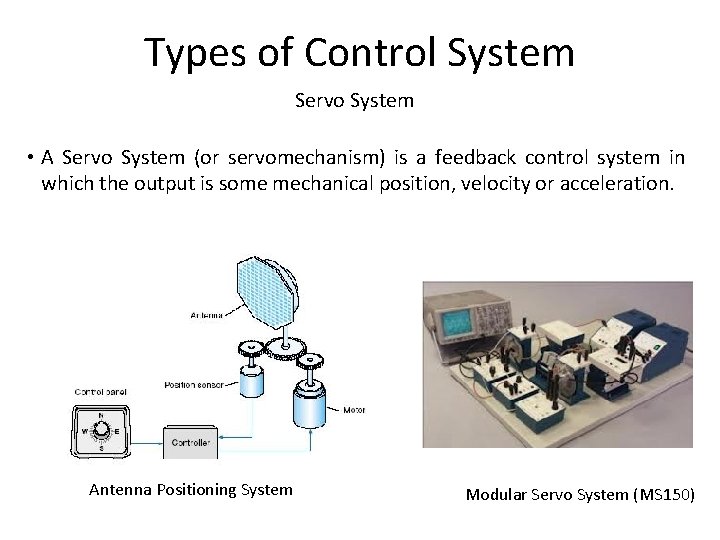
Types of Control System Servo System • A Servo System (or servomechanism) is a feedback control system in which the output is some mechanical position, velocity or acceleration. Antenna Positioning System Modular Servo System (MS 150)
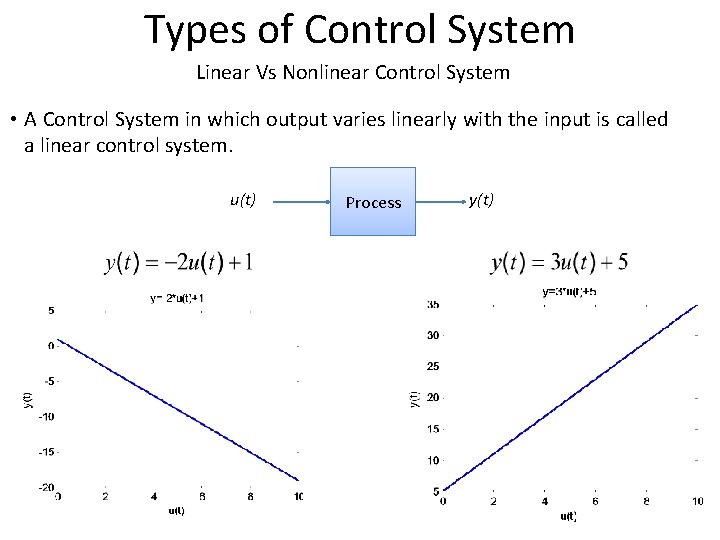
Types of Control System Linear Vs Nonlinear Control System • A Control System in which output varies linearly with the input is called a linear control system. u(t) Process y(t)
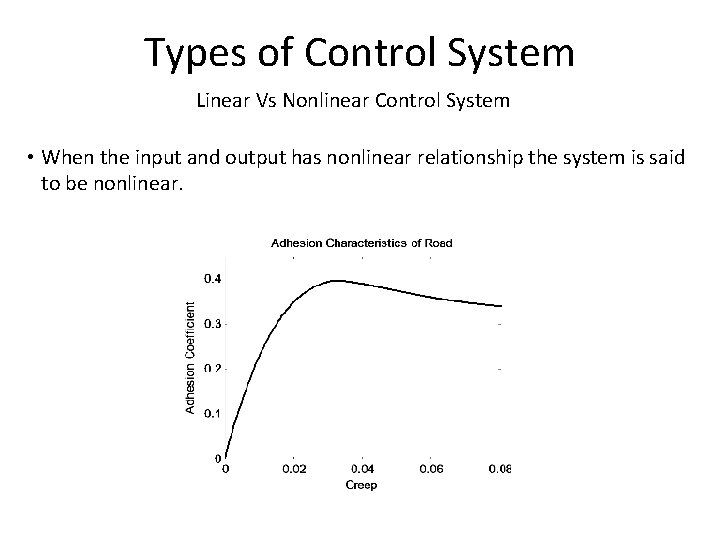
Types of Control System Linear Vs Nonlinear Control System • When the input and output has nonlinear relationship the system is said to be nonlinear.
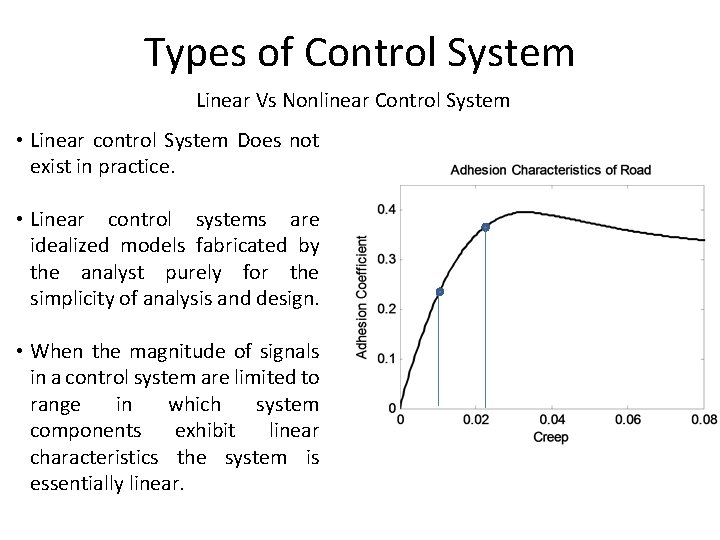
Types of Control System Linear Vs Nonlinear Control System • Linear control System Does not exist in practice. • Linear control systems are idealized models fabricated by the analyst purely for the simplicity of analysis and design. • When the magnitude of signals in a control system are limited to range in which system components exhibit linear characteristics the system is essentially linear.
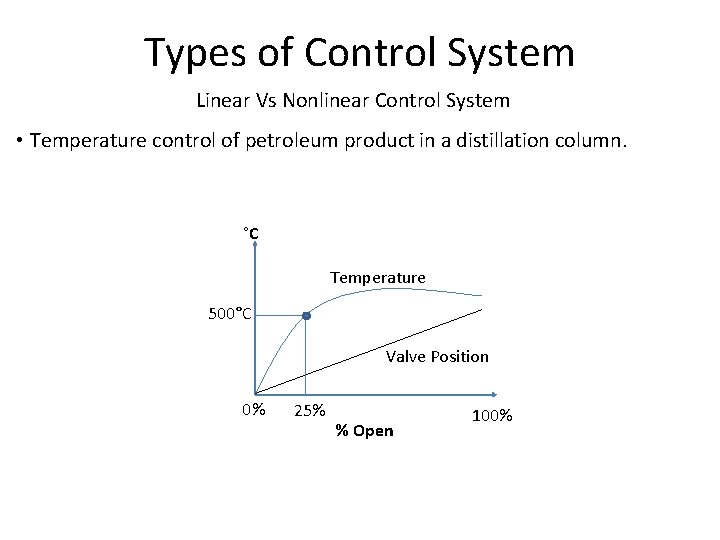
Types of Control System Linear Vs Nonlinear Control System • Temperature control of petroleum product in a distillation column. °C Temperature 500°C Valve Position 0% 25% % Open 100%
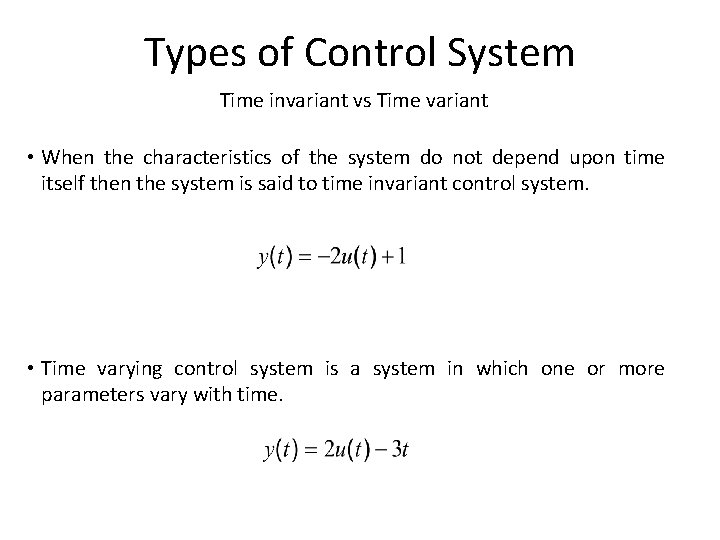
Types of Control System Time invariant vs Time variant • When the characteristics of the system do not depend upon time itself then the system is said to time invariant control system. • Time varying control system is a system in which one or more parameters vary with time.
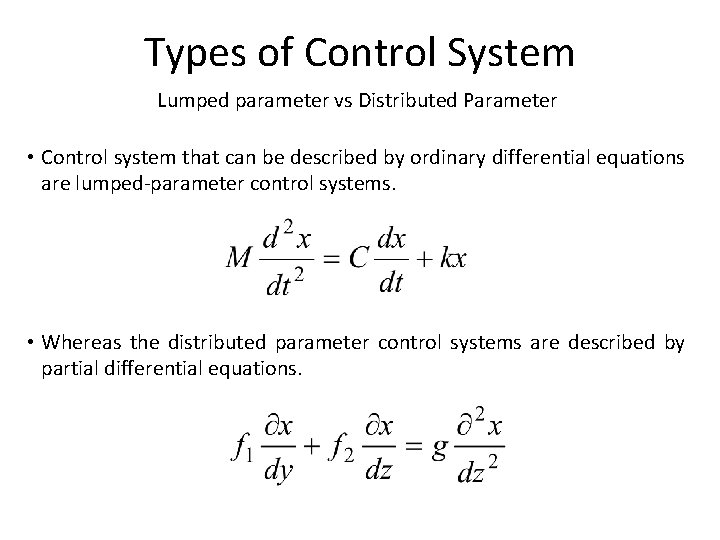
Types of Control System Lumped parameter vs Distributed Parameter • Control system that can be described by ordinary differential equations are lumped-parameter control systems. • Whereas the distributed parameter control systems are described by partial differential equations.
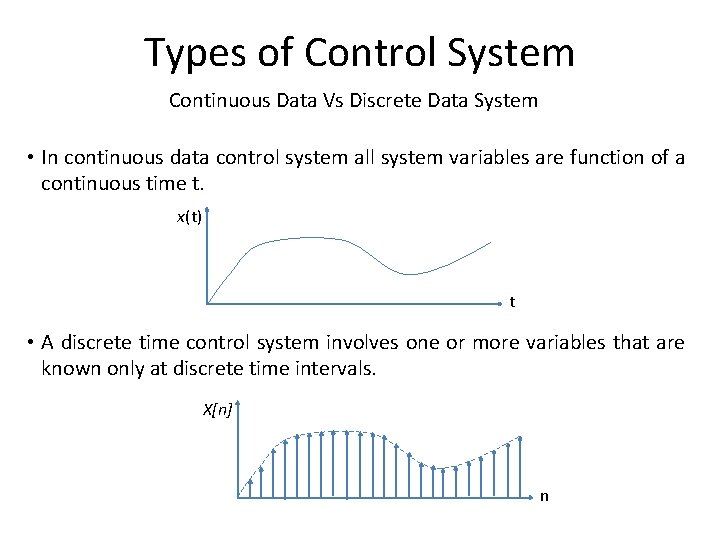
Types of Control System Continuous Data Vs Discrete Data System • In continuous data control system all system variables are function of a continuous time t. x(t) t • A discrete time control system involves one or more variables that are known only at discrete time intervals. X[n] n
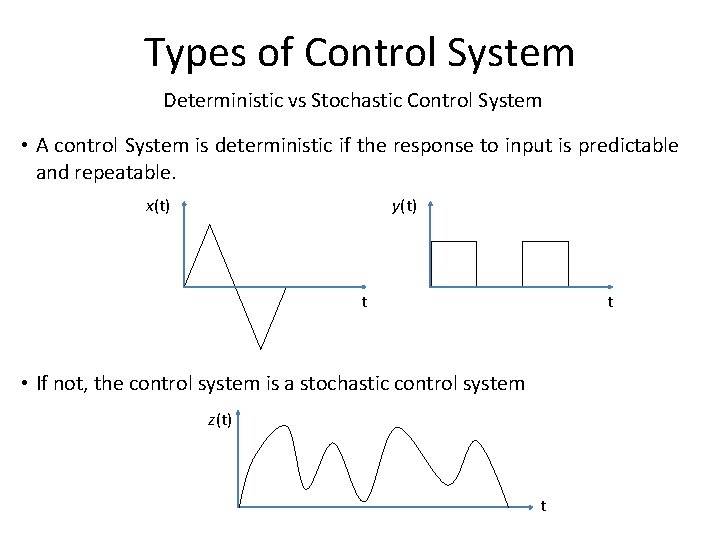
Types of Control System Deterministic vs Stochastic Control System • A control System is deterministic if the response to input is predictable and repeatable. x(t) y(t) t t • If not, the control system is a stochastic control system z(t) t
Types of Control System Adaptive Control System • The dynamic characteristics of most control systems are not constant for several reasons. • The effect of small changes on the system parameters is attenuated in a feedback control system. • An adaptive control system is required when the changes in the system parameters are significant.
Types of Control System Learning Control System • A control system that can learn from the environment it is operating is called a learning control system.
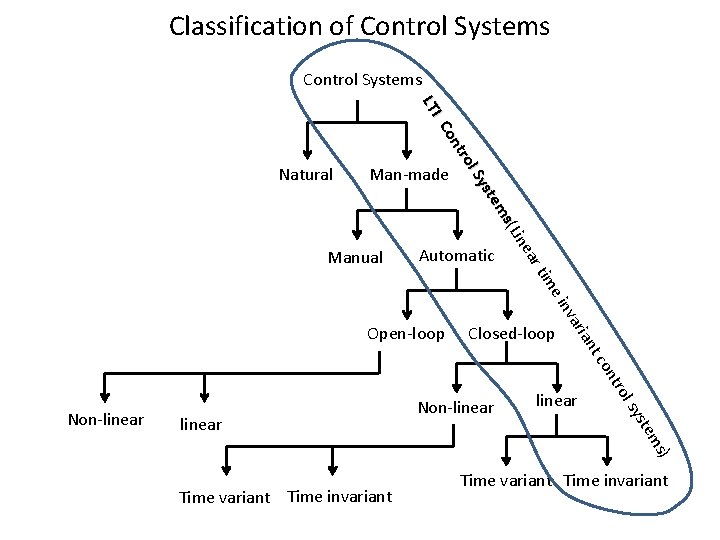
Classification of Control Systems a ine s(L em yst l. S tro on IC LT Natural Man-made Automatic rt Manual e im linear s) tem sys Non-linear l tro on linear Closed-loop tc an Non-linear ari inv Open-loop Time variant Time invariant
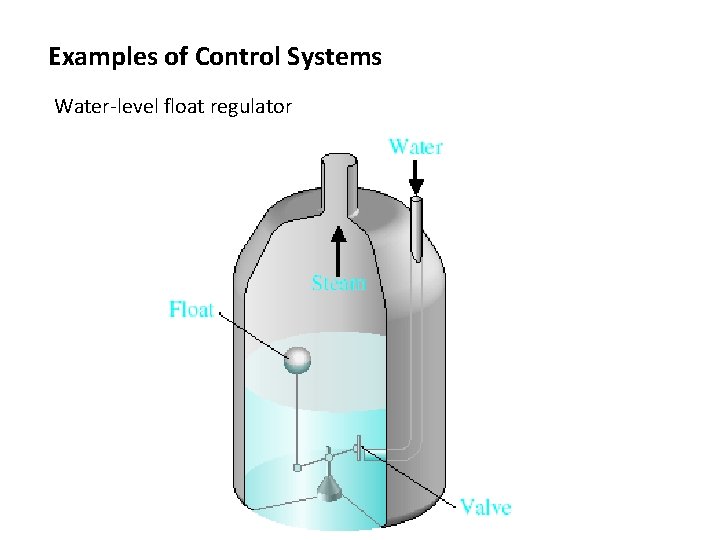
Examples of Control Systems Water-level float regulator
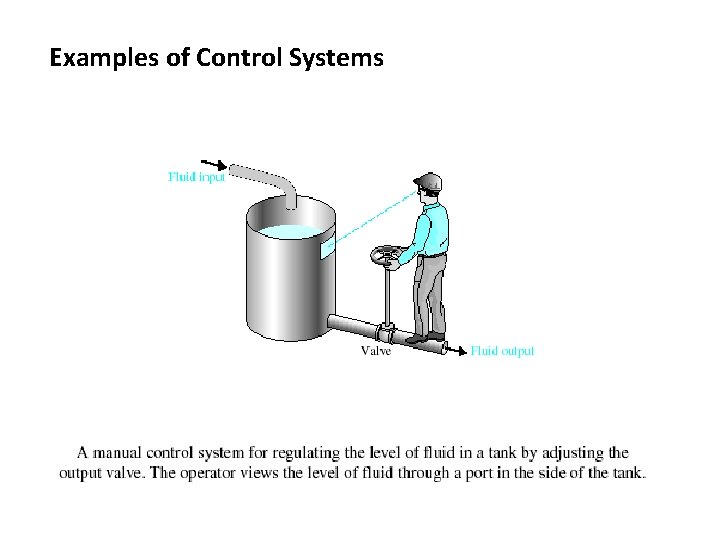
Examples of Control Systems
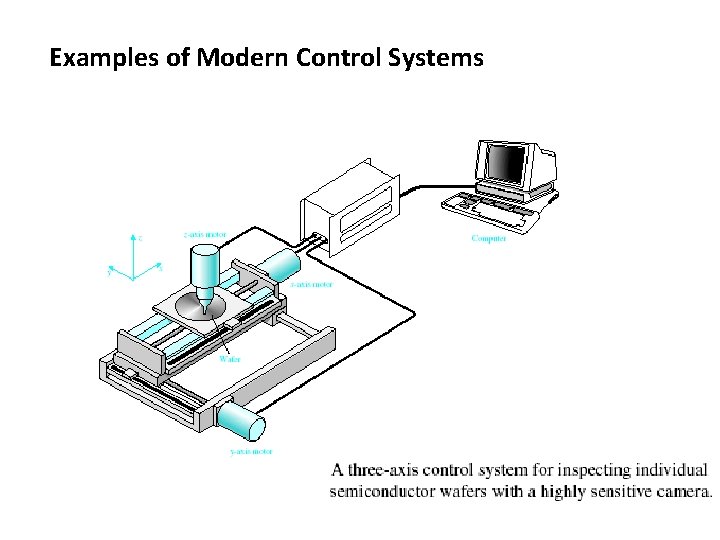
Examples of Modern Control Systems
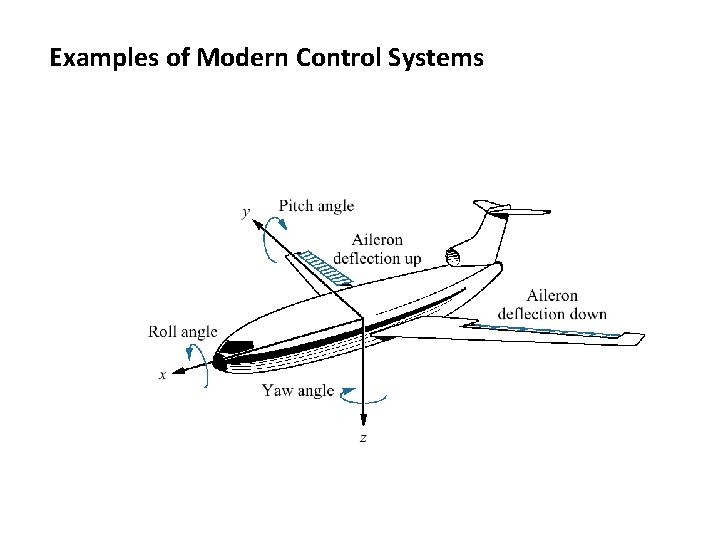
Examples of Modern Control Systems
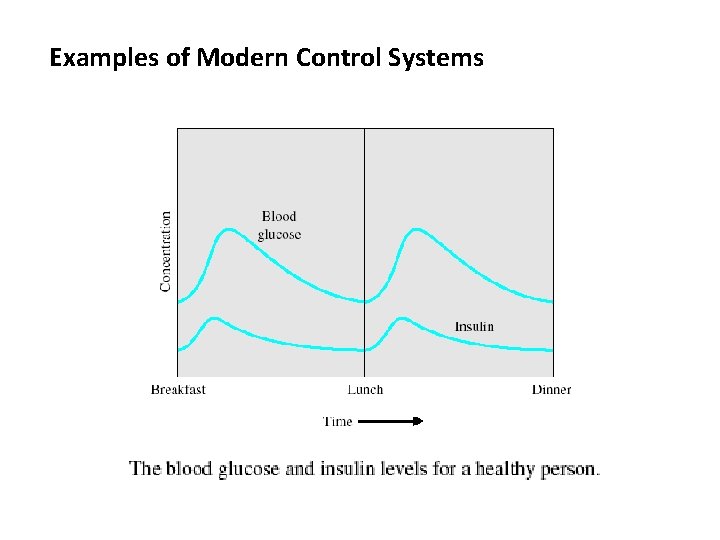
Examples of Modern Control Systems
To download this lecture visit http: //imtiazhussainkalwar. weebly. com/ END OF LECTURES-1 & 2
- Slides: 36