
Feedback and complaint mechanisms Amman July 2019 Objectives
Feedback and complaint mechanisms Amman July 2019
Objectives of the session By the end of the session, we will : • Have a common understanding of the key steps required to set up a feedback and complaint mechanisms • Share experiences across COs on key steps involved in managing FCM • Identify key actions to implement/ improve your CO FCM Agenda (1 h 30): • 15 min Presentation • 15 min Chalk Talk exercise • 20 min Workgroup exercise • 40 min Report-out by the workgroups and plenary discussion
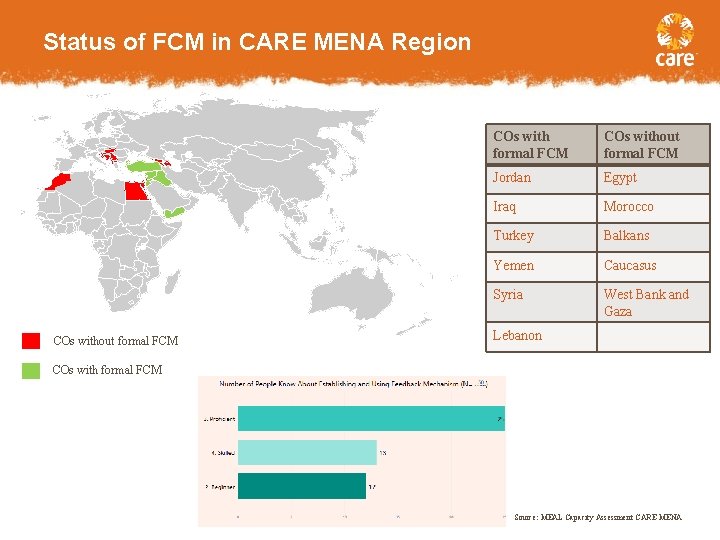
Status of FCM in CARE MENA Region COs without formal FCM Jordan Egypt Iraq Morocco Turkey Balkans Yemen Caucasus Syria West Bank and Gaza Lebanon COs with formal FCM Source: MEAL Capacity Assessment CARE MENA
What is a feedback and complaint mechanism (FCM)? • A FCM is a set of procedures and tools formally established and used to allow participants of CARE’s (humanitarian) programmes and other crisis-affected populations to provide feedback and complaints on their experience of receiving humanitarian assistance. • The mechanism requires processing of feedback and complaints received in order to resolve or refer the issue, including safe processes for dealing with serious complaints (e. g. abuse, exploitation and fraud). • Agencies should regularly analyse the feedback and complaints received and take this analysis into account in decision-making so that assistance is adapted and improved. • The complainants must be informed (collectively or individually) of the result to close the feedback loop.
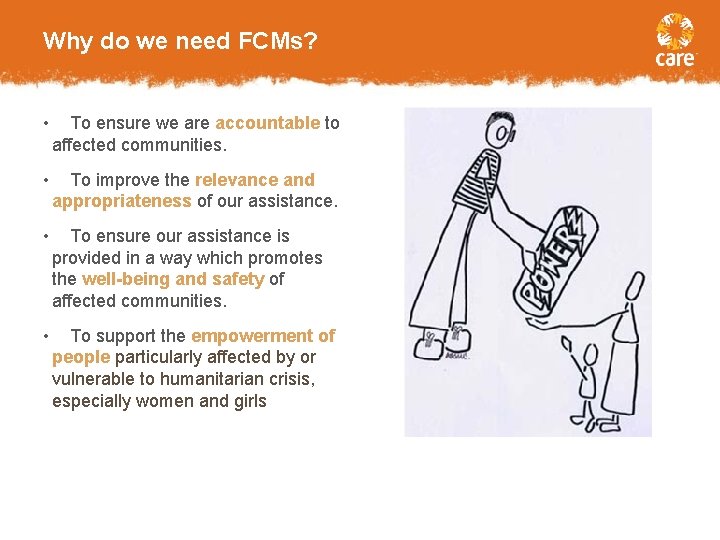
Why do we need FCMs? • To ensure we are accountable to affected communities. • To improve the relevance and appropriateness of our assistance. • To ensure our assistance is provided in a way which promotes the well-being and safety of affected communities. • To support the empowerment of people particularly affected by or vulnerable to humanitarian crisis, especially women and girls
External Landscape and Standards At the World Humanitarian Summit in 2016 the Grand Bargain was launched which called for a “Participation Revolution” to include people receiving aid in making the decisions which affect their lives. The GB Participation Workstream promotes two key standards: 1. The Inter-Agency Standing Committee (IASC) Commitments on Accountability to A�ected Populations 2. Core Humanitarian Standard (CHS) – commitment 5
CI Landscape and Standards The Humanitarian MEAL WG has identified FCMs as a priority to work on because: • COs are currently implementing FCMs with limited support; • CARE need to strengthen its approach to FCMs – to make good practice consistent; • No opportunities at the global level to capture good practice and share learning; • Lack of global CARE guidance and resources; • We have a commitment to improve on FCMs under the CHS improvement plan and within the process of reinforcing the implementation of CARE’s PSEA policy. • A practical guidance package on FCMs is now under development! • It will be included in the MEL Minimum Package and the CARE Emergency Toolkit
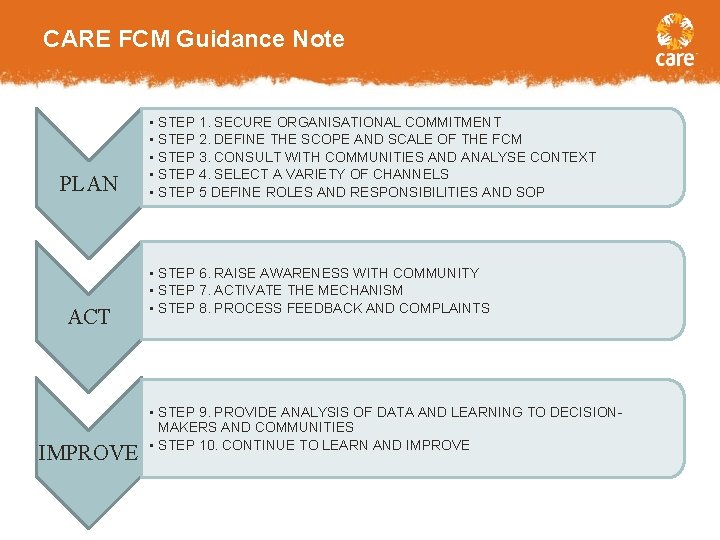
CARE FCM Guidance Note PLAN ACT IMPROVE • STEP 1. SECURE ORGANISATIONAL COMMITMENT • STEP 2. DEFINE THE SCOPE AND SCALE OF THE FCM • STEP 3. CONSULT WITH COMMUNITIES AND ANALYSE CONTEXT • STEP 4. SELECT A VARIETY OF CHANNELS • STEP 5 DEFINE ROLES AND RESPONSIBILITIES AND SOP • STEP 6. RAISE AWARENESS WITH COMMUNITY • STEP 7. ACTIVATE THE MECHANISM • STEP 8. PROCESS FEEDBACK AND COMPLAINTS • STEP 9. PROVIDE ANALYSIS OF DATA AND LEARNING TO DECISIONMAKERS AND COMMUNITIES • STEP 10. CONTINUE TO LEARN AND IMPROVE
Chalk Talk Exercise Chalk Talk is a silent way to reflect, generate ideas, and solve problems. There are 7 flipchart papers around the room with questions on them. 1. You will be moving silently in group around the room every 5 minutes. On each flipchart, individually you: a) Should write your responses or reactions on the flipchart paper. b) May circle others’ interesting ideas, write questions about others’ comments, add your own reflections or ideas, and c) can connect two or more interesting or provocative responses with a line and/or question mark. Everyone has a chance to write and respond as they wish. 2. On the last flipchart paper, you will spend 20 min in group to collectively: a) summarize what others have written on and add your own inputs b) Identify 3 -4 key actions that COs should implement to answer the question 3. Each group will present its work and we will engage in plenary discussion.
- Slides: 9