
Feed the Future MEL Webinar Series Standard Indicator
Feed the Future MEL Webinar Series: Standard Indicator Overview May 22, 2018
Presenters • Anne Swindale • Madeleine Gauthier • Kristy Cook Katie West • Tyrell Kahan Julie Mac. Cartee • Jessica Bagdonis • Janina Mera • Alexandria Schmall 2
Agenda 1. Introduction 2. Notable Changes 3. Publication of New Handbook 4. Transition to New Indicators 5. Overviews of Specific Indicators 6. Q&A 3

Introduction • Indicator transition (new handbook March 2018) • What are indicators? – Measures that enable us to monitor performance; – Support phase two of the USG’s FTF initiative, guided by the Global Food Security Strategy (GFSS); – Assess progress against each result in Result Framework; – Monitor the causal flow from outputs --> project outcomes --> population/systemlevel outcomes --> impacts; – Assess plausibility 4

New Results Framework 5
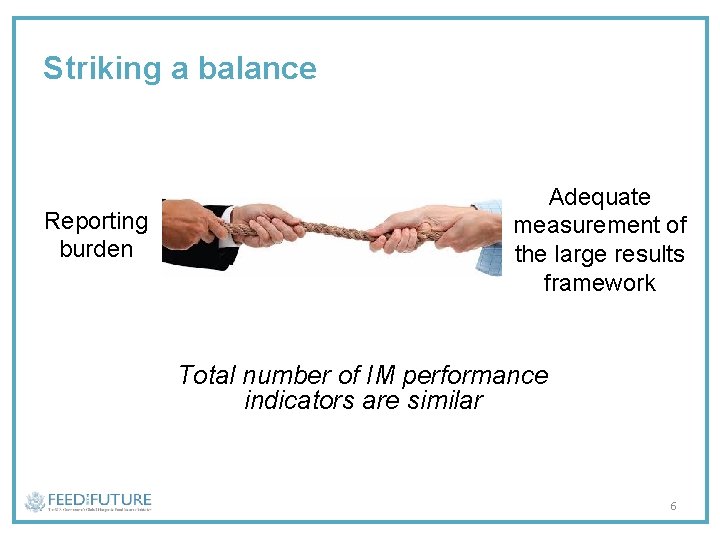
Striking a balance Reporting burden Adequate measurement of the large results framework Total number of IM performance indicators are similar 6
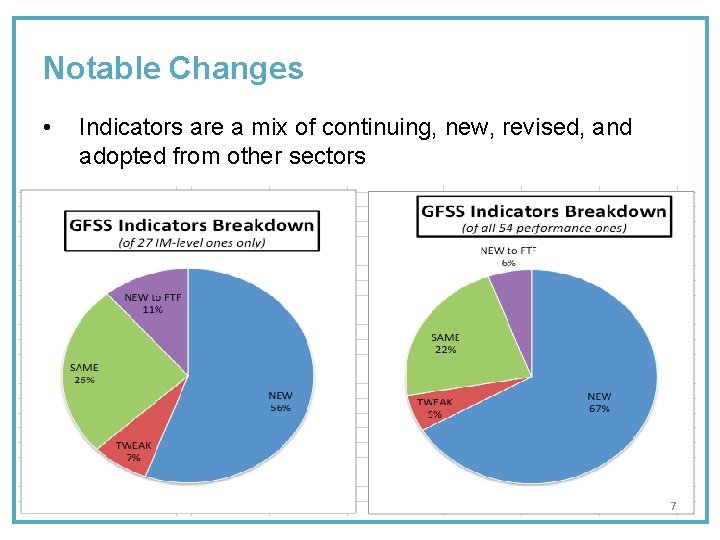
Notable Changes • Indicators are a mix of continuing, new, revised, and adopted from other sectors 7
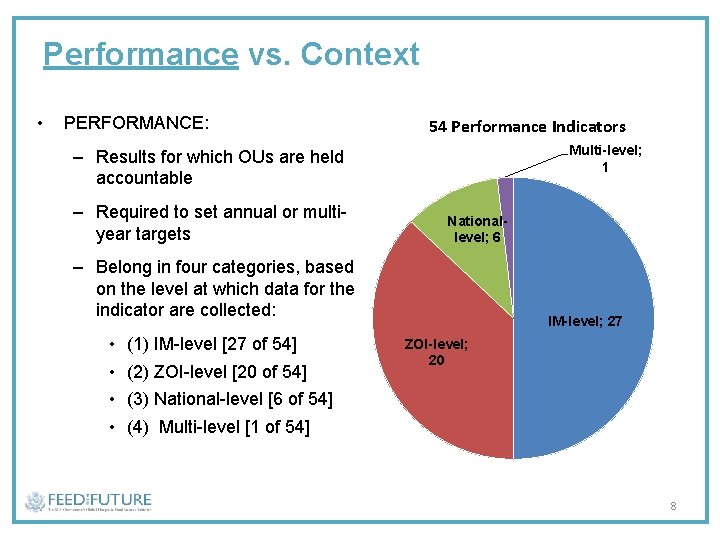
Performance vs. Context • PERFORMANCE: 54 Performance Indicators Multi-level; 1 – Results for which OUs are held accountable – Required to set annual or multiyear targets Nationallevel; 6 – Belong in four categories, based on the level at which data for the indicator are collected: • • (1) IM-level [27 of 54] (2) ZOI-level [20 of 54] IM-level; 27 ZOI-level; 20 (3) National-level [6 of 54] (4) Multi-level [1 of 54] 8
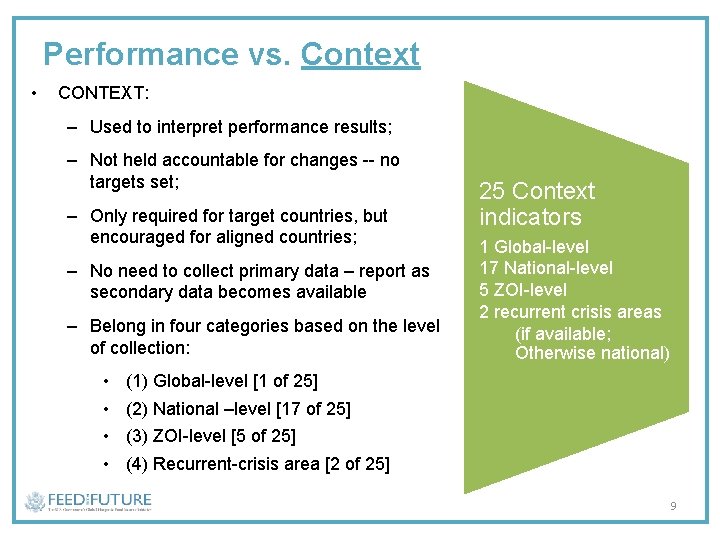
Performance vs. Context • CONTEXT: – Used to interpret performance results; – Not held accountable for changes -- no targets set; – Only required for target countries, but encouraged for aligned countries; – No need to collect primary data – report as secondary data becomes available – Belong in four categories based on the level of collection: • • 25 Context indicators 1 Global-level 17 National-level 5 ZOI-level 2 recurrent crisis areas (if available; Otherwise national) (1) Global-level [1 of 25] (2) National –level [17 of 25] (3) ZOI-level [5 of 25] (4) Recurrent-crisis area [2 of 25] 9
Performance Indicators: Standard vs. Custom Standard: • IMs and OUs held accountable for results • All are required-as-applicable (RAA) to ensure consistency of reporting and meaningful aggregation of results: – all OUs receiving Feed the Future funding are required to report on all indicators at the (IR) or (CCIR) level to which a Feed the Future-funded project contributes results – if an OU expects a project to generate results that are measured by the indicator, the OU must establish a baseline, set targets, and report results for the indicator. 10
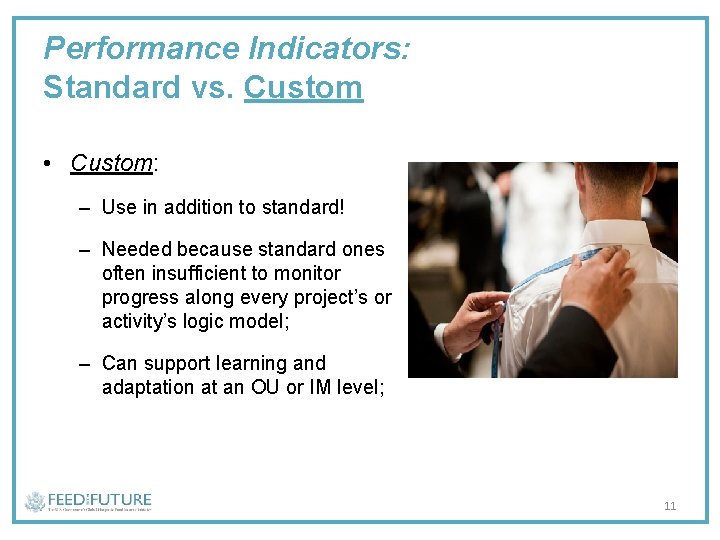
Performance Indicators: Standard vs. Custom • Custom: – Use in addition to standard! – Needed because standard ones often insufficient to monitor progress along every project’s or activity’s logic model; – Can support learning and adaptation at an OU or IM level; 11

Performance Indicators: Standard vs. Custom • Options for custom indicators: – Develop them; – Use ZOI-level ones at an IM-level; – Use archived FTF standard indicators (will remain in FTFMS!) – Add custom disaggregates to standard indicators – Use suggestions from sector experts, e. g. forthcoming market systems guidance 12
Indicator/PIRS-specific Changes • People-level indicators disaggregated by sex and age • Indicators in general have a greater focus on capturing changes throughout the value chain, including private sector partners, market participants, etc. • Reporting notes for the more complicated indicators include examples for FTFMS data entry in PIRS 13
Handbook of Feed the Future Indicator Definitions 14
Where to find them • “Old” (current) FTF Indicator Handbook (published July 2016) = https: //www. agrilinks. org/library/feed-future-handbookindicator-definitions • New FTF Indicator Handbook (published March 2018) = https: //www. agrilinks. org/post/feed-future-indicator-handbook 15
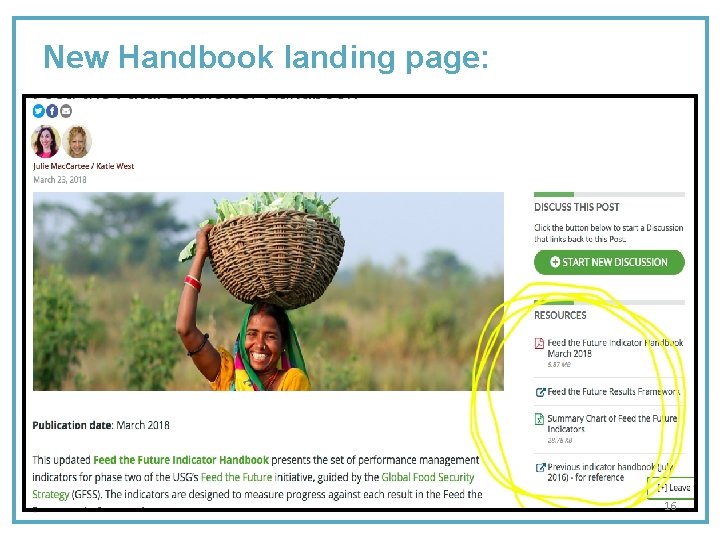
New Handbook landing page: 16
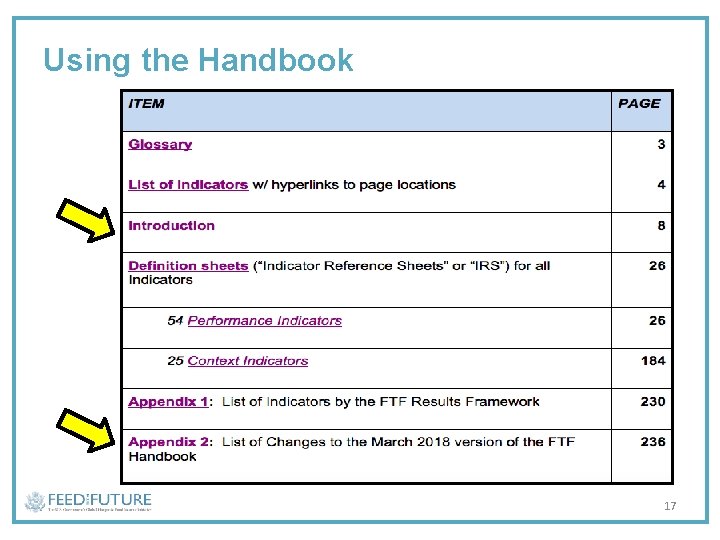
Using the Handbook 17
Appendix 2 – important! • Lists changes since last handbook (July 2016) – New! – New to FTF – Minor changes – Archived/Dropped 18
Transition & Rollout 19
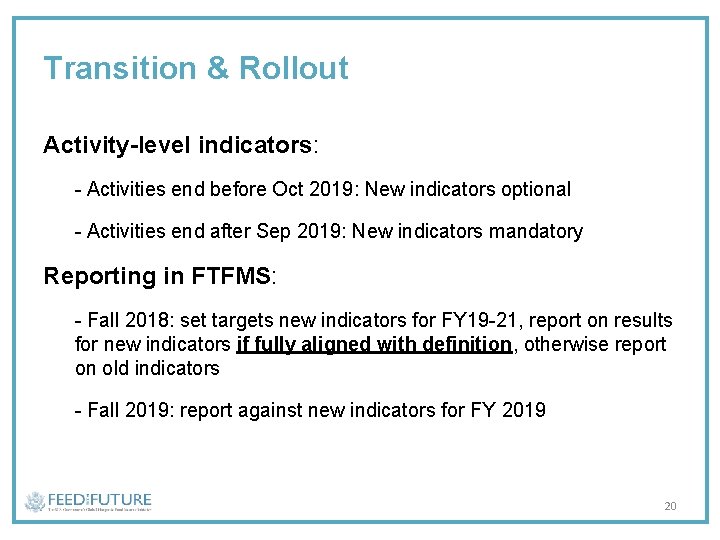
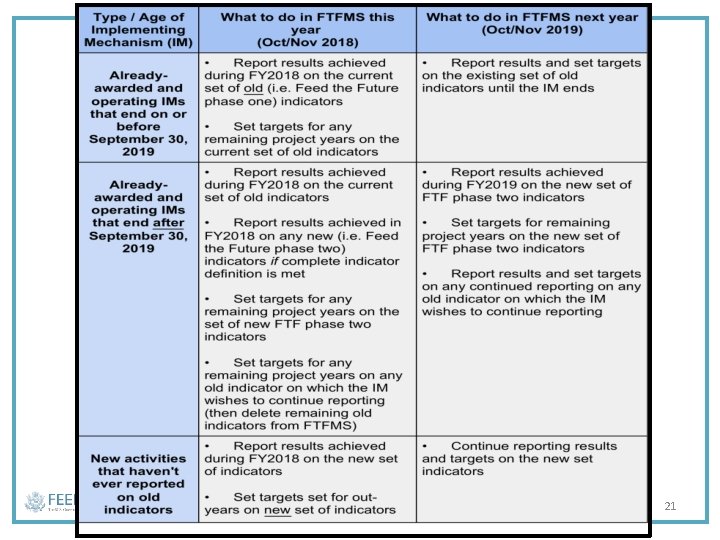
Transition & Rollout Activity-level indicators: - Activities end before Oct 2019: New indicators optional - Activities end after Sep 2019: New indicators mandatory Reporting in FTFMS: - Fall 2018: set targets new indicators for FY 19 -21, report on results for new indicators if fully aligned with definition, otherwise report on old indicators - Fall 2019: report against new indicators for FY 2019 20
21
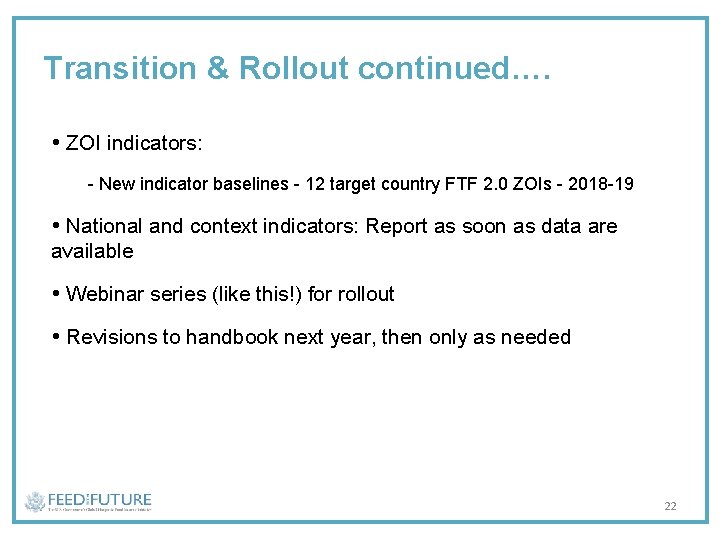
Transition & Rollout continued…. ZOI indicators: - New indicator baselines - 12 target country FTF 2. 0 ZOIs - 2018 -19 National and context indicators: Report as soon as data are available Webinar series (like this!) for rollout Revisions to handbook next year, then only as needed 22

Q&A 23
Overview of Specific Indicators 24
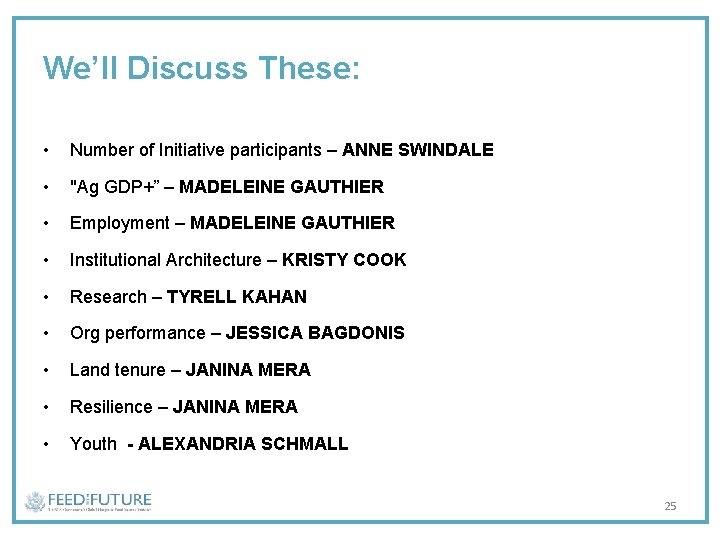
We’ll Discuss These: • Number of Initiative participants – ANNE SWINDALE • "Ag GDP+” – MADELEINE GAUTHIER • Employment – MADELEINE GAUTHIER • Institutional Architecture – KRISTY COOK • Research – TYRELL KAHAN • Org performance – JESSICA BAGDONIS • Land tenure – JANINA MERA • Resilience – JANINA MERA • Youth - ALEXANDRIA SCHMALL 25
Number of individuals participating Anne Swindale 26
![EG. 3 -2 Number of individuals participating in USG food security programs [IM-level] •](http://slidetodoc.com/presentation_image_h2/3b37c9715a5f16669167e911c92235cf/image-27.jpg "EG. 3 -2 Number of individuals participating in USG food security programs [IM-level] •")
EG. 3 -2 Number of individuals participating in USG food security programs [IM-level] • Captures breadth of FTF reach - - counts all project participants: – reached directly – through a deliberate service delivery strategy (not spillover) – participating in the markets we strengthen • People, not contacts! – Count once under Sex and Age disaggregates, more than once under Type of Individual • Firm proprietors, not all employees • Producers who buy or sell to assisted firms – Not non-producer customers or suppliers 27
![EG. 3 -2 Number of individuals participating in USG food security programs [IM-level] (cont.](http://slidetodoc.com/presentation_image_h2/3b37c9715a5f16669167e911c92235cf/image-28.jpg "EG. 3 -2 Number of individuals participating in USG food security programs [IM-level] (cont.")
EG. 3 -2 Number of individuals participating in USG food security programs [IM-level] (cont. ) • All household members ONLY IF: – Improved sanitation services – Family-sized rations • DON’T count children under 5 or under 2 --> Count under HL. 9 -1/9 -2 – DO count kids participating in FTF school feeding programs • Report at IM and OU level 28
Ag. GDP+ Madeleine Gauthier 29
![EG. 3 -e Percent change in value-added in the agri-food system (Ag GDP+) [National-level]](http://slidetodoc.com/presentation_image_h2/3b37c9715a5f16669167e911c92235cf/image-30.jpg "EG. 3 -e Percent change in value-added in the agri-food system (Ag GDP+) [National-level]")
EG. 3 -e Percent change in value-added in the agri-food system (Ag GDP+) [National-level] • National level indicator added to: – capture changes in the agriculture-related value-added generated beyond agricultural production (Ag GDP) – Track the impact pathway of our investments in market system approach • Requires a Social Accounting Matrix (SAM) and various country-wide datasets • IFPRI through a BFS mechanism will generate baseline and annual estimates • Missions can use the estimates for planning and programming purposes. IFPRI will produce a write-up describing the model and assumptions and provide the necessary support to generate the targets • Ag GDP+ is a required performance indicator! 30
Employment Madeleine Gauthier 31
![EG. 3 -g Employment in the agri-food system [National-level] • Estimates the total number](http://slidetodoc.com/presentation_image_h2/3b37c9715a5f16669167e911c92235cf/image-32.jpg "EG. 3 -g Employment in the agri-food system [National-level] • Estimates the total number")
EG. 3 -g Employment in the agri-food system [National-level] • Estimates the total number of people working in the agri-food sector in a given year • Data on employment by sector are linked to the components of the agri-food sector • IFPRI through a BFS central mechanism will generate the baseline and annual estimates • It is a performance indicator, although RAA! – IFPRI will provide the necessary support to generate the targets 32

Institutional Architecture Kristy Cook 33
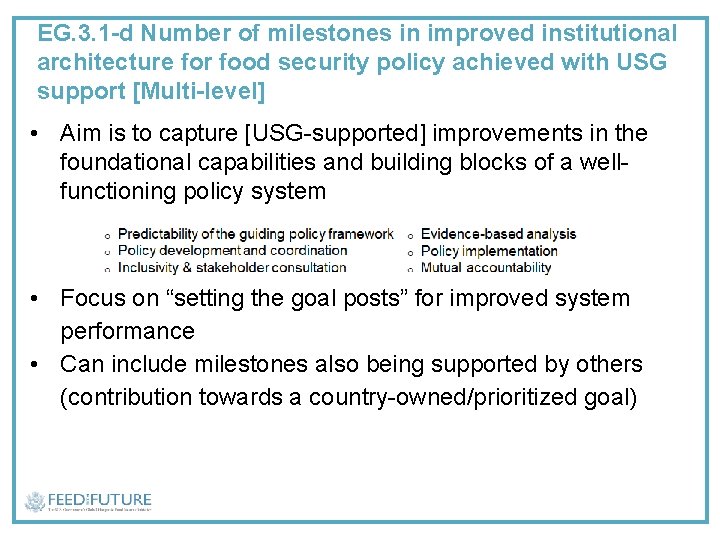
EG. 3. 1 -d Number of milestones in improved institutional architecture for food security policy achieved with USG support [Multi-level] • Aim is to capture [USG-supported] improvements in the foundational capabilities and building blocks of a wellfunctioning policy system • Focus on “setting the goal posts” for improved system performance • Can include milestones also being supported by others (contribution towards a country-owned/prioritized goal)
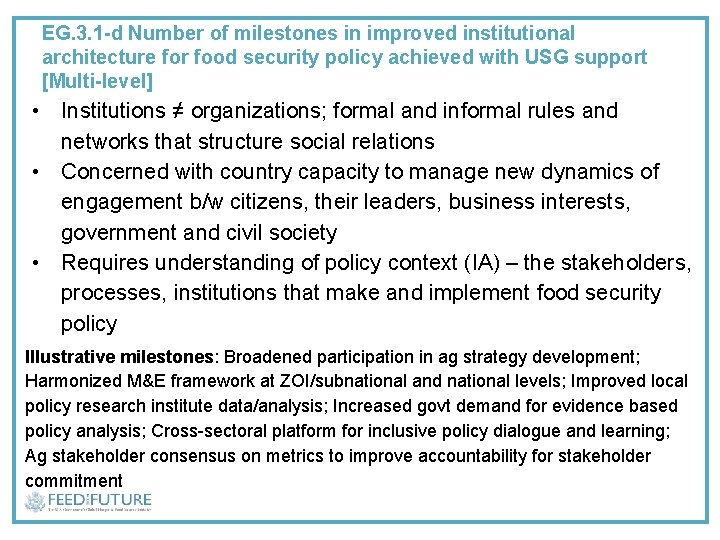
EG. 3. 1 -d Number of milestones in improved institutional architecture for food security policy achieved with USG support [Multi-level] • Institutions ≠ organizations; formal and informal rules and networks that structure social relations • Concerned with country capacity to manage new dynamics of engagement b/w citizens, their leaders, business interests, government and civil society • Requires understanding of policy context (IA) – the stakeholders, processes, institutions that make and implement food security policy Illustrative milestones: Broadened participation in ag strategy development; Harmonized M&E framework at ZOI/subnational and national levels; Improved local policy research institute data/analysis; Increased govt demand for evidence based policy analysis; Cross-sectoral platform for inclusive policy dialogue and learning; Ag stakeholder consensus on metrics to improve accountability for stakeholder commitment
Research Tyrell Kahan 36
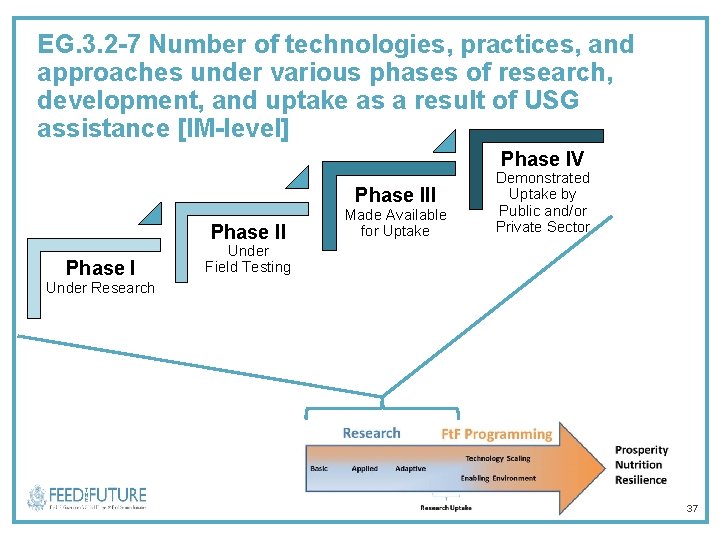
EG. 3. 2 -7 Number of technologies, practices, and approaches under various phases of research, development, and uptake as a result of USG assistance [IM-level] Phase IV Phase III Phase I Made Available for Uptake Demonstrated Uptake by Public and/or Private Sector Under Field Testing Under Research 37
Organizational Performance Jessica Bagdonis 38
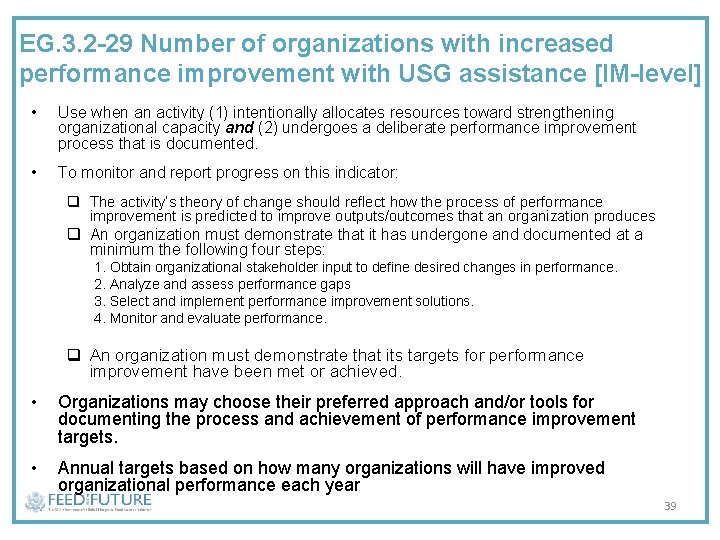
EG. 3. 2 -29 Number of organizations with increased performance improvement with USG assistance [IM-level] • Use when an activity (1) intentionally allocates resources toward strengthening organizational capacity and (2) undergoes a deliberate performance improvement process that is documented. • To monitor and report progress on this indicator: q The activity’s theory of change should reflect how the process of performance improvement is predicted to improve outputs/outcomes that an organization produces q An organization must demonstrate that it has undergone and documented at a minimum the following four steps: 1. Obtain organizational stakeholder input to define desired changes in performance. 2. Analyze and assess performance gaps 3. Select and implement performance improvement solutions. 4. Monitor and evaluate performance. q An organization must demonstrate that its targets for performance improvement have been met or achieved. • Organizations may choose their preferred approach and/or tools for documenting the process and achievement of performance improvement targets. • Annual targets based on how many organizations will have improved organizational performance each year 39
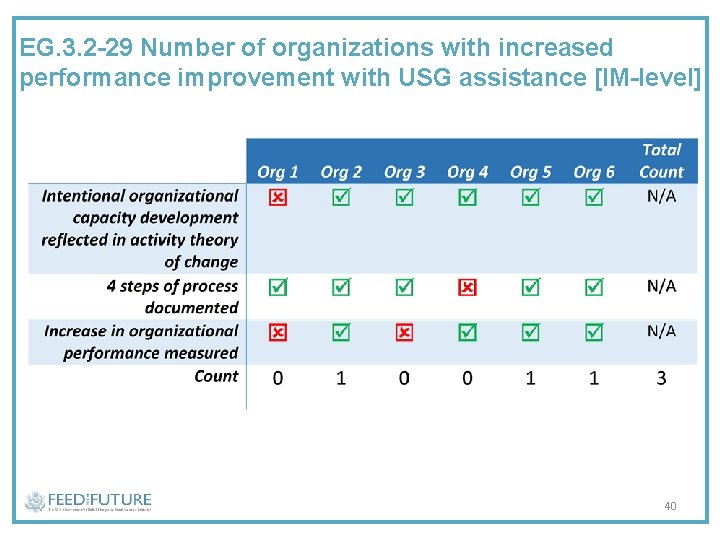
EG. 3. 2 -29 Number of organizations with increased performance improvement with USG assistance [IM-level] 40
Land Tenure Janina Mera 41
EG. 10. 4 -7 Number of adults with legally recognized and documented tenure rights to land or marine areas, as a result of USG assistance. • Not restricted to individual ownership rights – Every adult counted separately • Official land registry data supplemented by activity records 42
EG. 10. 4 -8 Number of adults who perceive their tenure rights to land or marine areas as secure as a result of USG assistance • Potential gap between legal rights and perception of rights • Captured through a survey of beneficiaries 43
Resilience Janina Mera 44
RESIL-1: Number of host government or community-derived risk management plans formally proposed, adopted, implemented or institutionalized with USG assistance • Two types-government and community • Four phases of development: proposed, adopted, implemented, institutionalized (report under each stage within the year) • Plans can be implemented over more than one year. 45
Youth Alexandria Schmall 46
YOUTH-3: Percentage of participants in USG-assisted programs designed to increase access to productive economic resources who are youth (15 -29) [IM-level] • 1/3 total global population (2. 3 billion people) are ages 15 -34 • 80% of young people live in low & middle-income countries • Agri-food sector (on/off-farm) is largest employer of youth, will continue to provide many opportunities ( value chains) • Including youth in our work helps achieve GFSS objectives & Feed the Future outcomes – Cross-cutting Intermediate Result (IR) 4 “Increased youth empowerment & livelihoods” • New to engaging youth in agri-food systems? Check out our new guide! – Feed The Future Project Design Guide for Youth-Inclusive Agriculture and Food Systems Volume I and II
Additional Resources & Training 48
Feed the Future MEL Webinar Series • Intro to the MEL System (recording available) • Standard Indicator Overview – Today! • New Indicators: Application of improved practices and technologies – June 13, 2018 • New Indicators: Yield and geospatial • New Indicators: Sales and investment indicators • New Indicators: Gender • Nutrition Indicators • Learning Agenda • Market Systems Measurement • Annual FTFMS users webinar 49
Have further questions? • Implementing Partners (IPs) -->> Contact your USAID Mission contact • USAID Mission staff -->> Contact your BFS MEL Technical Advisor (TA) 50

Q&A 51
- Slides: 51