
FEED ADDITIVES Prof Dr Pnar Saakl psacakliankara edu
- Slides: 12
FEED ADDITIVES Prof. Dr. Pınar Saçaklı psacakli@ankara. edu. tr November 2019
Feed additives • Products except for feed ingredients and premixes, or microorganisms added to feed • to improve feed quality and to prevent feeds from deterioration • to improve the animals’ performance & health • to improve the characteristics of feed, for instance to enhance flavour, to make feed more digestible
• to improve digestion and microflora of digestive system • Prevention of environmental pollution resulted from animal production • .
Conditions for feed additives • • • 1 -It should not cause cancer in both humans and animals. Therefore, it should not cause any negative effects on animal health and should not leave residues in animal tissues. 2 - Toxic limit should be specified. 3 -Since it is used in very small amounts, the determination methods to determine the small amounts should be specified. 4 -A cheating should not occur at the end of its participation. 5) It should not pollute the environment and should be used economically for performance-enhancing purposes in animals, otherwise it should not be used.
• Authorisation, marketing and use of feed additives is regulated according to • Council Regulation (EC) 1831/2003 about additives for use in animal nutrition
Classification of feed additives • Feed additive classifications based on Europe regulation and guideline • there are generally five groups for feed additive classification
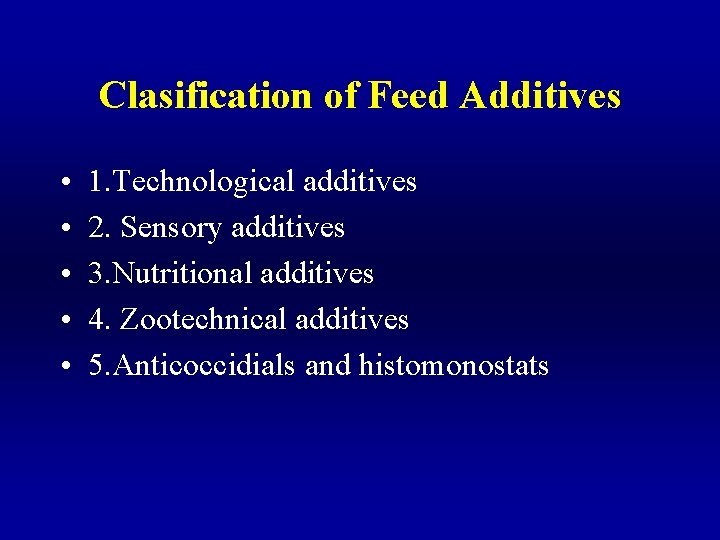
Clasification of Feed Additives • • • 1. Technological additives 2. Sensory additives 3. Nutritional additives 4. Zootechnical additives 5. Anticoccidials and histomonostats
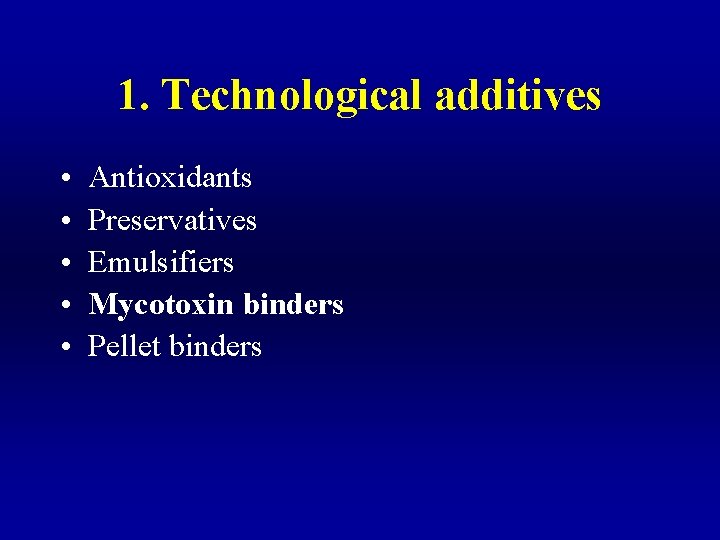
1. Technological additives • • • Antioxidants Preservatives Emulsifiers Mycotoxin binders Pellet binders
2. Sensory additives -Flavoring -Coloring : carotenoids egg yolk
3. Nutritional additives • Such additives supply specific nutrient(s) required by the animal for optimal growth. • Vitamin • Amino acids • Trace minerals • NPN materials: (urea) 42 -46 % N
4. Zootechnical additives • • • *Enzymes *Probiotics *Prebiotics *Organic acids *Herbal extract
5. Coccidiostats and Histomonostats These products are used to control intestinal health of poultry through direct effects on the parasitic organism concerned, they are not classified as antibiotics.